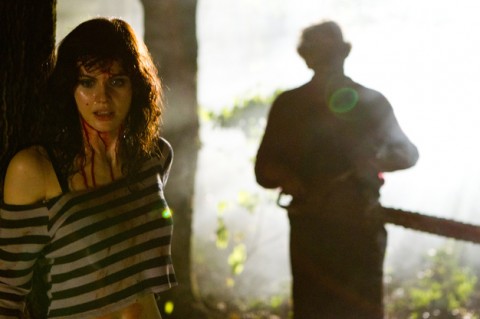
Horror fans are lining up to see Texas Chainsaw 3D (2013) this weekend, but in a series never known for its softcore offerings the best we get is Alexandra Daddario ’s consistently bare midriff. Also opening is the Big Oil drama Promised Land (2012), it’s skin-free but you can see Frances McDormand ‘s promised land right here at MrSkin.com! If you need some big screen nudity to really get your power tool revving, head over to the limited release Sushi Girl (2012) to get an eyeful of Cortney Palm dishing up her T&A. More after the jump!
Justin Bieber is bringing sexy back to Instagram. Not long after the artist posted seductive Selena Gomez photos to the photo-sharing service, Bieber has gone ahead and teased followers with a new batch of hot pictures. Of himself! Shirtless! The images were snapped during Justin and Selena’s holiday trip to Puerto Vallarta, Mexico. Earlier in the month, the couple spent time in Utah with another young Hollywood tandem, Harry Styles and Taylor Swift . It looks like all is well in the world of Justin Bieber and Selena Gomez, as well as the world of Beliebers everywhere, thanks to these adorable new topless shots.
A look back at this epic year in celebrity news would not be complete without reflecting upon some of the brightest stars who said goodbye to us in 2012. Here are 12 of the most notable pop culture figures – from singers to actors to authors and even historical figures – who passed away this year: Donna Summer – Last Dance 12. Donna Summer , disco’s queen, became synonymous with an entire genre of music with hits like “Love to Love You Baby” and “Last Dance.” 11. Ray Bradbury was an author ahead of even his sci-fi time. 10. Jenni Rivera . The popular Mexican singer-actress was taken from us – and her family – far, far too soon this month in a tragic plane crash. 9. Larry Hagman . Dallas star was the original TV villain. 8. Mitchell Guist . The Swamp People star attracted an enormous following thanks to his reality show, and the reaction to his passing was immense. 7. Nora Ephron ‘s screenplays – When Harry Met Sally, Sleepless in Seattle – have been often imitated but never duplicated in modern cinema. Phyllis Diller Standup 6. Phyllis Diller hilariously made herself the butt of her own jokes, but more importantly shattered the glass ceiling of comedy over a decades-long career. 5. Don Cornelius ‘ Soul Train didn’t just provide great music, it empowered a black audience and informed a white audience in a vast cultural experience. 4. Steve Sabol may not be a household name, but the NFL Films founder forever changed the way we watch the most popular sport in America. 3. Neil Armstrong & Sally Ride , the first man on the moon and first woman in space, were both pioneers outside of our atmosphere and inspirations on Earth. 2. Dick Clark may not have invented popular music, the American teenager or New Year’s Eve, but he left an indelible mark on all of the above. Whitney Houston National Anthem: The Best Ever 1. Whitney Houston ‘s final years were not what millions of fans would have hoped for, but her legacy and the power of her voice never diminished. These are just a dozen of the memorable figures we bid farewell to, of course. Share the names and memories of these and others you will miss below!
Dwyane Wade and Gabrielle Union got into the Christmas spirit for his Wade’s World Foundation. On December 23rd the power couple hosted the annual Father…
A career of playing righteous bad-asses in Pulp Fiction , the Star Wars prequel trilogy and the Marvel superhero movies has made Samuel L. Jackson one of the highest grossing actors of all time. Which makes his decision to play Stephen, the calculating and merciless right-hand man of plantation owner Calvin Candie ( Leonardo DiCaprio ) in Quentin Tarantino’s Django Unchained, Jackson’s most daring acting choice yet. Fans of the actor who see Tarantino’s spaghetti southern, which opens Christmas day, in the hopes of seeing Jackson in a Jules Winnfield -style role are in for quite a surprise. The 64-year-old Jackson originally wanted the role of the film’s titular hero, but when he learned he was too old for the part, he took the role of one of Django’s main antagonists and set out to make him, as he says in the interview below, ” the most reprehensible negro in cinema history.” Although it’s hard to imagine, Jackson told Movieline that he was initially depicted as even more villainous in earlier cut of Django Unchained , but that Tarantino “sanitized” Stephen in the editing room. Jackson also talked about his desire to reprise Mace Windu in Disney’s reboot of the Star Wars franchise and his frustration with America’s refusal to confront its history with slavery. Movieline: Stephen is such a complex character. He manages to be a villain, a slave and a father figure to Calvin Candie. There are also parallels between Stephen’s relationship to Calvin and Django’s relationship to Dr. King Schultz. Was all of this in the script? Samuel Jackson: It’s always been in the script. When Quentin and I were talking about it, he was saying that they were mirrored relationships and by the time Django and Schultz got to Candyland they would have developed the relationship that Calvin and I have always had. Theirs is more mentor/mentee. And ours is more father/son. But it’s still the same kind of relationship. Your character turns out to be the power behind the throne at Candyland. Yeah, I’m the brains at the plantation. I know what’s going on and I’ve been around longer. And Calvin is not the brightest candle in the room. As I said earlier, I’m the Dick Cheney of Candyland. Given what this movie has to say about slavery and how reprehensible your character is, did you have to think twice about taking this part? Not at all. When I read the script, and realized I wasn’t Django and then who Stephen was, I was like, okay, we’ve seen Uncle Toms, we’ve seen slaves, we’ve seen Stepin Fetchit, but we never seen this guy. And the potential for him to be the most reprehensible negro in cinema history is there. I think you succeed there. It’s in the film, but like Quentin says, we’re also talking about things that you don’t see. There are scenes we shot that aren’t in the movie in which I do some things that are way more reprehensible than what you actually see on screen.” Such as? Well in that scene where Django’s hanging upside down, and I give that speech. There’s a whole other section of that speech that goes on where I torture him. ” I burn his nipples off with a hot poker. I do all kinds of shit to him in that scene that would have just made people go, ‘ Ahhhhh!” Just for fun? There’s another scene we shot where, when Django first gets to Candyland, he and Stephen have a physical altercation. I show him to his room, and I say something to him and he slaps me down. He actually puts his hands on me. I’m supposed to be old and weak, so I don’t do anything. He puts his foot in my chest and he says all this shit to me about how fucked up I am and kicks me out of the room. He kicks me in the ass and kicks me out of the room. And from that point on, I’m on his ass trying to figure out what’s up. So there’s that, and I do some other things to some other slaves that are in the house that you actually see me do on the screen. I say shit about them, I reprimand them and do shit to them. So, Stephen is a detestable character who could have been much more detestable. Quentin sanitized Stephen a bit. What’s interesting about this movie is that it’s very entertaining and, yet, I had quite a visceral reaction to the scenes of brutality involving slaves. Yeah, they’re horrific. The guy sitting next to me walked out. Oh did he? And didn’t come back? No, he didn’t come back. And I got the impression that Tarantino wants moviegoers to really feel the brutality of those scenes. It’s not an easy time. You know, every time people do a movie about slavery, you don’t see that kind of shit. You might see a person get whipped, or you might see somebody get dressed down or shackled or whatever. But, you know, human life was cheap to those people. If you did something wrong, an example was made to make sure that whoever saw [the punishment] knew this is what could happen to you. We’ll cut your foot off. We’ll cut your hand off. You know, they used to take pregnant women — take one of them, cut her belly open, drop the baby out and just stomp it to death in front of all the slaves. Good lord. Just to let them know: I own you. I can do whatever I want with you. Like Leo says, “I can smash your brains out if I feel like it.” As a poorly informed white guy, by the end of the movie, I certainly felt like I had a greater understanding of why there’s so much lingering anger over that period in American history. Yeah, because we’ve been avoiding really talking about it. Okay, so you fucked over the Indians, and you gave them their land back and tax-free casinos. You fucked over the Japanese. You interred them during World War II and then you turned around and you gave all of them some money. Well, after you fucked us over, we didn’t get the 40 acres and a mule. You look at us every day and go, “Fuck y’all.” When the subject of reparations is raised, everybody goes: “Well, I didn’t have slaves. Those were my ancestors. Get over it.” Well you didn’t ask those other motherfuckers to get over it. Why do we got to get over it? When I was in Liverpool doing Formula 51 , that port was one of the first places slave ships stopped on the way over here. And there are huge shipping buildings that used to be shipping corporations and all of them have these slave faces painted on their facades. And people there told me, “Well, you know, there was a lot of slave trade here and this [city] was built on the blood of slaves. So we have their faces on the buildings.” And then they had a big apology ceremony while I was there. They owned up to their responsibility and their part in the slave trade. America has never done any shit like that. Do you think it would help or is too little, too late at this point? Fuck no. We’re past all that shit. There’s also been quite a bit of discussion in the media over the number of times that the word “nigger” is uttered in the movie. There was no other term for who we were. They weren’t talking about African-Americans and Negros. That was the name. That was it. How do you feel about white people using the word, for example in a pop-culture context. I’m kind of over it. I grew up hearing it. I grew up in Tennessee during segregation, so it was something that was screamed out, of course. When people ask me, ‘What’s the first time you were called nigger?’ I say, probably some time in my house when I was like one or two years old . So, I can look at a person and tell what their intent is, and I deal with it that way. I deal with it in context. Your performance as Stephen is full of surprises beginning with the moment that you first appear onscreen. What is your favorite scene in the movie? My favorite scene is not in the movie. Seriously? What happens in it? My favorite scene is the one in the barn where I explain to Django [who’s been captured and suspended upside down] what the problem was between him and me: He put his hands on me, and nobody has ever touched me in my life. I explain that I’ve been on this plantation 70-odd years and I’ve seen all kinds of shit done to niggers: hanging, drowning — Some of that does remain in the movie. And after I run through this litany of all this horrific shit that gets done to slaves, I say, you know I ain’t never been touched, and your black ass shows up and slaps me down. I’m doing this because you put your hands on me. Can you see any reason to empathize with the character you play? He’s a product of his environment. His grandfather did that job. His father did that job. He’d never been in the fields. He was raised to be Calvin Candie’s right-hand-man and because he’s in that position, not only can he read and write, he writes the checks. He runs the plantation. He makes sure the cotton gets picked. He is the king of a 75-mile radius world, and he knows that if he steps foot outside that, he’s just another slave in the South. So why wouldn’t he want that? As far as he knows, that system has worked all his life. Plus the white people on the plantation take orders from him. What better world could he be in? You’ve been pretty vocal about your desire to reprise the role of Mace Windu in one of the new Star Wars movies that Disney is making. Has the studio talked to you at all? I’m campaigning. They haven’t approached me yet. I’ve been putting my feelers out there, and I’ve got all my people on Twitter talking about it. So hopefully they’ll hear it and whoever’s writing the story will, you know, write me in as an Obi-wan Kenobi hologram ghost, or maybe even I can fuckin’ show back up with one hand. He is a Jedi. Right, and Anakin lost his arm in Episode II . Yeah. I’m down with that. I’m totally down with it. And I think they are going to need characters that audiences are familiar with to get [the franchise] going in a direction where people will feel comfortable and familiar with what’s going on. They just can’t bring in a whole bunch of new Jedi — no way. Read More on Django Unchained: Samuel L. Jackson Says He Burned Off Jamie Foxx’s Nipples In Cut ‘Django Unchained’ Scene Quentin Tarantino Says Slavery Still Exists Via ‘Mass Incarcerations’ & The ‘War On Drugs’ Follow Frank DiGiacomo on Twitter. Follow Movieline on Twitter.
Grab a drank. Grab a glass. Last night in NYC, La La Anthony hosted the Breakfast Club two-year Anniversary after party presented by Rémy Martin V. Celebrities in attendance included outspoken Power 105.1 Breakfast Club host, Charlamagne Tha God, Mob Wives reality star Renee Graziano, Maino, Basketball Wives LA star Malaysia Pargo, Chef Roble, and music executive Michael Kyser. La La was in a festive mood and was spotted sipping on a Rémy Martin V “VIP” cocktail while wearing a skin tight black jumpsuit with an assortment of gold chains. Hvae you hit up any good Holiday parties yet?? Images via Johnny Nunez, Wire Image
Just in time for Christmas, the annual Black List of promising unproduced scripts has been released this morning. While this year’s list is about what you’d expect for a collection of scripts voted on by nearly 300 industry execs nmdash; a high number of ‘based on true events’ abound nmdash; there are a few with rather promising premises. For example, Americatown , by Ben Pool, is a crime thriller set in a near-future American expatriate enclave within the city of Hong Kong. Timely! Matt Aldrich’s The Ballad Of Pablo Escobar also deserves a mention for the craziest idea on the list, which is casting the notorious druglord as the protagonist in a battle to protect his family against rival cartels and his government. The list also includes a script by Zach Whedon (brother of Joss), and one by A Nightmare on Elm Street reboot writer Eric Heisserer, among many others. The full list, plus synopses, is available here . While you read, try to find out for yourself which of these titles will almost certainly die during production. My guess is that Cherries will get a far less provocative name, probably something like Father’s Day . The top ten scripts based on the number of votes are: #10 – 28 mentions. DEVILS AT PLAY by James DiLapo #8 – 29 mentions. ME & EARL & THE DYING GIRL by Jesse Andrews #8 – 29 mentions. GLIMMER by Carter Blanchard #7 – 31 mentions. EXTREMELY WICKED, SHOCKINGLY EVIL, AND VILE by Michael Werwie #6 – 33 mentions. WUNDERKIND by Patrick Aison #5 – 35 mentions. STORY OF YOUR LIFE by Eric Heisserer #4 – 39 mentions. RODHAM by Young Il Kim #2 – 43 mentions. A COUNTRY OF STRANGERS by Sean Armstrong #2 – 43 mentions. SEUSS by Eyal Podell, Jonathan Stewart #1 – 65 mentions. DRAFT DAY by Rajiv Joseph, Scott Rothman The full list is as follows: FATHERS AND DAUGHTERS by Brad Desch SOMACELL by Ashleigh Powell GEORGE by Jeff Shakoor AMERICATOWN by Ben Poole MIDNIGHT AT NOON by Nathaniel Halpern THE FINAL BROADCAST by Chris Hutton, Eddie O’Keefe WUNDERKIND by Patrick Aison OUT OF STATE by Eric Pearson THE BALLAD OF PABLO ESCOBAR by Matt Aldrich COMANCHERIA by Taylor Sheridan CLIVE by Natasha Pincus FROM NEW YORK TO FLORIDA by Austin Reynolds STOCKHOLM, PENNSYLVANIA by Nikole Beckwith THE HOOVERVILLE DEAD by Brantley Aufill A COUNTRY OF STRANGERS by Sean Armstrong WHIPLASH by Damien Chazelle GLIMMER by Carter Blanchard TRANSCENDENCE by Jack Paglen THE EQUALIZER by Richard Wenk COME AND FIND ME by Zack Whedon UNTITLED COPS SCRIPT by Blake McCormick MURDER CITY by Will Simmons MONSOON by Matt Ackley MAN OF TOMORROW by Jeremy Slater FUCK MARRY KILL by Neel Shah, Alex Blagg THE PAPER MAN by Sean O’Keefe PESTE by Barbara Marshall THE OUTSKIRTS by Dominique Ferarri, Suzanne Wrubel EX BOYFRIEND OF THE BRIDE by Matt Hausfater THE LIGHTHOUSE by Eric Kirsten BLEEDING KANSAS by Russell Sommer, Dan Frey KING OF HEISTS by Will Staples THE BROKEN by John Glosser WHO FRAMED TOMMY CALLAHAN? by Harry Kellerman GOODBYE, FELIX CHESTER by Max Taxe THE JUDGE by Bill Dubuque EL TIGRE by Aaron Buchsbaum, Teddy Riley HIBERNATION by Will Frank, Geneva Robertson-Dworet CHERRIES by Brian Kehoe, Jim Kehoe THE DEVIL AND THE DEEP BLUE SEA by Mark Hogan FLOWER by Alex McAulay THE ONE THAT GOT AWAY by April Prosser TITANS OF PARK ROW by Mitch Akselrad BLACK BOX by David Guggenheim HEY, STELLA! by Tom Shephard DEVILS AT PLAY by James Dilapo OUR NAME IS ADAM by T.S. Nowlin THE KILLING SPREE by Derek Elliott, Jack Donaldson THE DISCIPLE PROGRAM by Tyler Marceca JOJO RABBIT by Taika Waititi SEUSS by Eyal Podell, Jonathan Stewart GROUND CONTROL TO MAJOR TOM by Jason Micallef THE FAULT IN OUR STARS by Scott Neustadter, Michael H. Weber TIMES SQUARE by Taylor Materne, Jake Rubin CONVERSION by Marissa Jo Cerar MCCARTHY by Justin Kremer THE SURVIVALIST by Stephen Fingleton RODHAM by Young Il Kim THE WINTER KILLS by Ben Carney SAND CASTLE by Chris Roessner ME & EARL & THE DYING GIRL by Jesse Andrews IF THEY MOVE… KILL ‘EM! by Kel Symons PENNY DREADFUL by Shane Atkinson DOPPELGANGERS by Evan Mirzai, Shea Mirzai BORDER COUNTRY by Jonathan Stokes WHALEMEN by Tucker Parsons DON’T MAKE ME GO by Vera Herbert DRAFT DAY by Rajiv Joseph, Scott Rothman SWEET VIRGINIA by Paul China, Benjamin China ALMANAC by Jason Pagan, Andrew Stark EXTREMELY WICKED, SHOCKINGLY EVIL, AND VILE by Michael Werwie THE PORTLAND CONDITION by Dan Cohn, Jeremy Miller STORY OF YOUR LIFE by Eric Heisserer ALL-NIGHTER by Brad Ingelsby SHUT IN by Christina Hodson HOLD ON TO ME by Brad Ingelsby THE KEEPING ROOM by Julia Hart THE EEL by Roberto Bentivegna Follow Ross A. Lincoln on Twitter. Follow Movieline on Twitter.
Martin Scorsese is taking on the 42nd President of the United States for his next project and Bill Clinton himself is fully participating in the non-fiction film. Produced in conjunction with HBO , the film will “explore his perspectives on history, politics, culture and the world.” Scorsese will produce and direct the film. In announcing the film, Scorsese said Clinton is a “Towering figure who remains a major voice in world issues,” adding, “President Clinton continues to shape the political dialogue both here and around the world. Through intimate conversations, I hope to provide greater insight into this transcendent figure.” William Jefferson Clinton served as the 42nd U.S. President from 1993 to 2001 and was the first Democratic leader in six decades to be elected twice. He is credited with leading the U.S. to one of the longest economic expansions in American history. After leaving office, he established the William J. Clinton Foundation which aims to “improve global health, strengthen economies, promote healthier childhoods and protect the environment by fostering partnerships among governments, business, NGOs and private citizens.” “President Clinton is one of the most compelling figures of our time, whose world view and perspective, combined with his uncommon intelligence, making him a singular voice on the world stage,” said HBO CEO Richard Plepler and programming president Michael Lombardo in a joint statement. “This documentary, under Marty’s gifted direction, creates a unique opportunity for the President to reflect on myriad issues that have consumed his attention and passion throughout both his Presidency and post-Presidency.” “I am pleased that legendary director Martin Scorsese and HBO have agreed to this film,” Clinton said in a statement. “I look forward to sharing my perspective on my years as President and my work in the years since with HBO’s audience.” Martin Scorsese collaborated with the 2011 doc George Harrison: Living in the Material World . He’s also worked with the premium network with the documentary Public Speaking (2010) and the series Boardwalk Empire , in which he is an executive producer.
Given the behind the scenes false starts that seemed to plague the production of The Hobbit: An Unexpected Journey – lawsuits, studio bankruptcy, a change in directors — it’s perhaps a tad ironic that beginning the story of Lord of the Rings before the story of Lord of the Rings was never a problem. No, for Peter Jackson , Fran Walsh, and Philippa Boyens, the power troika behind the flick, beginning an episodic, rollicking, children’s adventure story cum three-film epic was the easy part. Deciding where to end, however… Spoilers follow. How does one pinpoint a climax for a first film in a trilogy before the whole story is even a third of the way over? With what may be the turning point of J.R.R. Tolkien’s entire massive legendarium, suggested Boyens. “We understood that you had to arrive the characters at an emotional location as opposed to a geographical location. Instead of just getting them to a geographical point on the journey, it was more important for to arrive them at an emotional place so that you didn’t continue to tell the same emotional story,” the Oscar winning scribe told Movieline . “It’s very hard for Bilbo to be that little Hobbit who has to find his courage,” she continued. “I mean, that could go on and on and on and on. [But when] the ring comes to Bilbo and in that moment he chooses not to take Gollum’s life, that has enormous resonance for the entire mythology.” Occurring almost exactly 30 percent of the way through Tolkien’s The Hobbit , the scene comes immediately after Bilbo finds the One Ring and puts it on for the first time in order to escape from the clutches of the treacherous Gollum, who he has just beaten in a Riddle Game. Perched before Gollum in front of an open doorway that promises freedom, Bilbo has a chance to kill the creature but chooses not to. The scene, sometimes referred to by fans of the series as “The Pity of Bilbo,” has consequences for the rest of the series in a literal sense, as it is ultimately Gollum who manages to destroy the Ring by falling with it into the lava at Mount Doom. So resonant is the scene, in fact, that it’s overtly referenced several times in Lord of the Rings . “The pity of Bilbo may rule the fate of many,” Gandalf tells Frodo in Fellowship of the Ring . “The pity of Bilbo rules the fate of all,” echoed director Peter Jackson. “Bilbo had a chance to kill Gollum. The fact that he didn’t [kill Gollum] has now created the story of Lord of the Rings , for good or for bad.” Perhaps more importantly for Boyens and Company, it represented a kind of ecclesiastical or moral totem, a crossroads from which Bilbo would never be able to return. (Gandalf believes, for example, that Bilbo was able to give up the Ring so easily because he took it in a moment of pity. “Bilbo has been well rewarded,” he tells Frodo. “Be sure that he took so little hurt from the evil, and escaped in the end, because he began his ownership of the Ring so. With pity.”) Using this scene as the climax of the film then necessitated moving other things forward, like when in the story Thorin learns to trust and lean on Bilbo. From the cave scene forward in the film, Bilbo takes agency in his relationship with the dwarves, deciding to actively join them on their quest and helping to save Thorin from the orcs. “Bilbo discovers something in himself and I think that is true courage, knowing when, as Gandalf says, to spare a life,” Boyens insisted. “So we couldn’t just let that moment pass. And I think it would have gotten buried in the great morass of spider fights and other stuff that would have happened if [we didn’t end there and] kept pushing through.” The spiritual ramifications of the scene were so important to the screenwriters that they made a small but profound change in order to underline its moral importance, explained Boyens. In the book, Bilbo simply finds the Ring, as if it was misplaced by Gollum. In the movie, “[Gollum] loses it as he’s murdering someone and Bilbo receives it as he’s saving something,” Boyens explained. “So maybe that act – that unknown act without any knowledge of any greater consequence — is what Professor Tolkien wrote a lot about; [Goodness and grace] must be innate. It must be for its sake an act of charity, an act of kindness. That’s how fate works.” Is this the right place to end The Hobbit: An Unexpected Journey , even though it necessitated changing the text to move other things forward? Would you have chosen this spot? Sound off in the comments below. READ MORE ON THE HOBBIT : The Science of High Frame Rates, Or: Why ‘The Hobbit’ Looks Bad At 48 FPS Richard Armitage Talks ‘Hobbit’ And Thorin Oakenshield, Takes A Phone Call From Sauron ‘The Hobbit’ At 48 FPS: A High Frame Rate Fiasco? Follow Shawn Adler on Twitter . Follow Movieline on Twitter .
Samuel L. Jackson has created, as he put it, ” the most reprehensible negro in cinema history ,” with his portrayal of Stephen, the slave who runs Calvin Candie’s ( Leonardo DiCaprio ) Candyland plantation in Django Unchained . But, the actor told Movieline that he’s even more despicable in scenes that were cut from the final print of Quentin Tarantino’s spaghetti southern. Jackson’s character treats his fellow slaves with great cruelty as runs his master’s plantation with an iron fist and a calculating intellect. “I am the power behind the throne …the Spook Cheney of Candyland,” Jackson said of his role at a jammed press conference for the movie on Sunday morning that included Tarantino, Jamie Foxx , Kerry Washington , Christoph Waltz , DiCaprio, Don Johnson, Walton Goggins and Jonah Hill , despite that last actor’s miniscule cameo as a Klansman identified only as “Bag Head #2.”. Jackson’s sinister performance is one of the artistic high points of the movie and will have cineastes dissecting the complexity of his character for a long time to come. And if Tarantino decides to release a director’s cut of Django Unchained , there will be much more to discuss. In an interview with Jackson that will run in its entirety later this week, the actor told me, “There are scenes we shot that aren’t in the movie in which I do some things that are way more reprehensible than the things you actually see on screen.” Without getting too spoilery here, Jackson explained that a pivotal scene in which Django is captured originally ran much longer and involved Stephen torturing Foxx’s character. ” I burn his nipples off with a hot poker. I do all kinds of shit to him in that scene that would have just made people go Ahhhhh!” said Jackson, squirming in his seat for effect. (Tarantino may finally have shot a sequence more horrific than the ear removal sequence in Reservoir Dogs .) He added that the hot poker scene amounts to payback for another, earlier scene that was also cut from the movie in which Stephen and Django ( Jamie Foxx ) have a physical altercation upon the latter character’s arrival at Candyland. Although the tension between Django and Stephen is palpable in the final cut of the movie, Jackson said it underscored the two characters enmity for each other. Jackson also told me that the excised torture scene was his favorite of the movie, in part, because he got to explain to Django, “I’m doing this because you put your hands on me.” Although there’s no shortage of bloody brutality in the cut of Django Unchained that will open in theaters on Christmas Day, Tarantino explained that the scenes he cut would add a lot to the plot and in some ways change the story. Though he said, “I wouldn’t be surprised if I did” eventually release a director’s cut of the movie, “I want this to be the story for a while.” Follow Frank DiGiacomo on Twitter. Follow Movieline on Twitter.