Tag Archives: president

BP Spill As Partisan Issue

It’s hard to cast the Gulf of Mexico oil spill in anything resembling a positive light, but some Republican operatives are apparently pretty chuffed about the media coverage of the debacle, according to emails from inside GOP circles that accidentally found their way to the Huffington Post.

Kyrgyzstan Violence Kills Up To 41

An outbreak of violence in the southern part of Kyrgyzstan has erupted, killing up to 41 people and wounding 624 others as the newly-established national government imposed a state of emergency on the region on Friday. Witnesses claim fighting broke out between ethnic Krygyz groups and Uzbek groups in the southern city of Osh, a stronghold of the president who was overthrown in a revolt this April. —JCL Al-Jazeera English: Up to 41 people have been killed and at least 624 others wounded in an outbreak of violence in the southern Kyrgyzstan city of Osh. The unrest forced the government of the Central Asian nation to impose a state of emergency in the region on Friday. Several buildings across Osh were ablaze, according to witnesses, in the wake of shooting that began on Thursday night. “Clashes and exchanges of fire between groups of youths took place in Osh and the neighbouring districts of Karassu, Arava and Uzgen,” Farid Niyazov, a government spokesman, said. Read more Related Entries May 16, 2010 Thai Government Rejects Mediation May 7, 2010 Kanellos the Protest Dog

Read more:
Kyrgyzstan Violence Kills Up To 41

Rolling Stone’s Tim Dickinson on the Inside Story of How Obama Let the World’s Most Dangerous Oil Company Get Away with Murder

An extensive new investigation into the Obama administration’s handling of the BP oil spill disaster reveals that it was government mismanagement, delays and absence of oversight that allowed the crisis to spiral out of control. In the article “The Spill, the Scandal, and the President,” Rolling Stone’s Tim Dickinson writes, “Though George W. Bush paved the way for the catastrophe, it was Obama who gave BP the green light to drill.” Dickinson explores how Interior Secretary Ken Salazar kept in place the oil industry-friendly environmental guidelines that Bush had implemented and ultimately let BP, an oil company with the worst safety record, to get away with murder. Filed under BP Oil Spill http://www.democracynow.org/2010/6/11/rolling_stones_tim_dickinson_on_the added by: treewolf39

George Stephanopoulos Touts Democratic Talking Points, Urges Pawlenty to Denounce Tea Party Candidate

Good Morning America’s George Stephanopoulos on Friday parroted Democratic talking points while interviewing Governor Tim Pawlenty about the tea party movement. The potential presidential candidate mentioned the victory of several GOP women on Tuesday and Stephanopoulos pounced: ” You didn’t mention Sharron Angle, who’s going to be the Senate candidate up against Harry Reid. ” After playing a clip of the Nevada Republican candidate saying there’s “no such thing” as too conservative, Stephanopoulos listed off several of Angle’s positions and derided, “Are you concerned that some of your new candidates, especially those who have been backed by the Tea Party, may make it harder to win those seats in November?” According to Stephanopoulos’ spin, Democrats are “licking their chops” at the opportunity to run against Angle. Stephanopoulos must have ignored a new Rasmussen poll showing the Republican up 11 over Reid. The journalist’s critique followed closely to talking points released by the Democratic Senatorial Campaign Committee on Tuesday: “[Angle] cares more about promoting a strict social doctrine than helping grow the state’s economy. Sharron Angle’s rigid social agenda may generate national headlines, but Nevadans cannot afford it.” Considering the host’s past as a Democratic operative, this shouldn’t be too surprising. Twice this week, Stephanopoulos highlighted rumors against another Republican, Nikki Haley of South Carolina. Pressing the gubernatorial candidate on allegations of infidelity, the ex-Clinton aide brazenly demanded, “Can you assure South Carolina voters that they’re not going to be embarrassed if they elect you?” A transcript of the June 11 segment, which aired at 7:35am EDT, follows: GEORGE STEPHANOPOULOS: It was a big political week with the continuing fallout from the oil spill for President Obama. And a fresh batch of potential Republican stars, mostly women, coming out of Tuesday night’s primary elections across the country, which makes it a perfect week to kick off our series of conversations with the men and women who have their eyes on the biggest political prize of all, the White House. GOP Governor Tim Pawlenty of Minnesota, of course, has not announced yet. But, he’s a rising star in the party. And he’s starting to put in his time in places like Iowa. We’re so glad to see you hear this morning. MINNESOTA GOVERNOR TIM PAWLENTY: Good morning, George. Thanks for having me. STEPHANOPOULOS: So, let’s start out talking about the oil spill. You’ve been pretty tough on President Obama, saying the rig explosion happened on his watch. But, do you really think he could have done anything to prevent it? PAWLENTY: Well, we know a number of things. First of all, we have to get all the facts. But, one fact that’s important, in April of 2009, under this administration’s watch, the relevant federal agencies approved categorical waivers for environmental review for this operation. You know, that’s a significant decision. STEPHANOPOULOS: That was following the practice of past administrations. PAWLENTY: Yeah, we should be fair and say the notion that all administrations had these kind of operations going and they had no plan for really responding to this kind of disaster is horribly disappointing. A significant failure of government, broadly. But, we also know during this administration’s watch, they had the final say up or down on this operation. STEPHANOPOULOS: And does it make you rethink your support for oil drilling? Do you support, for example, the pause until we’re sure all of the rigs are safe? PAWLENTY: I do support the pause. We also need to make sure- this is an industry that’s operated 40 or 50 years, mostly without incident. But, you can’t have these things pumping oil on the bottom of the ocean floor without a plan and capacity to respond to a crisis like that. It’s pretty clear, they had no plan for what happens if a blowout preventer fails. STEPHANOPOULOS: Who should pay for all of this now? The Chamber of Commerce has said that it shouldn’t be all BP’s responsibility, that the federal government should pick up part of the tab. Do you agree with that? PAWLENTY: No. I mean, on what theory would the for be responsible for BP’s failure? The facts are still coming in. But, there were news reports coming in that there was a test for the blowout preventer. And it was delayed at BPs request. Now, what was behind that? Were they concerned because there was a malady or failure in the system? Why didn’t that come to the surface of the discussion earlier? There’s going to be questions and hopefully answers along those lines. STEPHANOPOULOS: Let’s talk about election night, Tuesday. Who was the big winner? PAWLENTY: Women. This is going to be, I think, in part, the year of woman. That’s a great thing. Particularly for my party, our party. My party needs to have more faces and voices that aren’t just middle-aged men. And so, I really applaud and celebrate the success of our women candidates. Susana Martinez down in New Mexico is going to be a fantastic candidate. Of course, you have got Meg Whitman and Carly Fiorina and others in California. I think it’s going to be terrific and I think, of course, the pendulum, we believe, is swinging back the other wary. STEPHANOPOULOS: You didn’t mention Sharron Angle, who’s going to be the Senate candidate up against Harry Reid. And I want to show you something she said on election night. SHARRON ANGLE: They said that Reagan was too conservative to win. There’s no such thing. STEPHANOPOULOS: Now, you know Democrats are licking their chops. They look at Sharron Angle’s record. They say she wants to do away with Social Security, the Department of Education, the Environmental Protection Agency, the IRS, make alcohol illegal. And they say that sure is too conservative. Are you concerned that some of your new candidates, especially those who have been backed by the Tea Party, may make it harder to win those seats in November? PAWLENTY: Well, each state is different. Each race is different. I don’t think you want to make a broad generalization that somebody is too conservative. What works in Nevada may be different than what works in Vermont. As a general rule, the Republican Party is a conservative party. The values and traditions that we have- STEPHANOPOULOS: Doing away with Social Security? PAWLENTY: Well, I’m not familiar with all of her record. But, you know, doing away with Social Security is not something I think most Republicans would support. We want to reform it and fix it and try to move it in a market direction. But I think most Republicans would say Social Security needs to be reformed, not abolished. STEPHANOPOULOS: So, I know, if you want to, you can tell us you’re going to run for President, if you want to take the opportunity. PAWLENTY: I’m going to, George. President of my hockey association. STEPHANOPOULOS: I knew- very good pause. Okay. Give us a window in how you’re thinking about it. How you’re thinking about looking at the race. And what would tip your decision one way or another? PAWLENTY: Well, a number of things. I’m very concerned about the direction of the country. I think I have ideas and experience, based on my time in Minnesota, a blue state. Conservative governor, reducing spending, holding line on taxes, reforming schools and public pensions and many other things. So, first of all, there’s a concern. I want to contribute to it and improve the outlook for the country in 2010. As to 2012, the way I look at it, if I can add value to the debate and be the one that delivers the message, I’d at least be open to continuing to public life in some fashion. But, maybe not. So, part of it is, is the message needed? Am I the one who should help deliver it? Or can I help in other ways? STEPHANOPOULOS: When you were thinking of running for governor of Minnesota, your wife Mary grabbed you by the lapels and said, “We need you. Minnesota needs you. You’ve got to do it.” What is she saying now?” PAWLENTY: [Laughs] My wife Mary, who I hope is watching this morning is wonderful. I hope you have a chance to meet her sometime. She has got great advice. But, she is very supportive to me continuing to play a role in public service, but is open to what that may be. You know, mostly to run for president these days, you have to be famous, have a lot of money or have novelty. I don’t have anything of that. But I have some good ideas and some good experience.

More here:
George Stephanopoulos Touts Democratic Talking Points, Urges Pawlenty to Denounce Tea Party Candidate

World Cup Hype

See the rest here:
World Cup Hype

Pakistan Out of 2010 FIFA Football World Cup

Adil Najam Unlike the 2006 FIFA World Cup, when Pakistan was represented in each and every game of the world’s premier sporting tournament – in the shape of Pakistani manufactured footballs – Pakistan will be missing in action at the 2010 FIFA Football World Cup that starts in South Africa later this week. This year’s official match football for the World Cup – Jabulani or Jo’bulani (manufactured by Adidas and meaning ‘to celebrate’ in Zulu – will come from China, not Pakistan. Pakistani footballs, of course, have a long history of being kicked around in Football World Cup tournaments. From the iconic Telstar (which was the first designated official game ball, at the 1970 Mexico World Cup and then at the 1974 World Cup in Germany) to the even more iconic Tango (the official ball of the 1978 and 1982 World Cups in Argentina and Spain), and even at the last World Cup in 2006 in Germany, hand-stitched, high-performance from Pakistan – really from Sialkot – have been the preferred choice for Adidas, the official providers of match balls to the FIFA World Cups. No longer so, it seems. Indeed, from once commanding as much as 85% of the world’s market in footballs, Pakistani manufacturers now believe that they will supply no more than 30-40 percent of the footballs sold around this mega-event. Pakistan, of course, is not a football power at all – ranked 165th out of 202 countries in the world. But like everywhere else, football fever can get high in Pakistan too ( here and here). This year, however, we would no longer be kicked around on the FIFA World Cup soccer fields. This should be read not just as a matter of national pride, but as yet another sign of the changing global economic landscape, Pakistan’s sliding economic fortunes, and a need to focus more deeply on Pakistan’s enterprise-level economic structures than we often do. The most commonly cited reason for Pakistan’s dwindling football fortunes is the use of child labor in the football industry. Even though the practice is now far less than it used to be, there are still instances of it and the stigma has lingered. In this particular case, technology may also have a lot to do with it. The new ball is being described in technological rather than craft terms: “The newly developed ‘Grip’n’Groove’ profile provides the best players in the world with a ball allowing an exceptionally stable flight and perfect grip under all conditions. Comprising only eight, completely new, thermally bonded 3-D panels, which for the first time are spherically molded, the ball is perfectly round and even more accurate than ever before.” And, of course, Pakistan’s security situation also must have had some impact in perceptions. An good overview report of the football manufacturing industry in Pakistan was recently published in The Express Tribune: Soccer or football is the most popular sport in the world. And for many, this means great economic opportunity. At one time, Pakistan’s export city of Sialkot was catering to 85 per cent of the total world demand for high-quality hand-stitched inflatable balls. A workforce of 85,000 was employed to produce 60 million balls per year worth $210 million. In Fifa World Cup years the demand for stitched balls rises by 70 per cent. Consecutive governments however, ignored this industry and failed to plan ahead to tackle the growing competition from China, India and Japan. For a long time this vital industry also faced criticism from European countries and especially from United States with allegations of using child labour. The Sialkot Chamber of Commerce and Industry took prompt measures to curb child labour from the soccer ball industry in accordance with the Atlanta Agreement signed with the International Labour Organisation (ILO) and Unicef in February 1997. It is estimated that some 93 per cent of child labour was progressively eradicated from this vital industry and necessary steps were taken to provide social protection to children and their families. The children who were associated with this industry were provided with good schooling. The vital steps taken by the soccer manufacturers and exporter were highly praised by the then United States President Bill Clinton in the address at the ILO convention at Geneva in June 1999. The Sialkot football industry has been contributing millions of export dollars to the national kitty but in the year 2006 the industry’s share in the international market took a significant hit with the entry of new players in the market, notably China and India. Manufacturers from these countries were able to supply balls at a much cheaper rate. According to industry sources, local soccer ball manufacturers have been able to grab around 30 to 40 per cent of the total orders floated globally for the upcoming Fifa World Cup. This is a sharp decline from the 70-80 per cent bagged during the 1998 and 2002 World tournaments. The local football industry earned $164 million in export earnings in the financial year 09, as against an average of $221 million per annum earned during financial years 2005-08. Power and gas shortage are not making it any easier for the industry, and sources say that a number of business have failed to meet deadlines which has dented their reputation. Technology was also a major factor in tilting the balance against the local industry. The penetration of machine-made balls hit the Sialkot hand made stitched soccer industry. And in the present scenario of fast growing globalisation hand-stitched balls will not be able to compete with machine-made footballs. It is important that the local industry moves forward and embraces new technology to meet the needs of the international market. Industry sources also say that China has received large export orders of footballs from a number of countries ahead of the June 2010 Football World Cup. Pakistan Sports Goods Manufacturers and Exporters Association is rightly concerned over this state of affairs. According to Arif Mehmood Sheikh, a former chairman (PSGMEA) the shift of a large number of orders to China should serve as an ‘eye opener’ for every one. He said that the factors behind the diversion of export orders to China was a combination of rising cost of production and inability to meet deadlines, which in turn were caused by rising POL prices and unreliable power supply. This has made it difficult for Sialkot exporters to compete with manufacturers in China, India, Nepal and Thailand. With the government looking for new avenues to bridge the fiscal deficit and the trade deficit, it is very important that measures be taken to build upon the advantages that Pakistan holds in the global market, and not allow others to encroach upon them. The Sialkot exporters have urged the government to come up with some sort of trade related package to stop the diversion of football export orders through the Trade Development Authority, likewise enforcing suitable measures to encourage the export of hand stitched fooballs. Outdated manufacturing techniques still in use by the local industry is a major hurdle in enhancing exports. This industry for its survival is in dire need of advanced technology and early provisioning of skilled labour. The Sialkot manufacturers and exporters have realised that in the event of a change in the global trend from hand stitched balls to mechanically stitched balls they will also need to make the shift. In order to cope with the menace of machine made balls, the Small and Medium Enterprise Development Authority has at put in place the final steps for the establishing of the Sports Industries Development Centre. It is expected that this project worth Rs435 million will enable the Sialkot sports manufacturing industry to adopt modern technology, without which there is no going forward. Sad as this situation is, I intend to follow the World Cup in South Africa, as will so many other Pakistanis. Probably no where more so than in Lyari – a community whose passion for soccer is boundless.

Read the rest here:
Pakistan Out of 2010 FIFA Football World Cup

World Cup Begins in Colour and Rhythm

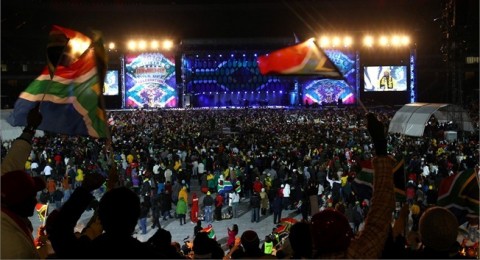
The South Africa 2010 party got under way in style last night with a joyous, colourful and truly African FIFA World Cup™ Kick-off Celebration Concert in Soweto, Johannesburg. Held in the football heartland that is Orlando Stadium, home of iconic club side Orlando Pirates, the concert featured a host of stars including Shakira, Alicia Keys, K’Naan and the Black Eyed Peas. A wide variety of acts took to the stage but the abiding theme was one of celebration for the African continent with the event broadcast across the world. The countdown clock introducing the three-hour extravaganza finally hit zero and with it came a cacophonous roar as seemingly thousands of South Africa flags were lifted aloft creating an ocean of colour among the estimated 30,000 in attendance. Joining the countless Rainbow Nation colours were a broad cross-section of national flags representing every corner of the globe, as the many visitors in attendance took the opportunity to enjoy Africa’s impressive ability to turn on a party. FIFA President Joseph S. Blatter and South African President Jacob Zuma jointly opened the concert after the early acts. As the evening progressed a cavalcade of football stars took to the stage between performances including former Bafana Bafana captain Lucas Radebe, Christian Karembeu, Quinton Fortune, Socrates and Jay Jay Okacha. Another joyous presenter was Archbishop Desmond Tutu decked out in Bafana Bafana supporter gear and who introduced a video presentation on Nelson Mandela with trademark enthusiasm. The large crowd rarely dropped their energy levels and their infectious enthusiasm was palpable. “I have been to a lot of concerts but I have never been to a concert like this,” said ebullient Johannesburg resident Khensami Majola, just as K’Naan took to the stage to perform his poignant song ‘Wavin Flag’. “It is amazing fun, we are having a huge jam. It is a perfect presentation of Africa – north, south, east and west.” The concert drew to a spectacular conclusion with Colombian pop princess Shakira in impressive form. She was joined on stage by Freshlyground for a rendition of ‘Waka Waka (This Time for Africa)’, the Official FIFA World Cup theme. Another proud concert-goer was Soweto local William Oosthuizen who spoke with pride as he took a rare break from dancing. “I am very proud and I am enjoying this immensely,” he said. “Beauty in the heart of Soweto. This is what Africa is all about. Sport has a unifying factor and it’s all about people enjoying themselves.” #

Read the original here:
World Cup Begins in Colour and Rhythm

Bafana Get Madiba Magic

Mandela gives Bafana some Madiba magic Nelson Mandela donned the captain’s jersey on Thursday during a meeting with the national football team aimed at injecting them with a little of his Madiba magic. Former South African President Nelson Mandela shakes hands with South African national team soccer player Steven Pienaar as he poses with the team in Johannesburg in this handout picture released by the Nelson Mandela Foundation on June 3, 2010. The 2010 FIFA Soccer World Cup kicks off on June 11. REUTERS/Zwidephotos/Nelson Mandela Foundation/Handout Photograph by: HO Credit: REUTERS Nobel peace winner Mandela, 91, met the squad and their Brazilian coach Carlos Alberto Parreira at the Nelson Mandela Foundation in Johannesburg. In a statement, the foundation said the country’s first black president drew cheers and a song from the team when he arrived wearing a number 4 Bafana Bafana jersey. “Nelson Mandela there is no one like you,” they were reported to have sung. South Africa’s sports teams have often turned to Mandela for inspiration before a major tournament or game. The Springboks national rugby side credit him with inspiring them to a home victory over New Zealand in the 1995 World Cup, by showing immense enthusiasm for a sport once associated with the apartheid regime. The frail statesman, who played a central role in South Africa’s campaign to host the football World Cup, aims to do the same for Bafana Bafana, according to a report in Business Day newspaper. Mandela has requested tickets to the opening game next week between South Africa and Mexico, Sports Minister Makhenkesi Stofile told the paper. Mandela’s foundation, which represents the anti-apartheid icon, refused to confirm the report. “We don’t discuss Mr Mandela’s movements ahead of time because of security reasons,” Sello Hatang, spokesman for the foundation said. Source – Timeslive.co.za 2010 World Cup Blog for the Fans

Read the original here:
Bafana Get Madiba Magic

FIFA World Cup cater for visually impaired

FIFA World Cup live action for blind and visually impaired football fans Getty Images Blind and visually impaired fans will be able to enjoy a special live-match experience at the 2010 FIFA World Cup™ in South Africa. Six stadiums will each have 15 seats equipped with headphones, and trained commentators will report live on the action happening down on the pitch. In addition, each of these six stadiums will have 15 seats that will be allocated to their sighted guides who will accompany them, while specially trained volunteers will provide assistance within the stadiums. This is a premier in South Africa’s sporting landscape. The initiative, launched by the Swiss National Association for the Blind (SNAB) and the South African National Council for the Blind (SANCB) and financially supported by FIFA, is aimed at making the tournament accessible to all. FIFA Partner Sony is providing the necessary transmitters that will allow people to receive match-day commentary in the stadiums free of charge. The SANCB is ensuring that the tickets are fairly allocated and only a very limited number of tickets are still available for 19 matches via .www. sancb.org.za . “Football is a universal sport and it must be accessible to everyone. We are therefore delighted to be able to make this unique live experience in the stadium also accessible to visually impaired and blind people. This project is another launching pad for South African sports and will create a legacy with services and facilities at football grounds for visually impaired and blind South Africans,” said FIFA President Joseph S. Blatter. The Institute of Advancement of Journalism was responsible for sourcing, training and coordinating the audio descriptors, while the Academy of Sound Engineering students will perform the technical audio functions that will be necessary to ensure that the audio descriptions are correctly transmitted to the visually impaired fans at the stadiums. The stadiums offering this service are: Johannesburg – Soccer City Stadium: 8 matches Johannesburg – Ellis Park Stadium: 7 matches Tshwane/Pretoria – Loftus Versfeld Stadium: 6 matches Durban – Durban Stadium: 7 matches Nelson Mandela Bay/Port Elizabeth – Nelson Mandela Bay Stadium: 8 matches Cape Town – Green Point Stadium: 8 matches Source – Fifa.com 2010 World Cup Blog for the Fans

Here is the original post:
FIFA World Cup cater for visually impaired

After Two Years with Obama, Linda Douglass Returns to News Media

Completing a full spin through the revolving door, Linda Douglass, a long-time CBS and ABC correspondent before jumping aboard the Obama campaign in 2008 – followed by HHS and White House positions promoting ObamaCare — has re-joined The Atlantic as a Vice President who “will concentrate on company strategy and communications,” the Washington Post’s Howard Kurtz reported online Thursday morning . Before joining the Obama campaign as senior strategist and senior campaign spokesperson on the road, Douglass toiled for National Journal , part of Atlantic Media which also owns The Hotline . Her first stint in the new administration was as Assistant Secretary for Public Affairs at the Department of Health and Human Services, followed by Communications Director for the White House’s Health Reform Office, a slot she left in April. Atlantic Chairman David Bradley recognizes the conflict between her political agenda and being a journalist, but he told Kurtz “she’s too big an editorial talent for us to keep her out of the editorial product.” From Kurtz’s June 10 post: While her political tenure “troubles me not at all” for the corporate part of the job, Bradley says, he sees a “blinking red light” when she gets involved with the journalistic side, especially as it involves the president or health care. But, adds Bradley, “she’s too big an editorial talent for us to keep her out of the editorial product.” Douglass, who left the ABC News Washington bureau in 2006 after spending much of the 1990s with CBS News, will advance the opinions of, amongst others, Andrew Sullivan, author of The Atlantic’s “ The Daily Dish ” blog. On last Friday’s Real time with Bill Maher, Sullivan applauded author Joe McGinniss for renting the house next to Sarah Palin’s, proclaiming he’s just trying “to find out who this farce and phony actually is.” > From April: “ Her ObamaCare Mission Achieved, ABC/CBS Veteran Linda Douglass Departs White House .” > My complete list of Obama-news media revolvers , updated just a few days ago, which now stands at 15.

Continued here:
After Two Years with Obama, Linda Douglass Returns to News Media