Pictures revealing the manor’s entryway and grand staircase have a distinctly old-school Tim Burton feel. By John Mitchell Johnny Depp and Michelle Pfeiffer in “Dark Shadows” Photo: Warner Bros. Here we are again, folks. We’re about two months away from the release of “Dark Shadows” and we still don’t have a trailer . It’s a little disconcerting that a film this big and anticipated doesn’t have an official trailer out yet. But since there’s not much we can do about that, let’s talk about the latest thing to creep into the Shadowsverse this week: pictures of Collinwood Manor. For those unfamiliar with the ’60s soap, the manor is the principal setting for the action of “Shadows.” When Barnabas (Johnny Depp) returns to Collinwood in 1972 after, you know, a few centuries buried in a mausoleum, he finds the once-grand estate in disrepair. His dysfunctional descendents who now reside at the grand manor haven’t fared much better. Elizabeth Collins Stoddard (Michelle Pfeiffer) has brought psychiatrist Dr. Julia Hoffman (Helena Bonham Carter) to live at Collinwood to help with her with her family’s assorted troubles, including her rebellious teenage daughter, Carolyn (Chlo
It’s official: Snooki is totally preggers. No, the Jersey Shore star is not married to Jionni LaValle . And, yes, she drinks both often and heavily. But people must stop giving this pint-sized trainwreck such grief says someone who has often held her hair back on the bathroom floor. “It’s not like she’s 16 and pregnant,” Sammi Giancola told E! News. “She’s doing her thing, she’s living her life and I just think she’s blessed. I can’t wait to see a little guido or guidette running around. I just think it’s going to be so exciting.” What about Snooki and LaValle’s wedding? (Note: Did you see that engagement ring ?!?) Sammi is psyched. “I can see her having a cheetah or zebra print-themed wedding because she loves animal print… I’m excited for them. I just can’t wait to party for the wedding and do all the fun things she has coming in her life now.” Do you think Snooki will make a good mother?
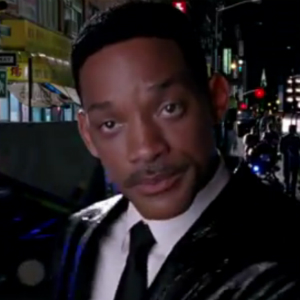
Sony’s got quite the job ahead of them selling the mega-budgeted sequel Men in Black III , due in May, if the new trailer is any indication: See Will Smith drop lines like “I don’t have no problem pimp-slapping the shiznit outta Andy Warhol” and be transported to a futuristic time-traveling retro ’60s that looks and sounds a lot like the one Austin Powers came from. I guess the ’90s are the new ’80s, but this is just lazy. The new sequel follows alien-hunting Agent J (Smith) into the past to save Agent K ( Tommy Lee Jones ) by teaming up with a younger version of K ( Josh Brolin doing his best Tommy Lee Jones impression). Look forward to the usual broad aliens-among-us gags and that mind eraser schtick that audiences loved in 1997! Smith bemoans that he’s “getting too old for this,” and I’m inclined to agree. Aren’t we all? Verdict: Looks tired. Insert mind eraser joke here.
What do you get when you fold two decades’ worth of young stars — and one very confused-looking Tom Sizemore — into a cautionary tale about the perils of meth use? Try Meth Head , a swear-y, scream-y, violent and thoroughly destabilizing journey to the depths of the worst known addiction this side of Words With Friends. Your venerable guides: Lukas Haas, Wilson Cruz, Scott Patterson and a laconic Sizemore among others. It’s the feel-bad movie of 2012, coming soon to a festival near you! To wit, from a press release: Kyle Peoples never wanted to be the man he has become in his 30s, an accountant stuck in a dead end job, with a lover who is more successful than he and a family that doesn’t get him at all. So when a night of partying leads to a new family of friends and fun, Kyle sees an opportunity for escape from reality. But Kyle’s new friendship with Maia and Dusty and the trio’s love of crystal meth eventually cost Kyle his job, his companion, his home and his family. Kyle’s escape becomes his trap, the party is an illusion and the crystal is slowly killing him, physically and psychologically. When he finally bottoms out and is no longer the young man his father once boasted about with pride, Kyle must choose: life or meth. Yikes. This thing has me wanting to go to rehab. Festival premieres are forthcoming, according to the release; stay tuned to Movieline for more details as events warrant. Follow S.T. VanAirsdale on Twitter . Follow Movieline on Twitter .
We always knew Scarlett Johansson had great lungs. Now the redheaded lust object and catsuit-clad Avenger is gearing up to put those boobies- uh, babies – to good use as Janet Leigh in Alfred Hitchcock and the Making of Psycho . Due in 2013, the film seeks to capitalize on the success of My Week with Marilyn (2011) by dramatizing the behind-the-scenes experiences of…well, it’s right there in the title. We just have one suggestion for the filmmakers on this one…this time, try a clear shower curtain for that infamous shower scene. Catch up with the breast of Scarlett Johansson right here at MrSkin.com
“Director Sacha Gervasi has tapped Scarlett Johansson and James D’Arcy to play Psycho stars Janet Leigh and Anthony Perkins in Fox Searchlight’s Alfred Hitchcock and the Making of Psycho . Anthony Hopkins will play the iconic director, while Helen Mirren will play his wife, Alma. Sources tell Variety that Making of Psycho has drawn comparisons to My Week With Marilyn , and that the role of Janet Leigh could lead to the same awards consideration for Johansson that the Marilyn Monroe role did for Michelle Williams.” [ Variety ]
” Shoot the dog .” In the vein of powerhouse Aussie import Animal Kingdom comes The Snowtown Murders , a chilling thriller based on the true story of charismatic charmer and sociopathic serial killer John Bunting, who led a band of criminals in South Australia as they kidnapped, robbed, terrorized, and murdered victims from their own community during the ’90s. Get a glimpse of the masterful manipulation skills that helped Bunting earn the notorious title of Australia’s worst serial killer in Movieline’s riveting exclusive clip, featuring Daniel Henshall as Bunting and Lucas Pittaway as his emotionally vulnerable protege — tasked here with proving himself by committing a heinous act at Bunting’s behest. In her review of the film , Movieline’s own Alison Willmore described Henshall’s Bunting as “an unassuming monster,” and as you can see in the clip below Henshall is wonderfully, and chillingly, unsettling. Director Justin Kurzel’s slow-burn pic introduces the notorious killer as a do-gooder savior who steps in to pull an ailing Australian community up by its bootstraps, drawing his group of brethren deeper and deeper into adopting and, frequently, aiding in his own ultraviolent tendencies; by the time the most heinous atrocities have been committed, it can at least be understood just how these neighbors and friends had fallen under Bunting’s destructive spell in the first place. First screened at the Cannes Film Festival (where it won the FIPRESCI Prize — special mention) as Snowtown , The Snowtown Murders is quite an unsettling but powerful watch, but is worth seeing especially if you’re curious about the so-called Australian New Wave. The film hits theaters in limited release today (NYC Friday at IFC Center, 3/15 in LA at the Egyptian) but can already be viewed now on IFC Midnight VOD. Follow Jen Yamato on Twitter . Follow Movieline on Twitter .
Film narration carries the dubious reputation of being a fallback trick for lesser directors, a device to trot out when other more classically visual narrative devices fail. In the same way that long, unbroken takes supposedly signify expertise, the use of narration often serves lazy critics with an easy indication that the director has lost the plot. Still, even the most anti-narration snob would have to concede that the larger film canon contains some pretty notable exceptions to this rule. The Naked City, A Clockwork Orange, Sunset Boulevard, GoodFellas, Ferris Bueller’s Day Off, The Big Lebowski, The Shawshank Redemption — all use narration, and far from stalling story or characterization, with them it pushes everything forward. Rather than quibbling over the merits of the device itself, acknowledging those notable examples of its effective use would at least seem to necessitate deeper analysis. If some filmmakers have successfully used it, serious students of film should probably take a closer look, if only to better understand the exceptions that prove the rule. To that end, we could loosely categorize film narration into four different groups according to two distinctions: the distance of the narrator’s involvement with the film’s conflict and themes, and the directness with which the narrator addresses the viewer. The first distinction is represented on one end of the spectrum by films like Taxi Driver , where the narration directly clues the viewer in to the motivations of a certain character or elaborates on the conflict that drives the film forward. Taxi Driver is an especially good example of the so-called involved voiceover, because it gives a first-hand view to the inner workings of the main character Travis Bickle’s demented psychology, fleshing out his odd behavior with an equally discomfiting internal monologue. Watching Bickle talk to his own reflection while parading an arsenal of homemade weapons is certainly harrowing, but to hear him detail the skewed reasoning behind his plotting with talk about “a real rain that will wash the scum off the streets” only adds another level to his menace. On the other end of this “involvement spectrum,” we see films like The Royal Tenenbaums , which feature a totally detached third person narrator who nonetheless comments meaningfully on the film’s action from afar. Played with a perfect mixture of somber knowingness and monotone disinterest by a heard-and-not-seen Alec Baldwin, the voiceover for Tenenbaums still adds layers of thematic meaning to much of what goes on. Whether by adding back-story, as when the narrator informs the audience of the divorce of Royal and Ethel Tenenbaum in the first scene, or character insight, as when he explains in one scene that Royal “didn’t realize what he had said was true until after he had said it,” the voiceover’s apartness actually serves as a useful perspective from which to view the action along with the audience and insert helpful cues along the way. The second distinction, having to do with the directness of address, or the level of audience engagement of the narration, involves how forcefully the narration is meant to appeal to the viewer. With films like High Fidelity or Annie Hall , for instance, the narrator grabs the viewer by the lapels and demands attention, speaking directly into the camera with vocal inflections suggesting conversation rather than monologue. This is probably the trickiest sort of voiceover to pull off, and the one that grates the worst when done wrong. The other end is represented by narrators who speak with an authoritative, almost historical tone, rattling off characters’ back-stories with seemingly little consideration of who may be watching or why. I found the tone of the initial voiceover by Cate Blanchett as Galadriel in The Lord of the Rings: The Fellowship of the Ring especially removed in this sense. Galadriel is involved in the goings on of the film’s story, interceding at several key moments throughout the saga, and yet she could not be more tonally remote from the audience. In fact, that is half the pleasure of Galadriel’s narration: She sounds like she’s speaking to the viewer from another world. The importance of this relative level of audience engagement reveals itself most in unreliable narration. For instance, the main character from Memento narrates intimately, always invoking the viewer’s sympathies, and yet because of Leonard’s particular character quirks, this closeness proves false by film’s end. If a diversity of type speaks anything to the value of a particular storytelling device, then film narrators definitely don’t deserve their bad reputation. Then again, if the domination of last weekend’s Oscar ceremony by The Artist shows anything, those purely visual filmmaking elements still very much strike the critical fancy, as they should. The simplest and best criterion for judging the effectiveness of narration will always be its facility to complement the moving pictures themselves. Nathan Pensky is an associate editor at PopMatters and a contributor at Forbes , among various other outlets. He can be found on Tumblr and Twitter as well.
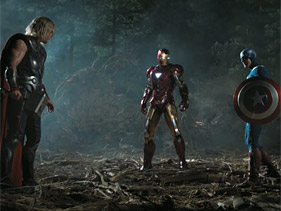
The Talk Nerdy team consults comic book and movie experts for their opinions on the second theatrical trailer for “Marvel’s The Avengers.” By Josh Wigler Chris Hemsworth, Chris Evans and Robert Downey Jr. in “The Avengers” Photo: Marvel Studios Help me out here, guys: Am I really the only one out there who thinks the new “Marvel’s The Avengers” trailer is the best superhero trailer of the past year? Sure, we’ve had excellent spots for “Dark Knight Rises” and “Amazing Spider-Man” in recent months, but did either of those feature the Incredible Hulk running full-sprint toward the sky to catch a battered and broken Iron Man? No, they didn’t — yet somehow, I’m the only person on Talk Nerdy who seems really, truly psyched for everything “Avengers” has to offer. As you’ll see in this week’s episode of Talk Nerdy below, my friends and co-hosts Eric Ditzian and Brian Phares are nowhere near as jazzed about “The Avengers” as I am. In fact, they’re quite worried about the Marvel movie. I share some of their concerns, sure, but more than anything, I’m seriously bummed that their levels of excitement are so low after watching the newest trailer for Earth’s Mightiest Heroes. Their reactions got me thinking: Am I losing my mind? Am I alone in my “Avengers” fan fever dream? I reached out to several colleagues and pals in the film and comic book space to get their opinions on the new trailer, and thankfully for my mental health, it seems I’m not alone in my copious praise. “I just have one word to describe the new trailer: BIG!” MTV Geek editor Valerie Gallaher said. “To see the core Avengers characters together and in action on such a colossal playing field is just a dream come true. And Hulk looks great and believable, which is a real relief for me.” “The new footage showcasing Robert Downey Jr. as Iron Man was invincible; the glimpse of Stark Tower, exquisite; and the promise of more Mark Ruffalo as Bruce Banner, incredible. We even got a quick look at Cobie Smulders as Maria Hill,” offered Steve Sunu with Comic Book Resources . “While the trailer didn’t really defy any expectations for Earth’s Mightiest Movie, it certainly met them — and piqued our interest as to why the Avengers are fighting Decepticons to the soundtrack of ‘Inception.’ ” Of course, my buddy Steve is referring to the giant monster/ spaceship seen at the end of the trailer. Popular theories are pointing to the creature being a Marvel Studios variation on Fin Fang Foom, the massive, shape-shifting space dragon from comic book lore. Jordan Hoffman offered some opinions on the mystery antagonist in his latest Planet Fanboy column for NextMovie , and also added his assessment of the “Avengers” trailer. “Will there be a better movie than ‘Marvel’s The Avengers’ this summer? Maybe … probably,” he said. “I mean, ‘The Dark Knight Rises’ and ‘Prometheus’ are looking outrageous. Will there be a trailer that draws more breath from the daydreams of comic-reading fanboys? I strongly doubt it.” Exactly my point. “Avengers” might not be the best geek movie coming out in 2012, but I’m hard pressed to identify a trailer with more geekgasm-worthy material. As Comics Alliance ‘s senior editor Caleb Goellner put it: “The new ‘Avengers’ trailer was essentially what every fan has been waiting for since Nick Fury broke into Tony Stark’s pad after the ‘Iron Man’ credits. Previous promotions did well with broadcasting the film’s human drama, but admittedly had me worried about its special effects budget. The new trailer slayed my concerns. The Hulk didn’t just catch Iron Man in this thing; the dude caught my heart.” Couldn’t have said it better myself, Caleb. What did you think of the “Avengers” trailer? Tell us in the comments section or let me know on Twitter @roundhoward ! Check out everything we’ve got on “Marvel’s The Avengers.” For breaking news, celebrity columns, humor and more — updated around the clock — visit MTVMoviesBlog.com . Related Videos Talk Nerdy Related Photos ‘Avengers’ Trailer: Five Key Scenes
He is the Lorax, he speaks for the trees – or at least he would, if he could get a word in edgewise. Because Dr. Seuss’ The Lorax , as directed by Chris Renaud and Kyle Balda, is so cluttered — with extra narrative, extra characters, extra everything — that its famously mossy and bossy central figure barely figures into the plot. More a bowdlerization than an adaptation of the great Theodor Geisel’s somber plea for environmental preservation, The Lorax is so big, flashy and redundant that it courts precisely the kind of blind consumerism it’s supposed to be condemning. It doesn’t trust kids to sit still and pay attention for even a minute. In the book, a young boy approaches the dark lair of the Once-ler, situated in the middle of a bare wasteland. The Once-ler spins a tale about what this godforsaken patch of land used to be like: It was dotted lavishly with Truffula Trees, their tufty heads looking like psychedelic dandelions and smelling of “butterfly milk.” This was a land populated by humming fish and bearlike creatures known as Bar-ba-Loots (“frisking about in their Bar-ba-Loot suits”), and guarded over by the stern, if noodgy, Lorax, who is especially protective of the area’s chief natural resource, those Truffula Trees. The Once-ler begins cutting down the trees for his own gain, initiating a destructive spiral that the book resolves only tentatively – with a single Truffula seed held out as a symbol of hope for the future. Those simple but potent ingredients aren’t enough for this Lorax, which was adapted – maybe “mauled” is the better word – by Ken Daurio and Cinco Paul. The boy who sets the whole story in motion is a pre-teener named Ted (voiced by Zac Efron), who lives in Thneedville, a town that’s completely made of plastic – air is pumped in by an evil and very short entrepreneur named Mr. O’Hare (Rob Riggle). Ted takes an interest in trees because the girl on whom he has a crush, Audrey (Taylor Swift), thinks they’re neat and wishes they weren’t all gone. So he approaches the lair of the reclusive Once-ler (Ed Helms), who spins the sad and sorry tale of the long-lost Truffula Trees, and of his encounter with the Lorax (Danny DeVito), who tried to stop their destruction before it was too late. But wait, there’s more – much, much more. Ted has a mother who tries to convince him that the artificial trees of Thneedville are perfectly adequate, as well as a grandmother who secretly advises him otherwise. The Once-ler has a family of social-climbing boobs who persuade him to ax the Truffula forest, a touch that’s designed, maybe, to make the Once-ler more sympathetic, but what’s the point? The Once-ler wriggles his way into the good graces of the Bar-ba-Loots (who aren’t referred to by their right and proper name but who are treated as if they were simply garden-variety bears) by showering them with marshmallows. And so forth. The great marvel of Dr. Seuss’ work – in addition to his noodly characters, silly-brilliant drawings and captivating rhyme schemes — was its economy: Dr. Seuss’ books tell fairly complex and imaginative stories in a remarkably simple way. (Even One Fish Two Fish Red Fish Blue Fish has a narrative, albeit one with a streak of Dada madness.) These books are never overpopulated – Seuss never, for example, threw in extra parental characters just to give his characters something to rebel against. Adolescent boys trying to impress girls? Please. But the story Seuss tells in The Lorax is almost completely obscured here, buried beneath needless extra details. The look of the film nods adequately to certain Seussisms – the tops of those Truffula Trees do look pretty luxurious, like Troll-doll hair in unbelievable shades of magenta and citrus orange. Yet there’s so much to look at that almost nothing registers. The town of Thneedville is elaborate and plasticky-looking, populated largely by fat, lazy people. The Truffula wonderland is much prettier to look at, but it’s almost too much of a good thing. The creatures who populate it – like those humming fish, who spend a great deal of time bouncing around dry land on their flexible tails – may be cute, but they also seem like afterthoughts; there’s just too much business happening all around them. Even the Lorax himself – despite DeVito’s singular vocal charms – comes through as a blur in the midst of a hyperactive muddle. When it comes to this mess, who’s left holding the Truffula-stuffed bag? Renaud was one of the directors (with Pierre Coffin) of what was, for my money, the best and most gleefully disreputable animated film of 2010, Despicable Me . That picture was relaxed and loopy; The Lorax is stiff and junked-up. The casual details that Seuss would drop so effortlessly are belabored here. For example, when the butterfly-milk scent of those Truffula tufts comes up in conversation, Ted and Audrey can’t let this magical true-fact pass without comment: “What does that even mean?” “I know, right?” they counter, compelled to show how hip they are to the idea that, you know, butterflies can’t actually produce milk. Thanks for that, masterminds behind Dr. Seuss’ The Lorax . It saves me a lot of time feeling around for those really tiny butterfly nipples. I should have known Theodor Geisel made it all up. Follow Stephanie Zacharek on Twitter . Follow Movieline on Twitter .




 Breaking Sports Video