Django Unchained had its New York City premiere last night, and like me you probably weren’t there. Sorry on all our behalves, everyone! Luckily we can console ourselves with the ongoing reveals of tracks from Django ‘s soundtrack. The latest is Unchained (The Payback/Untouchable) , a mashup of James Brown’s The Payback and Tupac’s Untouchable . Ready for a listen? You guys, I really want to love this. But despite the fact that James Brown and Tupac are both insanely dope, the track sounds like exactly half of awesome. Blame for that goes to Swizz Beats, who produced Untouchable for the 2006 album Pac’s Life , AKA the moment when the dead horse that is Tupac’s posthumous career was finally flogged into its component atoms. Tupac was a genius, but that doesn’t mean he’s a cipher that can be fitted into whatever era wants him. His flow was built on bomb-squad influenced beats and g-funk. Warping his rap style around the bob-free beats that popped up in the aughts is like releasing a disco remix of Paul Whiteman’s version of You’re The Tops . Frankly, Untouchable is in strong contention for the absolute worst of Tupac songs. Particularly hilarious is the fact that Swizz looped Pac to make him fit the track, so we get Tupac shouting “Y’all know me Y’a-Y’all know me” like a Shep Pettibone remix from 1988. Meanwhile, James Brown’s music was tailor made for a remix like the one used to make Unchained (The Payback/Untouchable) , and the combination only makes the molestation of Pac sound even worse. I wish they’d just requested access to Pac’s original vocals instead mashing up a superior song with an inferior song. Luckily, the beats and the remix of “The Payback” are great, and once you get used to how Tupac is criminally misused, you can enjoy the other more solid moments unfettered. No doubt it’s going to sound even better when it plays over scenes of blood-spattered cotton fields, so I’m in. RATING: The original Tupac track: 10 out of 100 black coffins for making one of the greatest MCs in the game sound wack. This mashup: 80 out of 100 black coffins for proving once again that James Brown’s music can always be used to make everything sound cool, despite the wackness. The original version of “Untouchable”: “The Payback”: [Source: A.V. Club ] READ MORE ON DJANGO UNCHAINED : REVIEW: Tarantino’s Django Unchained A Bloody But Bloated Affair From ‘100 Black Coffins’ To ‘Casa De Mi Padre,’ 5 Oscar Best Song Dark Horses We’re Rooting For Quentin Tarantino Tackles Slavery: ‘You’re Going to Want to Talk After’ Django Unchained Ross Lincoln is a LA-based freelance writer from Oklahoma with an unhealthy obsession with comics, movies, video games, ancient history, Gore Vidal, and wine. Follow him on twitter (@rossalincoln). Follow Movieline on Twitter .
Quentin Tarantino continues his quest to fight history’s great oppressors by way of the movies in Django Unchained . Inglourious Basterds conjured up a squadron of tough Jewish-American soldiers who took Nazi scalps and chased down Hitler with the help of a French Jewish theater owner, a British film critic turned lieutenant and a Allies-affiliated German movie star. Django Unchained doesn’t literally bring the forces of cinema to bear against slavery in the same fashion, but it does use tropes of Spaghetti Westerns and exploitation films to build the character of a former slave who learns to shoot and eventually faces down the residents of a plantation in order to retrieve his wife. There’s something inarguably rousing about Tarantino’s exuberant revisionist history, about the way he rewrites wretched eras in the past so that those who suffered are able to have their bloody revenge. And yet, Django Unchained and Inglourious Basterds are my two least favorite works in Tarantino’s oeuvre, not because of their concepts but because of their expansive, unhurriedly indulgent qualities. Don’t get me wrong — he’s still able to offer up scenes set to music that are the cinematic equivalent of a velvety slice of rich cheesecake, he has a facility with and takes an unbridled glee in dialogue in a way that’s unequalled among filmmakers working today, and he comes up with unforgettable characters that feel intensely modern but also like they’ve walked out of some long forgotten but incredible film. It’s possible that no one does momentary pleasures like Tarantino, and Django Unchained has no insignificant amount of instances of sheer enjoyment, from an introductory sequence in which a scene-stealing Christoph Waltz as Dr. King Schultz liberates the titular slave (Jamie Foxx) from traders to one in which Django rides onto an estate to some anachronistic hip-hop. But the film also comes across like a rough cut that was never looked at as a coherent whole, and some segments that start off as promising become interminable while others feel entirely unnecessary. There’s no pressure on or expectation for Tarantino to please anyone other than himself, and the film feels overstuffed with ideas that should have been pruned. That sense of fun needed to power something this outsized wanes before the film reaches its ending, two hours and 45 minutes later — it’s not a feature that you want to last forever, but one that seems to take it for granted that you feel that way. There’s a good movie inside Django Unchained , maybe even a great one, but it hasn’t been carved out of the lopsided excess. Django Unchained begins two years before the Civil War in the wilds of Texas, where German dentist-turned bounty hunter Schultz pulls up alongside a line of slaves being transported across the state. He hates slavery, but needs the help of Django in order to identify a trio of murderous brothers who once worked on the plantation from which he came, and so he buys the man with a promise to free him and give him a share in the reward once the deed is done. Cheerful, eloquent and dryly funny — “If there are any astronomy aficionados among you,” he tells a group of slaves suddenly facing the possibility of freedom, “the North Star is that one” — Schultz gets many of the best lines, and the segment in which he takes Django under his wing and shows him the ropes of being a bounty hunter are outrageously enjoyable, as they enact a Southern Western, face down an angry town from the confines of a bar, venture onto a plantation owned by Big Daddy (Don Johnson) to find their targets in a confrontation that splatters blood across the cotton growing in the fields, and face down the Klan in a scene that’s pure Mel Brooks. Waltz and Foxx are terrific together, the verbose, flowery Schultz balancing out the taciturn Django as he shakes off his former identity as a slave (just as he casts off his blanket in extravagant slow motion, bearing a scarred back) and becomes a confident force to be reckoned with. But the film slows its pace to a crawl as the pair travel to a giant Mississippi estate owned by Calvin Candie (Leonardo DiCaprio) called, naturally, Candyland, where they come up with a plan to buy back Django’s wife Broomhilda (Kerry Washington). Samuel L. Jackson is there too, playing a canny house slave named Stephen even more concerned with enforcing the power structure than his owner seems to be. If the first part of the film is Schultz’s, the second is Django’s, but he’s competing with big, talky performances from DiCaprio and Jackson that diminish his presence in comparison, as Tarantino lets a pair of scenes at a club and later at a dinner spin out endlessly like a virtuoso playing his instrument past his audience’s threshold of enjoyment and, eventually tolerance. The film is so in love with certain elements, like DiCaprio’s monstrous preening, his sister’s (Laura Cayouette) exaggerated Southern belle simpering and Jackson’s toadying, that the suspense of the ruse that’s being played gets lost in the clutter. By the time the film ends, and then ends a second time, it feels exhausted, not electric. Django Unchained is filled with film geek touches, including a cameo from Franco Nero, who played the title character in the 1966 Spaghetti Western Django , music from Ennio Morricone, the presence of both Russ and Amber Tamblyn in a town scene, and Zoe Bell and Tom Savini playing two of a group of trackers. They’re classic Tarantino — but the film’s not short on auteurist touches. It’s an unfortunate example of a director disappearing so far into his own vision that he’s lost interest in taking a step back and looking at it in its entirety. Follow Alison Willmore on Twitter . Follow Movieline on Twitter .
Killing Them Softly is set in Boston, maybe. Someone mentions living in Somerville, a scattering of the characters have the accent, and they talk about going down to Florida. But the film was shot in New Orleans, often in the industrial edges still ragged from Hurricane Katrina, and the only people who seem to inhabit its universe are gangsters — high level ones with pretentions of civility and hardscrabble losers struggling to get a few dollars together by way of hazardous schemes. What ties this abstract, violent place to the real world is the 2008 presidential election, which provides a backdrop for its tale of an ill-advised robbery and the guy brought in to clean up after it. There’s George W. Bush talking about the bailout on a TV in the corner as two guys knock over a card game; there’s Barack Obama promising change on a billboard over a neighborhood filled with empty lots and abandoned houses. It’s a neat idea, matching the brisk kill-or-be-killed business of unforgiving criminal life to an America staggering from the economic crisis. But as in his last feature, the gorgeous and stiltedly self-conscious The Assassination of Jesse James by the Coward Robert Ford , Australian filmmaker Andrew Dominik shows a tendency to lean too hard on his symbolism rather than letting it exist as part of the whole. In Jesse James it was the tying in of the last days of the outlaw to a meditation on celebrity. Here, it’s the capitalism-as-a-disease parallels on a national and narrative scale that start to feel on the nose long before a character barks “America’s not a country, it’s a business — now fucking pay me!” and Barrett Strong’s “Money (That’s What I Want)” plays over the closing credits. But when Dominik , working off his own screenplay adaptation of a novel by George V. Higgins, is less focused on trying to make an important movie, he turns out an indisputably fun one, a stylish and flamboyantly macho affair that cribs pleasantly from Mamet, Blue Velvet , Tarantino and Scorsese . The film starts with Frankie (Scoot McNairy), a ferrety guy recently out of prison and eager to convince his Australian pal Russell ( Ben Mendelsohn , memorably scary in Animal Kingdom ) to get in with him on a job. Russell’s working his own scheme involving kidnapping purebred dogs and using the money to buy an ounce of heroin and become a dealer, but Frankie’s pal Johnny (Vincent Curatola) has what he claims is a foolproof gig. They’ll rob a poker game run by a guy named Markie ( Ray Liotta ), who arranged to hold up his own game once in the past and got away with it. The games are protected, but if his gets robbed again everyone will assume he’s the one behind it. Killing Them Softly starts off with its main heist, if it can be called that, and then turns to the fallout, letting things rattle along for a considerable amount of time before introducing Jackie ( Brad Pitt ), a guy who can’t really be described as a hero or antihero. Jackie’s a fixer and a hitman who’s filling in for the last go-to guy, Dillon (Sam Shepard, glimpsed only in flashbacks), and he’s a competent, no nonsense figure in a world full of fuck-ups. Dominik’s film is interesting in that the crimes themselves, whether stick-ups or killings, are rarely difficult — it’s the aftermath that gets people in trouble, when they can’t keep their mouths shut about what they just pulled off or don’t know when to cut their losses and get out of town. Dominik shows an open appreciation for his actors and for the way tough guys, aspiring and genuine, talk to each other — and Killing Them Softly is as much centered around talking as it is action. Pitt, playing a practical know-it-all who falls somewhere between Rusty Ryan and Tyler Durden, is terribly entertaining shooting the shit with Driver (Richard Jenkins), the representative of the unspecified group who hired him, the two complaining about the new “total corporate mentality” like disgruntled office workers on a smoke break. Later, he brings in Mickey (James Gandolfini) from New York to help out, and watches him with worried calculation as he turns out to be in rough shape. If gangsterism is just capitalism in a more raw form, then Jackie is the creature best suited for this world. He knows the rules and enforces them without prejudice, because it’s just business and this is just a job. Killing Them Softly doesn’t give that idea its intended sting. The film wants to be angry and scathing, but, to its credit, enjoys its characters and its mechanics too much to have a sharp edge. Whether it’s showing someone’s death in a luxurious slow motion spray of bullets and glass or lingering as someone drunkenly reminisces about a girl he sometimes sleeps with but has no hold on, the film is too fond of its rich details to allow them to become damning symbols of the system in which they can be found. Follow Alison Willmore on Twitter. Follow Movieline on Twitter.
James Rolfe is the Angry Video Game Nerd, a man who knows how to define a niche. His eponymous online videos have featured on YouTube, ScrewAttack, GameTrailers, Opie & Anthony and Cinemassacre, and for eight years anyone who ever wanted to watch a man get extremely angry while screaming about old video games knew exactly where to go. And a lot of people did. The series is the textbook — no, the wiki entry — for online viral success. Initially made as a laugh for a few friends, the early videos became YouTube sensations and spawned over a hundred episodes, millions of hits, multiple DVDs, and now the the impossible dream of most online video makers: a full feature film. It’s another victory for crowd funding. Rolfe http://www.indiegogo.com/Angry-Video-Game-Nerd-The-Movie
Quentin Tarantino is one of America’s most celebrated living filmmakers and his latest film – currently due out Christmas day – is highly anticipated. But even a critically acclaimed filmmaker can have a dud, even if some fans might disagree. Tarantino himself weighed in on what he considers his least accomplished work. ” Death Proof has got to be the worst movie I ever [made],” Tarantino told THR. “And for a left-handed movie, that wasn’t so bad, all right? So if that’s the worst I ever get, I’m good. But I do think one of those out-of-touch, old, limp, flaccid-dick movies costs you three good movies as far as your rating is concerned.” Death Proof was part of Grindhouse , a double feature along with Robert Rodriguez’s Planet Terror . The duo didn’t exactly score at the box office either. It took in just over $25 million domestically on a budget that reportedly reached $67 million. Not all turned out dismal though, it did receive a 65 percent on Rotten Tomatoes among critics – not horrendous though certainly not gangbusters. Tarantino recently hinted to Playboy that his latest film Django Unchained may signal the sunset of his filmmaking career, saying that he wants to “stop at a certain point.” “Directors don’t get better as they get older. Usually the worst films in their filmography are those last four at the end. I am all about my filmography, and one bad film fucks up three good ones … When directors get out-of-date, it’s not pretty.” [ Sources: Huffington Post , THR , Box Office Mojo ]
Quentin Tarantino is one of America’s most celebrated living filmmakers and his latest film – currently due out Christmas day – is highly anticipated. But even a critically acclaimed filmmaker can have a dud, even if some fans might disagree. Tarantino himself weighed in on what he considers his least accomplished work. ” Death Proof has got to be the worst movie I ever [made],” Tarantino told THR. “And for a left-handed movie, that wasn’t so bad, all right? So if that’s the worst I ever get, I’m good. But I do think one of those out-of-touch, old, limp, flaccid-dick movies costs you three good movies as far as your rating is concerned.” Death Proof was part of Grindhouse , a double feature along with Robert Rodriguez’s Planet Terror . The duo didn’t exactly score at the box office either. It took in just over $25 million domestically on a budget that reportedly reached $67 million. Not all turned out dismal though, it did receive a 65 percent on Rotten Tomatoes among critics – not horrendous though certainly not gangbusters. Tarantino recently hinted to Playboy that his latest film Django Unchained may signal the sunset of his filmmaking career, saying that he wants to “stop at a certain point.” “Directors don’t get better as they get older. Usually the worst films in their filmography are those last four at the end. I am all about my filmography, and one bad film fucks up three good ones … When directors get out-of-date, it’s not pretty.” [ Sources: Huffington Post , THR , Box Office Mojo ]
There aren’t many more clues to be had about Quentin Tarantino ‘s Django Unchained in this exclusive Yahoo! Movies trailer , or in the director’s latest interview with The Hollywood Reporter. But he does share a nifty story about a young fan who wrote herself into a third chapter of Kill Bill . Tarantino took part in a THR roundtable that also featured Ben Affleck ( Argo ) Gus Van Sant ( Promised Land ), David O. Russell ( Silver Linings Playbook ) and Ang Lee ( Life of Pi ) . how the final cut of his hotly anticipated slavery-era story is different from the movie he originally envisioned, Tarantino replied, “It’s shorter.” But he does recount an interesting anecdote involving a fan. The director says that a “14-year-old girl wrote a little synopsis for Kill Bill Vol. 3,” explaining: “She wanted to play the daughter grown up, or at least at her age.” Tarantino says he read the synopsis and called the fan to thank her. “I thought it was just so sweet that this little girl liked the movie so much that she continued the story herself,” he said. “I always really hope that people take the story on themselves and take it to a different place and fill in the blanks that I didn’t tell them about.” Based on this Django Unchained trailer, I say — I say — I foresee some of Tarantino’s more computer-savvy fans remaking this trailer with Foghorn Leghorn playing plantation owner Calvin Candie instead of Leonardo DiCaprio. Check it out below. [ The Hollywood Reporter, Yahoo! Movies ] Follow Frank DiGiacomo on Twitter. Follow Movieline on Twitter.
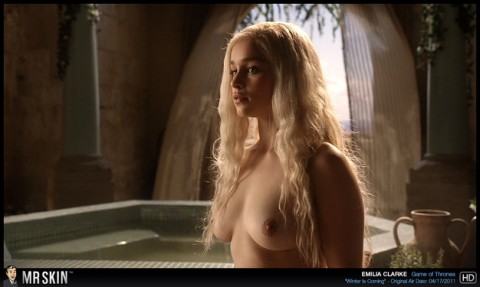
It’s nearly Thanksgiving, and here at Skin Central we are spankful for the hearty helping of nudes this week on DVD and Blu-ray. Kicking things off is the eye opening first season of Game of Thrones now available in collector’s edition. You can revisit Emilia Clarke’ s burning hot nude scenes in the Anatomy Award winning show, plus the lusty lesbo antics of Esme Bianco and Sahara Knite in glorious high-def. Winter won’t be the only thing coming! Also releasing is Tarantino XX : an 8-Film Collection from the lauded director featuring such classics as Patricia Arquette ’s patties in True Romance (1993) and Bridget Fonda ’s buns in Jackie Brown (1997). That’ll put some grind in your grindhouse! Finally, there is the Kris Kristofferson epic, Heaven’s Gate (1980), featuring the heaving hoots and hairpie of the incomparable Isabelle Huppert . See pics after the jump!