Tag Archives: research

The Brain Speaks: Scientists Decode Words from Brain Signals

Sept. 7, 2010 — In an early step toward letting severely paralyzed people speak with their thoughts, University of Utah researchers translated brain signals into words using two grids of 16 microelectrodes implanted beneath the skull but atop the brain. “We have been able to decode spoken words using only signals from the brain with a device that has promise for long-term use in paralyzed patients who cannot now speak,” says Bradley Greger, an assistant professor of bioengineering. Because the method needs much more improvement and involves placing electrodes on the brain, he expects it will be a few years before clinical trials on paralyzed people who cannot speak due to so-called “locked-in syndrome.” The Journal of Neural Engineering's September issue is publishing Greger's study showing the feasibility of translating brain signals into computer-spoken words. The University of Utah research team placed grids of tiny microelectrodes over speech centers in the brain of a volunteer with severe epileptic seizures. The man already had a craniotomy – temporary partial skull removal – so doctors could place larger, conventional electrodes to locate the source of his seizures and surgically stop them. Using the experimental microelectrodes, the scientists recorded brain signals as the patient repeatedly read each of 10 words that might be useful to a paralyzed person: yes, no, hot, cold, hungry, thirsty, hello, goodbye, more and less. Later, they tried figuring out which brain signals represented each of the 10 words. When they compared any two brain signals – such as those generated when the man said the words “yes” and “no” – they were able to distinguish brain signals for each word 76 percent to 90 percent of the time. When they examined all 10 brain signal patterns at once, they were able to pick out the correct word any one signal represented only 28 percent to 48 percent of the time – better than chance (which would have been 10 percent) but not good enough for a device to translate a paralyzed person's thoughts into words spoken by a computer. “This is proof of concept,” Greger says, “We've proven these signals can tell you what the person is saying well above chance. But we need to be able to do more words with more accuracy before it is something a patient really might find useful.” People who eventually could benefit from a wireless device that converts thoughts into computer-spoken spoken words include those paralyzed by stroke, Lou Gehrig's disease and trauma, Greger says. People who are now “locked in” often communicate with any movement they can make – blinking an eye or moving a hand slightly – to arduously pick letters or words from a list. University of Utah colleagues who conducted the study with Greger included electrical engineers Spencer Kellis, a doctoral student, and Richard Brown, dean of the College of Engineering; and Paul House, an assistant professor of neurosurgery. Another coauthor was Kai Miller, a neuroscientist at the University of Washington in Seattle. The research was funded by the National Institutes of Health, the Defense Advanced Research Projects Agency, the University of Utah Research Foundation and the National Science Foundation. Nonpenetrating Microelectrodes Read Brain's Speech Signals The study used a new kind of nonpenetrating microelectrode that sits on the brain without poking into it. These electrodes are known as microECoGs because they are a small version of the much larger electrodes used for electrocorticography, or ECoG, developed a half century ago. For patients with severe epileptic seizures uncontrolled by medication, surgeons remove part of the skull and place a silicone mat containing ECoG electrodes over the brain for days to weeks while the cranium is held in place but not reattached. The button-sized ECoG electrodes don't penetrate the brain but detect abnormal electrical activity and allow surgeons to locate and remove a small portion of the brain causing the seizures. Last year, Greger and colleagues published a study showing the much smaller microECoG electrodes could “read” brain signals controlling arm movements. One of the epileptic patients involved in that study also volunteered for the new study. Because the microelectrodes do not penetrate brain matter, they are considered safe to place on speech areas of the brain – something that cannot be done with penetrating electrodes that have been used in experimental devices to help paralyzed people control a computer cursor or an artificial arm. EEG electrodes used on the skull to record brain waves are too big and record too many brain signals to be used easily for decoding speech signals from paralyzed people. Translating Nerve Signals into Words In the new study, the microelectrodes were used to detect weak electrical signals from the brain generated by a few thousand neurons or nerve cells. Each of two grids with 16 microECoGs spaced 1 millimeter (about one-25th of an inch) apart, was placed over one of two speech areas of the brain: First, the facial motor cortex, which controls movements of the mouth, lips, tongue and face – basically the muscles involved in speaking. Second, Wernicke's area, a little understood part of the human brain tied to language comprehension and understanding. The study was conducted during one-hour sessions on four consecutive days. Researchers told the epilepsy patient to repeat one of the 10 words each time they pointed at the patient. Brain signals were recorded via the two grids of microelectrodes. Each of the 10 words was repeated from 31 to 96 times, depending on how tired the patient was. Then the researchers “looked for patterns in the brain signals that correspond to the different words” by analyzing changes in strength of different frequencies within each nerve signal, says Greger. The researchers found that each spoken word produced varying brain signals, and thus the pattern of electrodes that most accurately identified each word varied from word to word. They say that supports the theory that closely spaced microelectrodes can capture signals from single, column-shaped processing units of neurons in the brain. One unexpected finding: When the patient repeated words, the facial motor cortex was most active and Wernicke's area was less active. Yet Wernicke's area “lit up” when the patient was thanked by researchers after repeating words. It shows Wernicke's area is more involved in high-level understanding of language, while the facial motor cortex controls facial muscles that help produce sounds, Greger says. More at link… added by: Almibry
‘Magic mushrooms’ ingredient beneficial to cancer patients, report says – latimes.com

Researchers find psilocybin improved the anxiety and depression of terminal cancer patients for up to six months. The study is considered a first step in restoring the hallucinogen's respectability. By Thomas H. Maugh II, Los Angeles Times September 7, 2010 The psychedelic drug psilocybin, the active ingredient in “magic mushrooms,” can improve mood and reduce anxiety and depression in terminal cancer patients, Los Angeles researchers reported Monday. A single modest dose of the hallucinogen, whose reputation was severely tarnished by widespread nonmedical use in the psychedelic '60s and ethical lapses by researchers such as Timothy Leary, can improve patients' functioning for as long as six months, allowing them to spend their last days with more peace, researchers said. The research was a pilot study involving only 12 patients, but it is viewed as a first step in restoring the drug to respectability. Get important science news and discoveries delivered to your inbox with our Science & Environment newsletter. Sign up

Animal Rights Groups Face Off with Federal Laboratory Scientists Over the Fate of Chimps

Almost 200 have had a long break from testing that dates to NASA's early days, but that could end. By Michael Haederle, Los Angeles Times September 3 2010 Ever since the first of their number arrived in New Mexico half a century ago as test subjects in the fledgling U.S. space program, nearly 200 government-owned chimpanzees were routinely injected with viruses and used to test everything from experimental vaccines to insecticides. They have enjoyed a decade-long respite from research at an indoor-outdoor habitat on Holloman Air Force Base near Alamogordo, but now the government wants to move the chimpanzees to a Texas laboratory, where they might face renewed testing. The plan has animal welfare groups and elected officials squaring off against federal scientists at a time when Congress is considering legislation that could shut down federal chimpanzee testing altogether. Chimpanzees are our closest living relatives, sharing between 94% and 98% of our DNA, which is why some scientists see them as ideal research subjects. The similarity extends to their cognitive abilities. Chimps are intelligent and self-aware, even able to plan future actions. “These animals have been put through the wringer and they deserve to be retired,” says Kathleen Conlee, a program manager with the Humane Society of the United States, who has worked in a primate breeding facility and a great ape sanctuary. “The Humane Society doesn't think a laboratory environment can ever meet the psychological needs of a chimpanzee.” Moving the chimpanzees to the Southwest National Primate Research Center in San Antonio is expected to save $2 million a year in upkeep, while making more of a dwindling number of research animals available for crucial medical testing, said Harold Watson, a program director in the National Center for Research Resources at the National Institutes of Health. John L. VandeBerg, director of the San Antonio primate center, says the chimpanzees are needed to test potential vaccines for diseases, such as hepatitis C and hepatitis B, because they are the only species other than humans that can become infected with those viruses. “We only use chimpanzees when it's not possible to do critical experiments with any other species,” VandeBerg said. The primates are well cared for, he said, and only about 100 are used in research at any time. “They are not people, they are animals,” he said. “I believe it's our ethical responsibility to do the research to alleviate the pain, suffering and deaths of millions of human beings.” VandeBerg concedes past abuses in chimpanzee experiments, but he says research now “involves procedures that are no different than those that are used every day in human clinical medicine. It generally involves drawing blood samples from a vein, just as we do with people; we've all had that done.” There are fewer than 1,000 research chimpanzees in the U.S., about half of them under NIH management. Their numbers are slowly declining because of a federal moratorium on breeding and deaths due to old age. The oldest, a female named Flo, turns 53 on Sept. 29. Although the U.S. is virtually the last country in the world to permit invasive testing of chimpanzees, VandeBerg and others have argued for the resumption of a breeding program to permit further biomedical research. Meanwhile, the Great Ape Protection Act, which would phase out invasive research on federally owned chimps and retire them to sanctuaries, has been introduced in Congress with bipartisan support. Announcement of the plan to relocate the chimpanzees when the current third-party management contract at the Holloman facility expires in May 2011 prompted New Mexico Gov. Bill Richardson and Tom Udall, the state's junior U.S. senator, to urge the NIH to reconsider. Richardson paid a visit to NIH headquarters in Bethesda, Md., in August to press the point but made little headway. The Holloman chimpanzee colony traces its origins to the 1950s, when NASA acquired chimps for research during the early days of Project Mercury. By the 1970s they had become part of a breeding program, and the Holloman facility was leased to the late Dr. Frederick Coulston, a controversial toxicology researcher who used them to test insecticides and cosmetics. Later, the chimps were managed by New Mexico State University, but during the early 1990s ownership was transferred to Coulston, who by then had started the nonprofit Coulston Foundation and built a nearby private facility in which the chimpanzees were housed in cramped steel-and-concrete cages with little room for exercise. There were persistent accusations of severe abuse and neglect on Coulston's watch, with nearly 50 chimpanzees and monkeys dying from disease, poor veterinary care and experimentation amid documented violations of the Animal Welfare Act. By the time the Coulston lab went bankrupt in 2002, nearly 300 chimpanzees had been transferred to Save the Chimps, a nonprofit organization that operates a sanctuary in Florida. The remaining 186 chimpanzees have been housed as a reserve population at the Holloman facility, which is now managed by Charles River Laboratories under a 10-year contract that expires next year. About 60 others that were at Holloman have been transferred to other facilities over the past decade. The plan to transfer the Holloman chimpanzees to Texas has riled national animal welfare organizations, including People for the Ethical Treatment of Animals, the New England Anti-Vivisection Society and Animal Protection of New Mexico. An alert from the Humane Society in late July resulted in 25,000 protest letters addressed to Kathleen Sebelius, secretary of Health and Human Services, which oversees NIH, the society's Conlee said. “They're certainly not going to move these chimpanzees without hearing about it from the public,” Conlee said. “We're not against human disease research. We want them to use the money in a better fashion than they do.” Some experts question the scientific premise behind continued use of chimpanzees as an animal model for HIV and hepatitis research. Although it is true that chimpanzees can be infected with viruses like HIV and hepatitis C, they do not develop symptoms. “They're an abject failure,” said Dr. John Pippin, a retired cardiologist who works for the Physicians Committee for Responsible Medicine. “They have contributed nothing to the development of a vaccine for either disease.” He chalks up the continued reliance on animal models to scientific inertia. “It's an enormous industry,” he said. Animal research accounts for between $12 billion and $13 billion annually in federal grant money, and 42% of NIH protocols are for animal research, he said. Pippin contends it is more appropriate to experiment on cell cultures grown from human tissue for vaccine development. In the quest to develop an HIV vaccine, some of the most promising research is in studying the immune response of so-called elite controllers — the small number of HIV-infected people who have never gone on to develop full-blown AIDS, he said. Watson of the National Center for Research Resources acknowledges the strides that have been made in developing new ways to develop and test vaccines, but he insists that the chimpanzees are still needed because their infection process closely mimics that in humans. “The alternatives are something that we're very sensitive to, and our scientists are constantly looking for and finding alternatives for certain things,” Watson said. “But as it stands right now, there's not really an alternative to chimpanzees for evaluating the vaccine.” added by: EthicalVegan

As Long as There are "Veal Calves," There Is No Such Thing as "Humane Treatment"

Costco Responds to Animal Cruelty Charge The mega-popular chain store pledges humane treatment of veal calves Updated 8:30 PM PDT, Wed, Sep 1, 2010 Following the release of video purportedly showing animal cruelty at a supplier's farm, Costco Wholesale vowed Wednesday to make sure the calves that produce the veal on its shelves are treated humanely. “We're very disappointed not only in our vendor but ourselves,'' Jeff Lyons, Costco's senior vice president of fresh foods, said. “We didn't know this was taking place.'' The video taken by the animal rights group, Mercy For Animals, at Ohio-based Buckeye Veal farm in April showed rows of narrow wooden stalls, each of which housed a calf chained by its neck to a low bar. The calves were unable to turn around or even lie down comfortably. Some could be seen trying to pull free. Several were covered in feces. Mercy for Animals' Nathan Runkle said today, “Costco has, literally, taken a step forward on this important issue.'' “However, consumers should know that crate-free doesn't mean cruelty-free,'' he added. “Ditching veal is the most compassionate choice shoppers can make to prevent animal abuse.'' Lyons said Costco has ordered its supplier — Atlantic Veal and Lamb Inc. — to trace all the veal that became part of Costco's inventory. “(Atlantic Veal is) right now on notice to provide the lot identification so that we can identify the farms that have the proper handling procedures,'' Lyons said. “We will then audit those farms and make sure that is a true statement, and once that's done, we will continue to do business with them. But if they cannot provide that information, then we will delete the program. “We're going by the obligations that we've made, the commitments we've made to that vendor, and we're doing our research.'' Gaylord Barkman of Buckeye Veal, said on Tuesday that the company has been in the process of switching from individual stalls to group housing, where the calves can roam and interact with other calves. Buckeye Veal has 480 calves in individual shelves, 850 in group housing and 150 that will be moved to group housing in four weeks. When asked whether Costco would accept calves from Buckeye Veal's group housing facility, Lyons said, “If that manufacturer is doing something that we don't agree with but is acceptable by the Veal Association and the American Veterinary Association, that's not our business — that's their business. “If they were doing something illegal, that'd be different. But if everything is approved by other entities, then they can do whatever they like. We're not going to participate in that.'' First Published: Sep 1, 2010 8:21 PM PDT added by: EthicalVegan

CBS, NBC Mourn Loss of Funding for Embryonic Stem Cell Research

A  recent court ruling  found that federal funding for embryonic stem cell research violates laws prohibiting the government from using taxpayer money for research that destroys an embryo. The ruling has sent the evening network news broadcasts reeling. While ABC’s “World News” briefly reported on the ruling Aug. 23, the NBC “Nightly News” and CBS “Evening News” have both aired reports suggesting that the ruling would end life-saving research – in spite of the fact the embryonic research can continue if privately funded, and federal funding of adult stem cell research is unaffected. NBC’s Robert Bazell reported Aug. 24 that the ruling “left a lot of researchers fairly stunned.” CBS’s Wyatt Andrews called the ruling “a shock.” But was it really? Neither report mentioned that federal funding for embryonic stem cell research was  severely restricted  under the Bush administration, and was only widened by the Obama administration  in July 2009 . Both reports also suggested that the ruling would end life-saving research. Bazell featured Dr. Chuck Murray, who is “in the delicate business of rebuilding severely damaged hearts and has tried adult and embryonic stem cells in his efforts.” The segment featured heart muscle built from embryonic stem cells, and Bazell warned that “because of yesterday’s court ruling, this research might have to stop by the end of the year.” But he didn’t mention that the rest of Dr. Murray’s research – on adult stem cells – is unaffected by the ruling. On CBS, Andrews warned the ruling “could halt a half-million dollar research project both the University of Maryland and Johns Hopkins have been using to study childhood leukemia” and another studying Down syndrome. But later in the report he noted that the National Institutes of Health has said that “more than 200 existing stem cell experiments could continue for now but may not be renewed.” Andrews did note adult stem cell research is unaffected by the ruling. While both reports suggested the ruling would mean the end of promising research, they both alluded to the fact that the research will, in fact, continue – just not with taxpayer money. Private funding of embryonic stem cell research is not affected by the ruling. Both reports also included brief input from pro-life advocates and medical ethicists who praised the decision. Like this article? Sign up for “Culture Links,” CMI’s weekly e-mail newsletter, by   clicking  here.

Read more:
CBS, NBC Mourn Loss of Funding for Embryonic Stem Cell Research

Bob Schieffer Blames Internet For Americans Believing Obama Is Muslim

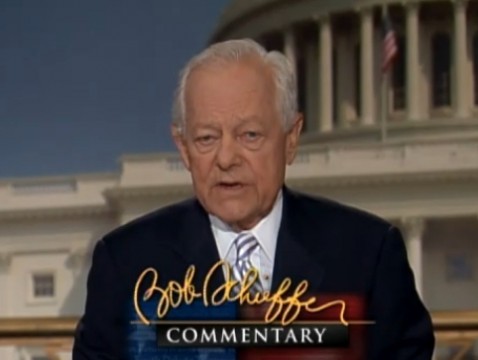
Bob Schieffer on Sunday blamed the internet for the growing number of Americans that think Barack Obama is a Muslim. Namelessly referring to last week’s Pew Research Center poll finding that eighteen percent now believe this, the “Face the Nation” host concluded Sunday’s program saying that “in the internet age, ignorance travels as rapidly as great ideas.” He continued, “Now, not only great minds can find one another and compare notes, so too can the nuts and the perverts and those who are simply looking to validate their prejudices.” And continued, “So despite a mountain of evidence to the contrary, a new poll tells us a growing number of Americans, most of them on the right, believe Barack Obama is a Muslim. No doubt, due in part to the fact that stories to that effect have gone viral on the internet” (video follows with transcript and commentary):  BOB SCHIEFFER, HOST: Finally, today on another subject. The greatest advances in the store of human knowledge have always taken place when great minds found themselves in the same place at the same time, as when the Greeks gathered on the hillsides of Athens, when the political geniuses who founded this country came together. The great promise of the internet was that for the first time great minds no longer had to be in close proximity. But what we have also learned now is that in the internet age, ignorance travels as rapidly as great ideas. Now, not only great minds can find one another and compare notes, so too can the nuts and the perverts and those who are simply looking to validate their prejudices. So despite a mountain of evidence to the contrary, a new poll tells us a growing number of Americans, most of them on the right, believe Barack Obama is a Muslim. No doubt, due in part to the fact that stories to that effect have gone viral on the internet.   Disagreeing with our leaders is our right. And in truth, part of the fun of being an American. But to suggest the President is a Muslim is absurd. No matter how fervently some who dislike him may wish it so.   The purpose here, though, is not to argue politics but just to underscore how this illustrates the downside of the internet, the only news delivery system we’ve ever had that has no editor. We must always remember that that what we read there may not always be true. Indeed. Ironically, we must also remember that what we see on television may not always be true either. After all, when Schieffer said “a new poll tells us a growing number of Americans, most of them on the right , believe Barack Obama is a Muslim,” this was a nice little sleight of hand to disguise the truth. Here’s what the Pew poll really said : The view that Obama is a Muslim is more widespread among his political opponents than among his backers. Roughly a third of conservative Republicans (34%) say Obama is a Muslim, as do 30% of those who disapprove of Obama’s job performance. But even among many of his supporters and allies, less than half now say Obama is a Christian. Among Democrats, for instance, 46% say Obama is a Christian, down from 55% in March 2009. The belief that Obama is a Muslim has increased most sharply among Republicans (up 14 points since 2009), especially conservative Republicans (up 16 points). But the number of independents who say Obama is a Muslim has also increased significantly (up eight points). There has been little change in the number of Democrats who say Obama is a Muslim, but fewer Democrats today say he is a Christian (down nine points since 2009). As such, what Schieffer said about “most of them on the right” may have been accurate, but it certainly didn’t properly relay the poll’s findings. Maybe more importantly, the Pew survey didn’t ask participants where they get their news from. This means that Schieffer’s accusation that the opinions expressed by respondents he disagrees with must certainly come from the internet is only a speculation without any basis in fact. It appears despite his suggestion to the contrary, ignorance travels pretty quickly on television as well.  

More:
Bob Schieffer Blames Internet For Americans Believing Obama Is Muslim

NYT’s Charles Blow: Obama Is Not Good For Jews

“Is President Obama good for the Jews?” asked New York Times columnist Charles Blow Saturday. His answer was quite surprising: “For more and more Jewish-Americans, the answer is no.”  In his piece marvelously titled “Oy Vey, Obama,” Blow referred to Thursday’s Pew Research Center report finding “33% of Jewish voters identify with or lean toward the Republican Party, up from 20% in 2008.” From there, Blow went where a liberal columnist for the New York Times typically dares not: This is no doubt a reaction, at least in part, to the Obama administration having taken a hard rhetorical stance with Israel, while taking “special time and care on our relationship with the Muslim world,” as Robert Gibbs, the White House press secretary, put it in June. If that sounds like courtship, it is. Some of the president’s most ardent critics and some of Israel’s staunchest American defenders – two groups that are by no means mutually exclusive – have seized on what they see as the administration’s unfair and unbalanced treatment of Israel and have taken their denunciations to the extremes. After addressing some recent events – the Administration’s denunciation of Israeli settlements last September, the White House urging Israel to sign the Nuclear Nonproliferation Treaty in April, and May’s Gaza flotilla incident – Blow shared with his readers some more data on this issue: Fair or not, these criticisms are crystallizing into a shared belief among many: Obama is burning bridges with the Jewish community in order to build bridges to the Muslim world. There is very little independent polling, aside from Pew’s party identification polling, to help us understand how American Jews see the president, his stance toward Israel and the political implications. So in that vacuum, pollsters with partisan leanings have been spinning their findings like dreidels. In April, the Republican polling firm McLaughlin & Associates released a survey that they said showed that only 42 percent of American Jews would vote to re-elect President Obama. He captured 78 percent of the Jewish vote in 2008. Recently, the democratic pollster Stanley Greenberg and the Israel Project, a nonprofit in Washington, conducted a poll that they said found American support of Israel was dropping like a rock. Wherever the truth lies, it is fair to say that it doesn’t bode well for Obama. Indeed it doesn’t, although it’s quite shocking to read such a conclusion in a column by one of the Times’ most liberal contributors.

Go here to read the rest:
NYT’s Charles Blow: Obama Is Not Good For Jews

New Study Shakes Up Scientists’ View of California’s San Andreas Earthquake Risk

Study shakes up scientists' view of San Andreas earthquake risk Researchers find major quakes on the southern section, on average, every 88 years — three times as often as previously thought. It's the strongest evidence yet that we're overdue for a massive quake. San Andreas fault study Photo: Sarah Robinson, 23, a graduate student at Arizona State University, runs along a trench at the Bidart Fan sector of the San Andreas fault in June 2009. She is on a team of geologists trying to construct a history of earthquakes on the San Andreas fault by reading lines of sediment in the earth. (Ricardo DeAratanha / Los Angeles Times / June 1, 2009) ___ By Rong-Gong Lin II, Los Angeles Times August 21, 2010 Southern California is long overdue for a major earthquake along the San Andreas fault, according to a landmark study of historic seismic activity released Friday. The study, produced after several years of field studies in the Carrizo Plain area about 100 miles northwest of Los Angeles, found that earthquakes along the San Andreas fault have occurred far more often than previously believed. For years, scientists have said major earthquakes occurred every 250 to 450 years along this part of the San Andreas. The new study found big temblors on the fault every 88 years, on average. The last massive earthquake on that part of the fault was in 1857, leading scientists to warn that another such temblor is likely in Southern California. “The next earthquake could be sooner than later,” said Lisa Grant Ludwig, a UC Irvine earthquake expert and co-author of the study, which was published online in the journal Geology. “It was thought that we weren't at risk of having another large one any time soon. Well, now, it might be ready to rupture.” Other seismic experts described the revelation as a major change in the way they think about earthquake risks along the southern San Andreas fault. Thomas Jordan, director of the Southern California Earthquake Center, said the fault is “locked and loaded. It's been a long time since an earthquake has occurred on that fault — over 150 years.” To reach the new conclusion, scientists dug trenches deep into the Carrizo Plain. They used carbon dating and sophisticated imaging technology known as lidar to find signs of earth movements. They were able to detect earthquakes dating back to the 15th century, creating a far more complete record than had previously been known. The research found that earlier examinations of the San Andreas had badly undercounted the number of major earthquakes. Those were based on observations made in the 1970s when scientists used measuring tape to look for evidence of past earthquakes. “Now we have better techniques,” Grant Ludwig said. “We can see there's actually more earthquakes.” Scientists now estimate that earthquakes occurred on that section of the fault in 1417, 1462, 1565, 1614 and 1713. The finding adds weight to the view of many seismologists that the San Andreas has been in a quiet period and that a major rupture is possible. A 2009 study, which Grant Ludwig also participated in, suggested that the San Andreas was overdue for a rupture. But Friday's report offers a much more grim estimate of how frequently quakes have occurred on that segment of the fault. The San Andreas fault is considered one of the most dangerous in Southern California, partly because it is so long that its southern section is capable of producing a temblor as large as magnitude 8.1. By contrast, earthquake experts consider 1994's destructive 6.7-magnitude Northridge quake, which occurred on a different fault, to be a medium-sized quake. The San Andreas is a sleeping giant. It's hard to imagine the power of a huge quake on the southern section because the last one occurred more than a century ago when the area was sparsely populated. Just 4,000 people lived in Los Angeles at the time. The 1857 temblor, with an estimated magnitude of 7.9, is known as the Fort Tejon quake, but that's a bit of a misnomer because it is thought to have started farther north, way up in Parkfield in Monterey County. The quake then barreled south on the San Andreas for about 200 miles, through Fort Tejon near the northern edge of what is now Los Angeles County, then east toward the Cajon Pass in San Bernardino County, near what is now the 15 Freeway. The quake was so powerful that the soil liquefied, causing trees as far away as Stockton to sink. Trees were also uprooted west of Fort Tejon. The shaking lasted 1 to 3 minutes. The study was conducted by scientists at UC Irvine and Arizona State University. As preliminary data went out for peer review, other earthquake scientists immediately took note. The U.S. Geological Survey was so concerned that it dispatched its own team of investigators to the Carrizo Plain to look over the initial findings and review the evidence in the trenches. “These investigators really were challenged by their scientific peers,” said Ken Hudnut, a geophysicist at the U.S. Geological Survey. “And they made it through. They ran the gantlet and came through with a really solid paper.” Hudnut said the “Big One” wouldn't compare to most quakes Californians have endured. Such a large quake on the San Andreas, generally above a magnitude 7, would send enormous V-shape energy waves spreading out from the fault. If the earthquake energy hit the Los Angeles Basin, the soft sediment underneath it could actually amplify the waves, making the shaking worse. Hudnut said the study offers both “bad news and good news,” noting that it also concluded future earthquakes along that section of the San Andreas could be smaller than the 1857 quake. “It's not the kind of news that ought to make people crawl into the fetal position. Rather, it's the kind of information that ought to once remind people about basic earthquake preparedness,” Hudnut said. Grant Ludwig said her research should motivate people to prepare. “If you're waiting for someone to tell you when we're close to the next San Andreas earthquake, just look at the data,” she said. “If we look at the only data we have, it's not very comforting. I'm preparing for that possibility.” added by: EthicalVegan

Is CNN Perpetuating the ‘Obama is Muslim’ Meme? Chyron: ‘W.H.: Pres. Obama Isn’t Muslim’

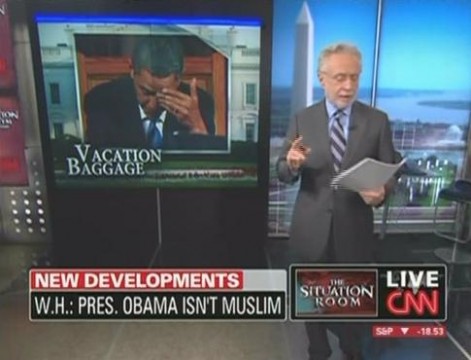
Every time the question about President Barack Obama’s faith is brought up, the wizards of smart in the mainstream media get up in arms about “right-wingers” or “tea partiers” perpetuating those allegations. But is it possible that by devoting so much attention to these issues of Obama’s faith and his citizenship, the media are creating the very feeding frenzy they’re appalled by? On CNN’s Aug. 19 “The Situation Room,” host Wolf Blitzer led his program off with at what first glance is a startling chyron: “W.H.: Pres. Obama Isn’t Muslim”. That graphic was in response to a recent Pew Research Center poll that found 18 percent of respondents thought Obama was Muslim. Later in the program, Blitzer went to his panel – CNN political analyst James Carville and Washington Times columnist and Heritage Foundation fellow Tony Blankley. Initially Carville said he didn’t have a clear explanation. Video with partial transcript and commentary below fold “I don’t other than the fact people are just willing to believe anything or there are a lot of stupid people out there,” Carville said. “I really don’t have an explanation, just like I don’t have an explanation for the fact that you see some of these polls that a quarter of the people believe he was born outside the country. I’m just as flummoxed as the next person.” Blankley cited an instance in 19 th Century England, which people questioned the faith of British Prime Minster Benjamin Disraeli. “I would compare it to what happened to Benjamin Disraeli, the British Prime Minister in the mid-19 th Century,” Blankley said. “He was suspected of being a Jew all through his career. His dad had been Jewish, but he baptized young Benjamin in the Church of England and he remained a practicing Christian with Jewish ancestry. I think it’s a similar situation with Obama.” And according Blankley, although he didn’t condone that belief, he suggested the same sort of circumstances were in play with the 44 th President of the United States. “His father was obviously Muslim and so that suspicious is there,” Blankley continued. “And then I think — what’s interesting is the numbers have gotten worse for him since he’s been President and I think some of his decisions, the outreach to Islam, good as it may be, wise as it may be, encourages some. His getting into a fight with the Israeli prime minister and his lack of attending church conspicuously, although Reagan, the President I worked for, didn’t go to church much because he said it would interrupt the congregation. So, there are good reasons for it, but the public is going to think what it’s going to think and he’s not made it easier.” Carville wasn’t buying it. Instead he just chalked the public up as “stupid” and willing to believe anything. He conflated the argument with questions about the President’s birth certificate. “I guess I would dispute, Tony — I don’t think the public thinks,” Carville said. “How can they think he wasn’t born in the United States, I mean with two birth announcements in both Honolulu papers. Again, I don’t have an explanation, and the quality of information to people today is exponentially higher than it was in 19 th century England. But again you’ve got to assume some people are just willing to believe anything and some people are out and out stupid. I wish I had a better explanation for it.” Despite the explanations (or lack of) from esteemed panelists, it’s possible the media themselves are to blame. By consistently using questions about Obama’s faith and his citizenship as fodder to demean conservatives, specifically the Tea Party movement and thereby creating a general mistrust by saying vile things, have the mainstream media perpetuated the very allegations they are abhorred by?

See the article here:
Is CNN Perpetuating the ‘Obama is Muslim’ Meme? Chyron: ‘W.H.: Pres. Obama Isn’t Muslim’

WaPo Laments False Rumor Obama’s a Muslim: He’s Been a ‘Diligent and Personally Committed’ Christian?

Thursday’s Washington Post reports that a new poll by the Pew Research Center found “The number of Americans who believe – wrongly – that President Obama is a Muslim has increased significantly since his inauguration and now account for nearly 20 percent of the nation’s population.” Team Obama quickly blamed “’misinformation campaigns’ by the president’s opponents.” The Post’s Jon Cohen and Michael D. Shear just pass that along without any specifics. But what’s really shaky is the story’s accuser, Obama “faith adviser” Joshua DuBois, trying to tout how the president is deeply, “diligently” Christian, when the president is much more diligent at golfing than he is at church attendance. The number of Sunday church services Obama has attended since the Inauguration doesn’t get beyond counting on one hand, even bypassing the pews at Christmas. Numerous liberal outlets have giddily promoted that Obama is a Christian because he receives little religious and inspirational quotes on his BlackBerry from his adviser DuBois. (Matt Lauer: “It’s spirituality meets high-tech! That’s pretty good!” ) They also routinely careen around the idea that if Obama is a Christian, he came to Jesus by being for two decades a Jeremiah Wright we-deserved-9/11 Christian . Cohen and Shear naturally avoided that: The president’s religion, like his place of birth, has been the subject of Internet-spread rumors and falsehoods since before he began his presidential campaign, and the poll indicates that those rumors have gained currency since Obama took office. The number of people who now correctly identify Obama as a Christian has dropped to 34 percent, down from nearly half when he took office. White House officials expressed dismay over the poll results. Faith adviser Joshua DuBois blamed “misinformation campaigns” by the president’s opponents. “While the president has been diligent and personally committed to his own Christian faith , there’s certainly folks who are intent on spreading falsehoods about the president and his values and beliefs,” DuBois said. DuBois said the president’s Christian faith plays an “important part” in his daily life. And he pointed to six speeches on faith that the president has given in which he talked about his beliefs. But Dubois said coverage of Obama’s Christianity has been scant compared with news about the economic crisis, legislative battles and other issues. In other words, DuBois is claiming that Obama’s given more speeches on faith than he’s attended a church service to hear a minister’s speech on faith.  Blaming the media for “scant coverage” of Obama’s allegedly devout Christianity is the lamest line DuBois offered. Matt Lauer and other journalists (like Obama’s Five Guys burger partner Brian Williams) would have been more than willing to offer supportive time for Obama to discuss his religion. These Post reporters should have pressed DuBois about Obama’s obvious and public lack of interest in the subject — suggesting that perhaps the idea that Obama’s fervently, diligently Christian is more rumor than fact — and whether that noticeable apathy is a bone to his secular-progressive political base.

Read the rest here:
WaPo Laments False Rumor Obama’s a Muslim: He’s Been a ‘Diligent and Personally Committed’ Christian?