Tag Archives: review

Madonna Halftime Show: The Reviews Are In!

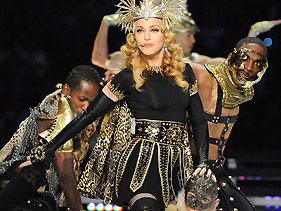
Super Bowl performance reinstates Madge as ‘the biggest pop vixen on the planet.’ By Jocelyn Vena Madonna performs at Super Bowl XLVI Photo: Jeff Kravitz/ FilmMagic Madonna did it all on Sunday night when she performed during the Super Bowl halftime show in Indianapolis. She was an Egyptian Queen “Vogue”-ing it up for her biggest devotees. She was a cheerleader, cheering on L-U-V alongside a middle-finger flinging M.I.A. and Nicki Minaj for “Give Me All Your Luvin’.” She got her “Music” on with LMFAO and she sang the gospel of “Like a Prayer” with Cee Lo Green. In a sea of costume changes (with looks by Givenchy and Adidas Originals Jeremy Scott), dancers, acrobats, A-list collaborators and a killer set list, Madonna seemed to leave very little to chance. Sure, there were a few slip-ups , but, in the end, Madonna ensured that all anyone would be talking about around the water cooler come Monday morning was her, whether or not you completely loved what she did during the show. “It’s Madonna Louise Ciccone’s world, we’re just living in it,” Billboard.com wrote about her 12-minute-plus performance. “The pop icon took to the world’s biggest stage to rock three-and-a-half older tracks and a playful new song during the Super Bowl halftime show.” While the Super Bowl audience is usually dominated by people who most likely aren’t Madge fans, the singer, according to one review, seemed indifferent to that fact. “Madonna was defiantly unconcerned with the more conservative red state wing of the football fanbase who’d never be caught dead singing along to one of her songs,” the Los Angeles Times noted about her performance. “And her halftime show was pure spectacle by the Cleopatra of the game.” The show, according to the Chicago Tribune , wasn’t just about her, but also about reminding fans that she’s about to drop her next album, MDNA, in March. “This was Madonna’s party, and besides breaking off bits of her greatest hits to remind people of a time when she was the biggest pop vixen on the planet, she had important career-advancing work to do,” the review noted. “Madonna, after all, never does anything unless she’s got something to sell, and with a new studio album due out in March and a tour to follow, she had plenty on her to-do list.” Leave your review of Madonna’s halftime performance in the comments below! Related Photos Super Bowl XLVI Performances: Madonna And Kelly Clarkson Katy Perry’s Super Bowl Appearance Related Artists Madonna
Here is the original post:
Madonna Halftime Show: The Reviews Are In!

REVIEW: Found-Footage Sci-Fi Tale Chronicle Is Uneven But Earnest, and Often Exhilarating

The allegory-rich Chronicle opens with a kind of generational statement: “I bought a camera,” senior class punching bag Andrew (Dane DeHaan) says, “and I’m filming everything from here on out.” Andrew is talking to his father (Michael Kelly), a drunkard ex-fireman who punishes his son for the stress of caring for his dying wife, though the announcement is meant for us as well. Chronicle fits into the growing genre of “found footage” films, though that becomes just one formal element of many director Josh Trank meshes together to put a new spin on the subject of teenage alienation and its more extreme social side effects. People don’t respond well to Andrew’s decision to begin filming everything he does, though that may be because nobody responds well to anything Andrew does. Throughout the first part of Chronicle everyone he meets wants to know why he’s filming or tells him to stop; his popular, aspiring intellectual cousin Matt (Alex Russell) is particularly camera shy. In a gesture of great social generosity, Matt brings Andrew and his massive camcorder to a barn party for some fun one Friday night. Together with the ridiculously congenial class president hopeful Steve (Michael B. Jordan), Andrew and Matt explore what appears to be a sinkhole in a ravine outside the barn. What they find inside is a glowing chamber of vascular crystals. They emerge with spontaneously bloodied noses and telekinetic powers. So, you know, another Friday night in Seattle. The trio take the event more or less in stride, so that what ensues is basically a montage of their various attempts to create the best YouTube video ever. The boys treat their superpowers like one more of puberty’s bodily twists, and trade tips on how to manage it. They begin by moving other objects around and creating force fields to shield their bodies from pain. The more they develop the power, like a muscle, the stronger it becomes. Soon they begin moving themselves around, and then up into the sky. What could go wrong? Trank keeps the fraternal tone so light it’s sometimes just shy of forced — the script, by Max Landis (the son of John Landis), is a little heavy on the “Dude, no way!” dialogue. But the first half of Chronicle establishes an affable and believable bond between the three characters — something one of them badly needs. They talk about girls and plan to see the world — Andrew wants to make a spiritual mission to Tibet. And yet it’s Andrew who begins pulling away from the pack. The kid’s got a lot of unfocused rage, and it starts slipping out in small acts of aggression. The group’s golden rule — basically don’t hurt anybody — doesn’t preclude letting Andrew earn a little social cred at the school talent show, so he puts on a “magic” act that makes him an instant hero. But a sexual humiliation soon follows, and it proves to be a point of no return. Only his friends are powerful enough to stop him, which means they quickly become his enemies. Andrew starts out with the desire to create a true record of the abuse he is suffering, presumably one that will be witnessed. And yet the fact that Andrew’s persecutors are presented from his vantage, literally and otherwise, reinforces the sense that if the camera doesn’t lie, perspective still tends to exaggerate. This uneven but earnest, often exhilarating film derives its greatest interest from the way it turns the found-footage format inside out: At some point Andrew learns to control the camera’s movement with his mind, so instead of seeing what he sees, we’re watching a self-directed version of his life. When that movie becomes a kind of disaster pic it would seem that the further we move from Andrew’s literal perspective, the deeper we get into his psyche and the hellmouth of teenage rage. By the time he’s putting the entire metro area on notice — having thrashed his father and all the local bullies — Andrew has no camera and the metaphor has run away with the story entirely. The crazy thing is it almost works. The finale, which goes off like an unmanned fire hose, rests on the assumption that everything is in fact being filmed from here on out — a subtext of the found-footage conceit. The question of who has found and edited this thing together is treated as understood, an apt reflection of the genre’s popularity. Doesn’t some part of every self-documenter assume a future curator will rescue him from oblivion? That someday his story will be told? The coda suggests the evidence will exonerate Tibet-loving Andrew for that time he had his revenge on Seattle; the truth is he was just misunderstood. Follow Michelle Orange on Twitter . Follow Movieline on Twitter .

See the original post:
REVIEW: Found-Footage Sci-Fi Tale Chronicle Is Uneven But Earnest, and Often Exhilarating

REVIEW: Ben Wheatley’s Kill List Works Hard to Be a Cult Film — Which Is Why It Can Never Be One

Everyone wants to be the one to discover the next low-budget and/or indie supernatural shocker, the stylish, wicked little thing that scares the bejesus out of you and sends you running to your friends, saying, “You’ve gotta see this!” UK filmmaker Ben Wheatley’s Kill List isn’t that wicked little thing — not by a long shot. Yet it’s a frustrating case. Wheatley drops enough unnerving bread crumbs in the first two-thirds to leave you wondering where the hell he’s headed, and even the big finale should be satisfying enough: It just belongs to a different movie, and it’s unsettling in a way that doesn’t feel earned. That Kill List begins, seemingly, as a standard domestic drama is just one of Wheatley’s intentional red herrings. (He co-wrote the script with Amy Jump.) In the movie’s opening scene Jay (Neil Maskell) is bickering with his wife, Shel (MyAnna Buring), in the presence of their somewhat daft-looking young son, Sam (Harry Simpson). It turns out Jay, an altogether regular-looking and somewhat doughy husband type, hasn’t worked for months: He’s a hit man and the hits just haven’t been coming, since he botched his last job. Then buddy and former associate Gal (Michael Smiley) shows up at the couple’s home for a dinner party, a leggy stretch of girlfriend in tow: He wants to loop Jay into a gig he’s been offered, which requires offing a number of targets. Meanwhile, the sultry, doe-eyed girlfriend, Fiona (Emma Fryer), who looks pretty friendly and normal-like (she explains to her hosts that she works in “human resources”), slips into the couple’s bathroom, removes a mirror from the wall, and does something funny to the back of it. It’s the first of the movie’s numerous “What the — ?” moments, some of which involve episodes of grim brutality that are at first discreetly presented, and then less so. That’s part of Wheatley’s MO: When the violence first kicks off, he cuts away, lulling you into thinking he’s not going to be exploitive. Surprise! Get ready for – and there’s a minor spoiler ahead, though it has nothing to do with the movie’s allegedly supershocking finale – seeing a bunch of brains blown all over a table, like the contents of the world’s ewkiest piñata. Later, we’re treated to a partial view of a rabbit skinning – yum! Should we commend Wheatley – who previously made the 2009 crime comedy Down Terrace – for putting us off guard only to pull the rug out from us? Or is he really just being a sneaky cheat? The more I think about Kill List, the cheaper its shockeroo tactics seem, despite the fact that through its first two-thirds, the picture is compelling almost in spite of itself. Kill List features lots of unapologetic art-house cutting: Scenes are edited into jagged shards, the better to dislocate us with. And in places, it’s bitterly funny. When Jay and Gal approach the first mark on their list – I won’t tell you who it is, but it’s the type of person neither you nor I would be particularly happy about killing – Gal says dryly, “Well, at least it’s not a toddler.” But the plot of Kill List depends too much on Jay’s descent-into-madness routine, and it doesn’t quite wash. This is definitely a guy with a habit of flying off the handle: He threatens physical harm to a bunch of meek, happy Christians who break into a spirited rendition of “Onward Christian Soldiers” in a restaurant. (OK, maybe that’s not so bad.) The idea is that this seemingly devoted family man has, you know, a dark side. This is a guy who’s so used to killing without reason that he no longer needs a reason: Kill List has been carefully and disingenuously front-loaded with post-Iraq meaning. And that’s before it takes a sharp left turn into Wicker Man -style folderol. Kill List is meticulously designed to be a cult film, which means it can never truly be one: It grabs its audience by the collar instead of beckoning seductively and carelessly. The conclusion of Kill List would be more unsettling if the subtle gradation of clues leading up to it didn’t raise so many unanswered questions, just for the hell of it. A mysteriously infected hand, instances of people thanking other people for things they haven’t even done yet – those could have been superb little macabre touches, if only they’d been woven more tightly into the narrative and not just left dangling like shabby hangnails. By the time Kill List jumps off the deep end into occulty weirdness, it’s almost too late for shock value. The ending is designed to make us recoil in horror. But you might be left wondering why you’d bothered with any of it in the first place. Follow Stephanie Zacharek on Twitter . Follow Movieline on Twitter .

Read more:
REVIEW: Ben Wheatley’s Kill List Works Hard to Be a Cult Film — Which Is Why It Can Never Be One

Why Does Mitt Romney Drive Us Nuts?

http://www.youtube.com/v/aPgSgycAuqE

See the rest here:

This is why. Naturally, this is being considered a gaffe. Romney has been raked over the coals all day for it, even by people who have been supportive of his campaign. National Review’s Jonah Goldberg… I get the point he’s making. It’s a point that Bill Clinton won the presidency with — but with language Broadcasting platform : YouTube Source : The Hayride Discovery Date : 01/02/2012 14:39 Number of articles : 2

Why Does Mitt Romney Drive Us Nuts?

REVIEW: The Innkeepers Seeks to Reinvent the Ghost Story by Sheer Force of Ambition

The heroes and heroines of old-fashioned ghost-story flicks resemble the average horror fan more closely than any other of the genre’s archetypes. Amateur ghostbusters like The Innkeepers ’s Claire (Sara Paxton), for instance, troll spooky hallways and scour dank basements for thrills, which is to say without the real threat of physical harm. We go to movies like The Innkeepers , Ti West’s follow-up to his delightful old-school creep-out The House of the Devil , to explore and experience fear from a similarly safe remove. Like the average horror fan, Claire can be her own worst enemy; on both sides of the screen, much depends on the question of whether one can be scared to death. Along with her laconic co-clerk Luke (Pat Healy), winsome, asthmatic Claire is the only staff on site at the Yankee Pedlar Inn during its closing weekend. A grand old establishment with a rumor-laden pedigree, the inn has only a few last guests to deal with, including a harried mother and son (Alison Bartlett and Jake Ryan) and a fading television actress named Leanne Rease-Jones (Kelly McGillis). The fact that a couple of low-ranking attendants have been left to close up the joint adds to the cavernous building’s feeling of abandonment. Like all haunted houses, the emptiness of this one poses a mournful and ominous question: Where did all the people go? Luke and Claire have an idea of where at least one wound up. The legend of a bride who committed suicide on her wedding day and was left to rot in the inn’s basement fuels their idle, overtime chatter. Luke is working on a crude, paranormal activity-type web site and claims to have seen the undead bride once; Claire, bored and curious, marshals his electronic voice phenomena kit and pokes around for sound vibrations. The first two “chapters” pass congenially, as characters come and go and we’re played for a couple of cheap scares. Unlike Devil , which builds slowly to an almost excruciating peak of tension, The Innkeepers is dotted with dead-end sequences — a YouTube prank, a bat in the attic — that break up a sometimes sluggish pace but also promote a certain aimlessness in the narrative. More so than in West’s previous film, which worked on its own steam right up until the end, The Innkeepers feels like a devoted horror fan’s attempt to reinvent a classic genre by sheer force of quality. Without a strong story to dance with, all of those fabulous tracking shots, lovingly uncanny art direction details and flickering shafts of light can make The Innkeepers feel more like an exercise in craft than a scary movie. Still, there is pleasure in Paxton’s slightly daffy, tomboyish take on the final girl and in McGillis’s welcome, perfectly anomalous presence. Leanne turns out to be something of a ghost whisperer, and it’s fun watching McGillis sell some pretty fruity lines between pulls on her cigarette. Luke is an intermittent and oddly diffident player in what becomes Claire’s adventure, although they share a pivotal and terrifically frightening séance scene toward the end. He warns Claire that chasing spirits has serious side effects — you’ll start seeing things everywhere you go, he says, you’ll warp your radar for what’s real and what’s not. It sounds like a statement of ambition for the best kind of ghost story, which is ultimately what The Innkeepers turns out to be. Follow Michelle Orange on Twitter . Follow Movieline on Twitter .

Follow this link:
REVIEW: The Innkeepers Seeks to Reinvent the Ghost Story by Sheer Force of Ambition

Travis Barker Gives Twin Berlin An ‘Incredible’ Opportunity

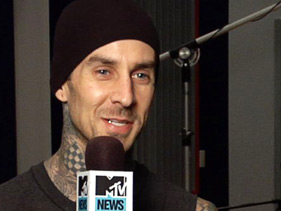
Blink-182 drummer helped ‘Your Next Record’ contest winners put together their brand-new EP, There Goes My Virtue. By Matt Elias Travis Barker Photo: MTV News Blink-182 ‘s Travis Barker is giving a boost to Boston rock trio Twin Berlin’s EP release Wednesday (February 1). The veteran drummer handpicked the unsigned band out of a sea of submissions for Guitar Center’s “Your Next Record” contest. As part of the grand prize, Twin Berlin got to record a three-song EP produced by Barker himself, resulting in There Goes My Virtue . MTV News caught up with Barker and the band back in November, when they were tinkering away at Red Bull Studios in Los Angeles. Although he’s a percussionist at heart, Barker said he wasn’t just looking for the next great drummer. “There were some bands in the Guitar Center contest that were amazing drummers, but it was more a song thing for [Twin Berlin] — a great song,” Barker said. “They seem hungry, and they all have great personalities and attitudes about the whole thing. I just wanted to help emphasize what they were already doing and clean things up, maybe suggest arrangement ideas, just little things that will make a difference.” For Twin Berlin, the contest was a natural fit. “[Bassist] Sean is a huge Blink fan and everything, and we all really like Travis a lot,” drummer James Janocha said. “So we just figured, ‘Hey, why not enter?’ ” Barker recalled, “When they gave me all the bands’ songs, I didn’t know what the bands’ names were, I didn’t know what the guys looked like, I didn’t know how many people were in the group — it was purely based on one song, and that one song just won me over. I listened to the CD probably every day for three weeks, and that song just resonated with me.” The song Barker refers to, “Can’t Take, Take, Take,” ended up as the first track on the new EP, rounded out by “Don’t Hang Around” and “Give Up on Me.” While the trifecta of songs represents Twin Berlin’s gritty, unapologetic style of rock and roll, the recording process was far from their familiar DIY surroundings. “To get the chance to be able to work in a studio like this, it’s incredible,” guitarist/vocalist Matt Lopez said. “We used to record in this guy’s shed, so this is pretty insane.” Share your review of Twin Berlin’s new EP in the comments below!

Read the original:
Travis Barker Gives Twin Berlin An ‘Incredible’ Opportunity

Selena Gomez, Justin Bieber Share A Dating ‘Philosophy’

‘If you’re in love, you’re in love to the fullest,’ singer/actress tells Cosmopolitan. By Jocelyn Vena Photo: Cosmopolitan Selena Gomez turns the big 2-0 later this year, and she seems to be leaving her tween image behind. The 19-year-old is the latest teen star to appear on the cover of Cosmopolitan, following last month’s issue of the women’s magazine, featuring 17-year-old Dakota Fanning. For her first cover for the magazine, Gomez dons a low-cut, floral-print dress as she looks rather seductively into the camera. She’s sitting with her one leg perched in front of her body, displaying a saucier side of herself than fans might be used to seeing. Inside the issue, she’s talking all about love, opening up about her longtime boyfriend, Justin Bieber. “I’m just like every 19-year-old girl,” she said. “If you’re in love, you’re in love to the fullest, and you just want to go to the movies, hang out, and be as normal as possible. I’m fortunate that I’ve found someone who has that philosophy.” In another Cosmo quote floating around online, Gomez dishes on a past boyfriend (Taylor Lautner? Nick Jonas?) who didn’t make things as easy on her. “I was in a relationship previously where I had to hide everything and it wasn’t my choice. I had to go through different exits and take separate cars and do the craziest things, and it just really wasn’t worth it,” she explained. “It was like a year of my life completely wasted.” The more mature magazine cover comes as Gomez prepares for the next phase of her career . In the coming weeks, she’ll hit the set for her next film, the more adult-themed “Spring Breakers,” which follows a group of college girls who rob a restaurant to pay for their spring break. When they land in jail, a drug and arms dealer bails them out, and they quickly become entangled with him and his business. “It’s a different character than I have ever played before,” she told MTV News about the film, which will be directed by “Kids” mastermind Harmony Korine. “It’s a different kind of vibe I think than people are used to seeing me in. What you’re going to see is more raw, I think. It’s going to be raw and more about acting.” What do you think about Selena’s grown-up image? Let us know in the comments! Related Videos Selena Gomez: 2011 In Review Related Photos The Evolution Of Selena Gomez Related Artists Justin Bieber Selena Gomez

Read more from the original source:
Selena Gomez, Justin Bieber Share A Dating ‘Philosophy’

REVIEW: Mind-Blowingly Charmless Katherine Heigl Will Rob You Blind in One for the Money

One for the Money feels like the forgotten pilot for a TV show that wasn’t picked up for series. Watch as Stephanie Plum ( Katherine Heigl ), Trenton divorcee-turned-bounty hunter, hunts down bail skippers in her high heels while trying to choose between troubled cop Joe Morelli (Jason O’Mara) and badass fellow bond agent Ranger (Daniel Sunjata) — Tuesdays on USA! Plum is the creation of author Janet Evanovich and the basis of a bestselling 18 novel franchise, and if you squint at this big screen adaptation (directed by Julie Anne Robinson, of  The Last Song and episodes of Weeds , Grey’s Anatomy,   2 Broke Girls and others) you can make out some of the character’s potential appeal — she’s an everywoman who discovers an unexpected talent for a tough gig, an outspoken Jersey girl who refuses to let the fact that she’s out of her comfort zone stop her from getting the job done, etc, etc. But as played by Heigl, Stephanie is mind-blowingly charmless, the latest variation of the on-screen persona the actress has mysteriously embraced — the prissy, once-wronged gal prone to bouts of inconveniently timed clumsiness and acrimonious banter with her eventual love interest. I don’t dislike Heigl on principle, but it’s all too easy to call out everything that’s gone wrong with the romantic comedy in recent years by way of her filmography. Her characters apparently need to be subjected to a journey of humiliating comeuppance in order to win over/come around to their unlikely loves — the rom-com as punishment fantasy. Here her hostile Romeo, Morelli (no one refers to him by his first name), is the roguish town heartbreaker who’s on the lam after having been charged with murdering Ziggy Kuleska, a local tough involved in some major criminal activity. For Stephanie, Morelli’s more serious offense is not calling her back after relieving her of her virginity in the back of a bakery when they were in high school, for which she still bears a grudge. ( One for the Money ‘s tendencies to see things like murder only as vexing complications in its protagonist’s personal life speaks both to its tonal confusion and to how minor the case around which it’s theoretically structured actually is to the film as a whole.) Stephanie will net $50,000 if she can bring the man in, though the first time she finds him she realizes she doesn’t actually have a way to do that unless he agrees to come with — and he insists he’s innocent. Heigl and O’Mara snipe at each other with the sizzling chemistry of two people who can’t wait to whip out their BlackBerries and check their email as soon as a take is over. The pair’s rictus pantomime of sexual tension is countered by Stephanie’s relationship with the hyper-competent and permanently Kevlar-clad Ranger, whom she describes as “Michelangelo’s David dipped in caramel,” and who serves as an alternate aloof romantic possibility as well as a tutor in the ways of bounty hunting. He’s more superhero and plot device than person, but he’s at least not burdened with the New Jersey accent Heigl and O’Mara gamely, unsuccessfully attempt. Stephanie is supposed to be earthy and sassy, not qualities Heigl is able to summon, but she’s also problematically written as somewhere between active if imperfect heroine and Bella Swan-style object in need of rescuing. She’s terrible at what she does, even for a beginner — a running gag about her having to rummage through her purse for her gun at urgent moments is enough to make you want to bang your forehead on the theater seat in front of you. She gets one person killed and another badly beaten, and she frequently places herself in danger, requiring the intervention of Morelli or Ranger. The tension between the allure of being saved and protected versus the desire to do things oneself is by far the most intriguing part of  One for the Money , because the film (which was written by Stacy Sherman, Karen Ray and Liz Brixius) has no idea how to balance the two and ends up instead making Stephanie seem like an indulged annoyance. One for the Money ‘s TV pilot air is furthered by the flat look of the film, and by characters who are introduced largely to have no other purpose, there to be given storylines in some (saints forbid) later installment. Annie Parisse is Mary Lou, the best friend Stephanie always calls for advice; Debbie Reynolds plays Stephanie’s loopy grandmother who shoots the roast the rest of the family is eating while fooling around with her granddaughters newly acquired pistol, because accidental domestic gun violence is always good for a laugh. Patrick Fischler is Vinnie, Stephanie’s sleazy cousin/boss, and Sherri Shepherd plays Lula, a brassy hooker who offers our aspiring bond agent information. John Leguizamo, Fisher Stevens and Leonardo Nam show up too. Hopefully the masses won’t, because there are 17 more of these books just waiting to be dragged, kicking and screaming and rummaging in their purses for their weapons, onto the big screen. Follow Alison Willmore on Twitter . Follow Movieline on Twitter .

More here:
REVIEW: Mind-Blowingly Charmless Katherine Heigl Will Rob You Blind in One for the Money

How to Remember Heather O’Rourke

“I enjoy these strange and possibly creepy videos, although I’m not entirely sure why — there’s something weirdly special about memorializing a child’s untimely death with clips of her sliding across the floor in a football helmet or staring round-eyed into strobing TV static. As camp artifacts they’re unbeatable, but occasionally music and image collide just right and I get a little choked up, despite myself.” [ The Hairpin ]

Link:
How to Remember Heather O’Rourke

REVIEW: Super-Preposterous Man on a Ledge At Least Has Crazy Confidence on Its Side

It’s so hard to find a reasonably enjoyable thriller these days that anything with a marginally intriguing premise and fewer than 10 plot holes has come to seem like a minor miracle. Man on a Ledge might have been that kind of modest miracle: Sam Worthington stars as Nick Cassidy, a pissed-off ex-cop who’s been convicted of a crime he didn’t commit. Somehow – and the whole of Man on a Ledge deals with the whys and wherefores of that somehow – he springs himself from Sing Sing, suits up in some phenomenally nice-looking threads, and checks himself (under an assumed name) into a room on one of the upper floors of a midtown Manhattan luxury hotel. After a room-service breakfast of champagne, lobster and French fries, he creeps out onto the ledge and greets the cops who respond to the call with some very specific demands. Chief among those requirements is that he’ll speak with only one NYPD psychologist, Lydia Spencer (Elizabeth Banks). Spencer has been having a rough time on the force of late: When we first see her, she’s barely able to rouse herself from her bed –  she’s having some sort of killer morning after, and her messy tumble of blond hair makes her look like a discarded Barbie doll. Cassidy, of course, has specific reasons for wanting to speak with Spencer. And even if he makes her day tougher than it was at the beginning, it’s clear from the way her superiors order her around – they include a sarcastic nutbuster played by Edward Burns and Titus Welliver as an overly caricatured, gum-chewing NYPD bossy-pants – that they don’t take her as seriously as Cassidy does. Somewhere in there, Jamie Bell and Genesis Rodriguez sneak around as part of a carefully orchestrated plan to… well, to tell you too much would give the game away, but it involves a giant honker of a diamond that Cassidy supposedly stole from a loathsome Donald Trump type (played with great relish by Ed Harris, who usually gets to portray only principled guys). Meanwhile, Cassidy’s close friend and former partner (played by Anthony Mackie), frets about Cassidy’s fate. Because Cassidy is, after all, clinging somewhat daintily to a narrow strip of stone some 20 stories off the ground: This is a guy who doesn’t care if he lives or dies as long as he ultimately proves his innocence. And as you watch Man on a Ledge , you’ll have good cause to wonder why he’s going to such extremes. Director Asger Leth (son of Danish filmmaker Jørgen Leth and also the director of the 2006 documentary Ghosts of Cit