This little guy is just now launching his modeling career and has super-famous parents… Can you guess to whom he belongs??? In case you can’t figure it out, flip the script to peep more pics and to see who his parents are!!
Arndt, who also wrote the script for ‘Hunger Games’ sequel ‘Catching Fire,’ is rumored to be involved in all three new ‘Star Wars’ films. By Kara Warner Michael Arndt Photo: Getty Images
This week is about threesomes, in two movies that couldn’t be more different. Although both are the products of legendary filmmakers, one’s a restrained British drama while the other is a knockabout farce. (And if these movies put you in the mood for more ménage-a-cinema, check out 3 , Cloud Atlas co-director Tom Tykwer’s last film, a sexy and intelligent movie that got very little traction in this country.) HIGH: Sunday Bloody Sunday (The Criterion Collection; $29.95 DVD, $39.95 Blu-Ray) Who’s Responsible: Written by Penelope Gilliatt; directed by John Schlesinger; starring Peter Finch, Glenda Jackson and Murray Head. What’s It All About: Jewish physician Daniel (Finch) and divorcee Alex (Jackson) are both having a relationship with artist Bob (Head). Both Daniel and Alex are aware of the arrangement, and they put up with it because each does not want to lose the emotionally elusive Bob. Why It’s Schmancy: Sunday Bloody Sunday made history for its then-shocking kiss between Finch and Head — made all the more revolutionary in 1971 for Schlesinger’s refusal to treat it any differently than a heterosexual smooch. But what has made the film endure is the core honesty of the characters. (In an interview on the DVD, Head says that Schlesinger had once shared a boyfriend with a woman and that the film was a way for him to disentangle the experience.) Brilliantly acted, sensitively written and beautifully shot, Sunday Bloody Sunday is, as author William J. Mann notes on the DVD, Schlesinger’s masterpiece. W hy You Should Own It: Once again, The Criterion Collection packages its releases brilliantly. In addition to the extras with Head and Mann, there are excerpts from a 1975 AFI lecture given by Schlesinger, interviews with production designer Luciana Arrighi, cinematographer Billy Williams and Schlesinger’s longtime partner Michael Childers. An accompanying booklet includes a new essay as well as Gilliatt’s introduction to the published screenplay. The picture and sound are both exquisite as well, particularly in hi-def. LOW: Micki + Maude (Part of a four-film collection from Mill Creek Entertainment; $9.98 DVD) Who’s Responsible: Written by Jonathan Reynolds; directed by Blake Edwards; starring Dudley Moore , Ann Reinking, Amy Irving and Richard Mulligan. What’s It All About: Rob Salinger (Moore) really, really, really wants to have a baby, but his wife Micki (Ann Reinking), an assistant DA, seemingly has no interest in having children. When he falls for Maude (Irving), and she becomes pregnant, he prepares to marry her and divorce Micki — until it turns out that Micki is also with child. Not willing to cross Maude’s pro-wrestler dad, Rob marries her anyway, leading to the harried two-timer spending days with one wife and nights with the other. Cue the inevitable delivery room sequence, with both spouses in adjoining suites and Rob trying his best to keep the charade going. Why It’s Fun: The premise sounds like a turn-off, but Reynolds, Edwards and Moore manage to make Rob a sympathetic character: he really wants to be a father, and he really loves both of these women. So, through some miracle, this bigamist scoundrel comes off as a decent guy just trying to do the right thing. Few American filmmakers do door-slamming farce as well as the late, great Edwards, and the big hospital scene at the end ranks as a real comic gem. Micki + Maude isn’t often listed among the director’s greatest films, but it’s overdue for a reappraisal. Why You Should Buy It (Again): The film comes packaged in a very mixed bag of romantic comedies, ranging from the great ( Modern Romance ) to the forgettable ( There’s a Girl in My Soup , starring frequent Edwards collaborator Peter Sellers, and Hanky Panky ). The real reason to own this film is that much of Micki + Maude ’s comedy relies upon Edwards’ masterful use of the anamorphic screen, so this really isn’t a movie you want to watch on TV unless it’s letterboxed. Alonso Duralde has written about film for The Wrap, Salon and MSNBC.com. He also co-hosts the Linoleum Knife podcast and regularly appears on What the Flick?! (The Young Turks Network). He is a senior programmer for the Outfest Film Festival in Los Angeles and a pre-screener for the Sundance Film Festival. He also the author of two books: Have Yourself a Movie Little Christmas (Limelight Editions) and 101 Must-See Movies for Gay Men (Advocate Books). Follow Alonso Duralde on Twitter. Follow Movieline on Twitter.
You’ll hear much of the movie stars and familiar faces that pop up again and again in Tom Tykwer and Lana and Andy Wachowski ‘s sprawling, ambitious Cloud Atlas , from Tom Hanks to Halle Berry to frequent Wachowski Starship performer Hugo Weaving. But the beating heart of the film belongs to Korean actress Doona Bae, who makes her English language debut as the luminous Sonmi-451, a genetically-engineered “fabricant” whose fierce humanity and love for a freedom fighter ( Jim Sturgess ) will change the future. Like Sonmi-451, Bae’s world opened up with an unexpected offer from a stranger. A successful model and actress in her native South Korea, she starred in Park Chan-Wook’s Sympathy for Mr. Vengeance and Boon Jong-Ho’s The Host — two of the most popular Korean crossover hits of the last decade, although the humble Bae is still surprised to hear that American audiences may have seen her work. Courted for the role of Sonmi-451 by the Wachowskis themselves, Bae won the part, then took a crash course in English to film her scenes. Bae’s Sonmi-451 (her name a nod to Fahrenheit 451 courtesy of author David Mitchell) inhabits the futuristic world of Neo Seoul circa 2144, where she’s broken out of capitalist enslavement by Hae-Joo Chang (Sturgess), a rebellion operative. Although the actress, like her castmates, portrays multiple characters through the film’s nested plots (including a pre-Civil War Caucasian belle with freckles and a hoop skirt), Bae commands the screen in one of the most transfixing performances of the year every time the film alights back on her ethereal Sonmi. Movieline spoke with the eloquent, soft-spoken Bae in Los Angeles about her journey with Cloud Atlas and the childhood dream of traveling stateside that she couldn’t follow then, but is living now. How did you first meet the Wachowskis and hear about the vision they and Tom Tykwer had for Cloud Atlas ? They just called me! It was weird because I had no American agent at the time, and I didn’t even have a manager in Korea. I was in between managers, so it was hard to find me. [Laughs] But I got a call from my Korean friend, the film director Pil-Sung Yim [ Doomsday Book ], and he said, “Doona, some famous Hollywood filmmakers want to send you a script – do you want to read it?” I said, “Yes, of course!” I got the script and I found, “Oh my god – this is Lana and Andy Wachowski and Tom Tykwer, this must be amazing.” After you got the script, what happened next? I did some auditions and sent in a self-taped recording – my older brother recorded it, and I just read the Sonmi part at home. Which scenes did you record? The scenes with the Archivist in the interrogation room, and one with Chang after I see the slaughterhouse. Two scenes. Then we met each other in Chicago and had camera tests. Then I got the part. [Laughs] It was like a dream. I’m still dreaming. Were you already interested in doing English-language films or attempting to find Hollywood movies to cross over with before Cloud Atlas came along? Actually, no. I wasn’t looking for any parts – if so, I would have learned English earlier. I think if so, I would have prepared. But I thought it might not be possible. Here, science fiction and foreign film fans have seen your work – Sympathy for Mr. Vengeance and The Host in particular played well stateside – so it felt like it would make sense for you to make that move. Really? I haven’t thought about it. Actually, I wasn’t ready, I think – but I worked hard. I worked hard on the language. My favorite subject was English and I wanted to study English abroad when I was young, when I was a kid, but my mom said “No, it’s too dangerous to go abroad by yourself.” So I gave up. Now I’m learning English. I’ve been learning English in London for six months. Jim [Sturgess] says your English has improved quite impressively, and fast. Oh, thank you Jim! So sweet. Had the Wachowskis seen your film Air Doll ? Your character follows a slightly similar path to Sonmi’s. Yes! When I first met Lana and Andy on Skype, I was so curious about it. “How do you know me?” I asked. [Laughs] And Lana said, “We saw Air Doll and The Host and Sympathy for Mr. Vengeance .” “Oh, Air Doll !” I see. There is some connection between the two characters. Sonmi has such a big arc – she changes so much, from being naïve and childlike at the beginning of her story to becoming such a powerful and intelligent woman. That’s exactly what I think of her, actually. I like Sonmi because she has both purity and innocence and at the same time she’s got such a strength. When you were playing her, did you feel a moment in her journey when you felt like she changed the most on her way to becoming who she would be? Actually I don’t study the script – I didn’t analyze anything, I just emptied myself and felt Sonmi, let her into my heart. So when I first saw Yoona-939 die, it was a big shock. It was like I realized something at that time. Also when I met Chang and saw the slaughterhouse – it was gradual. There are so many actors in this cast, but beyond Jim who you spent most of your time with, who did you bond with the most ? Ben [Whishaw] . We became good friends. We actually had no scenes with each other but personally we had a good time – and actually, I was very lonely because I went to Berlin by myself, on my own. I was lonely and a little bit depressed and stressed, and Ben was so sweet. He cheered me up. I’ve got some good energy from him. You recently starred in As One , a film about a Korean table tennis team. Did you ever challenge Susan Sarandon to a match? Oh, not yet! She’s got a ping pong club in New York City, I want to go there! I trained for six months with my left hand, so I can play ping pong with both hands. I should challenge her. I can beat her! Read more on Cloud Atlas , which opens Friday . Follow Jen Yamato on Twitter . Follow Movieline on Twitter .
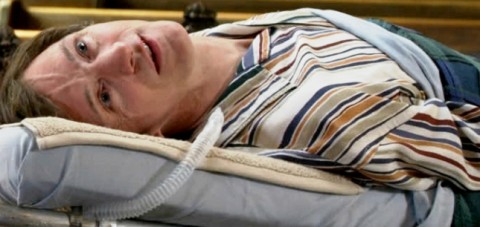
Ben Lewin’s The Sessions (formerly The Surrogate ) emerged as the undisputed hit of Sundance 2012, landing a $6 million sale with the unlikeliest of subjects: A paralyzed man’s quest to lose his virginity, based on the life and writings of Bay Area poet Mark O’Brien. Thanks to Lewin’s sensitive and honest script and an impressive turn by indie favorite John Hawkes — who shines with wit and grace in a physically demanding performance as O’Brien, who has no use of his limbs due to polio but begins to explore his sexuality with the help of a hands-on sex therapist (Helen Hunt) – The Sessions earned consecutive standing ovations and got critics buzzing with the possibilities for next year’s Academy Awards. Movieline sat down with Hawkes after the film’s Sundance debut to discuss the indie labor of love, why O’Brien’s story resonates so powerfully, and how opportunities have expanded for him since breaking out two years ago in Park City with his Oscar-nominated turn in Winter’s Bone . I grew up close to Berkeley and was a little familiar with Mark O’Brien before seeing the film, but it captured that sense of place for me – especially with little touches like Pink Man to set the atmosphere. Yes, of course! That’s good, because we shot in Los Angeles because we couldn’t afford to shoot up there. We had to make our own Pink Man and everything. [Laughs] Luckily there are a couple of Victorian streets in Los Angeles that we were able to utilize. How familiar were you with O’Brien’s story beforehand? I was minutely aware of Mark because I had heard of Jessica Yu’s amazing, Academy Award-winning short doc about Mark, called Breathing Lessons . I’d just vaguely kind of remembered that, and I may have seen an article about him at that time, but it was a new kind of story to me when I picked up the script and read it. I was pretty taken with the script itself, by Ben Lewin, and knowing he was going to direct the film which is often a wonderful thing – it’s the person who wrote the script, directing the movie. I just thought he was an extraordinarily interesting man, a polio survivor himself and very uniquely qualified to tell the story. When the project came to you – a very challenging role, to say the least – what made you decide you had to do it? My first question to Ben, as we sat down to meet before he’d offered the role and before I’d accepted the role, was ‘Why not a disabled actor?’ And he assured me that he had taken the last couple of years, he’d put out feelers to disabled groups, and had auditioned several people – a couple of them are in the film – and just felt like he hadn’t found his Mark. So with that huge question answered, I talked to Ben a lot about how he saw the film as a whole, how he saw the character of Mark; I had my ideas, we chatted and seemed to get along really well, so it was a good fit. We went forward from there. And this is a very small project. Ben raised the money by appealing to friends, basically, and so this tiny little script suddenly attracting William H. Macy, Helen Hunt, and a bunch of other wonderful actors – it’s vindicating to read something and think, ‘This is really good!’ And then you realize other people think so too. I’m not insane, it is a great script! How challenging was the shoot itself, physically? It was very challenging – again, a minute amount of the challenge that a disabled person faces, moment to moment, but certainly it was physically challenging. I helped invent a device that we used to curve Mark’s spine, basically a large piece of foam that we nicknamed ‘The Torture Ball’ because it would lay under the left side of my body and curve my spine for every shot in the movie. Sometimes I’d have to lay on that for an hour at a time, and it was hard – it apparently displaced my organs. [Laughs] My chiropractor told me that my organs were migrating and to hopefully finish the movie soon. I have minor health issues that may relate to laying on that thing, but nothing compared to what many people suffer daily, and it’s a small price to pay for what’s turned out to be a really beautiful film. To paraphrase Mark himself in the film, it may have hurt – but it was worth it? Yes! Definitely. It’s an interesting choice that Ben made to present Mark’s story here not as a straight biopic but with a focus on his relationship with his sex surrogate. What do you think that shifted angle brings, as opposed to a more conventional portrayal? Interesting. I think Ben originally had seen the movie as a biopic and then began to realize that the part of Mark’s life that interested him the most was his quest to learn his sexual possibilities as a disabled man. I think it’s a really wise choice; biopics are interesting, but I’d rather see a documentary of a person’s whole life, and I’d much rather see a narrative feature focused on a small piece of their life. And if you can focus on a small piece of someone’s life and tell it well enough, I think it informs the whole of their life. And there’s a real interesting story there – there’s a relationship that develops, certainly heightened in our film, but with the blessing of the real surrogate, Cheryl Cohen Green, to heighten and complicate their relationship a bit and to make it a love story of sorts. The subject matter, as you describe it, doesn’t have wide appeal but I think it has so much humor and so much truth, it’s a breath of fresh air. Mark’s voice really comes through – the same painfully honest, witty spirit you can see in his writings. It was important to me to fight self-pity at every turn, and for the film as a whole to fight sentiment as much as possible. He certainly never wanted people to feel sorry for him . No! The idea that he was a courageous person and stuff, he thought was bullshit. Like, how do you presume to know what I feel, what I go through? I think through his articles he was very interested in the political and social aspects of his disability. One thing that’s striking about Jessica Yu’s film, and I believe I also read something Mark wrote about it, is that to the taxpayer – to those of us who help support disabled people by paying taxes – it was half or maybe one-third of the cost of him being in an institution and live on his own, to pay rent, to hire attendance, way less of a strain on the taxpayer than keeping him an institution, where he was sadly stuck for a few years of his life when his parents were too old to take care of him. Luckily, the University of California, Berkeley in the ‘70s said, we’ll take care of any student who qualifies, who can pass our admission – it doesn’t matter what their disability. There’s an amazing photograph of his iron lung, 800 lbs. of it, hanging from a crane right outside his dorm room window as they’re trying to get it inside. So I know Mark always had a really felt beholden to Berkeley and felt a wonderful debt to that college and that town. They opened up his life, he was kind of reborn in his 30s in Berkeley. Sex and love are central to Mark’s journey in this film, and it’s such a fascinating terrain to explore – the relationship between disability and sexuality, and sexuality and manhood, and what they all might have meant to him. I can’t exactly speak in exact detail to his innermost thought, but he was quite effusive in his writings. In Jessica Yu’s film there is a brief mention of his surrogate time. Bill Macy’s made the point that he worked with a group, and disabled people, like able-bodied people, want to be independent as much as possible and live their lives that way, and they also want to love and be loved. Those are commonalities among people everywhere, and certainly disabled people are no exception. I think that Mark mainly was interested in sex because he was more largely interested in love and in a relationship with someone, and I think that he felt that if he ever met someone he could love, that he would want to have explored his possibilities, sexually. So that’s where the surrogate comes in. The minute that the first screening here ended, folks were buzzing about next year’s Oscars. It’s a little early! [Laughs] It’s a lot early. I mean, there may be twenty more amazing films that come out in the next year. I hope so! So who knows? It’s way too early and it doesn’t exactly make me nervous, I just turn a deaf ear to it because low expectations have always been the key to happiness for me. I don’t want to expect things to happen as much as hope, and if those Oscar predictions come true, fantastic – because it will bring more people to this film. After the success of Winter’s Bone , perhaps, how much did things change for you? Has the way that you’ve chosen projects in the last few years evolved at all? No, though I’ve certainly been afforded the opportunity to choose what I might be a part of. It’s not like every director in every movie is seeking me out by any means, there are a lot of things I’m not suited for, a lot of things I’m not interested in, and a lot of things that directors wouldn’t be interested in me for. What are you interested in? I’m interested in amazing stories told by talented people, and to get to play a terrific role. The three things I try to find are story, parts, people. Has it gotten easier to find the great characters? You know, I think it maybe is. It’s certainly changed for me because when I first got to Los Angeles 20 years ago, I had worked a lot of my life and was still working regular jobs. Acting was more fun to me, and paid better when I could get the gigs, so in order to avoid any further carpentry and restaurant work and things I’d been doing for many years, I just took whatever came my way. I was happy to be able to pay rent and eat. Certainly I’m freer now; I don’t get to do everything I want to do, but I no longer have to do things I don’t want to do – so that’s good. This interview previously ran as part of Movieline’s Sundance 2012 coverage. Follow Jen Yamato on Twitter . Follow Movieline on Twitter .
With Kelly Marcel tapped to pen the script, we look at the obstacles in adapting E L James’ best-selling novel. By Amy Wilkinson “Fifty Shades of Grey” book cover Photo: The Writer’s Coffee Shop
Greta Gerwig has gone from so-called Mumblecore actress, appearing in indie titles LOL , Hannah Takes The Stairs and Nights and Weekends to bigger fare by the likes of Ivan Reitman and Woody Allen in No Strings Attached and the recent To Rome with Love . But what most audiences may not know, is that she’s picked written some of the material she’s played on screen, including her latest Frances Ha , which she co-wrote with director Noah Baumbach . The comedy is Gerwig’s second match-up with Baumbach following 2010’s Greenberg and the pair began bouncing ideas off each other, eventually creating the hysterical black and white feature that debuted at the recent Toronto International Film Festival and will be having its U.S. premiere at the upcoming New York Film Festival . “We started trading some ideas after Greenberg Gerwig said in New York this week. “I knew I wanted to work with Noah again, and luckily he felt the same way.” Baumbach and Gerwig emailed sent email back and forth, creating Frances Ha ‘s electric personalities and hypnotic banter. In the film, Gerwig plays Frances, a New Yorker who is constantly on the move. Her best friend Sophie (Mickey Sumner) ups and moves into a plush apartment with a friend in New York’s TriBeCa neighborhood, leaving Frances to fend for herself. A budding dancer, she is dropped from her apprenticeship at a dance company, but her slow descent never does little to undermine her determination to succeed. Friendship is at the heart of the film and the sometimes racy lifestyle of twenty-somethings living in New York is played out honestly, even with some discomfort. “If you want to get technical about it, anything other than women falling in love is under-represented across the board [in movies],” said Gerwig. “When we were writing it, Frances and Sophie emerged rather than something that was imposed. It became clear that this was the most important relationship in her life and we decided that that was the story we would focus on.” Though Gerwig and Baumbach were obviously very aware of the script, the Oscar-nominated director of The Squid and the Whale decided not to let the other actors see the entire screenplay. He decided to experiment with actors only focusing on only their material and be left in the dark as to how their words and deeds fit into the bigger picture. “I thought there might be something interesting to having actors play at the moment and what was in front of them instead of having them in some ways tell the overall story, so that was the experiment…I didn’t want them to think how this scene falls in the movie,” said Baumbach. “They may know all too well where a scene falls in the movie. You don’t want the characters to know that really.” Gerwig received praise for her performance at a pre-NYFF screening of the film this week. Her character is a case study in contrasts. She’s smart, but makes bad decisions. She’s determined, but is constantly stumbling. She has strong relationships, but she’s often left in the lurch. Gerwig wrestled up a persona that would have been difficult for just any actor to pull off Frances’ unique peculiarities. Asked how she tackled Frances, Gerwig wasn’t quite sure how her personality came about. “I never really particularly meant to have a different way of acting than anyone else,” she said. “I don’t mean to sound like Johnny Cash, but that line, ‘I play guitar like this because I don’t know any other way’ – I don’t know any other way to act.” Continuing she added, “It’s always weird when you talk about acting because it inevitably descends into something mystical. But it’s from the inside coupled with needing to know why I am saying something. Working on the script doesn’t make acting any easier. It actually in some ways makes it more difficult because you know what something is supposed to be.” IFC Films picked up Frances Ha and will release the film in theaters and VOD at a future date.
Volleyball Players Have Athletic And Shapely Rear Ends For those of you who aren’t volleyball enthusiasts, you probably only have a chance to watch the sport every 4 years when the summer Olympics roll around. However, every 4 years you may notice that the ladies who partake in volleyball have some pretty amazing cakes. Flip the script for a lii Olympic volleyball donk action!
Rihanna Snorkeling, Smoking, And Drinking Champagne On Yacht in Italy For those of you who have not grown tired of seeing Rihanna “yolo’ing it up” on yachts and such in Europe, here are more pics of her flauntin’ those little cakes of hers in Portofino, Italy. Flip the script to peep RihRih poppin bottles of Ace Of Spades, chiefin on some yahmean, snorkeling, and most importantly “hosing herself down”…
Catwoman herself recalls reading the script for the first time. By Amy Wilkinson, with reporting by Josh Horowitz Anne Hathaway as Catwoman in ‘The Dark Knight Rises’ Photo: Warner Bros. Pictures