Tag Archives: small-business

Like Father Like Son, NBC’s Today Show Covers Ben Quayle Like He’s a Joke

NBC’s Kelly O’Donnell, in a story aired on Friday’s Today show, traveled to Arizona to profile Republican Ben Quayle’s run for Congress and in the process gave Dan Quayle’s son the same sort of treatment the former Vice President’s received from the media, as the NBC correspondent treated him like a joke. While O’Donnell briefly mentioned that Ben Quayle is a small business owner, the thrust of her piece was making light of foibles of the son and even father. In her story O’Donnell aired a joke from her NBC colleague Jay Leno to make fun of a Quayle campaign mailer, pressed Quayle to deny he “wrote under the name Brock Landers, a porn star character from the movie Boogie Nights” for a blog and of course dredged up old footage of his dad misspelling the word potato and being ridiculed by Lloyd Bentsen in a 1988 vice presidential debate. [ audio available here ] The following is the full O’Donnell story as it was aired on the August 20 Today show: MEREDITH VIEIRA: As Vice President, Dan Quayle became well acquainted with the rough-and-tumble world of politics. Now his son is jumping into the fray running for Congress in Arizona and he is already facing some criticism. NBC’s Kelly O’Donnell is in Scottsdale with details. Kelly, good morning to you. [On screen headline: “Like Father, Like Son, Ben Quayle Runs For Congress”] KELLY O’DONNELL: Good morning, Meredith. Well Tuesday is the Republican primary here in Arizona and Ben Quayle says growing up with all those pressures in politics and being a small business owner today has prepared him. Well it sure helps to have a thick skin because he is already taking some knocks and drawing attention. (Begin ad clip) BEN QUAYLE: Barack Obama is the worst President in history. (End clip) O’DONNELL: It is brash. And with that, the Quayle name is back in national politics. (Begin ad clip) BEN QUAYLE: Somebody has to go to Washington and knock the hell out of the place. (End clip) BEN QUAYLE TO O’DONNELL: I have great respect for the Office of the President and I didn’t take those, this statement lightly. O’DONNELL: Ben Quayle was just a kid when his father Dan served as Vice President under George H.W. Bush. Now 33 and newly married, Ben is a lawyer and has a small investment firm with about 20 employees, running for an open seat in Congress, in Phoenix and Scottsdale, where his parents Dan and Marilyn and siblings now live. BEN QUAYLE: I saw the bad side of politics. I saw what they did to my father and what my family had to go through and I didn’t know if I wanted to put my own family through that. (Old clip of Dan Quayle) DAN QUAYLE: Potato. O’DONNELL: Dan Quayle’s stumbles made him a punch line, mocked with no mercy when he misspelled the word “potato” adding an “e” and that stinging jab at the vice presidential debate. LLOYD BENTSEN: I knew Jack Kennedy. Jack Kennedy was a friend of mine. Senator, you’re no Jack Kennedy. O’DONNELL: Did you expect your father might take a few hits with you as a candidate? BEN QUAYLE: Well as a Quayle you kind of know you have a targe t on your back. We’re used to that. Doesn’t make it any easier. O’DONNELL: Now Ben gets the late night treatment. JAY LENO: Now Dan Quayle, remember Dan Quayle, former Vice President? O’DONNELL: Jay Leno and Quayle’s Republican opponents took shots at this campaign mailer, where Quayle talks about raising a family in Arizona. LENO: The trouble is he doesn’t have any kids. They’re rented for the brochure! O’DONNELL: In fact, those little girls are Quayle’s nieces. But for a family values candidate, another controversy has caused quite a stir. Quayle admits he wrote racy blog posts for a website called the Dirty Scottsdale a few years ago. That site says Quayle wrote under the name Brock Landers, a porn star character from the movie Boogie Nights, but he denies that. (Clip from the movie Boogie Nights) BEN QUAYLE: I am not Brock Landers. O’DONNELL: Do you regret even being involved at all? BEN QUAYLE: The only downfall of this whole thing is that a terrible website has gotten a lot of attention and a lot of free publicity. O’DONNELL: But do you regret your own contribution? BEN QUAYLE: You know I can’t look back and, and think about regrets. I’m looking forward to the future. That’s what the American people want. O’DONNELL: Well, Ben Quayle certainly has the name recognition here, but he is in a crowded field, one of 10 Republicans trying to get the nomination. He also has the most money. He’s raised more than a million dollars and former President Bush, George H. W. Bush, even held a fundraiser for him at his home. Meredith?” VIEIRA: Alright, Kelly O’Donnell, thank you very much.

Original post:
Like Father Like Son, NBC’s Today Show Covers Ben Quayle Like He’s a Joke

NBC’s Andrea Mitchell Hits Democrat From the Left on Bush Tax Cuts

On the Wednesday edition of her self-titled MSNBC show, Andrea Mitchell actually hit a Democratic Senator from the left on tax cuts. Democratic Indiana Senator Evan Bayh appeared on Andrea Mitchell Reports to offer his support to extending the Bush tax cuts as a way to stimulate the economy but a skeptical Mitchell pressed: “Senator, given the deficit and the wealth of the upper class, and the fact that they sit on their money and put it into savings, why give them this tax break?” Bayh went on to tell the NBC correspondent that raising taxes “will lower consumer demand at a time we want people putting more money into the economy” and pointed out “the people you’re referring to, in those upper brackets, are the ones that make decision about hiring and making investments.” The undeterred Mitchell responded with the Obama administration line that “you should extend the tax cuts for the middle class but not for people making more than $250,000 a year.” Bayh, delivering a basic economics lesson, reminded Mitchell that while “middle class taxpayers are using the extra money to pay down debt, credit card bills, mortgages, things like that…It’s the people in the upper brackets who continue to spend at a higher rate, propping up consumer demand” and insisted “If we want people to hire more individuals, if we want them to make business investments, raising burdens on them probably doesn’t improve their optimism, confidence and discourages rather than encourages them to do those kinds of things.” However, Bayh did relent when he offered to Mitchell that eventually the tax rates “are probably going to have to go up but it ought to be as part of a comprehensive deficit reduction package.” The following exchange was aired on the August 4 edition of MSNBC’s Andrea Mitchell Reports: ANDREA MITCHELL: July’s official unemployment numbers due out Friday but an independent study says that the U.S. economy added only 42,000 private sector jobs last month. That is sluggish. That sluggish growth and the overall weak economy has Republicans and even some Democrats rallying against letting any of the Bush tax cuts expire, including the ones for the upper class. And joining us now Democratic Senator Evan Bayh, one of those Democrats that serves on the Banking and Small Business committees . Senator, given the deficit and the wealth of the upper class, and the fact that they sit on their money and put it into savings, why give them this tax break? SEN. EVAN BAYH: Well, a couple of things, Andrea. First, as you noted, the economy is very weak right now. And raising taxes will lower consumer demand at a time we want people putting more money into the economy. Secondly, the people you’re referring to, in those upper brackets, are the ones that make decisions about hiring and about making investments. We want them to do more of that, and so raising burdens on them during a time like this is just not the right thing to do. Now once the economy has a head of momentum under it, a self-sustaining recovery, we’re adding jobs, not the forty-some thousand you mentioned, but more than 100,000 – 200,000 every month then we can pivot and look at deficit reduction. Because in the long run I share that, the concern about that. But right now we want to emphasize growth and getting the economy moving and then pivot and get the deficit down. MITCHELL: Well what do you say to the White House and their position is that you should extend the tax cuts for the middle class but not for people making more than $250,000 a year. BAYH: Well, a couple of things. There’s some evidence that’s come out recently that middle class taxpayers are using the extra money to pay down debt, credit card bills, mortgages, things like that. That’s a good thing to do but it doesn’t stimulate the economy. It’s the people in the upper brackets who continue to spend at a higher rate, propping up consumer demand. And then there’s the point that I mentioned. If we want people to hire more individuals, if we want them to make business investments, raising burdens on them probably doesn’t improve their optimism, confidence and discourages rather than encourages them to do those kinds of things. And the final point that I make, Andrea is, eventually those rates are probably going to have to go up but it ought to be as part of a comprehensive deficit reduction package combined with spending enforceable spending restraint. To just go out and raise taxes with no spending restraint, particularly during a recession, it’s just not the right time to do that. MITCHELL: Well at this stage, as you’re leaving the Senate. You don’t have to worry about the political fallout in, in the midterm elections, but are your colleagues going to go along, your Democratic colleagues, go along with extending the tax breaks for the, for the rich? BAYH: No, the vast majority of them won’t. I suspect that there will be three or four or five of us who have qualms about that. But I won’t identify the member but someone who you would quickly recognize as a very liberal member of the caucus yesterday was speaking up about she happened to believe that raising taxes on anyone making less than $8 million a year, at this moment, was not the right thing to do. So even some of the more liberal MITCHELL: Eight million?! BAYH: No, no $1 million. I’m sorry, $1 million. MITCHELL: Okay. BAYH: I should enunciate more clearly. $1 million a year was not the right thing to do. So this debate has a ways to go. We need to do two things in sequence. Number one, err on the side of more stimulus for the economy, getting it moving. That means not raising taxes right now when it’s very sluggish as you pointed out. And then a real focus on deficit reduction starting with spending restraint. And then if we have to raise revenue, which in all likelihood we probably will, focusing on the people who are in the position to help us do that best but not now. MITCHELL: Evan Bayh from the Senate. Thank you very much.

Read the original here:
NBC’s Andrea Mitchell Hits Democrat From the Left on Bush Tax Cuts

ABC’s George Stephanopoulos Grills Michele Bachmann: Will Tea Party ‘Undermine’ GOP Chances?

One day after suggesting that terrorist attacks during Barack Obama’s watch be ” set aside ,” Good Morning America’s George Stephanopoulos grilled Michelle Bachmann, forcing her to respond for every supposed crime of the Tea Party movement. The former Democratic operative wondered if being “more formally aligned with the Tea Party” movement could ” undermine Republicans chances of taking the House back in November .” He then quizzed, “What did you think when you saw that billboard, comparing the President to Hitler and Lenin?” In contrast, during Iraq war protests, vulgar, sometimes violent signs held up by liberals were routinely ignored by journalists. Yet, Stephanopoulos berated the Minnesota representative, “You yourself had to distance yourself last fall from members of the Tea Party that were using Holocaust imagery.” Earlier in the piece, the GMA host hit Bachmann for suggesting that extension of unemployment benefits should be paid for. He asserted, “The tax cuts passed by President Bush are set to expire at the end of the year. I know you want to extend them. Do you support paying for those, as well?” Asking a politician to be consistent on how to pay for their programs and policy beliefs is fair. It’s just too bad that reporters rarely ask Democrats how they will pay for things or what programs should be cut. A transcript of the segment, which aired at 7:09am EDT, follows: GEORGE STEPHANOPOULOS: For more on this, we are going to turn to the founder of the brand new Tea Party caucus in the House, Republican Congressman Michele Bachman of Minnesota. Thanks for joining us this morning, Congresswoman. And let’s get right to this unemployment debate. President Obama, you saw that offensive in the Rose Garden yesterday, very tough on your party. He took on those who, he said, have no problems on spending hundreds of billions of dollars on tax breaks for the wealthiest of Americans. But are now saying we shouldn’t offer relief to the middle class Americans. How do you respond? MICHELE BACHMANN: Well, the best way to offer a relief to the middle class is to have a pro-job growth economy. And that’s not what the President has laid forth in his strategy. Republicans are not opposed to unemployment benefits, hardly. We’re looking at $34 billion in unemployment. But, remember, it was Democrats that made a big deal of the concept of pay-go. They said they would not spend money unless they made cuts in other places. Neither the President, nor Speaker Pelosi has made an attempt to cut spending in order to pay for the benefits. This is a basic function of government. And, so, it’s important that they find other cuts in other places. But instead, George, what we’ve seen, they’ve continued to expand the long line of benefits in other areas. We need to make first things first. STEPHANOPOULOS: Let’s take a look at that principle. The tax cuts passed by President Bush are set to expire at the end of the year. I know you want to extend them. Do you support paying for those, as well? BACHMANN: I think we need to be paying for all of the spending that’s going out. But when people are able to keep more of their own money, that shouldn’t be considered a cost. STEPHANOPOULOS: So, that’s a no? BACHMANN: Well, I think what we need to do is have a pro-job growth formula. And, really, what that is, cut the dramatic government spending that has happened. This didn’t happen in a vacuum. President obama spent over $1 trillion on stimulus. We were all promised that about four million jobs would be created. Instead, about four million jobs were lost. Then, President Obama decided to take over, through either direct ownership or control, one private industry after another. What we’ve learned is that the federal government takeover of private business leads to unemployment, not employment. STEPHANOPOULOS: Let me be clear then- BACHMANN: Your story’s accurate. People want jobs. That’s true. They don’t want unemployment. But the government’s policies have brought about failure in private job creation. STEPHANOPOULOS: But, to be clear, you’re saying the tax cuts don’t have to be paid for. But this unemployment extension does. Let me turn to the new Tea Party caucus that was formed. You said it was designed to promote fiscal responsibility, adherence to the Constitution and limited government. I’m wondering, why do you think it’s necessary? Are leaders in the House not living up to that responsibility? BACHMANN: Well, what we’ve been hearing from people all over the country, George, is that Congress is not listening to the American people. This is a forum for members of Congress to be able to listen to what people have been trying to tell us. And it is very simple. It’s a banner that comes under the idea of don’t spend more than what you’re taking in. People want the federal government to live just the way they do. And they want us to adhere to principles of the Constitution, because people believe they’re taxed enough already. This isn’t a political party, like the Republican Party or Democrat Party. It’s a set of ideas that, after all, members of Congress, swore that they would uphold under the Constitution. STEPHANOPOULOS: You also run the risk of taking in the controversy that comes with the Tea Party, as well. We all saw the billboard in northern Iowa last week, comparing President Obama to Hitler and Lenin. The broader movement had to expel the Chairman of the Tea Party Express this weekend for making racist comments. You yourself had to distance yourself last fall from members of the Tea Party that were using Holocaust imagery. Are you worried that being more formally aligned with the Tea Party, you might undermine Republicans chances of taking the House back in November? BACHMANN: Well, what I think what we’re trying to do more than anything, again, is to give a forum to the ideas that people have tried to talk to us about. Most of the people who came to Washington, to rallies, and to town hall meetings across the country, are just trying to get the attention of Congress to say, would you please stop spending money that you don’t have. Because, the money is our money. That’s what the people are saying. These are lawyers, doctors, small business owners, housewives, farmers. People from all walks of life, just saying, please, federal government, get your act together. And start acting in a way that will not leave us bankrupt and will create a pro-growth agenda here in America. STEPHANOPOULOS: We only have a few seconds. What did you think when you saw that billboard, comparing the President to Hitler and Lenin? BACHMANN: Well, you know, some things aren’t helpful going forward. And to focus on the ideas of a pro-growth economy, living within our means, that’s positive. That’s what we hope to do in this caucus.

Continue reading here:
ABC’s George Stephanopoulos Grills Michele Bachmann: Will Tea Party ‘Undermine’ GOP Chances?

Left-Wing Talk Show Host Ed Schultz Lashes Out at MRC/NB Summer Intern

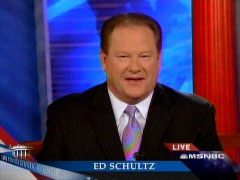
On his June 24 radio show, left-wing host Ed Schultz went on a rant against NewsBusters’ Matt Hadro, who earlier that day wrote a pretty inoffensive piece documenting how Schultz credited President Obama’s $862 billion stimulus package with more than doubling the size of his North Dakota construction firm. Schultz bizarrely (and incorrectly) tried to ridicule the Media Research Center summer intern as a spoiled rich kid. (Audio excerpt here .) Did Mommy and Daddy pay your way to go to school? Are you a little conservative boy that gets all the tax breaks of the top 2 percent rich? Have you ever gotten your hands dirty doing a job, Matt? [employs falsetto voice] ‘Oh, Matty, it’s time for milk and cookies! It’s 4:00, come home now! And here’s some more money. Oh, I think it’s so cute that you’re working for those wonderful conservatives over at Newsbusters. Oh, Matty!’ I’ll bet you that’s exactly who that kid is. What triggered Schultz’s wrath was Hadro’s matter-of-fact reporting of what the talk radio host said on C-SPAN’s Washington Journal on Wednesday: “We’ve gone from eight employees to 20 employees in the past year, because of the stimulus package,” he said of his construction company. “We’ve put some people back to work. There is some growth.” Schultz is evidently quite thin-skinned, since Hadro’s piece included no criticism of the host, his construction company, or the stimulus, but merely recounted what he said on C-SPAN. But the topic obviously struck a nerve, since Schultz lashed out at NewsBusters as “so negative” and “so hateful” in its depiction of him: Tell me, what’s negative about expanding a company?! What’s negative about giving someone a job?! These people are so negative on America, and so hateful of Obama and anybody who has any type of success whatsoever, the mission is to put ’em in light, in bad light, any way they possibly can. Here’s a longer transcript of Schultz’s June 24 fulmination: ED SCHULTZ: Hell, the righties, they’re even upset when we do create jobs. What’s the big deal? Those of you who follow the radio show, I wouldn’t call it a running feud because they’re not worth it, but I do love to point out every time I make NewsBusters, which is Brent Bozell’s right-wing, psycho-analysis, conservative think-tank. They like to, well, they just write a bunch of stuff about me, no matter what it is. (…) I’m on C-SPAN yesterday and I live my life a little bit on the air. It is a fact that this President has done so much for small business, more than anybody else that I can see in recent terms. And our company has gone from eight employees to 18, 20, 22, depending on what’s going on, what the project is! It’s American! It’s risk-taking! It’s what I talk about! And you jerks over at NewsBusters, you never call me, which shows that you’re not journalists. Never have you ever interviewed me. But this is how these conservative psychopaths operate. Tell me, what’s negative about expanding a company?! What’s negative about giving someone a job?! These people are so negative on America and so hateful of Obama and anybody who has any type of success whatsoever, the mission is to put ‘em in light, in bad light, any way they possibly can. So the story reads, “While defending the Obama administration as a champion for small business owners, MSNBC host Ed Schultz revealed that his construction company more than doubled its number of employees in the past year – thanks to the stimulus bill.” Oh! Obama wrote me a check. Is that what it was? Is that the idiot implication there? Anybody who knows anything about jobs in construction knows that you have to bid! But, I think what we’re going to do is, we’re going to check out who Matt Hadro is and we’re going to find out how much money he makes. We’re going to find out if he’s ever written a check for someone else who’s done work for him. We’re going to find out if he is a risk taker! In fact, I’m going to see if I can find out a little bit more about Brent Bozell. What has he ever done other than suck the hind tit off conservatives who want to fuel money right into his conservative think tank. He’s a leech. I’m out there supporting the boys, hiring kids, paying ’em union wages, getting ’em health care, doin’ what I gotta do, growing the company. But because I’m on MSNBC and because I champion for small businesses, they try to cook up some kind of a story like there’s, well, (sarcastically), what’s going on here? Continuing to read it — it’s actually kind of funny, because there’s no new information there. There’s nothing there, other than what I said on C-SPAN. Absolutely nothing there. And I love it. I love the publicity. And I love pointing out who these jerks are, and how poor they are when it comes to research. And Matt Hadro, I’m going to make you a star, buddy. I want to make you a star. I want you to show some spine and be a guest on the Ed Schultz radio show. Hell, I’ll even put you on TV. I can do that too. And let’s debate the stimulus package. And let’s find out what you’re all about. Did mommy and daddy pay your way to go to school? Are you a little conservative boy that gets all the tax breaks of the top 2 percent rich? Have you ever gotten your hands dirty doing a job, Matt? [Pretending to be Matt’s mother] ‘Oh Matty, it’s time for milk and cookies, it’s four o’clock, come home now. And here’s some more money. Oh, I think it’s so cute that you’re working for those wonderful conservatives over at Newsbusters. Oh, Matty!’ I’ll bet you that’s exactly who that kid is. (Laughing) And Matt, I will pay your airfare from wherever the hell you are, at no expense to NewsBusters, I will put you on a plane. Well, better yet, I’ll put you on my plane. And I will take you to our construction site. And I will show you and let you interview the guys who were jobless until they came to work for E. A. Schultz Construction. You know what I’ll even do, Matt? I’ll even open up our books. I’ll show you what we’ve bid on, I’ll show you what we’ve won, I’ll show you what we’ve lost. In fact, if you have a hair on your ass, maybe you’d like to work. Do some real work instead of playing with that computer and throwing up a bunch of hate and half truths and accusations. You see, Matt, I believe in the working people. You don’t. You wanted to vilify our efforts. You want to vilify our investment. You want to put us in a bad light because we are, proudly, a liberal construction company! That actually pays people!

See the article here:
Left-Wing Talk Show Host Ed Schultz Lashes Out at MRC/NB Summer Intern

Rep. Joe Barton Apologizes to BP’s Tony Hayward for White House "Shakedown"

BP CEO Tony Hayward is in the midst of a harsh grilling today on Capitol Hill, where he is testifying House Committee on Energy and Commerce hearing on “The Role of BP in the Deepwater Horizon Explosion and Oil Spill.” But not long after the hearing began, Hayward got something not many expected from lawmakers: An apology. Rep. Joe Barton, a Texas Republican, apologized to Hayward for what he described as a “shakedown” at the White House yesterday. He was referring to the deal worked out between the Obama administration and BP to set up a $20 billion fund administered by a third party to pay for damages from the catastrophic oil spill in the Gulf of Mexico. “I'm ashamed of what happened in the White House yesterday,” Barton said. “I think it is a tragedy of the first proportion that a private corporation can be subjected to what I would characterize as a shakedown, in this case, a $20 billion shakedown.” He complained that “the attorney general of the United States, who is legitimately conducting a criminal investigation and has every right to do so to protect the interests of the American people, [is] participating in what amounts to a $20 billion slush fund that's unprecedented in our nation's history, that's got no legal standing, and which sets, I think, a terrible precedent for the future.” “I apologize,” Barton added. “I do not want to live in a country where any time a citizen or a corporation does something that is legitimately wrong is subject to some sort of political pressure that is — again, in my words, amounts to a shakedown. So I apologize.” “I'm speaking now totally for myself,” he noted. “I'm not speaking for the Republican Party.” Not long after Barton spoke, the White House released a statement calling his comments “shameful.” “What is shameful is that Joe Barton seems to have more concern for big corporations that caused this disaster than the fishermen, small business owners and communities whose lives have been devastated by the destruction,” said Press Secretary Robert Gibbs. “Congressman Barton may think that a fund to compensate these Americans is a 'tragedy', but most Americans know that the real tragedy is what the men and women of the Gulf Coast are going through right now. Members from both parties should repudiate his comments.” According to the Associated Press, Barton has taken more than $100,000 in political contributions from oil and gas interests since the beginning of 2009, more than all but one other member of the House Energy and Commerce Committee. At the hearing, Rep. Ed Markey (D – MA) said he “could not disagree more strongly” with Barton's comments. “Not only is the compensation fund that was created yesterday at the White House in an agreement reached between BP and President Obama not a slush fund and not a shakedown, rather it was the government of the United States worked to protect the most vulnerable citizens that we have in this country right now – the residents of the Gulf,” he said. “American citizens are being harmed,” Markey added. “We cannot wait, as unfortunately so many victims of the Exxon Valdez had to wait years to see those families compensated. We can't lose sight of fact that the 1984 Bhophal disaster and lawsuits related to it, were only settled last week. We have to make sure American citizens are protected.” “The families of the Gulf will be crushed financially unless this compensation fund is put in place,” said Markey, arguing that the history of Gulf families will be “permanently altered” without action. Markey added that the creation of the slush fund reflected “American government working at its best” to ensure that families do not become “roadkill” as a result of corporate practices. As Markey spoke, Barton leaned back in his chair reading what appeared to be the newspaper Investor's Business Daily. added by: TimALoftis

Matthews Exclaims ‘Tea Partier Declares War!’ Warns of Movement’s ‘Lock and Load Mentality’

Chris Matthews, on Monday’s Hardball, claimed that a Tea Party candidate, in his new ad, had just declared war and warned this was an example of the “lock and load mentality” of “the Tea Party folk.” Matthews, during his Sideshow segment, played a clip from a Rick Barber for Congress ad in which the candidate engages in an imagined conversation with Sam Adams and George Washington in which Barber tells the Founding Fathers how far the government has grown in it scope, with the actor playing Washington saying at the end it’s time to “Gather your armies.” Matthews took this as a sign that Barber was “advocating taking up arms against the government.” Matthews also asserted the tea partiers view the federal government as “a foreign occupying force” and told viewers they can see “more of this sort of thing” on his new documentary “Rise of the Right” to be aired this upcoming Wednesday night on MSNBC. The following teaser, ad clip and Matthews commentary were aired on the June 14 edition of Hardball: CHRIS MATTHEWS: Up next it’s a campaign you have to see to believe! A Republican running for Congress in Alabama, basically is advocating taking up arms against the government. This is the closet thing, well I’m not gonna say it. Well it’s the closest thing to “Let’s revolt!” that I’ve seen. You’re watching Hardball only on MSNBC. … MATTHEWS: Now to the Sideshow. First tonight, a tea partier declares war! Rick Barber, one of the candidates competing in the Republican run-off in Alabama’s second congressional district has just come out with an ad for TV that tells you the true dimension of the Tea Party mentality. The spot begins midway through an imagined meeting with Founding Fathers Sam Adams, Benjamin Franklin, and George Washington. Here it is. (Begin ad clip) RICK BARBER: And I would impeach him. And if that’s not enough, some of you men own taverns. Sam, you were a brewer. Mr. President, a distiller. You know how tough it is to run a small business without a tyrannical government on your back. Today we have an Internal Revenue Service that enforces a progressive income tax. Now the same IRS is gonna force us to buy health insurance, cram it down our throats or else. Now I took an oath to defend that with my life. I can’t stand by while these evils are perpetrated! You gentleman revolted over a tea tax – a tea tax! Now look at us! Are you with me? ACTOR PLAYING GEORGE WASHINGTON: Gather your armies. (End clip) MATTHEWS: Actually Washington put down the Whiskey Rebellion. Well this is the lock and load mentality you just saw there, of the Tea Party folk. They see themselves as involved in a battle with the federal government, which they view is a foreign occupying force, like the British during colonial days. For more on this sort of thing, watch our documentary, Rise of the New Right, this Wednesday at 7:00 o’clock Eastern.

See the rest here:
Matthews Exclaims ‘Tea Partier Declares War!’ Warns of Movement’s ‘Lock and Load Mentality’

Barack Obama’s Speech in Wall Street

United States of America’s President Barack Obama delivered his speech at the Great Hall of Cooper Union in front of several  important executives of Wall Street. Obama directly addressed his speech to the CEO’s present. Here’s a copy of his speech. It’s good to be back in the Great Hall at Cooper Union, where generations of leaders and citizens have come to defend their ideas and contest their differences. It’s also good being back in Lower Manhattan, a few blocks from Wall Street, the heart of our nation’s financial sector. Since I last spoke here two years ago, our country has been through a terrible trial. More than 8 million people have lost their jobs. Countless small businesses have had to shut their doors. Trillions of dollars in savings has been lost, forcing seniors to put off retirement, young people to postpone college, and entrepreneurs to give up on the dream of starting a company. And as a nation we were forced to take unprecedented steps to rescue the financial system and the broader economy. As a result of the decisions we made – some which were unpopular – we are seeing hopeful signs. Little more than one year ago, we were losing an average of 750,000 jobs each month. Today, America is adding jobs again. One year ago, the economy was shrinking rapidly. Today, the economy is growing. In fact, we’ve seen the fastest turnaround in growth in nearly three decades. But we have more work to do. Until this progress is felt not just on Wall Street but Main Street we cannot be satisfied. Until the millions of our neighbors who are looking for work can find jobs, and wages are growing at a meaningful pace, we may be able to claim a recovery – but we will not have recovered. And even as we seek to revive this economy, it is incumbent on us to rebuild it stronger than before. That means addressing some of the underlying problems that led to this turmoil and devastation in the first place. One of the most significant contributors to this recession was a financial crisis as dire as any we’ve known in generations. And that crisis was born of a failure of responsibility – from Wall Street to Washington – that brought down many of the world’s largest financial firms and nearly dragged our economy into a second Great Depression. It was that failure of responsibility that I spoke about when I came to New York more than two years ago – before the worst of the crisis had unfolded. I take no satisfaction in noting that my comments have largely been borne out by the events that followed. But I repeat what I said then because it is essential that we learn the lessons of this crisis, so we don’t doom ourselves to repeat it. And make no mistake, that is exactly what will happen if we allow this moment to pass – an outcome that is unacceptable to me and to the American people. As I said two years ago on this stage, I believe in the power of the free market. I believe in a strong financial sector that helps people to raise capital and get loans and invest their savings. But a free market was never meant to be a free license to take whatever you can get, however you can get it. That is what happened too often in the years leading up to the crisis. Some on Wall Street forgot that behind every dollar traded or leveraged, there is family looking to buy a house, pay for an education, open a business, or save for retirement. What happens here has real consequences across our country. I have also spoken before about the need to build a new foundation for economic growth in the 21st century. And, given the importance of the financial sector, Wall Street reform is an absolutely essential part of that foundation. Without it, our house will continue to sit on shifting sands, leaving our families, businesses and the global economy vulnerable to future crises. That is why I feel so strongly that we need to enact a set of updated, commonsense rules to ensure accountability on Wall Street and to protect consumers in our financial system. A comprehensive plan to achieve these reforms has passed the House of Representatives. A Senate version is currently being debated, drawing on the ideas of Democrats and Republicans. Both bills represent significant improvement on the flawed rules we have in place today, despite the furious efforts of industry lobbyists to shape them to their special interests. I am sure that many of those lobbyists work for some of you. But I am here today because I want to urge you to join us, instead of fighting us in this effort. I am here because I believe that these reforms are, in the end, not only in the best interest of our country, but in the best interest of our financial sector. And I am here to explain what reform will look like, and why it matters. First, the bill being considered in the Senate would create what we did not have before: a way to protect the financial system, the broader economy, and American taxpayers in the event that a large financial firm begins to fail. If an ordinary local bank approaches insolvency, we have a process through the FDIC that insures depositors and maintains confidence in the banking system. And it works. Customers and taxpayers are protected and the owners and management lose their equity. But we don’t have any kind of process designed to contain the failure of a Lehman Brothers or any of the largest and most interconnected financial firms in our country. That’s why, when this crisis began, crucial decisions about what would happen to some of the world’s biggest companies – companies employing tens of thousands of people and holding hundreds of billions of dollars in assets – had to take place in hurried discussions in the middle of the night. That’s why, to save the entire economy from an even worse catastrophe, we had to deploy taxpayer dollars. And although much of that money has now been paid back – and my administration has proposed a fee to be paid by large financial firms to recover the rest – the American people should never have been put in that position in the first place. It is for this reason that we need a system to shut these firms down with the least amount of collateral damage to innocent people and businesses. And from the start, I’ve insisted that the financial industry – and not taxpayers – shoulder the costs in the event that a large financial company should falter. The goal is to make certain that taxpayers are never again on the hook because a firm is deemed “too big to fail.” Now, there is a legitimate debate taking place about how best to ensure taxpayers are held harmless in this process. But what is not legitimate is to suggest that we’re enabling or encouraging future taxpayer bailouts, as some have claimed. That may make for a good sound bite, but it’s not factually accurate. In fact, the system as it stands is what led to a series of massive, costly taxpayer bailouts. Only with reform can we avoid a similar outcome in the future. A vote for reform is a vote to put a stop to taxpayer-funded bailouts. That’s the truth. And these changes have the added benefit of creating incentives within the industry to ensure that no one company can ever threaten to bring down the whole economy. To that end, the bill would also enact what’s known as the Volcker Rule: which places some limits on the size of banks and the kinds of risks that banking institutions can take. This will not only safeguard our system against crises; this will also make our system stronger and more competitive by instilling confidence here at home and across the globe. Markets depend on that confidence. Part of what led to the turmoil of the past two years was that, in the absence of clear rules and sound practices, people did not trust that our system was one in which it was safe to invest or lend. As we’ve seen, that harms all of us. By enacting these reforms, we’ll help ensure that our financial system – and our economy – continues to be the envy of the world. Second, reform would bring new transparency to many financial markets. As you know, part of what led to this crisis was firms like AIG and others making huge and risky bets – using derivatives and other complicated financial instruments – in ways that defied accountability, or even common sense. In fact, many practices were so opaque and complex that few within these companies – let alone those charged with oversight – were fully aware of the massive wagers being made. That’s what led Warren Buffett to describe derivatives that were bought and sold with little oversight as “financial weapons of mass destruction.” And that’s why reform will rein in excess and help ensure that these kinds of transactions take place in the light of day. There has been a great deal of concern about these changes. So I want to reiterate: there is a legitimate role for these financial instruments in our economy. They help allay risk and spur investment. And there are a great many companies that use these instruments to that end – managing exposure to fluctuating prices, currencies, and markets. A business might hedge against rising oil prices, for example, by buying a financial product to secure stable fuel costs. That’s how markets are supposed to work. The problem is, these markets operated in the shadows of our economy, invisible to regulators and to the public. Reckless practices were rampant. Risks accrued until they threatened our entire financial system. That’s why these reforms are designed to respect legitimate activities but prevent reckless risk taking. And that’s why we want to ensure that financial products like standardized derivatives are traded in the open, in full view of businesses, investors, and those charged with oversight. I was encouraged to see a Republican Senator join with Democrats this week in moving forward on this issue. For without action, we’ll continue to see what amounts to highly-leveraged, loosely-monitored gambling in our financial system, putting taxpayers and the economy in jeopardy. And the only people who ought to fear this kind of oversight and transparency are those whose conduct will fail its scrutiny. Third, this plan would enact the strongest consumer financial protections ever. This is absolutely necessary. Because this financial crisis wasn’t just the result of decisions made in the executive suites on Wall Street; it was also the result of decisions made around kitchen tables across America, by folks taking on mortgages and credit cards and auto loans. And while it’s true that many Americans took on financial obligations they knew – or should have known – they could not afford, millions of others were, frankly, duped. They were misled by deceptive terms and conditions, buried deep in the fine print. And while a few companies made out like bandits by exploiting their customers, our entire economy suffered. Millions of people have lost homes – and tens of millions more have lost value in their homes. Just about every sector of our economy has felt the pain, whether you’re paving driveways in Arizona or selling houses in Ohio, doing home repairs in California or using your home equity to start a small business in Florida. That’s why we need to give consumers more protection and power in our financial system. This is not about stifling competition or innovation. Just the opposite: with a dedicated agency setting ground rules and looking out for ordinary people in our financial system, we’ll empower consumers with clear and concise information when making financial decisions. Instead of competing to offer confusing products, companies will compete the old-fashioned way: by offering better products. That will mean more choices for consumers, more opportunities for businesses, and more stability in our financial system. And unless your business model depends on bilking people, there is little to fear from these new rules. Finally, these Wall Street reforms will give shareholders new power in the financial system. They’ll get a say on pay: a voice with respect to the salaries and bonuses awarded to top executives. And the SEC will have the authority to give shareholders more say in corporate elections, so that investors and pension holders have a stronger role in determining who manages the companies in which they’ve placed their savings. Now, Americans don’t begrudge anybody for success when that success is earned. But when we read in the past about enormous executive bonuses at firms even as they were relying on assistance from taxpayers, it offended our fundamental values. Not only that, some of the salaries and bonuses we’ve seen created perverse incentives to take reckless risks that contributed to the crisis. It’s what helped lead to a relentless focus on a company’s next quarter, to the detriment of its next year or decade. And it led to a situation in which folks with the most to lose – stock and pension holders – had the least to say in the process. That has to change. I’ll close by saying this. I have laid out a set of Wall Street reforms. These are reforms that would put an end to taxpayer bailouts; that would bring complex financial dealings out of the shadows; that would protect consumers; and that would give shareholders more power in the financial system. But we also need reform in Washington. And the debate over these changes is a perfect example. We’ve seen battalions of financial industry lobbyists descending on Capitol Hill, as firms spend millions to influence the outcome of this debate. We’ve seen misleading arguments and attacks designed not to improve the bill but to weaken or kill it. And we’ve seen a bipartisan process buckle under the weight of these withering forces, even as we have produced a proposal that is by all accounts a common-sense, reasonable, non-ideological approach to target the root problems that led to the turmoil in our financial sector. But I believe we can and must put this kind of cynical politics aside. That’s why I am here today. We will not always see eye to eye. We will not always agree. But that does not mean we have to choose between two extremes. We do not have to choose between markets unfettered by even modest protections against crisis, and markets stymied by onerous rules that suppress enterprise and innovation. That’s a false choice. And we need no more proof than the crisis we’ve just been through. There has always been a tension between the desire to allow markets to function without interference – and the absolute necessity of rules to prevent markets from falling out of balance. But managing that tension, one we’ve debated since our founding, is what has allowed our country to keep up with a changing world. For in taking up this debate, in figuring out how to apply our well-worn principles with each new age, we ensure that we do not tip too far one way or the other – that our democracy remains as dynamic as the economy itself. Yes, the debate can be contentious. It can be heated. But in the end it serves to make our country stronger. It has allowed us to adapt and thrive. I read a report recently that I think fairly illustrates this point. It’s from Time Magazine. And I quote: “Through the great banking houses of Manhattan last week ran wild-eyed alarm. Big bankers stared at one another in anger and astonishment. A bill just passed … would rivet upon their institutions what they considered a monstrous system… Such a system, they felt, would not only rob them of their pride of profession but would reduce all U.S. banking to its lowest level.” That appeared in Time Magazine – in June of 1933. The system that caused so much concern and consternation? The Federal Deposit Insurance Corporation – the FDIC – an institution that has successfully secured the deposits of generations of Americans. In the end, our system only works – our markets are only free – when there are basic safeguards that prevent abuse, that check excess, that ensure that it is more profitable to play by the rules than to game the system. And that is what these reforms are designed to achieve: no more, no less. Because that is how we will ensure that our economy works for consumers, that it works for investors, that it works for financial institutions – that it works for all of us. This is the central lesson not only of this crisis but of our history. It’s what I said when I spoke here two years ago. Ultimately, there is no dividing line between Main Street and Wall Street. We rise or we fall together as one nation. So I urge you to join me – to join those who are seeking to pass these commonsense reforms. And I urge you to do so not only because it is in the interests of your industry, but because it is in the interests of our country. Thank you. God bless you. And may God bless the United States of America. Barack Obama’s Speech in Wall Street is a post from: Daily World Buzz Continue reading

The Time for Health Reform Is Now

The Time for Health Reform Is Now President Obama makes the final case for reforming Americas health care system before a crowd at George Mason University in Virginia. The health insurance reform legislation that Congress will vote on this weekend puts American families and small business owners—not the insurance companies—in control of their own health care. From: whitehouse Views: 6163 208 ratings Time: 28:59 More in News & Politics

See more here:
The Time for Health Reform Is Now

George W. Bush Billboard Asks: Miss Me Yet?

Rumors are swirling that if you drive down I-35 in Minnesota, you’ll see a billboard featuring a smiling George W. Bush accompanied by the question “Miss me yet?” This was initially discredited as a photoshopped hoax, but it’s real. But the dual mysteries surrounding who paid for the ad, and what their motivation was, remain. Are they Obama supporters sarcastically hoping to remind people about George W., or Bush fans sincerely yearning for the “good” days of the past administration? Mary McNamara, general manager at the Minneapolis office of Schubert & Hoey Outdoor Advertising, the company which owns and leases out the billboard, says: “The ad was purchased by a group of small business owners who wish to remain anonymous.” However, “some of the people in the group were Obama supporters.” McNamara added that the message the group hoped to convey was one of “Hope and change, where is it?” She went on to say that she has yet to receive any negative feedback about the ad, which has been up for weeks. Not everyone buys that. Cindy Erickson, the chairwoman of the Democratic Party in Chisago County, where the billboard is located, suspects the ad’s funders are in actuality conservative activists posing as Obama supporters. “I don’t have any idea who did it, but my thought was that they’re Tea Party people,” she said. “Regardless, it’s been the subject of many conversations around here.” Minnesota was a “blue” state in ’08, but Chisago is part of a Republican-leaning string of suburban counties that Obama lost about 55-45 in the presidential election. While it’s subject to some interpretation, there’s little doubt that Obama has been under fire. Has George, however unwittingly, joined Sarah Palin in laying into him? What do you think of the Bush billboard?

Read the original here:
George W. Bush Billboard Asks: Miss Me Yet?

Corey Feldman: I Wanna Stiff My Ex

Filed under: Celebrity Justice , Dirty Divorces Corey Feldman is telling his soon-to-be ex-wife she ain’t gonna take their son away without a fight — and if he gets his way, she ain’t getting any spousal support from the courts either.Corey just filed legal docs in L.A. County Superior Court in ..

See the rest here:
Corey Feldman: I Wanna Stiff My Ex