‘It’s about the unraveling of one man,’ co-star Sarah Gadon tells MTV News about the story driving Pattinson’s new thriller. By Josh Wigler, with reporting by Josh Horowitz Robert Pattinson in “Cosmopolis” Photo: Alfama Films
‘It’s about the unraveling of one man,’ co-star Sarah Gadon tells MTV News about the story driving Pattinson’s new thriller. By Josh Wigler, with reporting by Josh Horowitz Robert Pattinson in “Cosmopolis” Photo: Alfama Films
Jessica Chastain can hold her own with British royalty when it comes to fashion. The Tree of Life actresss and the Duchess of Cambridge, Kate Middleton, each adorn a cover of Vanity Fair magazine’s September Style issue, which includes the magazine’s annual International Best Dressed List. The red-headed beauty — whose cover will go to subsribers — made the list for the first time, but joins other actors who are no strangers to the honor. Inglourious Basterds actress Diane Kruger made the list for the second time as did Best-Dressed Couple, The King’s Speech star Colin Firth and his producer wife Livia. Chinese actress Fan Bingbing ( Shaolin), France’s Léa Seydoux ( Mission Impossible: Ghost Protocol ) and model, actress, filmmaker and Schiaparelli muse Farida Khelfa. How to Get Ahead in Advertising actor and Wah-Wah director Richard E. Grant returns to the list for the first time since 2007, and My Week with Marilyn heartthrob Eddie Redmayne makes his debut in the Best-Dressed Men category. Jay-Z is named to the list for the first time, along with fellow musician Alicia Keys, who is back on the list for the first time since her inaugural appearance, in 2009. Actor Richard E. Grant makes a fashion comeback as well, named to the list for the first time since 2007. Colin Firth is on the list for the second year in a row, along with stylish wife Livia, in the Best-Dressed Couples category, and newcomer Eddie Redmayne is one of the Best-Dressed Men. You can see more photos of the Best-Dressed at Vanity Fair.com . Follow Frank DiGiacomo on Twitter. Follow Movieline on Twitter.
Danish comedy duo Casper Christensen and Frank Hvam would like you to know they are not pedophiles. Not that accusations of creative indecency would stop them from toying with the line of good taste, as they do to hilarious effect in the R-rated Danish sex comedy Klown . The Curb Your Enthusiasm -style road trip comedy, which they wrote and co-star in, happens to be the funniest, most outrageous film of the year, and it has already been acquired for American remake by Todd Phillips and Danny McBride. Klown debuted in New York, Los Angeles, and Austin over the weekend, stirring up a decent opening as it looks to expand to 13 additional markets in the coming weeks. Back home in Denmark, it’s already made $12.3 million; nearly 20 percent of the population reportedly watched it upon release in 2010. That’s a fantastic start for a buddy comedy chock full of explicit sexual gags, nudity, child endangerment and wanton irresponsibility galore — a NSFW comedy of discomfort. After floating down the the Guadalupe River outside of Austin, Texas last month for The Alamo Drafthouse’s wonderfully meta Rolling Roadshow screening series, Christensen and Hvam spoke with Movieline about the planned American remake, their scripting process, and their tricks for pushing the envelope. For instance, why you can’t pop a joke too early (“What would top ejaculating in a child’s face? It’s impossible”), and the gag from their Klown series that rivals the worst transgressions of Klown the Movie. Also: What is cinematic infant terrible Lars Von Trier (whose Zentropa outfit co-produced Klown , and whose Nazi-referencing Cannes controversy the duo dismiss as “a stand-up comedian at an open mic”) really like? You two had a successful run with Klown the TV show, but at what point did you crack the right way to make it into a film? Casper Christensen: We did six seasons, and Frank and I wrote all the episodes. It’s a lot of work. It’s a joyride, it’s a lot of fun, but sometimes in life you’ve got to just come up for fresh air. So after six seasons we just took a break from each other — Frank went on a stand-up comedy tour, I did television, and it felt good just to let go of the Klown universe for a while. But we always had ambitions to write a movie. We got together and said, ‘Let’s write this movie.’ I wanted to get back into Klown because the character was so much fun to act, and we knew the characters so well, that we thought it might be a good idea for the first movie that we wrote, to know something. It would be easier for us. So I convinced Frank that it could be a good idea to write Klown . Frank Hvam: It was a good idea. I have no regrets about that movie. CC: But we started out bouncing around ideas for a completely different movie before we did this one. How different was that concept? FH: It’s always based on some buddy stuff, because that’s our relationship — we are friends in real life. We have this comic dynamic that we know, and we use that. CC: We talked about setting it during the second World War. FH: Because we would probably fail totally in a war situation. CC: We talked a lot about war. FH: On which side would we be? [Laughs] CC: How would we be if we were soldiers? Would we still be friends? Who would really be the hero between the two of us? FH: Every time we see a war movie in Denmark it’s about Danish heroes, and we would like to tell a story about Danish assholes. CC: During the second World War. Maybe you can use that in a Klown follow-up. Do you already have an idea in mind for your next movie? CC: Oh, we have a plan! We’re going to start writing in January. It might be a Klown movie, but it might be something completely different. One of things Klown the film does well is give freshness to a concept that isn’t necessarily unique – the road trip set-up, for example. If you were to give comedy writing tips based on your experience writing Klown, where would you start? CC: You’ve got to have a good story, a story that means something to yourself. Fatherhood is interesting for Frank and I — we’re both fathers, spent a lot of time talking about it, and living not the everyday life, we live a different life than most people in Denmark so of course we talk about things like, what kind of father figure are we? That was most important for us — we had a good story, and we had something we wanted to talk about. CC: Once a story is in place, you’ve got to do good comedy on top of it. You’ve just got to refresh your thoughts — I’ve never seen this, this might be fun — and just believe in it. We weren’t trying to please anybody when we made the movie. We’re not going to go, ‘People might like canoeing.’ Frank and I liked the concept of canoeing, that’s why we did it. FH: Write for yourself. That’s a very important thing, otherwise you get confused. CC: Six seasons on television – there were a lot of characters that people liked and loved from the series that aren’t in the movie. We might disappoint people, but then what? We don’t care. It’s about what we think is important. So there are a lot of good characters that aren’t in the movie. Nudity, especially in R-rated comedy these days and especially involving male genitalia, is used often for shock value. How strategic do you have to be in using it at just the right moment, and for maximum effect? CC: When we wrote it we wanted to make sure one of the biggest laughs was going to be at the end of the movie, because it seemed downhill from there. FH: We also had to make sure it didn’t ruin the story. If we have something explosive and we can’t get on the horse again – our story horse – then it wasn’t worth it. CC: That’s why we don’t show the picture right after we take the picture. We put it late in the movie but early enough that you kind of have forgotten we took the picture. That’s when people go, ‘Oh!’ when Frank goes, “I’ve got Casper’s phone right here.” They’re suddenly reminded. FH: We were discussing having Bo in the bed having a pearl necklace instead of Frank’s mother in law. That would have been fun, but it would have destroyed the story because it would have been impossible for Frank and Bo to get on that canoe trip after that. CC: And what would top it? What would top ejaculating in a child’s face? It’s impossible. FH: Then it’s a skit. CC: No, then it’s illegal! Do you think American audiences will be more shocked by how far Klown goes in the pursuit of humor than audiences back home were? FH: It was a shocking movie at home, too. CC: Let’s not kid ourselves – it’s way too much, even in Denmark. Denmark doesn’t just have the coolest audience in the world, then? CC: Oh, no – that’s why you laugh, because it’s too much. FH: It’s ok that people are a little bit shocked. Otherwise we wouldn’t have a movie! CC: Some scenes get more laughs over here, though; the homosexual themes are much more taboo. FH: The home robbery scene is also a little more [taboo] because running away from a child during a robbery here in the U.S. is a death scene — in Denmark it’s bad, but it’s not that bad because the robbers are probably not armed. Thieves are nicer back home? CC: They’re still thieves! Don’t kid yourself. It’s dangerous, but not that many people have guns so it’s not that dangerous. There’s also a point when Frank is teaching Bo to swim and there’s a beautiful shot of the two characters, the lake is in front of them and the sun is going down, they’re both drying themselves off, and Frank goes, “Let me see that penis… it’s not that small.” It’s funny but it’s a beautiful scene, it’s a loving scene – it’s got feelings in it! In Denmark people laughed, they giggled, but over here it’s like [guffaws] they LAUGH. A grown man looking at a boy’s penis! But in Denmark it’s a beautiful thing. Why bring Klown to Zentropa? Was Lars Von Trier’s involvement part of the appeal? FH: He wasn’t that much involved, but we came to Zentropa because of Lars von Trier. We wanted to get some of the best film workers on our project and we wanted to get close to Lars because he’s a super cool guy. He involved himself in a little bit of the editing at the start. He wrote an episode, he acted in an episode, and he is good at forcing us to push the envelope. He really wants things to go wild, and if you’re close to Lars you just want to impress him. He’s cultivated quite the reputation for himself, and not just through films. CC: Once you get to know him he’s a good guy! He’s got a good sense of humor, he’s a little bit crazy – but in a good way. I’ve been to his house having dinner with his children and my children and it’s all normal… but then suddenly Lars picks up a rifle at the dinner party, stuff like that. Sometimes taking his shirt off during dinner. He wants to see what happens now – what if I did this? And that’s interesting to be around. FH: Basically, he’s just a nice guy. Do you think his detractors took his Cannes comments a little too seriously? FH: We were surprised. We couldn’t see that he’d made any mistake at that press conference. He was just a comedian in an open mic situation – CC: And somebody misunderstood his joke. Lars von Trier as stand-up comedian – sounds about right. CC: That’s what he is! He’s trying out material. FH: We have tried that too. People sometimes are not offended in their heart, but they can use a matter to promote their own cause, and then they start a war just to show who they are. Contined on next page…
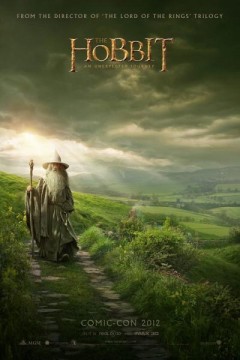
Peter Jackson’s upcoming saga The Hobbit will be three films , the director confirmed on his Facebook page. Previously, only a sequel had been confirmed. He called the expansion to three films “an unexpected journey indeed, and in the words of Professor Tolkien himself, ‘A tale that grew in the telling’.” “…On behalf of New Line Cinema, Warner Bros. Pictures, MGM and the entire [cast and crew], I’d like to announce that two films will become three.” The first installment, The Hobbit: An Unexpected Journey will hit theaters December 14, with the second film already set for December 13, 2013. Jackson made no mention of a schedule for the third film, but said after watching the first and shooting part of the second, a trilogy felt necessary. “It is only at the end of a shoot that you finally get the chance to sit down and have a look at the film you have made,” he said in his statement. “Recently I did just this when we watched for the first time an early cut of the first movie – and a large chunk of the second.” “We were really pleased with the way the story was coming together, in particular, the strength of the characters and the cast who have brought them to life.” “All of which gave rise to a simple question: Do we take this chance to tell more of the tale? The answer from our perspective as the filmmakers, and as fans, was an unreserved ‘Yes’.” “The richness of the story of The Hobbit, as well as some of the related material in the appendices of The Lord of the Rings, allows us to tell the full story, of the adventures of Bilbo Baggins and the part he played in the sometimes dangerous, but at all times exciting, history of Middle-earth,” wrote Jackson.
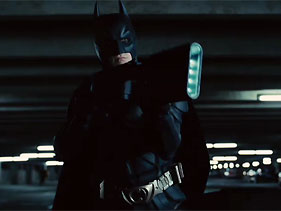
‘For me, movies are all about knowing the end of the story,’ the Batman filmmakers tells MTV News. By Josh Wigler, with reporting by Josh Horowitz Christian Bale as Batman in ‘The Dark Knight Rises’ Photo: Warner Bros. Pictures
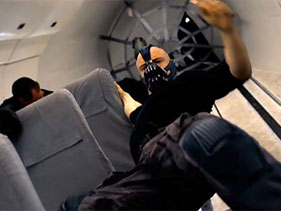
‘He didn’t have his face to help show the character and tell the story, [but] he did so much physically,’ Anne Hathaway says of her Batman co-star. By Josh Wigler, with reporting by Josh Horowitz Tom Hardy as Bane in ‘The Dark Knight Rises’ Photo: Warner Bros. Pictures
After creating a public persona with at least as much swagger as the character with whom he’s most strongly identified — Star Trek ’s Captain Kirk — it came as little surprise that the first thing William Shatner said at the beginning of Movieline’s interview for his new documentary was an explicit statement of purpose. “My film Get a Life is debuting July 28th on EPIX,” he said without being asked. “We’re going to show it at Comic-Con on Saturday – and we’re all excited about it.” Shatner is, deservedly, an icon: 45-plus years after first playing Kirk, he’s more beloved than ever, in great part because he has wholeheartedly embraced the adulation of hundreds of thousands of Trek fans. But in naming his documentary after the 1986 Saturday Night Live skit in which he jokingly challenged Trekkies to find something else to do with their time, he demonstrates that he’s not above a little self-satire, especially when it’s those fans who have continued to keep his career alive. That said, neither is he beyond some passing exasperation over hearing the same questions over and over again – evidenced most strongly when he’s finally asked something new. Shatner spoke to Movieline Wednesday morning from Kentucky, where he’s tending to his own obsession – horse breeding. While trying to get at what has made Star Trek such an enduring property, the actor revealed how he came to terms with being James T. Kirk, reflected on how the questions brought up in his first directorial effort, Star Trek V , were oddly answered 23 years later in Get a Life , and explained why fans probably shouldn’t ask him too many questions about Trek mythology. When you first started to examine why people continue to celebrate Star Trek , how in-depth did you intend to get? Was this meant to be sort of a reward for fans’ devotion or a video essay for you to try and understand it? Well, that’s exactly right. You know, the process of making a documentary is one of discovery, and like writing a story, you follow a lead and that leads you to something else and then by the time you finish, the story is nothing like you expected. And that’s the discovery I made – what you see happening to me on film is happening to me on film. I had no idea what to expect, and what I saw, my face reflected the astonishment of these various truths that came out that made it a far deeper experience than I ever thought of. How quickly did the examination become so existential? Was that something you saw in fans’ responses, or did that largely come from your conversation with the Joseph Campbell expert? That’s exactly right – from the fans’ responses, which led me to other fans that had a deeper understanding of what we were looking at, and then it just became exploration. And then bewilderment, and then wonderment! And it was something that was totally unexpected, and I expect that will be the audience’s experience as well – a totally unexpected observation of why people go to conventions, and about what the enduring fascination has been. So that’s the fascination, and that’s the secret behind the endurance of Star Trek – it has become part of the mythology of this culture. And nobody that I knew had a valid answer when I asked, “What do you think is the reason for the endurance of Star Trek , and why do you think people devote their lives to it, so much money and time, and bring their children to it?” The various answers I gave – science-fiction, the story, the appeal of the fact that we exist 300 years from now, all of those are part of it, but the real answer is more mystical than that. At what point did you decide to have that conversation with the Joseph Campbell expert? When I met him, the more I talked to him, the more fascinated I became, and so I decided to get a real setting and sit down and do a real interview. I’ve had some fun doing interviews in the past on television, and brought that experience to bear on him – and there was this whole philosophy laid out in front of me that put the whole documentary to a cohesive whole that I never expected. And had I not had it, it would be that much less. At what point did you really embrace or accept the fandom that your role as Kirk inspired? Quite a while ago. Over the years and talking to 10,000 people on an ad-lib basis, it kind of hones your skills for entertaining an audience in an [improvisational] way. And I began to use those experiences as a way of being an actor in front of an audience, and evolve stories and anecdotes that appeal to them. I wrote some books about it and ended up doing a one-man show about it last year – and we’ll be going out again this year – that exists because I’ve stood in front of large audiences not knowing what the next word coming out of my mouth was going to be. So I embraced the audiences a long time ago and sought to entertain them in various ways – this being one of them, the observation of what they are actually doing. How much are you able to apply the values and characteristics that fans see in Kirk into other creative ventures – to capitalize on the qualities that they seem to respond to? Well, the series appeals on a high moral level, that [Gene] Roddenberry engendered, and they’re universals – people are good, eventually people will be good, the evolvement of man is towards the positive, life will exist and we’ll work our way out of these problems. All of the positive aspects of life are there, and for me that certainly is a personal philosophy. How much at this point do you really know about Star Trek ? Can you go toe to toe with these fans and trade minutiae? No, no, no – I know nothing. My wife has to remind me of my name every so often. You know, it’s 40 years ago – why would I remember? It was a three-year job and then it was over, and then that was it. And then people began to remind me of what I had done. Which episode or part of the Trek world do you get asked about the most, and which do you find they ask about least, or seldom mention? There are many, many general questions, the likes of which you’re asking, and so, yeah, they’re just about what you think they are – your favorite episode, the philosophy, and why it has remained. Those questions still exist. But we sought in the documentary to bring this to another level to show these people – some in need, some in joy – but everybody being attracted to the Star Trek ideals, and yearning – that’s a word I haven’t used before – yearning for them to be true. And hoping, and living for that moment when the beauty that man can exude will be real and paramount. That’s what I think all of these people are looking for. What thing in your life gives you the same kind of passion – the fandom – that people show to Trek ? Well, right now I’m talking to you from Kentucky, where I’m competing for horses, in the horse world that I exist in for a large part of my life other than as an actor. My wife and I are totally involved in horses, and that is one of our great passions. And it’s interesting that I’m talking to you about Star Trek from another area of my life that makes me feel equally good. So in the way your fans know the mythology of the series, you would know the geneology of horses, maybe. Yes, exactly – you’re exactly right. The details of the horses are comparable to the details people ask me about Star Trek , only I think I’m far more knowledgeable about the horses than I am about Star Trek . Star Trek V , which you directed, confronted questions of faith and identity, and in retrospect it almost feels like you’re addressing the subtext of that film in this documentary. What an interesting observation. My God, man – that’s pure intelligence. My respect for you has increased enormously. That’s a wild conclusion, and yes, I agree with you. Had I known what I know now – because I had so many troubles and problems with getting the story for the search for God that Paramount wouldn’t let me make and Roddenberry wouldn’t let me make – I would have had more ammunition to convince them that the story I wanted to tell, and the story they forced me to tell made one or two compromises too many. That’s the lesson I learned on Star Trek V : When do you stand your ground and when do you compromise? We’re looking at that in our government right now, and that’s the problem with our government – everybody is standing on principle. Looking at that film and Get a Life as bookends, do you feel like you were asking questions then that you’re maybe finding answers for now? That’s right, man – you are absolutely right. I wanted to ask the question, if you were able to take a spaceship and find God, what would you find? And if you found the opposite, a fallen angel, what would you find? That’s the question I wanted to ask. That was going through my mind. Eric Van Lustbader used to write novels about an American in Japan and didn’t fit in in Japan, I wanted him to write that movie because he would have been the perfect guy to understand the philosophical questions being asked and put them into action. And the studio and Van Lustbader fought over the book right, and Van Lustbader never got to write the movie – which I think was a blow to what I would have liked to have done. So I never did accomplish in Star Trek V what I wanted to, but in this documentary, exploring those questions – where do we go, what do we do, what is mythology, what were the Greeks thinking when they made up those mythological beings, and what were they looking for. All of those questions that belonged to the universalities of man, those were some of the questions I wanted to ask in Star Trek V . And science-fiction allows us to do that because science-fiction is, in effect, the search for God. Absolutely. And that’s really all I have time to talk to you for. It’s a shame because your questions are now approaching unique – uniqueness. But I don’t have time for you. Todd Gilchrist is a Los Angeles-based film critic and entertainment journalist for a variety of online and print publications. You can follow his work via Twitter at @mtgilchrist . Read more from Comic-Con 2012 here. Follow Movieline on Twitter .