Tag Archives: style

INTERVIEW: ‘Teenage’ Filmmakers Matt Wolf & Jon Savage Make A Doc That Swings

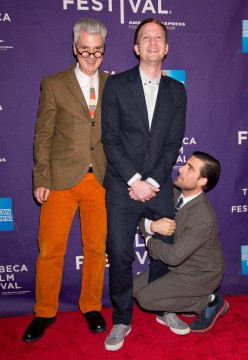
Teenage is as rebellious a film as the territory it covers. Based on punk author Jon Savage ‘s 2007 book Teenage: The Creation of Youth Culture 1875-1945 , Matt Wolf’s documentary eschews the talking heads and Chyroned dates that dominate the genre to immerse the moviegoer in a visually and aurally sumptuous history lesson. Wolf uses rare archival footage, period-piece recreations and a score by Deerhunter’s Bradford Cox to depict the evolution of teen culture via a number of influential and unconventional subcultures — swing kids, Boy Scouts, flappers, the German Wandervogel and even Nazi Youth — that coalesced from the late 19th century through the end of World War II. Understand them and today’s teens don’t seem so mystifying. I sat down with Wolf (he’s in the center of photo at left), Savage (he’s the one wearing orange pants) and the movie’s executive producer, actor Jason Schwartzman ( Moonrise Kingdom ) at the Tribeca Film Festival. Below is an edited version of our discussion: Movieline:  Jason, how did you get to be the executive producer of Teenage ?  Jason Schwartzman:  When Matt’s movie about Arthur Russell came out, Wild Combination , I saw it multiple times in the course of a couple days, told everybody that I could possibly tell about it and showed it to one of my best friends Humberto Leon , who owns the fashion company Opening Ceremony .  And when he saw that it was directed by Matt Wolf, he said, “Oh, Matt’s a really good friend of mine.”  One thing led to another and Humberto connected Matt and I to make a short film for his store opening in Japan. We spent a lovely beautiful afternoon together in Toronto. It was just a beautiful day, and I felt instantly connected to Matt.  I hope it’s okay that I say that. Matt Wolf: Please. Schwartzman: Does that make you feel uncomfortable? Wolf: No, I’m okay. Schwartzman: Too much pressure?  After that,  we started talking about books and music, and Matt said he was trying to make a documentary based on Jon Savage’s book Teenage . Being a fan of music and culture, I knew and loved Jon and was excited about this idea. And then a couple years later? Wolf: A year or two, I don’t know. Schwartzman: I reached out to Matt and said, “What’s going on with the movie?  Is there anything I can try to do?”  That began a process of getting the word out there and finding a way to finish the movie and make it happen. Movieline: You’ve taken a very unorthodox approach to making a non-fiction film. You call it “living collage.” Can you explain what you mean by that?  Matt Wolf:   When I read Jon’s book Teenage I didn’t just see it as source material.  It helped me imagine a philosophy for the filmmaking. John is well known for his book on punk,  England’s Dreaming , and in  Teenage,  he treated history in a punk way.  Early on in our collaboration, he told me about something he observed in the 1970s: He saw these teenage punks wearing thrift clothes from the ‘30s, ‘40s and ‘50s and they would cut them up and reassemble them with safety pins into something new.  He called that “living collage.”  It really struck a chord with me and made me think, “Well what about living collage as a kind of filmmaking style, where we pick and choose these kind of documents and fragments from previous youth cultures and reassemble them into something that feels fresh and new.”  And so living collage plays out visually in the way the film looks. In terms of the storytelling, the reason it probably feels unconventional is that, rather than telling the story with experts and historians, the film is told from the point of view of youth.  And in John’s book, a huge basis of it is actual quotes from teenagers that are sourced from diaries and journalistic sources and books.  And we kind of did a living collage of these quotes as well. You go so far as to not always identify who is talking. The moviegoer is essentially left to absorb what’s coming at him.  Jon Savage:  In an earlier edit we had lots of dates and times and Matt decided, and I thought it was a great idea, to actually take them out. Although it was good to have them, they were like the foundation. In any production, you have to start with a foundation and when the product is actually made, you don’t need [that foundation] any more.  It’s not as if you need to explain Hitler Youth to a lot of people. It’s interesting that you say that because I thought the movie flowed like a piece of music — a punk symphony, you could say. Wolf:  Yeah, that analogy makes sense to me, too. Music exists almost wall-to-wall through the film, and I perceive the voiceovers as being like lyrics. Very little of the archival footage we source has sound on it. . The voiceover is meant to provide a narrative foundation and to deepen the emotional impact of the film.  It’s also meant to provide context in a personal way where it’s helpful.  So kind of like lyrics in a song, you can just listen and hear it and have an emotional response to what you hear. Or that experience can be deepened by listening to the ideas in the lyrics. One of the first things I did when I started making this movie was to match archival footage to contemporary music that felt really transformational.  It felt like a departure from how we normally see archival footage being used. How did you come to use Deer Hunter’s Bradford Cox to score the movie? Wolf:   Bradford is my favorite contemporary musician, and we had actually corresponded as teenagers on an early blog that he ran. We reconnected over a music-themed film I made called Wild Combination years ago, and I approached him very early on in the process of Teenage to ask him if he’d like to score it.  He wrote back saying, “Yes,”  right away.  But, like I said, the film is wall-to-wall music, and I’ve also included some pre-existing songs in the film as well. Savage:  I gave Matt a hard drive. Wolf: Yeah, Jon gave me a lot of ideas for that music, too.  I think our shared taste in music also was a helpful starting point. Jon, should someone who plans to see Teenage read your book before or after watching the movie?  Savage:  Whichever way, but, actually, I think the movie stands on its own. War plays an important role in this movie: On one hand, it’s responsible for the cross-pollination of teen cultures from around the world. On the other, it turns teens into adults very quickly.  Wolf: It destroys them. At the beginning of this story, young people are perceived as a social problem.  They need to be controlled. They’re sent to war and what happens to them in World War I is a kind of foundational trauma that creates teenage rebellion as we know it. It creates generational tension, and it drives the whole story.  Then you have World War II, where young people are essentially sacrificed as cannon fodder by adults. But, at the same time, war stimulates the economy and enables teens to earn money and have a certain level of freedom.  It’s as consumers that teenagers become the ultimate stakeholders in societies. War can lead to the destruction of their innocence, but it can also empower them with a certain level of freedom in terms of time and space and economics.  War is the rear prism through which youth found their place in society. Savage: In our different ways, when I was doing the book and you were doing the film, we both fund the wartime stuff very hard. Wolf:   Totally. I think the Hitler stuff is really intense.  It’s at once totally intoxicating and absorbing. The reason Hitler and the Nazi experience for youth is a big part of the film is that Hitler both empowered and destroyed youth like no one else in history. In youth, he saw the potential to reimagine the world, but to very destructive and evil ends. It seems like every generation of adults laments how adventurous or promiscuous teens have become. But after watching this film, I wonder if that’s a myth. For instance, the German Wandervogel you depict from the late 19th and early 20th Centuries were quite free-spirited and daring.   Savage: The cycle is the same, but the circumstances are different.  Each generation has similar characteristics because it’s a physical and developmental stage of life that happens to everyone but within different societies and different context.  I think there’s always a proportion of teens that are going to be rebels.  There’s always a proportion that are going to be extremists and they’re always going to be the much larger proportion against whom the rebels and the extremists act: kids who just want to carry on and live life just like their parents did. Wolf: The focus of our film is these exceptional teenagers who are inventing new styles of communication, who are reimagining the future and the Wandervogel — this youth-led movement that’s incredibly liberated — is an example of that. Savage:  Matt found extraordinary footage that  hasn’t been seen. Schwartzman: I don’t believe that Wandervogel footage has ever been seen in a documentary.  It comes from a museum for youth movements in Germany who do not typically license out their footage. When I look at pop stars like Justin Timberlake and Justin Bieber, I feel like we’ve entered a period of extended adolescence.  Wolf:  The starting point for me has always been, why is the culture obsessed with youth and where does this obsession come from?  I do think that obsession has only intensified over time, but it’s hard to speculate about why that is. You mentioned the archetype of Justin Timberlake . In Teenage , we’re really finding the root and source of that, beginning with Rudolph Valentino, and with kids who fashioned their hair to look like him and who rioted at his funeral, and then progressing to Frank Sinatra , the first giant teen commercial pop star. Savage:  Matt’s totally right.  It has intensified because it’s become a huge industry.  I’m much older than [Matt and Jason] and when I was a teenager it wasn’t this thing it is now.  Since I was a young man, the whole area of pop culture and media has expanded exponentially. Wolf:  Films that are about youth culture are usually focused on the now, and I thought it was a provocative strategy to make a film about youth that is based completely in the past — not even the recent past, the distant past.  So it’s not working against the obsession with youth but it’s trying to attack the ideas and issue of youth culture in a totally different way.  Instead of making a film about punks and hippies and skaters and Justin Bieber , it’s about flappers and jitterbugs. Schwartzman: He is making a movie about the punks and the skaters and Bieber. It’s called Teenage 2. That was going to be my next question.  Would you consider making a Part 2?  Wolf:   Part of the reason Jon wrote the book in the style that he did is that, after the war, youth culture becomes this global phenomenon.  The American model of the teen years spreads everywhere.  It proliferates at such a rapid pace and is so gigantic that it’s probably not possible to explore the subject in a comprehensive way.  Looking at this pre-history that led up to the creation of the teenager felt like the perfect way to explore the themes and ideas of youth culture in a deeper sense. So, to me, this film completes the idea. Schwartzman: He had planned to go to the ’60s but he ran out of computer space. Savage: If I was able to do a follow-up to the book — and I think it would actually make a good film — I would go from ’45 to say ’54. Elvis. But then it just gets insane. The level of data  increases exponentially. Wolf:  And then it becomes like a TV special or a textbook that doesn’t really go deep into much at all.  After the war, it’s really difficult to not be just a greatest hits compilation. Watching Teenage left me with the distinct impression that if you had to choose the one medium that has had the most influence over youth culture, it would be music.  Savage:  Music is very, very important.  Again, from a European prospective, America’s great gift to the world is black American music. I’m still in awe of it after listening to it for 50 years, and to me one of the high spots of the film is the section about Swing. My single favorite piece of footage is the Chicago Swing Jamboree with 200,000 kids going crazy in 1938. There’s an integrated audience, everybody is going nuts you see this black American guy with a bowler hat — and he’s pogoing. That said it all to me. Wolf:   When I started making the film I thought it would be a deeper investigation of pop culture, but it ended up becoming much more political than I ever expected. I feel like the story of the German Swing Kids is the perfect synthesis of all the themes and the tension between politics and pop culture in the film. Here you have these kids who are like proto-punks:  They have wild fashion, they dress very flamboyantly, they’re smuggling in music from America, and they’re doing it as a form of rebellion against the Nazi regime. They don’t perceive themselves as activists, but they’re doing it with great courage. It shows the political power of popular culture in a certain context. The film is also about the spread of American culture throughout the world and music facilitated that like nothing else.  In the 1920’s, the British narrator says, “I got my hands on all the jazz records.  My mum asked me why it was good and I said, ‘Because it comes from America.'” Savage:  Swing looks to me like the proper birth of youth culture, certainly in a mass form, even more so than jazz in the ’20s. Wolf:   The Chicago Swing Jamboree is so meaningful because you see these teenagers pioneering this new style of expression and dance. It has its own slang, its own music vocabulary. Savage: It’s own lifestyle. Wolf: And it spreads to become a mainstream phenomenon. What’s next for each of you guys? Wolf:   I’m in the early stages of developing a bunch of projects. Jon and I are hoping to collaborate on a new film based on an unprecedented archive of gay life that this collector has.  It’s a personal photography collection of early gay life. I’m also working on a documentary portrait of Hilary Knight , the illustrator of Eloise . Savage: I’m writing a new book about the year 1966 in pop culture and youth culture. Schwartzman: I just finished a film about the making of Mary Poppins .  Sounds so dumb compared to what you guys just said. Follow Frank DiGiacomo on  Twitter. Follow Movieline on  Twitter. 

Read the original:
INTERVIEW: ‘Teenage’ Filmmakers Matt Wolf & Jon Savage Make A Doc That Swings
INTERVIEW: ‘Teenage’ Filmmakers Matt Wolf & Jon Savage Make A Doc That Swings

Teenage is as rebellious a film as the territory it covers. Based on punk author Jon Savage ‘s 2007 book Teenage: The Creation of Youth Culture 1875-1945 , Matt Wolf’s documentary eschews the talking heads and Chyroned dates that dominate the genre to immerse the moviegoer in a visually and aurally sumptuous history lesson. Wolf uses rare archival footage, period-piece recreations and a score by Deerhunter’s Bradford Cox to depict the evolution of teen culture via a number of influential and unconventional subcultures — swing kids, Boy Scouts, flappers, the German Wandervogel and even Nazi Youth — that coalesced from the late 19th century through the end of World War II. Understand them and today’s teens don’t seem so mystifying. I sat down with Wolf (he’s in the center of photo at left), Savage (he’s the one wearing orange pants) and the movie’s executive producer, actor Jason Schwartzman ( Moonrise Kingdom ) at the Tribeca Film Festival. Below is an edited version of our discussion: Movieline:  Jason, how did you get to be the executive producer of Teenage ?  Jason Schwartzman:  When Matt’s movie about Arthur Russell came out, Wild Combination , I saw it multiple times in the course of a couple days, told everybody that I could possibly tell about it and showed it to one of my best friends Humberto Leon , who owns the fashion company Opening Ceremony .  And when he saw that it was directed by Matt Wolf, he said, “Oh, Matt’s a really good friend of mine.”  One thing led to another and Humberto connected Matt and I to make a short film for his store opening in Japan. We spent a lovely beautiful afternoon together in Toronto. It was just a beautiful day, and I felt instantly connected to Matt.  I hope it’s okay that I say that. Matt Wolf: Please. Schwartzman: Does that make you feel uncomfortable? Wolf: No, I’m okay. Schwartzman: Too much pressure?  After that,  we started talking about books and music, and Matt said he was trying to make a documentary based on Jon Savage’s book Teenage . Being a fan of music and culture, I knew and loved Jon and was excited about this idea. And then a couple years later? Wolf: A year or two, I don’t know. Schwartzman: I reached out to Matt and said, “What’s going on with the movie?  Is there anything I can try to do?”  That began a process of getting the word out there and finding a way to finish the movie and make it happen. Movieline: You’ve taken a very unorthodox approach to making a non-fiction film. You call it “living collage.” Can you explain what you mean by that?  Matt Wolf:   When I read Jon’s book Teenage I didn’t just see it as source material.  It helped me imagine a philosophy for the filmmaking. John is well known for his book on punk,  England’s Dreaming , and in  Teenage,  he treated history in a punk way.  Early on in our collaboration, he told me about something he observed in the 1970s: He saw these teenage punks wearing thrift clothes from the ‘30s, ‘40s and ‘50s and they would cut them up and reassemble them with safety pins into something new.  He called that “living collage.”  It really struck a chord with me and made me think, “Well what about living collage as a kind of filmmaking style, where we pick and choose these kind of documents and fragments from previous youth cultures and reassemble them into something that feels fresh and new.”  And so living collage plays out visually in the way the film looks. In terms of the storytelling, the reason it probably feels unconventional is that, rather than telling the story with experts and historians, the film is told from the point of view of youth.  And in John’s book, a huge basis of it is actual quotes from teenagers that are sourced from diaries and journalistic sources and books.  And we kind of did a living collage of these quotes as well. You go so far as to not always identify who is talking. The moviegoer is essentially left to absorb what’s coming at him.  Jon Savage:  In an earlier edit we had lots of dates and times and Matt decided, and I thought it was a great idea, to actually take them out. Although it was good to have them, they were like the foundation. In any production, you have to start with a foundation and when the product is actually made, you don’t need [that foundation] any more.  It’s not as if you need to explain Hitler Youth to a lot of people. It’s interesting that you say that because I thought the movie flowed like a piece of music — a punk symphony, you could say. Wolf:  Yeah, that analogy makes sense to me, too. Music exists almost wall-to-wall through the film, and I perceive the voiceovers as being like lyrics. Very little of the archival footage we source has sound on it. . The voiceover is meant to provide a narrative foundation and to deepen the emotional impact of the film.  It’s also meant to provide context in a personal way where it’s helpful.  So kind of like lyrics in a song, you can just listen and hear it and have an emotional response to what you hear. Or that experience can be deepened by listening to the ideas in the lyrics. One of the first things I did when I started making this movie was to match archival footage to contemporary music that felt really transformational.  It felt like a departure from how we normally see archival footage being used. How did you come to use Deer Hunter’s Bradford Cox to score the movie? Wolf:   Bradford is my favorite contemporary musician, and we had actually corresponded as teenagers on an early blog that he ran. We reconnected over a music-themed film I made called Wild Combination years ago, and I approached him very early on in the process of Teenage to ask him if he’d like to score it.  He wrote back saying, “Yes,”  right away.  But, like I said, the film is wall-to-wall music, and I’ve also included some pre-existing songs in the film as well. Savage:  I gave Matt a hard drive. Wolf: Yeah, Jon gave me a lot of ideas for that music, too.  I think our shared taste in music also was a helpful starting point. Jon, should someone who plans to see Teenage read your book before or after watching the movie?  Savage:  Whichever way, but, actually, I think the movie stands on its own. War plays an important role in this movie: On one hand, it’s responsible for the cross-pollination of teen cultures from around the world. On the other, it turns teens into adults very quickly.  Wolf: It destroys them. At the beginning of this story, young people are perceived as a social problem.  They need to be controlled. They’re sent to war and what happens to them in World War I is a kind of foundational trauma that creates teenage rebellion as we know it. It creates generational tension, and it drives the whole story.  Then you have World War II, where young people are essentially sacrificed as cannon fodder by adults. But, at the same time, war stimulates the economy and enables teens to earn money and have a certain level of freedom.  It’s as consumers that teenagers become the ultimate stakeholders in societies. War can lead to the destruction of their innocence, but it can also empower them with a certain level of freedom in terms of time and space and economics.  War is the rear prism through which youth found their place in society. Savage: In our different ways, when I was doing the book and you were doing the film, we both fund the wartime stuff very hard. Wolf:   Totally. I think the Hitler stuff is really intense.  It’s at once totally intoxicating and absorbing. The reason Hitler and the Nazi experience for youth is a big part of the film is that Hitler both empowered and destroyed youth like no one else in history. In youth, he saw the potential to reimagine the world, but to very destructive and evil ends. It seems like every generation of adults laments how adventurous or promiscuous teens have become. But after watching this film, I wonder if that’s a myth. For instance, the German Wandervogel you depict from the late 19th and early 20th Centuries were quite free-spirited and daring.   Savage: The cycle is the same, but the circumstances are different.  Each generation has similar characteristics because it’s a physical and developmental stage of life that happens to everyone but within different societies and different context.  I think there’s always a proportion of teens that are going to be rebels.  There’s always a proportion that are going to be extremists and they’re always going to be the much larger proportion against whom the rebels and the extremists act: kids who just want to carry on and live life just like their parents did. Wolf: The focus of our film is these exceptional teenagers who are inventing new styles of communication, who are reimagining the future and the Wandervogel — this youth-led movement that’s incredibly liberated — is an example of that. Savage:  Matt found extraordinary footage that  hasn’t been seen. Schwartzman: I don’t believe that Wandervogel footage has ever been seen in a documentary.  It comes from a museum for youth movements in Germany who do not typically license out their footage. When I look at pop stars like Justin Timberlake and Justin Bieber, I feel like we’ve entered a period of extended adolescence.  Wolf:  The starting point for me has always been, why is the culture obsessed with youth and where does this obsession come from?  I do think that obsession has only intensified over time, but it’s hard to speculate about why that is. You mentioned the archetype of Justin Timberlake . In Teenage , we’re really finding the root and source of that, beginning with Rudolph Valentino, and with kids who fashioned their hair to look like him and who rioted at his funeral, and then progressing to Frank Sinatra , the first giant teen commercial pop star. Savage:  Matt’s totally right.  It has intensified because it’s become a huge industry.  I’m much older than [Matt and Jason] and when I was a teenager it wasn’t this thing it is now.  Since I was a young man, the whole area of pop culture and media has expanded exponentially. Wolf:  Films that are about youth culture are usually focused on the now, and I thought it was a provocative strategy to make a film about youth that is based completely in the past — not even the recent past, the distant past.  So it’s not working against the obsession with youth but it’s trying to attack the ideas and issue of youth culture in a totally different way.  Instead of making a film about punks and hippies and skaters and Justin Bieber , it’s about flappers and jitterbugs. Schwartzman: He is making a movie about the punks and the skaters and Bieber. It’s called Teenage 2. That was going to be my next question.  Would you consider making a Part 2?  Wolf:   Part of the reason Jon wrote the book in the style that he did is that, after the war, youth culture becomes this global phenomenon.  The American model of the teen years spreads everywhere.  It proliferates at such a rapid pace and is so gigantic that it’s probably not possible to explore the subject in a comprehensive way.  Looking at this pre-history that led up to the creation of the teenager felt like the perfect way to explore the themes and ideas of youth culture in a deeper sense. So, to me, this film completes the idea. Schwartzman: He had planned to go to the ’60s but he ran out of computer space. Savage: If I was able to do a follow-up to the book — and I think it would actually make a good film — I would go from ’45 to say ’54. Elvis. But then it just gets insane. The level of data  increases exponentially. Wolf:  And then it becomes like a TV special or a textbook that doesn’t really go deep into much at all.  After the war, it’s really difficult to not be just a greatest hits compilation. Watching Teenage left me with the distinct impression that if you had to choose the one medium that has had the most influence over youth culture, it would be music.  Savage:  Music is very, very important.  Again, from a European prospective, America’s great gift to the world is black American music. I’m still in awe of it after listening to it for 50 years, and to me one of the high spots of the film is the section about Swing. My single favorite piece of footage is the Chicago Swing Jamboree with 200,000 kids going crazy in 1938. There’s an integrated audience, everybody is going nuts you see this black American guy with a bowler hat — and he’s pogoing. That said it all to me. Wolf:   When I started making the film I thought it would be a deeper investigation of pop culture, but it ended up becoming much more political than I ever expected. I feel like the story of the German Swing Kids is the perfect synthesis of all the themes and the tension between politics and pop culture in the film. Here you have these kids who are like proto-punks:  They have wild fashion, they dress very flamboyantly, they’re smuggling in music from America, and they’re doing it as a form of rebellion against the Nazi regime. They don’t perceive themselves as activists, but they’re doing it with great courage. It shows the political power of popular culture in a certain context. The film is also about the spread of American culture throughout the world and music facilitated that like nothing else.  In the 1920’s, the British narrator says, “I got my hands on all the jazz records.  My mum asked me why it was good and I said, ‘Because it comes from America.'” Savage:  Swing looks to me like the proper birth of youth culture, certainly in a mass form, even more so than jazz in the ’20s. Wolf:   The Chicago Swing Jamboree is so meaningful because you see these teenagers pioneering this new style of expression and dance. It has its own slang, its own music vocabulary. Savage: It’s own lifestyle. Wolf: And it spreads to become a mainstream phenomenon. What’s next for each of you guys? Wolf:   I’m in the early stages of developing a bunch of projects. Jon and I are hoping to collaborate on a new film based on an unprecedented archive of gay life that this collector has.  It’s a personal photography collection of early gay life. I’m also working on a documentary portrait of Hilary Knight , the illustrator of Eloise . Savage: I’m writing a new book about the year 1966 in pop culture and youth culture. Schwartzman: I just finished a film about the making of Mary Poppins .  Sounds so dumb compared to what you guys just said. Follow Frank DiGiacomo on  Twitter. Follow Movieline on  Twitter. 

Read the original:
INTERVIEW: ‘Teenage’ Filmmakers Matt Wolf & Jon Savage Make A Doc That Swings

Amanda Bynes Shaves Half Her Head

Don’t call her “troubled actress.” Don’t call it “erratic behavior.” This is just the new Amanda Bynes, ladies and gentleman. The Twitter-loving self-obsessed (her words) celebrity often complains about people using old photos of her. This week, she found a proactive solution. “I buzzed half my head like [Cassie]! No more old photos! It’s the new me! I love it!” Amanda Bynes wrote on Twitter, debuting her half-shaved head: Bynes’ latest selfies show a nice curled updo that really accentuates the buzzed sides. Will she shave the rest off? We will have to stay tuned, THGers. What do you think of Amanda Bynes’ new look?   Love it! Edgy and hot! Not a fan! Look doesn’t do it for me! I don’t know, but this chick is bat$h!t insane. View Poll »

Read the original here:
Amanda Bynes Shaves Half Her Head

Shady Fox “Faux” News Network Says President Obama Won’t Slander Islam After Boston Marathon Bombing Because He’s Actually Muslim

Fox News Says President Obama’s “Muslim Faith” Is To Blame For Lack Of Islam Slander In true right-wing radical fashion, Fox News has now implied that President Obama’s “Muslim faith” background is the reason why he won’t condemn all Muslims in the wake of the Boston Marathon Bombings. via Think Progress Fox News is sounding the alarm about Muslim extremists in the aftermath of the Boston bombings and is using the tragedy to argue that President Obama is too weak or afraid to confront the threat. A day after Fox News host Bill O’Reilly wondered why Obama refused to condemn radical Islam before the Boston bombers’ motives were known, the network suggested that Obama’s middle name might provide the answer. Radio host Bill Cunningham implied, while appearing on Sean Hannity’s program, that Obama’s upbringing in Indonesia prevents him from opposing terrorism: CUNNINGHAM: Sean Hannity, maybe his middle name is a clue, as well as the fact that he spent his childhood practicing the Muslim faith. I think — of course he’s a Christian now, but we have to understand where he came from. He says the sweetest sound he ever heard was prayers at sunset. So with that orientation, I think it’s hard for this to say anything other than “Muslim jihadist terrorist” because it runs contrary to what he was taught as a boy in Honolulu and Jakarta, Indonesia. These fools have no boundaries to how far they will reach. SMH.

The rest is here:
Shady Fox “Faux” News Network Says President Obama Won’t Slander Islam After Boston Marathon Bombing Because He’s Actually Muslim

Jesus Take The Wheel: Daughter Finds Out Mother Is Among The 230 Dead In Bangladesh Building Collapse

Pray for the people in Bangladesh ! Daughter Finds Out Mother Is Among The Dead In Primark Factory Disaster According to Mail Online Bangladeshi rescue workers are continuing their increasingly desperate search for survivors in a collapsed clothes factory building where workers made cheap clothes for Primark. Hundreds were killed when the eight-story Rana Plaza in Savar on the outskirts of Dhakar collapsed yesterday, the day after cracks were seen in its walls. The death toll continues to rise and currently stands at more than 230. Forty people have been pulled alive from the rubble today. Many of those working in the building at the time were young women, while some of those killed and injured are bound to be children as the building also housed a crèche. Around 2,000 people have so far been pulled out alive. Doctors at local hospitals said they were unable to cope with the number of victims arriving from the disaster site. This afternoon workers still trapped could be heard crying out for help as firefighters and soldiers using drilling machines and cranes struggled to reach them. Officials say police had ordered the building evacuated on Tuesday, the day before its deadly collapse, after deep cracks became visible in its walls. But the factories flouted the order and managers ordered their staff to keep working. Some survivors have said they were threatened with the sack if they refused to enter the building. After the cracks were reported, managers of a local bank that also had an office in the building evacuated their workers. The garment factories, though, kept working, ignoring the instructions of the local industrial police, said Mostafizur Rahman, a director of that paramilitary police force. The Bangladesh Garment Manufacturers and Exporters Association had also asked the factories to suspend work starting on Wednesday morning, hours before the collapse. ‘After we got the crack reports, we asked them to suspend work until further examination, but they did not pay heed,’ said Atiqul Islam, the group’s president. Today the smell of rotting bodies wafted through holes cut into the building. Junior minister for Home Affairs, Shamsul Haque, said a total of 2,000 people had so far been rescued from the wreckage. Brigadier General Mohammed Siddiqul Alam Shikder, who is overseeing army rescue teams, said the death toll had climbed to 194. Dozens of bodies, their faces covered, were laid outside a local school building so relatives could identify them. Thousands of workers’ family members gathered outside the building, waiting for news, as thousands of garment workers from nearby factories took to the streets across the industrial zone in protest. General Shikder said rescue operations were progressing slowly. He said rescue teams were standing by with heavy equipment and would ‘start bulldozing the debris once we get closer to the end of the operation. ‘But now we are careful,’ he added He also said the size of the crowd was interfering with getting more rescuers to the scene. ‘We are ready with about 1,000 soldiers and rescue workers from other departments. But a huge crowd is obstructing our effort,’ he said. Searchers worked through the night to probe the jumbled mass of concrete with drills or their bare hands, passing water and flashlights to people pinned inside. Sumi, a 25-year-old worker who goes by one name, said she was sewing jeans on the fifth floor with at least 400 others when the building fell. ‘It collapsed all of a sudden,’ she said. ‘No shaking, no indication. It just collapsed on us.’ She said she managed to reach a hole in the building where rescuers pulled her out. Survivor Shaheena Akhter, 23, said: ‘Some of us did not want to work fearing something might happen, but the garment factory people told us that we had to join our work otherwise we will lose our jobs.’ Abdul Halim, an official with the engineering department in Savar, said the owner was originally allowed to construct a five-story building but he added another three stories illegally. Local police chief Mohammed Asaduzzaman said police and the government’s Capital Development Authority have filed separate cases of negligence against the building owner. Habibur Rahman, police superintendent of Dhaka district, identified the owner as Mohammed Sohel Rana, a local leader of ruling Awami League’s youth front. Mr Rahman said police were also looking for the owners of the garment factories. Among the textile businesses in the building were Phantom Apparels, New Wave Style, New Wave Bottoms and New Wave Brothers. Primark’s ethical trade team is working to collect information, assess which communities the workers come from and provide support ‘where possible’, the company said. Charles Kernaghan, executive director of the Institute for Global Labour and Human Rights, which has an office in Dhaka, says his staff are investigating. ‘You can’t trust many buildings in Bangladesh,’ Mr Kernaghan said. ‘It’s so corrupt that you can buy off anybody and there won’t be any retribution.’ Do you think the owner of the garment factory is to blame for threatening the factory workers’ jobs if they did not work? Getty

The rest is here:
Jesus Take The Wheel: Daughter Finds Out Mother Is Among The 230 Dead In Bangladesh Building Collapse

Justin Bieber Debuts Koi Fish Tattoo On Forearm! | MTV Style

Excerpt from:

Hi, Justin Bieber . *waves* It's us again. Listen, we know only a weekend went by since we last dished on your statement-making accessories (he sported a Chanel ski mask for those that missed it), but here we are Monday … See the rest here: Justin Bieber Debuts Koi Fish Tattoo On Forearm! | MTV Style

Justin Bieber Debuts Koi Fish Tattoo On Forearm! | MTV Style

Let’s Discuss Justin Bieber’s Chanel Ski Mask | MTV Style

Justin Bieber wore a Chanel logo ski mask and posted it to Instagram. See the article here: Let's Discuss Justin Bieber's Chanel Ski Mask | MTV Style

See more here:
Let’s Discuss Justin Bieber’s Chanel Ski Mask | MTV Style

Psy’s ‘Gentleman’ Nears 125 Million Views, But Can It Match ‘Gangnam Style’?

‘He set the bar pretty high to match the success of ‘Gangnam Style,’ ‘ says Billboard ‘s Silvio Pietroluongo. By Gil Kaufman Psy’s “Gentleman” artwork Photo: School Boy Records

Original post:
Psy’s ‘Gentleman’ Nears 125 Million Views, But Can It Match ‘Gangnam Style’?

Demi Lovato Thickness in a Bikini in Barbados of the Day

Lookin’ Good Sweetheart. You’d think Demi Lovato would try to get in shape at least a few months before getting into a bikini for the paparazzi to snap off pics of her… I mean unless she’s into a barrel of a body, all rounded out and filled with cellulite, spilling over her bikini… Maybe she saw Spring Breakers and in her medicated bi-polar, Selena Gomez hating state, because back in 2010 they had a falling out, thought that chunky in a bikini is the style of their generation thanks to growing up on High Fructose Corn Syrup and laziness…. Either way, it’s not hot to me….but you probably like it cuz being American, this body looks fit to you…. TO SEE THE REST OF THE PICS FOLLOW THIS LINK

Read this article:
Demi Lovato Thickness in a Bikini in Barbados of the Day

Zoe Kravitz Bikini Top for Vaga Magazine of the Day

I kinda hate Zoe Kravitz. She’s just some Lisa Bonet x Lenny Kravitz, rich brat who has decided she’s a fashion model, or fashion icon, because the media wrote about how cool her style was, cuz the media loves rich kids of rockstars and light skinned bitches from the Cosby Show you may have masturabted to, cuz she was the most accessible for white America to accept in that black doctor who wasn’t just called the doctor cuz he was a drug dealer and lawyer who wasn’t just representing herself in court in their fantasy household…not that you remember the Cosby Show. That was 30 years ago. The reason I kinda hate Zoe Kravitz is that when she peaked during her HARD NIPPLE PHOTOSHOOTS she blocked me on twitter and that’s just rude, a personality trait typical of cunty rich kids who have people everywhere stroking their ego cuz of who their parents are, but still behavior I hate. Here she is in a bra or bikini top, sucking. The highlight of this photoshoot is that the magazine is called VAGINA

See original here:
Zoe Kravitz Bikini Top for Vaga Magazine of the Day