Tag Archives: subway

Rachel Maddow’s Shabby Reportage on Iraq Extends to Iraq Itself

Here is how the Wall Street Journal began its lead editorial, “Victory in Iraq,” on Aug. 20 — When the men and women of Fourth Brigade, Second Infantry Division deployed to Iraq in April 2007 as part of President Bush’s surge, American soldiers were being killed or wounded at a rate of about 750 a month, the country was falling into sectarian mayhem, and Senate Majority Leader Harry Reid had declared that the war was ‘lost.’ On Wednesday, the ‘Raiders’ became the last combat brigade to leave Iraq, having helped to defeat an insurgency, secure a democracy and uphold the honor of American arms. For viewers of NBC and MSNBC earlier that week, the title of Fourth Brigade, Second Infantry Division would likely have struck a chord — on Aug. 18, both networks interrupted their scheduled broadcasts with exclusive live coverage of the brigade crossing the border into Kuwait, the last US combat brigade to leave Iraq. The two networks’ coverage went far beyond that, however. NBC’s chief foreign correspondent, Richard Engel, was embedded with the brigade as it left Iraq while MSNBC cable show host Rachel Maddow weighed in from Baghdad. Maddow remained in Iraq for the rest of the week, broadcasting four hours of her show from there, an hour more than usual. Yet through all that coverage, much of it focused on this specific combat brigade’s departure from Iraq, at no time did Maddow (nor any of her NBC/MSNBC colleagues appearing on her show) mention when the brigade went to Iraq — in April 2007, at the start of the much-maligned surge that was surely doomed to fail. Or so we were repeatedly told. Not that Maddow was obligated to mention the surge in her lede, as it were, as did the Wall Street Journal (on the opposite side of the political divide) in its editorial. But surely she could have cited it even once during her three days in Baghdad. Then there was Maddow’s arch retelling of recent Iraqi history (first part of embedded video) — The history of Iraq for the last generation is, Saddam taking power, a decade of the war with Iran, where we took Iraq’s side, then the first American war, then a decade of sanctions, then the second American war, toppling Saddam, presiding over a civil war, and now there’s us leaving. After all that, good luck! Hope it all works out for you guys! I was reminded of this specific Maddow revisionism while watching her show on Wednesday, when she began a segment claiming this (second part of video) — I am a crier. Some people cry at the sound of Harry Chapin’s ‘Cat’s in the Cradle,’ others at ‘Old Yeller’ or the end of ‘Where the Red Fern Grows’ where Billy visits his dogs’ graves. I cry at those things too. But the one surefire way to see tears streaming down these cheeks is a live rendition of our nation’s national anthem. It doesn’t matter if it’s a baseball game or an ad for a pickup truck or, God forbid, a busker on the subway, it’s just one of those things, some people like me are hard-wired to sob by the time the broad stripes and bright stars are so gallantly streaming. How noble indeed. More people might believe this if Maddow were not so willing to imply moral equivalence between the butchery of Saddam’s totalitarian regime and American efforts to thwart his lawlessness after Iraq invaded Kuwait in 1990. At the end of her stint in Baghdad, Maddow reported from the home of a “working class, poor Shiite family” (third and final part of video) — … and they’ve agreed to talk with me a little bit about, you know, what everybody likes to talk about over dinner — politics, war and George Bush. … followed by Bush not coming up in the discussion, as can be seen in the segment in its entirety on Maddow’s MSNBC site. Here was an infrequent example of something on Maddow’s show that piqued my interest — what would a “working class, poor Shiite family” in Baghdad say about George W. Bush? One safely assumes from the fact Maddow is teasing this that the Iraqis will excoriate Bush. But if they did, it somehow didn’t make it into the segment that ran. Most likely scenario — Maddow said this before the interview when she intended to ask her Iraqi hosts about Bush, followed by her forgetting to do so and them not mentioning him. Another scenario that can’t be ruled out — any of the Iraqis praising Bush, thereby ensuring that such blasphemy would not be heard by Americans watching MSNBC.

Originally posted here:
Rachel Maddow’s Shabby Reportage on Iraq Extends to Iraq Itself

WaPo Frets ‘Hostility’ Could Radicalize Young Muslims

With the eager help of the Council of American Islamic Relations (CAIR) and others, the liberal media have warned of and bemoaned an anti-Muslim backlash since 9-11. Unfortunately for them, the evidence never bore that out . Now they think the wait is finally over, and they’re hitting the anti-Islam hate meme with gusto. Case in point: the front page of the Washington Post’s Metro section on Aug. 27. “Hostility across U.S. jars young Muslims,” read the headline. Author Tara Bahrampour focused on Muslim students at local D.C.-area colleges and their reaction to the “swelling hostility that many of these students had scarcely known was there …” Evidence of “swelling hostility? For weeks, their faith had been under attack by some opponents of a proposed Islamic center near Ground Zero. Every time they turned on the TV, there were new reports of anti-Muslim sentiment: mosque construction being opposed hundreds of miles from Ground Zero; a Florida pastor vowing to burn copies of the Koran to mark the anniversary of Sept. 11; a poll showing that 43 percent of Americans hold unfavorable views of Muslims. And just this week, a Muslim cabbie was stabbed in New York. Certainly, there are unfortunate incidents that all Americans should condemn, and voices that should be ignored. But they hardly constitute a Mulsim-targeted kristallnacht. To the frustration of the media , the Muslim cabbie who was stabbed opposed the mosque, and his attacker – no right winger – worked for an organization that supports it . Yet Bahrampour and the sources she quoted escalated perceived slights and differences of opinion into “a civil rights issue.” She used the isolated incident of a Muslim teenager becoming upset about the ravings of a lone individual on the subway to suggest that mosque opposition will create “homegrown terrorism.” “That anger, youth leaders and terrorism experts warn, could push some young Muslims into the arms of such extremists as U.S.-born cleric Anwar al-Aulaqi,” she wrote. In his recruiting efforts, Aulaqi often portrays Islam as being under attack by the West.” (Interestingly, Bahrampour failed to note that al-Aulaqi was once celebrated by her newspaper as a moderate “Muslim leader who could help build bridges between Islam and the West,” and even had him host a web Q & A on its site.) She quoted Georgetown University’s Yahya Hendi, a Muslim chaplain. “The most vociferous mosque opponents ‘do not know what they are doing … They are radicalizing people.'” Once again, the onus is on Americans, not on those who could be turned to terror by public disagreements, perceived insults and isolated acts of violence.

Read this article:
WaPo Frets ‘Hostility’ Could Radicalize Young Muslims

Taylor Swift’s ‘You Belong With Me’ Video Inspired 2009 VMA Performance

‘I did get inspiration from her videos, and I was inspired by her,’ choreographer Danielle Flora says of show-stopping subway rendition. By Jocelyn Vena Taylor Swift in her “You Belong With Me” music video Photo: Big Machine Records At the 2009 Video Music Awards, Taylor Swift not only took over the subway for her show-stopping rendition of her VMA-winning hit, “You Belong With Me,” but she also took over Sixth Avenue and sang her heart out in a girly, apple-red dress. Choreographer Danielle Flora, who worked with the singer on the performance, admits that her Lucas Till-starring video played a major role in the staging and choreography of the performance. “I did seek a lot of inspiration from her video. I mean, I think it’s important to know someone’s work and what they’ve done, especially if you’re going to be choreographing for them,” Flora told MTV News. “You need to know what their style is and what they like and … really understand who they are. And I think I did get inspiration from her videos, and I was inspired by her.” As it turns out, Swift herself was as much an inspiration as the Roman White-directed video. “She is pretty amazing. I am inspired by her songwriting abilities,” she said. “She is a very interesting girl. She is a very smart girl.” In the video, Swift plays two characters, the nice girl next door and the raven-haired bad girl. In real life, as expected, Swift, who is set to release her new video, “Mine,” on Friday (August 27), is definitely more of the former. “Taylor Swift is exactly what you see. I mean, it’s not a front that she puts on,” Flora said of the megastar. “She actually really is the nice girl. She is gracious and thankful and she goes the extra mile to thank people and she works really hard and that also extends to the people around her. Everyone around her, her supporting crew, is awesome, too.” That made working with Swift for her “You Belong With Me” VMA performance that much more enjoyable. “It’s really nice. It makes everyone else’s jobs so much easier and you know she really is just a nice girl,” Flora said. Related Videos Frame By Frame: Taylor Swift’s ‘You Belong With Me’ Music Video Gearing Up For The 2010 VMAs! Related Artists Taylor Swift

See the original post here:
Taylor Swift’s ‘You Belong With Me’ Video Inspired 2009 VMA Performance

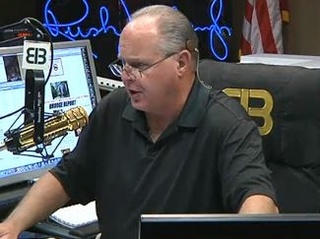
Daily Kos F-Bombs Rush Limbaugh With Profane Rants, Blames Him for Tea Party’s ‘Oxygen-Starved Brains’

Here’s another item for Bill Press and his ridiculous conceit that left-wingers are so much more civil than the “toxic talk” being emitted on right-wing radio. The Daily Kos blog now features a vicious, profanity-polluted blog post by “Brainspank” attacking Rush Limbaugh with the less-than-charming title the “Human S—smear.” He attacks Limbaugh for spreading an idiocy infection to “oxygen-starved brains” in the Tea Party:  If you listen to this guy and you believe a single word he says, you’re an idiot.  A lost cause.  I’m not talking to you and I’m not writing this for your benefit.  You are proof of the 1/4 paradigm.  Common sense and logic are lost on you.  The 1/4 paradigm are those that still supported Nixon after he was forced to resign.   The 25% percent who still believed in the idiot Dumbya when he left office and the rest of us in a s–tstorm.  You people are incurably stupid.  You still think Jesus Christ will be here to save you personally before you die.  I’m not talking to you.  As far as I’m concerned, you people are worthless human stains who’s only potential contribution to anything at all would be polluting the gene pool. And you do.  You reproduce without thought and it really worries me.  A whole ‘nother round headed generation of thick tongued, uneducated, bible thumping backward ass morons. This is all been great fun.  I’d debate the slow eyed prick bastard any day of the week.  Seriously, at a moments notice I’d take him on, and if were allowed to talk, I’d destroy him.  I would wipe the airwaves with him and I’m by no means an exception.  Just about any one of the 95% percent of Americans that don’t listen to him could acquit themselves quite nicely if given the opportunity.  We all know that’s not going to happen; callers with an opposing point of view on the “EIB” network are about as common as OxyContin addicts in the mesozoic era. But the point is this.  He’s dangerous.  Because of him and egregious a–holes of his ilk, we have a bunch of mouth breathing idiots walking around calling themselves the Tea Party.  We have Sharron Angle and Rand Paul and a growing number of oxygen starved brains that are willing to resort to violence because of an ideology that they haven’t the capacity to even grasp. “Brainspank” wrapped it up by hoping that Limbaugh and his dittoheads would die like crackheads:  They are the mentally handicapped.  Unable or unwilling to think for themselves and all too inclined to let a semi clever reptile do what they honor as the intellectual heavy lifting.  They will listen and follow and worship, no matter what. Let him have his little universe.  What would America be like with a blackout of all things S—smear?  Think about it.  A much better place.  F— this piece of s—.  Shut him down and shut him out.  Pay no attention.  Keep moving.  Nothing to see here. Crackheads will be crackheads and will sooner or later overdose on crack and there is not a thing we can do about it. [Hat tip: Whistling Straights]

Go here to read the rest:
Daily Kos F-Bombs Rush Limbaugh With Profane Rants, Blames Him for Tea Party’s ‘Oxygen-Starved Brains’

Newsweek Puff Piece on Al Sharpton Distorts Reality

The transformation of Reverend Al Sharpton from street provocateur to civil rights eminence ranks as one of the more remarkable image makeovers in American public life. And mainstream journalism has played a central role. Anyone doubting as much should read the recent (August 2) cover story of Newsweek magazine,  “The Reinvention of the Reverend.”  Written by Allison Samuels and Jerry Adler, the article is a fawning and misleading portrait of the Harlem-based preacher/politician. The piece doesn’t quite beatify Sharpton. But it does make a highly selective use of information, some of it factually wrong, in stating the case for “the Rev,” as he is commonly known, as a moral conscience of the nation. It also stands as an example, as if any more were needed, that “diversity” in the newsroom isn’t about a diversity of opinion.  Reverend Sharpton, as National Legal and Policy Center often has noted, has a long history of public demagoguery in the service of civil rights. In the spring of 2009 NLPC released a lengthy Special Report (which I had written) documenting how Sharpton has used his social standing among many fellow blacks to transform a crime, or an allegation of it, into collective moral grievance. His style follows a distinct pattern. First, he receives word of a black or blacks allegedly victimized by white civilians or cops. Should he be sufficiently outraged, he will insist on serving as that person (and his or her family’s) “adviser.” At that point, he will launch a nonstop media-focused campaign in the streets designed to mobilize public opinion in favor of the victim and against the opposition. In his mind, blacks continue to be second-class citizens, their cries for justice all but ignored by powerful elites. Thus, these elites must feel the heat of the street. In his 2002 autobiography, “Al on America,” he writes (pp. 93, 95): “To many in America, racism is a thing of the past. It’s something that happened ‘back then.’ To millions of blacks in this country, it is something we live with every day…(T)he outcome of my marches is one of the reasons why I will always be considered ‘controversial’ in some circles – because I rip the veil off Northern established liberal racism.” It’s true that Al Sharpton doesn’t project the buffoonish swagger and menace that launched his career as an A-list provocateur around 25 years ago and carried him through the Nineties. To some extent, that’s a product of aging. Now 55, he would look doubly foolish remaining in his old guise, pompadour hairstyle intact. But more significantly, he doesn’t have to project menace. He knows he can accomplish far more with his America-is-still-racist-country message by affecting statesmanlike dignity. Over the years the man has cultivated many friends and allies in the top echelons of politics, business, labor, philanthropy, clergy and entertainment. His New York-based nonprofit organization, National Action Network, enjoys generous financial support from corporations such as Coca-Cola, Home Depot, Macy’s, Toyota and Wal-Mart. He has become a Democratic Party kingmaker in New York City. And he’s reached across that proverbial aisle, befriending such conservative politicians and media stars as Republican National Chairman Michael Steele, former House Speaker Newt Gingrich and Fox News Channel talk show host Bill O’Reilly. With the help of his top aide and media consultant, Rachel Noerdlinger (herself an underrated figure), he’s become The Man to See. Not less than eight times since President Obama’s inauguration, he’s been a White House guest. At his core, Rev. Sharpton is still the same man, something he doesn’t hesitate to point out. The Newsweek article quotes him: “My mission, my message, and everything else about me is the same as always. The country may have changed, but I haven’t.” But his evolution in style, as opposed to beliefs, has everything to do with why mainstream media, generally dismissive of Sharpton during the Eighties, Nineties and even his run for the presidency in 2004, now appears almost lovestruck. No longer an embarrassing spectacle, he’s become Sensible and Dignified, a pragmatic facilitator of an overdue “national conversation” on race. Even more than Jesse Jackson, he is the presumptive heir to Martin Luther King, wielding his church- and street-bred wisdom to “heal” America. Typical of this view is an article appearing this March in the Wall Street Journal by Peter Wallsten titled, “Obama’s New Partner: Al Sharpton,” which hopefully took note of Sharpton’s emergence as a key confidante of President Obama. Now here come Newsweek’s Allison Samuels and Jerry Adler with a full-fledged cover story. It’s a puff job – often informative and nuanced, but still a puff job whose intent is image enhancement. Lead author Samuels herself is black; she in fact had authored a post-election celebration piece in 2008 in that magazine’s heralding the impending arrival of Michelle Obama as First Lady ( “What Michelle Means to Us” ). This latest article, not unexpectedly, takes any number of facts out of context and inserts some suspect ones. Consider the opening sentences: If the Rev. Al Sharpton didn’t exist, he would have had to be invented. In fact, the novelist Tom Wolfe has claimed he did invent him, in the character of the Reverend Bacon, a supporting figure in The Bonfire of the Vanities. Each generation of black America gives birth to its own incarnation of the charismatic preacher-activist who confronts the white power structure in the streets and talks circles around it on Meet the Press. Just a few months after the fictional Bacon made his appearance in 1987, the real Sharpton burst onto the national stage as the fiery advocate for Tawana Brawley, a New York teenager who claimed to have been raped by a gang of white men, including a policeman. This is wishful thinking. If Al Sharpton, whose syntax is often wanting, “talks circles” around lackeys of the white power structure on “Meet the Press” or any other political TV talk show, few have noticed. And Tawana Brawley didn’t simply “claim” to have been gang-raped; she fabricated a massive hoax which Sharpton chose to believe against all sound evidence to the contrary. Moreover, one hardly can imagine Tom Wolfe, an exceedingly sharp-eyed observer of the colliding social worlds of New York City, claiming that his composite literary creation, Reverend Reginald Bacon, “invented” Reverend Sharpton. If anything, it was the other way around. By the time “The Bonfire of the Vanities” appeared in bookstores in 1987, Sharpton already had become a national public figure, having made mayhem in the streets of New York in trying to railroad “subway vigilante” Bernhard Goetz and do likewise to the putative perpetrators of the death of a young black man, Michael Griffith, in the Queens neighborhood of Howard Beach. Sharpton, having absorbed first-hand the convictions and theatrical styles of Adam Clayton Powell, Martin Luther King, Jesse Jackson, and James Brown (among others), invented his own persona and ran with it. He needed no help from Tom Wolfe. The authors’ snow job becomes even more blatant when they assess the impact of his campaigns over the years: Sharpton has been right much more often than wrong in his choice of causes, dating back at least to the 1989 murder of Yusuf Hawkins, a black teenager who paid with his life for the mistake of walking down the wrong block in Brooklyn. Many African-Americans will be forever grateful to Sharpton for taking on the thankless task of defending the victims of Bernhard Goetz, who opened fire on four unarmed black teenagers in the subway. But he also has made some grave missteps. In 1991, during a tense confrontation between blacks and Orthodox Jews in Brooklyn, he notably failed to calm tensions with a remark about “the diamond merchants in Crown Heights.” In 1995 his reference to “white interlopers,” at a protest against the eviction of a popular Harlem music store, was followed by a fatal arson attack on the white-owned business that held the lease. Each of these statements misrepresents the facts, if not in letter then certainly in spirit. The phrase “right much more often than wrong” is a huge stretch. The authors give just two examples of his being “right.” Let’s a have a look at the case of Yusuf Hawkins. His fatal shooting one evening in August 1989, as I explained at length in the NLPC Special Report, was indeed a crime. But the sequence of events leading up to it makes clear this was as much a case of mistaken identity as it was a wanton act. Only a few among the crowd of white male teens was materially involved. Moreover, the group earlier had been threatened by a local white teenaged girl who reacted to members’ disapproval of her dating a black male by vowing to sic a group of his black friends on them. The young whites had good reason to be nervous when they encountered Mr. Hawkins and three black companions. They guessed wrong, of course. But the shooter’s action did not reflect on the whole Bensonhurst neighborhood. Oblivious to context, Rev. Sharpton and his minions thought it did. For many months thereafter, he routinely held protest marches through the neighborhood, holding up the community as a haven of hate. The ceaseless provocations would produce another crime in January 1991; an enraged white spectator stabbed Sharpton in the staging area of a planned march, nearly fatally. The case for Sharpton as a hero in the wake of the arrest of Bernhard Goetz is even more preposterous. By any reasonable definition, Goetz had acted in self-defense when he shot four young menacing blacks who had surrounded him in a New York City subway car on the afternoon of December 22, 1984. His “victims” – Barry Allen, Troy Canty, James Ramseur and Darrell Cabey – already by then had amassed a combined nine criminal convictions. Two of the “unarmed” youths, moreover, were packing sharpened screwdriver shanks. Their intent, as Cabey himself admitted at Goetz’s civil trial, had been to rob Goetz. To describe Goetz, a mild-mannered white electronics repairman, as having “opened fire” on these criminals is true only in the narrowest sense. Any number of blacks, one might add, publicly defended Goetz, including civil rights leader Roy Innis. If defending Goetz’s assailants was a “thankless” task, it’s because Sharpton didn’t deserve any thanks – especially since it was his intent to send Goetz to prison. Even where the authors Samuels and Adler admit Sharpton’s campaigns were ill-advised, they parse their language to minimize his role in egging on mobs, even if he wasn’t there in person. The “tense confrontation” between blacks and Orthodox Jews in Brooklyn’s Crown Heights in August 1991, in fact, was a case of predator fitfully encountering resistance from prey. Roving bands of blacks had gone on a rampage in the wake of a local black boy accidentally struck and killed by a passing car occupied by Jews. What ensued was a full-fledged riot, not simply a confrontation. One of the rioters stabbed an unarmed Jew to death. To say Sharpton “failed to calm tensions” gives him far too much credit. He helped create them. One wonders if Samuels and Adler would describe the Rape of Nanking as a “tense confrontation” between Japanese and Chinese. As for the fatal arson attack on a retail store in Harlem in December 1995, the Newsweek authors conveniently omit the fact that the attack (actually a combination of arson and gunfire) was committed by a black and that it claimed the lives of seven innocent people plus that of the murderer, Roland Smith aka “Abubunde Mulocko.” They also omit the fact that the white-owned retailer holding the lease on the black-owned record store (actually it was a sublease – a black Pentecostal church was the landlord), Freddy’s Fashion Mart, was white-owned. That’s why it was targeted in the first place. Sharpton, for his part, did more than simply denounce a “white interloper” on a radio broadcast months earlier. He also had sent one of his lieutenants, Morris Powell, a man with a history of mental instability, to organize menacing pickets in front of Freddy’s Fashion Mart to prevent the “racist” eviction of that record store which had operated at the same location for some 20 years. The murders were the culmination of months of Sharpton-directed intimidation. The authors, of course, don’t deny Sharpton’s faults (as if we don’t all have a few). But on balance, they conclude, his legacy is highly positive. Here’s how they wind things up: It is, of course, the fate of people like Sharpton to be misunderstood, and his own tendency to get carried away while addressing a crowd has contributed to it at times…He is out there alone, still standing on the same principle he first enunciated in his housing project in Brooklyn: poor people have the same rights as rich ones, to justice in the streets and in the courts. If he didn’t exist, we might, in fact, need to invent him. We’ll probably be seeing a lot more media revisionism like this. And we probably won’t have long to wait. Rev. Sharpton is prime organizer and scheduled lead speaker at a “March on Washington” on August 28 to commemorate the 47th anniversary of Martin Luther King’s “I Have a Dream” speech. The event will start with a rally at Washington, D.C.’s Dunbar High School and follow with a march to the site of the Martin Luther King Memorial now under construction on the National Mall. Having become the acknowledged standard bearer of King’s message, Sharpton’s stock probably will rise higher than ever. The problem is that his hobby horse, a “national conversation” on race, will continue to be one-sided. And if there is anything people like Sharpton don’t like, it’s when opponents inject inconvenient facts into the narrative. Crossposted at the blog of the National Legal and Policy Center

Link:
Newsweek Puff Piece on Al Sharpton Distorts Reality


Fearless Improv Group Takes Star Wars to the NYC Subway

Some New Yorkers have all the luck. If they’re not witness to Ghostbusters raiding the New York Public Library , then they’re hanging around on the subway while a squad of Stormtroopers and Darth Vader accost Princess Leia. Seriously. Click through for the video evidence.

Read more:
Fearless Improv Group Takes Star Wars to the NYC Subway

The Nastiest Things You’ve Ever Seen on the Subway [Horror Stories]

We had no idea what we were getting ourselves into when we asked for your subway horror stories . Here are some of the grossest things we’ve ever heard, and the winner of our sick little contest. More

A Guide to Subway Safety [Field Guide]

In the last six months, three New Yorkers have died after hopping down onto the subway tracks to retrieve something they dropped. Subways are not funhouse playlands! Are you being unsafe underground? This easy guide should help. More

Robin Hood Robs From The Rich

Russell Crowe robs rich white dudes on the subway of their used books. He'll probably give them to the poor. The poor love Jon Krakauer. (Thanks Brian) View

Jaycee Lee Dugard Grabs Lunch

Filed under: Jaycee Lee Dugard For the first time since surfacing last August after being kidnapped for 18 years, Jaycee Lee Dugard was spotted in public outside a Subway sandwich shop recently. The mother of two turns 30 on Monday. Read more

Originally posted here:
Jaycee Lee Dugard Grabs Lunch