Tag Archives: sydney

Is the egg recall a sign that we need tougher food safety laws? Or should we be reconsidering how we buy our food?

The recent recall of eggs suspected of causing salmonella has resulted in the recall of over half a billion eggs. The CDC began investigating the

Hippie’s dream car: EV made from hemp

Aptera, a California-based EV start-up, uses silica-based fabric for its composite material that is impossible to dent with a sledgehammer, according to the manufacturer. http://reviews.cnet.com/8301-13746_7-20014412-48.html added by: JackHerer

The Possibility of Facing a Genderless Future

A small but growing number of people are rejecting being labeled male or female. This spring, an Australian named Norrie May-Welby made headlines around the world as the world’s first legally genderless person when the New South Wales Registry of Births, Deaths and Marriages sent the Sydney resident a certificate containing neither M for male or F for female. For a few days, it appeared that the 48-year-old activist and performer had won a long legal battle to be declared “sex not specified”—the only category that felt right to this immigrant from Scotland. May-Welby’s journey of gender identity can only be characterized as a long and winding road. Registered male at birth, May-Welby began taking female hormones at 23 and had sex-change surgery to become a woman, but now doesn’t take any hormones and identifies as genderless. The prized piece of paper May-Welby sought is called a Recognised Details Certificate, and it’s given to immigrants to Australia who want to record a sex change. But the victory was short-lived. After so much publicity, it was perhaps inevitable that the New South Wales government would backtrack—which it did a few days later, saying the registry didn’t have the legal authority to issue a certificate with anything but male or female. May-Welby (who now goes by the single name Norrie) has filed an appeal with the Australian Human Rights Commission. It’s easy to dismiss this case as just one more bizarre news story from Down Under, but May-Welby’s case could also represent the future of gender identity. Although no one is keeping statistics, researchers who study gender say a small but growing number of people (including some who have had sex-change operations) consider themselves “gender neutral” or “gender variant.” Their stories vary widely. Some find that even after surgery, they simply can’t ignore previous years of experience living as another gender. Others may feel that their gender identity is fluid. Still others are experimenting with where they feel most comfortable on what they see as a continuum of gender. “For some, it’s a form of protest because gender is such a strong organizing principle in our society,” says Walter Bockting, an associate professor and clinical psychologist at the University of Minnesota Medical School who has been studying transgender health since 1986. “Their identities expand our thinking about gender.” In fact, some researchers compare the evolution in thinking about gender to the struggle that began a generation ago for gay and lesbian rights. Dr. Jack Drescher is a member of an American Psychiatric Association (APA) committee that is currently reviewing changes to the fifth edition of the Diagnostic and Statistical Manual, which is used around the world by clinicians, researchers, regulatory agencies, and insurance companies to classify mental disorders. DSM-5, as it’s called, won’t be published until 2013, but Drescher’s committee is reconsidering the diagnosis of gender-identity disorder, which encompasses people who do not identify with the gender assigned to them by biology. The current debate echoes the controversy over the APA’s 1973 decision to modify the second edition of the DSM by declaring that homosexuality could be considered a mental disorder only if it was disturbing to the patient. Drescher’s committee thought about dropping the diagnosis of gender-identity disorder altogether, but realized that if it did, people who wanted treatment (sex-change surgery, hormones, or talk therapy) wouldn’t be able to get the diagnosis they need for insurance coverage. Instead, Drescher says, the committee is proposing changing the name to “gender incongruence” and making the diagnosis contingent on the person feeling significant distress over their gender confusion. “We didn’t want to pathologize all expressions of gender variance just because they were not common or made someone uncomfortable,” Drescher says. But that seemingly simple change of language could help usher in a new era, in which a person’s gender could be expressed or experienced as male, female, “in between,” or “otherwise.” “People who work in this area have very flexible notions of gender,” Drescher says. “We don’t want to force people to fit into a doctor’s categories,” even though, he concedes, most cultures “tend to think in binaries.” Bockting predicts that such binary thinking will eventually disappear. Many scientists, he says, see gender as a continuum and acknowledge that some people naturally fall in the middle. Gender, Bockting says, “develops between the biological and the environmental. You can’t always detect gender by physical evidence. You have to ask the person how they identify themselves; in that sense, it’s psychological.” And gender isn’t synonymous with sex, he says, although the distinction may elude the layman. Sex, Bockting says, is assigned at birth based on the appearance of external genitalia. But, he says, “to determine a person’s gender identity, you have to wait until they grow up and can describe how they identify their gender.” And being genderless or gender-neutral isn’t the same thing as being asexual. “If you are asexual,” he says, “you are not interested in having sex with other people,” while gender-neutral people may be attracted to men, women, both sexes, or other people who are gender-neutral. And while May-Welby’s story may seem out there, Bockting says it’s not uncommon for people undergoing sex changes to find that surgery doesn’t resolve all their gender-identity issues. “With time,” he says, “they accept a certain amount of ambiguity … We have this idea that people take hormones and undergo surgery and become the other gender. But in reality it’s more complicated.” Even before the advent of sex-change surgery, there were always people who felt they didn’t fit into either gender. In India, a group of people called hijra have existed for centuries. They are typically biological males who dress as women but consider themselves to have neither gender, Bockting says. There is also a long tradition of eunuch culture. Even today, other countries are more comfortable with the idea of gender variance. Drescher says that France has removed transsexuality from its list of psychiatric disorders and put it in the category of rare diseases. The British government has also declared that transsexuality is “not a mental illness,” but people who want a sex-change can get treatment under the National Health Service. How all the debate will play out in this country is still unclear, but college students may be among those leading the charge for change. Many campuses—including Harvard, Penn and Michigan—now offer gender neutral housing and more unisex bathrooms to accommodate students who don’t fall neatly into male or female categories. The Common Application, which is used by most college applicants, just announced that it is considering adding voluntary questions that would give students a broader array of choices to describe their gender identity and allow them to state their sexual orientation, after gay advocates urged the change. How long before such changes begin to show up in other parts of society is unclear. But Drescher says he is certain of one thing after a lifetime of working with gender: “There is no way that six billion people can be categorized into two groups.” Now if we could only figure out the pronoun problem. added by: animalia_libero


Are We Facing a Genderless Future?

A small but growing number of people are rejecting being labeled male or female. This spring, an Australian named Norrie May-Welby made headlines around the world as the world’s first legally genderless person when the New South Wales Registry of Births, Deaths and Marriages sent the Sydney resident a certificate containing neither M for male or F for female. For a few days, it appeared that the 48-year-old activist and performer had won a long legal battle to be declared “sex not specified”—the only category that felt right to this immigrant from Scotland. May-Welby’s journey of gender identity can only be characterized as a long and winding road. Registered male at birth, May-Welby began taking female hormones at 23 and had sex-change surgery to become a woman, but now doesn’t take any hormones and identifies as genderless. The prized piece of paper May-Welby sought is called a Recognised Details Certificate, and it’s given to immigrants to Australia who want to record a sex change. But the victory was short-lived. After so much publicity, it was perhaps inevitable that the New South Wales government would backtrack—which it did a few days later, saying the registry didn’t have the legal authority to issue a certificate with anything but male or female. May-Welby (who now goes by the single name Norrie) has filed an appeal with the Australian Human Rights Commission. It’s easy to dismiss this case as just one more bizarre news story from Down Under, but May-Welby’s case could also represent the future of gender identity. Although no one is keeping statistics, researchers who study gender say a small but growing number of people (including some who have had sex-change operations) consider themselves “gender neutral” or “gender variant.” Their stories vary widely. Some find that even after surgery, they simply can’t ignore previous years of experience living as another gender. Others may feel that their gender identity is fluid. Still others are experimenting with where they feel most comfortable on what they see as a continuum of gender. “For some, it’s a form of protest because gender is such a strong organizing principle in our society,” says Walter Bockting, an associate professor and clinical psychologist at the University of Minnesota Medical School who has been studying transgender health since 1986. “Their identities expand our thinking about gender.” In fact, some researchers compare the evolution in thinking about gender to the struggle that began a generation ago for gay and lesbian rights. Dr. Jack Drescher is a member of an American Psychiatric Association (APA) committee that is currently reviewing changes to the fifth edition of the Diagnostic and Statistical Manual, which is used around the world by clinicians, researchers, regulatory agencies, and insurance companies to classify mental disorders. DSM-5, as it’s called, won’t be published until 2013, but Drescher’s committee is reconsidering the diagnosis of gender-identity disorder, which encompasses people who do not identify with the gender assigned to them by biology. The current debate echoes the controversy over the APA’s 1973 decision to modify the second edition of the DSM by declaring that homosexuality could be considered a mental disorder only if it was disturbing to the patient. Drescher’s committee thought about dropping the diagnosis of gender-identity disorder altogether, but realized that if it did, people who wanted treatment (sex-change surgery, hormones, or talk therapy) wouldn’t be able to get the diagnosis they need for insurance coverage. Instead, Drescher says, the committee is proposing changing the name to “gender incongruence” and making the diagnosis contingent on the person feeling significant distress over their gender confusion. “We didn’t want to pathologize all expressions of gender variance just because they were not common or made someone uncomfortable,” Drescher says. But that seemingly simple change of language could help usher in a new era, in which a person’s gender could be expressed or experienced as male, female, “in between,” or “otherwise.” “People who work in this area have very flexible notions of gender,” Drescher says. “We don’t want to force people to fit into a doctor’s categories,” even though, he concedes, most cultures “tend to think in binaries.” Bockting predicts that such binary thinking will eventually disappear. Many scientists, he says, see gender as a continuum and acknowledge that some people naturally fall in the middle. Gender, Bockting says, “develops between the biological and the environmental. You can’t always detect gender by physical evidence. You have to ask the person how they identify themselves; in that sense, it’s psychological.” And gender isn’t synonymous with sex, he says, although the distinction may elude the layman. Sex, Bockting says, is assigned at birth based on the appearance of external genitalia. But, he says, “to determine a person’s gender identity, you have to wait until they grow up and can describe how they identify their gender.” And being genderless or gender-neutral isn’t the same thing as being asexual. “If you are asexual,” he says, “you are not interested in having sex with other people,” while gender-neutral people may be attracted to men, women, both sexes, or other people who are gender-neutral. And while May-Welby’s story may seem out there, Bockting says it’s not uncommon for people undergoing sex changes to find that surgery doesn’t resolve all their gender-identity issues. “With time,” he says, “they accept a certain amount of ambiguity … We have this idea that people take hormones and undergo surgery and become the other gender. But in reality it’s more complicated.” Even before the advent of sex-change surgery, there were always people who felt they didn’t fit into either gender. In India, a group of people called hijra have existed for centuries. They are typically biological males who dress as women but consider themselves to have neither gender, Bockting says. There is also a long tradition of eunuch culture. Even today, other countries are more comfortable with the idea of gender variance. Drescher says that France has removed transsexuality from its list of psychiatric disorders and put it in the category of rare diseases. The British government has also declared that transsexuality is “not a mental illness,” but people who want a sex-change can get treatment under the National Health Service. How all the debate will play out in this country is still unclear, but college students may be among those leading the charge for change. Many campuses—including Harvard, Penn and Michigan—now offer gender neutral housing and more unisex bathrooms to accommodate students who don’t fall neatly into male or female categories. The Common Application, which is used by most college applicants, just announced that it is considering adding voluntary questions that would give students a broader array of choices to describe their gender identity and allow them to state their sexual orientation, after gay advocates urged the change. How long before such changes begin to show up in other parts of society is unclear. But Drescher says he is certain of one thing after a lifetime of working with gender: “There is no way that six billion people can be categorized into two groups.” Now if we could only figure out the pronoun problem. added by: animalia_libero
Weekday Vegetarian: Healthy Farmhouse Corn Cakes

Photo: Kelly Rossiter If I buy too much corn at the farmers’ market, which, truth be told is pretty much always, I sometimes grill the whole cobs all at once and then use up the corn kernals in other dishes. My husband’s favourite way to eat leftover corn is in corn cakes. I’ve tried lots of recipes over the years, and this is the one I’m going to keep…. Read the full story on TreeHugger

Read more:
Weekday Vegetarian: Healthy Farmhouse Corn Cakes

Florence And The Machine Call VMA Nods ‘A Dream Scenario’

‘It’s kind of strange and wonderful and terrifying all at the same time,’ Florence Welch tells MTV News. By Kara Warner Tuesday’s announcement of the 2010 Video Music Awards nominees included familiar favorites (Lady Gaga, Eminem, Katy Perry), as well as a few fresh faces and lesser-known acts. One such artist is British songbird/rocker Florence Welch, of Florence and the Machine , whose “Dog Days Are Over” is nominated for four VMAs : Best Rock Video, Best Art Direction, Best Cinematography and, the big one, Video of the Year. When MTV News caught up with the lead singer in between shows in Sydney, Australia, she was still getting over the shock of her nominations. “I’m still kind of processing it, to be honest,” Welch said. “It’s such an iconic event, and it’s something I’ve watched on TV since I was a kid. It’s one of those things: It’s not real life, it’s a dream scenario. So for me to be actually a part of it feels like I’m in some sort of parallel universe. It’s kind of strange and wonderful and terrifying all at the same time.” Regarding her fellow nominees, Welch admitted she’d love a chance to chat with Gaga. “I love her work,” she said. “I’ve met her twice now, and she’s always been so lovely. If I get to see her again, that would be nice.” Performance-wise, Flo said she’d like to see Drake up on the VMA stage. “I’m a huge fan of Drake, so if he’s going to be there, I’d like to meet him.” The London native called her nominations and the opportunity to attend the show “the most incredible thing ever.” “I wrote ‘Dog Days’ in a [closet] with my friend Isabella [Summers]. We had no instruments, we banged our hands against the walls. We were using pans as instruments,” Welch explained of the song’s creation. “We did it for fun, and then the video … I wanted it to be as artistic as possible. It wasn’t about being pretty,” she said. “I wanted something that was striking and made me look a bit scary, so for it to be recognized at something as huge as the VMAs is the most incredible thing, and I’m just really grateful for the opportunity to go. It’s incredible.” The 27th annual MTV Video Music Awards will be broadcast live from the Nokia Theatre in Los Angeles on Sunday, September 12, at 9 p.m. ET. Fans can go to VMA.MTV.com (or text VMA to 97979 if they are Verizon subscribers) to vote for the winners in general categories, including Best New Artist, through September 12.

More:
Florence And The Machine Call VMA Nods ‘A Dream Scenario’

A Look Back At Live Aid, By The Numbers

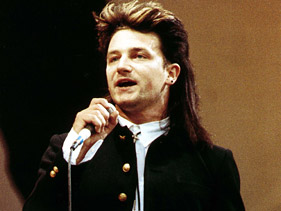
We celebrate the 25th anniversary of the groundbreaking charity concert by breaking out the calculators. By James Montgomery Bono performs at Live Aid on July 13, 1985 Photo: Peter Still/ Redferns Twenty-five years ago Tuesday (July 13), Bob Geldof and Midge Ure moved mountains, arranged satellites and assuaged rock-star egos to pull off one of the most monumental concerts in history. Live Aid, the transatlantic charity bash , brought together the biggest names in music — all of whom played for free — on two massive stages in London and Philadelphia, beamed their performances out to the entire world (including here in the U.S. on a fledgling cable network called MTV) and managed to raise hundreds of millions of dollars for famine relief in Ethiopia. It was, shall we say, a pretty incredible event — one Geldof rather shockingly booked in roughly three weeks, mostly on a whim (he was knighted for his efforts). And it’s not exactly hyperbole to say that it changed the world and defined an entire generation. So in celebration of Live Aid’s 25th anniversary, we decided to break out the calculators and crunch the numbers a bit. Here are some of the figures that helped make history. 1.5 billion : The estimated number of viewers who tuned in to watch the concerts, in 100 different countries. 150 million pounds : The amount that Live Aid raised for famine relief in Ethiopia. It works out to some $245 million U.S. 162,000 : The number of people who attended the two main Live Aid concerts — 72,000 in London’s Wembley Stadium and 90,000 in Philadelphia’s JFK Stadium. There were, of course, other concerts held in conjunction with Live Aid, in Sydney (OZ for Africa) and Cologne, Germany, to name a few. Bands also taped performances from Moscow, Japan, Austria, Norway and Yugoslavia. 70 : As best as we can count (using detailed Live Aid sites like this one ), this was the total number of acts/artists that performed on the stages in London and Philadelphia. It’s a list that includes Madonna, U2, Mick Jagger, David Bowie, Elton John, Queen, Black Sabbath, Run-DMC, Santana, Tom Petty & the Heartbreakers, Neil Young, the remaining three members of Led Zeppelin, Duran Duran, Bob Dylan and Tina Turner. Of course, we’re not counting the prince and princess of Wales (who appeared at Wembley), any of the celebs who introduced all the acts, everyone who joined in for the group finales at either concert or the artists who appeared in taped performances from around the globe. If you really want to get technical, here’s a list of everyone — musician, actor, comedian, royalty — who participated. 16 hours : The continuous length of the entire Live Aid concert. The show in London started at noon and ended at 11 p.m. In Philadelphia, things got under way at 8:51 a.m. and ended at 11:05 p.m. (4:05 a.m. in London), meaning that the entire thing ran for 16 hours. Though, as you can see, between London and Philly, there were actually more than 27 hours of total performances. 1 : The total number of artists who appeared at both the London and Philadelphia concerts. It was Phil Collins, who, after performing at Wembley, took a helicopter to Heathrow Airport, hopped on the Concorde and made it to JFK Stadium to do a second set — and play drums for Eric Clapton and the reunion of the former members of Led Zeppelin. He also reportedly convinced Cher — whom he met on the Concorde — to take the stage in Philly. What can we say? The man was dedicated. What are your memories of Live Aid? Let us know in the comments! Related Photos A Look Back At The Live Aid Concert, July 13, 1985

Read more here:
A Look Back At Live Aid, By The Numbers

Facebook dresses down nipple pics

Facebook is clamping down on nudity after it shut down a page featuring a topless porcelain doll. The doll features on a page advertising exclusive Sydney jewellery boutique, Victoria Buckley Jewellery. Facebook's Statement of Rights and Responsibilities, which governs its relationship with users and those who interact with the site, specifies strict rules when it comes to risque content. “You will not post content that: is hateful, threatening, or pornographic; incites violence; or contains nudity or graphic or gratuitous violence,” section seven of its safety section states. On Sunday morning business owner Ms Buckley received six messages from Facebook saying: “Images have been removed”. “We have removed your images, you're in violation,” Ms Buckley said she was told. But as Ms Buckley has a number of pages she was confused which images were removed. In a bid not to further breach the social media giant's rules, and lose her business's social media portal with 2,000 followers, she removed all pictures of the topless doll. Ms Buckley made efforts to contact Facebook, but could not track down anyone. She then started a new group called “Save Ophelia – exquisite doll censored by Facebook”, which was almost immediately shut down with no explanation. This was despite her also removing the images from that page after another violation notice. “I'm not trying to slag off Facebook, but I'm frustrated with this process,” Ms Buckley told AAP. “There's not a lot of clarity about what is going on. “I realise the images are a problem for Facebook, but the site was closed down overnight with no warning.” And the images are long gone. The story of Facebook's censorship has since attracted the interest of the world's media – branding it “nipplegate”. Facebook itself does not have a dedicated spokesperson in Australia. AAP spoke to a public relations company which explained the strict rules the site enforces. That person would neither confirm or deny the “nipplegate” incident, but did say that it is easy for images or content to be reported by fellow users. Given there are 400 million Facebook users, it is through that reporting process that breaches were discovered, the public relations person said. Although the Victoria Buckley Jewellery Facebook page still exists, the porcelain doll, which was judged to be showing too much flesh, has now been censored with a bold black rectangle across its tiny bust. added by: eden49

Cate Blanchett Shines on Australia’s Second Largest Rooftop Solar Installation

Photo: Sydney Theatre Company Better known for lighting up the stage and screen, Oscar winner Cate Blanchett, (with husband and Co-Artistic Director of the Sydney Theatre Company) has teamed up with Australian federal government, the University of New South Wales and the NSW Government Architect’s Office to shine the light in a project known as, Greening the Wharf. The light in this instance will be sunlight. Or more precisely the capture of it. The Sydney Theatre Company’s blog on the matter notes that EnergyAustralia have calculates the 1,900-plus solar panels (and energy efficiency savings) will generate about 614,000 kWh a ye… Read the full story on TreeHugger

Originally posted here:
Cate Blanchett Shines on Australia’s Second Largest Rooftop Solar Installation

Ben Cousins hospitalised

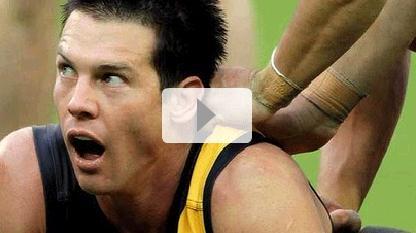
Ben Cousins, who has had a well-publicised battle with drug addiction, played in Richmond#39;s come-from-behind victory over Sydney at the MCG on Sunday. The 32-year-old also spent time in hospital before the start of the season with undiagnosed stomach pains. Richmond midfielder Ben Cousins has been hospitalised with what the club described as “an adverse reaction to a sleeping tablet”. The veteran midfielder was admitted to Epworth Hospital about midday and the club said more details would

See the original post here:
Ben Cousins hospitalised