‘It was [Dr.] Dre’s vision to bring this back to life,’ says Nick Smith president of the company that created the Tupac hologram at Coachella. By Gil Kaufman 2Pac hologram at Coachella Photo: Getty Images The Coachella festival is a place where minds routinely get blown, usually due to an awesome set or a killer reunion from one of your favorite bands. But on Sunday night it was thanks to the ghostly re-appearance of West Coast rap legend Tupac Shakur . He materialized on stage alongside his old friend Snoop Dogg during a crowd-pleasing set by the Doggfather and Dr. Dre, which also featured appearances from Eminem, 50 Cent, Wiz Khalifa and Warren G . The resurrection of ‘Pac , who was murdered in 1996, would have been a face-melting surprise had word about the stunt not leaked out just a few days before the set. But the 100,000 or so fans who were on hand still couldn’t believe it when Tupac materialized on stage to rip off “2 of Amerikaz Most Wanted.” “What up, Coachella?” the shirtless, pants sagging MC asked the crowd before bouncing into the classic single “Hail Mary.” “We worked with Dr. Dre on this and it was Dre’s vision to bring this back to life,” said Nick Smith, president of AV Concepts, the San Diego company that created the hologram. “It was his idea from the very beginning and we worked with him and his camp to utilize the technology to make it come to life.” Smith said he wasn’t allowed to talk about the creative aspects of the production — including how the hologram was able to seemingly perform the set in synch with Snoop and whether all the vocals were ‘Pac’s — but he did say that his company has the ability to recreate long-dead figures and visually recreate them in the studio. “You can take their likenesses and voice and … take people that haven’t done concerts before or perform music they haven’t sung and digitally recreate it,” he said. The hologram was the latest visual magic pulled off by AV, which is also behind the 2005 Grammys performance featuring Madonna and the holographic members of the Gorillaz, as well as holograms used in concert by Celine Dion and the Black Eyed Peas. The Tupac hologram was several months in the planning and took nearly four months to create in a studio and though Smith was not able to reveal the exact price tag for the illusion, he said a comparable one could cost anywhere from $100,000 to more than $400,000 to pull off. “I can’t say how much that event cost, but I can say it’s affordable in the sense that if we had to bring entertainers around world and create concerts across the country, we could put [artists] in every venue in the country,” he said. The life-size Tupac was amazingly life-like, down to the late rapper’s signature tattoos, Timberland boots, jewelry and movements, all of which were also recreated under the direction of Dre. The hologram, of course, already has a Twitter page and more than 3,300 followers at press time. A spokesperson for Dr. Dre could not be reached for additional comment at press time. Related Photos 2012 Coachella Music Festival Related Artists Tupac Dr. Dre
Critics are overwhelmingly impressed with James Cameron’s 3-D conversion. By Kevin P. Sullivan Kate Winslet at the “Titanic 3D” premiere Photo: Getty Images James Cameron has never been known for taking things halfway, and the new 3-D conversion of his epic “Titanic” is no exception. Cameron and his team spent years adding computer-generated depth to each frame to commemorate the 100th anniversary of the tragedy. When the director screened 20 minutes of footage for journalists last October, they responded with warm reviews, but now the final product is ready to set sail. Cameron has always stood by 3-D technology for film, through seemingly endless criticism, and now the reviews for his latest 3-D product are coming in as raves. Drew McWeeny from HitFix doled out high praise for “Titanic 3D,” calling it “the very best 3-D conversion of a film that I’ve seen so far.” Though the quality of the 3-D impressed McWeeny overall, he concluded that nothing about the new version of “Titanic” is really that different. “Adding 3-D to that works technically, but I’m not sure it changed anything, one way or another, emotionally,” he said. When converting a film as iconic as “Titanic,” expectations for the re-release can be very high. Lou Lumenick from the New York Post applauded Cameron’s use of 3-D, saying that it even enhanced the quality of the film. “James Cameron’s spectacular new 3-D version of ‘Titanic’ is everything I’d hoped for, and more,” Lumenick said. “He judiciously — and sometimes with great subtlety — uses the technology to make a great film even greater.” Lumenick said he found “Titanic 3D” “less of a strain on the eyes” than Cameron’s “Avatar.” While most 3-D movies come with complaints from the critics, post-conversion tends to suffer a worse fate. Scott Mantz from “Access Hollywood,” however, wrote that the post work on “Titanic” surpasses even films made for the format. “But what’s amazing is that for a movie that was shot in 2-D, ‘Titanic’ looks amazing in 3-D — almost like it was meant to be in 3-D all along.” Check out everything we’ve got on “Titanic.” For breaking news, celebrity columns, humor and more — updated around the clock — visit MTVMoviesBlog.com . Related Photos ‘Titanic 3D’ Premiere
The new trailer for People Like Us (nee Welcome to People ) is here, featuring Chris Pine and Elizabeth Banks as siblings who meet only after their father dies. The inheritance/estrangement/salvation plot (and a vaguely incestuous vibe that the trailer mostly counteracts with a few key shots of Olivia Wilde as Pine’s wife) thickens around the family, with Michelle Pfeiffer dropping in as Pine’s mother, which is just as bizarre as I expected it would be . Overall, though? Screenwriter Alex Kurtzman’s directorial debut looks all right! If nothing else, at least the title is an improvement. [via Moviefone ] People Like Us – Trailer No. 1 Follow S.T. VanAirsdale on Twitter . Follow Movieline on Twitter .
After years of foisting dashed-off 3-D — and its inflated ticket prices — on movie audiences, studios may have found their most reliable ally yet in shoring up box office: IMAX. And not just the punch and potential of the brand’s own 3-D, either, but good old conventional 2-D as well. Call it the IMAX Old Wave. Led by last weekend’s $155 million Hunger Games windfall — $10.6 million of which came from the giant-screen format — more and more evidence suggests that audiences are both showing a preference for IMAX and happily forgoing often-reviled 3-D visuals. Just as important, and perhaps far more telling, blockbuster directors like Christopher Nolan and Brad Bird are making influential use of IMAX technology to augment their creativity. Those results have been roundly embraced by critics and crowds, all while 3-D continues generating negative feedback and diminishing returns. Are the studios finally ready to follow filmmakers around the corner? Maybe, if cinematographer Robert Elswit’s recent experience is any indication. “3-D was never a choice for us, so the matter never really came up,” said Elswit, the Academy Award winner who served as Bird’s director of photography on last year’s IMAX-intensive Mission: Impossible – Ghost Protocol . “As for the IMAX decision, Brad certainly decided to go that route, but he was basically unproven as an action director. Having somebody as influential as Tom Cruise supporting the idea meant it was more likely to happen. Once he was completely in agreement that IMAX would benefit the film as a result the studio never fought it – Tom really influenced them to agree on spending the money, and ultimately it was not such a major expense, budget-wise.” The move underscores both the creative and commercial advantages in turning away from the muddy visuals of the ongoing 3-D “renaissance” in favor of the optimal experience of regular, two-dimensional IMAX viewing. The company itself has recognized this, delivering increasingly fan-friendly franchise titles (many of course, like Harry Potter and the Deathly Hallows – Part 2 and Transformers: Dark of the Moon , still in its proprietary IMAX 3D) while aggressively expanding to nearly 600 screens in 48 countries. Currently the company is well into a project that will add 15 new venues into China. Meanwhile, as Hollywood rebounds from last year’s dismal box office, IMAX has actually outpaced that success. Even before Hunger Games landed the third biggest opening weekend of all time, Hollywood had seen a 20 percent increase in year-to-date grosses over the same time frame in 2011. During this same time IMAX has enjoyed a 45 percent surge over last year’s numbers. Even the bomb John Carter boasted a healthy 17 percent of its meager opening from IMAX theaters. IMAX has such a busy slate this year that despite clearing 270 screens for Hunger Games ‘ debut in North America (and an additional 19 venues in the U.K. and France), it has to edge out the blockbuster after a week to accommodate its commitment to today’s Wrath of the Titans. This is not a fluke. The Canadian juggernaut has cultivated a following among viewers and filmmakers alike for four decades, with the more of the latter gravitating towards the 65mm format in recent years. Nolan, a longtime proponent of the technology, was instrumental in ushering in the IMAX Old Wave with his 2008 megahit The Dark Knight , while Bird and Elswit followed suit in 2011 with Ghost Protocol . “Brad wanted to use IMAX right from the start, and that was mainly due to Chris Nolan’s success in using it for sequences in his Dark Knight film,” Elswit told me. “We decided that we wanted to use IMAX cameras to shoot four or five of the action sequences” — most famous being the thrilling Burj Khalifa scenes , featuring Tom Cruise actually scaling and bounding around the top of the world’s tallest building. “Initially the plan was to construct a massive set replicating the tower and then digitally inserting the ground shot behind what we filmed,” Elswit explained. “Tom, however insisted that he actually go outside the actual location, and that enabled us to take IMAX cameras to the tower and film him scaling the building. That meant we were able to deliver those shots that could cause vertigo when watching in an IMAX theater.” The global reach of IMAX also provided an unforeseen benefit to their location shoot. “As it turns out Dubai has an IMAX theater,” Elswit said. “So we were able to go there and actually view our dailies in IMAX.” Then, in another unique move, Paramount debuted Ghost Protocol exclusively on 300 IMAX screens five days prior to its wide opening. From the shoot to the release strategy, the format conferred an event status that helped nab the film $45 million in IMAX grosses alone and represented the first wave in a nearly $700 million global phenomenon. Asked to elaborate on the specific cost differences of producing 3-D versus standard IMAX, Elswit demurred. But the implication was clear for the filmmakers weighing both formats: On the whole, IMAX wields the bigger bang for one’s buck. “When it comes to altering a print for 3-D in post, that is not so expensive,” he said. “But if you were to properly shoot in either format, I don’t really see a major difference in the cost. In fact, when it comes to shooting an action sequence — because that is the kind of scene where you would be more likely to use IMAX effectively — you would need to use at least three cameras, in order to film it properly and get the images you want. In that case shooting in 3-D becomes more expensive because there is so much more time needed to properly stage your cameras to get the shots properly filmed.” Proponents of 3-D — even those inside IMAX’s front office — face other challenges and red flags regarding the format’s long-term viability. As a side-by-side comparison of established auteurs embracing technology, we can look back to Martin Scorsese’s reported $170 million family film Hugo : While lauded by critics and winning multiple Oscars — including Robert Richardson’s eye-popping 3-D cinematography — the film grossed only $73 million domestically and barely broke even once foreign markets are taken into account. Other telling statistics came with the hit film The Lorax , whose hefty $70 million opening far exceeded expectations. Industry investment analyst Richard Greenfield found that while 3-D screens represented a nearly two-to-one majority of The Lorax ‘s theater count, the grosses expose a nearly even split between 2-D and 3-D. The per-screen average shows that more money was made in conventional screenings, a stunning figure once you factor in the inflated 3-D ticket prices. That breakdown means that while 60 percent of the screenings were displayed in 3-D, 60 percent of the audience watched in 2-D. Greenfield also noted the underperformance of Harry Potter and Deathly Hallows – Part 2 on IMAX 3D — a figure amounting to only 9 percent of its record-breaking $169 million opening gross — further arguing that if viewers had had more 2-D options, the 3-D share would have been even lower. Meanwhile, Hunger Games director Gary Ross — who has proclaimed his “love” for 3-D yet distanced the burgeoning franchise from the format (“I think that if we shoot this movie in 3-D, we become the Capitol,” he told one interviewer . “We start making spectacle out of something that I don’t think is really appropriate here”) — has already dictated that his sequel, Catching Fire , will likewise be projected in the traditional format. And those movies’ promise notwithstanding, IMAX CEO Richard Gelfond isn’t taking his company’s growth — in any dimension — for granted. “For us, one weekend and one film does not make a year,” he cautioned this week . “And that’s one thing you’ve really got to be clear [about] with investors and analysts.” Nevertheless, if artists’ preferences continue to mirror their audiences’ tastes, the combination may yield an inescapable influence on Hollywood’s decision makers. And once sizable, steady profits can be found on the 2-D side of the ledger, studios and IMAX won’t have any choice but to listen as the money does the talking. Brad Slager has written about movies and entertainment for Film Threat, Mediaite, and is a columnist at CHUD.com . His less insightful impressions on entertainment can be found on Twitter .
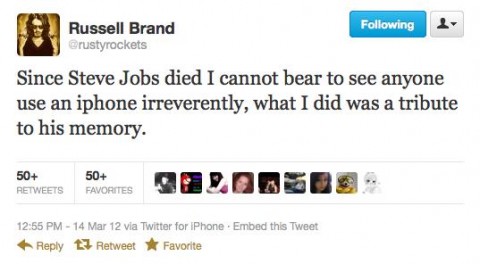
Russell Brand has Tweeted a hilarious confession to recent allegations that he ganked some paparazzi dude’s iPhone and hucked it through a window . The zany British comedian is accused of ripping an iPhone right out of the hands of a paparazzo in New Orleans and firing it toward a local law firm. Police are investigating, but Russell Tweeted the following mea culpa: Wonder if that would hold up in court. Genius, in any case … but THG does not condone window assaults via iPhone every time you see one misused. Unlike Chris Brown, who’s also being investigated for stealing an iPhone , Brand has since offered to pay for the device, as well as the window he broke.
Can humor be quantified? Not a chance, but that didn’t stop Google from trying. The tech giant actually created an algorithm which ranks the funniest YouTube videos. It takes into account certain elements of the clip(s), the uploader’s interpretation of it (based on title, description and tags) and of course user comments and votes. The video below – actually a collection of three practical jokes – won. While it’s definitely up there, ranking it THE best might be a bit of a stretch. Watch and see: Funniest Video of All Time? Google engineer Sanketh Shetty explained the methodology and its challenges: “Viewers emphasize reaction to videos in several ways: e.g. capitalization (LOL), elongation (loooooool), repetition (lololol), exclamation (lolllll!!!!), and combinations thereof. If a user uses an “loooooool” vs an “loool”, does it mean they were more amused?” The results of the experiment can be seen on Google’s Comedy Slam leaderboard. According to the same method, the funniest video of just this week is this one, featuring some dude trying to reach a tomato through ceiling fan blades. Spoiler alert: It ends badly for him. Enjoy: Dude’s Face Meets Ceiling Fan
If it takes you a beat to remember the movie to which Journey 2 is a follow-up, that may not just be because the makers have opted for a trimmer title than, say, the marquee-busting, geographically confusing Journey to the Center of the Earth: The Mysterious Island . The 2008 Journey to the Center of the Earth was solid if unexceptional summer box-office fodder starring Brendan Fraser as a scientist who adventured through a Jules Verne-documented fabulous world hidden under the earth’s crust, accompanied by his young nephew Sean (Josh Hutcherson) and their dishy Icelandic guide (Anita Briem). This new film, directed by Brad Peyton (of, yes, Cats & Dogs: The Revenge of Kitty Galore ) has dropped Fraser to instead follow the less-familiar and less-charismatic Hutcherson as the series through-line. Sean’s grown to surly teenagerdom and has been reluctantly relocated to Dayton with his mom (Kristin Davis) and new stepdad Hank (Dwayne Johnson), who has to learn how to fill in as the boy’s latest father figure. I’m maybe unreasonably fond of the actor formerly known as The Rock, and his willingness to stride fearlessly and unabashedly into sequels like this despite having played no part in the earlier installments (see also Fast Five and the upcoming G.I. Joe: Retaliation ) is curiously endearing — he’s the poor man’s everyone, game to replace any star around whom a franchise was previously built. And he’s not a bad substitute for Fraser, sharing the same cartoon-caricature handsomeness and willingness to combine brawny bits of action with goofball silliness, an apparent must for the family action adventure. But Johnson’s disarming commitment to the doodle of a character he’s playing isn’t enough to inject life into the rest of the film, which is an anemic retread of beats and elements from its predecessor, taking place on a secret island hidden beneath a constant storm in the South Pacific rather than in an underground realm hidden inside an extinct volcano in the North Atlantic. Instead of continuing the story, Journey 2 just blatantly recycles it. In the role of competent local/love interest this time around is Vanessa Hudgens as Kailani, on whom Sean immediately develops a crush, and who’s accompanied by her father Luis Guzmán, strenuously working at being the comic relief. In the place of dinosaurs there’s a giant lizard. Instead of a roller coaster-style mine cart ride there’s a roller coaster-style chase in which everyone rides massive bees. In the first film, the characters had 48 hours to escape deadly rising temperatures, while in this film they have a little less than that to get away before the island sinks into the ocean. You can argue that there’s no need to mess with a formula that worked, especially given how young the intended audience for this film is, but the one thing Journey 2 can’t recreate is the novelty that still clung to 3-D in 2008. Journey to the Center of the Earth was advertised as “the first live-action digital 3-D movie ever,” and much of its charm lay in the nostalgically corny pleasure it took in the technology, the sense of wonder it demonstrated for making things appear to fly out of the screen, even if that meant having someone rinse their mouth and spit the water out at the audience. In the four years since, our love affair with 3-D has hit some rough patches, and while Journey 2 has moments of multi-dimensional inventiveness, like a trick of perspective involving sea life swimming by close to camera, or an erupting mountain framed by a window serving as a character’s TV, it doesn’t offer much in terms of memorable spectacle. In fact, the film’s effects can look surprisingly outdated given they’re the primary selling point, from the hazy fantasy landscapes to a submarine-escape sequence that resembles a video game cutscene. This franchise is based on the idea that everything Verne wrote about not invented but real — the Vernians, of which Sean’s late dad could be counted, seeks out the locations the author described in his books. But the films are actually focused on missing and surrogate father figures, with family members rushing off to explore and go missing rather than stay with their children and be there for them when needed. Michael Caine, cruising along, turns up as Sean’s flaky Vernian grandfather, Alexander, the man who lured the party out to the island in the first place. When the action slows down enough for characters to have a conversation, which is thankfully not often, Alexander and Hank bicker over and compete for Sean’s attention and admiration like dueling swains. Will Sean come around to his new stepfather, and will Alexander realize that being reliable is just as important as being exciting? Of course — this is a family movie, after all — but you’ll have to sit through some abrasively broad, unfunny exchanges to get there. Dialogue, alas, is the kind of thing that can’t be enhanced by the wearing of 3-D glasses. Follow Alison Willmore on Twitter . Follow Movieline on Twitter .
Brad Pitt is well aware that an Internet search of his name yields hundreds of millions of results – not all of them positive and many full-on ridiculous. Heck, you can learn all about how he got Angelina Jolie pregnant , how he’s having an affair with Jennifer Aniston, and how he worried about Shiloh. Most or all of which is untrue, of course … which brings us to this quote: “On all the kids’ computers, we had our own names blocked,” the actor told Germany’s Bild in an interview. “They can’t Google their mom and dad.” “I don’t want to make myself dependent on what other people think.” Brad Pitt adds that he and Angelina Jolie aren’t exactly searching for themselves either, for good reason. “We don’t even notice all the noise,” he said . The same could be said for his stance on aging. Despite being just two years away from the big 5-0, the Moneyball star says he enjoys getting older. “I love becoming an older man. Your thoughts get clearer.” Those thoughts may include a wedding in the works. The actor told The Hollywood Reporter – for real this time – that he would like to marry Angelina. “It seems to mean more and more to our kids,” he added. Just don’t expect them to find out via celeb gossip sites.
Make no mistake, Apple’s announcement of its new iBooks 2 for Digital Textbooks today wasn’t quite as awe-inspiring as the unveiling of some of its past innovations. The loss of co-founder Steve Jobs certainly contributed to that. Still, the company which changed music with its iPod and mobile communications with the iPhone, said today it was offering software that would reinvent textbooks. It was a project inspired by Apple’s late CEO Jobs himself: Apple iBooks 2 Presentation “A lot may be wrong with education. One thing we hear louder than all else and where we can help is in student engagement,” said Phil Schiller, Apple’s marketing chief. “That’s why we get excited when students get their hands on an iPad. “The textbook is not always the ideal learning tool,” said Schiller. “Yet their content is amazing.” As such, Schiller and his Apple colleagues showed off two new applications to take the information in textbooks and put it, in interactive form, on iPads and computers. iBooks 2, a free download for iPads, available from Apple’s app store starting today. iBooks Author is a tool he said authors and publishers can use on their computers. The new interactive books would cost $14.99, far less than most paper textbooks. They could be updated continually, said Apple, without a programming degree. Students will be able to “mark up” iPad books electronically, creating the digital equivalent of note cards as they go through lessons, and keep the iBooks when done. Apple is partnering with three of the biggest publishers of school texts: Pearson, McGraw-Hill and Houghton Mifflin Harcourt, responsible for 90 percent of U.S. textbooks. Will it be successful? Do you really have to ask?
Damn shame that “a picture is worth a thousand words” and not dollars ! Eastman Kodak Co. filed for bankruptcy protection early Thursday morning, after the film pioneer failed to raise fresh cash to fund a long-sputtering turnaround, The Wall Street Journal reported. The 131-year-old company struggled for decades to cope with the emergence of competitors in its film business and the rise of digital technology. But its final pivot — an attempt to transform itself into a company selling printers — proved too costly amid declining film sales and expensive obligations to its retirees. The company said in a statement it has obtained “a fully-committed, $950 million debtor-in-possession credit facility with an 18-month maturity from Citigroup to enhance liquidity and working capital.” It said it believes it has “sufficient liquidity” to continue business operations during Chapter 11. “Kodak is taking a significant step toward enabling our enterprise to complete its transformation,” Kodak CEO Antonio Perez said in a statement. “Chapter 11 gives us the best opportunities to maximize the value in two critical parts of our technology portfolio: our digital capture patents … and our breakthrough printing and deposition technologies, which give Kodak a competitive advantage in our growing digital businesses.” Perez pointed out the fact that the company has effectively moved away from its traditional film operations, “closing 13 manufacturing plants and 130 processing labs, and reducing our workforce by 47,000 since 2003.” “Now we must complete the transformation by further addressing our cost structure and effectively monetizing non-core IP assets,” he said. “We look forward to working with our stakeholders to emerge a lean, world-class, digital imaging and materials science company.” The statement said that the Rochester-based company expects to pay employee wages and benefits and continue customer programs. Subsidiaries of the company outside the US will not be affected by the bankruptcy filing. The voluntary petitions for Chapter 11 business reorganization were filed in the US Bankruptcy Court for the Southern District of New York. The filing came as little surprise, with The Wall Street Journal reporting ahead of the announcement that the company was appointing a chief restructuring officer in anticipation of bankruptcy. Shares of Kodak ended Wednesday trading up 4.4 percent at 55 cents, but have fallen 14.6 percent during January, and almost 90 percent over the past 12 months, according to Fact Set data, MarketWatch reported. Eastman Kodak last week unveiled a new, streamlined business structure aimed at increasing productivity, cutting costs and boosting the troubled company’s digital business. Under the new structure, Kodak reduced its number of segments from three to two — the Commercial Segment and Consumer Segment. Kodak previously had three operating units: the graphic communications group, which provided digital equipment and software to printing industries; the consumer digital imaging group, which focused on print images; and film, photofinishing and entertainment. Kodak listed assets of $5.1 billion and debt of $6.8 billion in the bankruptcy filing. We hope they’re able to recover. It would be a shame to lose a pioneering company like Kodak. Source More On Bossip! X-Rated Bangers: The Hottest Black Adult Movie Stars In The Biz…Would You Wife Any Of Them? Part 2! Ballerific Cribs: Check Out Some Of The Luxurious Abodes Of NFL’s Finest [Photos] More Love: The Beautiful Cakes Of Women We’d Like To See In Future Episodes Of Love & Hip-Hop Celebrity Kush Chronicles: Rih-Rih And Her Hedonistic Streetwalker Steez Go For A Stroll While She Sparks MORE Yahmean!