Slick and mean and full of piss and chicken grease, Killer Joe has worse manners than its deadly, courtly antihero. But in its own way and to its own detriment, William Friedkin ’s splattery, southern gothic return to the screen seeks to amuse as well as shake and stir. What begins as a set of open provocations and genre tweaks propping up the story of a trashily blended Texas family’s encounter with an alpha hitman takes a turn through Coen and Lynch Lanes before winding up at the corner of Friedkin and Peckinpah. There a trailer ignites with violence and the tone of alternately abject and mordant depravity begins flailing like a rogue firehose. That the Smiths are low, stupid people is easily understood, but Friedkin hardly tires of reminding us. Killer Joe opens on the middle of a stormy Texas night, and the wailing and window-banging of a fuck-up named Chris ( Emile Hirsch ), who is locked out of the family’s trailer. When his stepmother Sharla (Gina Gershon) finally responds, Chris (and the audience) comes face to fat, mossy minge with her naked crotch. Chris’s complaints find no truck with his exceptionally dense, defeated dad Ansel (Thomas Haden Church), who echoes Sharla’s involuted logic about not being expecting to find her stepson on the other side of the door. It feels unpromising that what could be a funny gag gets lost in the scene-flattening commotion of idiocy, which too often gets cranked so high little else gets through. The Smiths have all kinds of boundary issues, not least when it comes to Dottie (Juno Temple), the gauzy baby doll daughter with a couple of little pink screws loose. Dottie sleepwalks, and either has crazy good hearing or crazy-girl intuition, because she cottons to Chris’s plan to kill their deadbeat mother (who remains deadbeat; we only get a brief glimpse of her corpse) from the moment he privately proposes it to Ansel. In deep to some coke dealers, Chris has word of his mother’s fifty thousand dollar life insurance payout (to Dottie) and a line on a police officer/hitman named Killer Joe Cooper ( Matthew McConaughey ). No good can come of such a scheme, of course, and no good does. Perhaps the family’s shouty moron shtick is designed to make the arrival of a glossy, black-clad sociopath feel more like a relief. McConaughey has toned down his surf bum beam (and highlights) for the role: in his bad sheriff getup he’s a cold-eyed buck with asses to stomp. Sharing a tight frame with Joe in a typical low-angle shot, Hirsch becomes a mini-pony of a man. But it’s McConaughey’s scenes with Temple that form the twisted center of the movie; they make a pair as riveting as it is unlikely. That it is not as simple as beast-meets-beast of prey is largely a credit to the actors – each exudes an unnerving charisma that enwraps the other and together they create the movie’s only dramatically persuasive atmosphere. It feels a little wrong saying that, given the terms of their relationship. When Chris and Ansel can’t cough up half of Joe’s fee in advance, he proposes taking Dottie as “a retainer.” Because the Smiths’ is a desperate world dulled into moral nihilism by poverty and other indignities, Ansel’s response to the idea of pimping his virgin daughter out to a hired killer is that it “might just do her some good.” We feel scared for Dottie, though after being soothed out of her initial upset she doesn’t seem that scared herself, which of course is really scary. The lead up to Joe’s claiming of his collateral and the chillingly erotic scene that results feels like Friedkin hitting a mesmerizing stride. Instead it forms a peak in what slackens into another, if notably performed and perverse, pulp fiction paradox: Though desperate to shock, its success depends on our desensitization. ( Killer Joe received an NC-17 rating and is perhaps the latest rival to the kink and violent degradations of 2010’s The Killer Inside Me .) Much of the film takes place in close quarters, spaces well parsed by Friedkin’s camera and imbued with a sense of confined desperation instead of plain old claustrophobia. Pulitzer Prize-winner Tracy Letts adapted the script from his own play (this is Friedkin’s second Letts adaptation, after 2006’s Bug ), and as often as a dark, stage-y laugh line falls flat, Joe’s embroidered (and then fearsome) tones and Dottie’s loaded non sequiturs (including her casual mention, after things have gone miserably awry, that it might still all work out — “as long as I don’t get mad”) seem to land exactly how and where they’re meant to be. It seems likely it was the creepy sexual content and not the horrific violence that earned the MPAA’s admonishment, a bias Killer Joe seems to repeat in moving from its glimpses of genuine human darkness toward the more generic drawing of bright red blood. Killer Joe is in limited release Friday. Follow Michelle Orange on Twitter . Follow Movieline on Twitter .
If William Friedkin ’s adaptation of The Exorcist left you feeling a tad jumpy, just wait until you see Killer Joe . After a six-year absence from the Cineplex, the 76-year-old Friedkin returns to the big screen on Friday with arguably the most disturbing film of his 45-year career. The ultra-violent and twisted black comedy stars Matthew McConaughey as Joe, a Dallas detective who moonlights as a hitman. After a client (Emile Hirsch) stiffs him on a job, Joe takes his sister (Juno Temple) as a retainer. A blood-soaked finale ensues, and, along the way, the picture is so brutal and grotesque at times that it earned an NC-17 rating, in part because of a scene in which McConaughey’s character forces Gina Gershon to perform fellatio on a chicken leg that he dangles from his crotch. Friedkin refused to cut the picture to earn an R rating, and it’s that uncompromising spirit that permeates his body of work. One of the most compelling directors to emerge from the easy riders-and-raging-bulls era, Friedkin broke through in 1971 — and won a Best Director Oscar — with the police thriller The French Connection . Two years later he would direct the white-knuckle horror masterpiece, The Exorcist , solidifying his standing in the pantheon of ’70s filmmakers that includes Coppola, Lucas, Cimino and Scorsese. Friedkin has not since matched the critical and box office heights of The French Connection and The Exorcist , although he showed glimpses of his greatness with such films as Sorcerer — an intense remake of Henri-Georges Clouzot’s The Wages of Fear set to a Tangerine Dream soundtrack — and To Live and Die in L.A.. He has, however, worked steadily. Killer Joe is his second collaboration with Pulitzer Prize-winning playwright Tracy Letts. Friedkin first adapted Letts’ play Bug for the screen in 2006. Over the last six years he has also directed opera and episodes of CSI and worked on his autobiography. As bold with his words as he is with his filmmaking, Friedkin had a frank discussion with Movieline about the ratings board, his disinterest in today’s studio films, why making The Exorcist into a TV show is “bullshit” and that Twitter photo of him as Ali G. Had you and Tracy been discussing Killer Joe since making Bug ? No, we only casually discussed it then, but a couple of years after Bug he sent me a screenplay. I read it and thought it was great. I called him back and I said, “Look if I can cast this and find somebody to finance it I’d love to do it,” and that was it. It took about a year to put together. What are the challenges of adapting a stage play to the screen? Films come from many different places. They come from plays, they come from actual events, from novels, from people’s own experiences. I’ve made 16 films in 45 years and they came from all those places. Some of the greatest films ever made were originally plays. Casablanca was a play called Everybody Comes to Rick’s. A Few Good Men was a play. Cabaret was a play— But aren’t there things that work on stage that need to be tweaked in order for them to work on film ? Not in a great piece of writing, like Streetcar Named Desire . The entire play takes place in the Kowalskis’ house in New Orleans. But you don’t think of it as a play. What you remember is Brando and Vivien Leigh and Karl Malden and how touching and emotional the situation is. The major challenge in making Killer Joe was to cast it properly. After that the writing is so good you just had to do it. You had to cast it with people who could understand it and reach down into their own life experiences to make it live. What did you see in Matthew McConaughey? He was being interviewed on one of those Larry King-type television shows and I saw him as himself, not as a guy in a romantic comedy. I thought this guy is really interesting and smart and very self-knowledgeable. He’s not this guy in the rom-coms. He’s from East Texas and he had the right accent and all of those things went well. I was originally going to go to some grizzled old warhorse to play Joe. But after watching this interview I thought, “This would be interesting: A good-looking guy who could charm the mustard off a hot dog.” I thought, “This is the way I want to go.” So I sent the script to [McConaughey], and when we first met he told me that he didn’t get it. He didn’t understand it and he just tossed it. And then he started to think about it, and he thought, “Well Jesus, this is funny. This is absurdly funny.” So he read it again, and he saw the humor in it as well as the danger. And he decided to take control of his own career and challenge himself with this. We met a couple of times to make sure we were on the same page and then I cast him. It’s certainly a role that will surprise people that know him from his Hollywood titles. Along with the comedy, I was surprised by how sincere his character could be¾especially the monologue he gives about East Texas. Well, it starts with the writing, and that’s what attracted the cast and me. [Letts’] people are real. They jump off the page. And I know all these people. None of them are strangers to me. Letts actually got the idea from a news article he read of a situation similar to this that happened in Florida. A big cloud hanging over the film is its NC-17 rating. This isn’t your first time having to fight the ratings board. Cruising was originally given an X rating. I had to go back 50 times to the ratings board with that film. Did that experience play a factor in how you handled the decision to stick with the NC-17 rating? Yeah. That’s basically what I thought, and I had to get the support of my distributor LD Entertainment. They were with me. They didn’t want to cut this film up into toothpicks. I think the rating is correct, by the way, although my view of the ratings board is very cynical and critical. I think they’re an arbitrary board with arbitrary standards. They’ll never give a major studio an NC-17. Never. What will happen is, behind closed doors, a major studio will make little nods and bows to them by cutting frames or shots here or there. Do you see yourself ever making another studio film? I doubt that I’ll ever work for a major studio again. Are you even interested in the kinds of movies they make now-the comic-book adaptations and raunchy comedies? Absolutely not. I don’t watch them and I certainly don’t want to make them. I’m not into Spandex. [Laughs] I’ve only done 16 films in 45 years. I look for stuff all of the time, but every film I’ve done took at least two years of my life. The Exorcist took three after all the press was done. Since the ‘90s you’ve been directing operas such as Puccini’s Gianni Schicchi for the Washington National Opera. Have you always been interested in them? No. I don’t go to operas. I listen to them on recordings sometimes. Zubin Mehta got me into directing operas. He’s a friend, and a great conductor, and we used to talk about music and movies. One day he said, “Why don’t you do an opera with me?” And I said, “Geez Zubin, I’ve never seen an opera.” And he said, “No, I think you’d be very good.” And he talked me into doing an opera. My first one was in 1998 in Florence and recently I did another opera in Florence. How many have you done? I haven’t counted, but I think I’ve done more than 12 since 1998. I just did Tales of Hoffmann in Vienna. Do these bring as much satisfaction to you as filmmaking? Definitely. It’s live musical theater and you’re dealing with material that’s 100-150 years old which means it has stood the test of time. The operas I’ve done are all classics. The Exorcist is closing in on its 40 th anniversary. Hard to believe. It’s been in the news lately. Have you seen the play in LA? I haven’t seen that yet, I’m going to see it at the end of the month. And there’s a TV adaptation in the works. That’s bullshit. They don’t have the rights. [ The Exorcist novelist] Bill Blatty still has the rights and he doesn’t want to see an exorcism on TV every week. I wouldn’t watch it-not even out of curiosity. It would just be total bullshit. But they’re going to rerelease The Exorcist in the late fall at the Smithsonian in Washington and then there will probably be some more theatrical and then a brand new Blu-ray that I just finished a few months ago. You’ve recently joined Twitter, are you enjoying it? Yeah. I think it’s a lot of fun. I take a half hour a day and read what people have to say and occasionally I think it’s worth a response. I see you’re very big on posting photos. And one in particular grabbed my attention— Me as Ali G? Yeah! I lost a bet to Sir Evelyn de Rothschild of the Rothschild family. The loser had to dress up as Ali G and I lost the bet. I wasn’t going to do it, but he bought me the costume. And I said ok. So he bought me all the bling and the costume and his wife took the picture. What’s the latest with you trying to get the rights to Sorcerer ? I’m in the 9 th District Court of Appeals suing Paramount and Universal because they both claimed they don’t own the film anymore and they don’t know who does. So I had to sue them to try to find out so I can get it back in release to the people who want to see it, which are largely film society and universities and people like that who are being denied the right to see that and many other films. The studios want to get rid of all 35mm [prints] and not even have any bookkeeping around by them. By November 26 there’s a settlement conference and if we can’t settle it by then there’s a trial in March of 2013. And I’ll go all the way with it, if it costs me every penny I have. What are you doing next? I don’t have any plans other to finish my autobiography. It will be out by the spring of next year. I’m not considering any other films right now. Is that because there’s nothing out there that interests you? I’m busy, but I haven’t seen anything I’m really interested in filming. Killer Joe is in limited release this Friday.
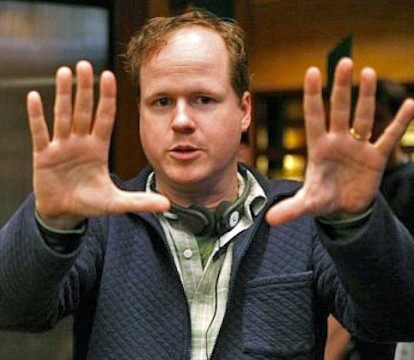
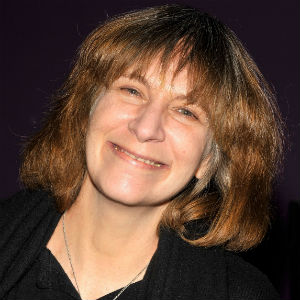
His film The Avengers is one of the highest grossers of the year and legions of fans gave adulation to him at the recent Comic-Con and even more did so at the box office. So what do you do when you have a blockbuster that has made nearly $1.5 billion worldwide and quickly counting? Take on Shakespeare and Much Ado About Nothing ! Well, he’s done it already and it’s headed to the Toronto International Film Festival in September, but the film adds to the filmmaker’s wide-ranging repertoire which has included, of course, The Avengers , a portion of last year’s doc Comic-Con Episode IV: A Fan’s Hope (as a writer) and TV episodes of Glee , The Office and Buffy the Vampire Slayer . Whedon’s version of Much Ado About Nothing will be a contemporary version of the Shakespearean story, which was shot in just 12 days, the Los Angeles Times notes . Toronto programmers noted the black and white movie “offers a dark, sexy and occasionally absurd view of the intricate game that is love.” The Bellwether Pictures project actually completed shooting last fall, well ahead of The Avengers massive debut in April. The film stars Amy Acker (from Whedon’s Cabin in the Woods and Alexis Denisof ( How I Met Your Mother ) as Beatrice and Benedick, which Bellwether calls “the least likely lovers” who are headed for their “inevitable tumble into love.” It is not the first time the story has been picked as a springboard for a contemporary re-telling. Kenneth Branagh took it on back in the early ’90s. That version starred Branagh along with Emma Thompson, Keanu Reeves, Kate Beckinsale and Denzel Washington. Also starring in Whedon’s Ado are Nathan Fillion ( Waitress , Clark Gregg ( Avengers , Fran Kranz ( Cabin in the Woods and Reed Diamond ( Moneyball ). [Source: Los Angeles Times ]
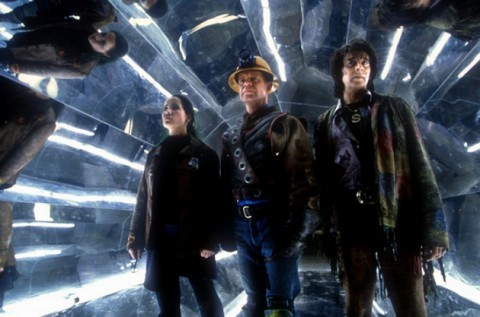
A caped crusader. A city wiped clean of criminals. A madman with a doomsday device who terrorizes the populace until average citizen heroes step forward to help save the day. Batman? Nope! On the heels of The Dark Knight Rises , Movieline takes a look back at 1999’s Mystery Men , new to Blu-ray, in the latest installment of Inessential Essentials . The film: Mystery Men (1999) Why It’s an Inessential Essential: Based on characters by comics creator Bob Burden, Mystery Men is an anomalously charming and amiably goofy superhero film. The film is very much a product of the creative chaos that ensued after Hollywood executives realized comic book properties like Batman could make a mint at the box office. But with many more duds than hits on their hands, execs were apparently clueless about what they should adapt and how to do it. It’s not only strange that a movie with characters as alienating-ly campy as the ones in Mystery Men ever got made — it’s even freakier to note that the film is actually pretty funny. So while mass audiences didn’t know what to make of the film when it was initially released, the film can now be enjoyed as a more than welcome antidote to the recent trend of self-serious but mostly drab superhero films. Mystery Men was co-produced by Dark Horse Comics publisher and creator Michael Richardson, the man responsible for turning such comic book properties as Tank Girl (1995) and The Mask (1994) into half-baked films. It was directed by Kinka Usher, making a big leap from being the assistant camera operator on such films as the 1987 Kato Kaelin vehicle Beach Fever (Usher would not go on to direct any other movies after Mystery Men , not even short films). Usher clearly directed the film in the style of the Joel Schumacher Batman movies; he makes frequent use of campy Dutch angles, crash zooms and first person POV shots, like the one where we see Ben Stiller being attacked by Geoffrey Rush’s character — from the perspective of Rush’s extended pinky. To call this film’s success as a comedy anomalous would be putting it very diplomatically. In the film, a group of wannabe superheroes that mostly don’t seem to have any real powers band together to fight the nefarious disco-obsessed Casanova Frankenstein (Geoffrey Rush, who had just won an Oscar for Shine two years before Mystery Men was made). Now that Frankenstein has kidnapped the all-powerful Captain Amazing (Greg Kinnear), the only people that can stop him are the then-unnamed group of heroes: Mr. Furious (Ben Stiller), a tantrum-throwing wimp who isn’t very strong; The Shoveler (William H. Macy), a middle-class father and a guy that fights crime with a shovel; and the Blue Raja (Hank Azaria), an adenoidal mama’s boy who pretends to be a British mystic and uses flatware as projectile weapons (mainly forks and spoons). To defeat Frankenstein, the team has to hire some new members, including the gaseous Spleen (Paul Reubens) and the haunted-bowling-ball-chucking Bowler (Janeane Garofalo). It’s a fittingly unusual line-up for a rather odd film. By today’s standards, Mystery Men is seriously dated. For starters, Smashmouth’s “Allstar” is used twice as a song cue. But it’s also often disarmingly eccentric, as in the scene where Tom Waits, who plays a mad scientist, shows off his arsenal of weird weapons (including the Blame Thrower), or the one where Wes Studi’s enigmatic, platitude-slinging hero The Sphinx trains the titular heroes (“To learn my teachings, I must first teach you how to learn”). All of the characters are also endearingly neurotic, like Invisible Boy (Kel Mitchell, of Keenan and Kel fame), a teenage loser who can only turn invisible when nobody else is looking at him, or Garofalo’s Bowler, a woman whose dead father nags her even from beyond the grave. Filmed on a reported $68 million budget, Mystery Men only grossed $33.4 million worldwide but went on to earn something of a cult status. How the Blu-Ray Makes the Case for the Movie: You can appreciate just how bizarre Mystery Men is just from watching the Spotlight on Location featurette, which makes it seem like the film’s production was pretty manic. For instance, Stiller reveals that the film’s cast were working with an improv-reliant script. “We’re always coming up with ideas, which is the fun thing about…” Stiller says, comically pausing to look around him and finishing his thought, ” not having a script.” Garofalo and Stiller both joke about the fact that they had little confidence in Usher. “I’m only doing this for the money,” she teases. “Kinka doesn’t know what the fuck he’s doin’. He hasn’t directed a movie before.” Even nice guy Greg Kinnear chimes in: “I describe [ Mystery Men ] as…a cartoon gone horribly, horribly wrong.” But Usher got results; even the film’s deleted scenes, like the one where Waits macks on a blue-haired retiree by telling her that he’s actually a doctor, are pretty funny. Other Trivia: In a rather thoughtful special feature, Burden shares a detailed history of his original comic book characters through interviews conducted before the film’s release. It’s especially funny to note that the character of the Shoveler was originally armed with King Arthur’s singing shovel, which was sentient and talked in “Middle English.” Also, apparently, Danny DeVito was supposed to not only direct the film at one point but play the Shoveler, too. Burden is also quoted in a Comics Buyer’s Guide interview as saying that he didn’t write the characters with modern actors in mind. “Originally, as I envisioned them, the Mystery Men were characters like Ernest Borgnine and Vic Tayback — all Mike Ditka-type guys. The only current star I could’ve seen as a Mystery Man would’ve been Steve Buscemi from Fargo .” Previously: Reconsidering Christopher Nolan’s Insomnia Simon Abrams is a NY-based freelance film critic whose work has been featured in outlets like The Village Voice, Time Out New York, Vulture and Esquire. Additionally, some people like his writing, which he collects at Extended Cut .
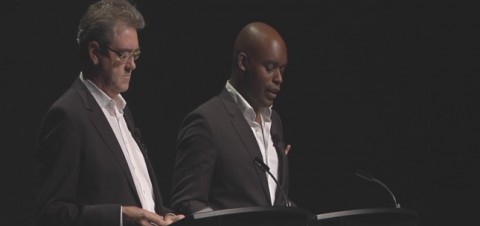
One of North America’s biggest annual film events released details of its lineup Tuesday morning including 17 Galas and 45 “Special Presentations” that will screen in the 37th Toronto International Film Festival in September. Festival CEO and Director Piers Handling as well as TIFF Artistic Director Cameron Bailey announced the lineup this morning in Toronto at a live event about this year’s festival, which includes 38 world premieres. As revealed earlier , Looper with Joseph Gordon-Levitt and Bruce Willis will open the festival. Debuts from directors worldwide including Andrew Adamson, Ben Affleck, David Ayer, Maiken Baird, Noah Baumbach, J.A. Bayona, Stuart Blumberg, Josh Boone, Laurent Cantet, Sergio Castellitto, Stephen Chbosky, Lu Chuan, Derek Cianfrance, Costa-Gavras, Liz Garbus, Dustin Hoffman, Rian Johnson, Neil Jordan, Baltasar Kormákur, Shola Lynch, Deepa Mehta, Roger Michell, Ruba Nadda, Mike Newell, François Ozon, Sally Potter, Robert Pulcini & Shari Springer Berman, Eran Riklis, David O. Russell, Tom Tykwer & Andy Wachowski & Lana Wachowski, Margarethe von Trotta, Joss Whedon and Yaron Zilberman are in the lineup. TIFF takes place September 6 – 16. Today’s lineup follows. More details from the festival will be announced the coming weeks… “We are thrilled to announce so many exciting and prestigious films today, with many more to follow,” said Handling in a statement. “This year’s Festival is looking particularly strong with bold, adventuresome work coming from established and emerging filmmakers.” “This year we present our most diverse Gala programme to date with films from Japan, China, India, the United Kingdom, Denmark, Italy, USA and Canada,” added Bailey. “Toronto’s red carpet is a global one and we’re excited to welcome some of the world’s best filmmakers and greatest stars to Canada.” Toronto lineup details provided by the festival : Galas : Looper by Rian Johnson, USA World Premiere (Opening Night Film) In the futuristic action thriller Looper , time travel will be invented – but it will be illegal and only available on the black market. When the mob wants to get rid of someone, they will send their target 30 years into the past, where a “looper” – a hired gun, like Joe (Joseph Gordon-Levitt) – is waiting to mop up. Joe is getting rich and life is good… until the day the mob decides to “close the loop,” sending back Joe’s future self (Bruce Willis) for assassination. Also starring Emily Blunt, Paul Dano and Jeff Daniels. A Royal Affair by Nikolai Arcel, Denmark/Sweden/Czech Republic/Germany North American Premiere A Royal Affair is a gripping tale of brave idealists who risk everything in their pursuit of freedom for the people. Above all, it is the story of a passionate and forbidden romance that changed an entire nation. Starring Mads Mikkelsen and Alicia Vikander. Argo by Ben Affleck, USA World Premiere When militants storm the U.S. embassy in 1979 Tehran, six Americans manage to slip away. Knowing it’s only a matter of time before they are found, a CIA “exfiltration” specialist comes up with a plan to get them out of the country: a plan so incredible, it could only happen in the movies. Starring Ben Affleck, Bryan Cranston, John Goodman and Kyle Chandler. The Company You Keep by Robert Redford, USA North American Premiere Jim Grant (Robert Redford), a civil rights lawyer and single father, must go on the run when a brash young reporter (Shia LaBeouf) exposes his true identity as a former 1970s radical fugitive wanted for murder. Sparking a nationwide manhunt, Grant sets off on a cross-country journey to clear his name. Also starring Susan Sarandon, Terrence Howard, Anna Kendrick, Stanley Tucci, Chris Cooper and Nick Nolte. Dangerous Liaisons by Hur Jin-ho, China North American Premiere As war looms in Shanghai, glamorous libertine Mo Jietu (Cecilia Cheung) runs into playboy Xie Yifan (Dong-gun Jang), an ex-boyfriend who’s never stopped loving her. She persuades him to play a treacherous game: Xie must seduce the innocent and naïve Du Fenyu (Zhang Ziyi) and then dump her. But the game becomes increasingly dangerous as Xie falls in love with Du, leading them all to tragic and shocking consequences. English Vinglish by Gauri Shinde, India World Premiere Money, fame and a knowledge of English. In India, these 3 factors play a huge role in how society judges an individual. English Vinglish is the story of Shashi, a woman who does not know English and in turn is made to feel insecure by her family and society at large. The film is the lighthearted yet touching and transformational journey of Shashi. Circumstances make her determined to overcome this insecurity, master the language, teach the world a lesson on the way to becoming a self assured and confident woman. This film marks the comeback of India’s biggest female star, Sridevi. Free Angela & All Political Prisoners by Shola Lynch, USA/France World Premiere Legendary radical activist Angela Davis’ words and actions made her a revolutionary icon in the 1960s. The documentary Free Angela & All Political Prisoners tells the dramatic story of how a young philosophy professor’s social justice activism implicates her in the botched kidnapping attempt of a judge that ends in bloody shootout. Newsweek asks: what would prompt Angela Davis, “the daughter of the black bourgeoisie, to take a desperate turn to terrorism?” Great Expectations by Mike Newell, United Kingdom World Premiere Based on the Charles Dickens classic. Orphan Pip rises from humble beginnings thanks to a mysterious benefactor. Moving through London’s class-ridden world as a gentleman, Pip uses his new status to pursue Estella, a beautiful, heartless heiress he’s always loved. The shocking truth behind his fortune will have devastating consequences for everything he holds dear. Starring Holliday Grainger, Ralph Fiennes, Helena Bonham Carter and Jeremy Irvine. Hyde Park on Hudson by Roger Michell, United Kingdom World Premiere In June 1939, President Franklin Delano Roosevelt (Academy Award® nominee Bill Murray) and his wife Eleanor (Olivia Williams) host the King and Queen of England (Samuel West and Olivia Colman) for a weekend at the Roosevelt home at Hyde Park on Hudson in upstate New York. With Britain facing imminent war with Germany, the Royals are desperately looking to FDR for support. But international affairs must be juggled with the complexities of FDR’s domestic establishment. Seen through the eyes of Daisy (Academy Award nominee Laura Linney), Franklin’s neighbour and intimate, the weekend will produce not only a special relationship between two great nations, but also a deeper understanding of the mysteries of love and friendship. Inescapable by Ruba Nadda, Canada World Premiere One afternoon, on a typical day at work, Adib is confronted with devastating news: His eldest daughter, Muna, has gone missing in Damascus. Now Adib, who has not been back in over 30 years, must return to Syria and deal with his secret past in order to find her. Inescapable is a thriller about a father’s desperate search for his daughter and the chaos of the Middle East he left behind. Starring Alexander Siddig, Marisa Tomei and Joshua Jackson. Jayne Mansfield’s Car by Billy Bob Thornton, USA/Russia North American Premiere Jayne Mansfield’s Car is a funny, poignant and searching look at three generations of fathers and sons in the South during the tumultuous ‘60s. It follows the family’s heartfelt — and sometimes hilarious — struggles with long-held resentments, secrets, the memories of war, and how life, death and loss shaped them all. Starring Robert Duvall, Kevin Bacon, Billy Bob Thornton and John Hurt. Love, Marilyn by Liz Garbus, USA World Premiere Nearly 50 years after her death, two boxes of Marilyn Monroe’s private writings and musings were discovered in the home of her acting coach. These papers, brought to life in this innovative documentary film by some of our contemporary icons and stars, give us a new understanding of Monroe — revealing her carefully guarded inner life. Featuring Elizabeth Banks, Lindsay Lohan, Evan Rachel Wood, Ben Foster, Uma Thurman, Paul Giamatti, Viola Davis, Jeremy Piven, Ellen Burstyn, Adrien Brody, Marisa Tomei and Glenn Close. Midnight’s Children by Deepa Mehta, Canada/ United Kingdom World Premiere “Born in the hour of India’s freedom. Handcuffed to history.” Midnight’s Children is an epic film from Academy Award-nominated director Deepa Mehta, based on the Booker Prize-winning novel by Salman Rushdie. At the stroke of midnight on August 15, 1947, as India proclaims independence from Great Britain, two newborn babies are switched by a nurse in a Bombay hospital. Saleem Sinai, the illegitimate son of a poor Hindu woman, and Shiva, the offspring of wealthy Muslims, are fated to live the destiny meant for each other. Their lives become mysteriously intertwined and are inextricably linked to India’s whirlwind journey of triumphs and disasters. Starring Satya Bhabha, Shahana Goswami, Rajat Kapoor, Seema Biswas, Shriya Saran, Siddharth, Ronit Roy, Rahul Bose, Kulbushan Kharbanda, Soha Ali Khan, Anita Majumdar, Zaib Shaikh and Darsheel Safary. The Reluctant Fundamentalist by Mira Nair, USA North American Premiere Based on the best-selling novel of the same title, that was translated into 25 languages, The Reluctant Fundamentalist is a riveting international political thriller that follows the story of a young Pakistani man chasing corporate success on Wall Street, who ultimately finds himself embroiled in a conflict between his American dream, a hostage crisis and the enduring call of his family’s homeland. Starring Riz Ahmed, Kate Hudson, Kiefer Sutherland and Liev Schreiber. Silver Linings Playbook David O. Russell, USA World Premiere An intense, loving, emotional and funny family story from The Fighter director, David O. Russell. Bradley Cooper and Jennifer Lawrence find themselves partners in a secret arrangement to rebuild their broken lives. Robert De Niro yearns to get closer to his son (Cooper), as he tries to keep the family afloat with his compulsive bookmaking. Jacki Weaver and Chris Tucker co-star. Thermae Romae by Hideki Takeuchi, Japan North American Premiere Ancient Roman architect Lucius (Hiroshi Abe) is too serious. His inability to keep up with the fast-moving times costs him his job. When a friend takes the dejected Lucius to the public bathhouse to cheer him up, Lucius accidentally slips through time and resurfaces in a modern-day public bath in Japan. There, he meets aspiring young manga artist Mami (Aya Ueto), along with others of the “flat-faced clan.” Shocked by the many inventive aspects of Japan’s bathing culture, Lucius returns to ancient Rome and garners tremendous attention when he implements these novel ideas back in Rome. As he time-slips back and forth between ancient Rome and modern-day Japan, Lucius’ reputation as the ingenious, new bath architect begins to grow. Twice Born by Sergio Castellitto, Italy/Spain/Croatia World Premiere Gemma visits Sarajevo with her son, Pietro. Sixteen years ago they escaped the war-torn city while the boy’s father remained behind and later died. As she tries to repair her relationship with Pietro, a revelation forces Gemma to face loss, the cost of war and the redemptive power of love. Starring Penelope Cruz and Emile Hirsch. Special Presentations : A Few Hours of Spring by Stéphane Brizé, France North American Premiere Forty-eight-year-old Alain Evrard is obliged to return home to live with his mother. This situation causes all the violence of their past relationship to rise to the surface. Alain then discovers that his mother has a fatal illness. In the last months of her life, will they finally be capable of taking a step toward each other? Anna Karenina by Joe Wright, United Kingdom International Premiere The third collaboration of Academy Award nominee Keira Knightley with acclaimed director Joe Wright, following the award-winning box office successes Pride & Prejudice and Atonement, is a bold, theatrical new vision of the epic love story, adapted from Leo Tolstoy’s timeless novel by Academy Award winner Tom Stoppard (Shakespeare in Love). The story powerfully explores the capacity for love that surges through the human heart. As Anna (Knightley) questions her happiness and marriage, change comes to surround her. Also starring Jude Law and Aaron Taylor-Johnson.
“Don Corleone cuts a fearsome figure through the mafia underworld, yet Brando also makes him into an emotionally needy butterball. When Bonasera makes the gesture of friendship (an awkward ‘Be my friend?’), the Don waves off the request. He knows how to play hard to get. It’s an odd juxtaposition, and a funny one at that. Without Brando’s levity, the dark sadness of the scene might have become unbearable. With it, the audience learns that The Godfather won’t limit itself in scope. Any emotion, any subject, anything is fair game.” [ Splitsider ]
At least one gunman opened fire at a midnight screening of The Dark Knight Rises early Friday morning in Aurora, Colorado, injuring as many as twenty people. An early report from local radio station 850 KOA cites witness reports that a shooter, possibly wearing a mask, opened fire and set off tear gas during a shoot-out scene in the film. Various reports cite at least ten people dead, although details are still emerging with at least one suspect in custody . Developing… UPDATE: NBC News ( @NBCNews ) and AP ( @AP ) report 14 people are dead, with 50 others wounded in the attack. UPDATE: Video purported to show the scene at the Aurora Century 16 following the shooting has hit YouTube (below). Be warned – it’s unverified (although at least one fan in full Batman costume can be seen) and contains footage of an apparently bloodied cinemagoer exiting the theater. UPDATE: Aurora Police Chief Dan Oates shared details of the shooting via press conference : The violence erupted about 12:30 a.m. MDT as the gunman stood at the front of one of the Century 16 theaters at the Aurora Mall. “Witnesses tell us he released some sort of canister. They heard a hissing sound and some gas emerged and the gunman opened fire,” Oates said at a news conference. One suspect is in custody and there’s no evidence of any additional shooters, Oates said. [ KOA , Reuters , MSNBC ]
The Dark Knight Rises director Christopher weighed in about the brouhaha that flared this week after some passionate Batman fans threw a fit after a spattering of negative reviews, resulting in aggregator site Rotten Tomatoes’ decision to disable user comments for the time being. Nolan’s final stint in the trilogy is expected to fetch box office records this weekend and so far reviews have been mostly positive, but a few critics gave TDKR a thumbs down and some fans went ballistic. Wednesday night at the film’s London premiere, Nolan appeared to defend fans’ emotional response. [ GALLERY: Christian Bale, Anne Hathaway & Co. at the Dark Knight Rises premiere ] “I think the fans are very passionate about these characters the way a lot of people are very passionate. Batman’s been around for over 70 years and there’s a reason for that,” A.P. reported Nolan as saying. “He has a huge appeal, so I think you know people certainly respond to the character.” RT’s editor-in-chief Matt Atchity said in an open letter on the site that the venomous push-back may alter their policies going forward, changing its commenting system so that it no longer allows for anonymity. “You’ll have to stand by your comments, just like a critic does. So you’ll still be able to argue about a movie you haven’t seen, but people will know it was you,” wrote Atchity. In an unrelated bout of TDKR mini-controversy, Nolan also offered up his take on conservative radio host Rush Limbaugh’s opinion that the pic’s villain, “Bane” is a not so-subtle reference to presumptive Republican nominee Mitt Romney’s former employer Bain Capital, decrying the movie and its makers for maligning the former Massachusetts governor who continued to hold a major investment in the company after departing its day to day operations. Liberals have accused Romney and Bain of “outsourcing American jobs overseas.” “I’m not sure how to address something that bizarre, to be honest,” said Nolan. “I really don’t have an answer for it, it’s a very peculiar comment to make.” Morgan Freeman, who plays Lucius Fox in Rises called the whole thing “ridiculous.” The Bane character originated back in 1993, first appearing in DC Comics’ Batman: Vengeance of Bane #1 , according to Wikipedia. [Source: A.P. , Rotten Tomatoes , Wikipedia ]
It’s hard to imagine that the documentary Lauren Greenfield initially set out to make when she started shooting The Queen of Versailles would have turned out to be anything other than grotesque. When the filmmaker, who previously directed the unflinching eating disorder investigation Thin , first approached her subjects Jackie Siegel and her billionaire husband David, it was to record them as they built their dream home, Versailles, a monstrous 90,000-square-foot Orlando abode that when completed would be the largest single-family house in the U.S. Like the Siegels themselves, the plans for Versailles displayed an astounding capacity for excess and extravagance with no accompanying sense of taste or restraint. Inspired in equal parts by the French palace after which it was named and the Paris Las Vegas Hotel, the house and its accompanying area was intended to include 10 kitchens, 30 bathrooms, a bowling alley, a baseball field and a grand ballroom, among other indulgences. As Jackie, a 43-year-old former Mrs. Florida, gigglingly swans through the half-constructed building in her designer outfit to the film’s bitingly whimsical soundtrack, pointing out offhandedly to the camera that “this is what five million dollars worth of marble looks like,” she looks like a perfect symbol of oblivious privilege, a easily loathed nightmare of the One Percent. But when David’s timeshare company Westmark gets walloped by the 2008 financial crisis, the Siegels and their eight kids (seven are Jackie’s and one is a niece plucked from a troubled home life) face a writ-large version of the economic turmoil into which so many households were plunged. The Siegels may be rich, but underneath the $17,000 Gucci crocodile boots, they turn out to be just as leveraged as other families who had to fight to hold on to their homes and their livelihoods, and soon their mammoth mansion is being put up for sale, an empty shell with luxury trimmings available for a mere $100 million. The Queen of Versailles begins by inviting us to judge the Siegels, to laugh and to sneer at them — and you have to, when you see things like the custom 18th century-style family portraits of David and his wife hanging on the walls, or Jackie’s late, beloved dog Chanel, commemoratively stuffed and mounted in a glass display case. But the film shifts into something profound, a genuine quiet tragedy, as the Siegels are forced to scale back and their pursuit of the American dream starts to look like a kind of infection rather than anything to do with happiness, a compulsion that demands more and more. David earned the fortune, but this is Jackie’s movie, and we start to fall in love with her as she remains steadfastly bubbly in the face of finances crumbling and her husband pulling away to obsess over saving the tower his company just had built in Vegas. She’s a little ridiculous, sure, with her cantilevered bosom and carefully tautened visage, grappling to hold on to youth for the sake of a spouse who jokes about trading her in for two 20-year-olds. But Jackie’s actually much less of the silly trophy wife than she appears and into which she’s transformed herself — in interviews, she talks about how she got an engineering degree and a job at IBM before deciding to pursue modeling instead, and reveals how she fled her first abusive marriage. David isn’t abusive, but as times get (relatively) tougher it becomes clear that he looks at Jackie, his third wife and over 30 years younger than him, as just another acquisition rather than as a partner. “Do you get strength from your marriage?” asks an off-camera Greenfield, and he responds, “No, not really. It’s kind of like having another child.” Both he and Jackie came from normal middle-class backgrounds, but the lifestyle they’ve settled into isn’t one that can easily be adapted or downsized — when they have to fire most of the 19 staff members that keep their household running, the already sizable house they’ve been living in while waiting on Versailles to be completed becomes an expensive shambles, with dog crap everywhere and other pets dying of neglect. “Nothing makes me happy anymore,” David tells the camera toward the end of the film, after having to lay off a slew of employees, still searching frantically for financing to save his Las Vegas tower from the bank. And both he and Jackie have the look of children who’ve made themselves sick gorging on candy but feel like they need to keep eating because they know it’s a treat. He retreats into his cluttered work room, where he sits with the TV on, surrounded by paperwork, avoiding his family. Forced to downgrade to Walmart, Jackie purchased multiple shopping carts full of toys that her kids don’t need or want — the camera silently observes the new bike she purchased for one of the children being added to a huge pile of them already crowding the garage. Why did the Siegels let Greenfield keep filming? Well, why did they let her start in the first place? These are people who aren’t afraid to discuss the fact that the pile of caviar they’re eating cost $2,000, because the amount that was spent on it is part of (maybe all of) the pleasure, and that only counts when there’s an audience to appreciate it. There’s a certain type of painful honesty that shines through in both their interviews toward the end and, particularly, in those with the staff, women from places like the Philippines who are saving up for homes of their own with families they haven’t seen for years. David is now suing Greenfield for the way his family and business is portrayed in the film, but The Queen of Versailles isn’t a hit piece — it develops an almost mournful empathy for its subjects as they fall from great heights to merely impressive ones. To say that money can’t buy happiness is a trite reduction of the complicated range of emotions the film evokes — maybe it’s more that money can allow you to escape from the self-reflection that’s always threatening to catch up with you and lay you bare. Follow Alison Willmore on Twitter . Follow Movieline on Twitter .
Francis Lawrence’s Hunger Games sequel Catching Fire has nabbed yet another notable name for film fans in Amanda Plummer, the stage/TV/film veteran perhaps best known as the diner-robbing “Honey Bunny” in Pulp Fiction as well as for her roles in The Fisher King and So I Married an Axe Murderer . Plummer will take the role of a Tribute and former Games winner whose eccentricity belies an uncanny intelligence as she competes with Jennifer Lawrence’s Katniss & Co. in the arena. Plummer will play Wiress, an older Tribute called to compete in the Quarter Quell, the all-star death match of sorts that propels the second installment of the series. She joins fellow cast newcomers Philip Seymour Hoffman as Plutarch Heavensbee and Jena Malone as fellow Tribute Johanna Mason in the sequel, slated for release on November 13, 2013. [ THR ]