Despite the censors and lackluster reviews, 2011’s Hong Kong softcore period piece 3D Sex and Zen went on to make money. So naturally, producer Stephen Shiu wants to up the ante. A sequel entitled 4D Sex and Zen: Slayer of a Thousand from the Mysterious East is being plotted to include the added in-theater experience of vibrating seats. I mean, of course ! How have the folks at D-Box not figured out how to capitalize on the erotic fourth dimension already? [ Yahoo! Phillippines via Twitch Film ]
Some folks out there may have enjoyed Billy Crystal ‘s ninth outing as host of the Academy Awards last night, but his turn was as tepid as James Franco’s 2011 “performance” was bizarre. Crystal’s Oscars -themed song and dance routine? Dated. The weak banter and soft barbs at Hollywood’s gathered illuminati? Snoozeville. Given that the previously and frequently great Crystal was upstaged by the night’s random moments ( Angelina Jolie’s leg, J. Lo’s boob, those Cirque du Soleil acrobats ) and young, actually funny presenters (the Bridesmaids crew and Emma Stone) it’s time to start anew and refresh what’s already known as the fussiest night in the film calendar. In other words: Who would make the ultimate, charismatic, hilarious, non-sucky Oscar host? Let’s start by taking anyone who already hosted the Oscars off the board, for freshness’ sake; that includes 2005 host Chris Rock , who provided last night’s telecast with a much-needed jolt of real talk hilarity as he presented Best Animated Feature. Or, say, Ellen Degeneres , Emmy-nominated for her 2006 turn, who was nonetheless all over the tube Oscar night in those movie-themed JC Penney ads. The tradition of hiring comedians to host is a longstanding one that paid off in spades in the days of Bob Hope (who hosted a record 18 shows). But these days even the most daring, subversive stand-ups (read: the funny ones) run up against the stifling sense of decorum perpetuated by the older-skewing Academy; it seems you either get an “edgier” host who dares to push the envelope and draw in the coveted younger demographic — Bieber alone can’t cut it, even if the ill-advised blackface gets press — or you hire a safe host who won’t go too far and bore everyone to death. In fairness to Crystal, he was saddled with an awfully boring script. The few sparks of life only came in the odd ad-lib or when he roasted celebs in the audience, but even that devolved into easy mean jokes. (Leave Nick Nolte alone!) Another past Oscar trend was to cast a slew of famous actors to host the night — charismatic personalities who split hosting duties and draw in diverse viewers. In 1974 it was the eclectic mix of John Huston, Burt Reynolds, David Niven, Diana Ross; a year later the Academy tapped Sammy Davis Jr, Bob Hope, Frank Sinatra, and Shirley MacLaine. Why not get the modern day equivalent of an A-lister superteam to host? I’m not talking Anne Hathaway and James Franco, but George Clooney ! Robert Downey Jr.! Sandra Bullock! Cute little Emma Stone, for goodness sake! Then again, maybe there are celebrities out there who could reinvigorate the Oscars solo: Oprah, for one? The talk show titan was batted around last year as a potential Oscar host before then-telecast co-producer Brett Ratner hired Eddie Murphy (who would also probably be great, if he were to come back). I’d watch an entire telecast hosted by Zach Galifianakis, even if it was a three-hour parade of weirdness on par with his and Will Ferrell’s crash cymbals gag. If the Academy’s older membership and demographic knew who the hell he was, Louis C.K. would be fantastically entertaining. And then there’s Sacha Baron Cohen… I’ll turn it over to you, Movieliners — who would make the perfect audience-grabbing, attention-holding non-snoozeworthy Oscar host… and would the Academy ever bite?
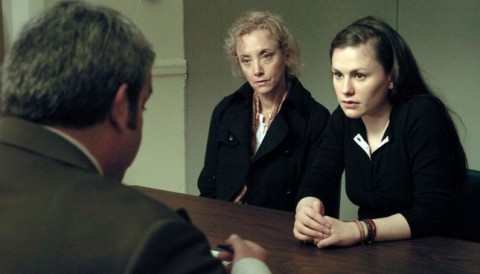
It only took about 20 years from conception to writing to development to shooting to the most notoriously protracted post-production saga in recent memory, but Kenneth Lonergan’s embattled epic Margaret finally had the festival premiere it deserved Saturday night in Manhattan. In its own way, even that event was chronologically vexed. The special screening — part of the Film Society of Lincoln Center’s annual Film Comment Selects series — came a few months after distributor Fox Searchlight gave the tale of an Upper West Side teenager transformed by her role in a fatal bus accident the most cursory release possible: One week in Los Angeles and New York, then out of theaters entirely before a critical groundswell rallied on its behalf in the heart of awards season. The campaign yielded the occasional fruit — Best Actress consideration for leading lady Anna Paquin here , Best Supporting Actress consideration for Jeannie Berlin there — but more than anything, it spotlighted Margaret ‘s breathtaking range of fascinations and flaws , a spectrum stretched over the film’s contractually mandated 150-minute running time (pared down from a rumored maximum of four hours) and a six-year behind-the-scenes drama that was once said to involve as many lawyers as it had editors. On Saturday, though, Lonergan — accompanied onstage afterward by lead editor Anne McCabe and every available cast member including Jean Reno, J. Smith-Cameron (pictured above with Lonergan) and Lonergan’s best friend (and eventual post-production patron) Mathew Broderick — had no intention of dwelling on Margaret ‘s tortured route to the screen. Not that Film Comment editor Gavin Smith didn’t give the writer-director his best shot, asking Lonergan to recount Margaret ‘s evolution from a 167-page script to the film we saw Saturday night. “I know that’s a long story,” Smith said, “but I think there’s a chance for you to correct some misinformation about the project.” “Well, I don’t really want to correct any misinformation about the project,” Lonergan replied, his voice pitched barely above a mumble. “Maybe you could narrow it down a little bit, because from writing the script to casting it to shooting it to editing it, there are so many steps involved. Is there any particular element?” “Well,” Smith said, “at a certain point in the process — and maybe this is a question for Anne, your editor — you arrived at a cut that was considerably longer than the cut that other parties involved with the project wanted it to be.” “No, uh…” Lonergan began. “Actually, the fact is we had a lot of cuts of the film. We did a lot of screenings. This is the cut that we ended up with and that we got released. I’m very pleased with this cut. It’s part of any normal process to go through a series of cuts, and you try to make it shorter or you try to make it longer or you try to emphasize this or that element of the process. And a lot’s been written about it — none of it accurate — and I don’t want to deflect the question too much, but I’m frankly more interested in talking about the actual content of the film and the script and all that. I think that it’s just more in the nature of movies. It’s like writing a script: You have a lot of different versions and you settle on [one]. Rembrandt said [when asked], ‘How do you know a painting’s finished?’ ‘It’s when you can’t think of the last brushstroke,’ he said. In this case, the version that got released is the version that got completed in… I think 2008? And I think it’s wonderful. I’m very proud of it. I think Anne is, too, as far as I know.” “Definitely,” McCabe said from the far end of the stage. “I don’t think she’s ashamed of it. So I think I…” Lonergan paused. “I’m much happier talking about the film itself, or the script or the actors or the process of shooting or anything, anything, anything but that, for God’s sake. The rest of it is so boring, and it’s all wrong anyway. I don’t even know what happened. But I’m very glad it’s here now, and I’m very, very proud of it.” Anyway, Margaret ‘s drawn-out post-production has nothing on a gestation period that commenced decades ago — in 11th or 12th grade, to hear Lonergan tell it, when a classmate of his confided having witnessed an accident much like the one that sets off the film’s cataclysm of guilt, shame, shattered innocence and debilitating self-absorption. “It always stayed with me, and I always wanted to write about it,” Lonergan said. “It always cropped up in various things that I was writing over the years, and I finally had the idea for the whole film sometime around 1990… in the early ’90s. But I had other things lined up first to write, and I probably ended up writing it around 2000. It was just the idea of something that big happening to someone that young. The idea of having to deal with something that adult struck me as being a very compelling and interesting idea that stayed with me for… Well, I don’t want to tell you exactly how old I am, but then I was in high school and now I’m 49.” Other youthful, semi-autobiographical callouts crept out of that foundation as well. One of Margaret ‘s more contextually confounding scenes involves a classroom debate over the implications of a passage in King Lear ; playing one of the main character’s teachers, Broderick drew on his and Lonergan’s NYC high-school days in squaring off with not Paquin, but rather with her young castmate Jake O’Connor. The fierce sparring culminates in (spoiler alert?) the consumption of orange juice and a sandwich — just one of Margaret ‘s many tongue-in-cheek digressions borrowed from memory. Asked by O’Connor himself about the scene, Broderick demurred. “I don’t really have any thoughts,” he said. “I just say the thoughts that Kenny wrote. I think its pretty clear, that scene. It’s funny to me that people take your side. It’s also interesting because that really happened. Kenny and I both sat there while pretty much precisely that argument happened.” “That’s true,” Lonergan said. “That actually happened. That’s as best as I can remember the actual conversation. I’m pretty sure it’s pretty close.” “Even the sandwich?” Smith-Cameron asked. “There was a teacher we had — whom this was very loosely based on — who was hypoglycemic,” Broderick explained. “And he had a bad temper, sort of, and every now and then he’d be mad at somebody, and he’d take a sip of juice and have a bite of a sandwich.” “It was not in the script,” Lonergan said. “Matthew remembered that, and he brought orange juice and a sandwich for the scene. I had not remembered that. Yeah, we went to high school together. That scene on the rock where they’re smoking pot? Those two little girls are also Matthew and I.” The audience cracked up. “We didn’t intend to change the world,” Broderick said, “We just wanted to smoke pot.” The overall high spirits in the theater belied the reason many of its standing-room only crowd members attended: to hear Lonergan’s definitive take on how and why Margaret became the ” film maudit ” cited in the Film Comment Selects program guide . His reluctance to contribute to its mythology feels like his most telling directorial stroke; in a film as sporadically brilliant as it is rife with showy, uneven performances and blunt-force moral grandstanding, the only thing left for Lonergan to control is the texture of its history. We may never know how he and his collaborators settled on the Margaret we’ve gotten to know in recent months, which is exactly how Lonergan must have it for any chance to preserve its soul. Nevertheless, a telling insight into that soul came at the end of Saturday’s discussion as Lonergan elaborated on his depiction of New York City itself — long, panoramic views of Midtown Manhattan and the Upper West Side, headlights in its veins, the heavens thrumming with the skyscraper buzz of private lives and random aircraft watching over it all. The best, the worst, the unknown happens unceasingly all around us. Margaret deals with one young woman’s enlightenment — and resistance — to that physical reality, perhaps reflecting Lonergan’s own confrontation with creative compromise. “At the time I think it was always in the back of my mind about 9/11,” Lonergan said. “It was shot much closer to 9/11; in 2002, 2003, 2004, even 2005, you may remember, it was very hard to see an airplane go by and just look at it without getting a little nervous or without it having an extra reverberation. That’s faded now, I’d say. So that’s why we shot a lot of footage of airplanes. But the reason we shot so much footage of the city itself was because I just wanted her to be one [person]. That’s what she’s up against. It’s not evil, but just everybody else having their own lives. That is the inertia — the tremendous inertia — that she is unable to move in the direction that she feels is right.” Whether or not Margaret itself ever fully succeeded in moving in that direction for its filmmaker and its principals may never be known. But judging by the reaction of Lonergan’s audience on Saturday night — and the expansion of his audience as Margaret finds champions in film culture and beyond — the institutional inertia from whence Margaret came may yet succumb to a wave of curiosity and passion not unlike that of its creator. The kind that, paradoxically, we never see coming until the lights go down. Follow S.T. VanAirsdale on Twitter . Follow Movieline on Twitter . [Top photo of Kenneth Lonergan and J. Smith-Cameron: WireImage]
Movieline’s backstage at the Film Independent Spirit Awards, where Seth Rogen is hosting (and absolutely killing it) at the annual celebration of indie filmmaking, held in a tent on the beach in Santa Monica. Want the irreverent, no holds-barred celeb-skewering monologue that Billy Crystal most certainly will not deliver tomorrow night? Stay tuned for clips of Rogen to hit the airwaves tonight. Meanwhile, follow along on Twitter (at @movieline ) and check back here to see this year’s winners updated as they happen! Winners highlighted in bold below as they happen. BEST SUPPORTING MALE Albert Brooks Drive John Hawkes Martha Marcy May Marlene Christopher Plummer Beginners John C. Reilly Cedar Rapids Corey Stoll Midnight in Paris BEST FIRST SCREENPLAY Mike Cahill, Brit Marling Another Earth J.C. Chandor Margin Call Patrick DeWitt Terri Phil Johnston Cedar Rapids Will Reiser 50/50 BEST CINEMATOGRAPHY Joel Hodge Bellflower Benjamin Kasulke The Off Hours Darius Khondji Midnight in Paris Guillaume Schiffman The Artist Jeffrey Waldron The Dynamiter BEST SUPPORTING FEMALE Jessica Chastain Take Shelter Anjelica Huston 50/50 Janet McTeer Albert Nobbs Harmony Santana Gun Hill Road Shailene Woodley The Descendants JOHN CASSAVETES AWARD Bellflower Circumstance Hello Lonesome Pariah The Dynamiter BEST MALE LEAD Demián Bichir A Better Life Jean Dujardin The Artist Ryan Gosling Drive Woody Harrelson Rampart Michael Shannon Take Shelter BEST DOCUMENTARY An African Election Bill Cunningham New York The Interrupters The Redemption of General Butt Naked We Were Here BEST SCREENPLAY Joseph Cedar Footnote Michel Hazanavicius The Artist Tom McCarthy Win Win Mike Mills Beginners Alexander Payne, Nat Faxon, Jim Rash The Descendants BEST INTERNATIONAL FILM A Separation (Iran) Melancholia (Denmark/Sweden/France/Germany) Shame (UK) The Kid With a Bike (Belgium/France/Italy) Tyrannosaur (UK) ROBERT ALTMAN AWARD Margin Call BEST FIRST FEATURE Another Earth In the Family Margin Call Martha Marcy May Marlene Natural Selection BEST DIRECTOR Michel Hazanavicius The Artist Mike Mills Beginners Jeff Nichols Take Shelter Alexander Payne The Descendants Nicolas Winding Refn Drive BEST FEMALE LEAD Lauren Ambrose Think of Me Rachael Harris Natural Selection Adepero Oduye Pariah Elizabeth Olsen Martha Marcy May Marlene Michelle Williams My Week with Marilyn BEST FEATURE 50/50 Beginners Drive Take Shelter The Artist The Descendants
Forty-eight hours to Oscar. Gut-check time — or maybe make that “gut-instinct check” time, a moment to break away from the meticulous zeitgeist-combing science of Movieline’s Institute For the Advanced Study of Kudos Forensics and make a few choices for myself. Not that they’ll be so different, but if you can’t go with a hunch where 5,765 fickle, insular industry minds are concerned, then what can you go with? We can’t all be be Otis the Oscar Cat , you know. Anyway, let’s make this quick: BEST PICTURE A certain voluble sliver of the Oscar punditocracy likes to whine about The Artist ‘s awards-season supremacy — as if it signaled some searing compromise of the Academy’s historic tradition of recognizing only the finest, most artistically challenging and rigidly contemporary work. These people sound like some bitter old man bitching about how the Super Bowl halftime show never features anyone good anymore, or some mouth-breathing fanboy complaining about the vanquished integrity of Star Wars . You guys, they were never good to begin with . In their own way — as meritocratic tastemakers — neither were the Academy Awards. This year’s foregone Artist win has less to do with regressive, reductive cultural tastes than it does with Harvey Weinstein being a good marketer, no different than 15 years ago. If these whinging bozos won’t learn, then can’t they at least shut up? Will win : The Artist Should win : Melancholia . Wait, what? Oh. Fuck it. That’s the best picture of 2011. Period. BEST DIRECTOR Have you seen Midnight in Paris recently? Man, that one does not hold up. The Descendants never did in the first place. Hugo is fine, but I think the groundswell of voters who got Terrence Malick into the competition in the first place could be formidable enough to actually sweep him right past Martin Scorsese into very close competition with Michel Hazanavicius. In fact, you know what? I’ll call it for Malick, why the hell not. Will win : Terrence Malick, The Tree of Life Should win : Lars von Trier, Melancholia . Yes, I heard you the first time. Make your own predictions. BEST ACTOR Here’s where I’m a lot more confident in the upset factor: Demi
In the vigilante fantasy Gone , Amanda Seyfried plays Jill, a young Portland woman who can’t shake the memory of her abduction a year ago. She managed to slip through the guy’s clutches – he’d been holding her at the bottom of a deep pit in a sprawling local park – but the local cops, after finding no evidence of said hole (it’s a very big park), decided she made the whole thing up. Then one night Jill’s sister (Emily Wickersham) goes missing in a similar fashion: When Jill goes to the cops for help, they eye her warily, all except newbie detective Wes Bentley , who purrs at her creepily, in a red-herring sort of way. The thing about Seyfried is that she does look a little – OK, a lot — like a crazy waif, capable of making up any old thing and getting you to believe it by blinking those saucer-sized Blythe-doll eyes. She does a lot of that here, and she’s part of what makes Gone reasonably effective: Seyfried can look fragile, feral or a combination of both. Her skin is so translucent that she looks something like a pond creature, delicate and mysterious but also capable of staying underwater for a long, long time without breathing – in other words, she can surely take care of herself. Which is why you never worry too much about her character in Gone – you know she’ll come out on top, but it’s fun to doubt her here and there along the way. The picture is very simply constructed, using a minimum of tricks as it works its way toward its inevitable conclusion. (The director is Brazilian filmmaker Heitor Dhalia; the script is by Allison Burnett.) Essentially, Jill spends a day following a sequence of clues: She finds a possibly significant hardware-store receipt and treks to the establishment to quiz its super-friendly owner. (You know, the kind of guy who’ll sell you duct tape, a shovel, a flashlight and a mini-saw, chuck it all in a paper sack and say, “You have a great day now!”) En route to her prey, she queries a slacker kid about a mysterious fellow who’s been living in a local divey hotel. The kid warns her that the man in question is kind of shady: “My girlfriend says he has rapey-eyes.” Whatever those are – and it’s all too easy to imagine – you wouldn’t want to meet them in a dark alley, or at the bottom of a deep hole. As vigilante thrillers go, Gone is actually kind of subtle – perhaps too subtle. The movie repeatedly tosses the “Can we believe her or can’t we?” coin to the point where we don’t even have to guess. But ultimately, the plot doesn’t really hinge on who the would-be killer is, or even on the question of whether or not we can believe Jill. The more resonant question is, What happens when authority figures think they don’t have to take a pretty, sweet-looking girl seriously? The creepiest thing in Gone isn’t the inevitable showdown between Jill and her prey; it’s the way the cops stalk her (she’s toting an illegal firearm, which, they’ve decided, makes her Public Enemy #1), talk about her behind her back as if she were just some random loony (she did spend time in a mental hospital), and use the people she trusts to help reel her in. The aura of slow-burning paranoia is the best thing about the picture, though it’s not enough to fully sustain it. In the end, Gone really does have to be about Jill’s being smart enough to outwit her possibly imaginary nemesis – that’s what the audience comes to see, after all. Seyfried, a mini-Valkyrie with flaxen hair, can take care of herself all right. Still, those moments where you think she just might be an attention-seeking hysterical cutie-pie are exactly what gives the movie’s ending its satisfying click. Seyfried has spent too much time lately in vehicles that aren’t worthy of her, Red Riding Hood being the most egregious example. Gone at least takes her seriously – except when, to delicious effect, it doesn’t. Follow Stephanie Zacharek on Twitter . Follow Movieline on Twitter .
And why? Because they’re based on hype. But that’s OK, Ben Zauzmer — Harvard freshman, analytical whiz kid and proprietor of the new “matrix algebra”-based awards prognostication site Ben’s Oscar Forecast! Movieline’s Institute for the Advanced Study of Kudos Forensics has the science down and is soliciting interns for next year’s awards-season death march. Inquire within. According to his site, Zauzmer’s predictions derive quantities for each film’s Oscar nomination (or non-nomination) showing, representation at other awards shows, and Metacritic and Rotten Tomatoes data for the “major categories.” Next: With all of these numbers in the chart for each nominee in the category over the past decade, using a formula from linear algebra, Ben derived the best approximation of the relative factors of each award and critic score. These factors were applied to this year’s nominees – one formula for each category – and the percentage was calculated as a movie’s score out of the total scores. Pretty cool, except… uh: Best Picture Winner: The Artist (18%) Best Director Winner: Michel Hazanavicius – The Artist (28%) Best Actor Winner: Jean Dujardin – The Artist (28%) Best Actress Winner: Meryl Streep – The Iron Lady (24%) Viola Davis – The Help (24%) [ED: Davis and Streep are separated by 0.7%, surprise] Best Supporting Actor Winner: Christopher Plummer – Beginners (29%) Best Supporting Actress Winner: Octavia Spencer – The Help (27%) Best Writing – Original Screenplay Winner: Woody Allen – Midnight in Paris (27%) Best Writing – Adapted Screenplay Winner: Alexander Payne, Nat Faxon, Jim Rash – The Descendants (24%) Best Animated Feature Winner: Rango (32%) Best Foreign Language Film Winner: A Separation – Iran (27%) …so on and so forth. Where have we seen these before? There’s no doubt something here, though — perhaps what’s missing is to factor in the average Academy voter’s age ? Oh, and the average weekly advertising outlay by The Weinstein Company. OH , and Uggie’s own age multiplied by the crucial tail wags-per-minute (TwPM) metric. Anyway, yeah. Needs work! But math is hard, etc. [ Ben’s Oscar Forecast ]
Here is your first look at Mark Ruffalo in his full motion-capture Hulk get-up from The Avengers . No spoilers on the home page; click through for the Hulk-y goodness/weirdness, whatever. The faithful will find more Avengers photos at ScreenRant (via /film ). That is all.
I have neither this decal nor a car to which I could apply it, but the genius of this backlash to the Artist backlash makes me desire both. [ The Hot Blog ]
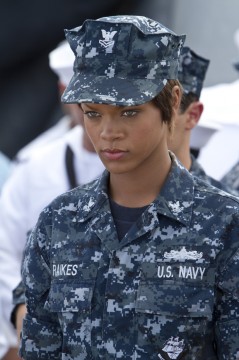
A new batch of Battleship stills show singer-turned-actress Rihanna in Navy gear manning all manner of combat machinery as the resident weapons specialist in Taylor Kitsch ‘s crew. But can her feature debut in Peter Berg’s summer blockbuster counteract the criticism she’s getting from reuniting, at least professionally, with Chris Brown? The stills (below, via Universal and Digital Spy ) hit the web at a conspicuous time for Rihanna, who was assaulted in 2009 by then-boyfriend Brown. After a three-year split, during which time Brown was sentenced to domestic violence counseling and community service and ordered to stay away from Rihanna by restraining order, the two collaborated on a pair of songs released this week. According to producer The-Dream, who oversaw the “Birthday Cake” remix featuring Brown, the move was Rihanna’s idea. “The true thing really is to forgive,” he explained to Billboard Magazine . “And … you want to believe in people.” Some celeb-watchers take the reunion as more than just a professional expression of forgiveness. “The message couldn’t have been clearer to the world,” writes Hollywood Life’s Bonnie Fuller. “We’re a couple again and we’re saying it in the strongest way that we know how — through our music.” That seems like a bit of a stretch, but whatever the relationship, many fans who supported Rihanna as she bounced back from the public fallout of the 2009 incident are understandably upset that the 24-year-old would unite on any front with her former attacker. Enter Battleship . Over a year after the assault, Rihanna was cast as Petty Officer Raikes in Universal’s naval actioner. She’d been looking to break into film already, telling MTV in 2008 that she was looking “seriously” into making her acting debut. Battleship , then, provided a prime opportunity; as Raikes, Rihanna gets to play a strong, serious-minded character involved directly in action sequences whom she’s described as “one of the guys” — as opposed to the film’s eye candy, as embodied in Brooklyn Decker as Kitsch’s love interest. That character quality alone may have been reason enough to break into a side career in acting with Battleship , but it also allows Rihanna to project an image of strength and resilience to her fans. At the helm of a gunboat or wielding assault rifles, she is seen in a position of control and dominance, the would-be executor of violence (against aliens, in this case) instead of a victim. Of course, that’s not to say Battleship will erase the image of Rihanna, battered and bruised, from our collective memories. It certainly shouldn’t, in the least. And it’s not quite a pointed personal statement that, say, a G.I. Jane or a Brave One -styled vigilante pic might be; it’s a subtle move that simultaneously eases first-time actor Rihanna into the movies in a supporting role with more seasoned actors around to do the heavy lifting. Conspicuous as it is that new Rihanna-holding-guns images were released into the world around the same time as her Chris Brown collaborations (joining a few more that were previously released by Universal), it hints at an effort to protect her image from the backlash that any Brown-related association invites. But Battleship has yet to be seen, and Rihanna, who hasn’t yet directly addressed the Brown collaborations, may yet still win back or further alienate her following in the weeks to come.