Tag Archives: weekly-standard

Flashback: Reacting to MRC, ABC News Chief Westin Apologized for ‘No Opinion’ on Whether Pentagon Was ‘Legitimate’ 9/11 Target

Reporting ABC News President David Westin’s plan to step down at the end of the year, the Washington Post’s Howard Kurtz noted “some early missteps” during his 13-year tenure, such as “a comment after the Sept. 11 attacks, for which Westin apologized, that journalists should offer no opinion about whether the Pentagon had been a legitimate military target.” That apology was promoted by an MRC CyberAlert item in October of 2001 which put into play an answer Westin delivered during a Columbia University Graduate School of Journalism seminar. Barely six weeks after the 9/11 attack, Westin was remarkably reticent about expressing an opinion, contending that’s improper for a journalist to do so – how quaint: The Pentagon as a legitimate target? I actually don’t have an opinion on that and it’s important I not have an opinion on that as I sit here in my capacity right now….Our job is to determine what is, not what ought to be and when we get into the job of what ought to be I think we’re not doing a service to the American people….As a journalist I feel strongly that’s something that I should not be taking a position on. I’m supposed to figure out what is and what is not, not what ought to be. After the Monday CyberAlert item was widely picked up (FNC’s Brit Hume, plastered across the DrudgeReport, New York Post, lengthy discussion by Rush Limbaugh) on Wednesday, October 31, 2001 ABC News called to get an e-mail address to send a statement from Westin, which read: Like all Americans, I was horrified at the loss of life at the Pentagon, as well as in New York and Pennsylvania on September 11. When asked at an interview session at the Columbia Journalism School whether I believed that the Pentagon was a legitimate target for terrorists I responded that, as a journalist, I did not have an opinion. I was wrong. I gave an answer to journalism students to illustrate the broad, academic principle that all journalists should draw a firm line between what they know and what their personal opinion might be. Upon reflection, I realized that my answer did not address the specifics of September 11. Under any interpretation, the attack on the Pentagon was criminal and entirely without justification. I apologize for any harm that my misstatement may have caused. Monday, October 29 CyberAlert : “Pentagon a Legitimate Target?” Wednesday, October 31 CyberAlert Extra : “Reacting to CyberAlert Item, ABC News President David Westin Has Apologized and Said ‘I Was Wrong’ for Having ‘No Opinion’ on Whether the Pentagon Was a ‘Legitimate’ Military Target” A few weeks later, Weekly Standard Executive Editor Fred Barnes recounted in the magazine : …On October 23, Westin spoke to a class at Columbia University’s Graduate School of Journalism. Asked if the Pentagon were a legitimate target for attack by America’s enemies, he said, “I actually don’t have an opinion on that…as a journalist I feel strongly that’s something I should not be taking a position on.” The comment drew no criticism from the students, which may tell you something about them. But four days later, the Westin speech was shown on C-SPAN, where Brent Baker of the Media Research Center caught it at 2 A.M. Baker put excerpts in the daily “CyberAlert” he writes for MRC’s website. Rummaging through the Internet, Brit Hume spotted the item and mentioned it on “Special Report” that evening on Fox. Two days later, the New York Post picked it up and the next day so did the Drudge Report. That alerted Rush Limbaugh, who devoted an hour or more to it on his radio show. With Limbaugh’s show still in progress, Baker got a call from ABC. A reply would be e-mailed to him soon for posting on the MRC website. It was a total capitulation. “I was wrong,” Westin wrote. “Under any interpretation, the attack on the Pentagon was criminal and entirely without justification.”… Westin’s original October 23 answer, in full: The Pentagon as a legitimate target? I actually don’t have an opinion on that and it’s important I not have an opinion on that as I sit here in my capacity right now. The way I conceive my job running a news organization, and the way I would like all the journalists at ABC News to perceive it, is there is a big difference between a normative position and a positive position. Our job is to determine what is, not what ought to be and when we get into the job of what ought to be I think we’re not doing a service to the American people. I can say the Pentagon got hit, I can say this is what their position is, this is what our position is, but for me to take a position this was right or wrong, I mean, that’s perhaps for me in my private life, perhaps it’s for me dealing with my loved ones, perhaps it’s for my minister at church. But as a journalist I feel strongly that’s something that I should not be taking a position on. I’m supposed to figure out what is and what is not, not what ought to be.

Go here to read the rest:
Flashback: Reacting to MRC, ABC News Chief Westin Apologized for ‘No Opinion’ on Whether Pentagon Was ‘Legitimate’ 9/11 Target

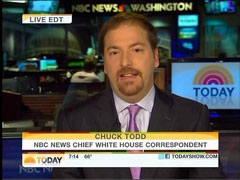
NBC’s Chuck Todd Projects ‘Democrats Are In Deep, Deep Trouble’

If Democrats weren’t nervous about November’s midterm elections yet, they could soon be, especially when you consider that even their allies in the liberal media are starting to forecast doom for them, as NBC’s Chuck Todd did on Tuesday’s Today show, going as far to predict “Democrats are in deep, deep trouble.” Todd, appearing in the 7am half hour of this morning’s Today show explained to viewers that ” The Tea Party has provided an enthusiasm boost to the Republican Party,” however he reminded Democrats that they still had “six weeks to turn this around” but then added that “if they don’t, they are headed for an historical defeat in November.” Interestingly though Todd and his NBC colleague Kelly O’Donnell, in her set up piece, didn’t exactly paint a big Republican win as a defeat for liberals, as they couldn’t even bring themselves to attach that label to any Democrats running in 2010. While Todd and O’Donnell used the “conservative” label a total of four times between them, neither of them used the “liberal” label even when they discussed Florida Representative Kendrick Meek who has a lifetime ACU rating of 7 and a lifetime ADA rating of 92 percent.  The following O’Donnell set-up piece and Todd segment were aired on the August 24 Today show: ANN CURRY: Now to politics. Voters are heading to the polls in five states today headlined by primaries in Florida and Arizona that pit the political establishment against Washington outsiders. NBC’s Kelly O’Donnell is in Phoenix this morning, with details on this. Kelly, good morning. [On screen headline: “Primary Day, Incumbents Battle Outsiders In November Preview”] KELLY O’DONNELL: Good morning, Ann. That’s right. From Phoenix to Florida to Fairbanks voters are deciding some of the most talked about races this year. They include well-known incumbents and some very interesting outsiders and including is John McCain, who will start right here. He has spent more than $20 million in campaign cash and some of that was left over from his presidential run in 2008. Senator John McCain says he has something to prove. JOHN MCCAIN TO VOTER: Thank you very much. O’DONNELL: Going for a fifth term in this anti-incumbent year. (Begin ad clip) MCCAIN: I appreciate your support. I ask for your vote. (End clip) O’DONNELL: Means fighting off a conservative challenger and that requires fighting against Barack Obama once again. MCCAIN: I’m running against his policies and what he and his administration have done to this country, but at the same time I’m running for Arizona. I’m running for jobs. I’m running for keeping people in their homes. J.D. HAYWORTH: I’d really be honored to have your support in the primary. O’DONNELL: Opponent J.D. Hayworth, a former congressman, accuses McCain of supporting amnesty for illegal immigrants. HAYWORTH: This is really true. O’DONNELL: McCain exposed a 2007 TV show where Hayworth was a pitch man on how to get free government money, hardly the Tea Party conservatism he talks about today. HAYWORTH: Even if they have some concerns about me and even shocking for me to feel that my personality may rub people the wrong way, the fact is they know I will vote against amnesty. O’DONNELL: Turning to Florida’s crowded senate race, Democrats are caught in a class struggle. KENDRICK MEEK: I’m the true candidate for the middle class. O’DONNELL: Miami Congressman Kendrick Meek has moved from long shot to leader in the polls up against self-made billionaire Jeff Greene, who’s glitzy social life gets him attention. The winning Florida Democrat will be in a three-man race in November against Tea Party conservative Marco Rubio and Governor Charlie Crist, who quit the Republican Party to run as an independent. And there’s a cold snap in Alaska’s Republican Senate primary. UNIDENTIFIED MAN: Hi, Senator. How are you? O’DONNELL: Incumbent Lisa Murkowski. LISA MURKOWSKI: I’m not working for the party. I’m working for Alaska. O’DONNELL: And Sarah Palin is working against Murkowski with a Facebook page endorsement of challenger Joe Miller. Palin writes, “Alaskans can trust Joe to not shed his conservative antlers in D.C.” And there’s some history there. Palin defeated Senator Lisa Murkowski’s father when Palin became governor. So there’s been a long rivalry there. And of course it all ties back here. Palin, of course, was here in the spring trying to help out her former running mate, at a time when he looked very vulnerable as one of the incumbents who was being targeted this year. But a lot has changed. Today McCain is the frontrunner with a double-digit lead. Ann? ANN CURRY: Alright Kelly O’Donnell this morning. Kelly thanks. Chuck Todd is NBC’s political director and the chief White House correspondent for NBC News. Chuck, good morning. CHUCK TODD: Good morning, Ann. CURRY: We just heard from Kelly that John McCain is ahead, at least according to the polls, by double digits. But he had to spend like $20 million while his opponent spent just about $3 million. So what does that tell us about what’s going on in Arizona, Chuck? TODD: Well look, John McCain had to do this the old-fashioned way in politics, he’s winning ugly. The $20 million was necessary. He always had about 35 to 40 percent of the Republican conservative electorate down there that wasn’t crazy about him, was upset about him on immigration, on taxes, on a number of issues. And so McCain had to disqualify J.D. Hayworth. And here is what we found out, Ann. As upset as voters are these days about Washington politicians, infomercial hucksters are even worse and that’s what McCain did. He completely disqualified J.D. Hayworth. The big question, Ann, that a lot of people in Washington have is, which John McCain comes back to Washington? Is it this new consistent conservative and is a consistent thorn in the side of President Obama or is it the guy from the early part of this decade who was unpredictable and he didn’t know which side of the aisle he’d come down on a different issue? CURRY: Let’s, let’s talk, move on to Florida. Why should the whole country be paying attention to what’s happening there? TODD: Well look this Democratic Senate primary, it’s kind of nuts, it’s kind of this, but a Kendrick Meek win, by the Miami congressman, means the Democratic establishment cannot flee the Democratic nominee there. They can’t go over to Charlie Crist. And the big picture is this. Florida held up the country on who was gonna be president in 2000. Because we don’t know which way Charlie Crist is gonna vote, if he’s gonna be with the Democrats or the Republicans, on election night if he wins – and there’s no guarantee he’s gonna win, this is gonna be a nutty three-way race, maybe the best campaign in this state since Claude Pepper lost because his sister was a thespian. But what we won’t know is whether, is whether, who’s gonna control the Senate? Charlie Crist could hold that up for weeks. CURRY: On the question of who is gonna control the Senate and actually Washington, are incumbents as weak as we thought they were going to be, Chuck? And what, what is what you’re looking at in terms of these races telling us about the true party of the Tea Party, true power of the Tea Party? TODD: Well look, here’s, here’s what we know. Look incumbents are not getting defeated in these primaries at a clip that a lot of people expected. There’s been a few high-profile exceptions. But the bigger picture is this. Democrats are in deep, deep trouble. The Tea Party has provided an enthusiasm boost to the Republican Party. They are as excited about voting as the Republicans have been since 1994. Democrats have about six weeks to turn this around because if they don’t, they are headed for an historical defeat in November. Losses that could not just include control of the House but also the Senate with or without this, the, what happens with Charlie Crist in Florida. It is that bad right now for Democrats, Ann. CURRY: Alright, on that note we’ve got leave it. Chuck Todd, always a pleasure. Thanks. TODD: You got it.

Here is the original post:
NBC’s Chuck Todd Projects ‘Democrats Are In Deep, Deep Trouble’

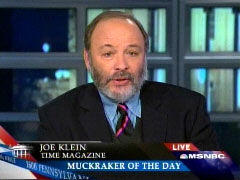
Joe Klein’s Latest Adventure in Missing the Point: Taking Bill Kristol Out of Context

Time magazine’s Joe Klein yesterday did what he does best: take one paragraph from a neoconservative’s column and blow it out of proportion and out of context in order to go on an extended screed bashing conservatives in general and neocons in particular. Writing for his magazine’s Swampland blog yesterday, Klein addressed Bill Kristol’s editorial for the August 30 Weekly Standard print edition entitled, ” He’s No Muslim, He’s a Progressive. ” Klein started off with a backhanded compliment: Well, it’s good to learn that there are limits to Bill Kristol’s tactical skeevery. He clearly states here that Barack Obama is not a Muslim. No winks, no nods, no gratuitous McConnellesque “If he says he’s not, that’s okay with me.” With that out of the way, Klein dove into his screed: But read the editorial all the way through and you get to this paragraph: It’s similar with the Community Center Formerly Known as the Ground Zero Mosque. Today’s progressives are multiculturalists. They’re inclined to make grand claims about the positive merits of a multicultural, non-judgmental mosaic replacing our old, uniculturalist melting-pot view of America. But when political realities force them to retreat, as Obama has done in the mosque controversy, from a proud multiculturalism to a narrow defense of the right to the free exercise of religion and the right to build on private property, they’re in trouble. The free exercise of religion and respect for private property are not a promising agenda for progressives. Say what? Is Kristol actually admitting that his crowd, including his aspirational hand-puppet Sarah Palin, have been arguing against the conservative themes of the “free exercise of religion and respect for private property?” Um, no, Joe. Here are the paragraphs immediately preceding and following the one you quoted (emphasis mine) So progressivism seeks to bring big changes to our backward country. Progressives like to dream about passing “the most progressive legislative agenda .  .  . not just in one generation, maybe two, maybe three.” But when progressivism has to give up its grand transformational claims, then we’re back in the world of reality and results, of the practical consequences of policy choices. A political debate over consequences rather than intentions, and over the real world rather than an imagined one, is one that is, as it has been for a long time, good for conservatives and bad for progressives. Progressivism is in retreat. Obama’s problem isn’t that people falsely think he’s a Muslim. It’s that the public is correctly concluding he’s a garden-variety multiculturalist progressive. So November’s election won’t just be a repudiation of one non-Muslim president. It will be a repudiation of a multiculturalist progressive worldview —and of the bitter elites who cling desperately to that worldview and are consumed by antipathy to most Americans, who don’t. Kristol was arguing that with the Ground Zero mosque issue as with health care reform and various other issues, progressives are envisioning themselves as more enlightened than the general public, whose views must be damned when they stand in the way of advancing a progressive agenda. Progressives live in a la-la land where good intentions matter more than the unintended consequences they spawn. That’s Kristol’s point.  Yet Klein insists that the thing he admires about true conservatives is that they are realists: Here are some conservative principles I admire: Foreign policy realism, budget discipline and a belief in (carefully regulated) markets as the best vehicles for delivering prosperity and even some forms of government services. The best conservatism has a healthy respect for complexity and a deep skepticism about the perfectability of human nature. For one who admires people who have “a healthy respect for complexity,” Klein is determined to ignore or dismiss the true complexity of the Ground Zero mosque issue. Klein failed to point out a single conservative leader who insists that the First Amendment doesn’t apply to Muslims. The issue has always been the impropriety and lack of sensitivity of building a mosque two blocks from Ground Zero, particularly given the controversial remarks Feisal Rauf has made about the U.S. being an accessory to the 9/11 attacks and his refusal to label Hamas a terrorist organization . But perhaps complexity and nuance are a little too much to ask from Joe Klein, particularly when doing so means he has to logically wrestle with his political opponents rather than demonize them.

The rest is here:
Joe Klein’s Latest Adventure in Missing the Point: Taking Bill Kristol Out of Context

Author Richard Epstein Renounces Gray Lady: ‘She’s Become a Bit…of a Slut’

Richard Epstein disowned the New York Times today. ” Adios, Gray Lady ,” he proclaimed at the Weekly Standard’s website. “She’s become a bit – perhaps more than a bit – of a slut,” Epstein claimed, “whoring after youth through pretending to be with-it.” Epstein, a prominent libertarian author and law school professor, hysterically decried the Times’s ongoing descent into pomposity and cultural irrelevance. And Epstein would know – he claims he’s been a subscriber for 50 years. Chief among Epstein’s grievances was the contents of the Times’s opinion pages. Though he praised David Brooks, longtime token conservative of the Times’s commentators (and by many measures hardly a conservative at all), as not being “locked into a Pavlovian political response,” Epstein claimed that “I find no need to read any of the Times’s regular columnists.” Every so often I check to remind myself that Maureen Dowd isn’t amusing, though she is an improvement, I suppose, over the termagantial Anna Quindlen, whom I used to read with the trepidation of a drunken husband mounting the stairs knowing his wife awaits with a rolling pin. I’d sooner read the fine print in my insurance policies than the paper’s perfectly predictable editorials. Laughter, an elegant phrase, a surprising sentiment-the New York Times op-ed and editorial pages are the last place to look for any of these things…. I could go on about the artificial rage of Frank Rich-the liberals’ Glenn Beck-or the forced gaiety of “Sunday Styles,” but the main feeling I have as I rise from having wasted an hour or so with the Sunday New York Times is of what wretched shape the country is in if it is engaged in such boringly trivial pursuits, elevating to eminence such dim cultural and political figures, writing so muddledly about ostensibly significant subjects. Ouch. Epstein’s grievances, though, went far beyond the paper’s columnists, to other, less ostensibly political sections. I sometimes glimpse the Arts section to see which wrong people are being praised or have been awarded large cash prizes or recognized for years of mediocre achievement by election to the American Academy of Arts & Letters. Arts, of course, are no longer quite The Arts, at least in the New York Times, which features hard rock and rap music and video games and graphic novels under the rubric The Arts. Only the photographs of dancers lend an aesthetic dimension to the shabby section. I lift the Sunday New York Times from the hallway outside our apartment with a heart twice the weight of the hefty paper itself. From it I extract the Book Review, the magazine, “Sunday Styles,” the “Week in Review.” For decades now the New York Times Book Review has been devoted to reinforcing received (and mostly wrong) literary opinions and doing so in impressively undistinguished prose. The New York Times Magazine has always been dull, but earlier it erred on the side of seriousness. Now it is dull on the side of ersatz hipness. The other Sunday I put myself through a long article on the dangers of leaving a record of one’s minor misdeeds on the Internet. The article’s last sentence instructed that “we need to learn new forms of empathy, new ways of defining ourselves without reference to what others say about us and new ways of forgiving one another for the digital trails that will follow us forever.” Yes, I thought, and wet birds never fly at night. Epstein ends his jeremiad with a simple request: “Cancel my subscription, please.”

Link:
Author Richard Epstein Renounces Gray Lady: ‘She’s Become a Bit…of a Slut’

Paul Ryan Strikes Back at ‘Intellectually Lazy’ Paul Krugman

Republican Congressman Paul Ryan of Wisconsin has struck back at Paul Krugman calling the New York Times columnist “intellectually lazy.” As NewsBusters reported Saturday, Krugman wrote an article the previous day castigating Ryan as ” The Flimflam Man ” calling the Congressman a “charlatan” and a “fraud” while claiming his “Roadmap” to balance the nation’s budget was “drenched in flimflam sauce.” Krugman’s criticisms of the Republican rising star were of course praised by all manner of media member from the shills at MSNBC to the sycophants in the liberal blogosphere. Since then, Ryan has responded and responded well, first at the Milwaukee Journal Sentinel on Saturday: The assertion by Krugman and others that the revenue assumptions in the “Roadmap” are overly optimistic and that my staff directed the Congressional Budget Office not to analyze the tax elements of the “Roadmap” is a deliberate attempt to misinform and mislead. I asked the CBO to analyze the long-term revenue impact of the “Roadmap,” but officials declined to do so because revenue estimates are the jurisdiction of the Joint Tax Committee. The Joint Tax Committee does not produce revenue estimates beyond the 10-year window, and so I worked with Treasury Department tax officials in setting the tax reform rates to keep revenues consistent with their historical average. What critics such as Krugman fail to understand is that our looming debt crisis is driven by the explosive growth of government spending – not from a lack of tax revenue. Krugman also recycles the disingenuous claim that the “Roadmap” – the only proposal certified to make our entitlement programs solvent – would “end Medicare as we know it.” Ironically, doing nothing, as Democrats would prefer, is certain to end entitlement programs as we know them, and in the process, beneficiaries would face painful cuts to these programs. Conversely, the “Roadmap” would pre-empt these cuts in a way that prevents unnecessary disruptions for current beneficiaries. It reforms Medicare and Social Security so those in and near retirement (55 and older) will see no change in their benefits while preserving these programs for future generations of Americans. As Ryan noted, his recommendations are hardly as extreme as liberal shills like Krugman claim: Far from the “radical” label that critics have tried to pin on it, the Medicare reforms in the “Roadmap” are based on suggestions made by the National Bipartisan Commission on the Future of Medicare, chaired by Sen. John Breaux (D-La.). That commission recommended in 1999 “modeling a system on the one members of Congress use to obtain health care coverage for themselves and their families.” With respect to Medicare and Social Security, the “Roadmap” puts in place systems similar to those members of Congress have. There has been support across the political spectrum for these types of reforms. By dismissing credible proposals as “flimflam,” critics such as Krugman contribute nothing to the debate. Standing on the sidelines shouting “boo” amounts to condemning our people to a future of managed decline. Absent serious reform, spending on entitlement programs and interest on government debt will consume more and more of the federal budget, resulting in falling standards of living and higher taxes as we try to sustain an ever larger social welfare state. The American people deserve a serious and civil discussion about how to reduce our exploding debt and deficit. By relying on ad-hominem attacks and discredited claims, Krugman and others are missing an opportunity to contribute to this discussion and are only polarizing and paralyzing attempts to solve our nation’s fiscal problems. On Sunday, Krugman replied at his Times blog: As I predicted , a snow storm of words, dodging the math questions. Notice that Ryan does not address the issue of the zero nominal growth assumption, and how that assumption – not entitlement reforms – is the key to his alleged spending cuts by 2020. By the way, if you look at the artful way his excuses are constructed – giving the false impression that he couldn’t get a revenue score for love nor money – how is that not flimflam? On Monday, Ryan spoke with The Weekly Standard’s John McCormack to further clarify the situation: “I realize he’s a columnist and not a journalist, yet he could have easily tried to have verified his claims with a phone call or an email,” Ryan said of Krugman. “Instead he went with his confusion and chose to impugn motives,” said Ryan, “which strikes me as a very intellectually lazy exercise or style.” Krugman wrote on his blog on Saturday that “Ryan could have gotten JCT to do a 10-year estimate; it just wouldn’t go beyond that. And he chose not to get that 10-year estimate.” Ryan says that’s not true. “We asked Joint Tax to do it,” Ryan told me. “They said they couldn’t. They don’t do them long-term outside the 10 year window. They couldn’t do it in the first 10 years because of just how busy they were.” Ryan says Krugman could have cleared this confusion up with a simple phone call. “Megan McArdle figured it out on her own,” Ryan said, referring to a blog post by The Atlantic ‘s business and economics editor.  Clearing up confusion is never Krugman’s modus operandi, as he’s made a living misinforming the public on such issues. But Ryan wasn’t done: Ryan also responded to Krugman’s criticism that his domestic discretionary spending freeze is impractical and doesn’t spell out exactly which programs would be cut. “Domestic discretionary spending went up 84 percent last year,” said Ryan. “There has been such a gusher of domestic discretionary spending that I think we can live with a freeze for a long time to come.” The point of a spending freeze, said Ryan, is to put “strong enforceable controls in place and then make the experts, whether it be the appropriators or the agencies, come up with a way to live within their means.” Ryan marvelously concluded: “The Roadmap is designed to maintain a limited government in the 21st century, and it is the antithesis of the progressivist vision which [Krugman] subscribes to. That’s fine. I understand it violates his vision for a progressivist society,” Ryan continued. “What I think is rather bizarre is his strange personal attack and ad hominem attacks based upon his confusion surrounding the scoring process, which could have been easily clarified with a simple phone call or email.” “I’m not going to descend into the mudpit with Krugman on this stuff,” Ryan said. “I want to stay on policy and ideas.” Actually, mudpit would be an uptick considering the nether regions folks like Krugman propagandize from, for his attacks on Ryan were typically devoid of facts. As NewsBusters reported Saturday, the primary statistical source for Krugman’s “Flimflam” piece, the liberal Tax Policy Center, quickly corrected the record on Friday surprisingly defending Ryan. But Krugman isn’t concerned with that. As Hot Air’s Allahpundit noted Tuesday, the Times columnist is part of an orchestrated strategy by the Left to attack all on the Right that are gaining traction with the American people: It’s the same reason why Chris Matthews went to such pains to make Ryan look unserious and why the DNC is now lumping him in with candidates like Sharron Angle in an attempt to make him seem kooky . According to the Narrative, today’s conservatives are a horde of feral, brainless bigots following whatever primitive impulses their political id generates. Ryan, being both soft-spoken and very intellectually serious about the unsustainability of entitlements, is both a threat to that narrative and to the welfare state itself. As such, frankly, he’s lucky he’s gotten off as easy as he has thus far. Potentially, he’s progressive public enemy number one.  Indeed. What also makes Ryan so dangerous to folks like Krugman is that he represents a new breed of young, extremely intelligent, and attractive conservatives that could very well be presidential material in the future. As such, the liberal attack machine in the media feels it’s necessary to bash him whenever possible and without any concern for the facts. As the fabulous David Byrne sang decades ago, “Same as it ever was.” 

See the article here:
Paul Ryan Strikes Back at ‘Intellectually Lazy’ Paul Krugman

Michael Steele: Mentally Deficient

Republican National Committee chairman Michael Steele has segregated himself from any and all party’s once again. Michale Steele seems to have either forgotten that there was a President before Obama, or that Bush was never President. Steele was caught on video spewing republicanism’s, saying that Afghanistan is “a war of Obama’s choosing”; I didn’t know Obama had the power to send troops while being on the Illinois senate. Steele is also quoted saying “If he’s such a student of history,” Steele said, referring to President Obama, “has he not understood that, you know, that’s the one thing you don’t do, is engage in a land war in Afghanistan? Everyone who has tried, over 1,000 years of history, has failed.” I again am astonished that this man is ignoring the fact that, Republican former President George W. Bush invaded Afghanistan in 2001 after September 11( I had to explain this just in-case there are more people who forget the past like Steele). Now the Democrats are jumping all over his words as they should, but shockingly even very prominent conservatives are demanding his immediate resignation. William Kristol, editor of the Weekly Standard, called Steele’s remarks “an affront, both to the honor of the Republican Party and to the commitment of the soldiers fighting to accomplish the mission they’ve been asked to take on by our elected leaders.” Fellow conservative Erick Erickson had this to say, Steele had “lost all moral authority to lead the GOP.” Steele is now in full damage control, coming out re-explaining his statements. If you have to re-explain your political standings and true beliefs then your just trying to save face. A party spokesman said that Steele’s comments were in the context of speaking to future candidates and questions on the campaign trail. Steele however separated himself even further from his comments by saying this, Steele called winning the war in Afghanistan “a difficult task,” but “a necessary one.” While also backing it up with this statement, “The stakes are too high for us to accept anything but success in Afghanistan.” The Director of the RNC has been saying that Steele’s job is intact and that Democrats are misinterpreting his statements. This is just yet another example of the Republican foot in mouth that seems to be running rampant lately. While most Republicans surly believe what Steele has said, they cannot get elected by saying what they truly believe. Of course Republicans are going to back away from him, because they want to get elected off of the less conservative ideals they preach, and once in office force the more extreme views on the public. Source: http://www.latimes.com/news/nationworld/nation/la-na-rnc-steele-20100703,0,44924… added by: Colin_McCabe

Media Make Selling Soccer a Goal

Something about the soccer World Cup brings out the missionary in the mainstream media, and every four years they strive to bring the good news of “the beautiful game” to the ignorant American masses. This year is no different. The 2010 World Cup is set to begin in South Africa on June 11. More than just covering the month-long event, the media are already doing their best to hype it, overstating its popularity in the United States and its potential appeal to U.S. sports fans. From Time magazine dedicating an entire issue to “The Global Game,” to CBS’s helpful ” The World Cup Guide for Americans ,” the public is being brow-beaten to catch “World Cup Fever.” And while soccer partisans may try (mostly unsuccessfully) to score on point-by-point comparisons to baseball or football, the most compelling argument many media outlets can muster is, “The rest of the world loves it. We should too.” The liberal media have always been uncomfortable with “American exceptionalism” – the belief that the United States is unique among nations, a leader and a force for good. And they are no happier with America’s rejection of soccer than with its rejection of socialism. Hence Americans are “xenophobic,” “isolated” and lacking in understanding for other nations and their passion for “the planetary pastime,” as Time magazine put it. But, they are confident, as America becomes more Hispanic, the nation will have to give in and adopt the immigrants’ game. On the other hand, the media assure the public that soccer is already “America’s Game,” and Americans are enthusiastically anticipating the World Cup, even though the numbers don’t bear that contention out. So, every four years they return with renewed determination to force soccer’s square peg in the round hole of American culture. Soccer is Popular, isn’t it? Time magazine is leading the “Ole’s” for soccer this year, putting the World Cup on its cover and dedicating 10 articles to the sport in its June 14 issue. One of those articles proclaimed in the headline, ” Yes, Soccer Is America’s Game .” Author Bill Saporito argued that “soccer has become a big and growing sport.”  “What’s changed is that this sport and this World Cup matter to Americans,” Saporito asserted. “These fans have already made the transition from soccer pioneers to soccer-literate and are gradually heading down the road to soccer-passionate.” Soccer is even in the White House, Saporito pointed out. President George W. Bush was a former co-owner of a baseball team. And although President Obama played basketball, his daughters play little league soccer, and current White House Press Secretary Robert Gibbs played soccer in high school and college. On MSNBC’s “Morning Joe” on June 3, host Joe Scarborough noted the importance of the World Cup to other countries, but explained that Americans just don’t understand “what a huge sport this is.” Still, he said hopefully, “It is a growing sport in America as well, isn’t it?” Growing, but not “huge” by any standard. The final game of the 2006 World Cup drew 16.9 million viewers in the United States. While that number may seem respectable, it pales in comparison with the 106 million viewers that tuned in to watch the 2010 Super Bowl. The final 2009 World Series game drew 22.3 million viewers, and 48.1 million tuned in to watch Duke beat Butler in the 2010 NCAA men’s college basketball championship. A look at game attendance figures is instructive, as well. According to Major League Soccer’s MLS Daily , as of June 7, 2010, the highest drawing pro soccer team, the Seattle Sounders, averaged 36,146 attendees over seven home games. Conversely, the Seattle Mariners baseball team has averaged 25,314 over 32 home games. The Mariners are dead last in the American League West division, and 24 th in the league in batting average, 30 th in home runs, 27 th in RBIs and 25 th in number of hits. In short, they’re horrible. With a record of 4-5-3, the Sounders aren’t very good either, but they play in a very liberal city, are currently benefiting from World Cup year interest in their sport, and they play a schedule that allows far fewer opportunities for fans to attend. Another number is Hollywood box office. John Horn of The Los Angeles Times contemplated on June 6 about Hollywood’s lack of a mainstream movie about soccer. In ” Why is There No Great Hollywood Soccer Movie?” Horn pointed out that each sport has its own hit movie except soccer. He explained that, “When 20th Century Fox adapted Nick Hornby’s book ‘Fever Pitch,’ [the film starred Drew Barrymore and Jimmy Fallon] the subject sport was changed from soccer (the Arsenal Football Club) to baseball (the Boston Red Sox.)” But aren’t American kids playing soccer in huge numbers? After all, there’s a sought-after (by liberals) voting demographic out there called “soccer moms.” Yes, but as of 2009, soccer trailed baseball and basketball in terms of U.S. youth participation, according to the Sporting Goods Manufacturers Association . And mass participation doesn’t necessarily translate into lasting enthusiasm. That has to do with the reasons children play soccer in the first place. As both soccer’s boosters and detractors have pointed out, at the youth level, it’s easy, more about participation than competition. As Webb wrote at First Things, to contemporary American parents, “Baseball is too intimidating, football too brutal, and basketball takes too much time to develop the required skills … Soccer is the perfect antidote to television and video games. It forces kids to run and run, and everyone can play their role, no matter how minor or irrelevant to the game.” Those aren’t the qualities that inspire love of a sport, and many children stop playing when they reach adolescence.  But in a World Cup year, no contortion is too severe to convince Americans to accept the sport. For example, The June 6 “New York Times Magazine” featured a piece titled “Next-Gen American Soccer,” a pictorial of young players it called “The potential face of the U.S. national team at future World Cups.” Meant to show that the United States already has excellent young talent, and that the future is bright for American soccer, the introductory text contradicted the intention. Explaining that the photographer had to travel to two European countries and two U.S. cities to shoot these up-and-comers, The Times wrote, “It’s an itinerary that hints at another truth about American soccer talent: it’s not only coming from abroad; at ever younger ages, it’s also going abroad … More than 200 prospects now playing in other countries would be eligible for the at next year’s [Under]-20 World Cup. Ability and American citizenship are all that’s required.” In other words, soccer is so popular in America that a good chunk of the nation’s best young players go overseas to ply their trade. On the other hand, somewhere along the way these kids acquired U.S. citizenship, so they’re going to carry our flag in future World Cups. Why Should We Be Different? As healthcare reform and stimulus spending have underscored, if Europe jumped off a cliff, the American left would be right behind it. So it makes sense that the media’s main argument for accepting soccer is that “everybody’s doing it.” In his Time article, Saporito quoted Seattle Sounder’s owner Joe Roth. “Soccer is the only game played around the world,” Roth explained. “We can’t be that different than anyone else in the world.” Roth also told the LA Times’ Horn that, “We’re basically a xenophobic country and don’t look at what’s going on in the rest of the world as closely as we should.” Liberal blogspot Huffington Post featured a June 4 article urging Americans to pay attention to the World Cup. In ” Why You Should Care About the World Cup,” author John Vorhaus informed readers he would call soccer “football” in the rest of his article, and attempted to convince Americans to watch the World Cup because the rest of the world cares. He argued that, “Football wasn’t my sport – isn’t and never will be my sport – but billions of people care enough about it to put their lives on absolute hold for four weeks every four years.” (Of course, Europeans famously put everything “on absolute hold for four weeks” far more frequently, when the entire continent shuts down for vacation in August.) “As a responsible citizen of the world,” he wrote, “I feel like that’s something I should pay attention to.” Vorhaus also asserted, “More to the point, you’ll get a taste of something that the rest of the world cares passionately about. In these troubled and isolated times in America, it couldn’t hurt at all for us to understand the passions of our foreign friends, competitors, even enemies.” “Citizens of the World” (aka. liberals) talk about the World Cup with the same reverence they reserve for the United Nations, and invest the sport and its championship with symbolic importance. Time’s managing editor, Rick Sanchez, told “Morning Joe” on June 3 the World Cup was the “biggest event in the world,” and “an optimistic idea,” and soccer was “a global sport.” Indeed, Time’s cover story proclaimed soccer, ” The Global Game .” Author John Carlin touted it as the “species’ favorite pastime,” a wonderful game because not only can it be played in most places, but the players are so physically diverse that almost everybody can play. Carlin asserted that how soccer can bring divided groups of people together, but then quoted Nike’s corporate vice president of global management as stating, “We’ve noticed there is nothing like the emotional connection that people have with soccer. There is a tribal instinct with it.” Like many things about America, its soccer backwardness embarrasses right-thinking liberal journalists. In the same “New York Times Magazine” that featured the “Next-Gen” piece, Michael Sokolove wrote a article about an intense European soccer academy and reported that he, “heard a lot of misconceptions … Many people seem to believe that the sport is still a novelty in the United States, a game that we took up only the last couple of decades and that is not very popular or perhaps is even disdained by our best male athletes …” He reported that Dutch soccer journalist and historian Auke Kok questioned if their “football is too stylish, too feminine?” Sokolove reported that was not the case, but still wondered why “the United States still does not play at the level of the true superpowers of soccer.” Bleacher Report’s Tyler Juranovich offered his own take into why Americans were so against soccer. A soccer fan, he wrote, “It’s not news that soccer’s popularity in America is slow growing. It’s popular everywhere else but not in the good ol’ US of A. My theory is because America isn’t as dominant at soccer as other sports, we have a hard time taking it seriously. Americans are a little arrogant when it comes to sports, and you can’t really blame us. We are dominant in football, baseball, and basketball.” Diversity’s Sake Part of the liberal sales pitch for soccer is its popularity with Hispanics. Liberals who fetishize race are eager to adopt a sport with a special appeal for a certain minority, and it would never occur to them that new arrivals to the country might be well served adapting to traditional U.S. pastimes. To the left, it’s America that must change. Saporito maintained that “the browning of America,” will grow the sport. Time’s Sanchez told Scarborough, “… you know, when America becomes a nonwhite majority nation in 2040, I mean, you know, the sport of soccer is the sport of, you know, of Hispanic Americans, of all kinds of immigrants to America.” In his June 3 rd “guide” to the tournament for ignorant Americans, CBS’s Chris Matyszczyk (who actually wrote that baseball players wear “girly pants”) posited, “Very soon, America will be a Hispanic country. The Hispanic culture has always been very partial to the world’s most wonderful game.” To Matyszczyk, soccer is the future, and demographics say so. Therefore, Americans should preemptively surrender for the sake of their children. “So, if all the obvious glories of the World Cup still cause you to utter expletives and bury your head in decaying Astroturf,” he wrote, “surely it is worth thinking of your children. They will be growing up in an America much different from yours, an America that has soccer at his heart and the NFL somewhere nearer its feet.” A Game of the Left Since at least the 1970s, Americans have been told that soccer was the future, and it would soon dominate other sports. But the United States proved pretty resistant to soccer’s charms, to the chagrin of its boosters on the left. (And yes, it’s support has mainly come from the left; in 2002 conservative soccer fan Robert Zeigler plaintively asked in National Review , “What is it about soccer that makes it (in America) the nearly exclusive domain of liberal sports fans?”) Commentators on the right have generally applauded the nation’s indifference and pointed the flaws of soccer itself as the cause. Writing in the last World Cup year (2006) in the Weekly Standard, Frank Cannon and Richard Lessner said, “Despite the heroic efforts of soccer moms, suburban liberals, and World Cup hype, soccer will never catch on as a big time sport in America. No game in which actually scoring goals is of such little importance could possibly occupy the attention of average Americans. Our country has yet to succumb to the nihilism, existentialism, and anomie that have overtaken Europe.” Soccer’s 0-0, 1-1 or 1-0 outcomes don’t sit well with Americans, who like to think that work accomplishes something, the authors wrote. “Soccer is the perfect game for the post-modern world. It’s the quintessential expression of the nihilism that prevails in many cultures, which doubtlessly accounts for its wild popularity in Europe. Soccer is truly Seinfeldesque, a game about nothing, sport as sensation.” Stephen H. Webb wrote for First Things in 2009 , “More than having to do with its origin, soccer is a European sport because it is all about death and despair. Americans would never invent a sport where the better you get the less you score.” Then there is soccer’s “flop-‘n’-bawl,” according to another 2006 Weekly Standard article by Jonathan V. Last . “Turn on a World Cup game, and within 15 minutes you’ll see a grown man fall to the ground, clutch his leg and writhe in agony after being tapped on the shoulder by an opposing player. Soccer players do this routinely in an attempt to get the referees to call foul. If the ref doesn’t immediately bite, the player gets up and moves along,” Last wrote. “Making a show of your physical vulnerability runs counter to every impulse in American sports. And pretending to be hurt simply compounds the outrage.” And to conservatives, the troubling aspects of the game aren’t confined to the pros. Soccer requires comparatively little from children but the ability to run after the ball – the risk of failure for anyone except maybe the goal keeper is zero. Even the strong chance that any given game will end in a tie makes it attractive for parents reluctant to impart life’s difficult lessons to young kids. Webb wrote in First Things that, “Sporting should be about breaking kids down before you start building them up. Take baseball, for example. When I was a kid, baseball was the most popular sport precisely because it was so demanding … you had to face the fear of disfigurement as well as the statistical probability of striking out. The spectacle of your failure was so public that it was like having all of your friends invited to your home to watch your dad forcing you to eat your vegetables.” In short, a powerful component of character building is missing from youth soccer, an important component of character is missing from pro soccer, and a sense of purposefulness is missing from the entire sport. American Classics It must baffle soccer partisans that Americans haven’t taken to their game. After all, the United States is a sports-obsessed nation. Americans look to sports to teach work ethic, teamwork and responsibility, in addition to the physical and mental skills necessary for competition. They love underdogs and “Cinderella stories” and “Evil Empires” and “bums,” “Hogs” and “No-Name Defenses.” And Americans like to think their sports reflect something about them. Michael Shackelford of Bleacher Report praised football because it, “requires a combination of power and agility, brute strength, and grace … In other words, it requires American characteristics in order to succeed.” And sports have played an important and overwhelmingly positive role in the history of America. During the Civil War, men of both armies were obsessed with baseball, and after the peace our “national pastime” helped repair the ties between north and south. And nearly a century before Jackie Robinson broke the color barrier, Walt Whitman said “I see great things in baseball. It’s our game – the American game.”

Sarah Palin’s 2012 Map to Victory

It’s national campaign stat-porn season again! Number muncher Nate Silver posted some of his magic maps this morning . These maps explain how Sarah Palin could be the 2012 Republican nominee for President! That reddish line from the northwest through the deep South presents Palin’s best shot at the nomination, according to Silver. Basically she has to win either Iowa or South Carolina (or both!) in order to have a shot. But she does well with rural, non-college educated voters who care about terror and God. And that’s an important part of the GOP base! But the most important part of the GOP base is rich people who don’t want to pay taxes. And they will ensure that the nominee is Mitt Romney. He has the organization and the money and, most importantly, he came in second in 2008. That’s how the Republican nomination process works. Huckabee has an outside chance, but for some reason he is intensely hated by many of the GOP money people. Pawlenty is increasingly hated in his home state of Minnesota, but he might end up the least offensive “normal guy” backup choice. Meanwhile, Sarah Palin’s organization is a joke. Pam Pryor, a former RNC senior adviser, leads Palin’s political action committee and is orchestrating her outreach to social conservatives. Randy Scheunenmann remains her policy maestro, with informal assistance from his Orion Strategies colleague Michael Goldfarb, the former Weekly Standard writer and McCain campaign rapid responder. (Goldfarb did not return an e-mail seeking comment about his future in Palin’s world.) Fred Malek is perhaps the single Washington establishment figure that Palin turns to. Michael Goldfarb is a liability. Pam Pryor is an experienced evangelical adviser to Republicans but she hasn’t ever worked for a major candidate. Scheunenmann—one of Ahmad Chalabi’s men in Washington and lobbyist for the Republic of Georgia—was nearly fired from the McCain campaign (along with Goldfarb) for undermining and backstabbing. Fred Malek once counted Jews in the Department of Labor for Richard Nixon. As Dave Weigel pointed out, Huckbaee, Pawlenty, and Romney have bigger and better teams in place. Palin’s PAC can raise substantial amounts of money without much trouble, thanks to her high profile and intense fanbase, but they’re already famous for spending more money on her book than they did on candidates and their most recent fundraising letter has already been mocked for a grammatical error. And, obviously, Palin could surround herself with trained and experienced professionals, but she hates trained and experienced professionals, and the moral of her own stupid book is that she chafes at attempts to make her act like a grown-up. She could very well end up with the Republican nomination, but that would take a series of fluke victories and lucky breaks, and those have not traditionally been deciding factors in the GOP nomination process. But she is definitely kooky enough to give it a go, for which we should all be thankful. Because it will be hilarious.

More:
Sarah Palin’s 2012 Map to Victory