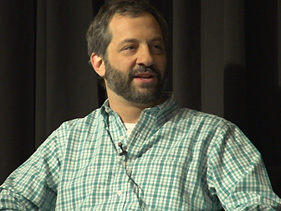
Writer/director shares behind-the-scenes details from his early career as part of MTV Pioneers speaker series. By Kara Warner, with reporting by Josh Horowitz Judd Apatow speaks in our “Pioneer Series” Photo: MTV News
Steve Holland Writer Season 6, Episode 9 The Parking Spot Escalation Thu, Nov 29, 2012 Mark Cendrowski Director Season 6, Episode 8 The 43 Peculiarity Thu, Nov 15, 2012 Jim Reynolds Writer Season 6, Episode 8 The 43 Peculiarity Thu, Nov 15, 2012 Steve Holland Writer Season 6, Episode 8 The 43 Peculiarity Thu, Nov 15, 2012 Margo Harshman Alex Season 6, Episode 8 The 43 Peculiarity Thu, Nov 15, 2012 Ryan Cartwright Cole Season 6, Episode 8 The 43 Peculiarity Thu, Nov 15, 2012 Mar
If Quentin Tarantino ‘s demonstrative hand gestures don’t distract you too much, here’s an interesting clip in which the Django Unchained director discusses the influence that crime novelist Elmore Leonard had on his formative years as a screenwriter and filmmaker, as well as his appreciation of actress Pam Grier. Rolling Stone posted this exclusive video , which is part of the bonus material included in Tarantino XX , a 10-disc Blu-Ray box set that collects the eight movies from the first 20 years of his career: Reservoir Dogs , True Romance, Pulp Fiction , Jackie Brown , both Kill Bill films, Death Proof and Inglourious Basterds . In what appears to be a Film Independent Q&A on Tarantino’s 1997 film Jackie Brown , which was adapted from a Leonard novel, the filmmaker explains that he used to read the writer’s books and “adapt them into movies in my mind,” asking himself: “How would I turn this into a movie?” He adds that engaging in that mental exercise, “years before I could ever afford to make a movie, really..helped me with my structure.” There’s also a curious moment at the end of the clip where Tarantino talks about wanting “to be Josef von Sternberg” to Pam Grier’s “Dietrich.” While I appreciate Tarantino’s appreciation of Grier’s talent, I think that line says more about him than her. Von Sternberg made the little known Marlene Dietrich a star when he cast her in The Blue Angel and then worked with her for five more films. Grier was hardly an unknown when Tarantino began working with her. Thanks to her roles in Coffy and Foxy Brown , Grier was already a cult icon. Tarantino merely reminded us of that. He also didn’t exactly make her a star. [ Rolling Stone ] Follow Frank DiGiacomo on Twitter. Follow Movieline on Twitter.
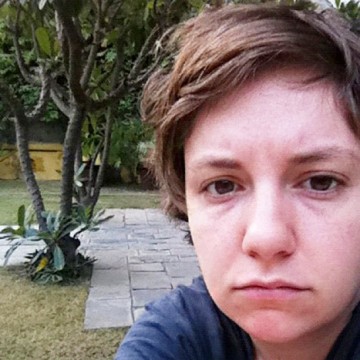
Lena Dunham talks a lot about sex, both on her HBO series Girls and in a Barack Obama campaign ad that got the Emmy nominee in trouble. So with the writer/producer/actress visiting her mother in India and Tweeting a photo to Instagram of the makeup-free trip, we felt it only proper to ask the following question… … Lena Dunham: Would you hit it? Heck yes! No way! Maybe after a six-pack! View Poll »
Preach white man, preach… Joaquin Phoenix Talks Racism In Hollywood With Interview Magazines Via Interview Magazine Joaquin Phoenix has been known to be a bit of a fawking weirdo, but in his latest chat with Interview Magazine he takes on an issue that he feels strongly about, racism against African-Americans in Hollyweird. After briefly describing his childhood troubles, Joaquin asks the writer about his concern over racism in the film industry. PHOENIX: Yeah. So I don’t experience any of that. I mean, dude, how can you work in film and still see the overt racism that exists in film and not just be furious all the time? MITCHELL: You know what? As a black person, you see so much racism. Films are no different than the government, politics—it’s everywhere. It’s not exclusively film. It’s infuriating to see it in film. But my being in film changes things. PHOENIX: Yeah, but there’s all of this horrible racism that white people don’t even recognize. Did you see Jumping the Broom? MITCHELL: I’m a black person. Of course I saw it. PHOENIX: I feel like all white people have to see the film just because I’ve never seen a movie in which most of the white characters in the movie were just working. It was fucking great. It was almost comical. There was a scene during the wedding reception, and there are, like, eight white people just carrying stuff. The main white character with some dialogue was the ditzy, stupid assistant. I enjoyed it so much because you never see that. But that’s something that I think white people don’t notice. They don’t notice that the fourth character is black and that’s what it always is. It’s always happening. It’s just the assumption that, “Well, that’s just a representation of life.” Joaquin also talks about a run-in he had with some movie producers who were totally oblivious to the racist undertones of their films. PHOENIX: You know, I got this script a while ago for this thing. It was kind of like an action movie, and it definitely dealt with race in a big way. But then it didn’t. Without getting into specifics . . . MITCHELL: Did the film get made? PHOENIX: Oh, it got made. But you could not believe that this thing actually got made, because it seemed like it was from the 1940s or something. It’s got this black character in it who was literally always being saved by the white dude because he was, like, cowering in the corner. So I went in and met the director and producer and I said, “You guys realize that your only black character is this guy, and it’s like the most clichéd thing we’ve seen in movies forever.” And they were like, “What do you mean?” And I was like, “You mean you’re not even aware of it?” They didn’t even realize what they were doing. So I said, “Look, I’ll give them a read if the black character doesn’t get killed and is going to make it into the sequel. They have to put him in their sequel, the black character.” So I spoke to the writer and was like, “Dude, be a hero. When this movie comes out in the summertime, give black kids a character they can see themselves in.” But it just didn’t occur to them, and I realized what a battle it is when people aren’t even aware of what they’re doing. I know what that battle is. I’ve done battles like that before, and you lose. So I didn’t do the movie . . . They did keep the black character alive, though. He’s in the sequel-at least, that’s what I’ve heard. MITCHELL: Was it a successful movie? PHOENIX: I don’t think it’s come out yet. It’s one of those big action movies. Interesting, you don’t often hear white actors/actresses stand up and speak out against the foul industry practices that they KNOW are going on. This interview doesn’t make Joaquin Malcolm or Martin, but it is kind of refreshing to hear. How do you feel about Mr. Phoenix’s comments? Image via
With Kelly Marcel tapped to pen the script, we look at the obstacles in adapting E L James’ best-selling novel. By Amy Wilkinson “Fifty Shades of Grey” book cover Photo: The Writer’s Coffee Shop
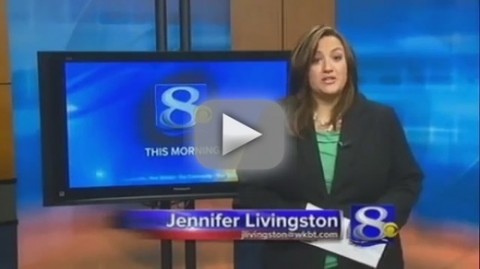
A news anchor in LaCrosse, Wis., received a harsh email from a viewer about her weight and responded with an awesome, televised tirade against online bullying. News Anchor Responds to Bullying Jennifer Livingston of WKBT-TV read this letter from a viewer: “Obesity is one of the worst choices a person can make and one of the most dangerous habits to maintain,” the viewer wrote, for no reason at all. “I leave you this note hoping that you’ll reconsider your responsibility as a local public personality to present and promote a healthy lifestyle.” Livingston’s husband, a fellow WKBT anchor, posted the email on Facebook and received an outpouring of support. Moved by this, she called the writer out as a bully. “The truth is I am overweight,” Livingston said . “You can call me fat and yes, even obese on a doctor’s chart. To the person who wrote me that letter, do you think I don’t know that? Your cruel words are pointing out something I don’t see?” “You don’t know me. You are not a friend of mine. You are not a part of my family, and you admitted that you don’t watch this show so you know nothing about me besides what you see on the outside – and I am much more than a number on a scale.” After pointing out that this kind of behavior likely influences the man’s kids to behave the same way at school and perpetuate the cycle, she concluded, “We are better than that bully. We are better than this email. We are better than the bullies that would try to take us down.” Amen.
Also in Tuesday morning’s round-up of news briefs, Emmy winner Danny Strong is rumored to be the writer for the final installments of a big franchise. A study of men and women using mobile devices in choosing their movies gives its findings. And the upcoming 53rd Thessaloniki International Film Festival gives some details for its upcoming event. 53rd Thessaloniki International Film Festival to Fete Three Diverse Directors Finland’s Aki Kaurismaki ( Le Havre , Iran’s Bahman Ghobadi ( No One Knows About Persian Cats ) and Germany’s Andreas Dressen ( Cloud 9 ) will be celebrated at the upcoming Thessaloniki International Film Festival, taking place in Greece November 2 – 11. Around the ‘net… Seth MacFarlane is ‘Ecstatic’ About Oscar Hosting Job The Family Guy creator said he can’t remember if it was before or after his successful turn at hosting the season premiere of Saturday Night Live September 15th, but said the Academy approached him around then. MacFarlane said he was excited and has done a fair amount of hosting in the past, but nothing as huge as this. “I was, very, very pleasantly surprised,” Deadline reports . Beatles Unseen Magical Mystery Tour Footage Goes Online Previously unseen footage of the Beatles sharing fish and chips during filming of their 1967 film Magical Mystery Tour has surfaced on The Space . “”Few people have seen Magical Mystery Tour in its entirety and the material in the chip shop has never been shown anywhere,” explained Arena editor Anthony Wall. “It captures perfectly the fabulous world of The Beatles at this time.” BBC reports . [ Related, check out Gallery Images of the Unseen Magical Mystery Tour on Movieline ] Game Change Writer Danny Strong To Write Hunger Games: Mockingjay Finale A final deal is still pending, but the two-part finale to The Hunger Games will likely go to Strong, who wrote the HBO movie which placed strong at the Emmys. Mockingjay is the third book in Suzanne Collins’ trilogy, which will be split into two features, Deadline reports . More Men Than Women Use Mobile Phones to Choose Movies, Watch Trailers Seventy-one per cent of men said they use their phone to help them choose a film, versus 69 per cent for women and more men (38 per cent) than women (33 per cent) turn to social media to check what people are saying about a film, THR reports .
Also in Wednesday morning’s round-up of news briefs, American would-be filmmaker whose anti-Islam film sparked violence in Egypt and Libya reacts. And more Toronto titles head to theaters. Channing Tatum May Direct Magic Mike 2 Steven Soderbergh is on a bit of a filmmaking hiatus – he says for the moment (he’s now wrapped on what could be his final film, Behind the Candelabra ), which means there is a need for a Mike director, and Channing Tatum told German site Filmstarts (via AlloCine) that he could direct the film himself, possibly with screenwriter and producing partner Reid Carolin, The Playlist reports . Joss Whedon’s Much Ado About Nothing Heads to Theaters The Avengers ‘ director’s Toronto International Film Festival debut now has a home. Roadside Attractions and Lionsgate will team on Whedon’s Much Ado About Nothing . The black-and-white movie features friends and actors he’s worked with over the years — including many Buffy the Vampire Slayer and Firefly alums – starring in the adaptation of the Shakespearean play, THR reports . Anti-Islam Filmmaker In Hiding After Egyptian/Libyan Violence Writer/director Sam Bacile remained defiant after a YouTube trailer of his movie attacking the Prophet Muhammad sparked violence in the neighboring African countries, which resulted in the deaths of three American staff members in Libya including the US. Ambassador. Speaking by phone, Bacile said “Islam is a cancer” and that the 56-year-old intended his film to be a provocative political statement condemning the religion, A.P. reports . Norwegian Thriller Thale Heads to U.S. Theaters The Toronto International Film Festival’s Norwegian supernatural thriller Thale will open in U.S. theaters early next year via XLrator Media which picked up Stateside rights at the festival. Thale “tells the story of a mythical “huldra,” a beautiful, tailed female forest creature, who is discovered in a concealed cellar by two crime scene cleaners. The creature is unable to speak so she can’t explain how she came to be there, but the pieces of the puzzle soon come together,” Deadline reports . What Maisie Knew Headed to N. America Starring Alexander Skarsgard, Julianne Moore and Steve Coogan, the film revolves around the 7-year old title character, played by Onata Aprile. She is caught in a custody battle between her aging mother rock star and her art dealer father. Millennium Entertainment is closing a deal for the title for North American rights. It is playing in Toronto, Deadline reports .
New Zealand native Melanie Lynskey finds her way to the spotlight – at long last – playing a woman, stuck in a sadly hilarious vortex of post-divorce depression, who’s jolted out of her early mid-life ennui by an electrifying affair with a younger man ( GIRLS ’ Christopher Abbott) in Todd Luiso’s Hello I Must Be Going . It’s an extraordinary dual capacity for deeply-felt pathos and comedy that Lynskey possesses and showcases, often simultaneously, as Amy Minsky; for Lynskey, one of the most genuine actors in the game, it was the kind of role that’s come along all too infrequently in the nearly two decades since her assured debut at the age of 15 in Peter Jackson’s Heavenly Creatures . “It was kind of a dream that I would find a part that had so much for me to do, but it’s so rare,” Lynskey said over iced coffees in Los Angeles. Longtime devotees know her well from Heavenly Creatures , in which she and Kate Winslet played a pair of real-life teen murderesses, or from her supporting turns in films like Ever After , Detroit Rock City , and Coyote Ugly ; when we first met in Seattle a few months prior, a fan recognized her as Reese Witherspoon’s old classmate in Sweet Home Alabama (“Baby in a bar!”). But while she’s tasted mainstream success, the soft-spoken Lynskey, whose wicked sense of humor complements her humility (she’s truly one of the most grounded actors around, as evidenced by her Twitter musings ), seems far more at home in the creatively-fulfilling climes of independent film. Three years into her tenure as the daffy, delightful Rose on Two and a Half Men , she asked to be let out of her contract so she could make films while coming back as-needed in a recurring role. In the time since, she’s turned in some of her best, most acclaimed work in potent supporting turns like Away We Go , Up In The Air , The Informant , and Win Win . “The show was so successful and I could see a crossroads,” she explained. “It was like, this way you’ll be a millionaire and one of the people on this show, and this way you’re not going to make a lot of money but you’re going to be able to build something that’s a little more interesting.” In Hello I Must Be Going that choice paid off not just with her first starring role, it also prompted Lynskey to examine her own journey in contrast to Amy’s vulnerable emotional life. “You come home and everything looks beautiful. It gave me a real appreciation for happiness, and for my friends, for interests that I have, and the fact that I do have a life that I really love.” Below, dive in as Melanie Lynskey takes us into her work on Hello I Must Be Going , her reaction to male critics who’ve criticized Amy’s physicality, lessons learned on the set of Heavenly Creatures , her experience on – and pulling away from – Two and a Half Men , her favorite film critics, David Wain’s upcoming They Came Together , and the theme songs she uses to get into character. One of the great things about Hello I Must Be Going is that audiences get to see you front and center – they know your work, we’ve seen you do comedy and drama, but this is a vehicle that allows you to combine those talents. Were you looking for something of this more intimate scale, or these particular chords to play? It was kind of a dream that I would find a part that had so much for me to do, but it’s so rare. We made this movie for no money, but even those tiny, tiny movies – movie stars are doing them, famous people. So much of the stuff that Michelle Williams does – can you imagine doing Wendy & Lucy ? What a dream! Or Blue Valentine ? She’s so amazing. But what a great thing to get to create something like that. It seems performers do have to turn to the independent world to find projects like that. How did they find you for this film? Yeah, I think so. I just got asked – I was in Toronto and my agent was like, do you want to come do this reading for the Sundance Institute? They were doing a staged reading of it in front of a little audience. I read the script and said, “Yes – I will fly myself back!” I loved it so much. At the time I thought I’d just be doing the reading, I didn’t anticipate having a future with it. Who was at the initial staged reading? There were not a lot of the same actors. Dane DeHaan read Chris Abbott’s part, and he was wonderful. There were a lot of good actors in it. It was fun. We worked on it for a day and Todd [Luiso] directed it. It just went really great, the energy was really wonderful. After that reading they said, “We want to make it with you,” and at the time with Dane, and then they tried to get money that way – but they realized they had to ask for less and less money with me in it. [Laughs] Eventually they got some money and stuck with me and I’m so grateful. Your character is stuck in a post-divorce depression but there’s a real humorous undercurrent to her, and so much of that is expressed in your face – in your expressions, your reactions to these oblivious people around you. There’s a tone to the script where you can just tell how Amy is feeling, and it was written from her perspective. There weren’t many reaction cues in the script but Sarah [Koskoff] and are really similar, the writer and I, so that was good – we have a similar take on things and were both excited that we wanted to do the same thing with it. Chris balances the film opposite you – there’s a quality to his eyes that makes you feel you’re peering into his soul, just looking at him. That’s such a perfect way to put it. It’s so true. There’s something about him that’s open and accessible but still mysterious; he has a really interesting quality, and his performance is so spontaneous. It feels off the cuff. He’s such a great person, a sweet, sweet person. Kind and lovely – I got so lucky with him. He seems like he’s always perceiving the world around him. He is, and he’s not judging. It’s nice. There’s a nice quality to him where he’s sort of scoping people out and watching people but he’s not too cool for school, even though he’s very cool. [Laughs] It was funny when I started watching GIRLS – I was like, Oh my god, he’s playing such a goofball! It’s so different from him. Was there much time to get to know him before you started shooting? No. It was crazy, because the other actor was going to do the movie and the casting process was kind of quick after he had to drop out. I remember Todd saying to me one day, “Do you want to watch this audition tape? I keep thinking about this one person…” and when he showed me Chris’s audition tape I started crying. I cried with relief, mostly, like, “Oh thank God they have somebody good!” I was so afraid! That’s a good point – there are so many elements up in the air in the making of a movie. And the age difference between the characters – she’s 35, he’s 19 – sort of requires two performers who can meet in the middle . It was important to me that it wasn’t all about the age difference in a creepy way, and Chris has a maturity to him which I think is important. The characters are at such similar points in their lives; “Who am I, and what am I going to do with the rest of my life?” So I didn’t want it to be sketchy. They cast Chris and I was in Connecticut working with Todd and Sarah and we sort of just awkwardly met each other. He had to leave to go shoot something and they were like, “He’s cute, right? Did you like him?” It was like a weird set-up. “He’s tall!” This was a really quick shoot, which means that you get what you get while you’re there. It’s always interesting to me to just kind of go along for the ride. Sometimes you come across somebody with whom your ideas don’t mesh and it’s an unfortunate kind of clash, but that doesn’t happen very often. What I like seeing is what somebody wants. Every experience is so different, but you never know until you start. Actors often say the gratifying part of the process is the work they do on set, within scenes. Do you feel that way, and to what extent did this particular shoot do that? It’s interesting. It was somewhat of a transition period for me, even though I wasn’t aware of it at the time. It’s interesting to play a character who’s asking, “What does the rest of my life hold for me? I’ve made these choices and I sort of thought everything was going to go one way, and what would happen if it all got turned upside down?” It was interesting to put yourself in that space of having nothing and feeling nothing and just not knowing what was going to come at all. In a lot of those scenes, the toughest stuff for me in those scenes is where she’s very depressed, because it’s just so horrible to sit in that, you know? But it’s hopeful. It’s an interesting thing as a person to spend a day where you’re just letting yourself feel awful. You come home and everything looks beautiful. It gave me a real appreciation for happiness, and for my friends, and for interests that I have and the fact that I do have a life that I really love. It’s good that you are able to pull yourself from that darkness. Not everybody has that, and it seems like one of the tougher aspects of being an actor. I was kind of trained to do that on Heavenly Creatures . It was pretty crazy. They were so worried about taking this 15-year-old who’s never done a movie before and being like, “Hey, cry all day and go crazy and see you tomorrow!” They were so concerned about me losing my mind, so there was a whole process at the end of the day of getting rid of everything. The woman who played my mother was kind of my acting teacher – she was helping me with technique and stuff, and she would brush me off and brush the emotion away. It was really great, and it was a good lesson to learn. You don’t need to take it home with you, and it’s better if you don’t. You were 15 when you made that film – at what point did you realize Heavenly Creatures was the real beginning of a career, that it would launch you into the world? It’s funny, because it doesn’t feel like it did. [Laughs] There was a point when I realized it was not going to. But it was a start. I think when I got an agent in America and I was like, “Oh my god, people really saw this movie.” But the progression was so slow, there was no kind of – here are movies, and here’s other opportunities! It was just like, “Nice job.” I mean, I went to the Venice Film Festival – that was incredible, that was crazy. I had so many surreal moments. Yesterday I was at high school studying for my English exam, and today I’m having lunch with Uma Thurman and Harvey Weinstein. And Quentin Tarantino, talking and talking. It was amazing. Heavenly Creatures is a fascinating film to look at now, just to revisit this point when three careers – yours, Kate Winslet, and Peter Jackson, whose films to that point had been very different – sprang and took off. It’s so amazing. It’s absolutely no surprise to me that Peter has done what he’s done and Kate has done what she’s done. But it was kind of a crazy thing to be a high school student and do this movie with people who had such a fire in them. How did your classmates react to the film? Some people were nice. I had friends who were like, “The movie was really beautiful,” but then most people were like, “I could see your tits.” [Laughs] I was like, yep, you could. “You kissed a girl!” I did. But that was fine. It was just a little alienating.