Category Archives: Sports

World Cup Impac on Bussiness

World Cup fever is set to trigger headaches for HR and IT managers at businesses big and small around the world. For one, there’s likely to be a higher than normal level of absenteeism in certain countries when their nations are playing. Italians, for example, maybe unusually absent from work June 14, 20 and 24 while Brits may be scarce June 12, 18 and 23. Then there’s the issue of network traffic: With games streamed live and on-demand, more than a few employees may be tempted to catch up on the action online. Given the density of data they’ll be pulling, it could cause corporate networks to slow to a crawl as all those video packets are routed through. Of course, company executives can attempt to nip this all in the bud with a well-timed missive reminding staff that work is work and play is play and that World Cup games are strictly for outside work consumption. But that wouldn’t be very sporting, says Susan Doniz, former CIO at multi-national giant Proctor and Gamble and newly promoted to run global service for P&G’s line of beauty and grooming products. “We had this issue when I was in Argentina with P&G,” she says. “I wanted to book a meeting and everyone said, ‘oh, no, you can’t at that time that day.’” At first the idea a mere soccer game would interfere with productivity was a complete culture shock but she soon became a convert to the game. “In Argentina, in Buenos Aires, I never saw the streets so empty as when there was a big game on,” she says. “I worked all over Latin America and Mexico and in Europe too. At one point we realized that because a game was on there would be no one to run the production line at one of our factories. It seemed absurd that a soccer game would shut down a line but we had to do something to accommodate the employees. We set up TVs in the common area so they could watch the game.” P&G employees this time around across the globe will be encouraged to come to the common areas to watch games on TV. “It’s a two for one,” says Doniz. “One, it’s good from an employee moral aspect. You have young people, older workers, everyone, sharing a moment together. In fact, it becomes strange if they stay in their cubicles and don’t socialize. And of course, it means the network isn’t getting slowed down.” It also cuts across all levels, she adds, meaning it’s truly a moment shared in fun and not fabricated. “I think our Canadian CIO is Italian so I’m betting he’s going to be watching with everyone too.”

More:
World Cup Impac on Bussiness

Twitter’s World Cup There

If Twitter is fast becoming the world’s watercooler as it is, watch what happens in the next few weeks as the World Cup takes over the planet. And as with any event of that size and – being a football fan at heart – importance, rest assured that hip Internet companies will be scrambling to lay some easter eggs. Yesterday, we learned that Google has a special surprise in store for those who search for ‘world cup’ – scroll to the bottom if you’ve been living under a rock for the past 24 hours and you don’t know what we’re referring to. An eagle-eyed reader just alerted us to the fact Twitter itself is also doing its part, by quietly adding a custom ‘South Africa 2010′ theme to its design gallery. We don’t know how long it’s been there, but here’s how to get it: go to Twitter.com, log on, go to Settings and then click the Design tab. The theme can be found at the bottom. [ Via ]

See more here:
Twitter’s World Cup There

Wavin’ a different flag

The fact that I can count down the days to the 2010 FIFA World Cup on my fingers gives me one of the best feelings of excitement ever. While football might not be on par with cricket in terms of fervor and zeal in our neck of the woods, when the World Cup rolls around every four years, even the most dormant of football fans are awakened and make it a point to watch the beautiful game being cherished. I fell in love with football after getting caught up in the excitement of the 2002 World Cup and it has been a wonderful journey since; comprising breathtaking goals, brilliant tackles and awe inspiring saves. From June 11 until July 11, football fans across the nation will be glued to their television screens and all eyes will be on South Africa as it hosts one of the biggest events in the sporting world for the first time on African soil. With thirty-two countries participating and sixty-four games being played, the World Cup guarantees non-stop entertainment for its fans. Hiba, a student from Szabist, Karachi says, “I am excited for the World Cup and just want it to start now! I will be supporting Germany and I really want them to win it this time after coming so close in the last two World Cups. “A month back, I would have confidently predicted Germany to at least reach the semi-finals if not the final; however, the recent injuries to the players have left me worried. They were already in a tough group so now I just hope they play to their potential and we’ll see what happens.” The World Cup has a tendency to attract even those who do not follow football as fanatically as some. “I will try watching some of the matches. I’d probably be supporting the underdogs,” says Usman, a student at the Lahore University of Management Sciences. “I’m not a big football fan but I will end up watching the World Cup because most of my friends will be.” While there is massive support for big teams such as Spain and Germany, a lot of people are rooting for the underdogs too. “I would love to see an underdog do well, especially an African country, and of all the teams, Ivory Coast are the most likely to perform well, even though the competition is stiff for them as they will be facing giants Brazil and Portugal. “I cannot wait to watch Messi, simply because of his performance for Barca. Other than him, Ronaldo and Kaka are definitely in the spotlight, but personally, I want some action from Van Persie, Sneijder, and Ribery,” says Bilal, a student from the Fatima Jinnah Dental College. These sentiments are echoed by many others who are looking forward to star studded performances by Ronaldo, Kaka, Messi and Rooney in the absence of the now elder statesmen David Beckham and Michael Ballack. The anticipation in the country is such that even the arid, coastal strip of the Makran coast wears a rainbow feel as you travel through its ports while the violence hit northern valley of Swat has also been going through football therapy, organising matches to keep the youth busy and distracted. The effect of football reaches beyond the festivities in Pakistan as documented by a report in The News which revealed that during 2006 World Cup the crime rate in Lyari actually fell. Lyari is a heavily populated locality in Karachi, plagued by gang wars and street crime. It is a hotbed of football and home to Abdul Ghafoor, the ‘Pele’ of Pakistan. So how is it that the football World Cup is so hyped up in Pakistan when we do not even have representation (aside from a few officials at the opening ceremony) in the tournament? When asked, most people said it is largely because football is starting to emerge as a popular sport here, building a bigger fan base. While it might not rival the passion for cricket in Pakistanis, it definitely tugs at some strings. “It is sad that our country does not qualify for the World Cup but I think the game here is emerging; there are local and private clubs and if the government starts supporting football here, I think we have the potential to be part of the sport at that level but till then I’m happy chanting ‘Viva Espana’ and I hope Spain wins!” says Huzefah from the Indus Valley School of Arts. Every four years the World Cup also offers restaurants, hotels and cafés the opportunity to cash in on the action and as such the various hotspots around Pakistan are getting into the spirit. In Karachi popular match viewing spots such as the Sports Bar and Le Grand have made special arrangements for the World Cup and are expecting a big turnout, especially for the later stages of the tournament. The Sports Bar has private viewing spaces, which, people can book in advance. Matches will also be shown at the Rahat Stadium and Sheraton Hotel, which can accommodate large groups of excited aficionados. Football fans in Lahore will be going to Kaps, the Mall of Lahore and Jinnah Gardens to watch the World Cup. However, these won’t be the only places hosting big screens and large crowds – university campuses too have made arrangements to cater to the frenzy. The Lahore University of Management Sciences (LUMS) is also a popular spot for the football fans to gather and watch the games on big screens. Shaukat Hamdani, a LUMS alumni, pointed out that even though lots of people such as himself will be sitting at work when the matches start, there’s always the mini-golf in Lahore to get together at for the later games. Regardless of it not being Pakistan’s most popular sport, a lot of places are banking on the event to bring big business. The Pearl Continental hotel in Bhurban is one of these places while Café Brabus and Espresso Lounge in Islamabad too are making arrangements to cater to the fans. One day, we will hopefully have Pakistan to cheer for but until then let us make the most out of the 2010 FIFA World Cup. Who will it be from the thirty-two? Maradona’s Argentina? Euro 2008 winners, Spain? The favourite favourites, Brazil? The defending champions, Italy? One of the underdogs? I cannot wait to find out! By Tabinda Siddiqi for Dawn.com

Visit link:
Wavin’ a different flag

Football’s Myths

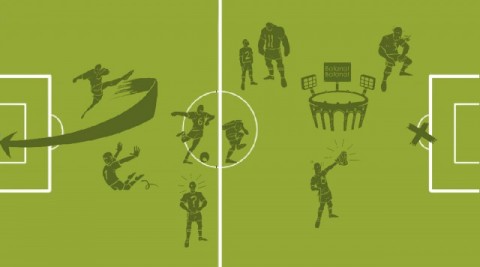
FAKING A FALL: How can you tell when a player is diving? One telltale is the “archer’s bow,” says British psychologist Paul Morris. This is when a player falls with both arms in the air, with open palms, chest thrust out and legs bent at the knee, like a sprung archery bow. “This occurs in many dives but biomechanically it does not occur in a natural fall,” said Morris. “Instead, instinctively the arms go down in an attempt to cushion the fall or out to the side for balance.” HOW IT’S SPUN: Remember Roberto Carlos scoring “the Impossible Goal,” a swerving spot kick against France in 1997? How did he do it? Some say it’s because Carlos is Brazilian. Physicists, though, point to a combination of the Magnus force and Bernoulli’s principle. Just after a kick, a spinning ball moves forward at relatively high velocity, and the air flows irregularly over it. When the ball slows — specifically, when it is between 29 to 37 kilometres (18 to 23 miles) per hour — the airflow becomes smooth, or “laminar,” which instantly boosts the air’s braking effect, sometimes by as much as 150 per cent. This drastically brakes the forward movement of the ball and enhances a curving movement derived from the ball’s spin. So Carlos’ goal initially dipped to the right of the defensive wall and then suddenly swerved into the net, leaving the French dumbfounded. NO NET GAINS: Three common beliefs about patterns in goal scoring are false, according to football statisticians gathered at a workshop at Germany’s University of Mannheim in 2006. Firstly, there is no evidence that players who scored in a previous match are any likelier to score in their next game. Secondly, a goal scored just before half time has no greater impact on the outcome of the game than a goal scored earlier in the first half. Finally, teams that have just scored are not especially more vulnerable to conceding a goal than at other times. SEEING RED: Football clubs with red team strips are more successful than rivals with other colours, according to a 2008 analysis by the universities of Durham and Plymouth. Red-wearing teams (such as Manchester United, Liverpool and Arsenal) won more often, while teams wearing yellow or orange fared worst. The theory: there’s a psychological boost from wearing red, a colour which is often associated in nature with male aggression and display. UNPREDICTABILITY: Those who say football is the world’s most exciting game can take comfort in statistics. Football beat four other major sports (American football, ice hockey, baseball and basketball) for “upset frequency” when the underdog won, according to the Los Alamos National Laboratory. American football was the most predictable. Its “upset frequency” was a whopping 25 per cent less than football. HOME AND HORMONES: Could biology explain home advantage? British researchers Sandy Wolfson and Nick Neave took levels of testerone from players before a home game, an away game and at a training session. Levels were much higher before a home game. The male hormone is linked with dominance, confidence and aggression, which implies the lads psyched up to defend their territory. ALE’S OUT: Those who contend that drinking beer or other alcoholic beverages helps post-match recovery are addled, say medical researchers. In a New Zealand study published in January in the Journal of Science and Medicine in Sports, volunteers carried out strenuous exercise, which was followed by a meal. Some drank orange juice, while the other drank OJ and vodka, the equivalent to around eight standard alcoholic drinks. The guinea pigs were measured a day and a half, and then two days and a half, after exercise. The alcohol group had 15-20 percent less muscular force than the non-alcohol group, and also reported more soreness. “Even moderate amounts of alcohol” are out. PENALTIES: A mathematical study of penalties at Liverpool’s John Moores University puts the death nail into the “blast-it-and-hope” approach. The perfect penalty, it found, is a ball that is struck high, targeted precisely to the right or left of the goalie, and fast, travelling at 25 to 29 metres per second (90 to 104 kilometres or 56 to 65 miles per hour). Anything faster than this boosts the chance of a miss because of inaccuracy, while anything slower helps the goalie to intercept it. Seen only through the prism of statistics, the balance in penalties is tilted massively in favour of the taker: between two-thirds and three-quarters of strikes result in a goal, according to various analyses in top-flight European club football. “The optimum strategy for penalty takers to use is to pick a spot and shoot to it, ignoring the goalkeeper in the process,” said researcher Greg Wood. HIGHS AND LOWS: High-altitude countries are known for the advantage they have when playing at home, when low-altitude opponents struggle in the thin air, according to the Britsh Medical Institute. In the case of two teams from the same altitude, the probability of the home side winning was 53 per cent. This rose to 82 per cent for an altitude difference of +3,695 metres, as when high-altitude Bolivia were at home to sea-level Brazil. Moving swiftly to take the penalty (less than three seconds after the whistle is blown) gives the striker the element of surprise, while delaying the strike by more than 13 seconds makes the keeper unsettled, according to the researchers, who looked at decades of international matches involving England. Waiting for the goal-keeper to move also boosted chances. However, waiting longer than 0.41 milliseconds caused a scoring chance to be halved. A runup of four to six steps was the most successful approach, while a long runup of 10 metres was the least. Published in the Express Tribune, June 10th, 2010 .
Link:
Football’s Myths

World Cup 2010 Jabulani Official Soccer Match Ball

Jabulani means to celebrate in Zulu, one of the 11 languages of South Africa, and the design of the Jabulani has 11 colors to honor those 11 languages, in addition to the 11 communities of South Africa and and the 11 players on a team. The 11 colors also honor the fact that this is adidas’ 11th FIFA World Cup ball. Constructed with eight new thermally bonded, spherically shaped, 3 D EVA and TPU panels, the Japbulani is perfectly round and has been equipped with a new Grip’n’Groove technology. Grip’n’Groove is a textured treatment that ensures the Jabulani flies straight and true. The Japbulani is designed for never before seen power, swerve and control. It’s a ball truly worthy of the best in the game.

Go here to see the original:
World Cup 2010 Jabulani Official Soccer Match Ball

Let The Game Begin

Visit link:
Let The Game Begin

FIFA Congress Opening Ceremony

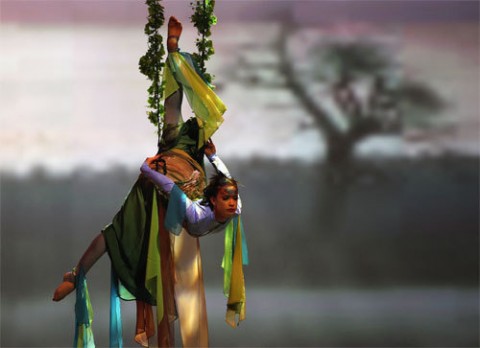
Artists perform during the FIFA Congress Opening Ceremony at the Gallagher Convention Centre on June 9, 2010 in Johannesburg, South Africa. (Photo by Phil Cole/Getty Images )

Link:
FIFA Congress Opening Ceremony

World Cup Begins in Colour and Rhythm

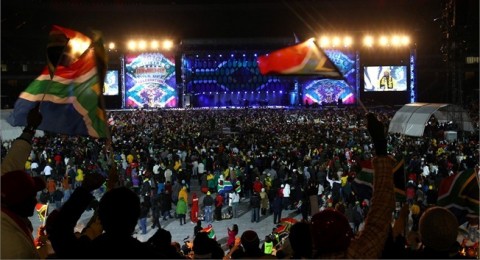
The South Africa 2010 party got under way in style last night with a joyous, colourful and truly African FIFA World Cup™ Kick-off Celebration Concert in Soweto, Johannesburg. Held in the football heartland that is Orlando Stadium, home of iconic club side Orlando Pirates, the concert featured a host of stars including Shakira, Alicia Keys, K’Naan and the Black Eyed Peas. A wide variety of acts took to the stage but the abiding theme was one of celebration for the African continent with the event broadcast across the world. The countdown clock introducing the three-hour extravaganza finally hit zero and with it came a cacophonous roar as seemingly thousands of South Africa flags were lifted aloft creating an ocean of colour among the estimated 30,000 in attendance. Joining the countless Rainbow Nation colours were a broad cross-section of national flags representing every corner of the globe, as the many visitors in attendance took the opportunity to enjoy Africa’s impressive ability to turn on a party. FIFA President Joseph S. Blatter and South African President Jacob Zuma jointly opened the concert after the early acts. As the evening progressed a cavalcade of football stars took to the stage between performances including former Bafana Bafana captain Lucas Radebe, Christian Karembeu, Quinton Fortune, Socrates and Jay Jay Okacha. Another joyous presenter was Archbishop Desmond Tutu decked out in Bafana Bafana supporter gear and who introduced a video presentation on Nelson Mandela with trademark enthusiasm. The large crowd rarely dropped their energy levels and their infectious enthusiasm was palpable. “I have been to a lot of concerts but I have never been to a concert like this,” said ebullient Johannesburg resident Khensami Majola, just as K’Naan took to the stage to perform his poignant song ‘Wavin Flag’. “It is amazing fun, we are having a huge jam. It is a perfect presentation of Africa – north, south, east and west.” The concert drew to a spectacular conclusion with Colombian pop princess Shakira in impressive form. She was joined on stage by Freshlyground for a rendition of ‘Waka Waka (This Time for Africa)’, the Official FIFA World Cup theme. Another proud concert-goer was Soweto local William Oosthuizen who spoke with pride as he took a rare break from dancing. “I am very proud and I am enjoying this immensely,” he said. “Beauty in the heart of Soweto. This is what Africa is all about. Sport has a unifying factor and it’s all about people enjoying themselves.” #

Read the original here:
World Cup Begins in Colour and Rhythm

South Africa, are you ready?

South Africa, South Africa, are you ready?” Black Eyed Peas will.i.am shouted to the 30-000 strong crowd 12 minutes into the live broadcast – and from that moment, the first-ever FIFA World Cup Kick-Off concert hit its stride and the pace never let up. Dressed in glitzy military-themed costumes, Black Eyed Peas ran rapidfire through a medley of hits: “Where Is The Love,” “Pump It,” “Meet Me Halfway,” “Boom Boom Pow,” and “I Gotta Feeling” – the latter’s refrain of “tonight’s gonna be a good, good night” setting the tone for a rare display of stadium-sized international music talent. The live broadcast had opened with a statement of African past and present, with veteran South African jazzman Hugh Masekela segueing from his classic “Grazing in the Grass” into the late Miriam Makeba’s signature song, “Pata Pata” – this time featuring young Afro-soul multi-award winner, Lira on vocals. The potency of Africa’s talent was plain to see: whether it was Benin’s Angelique Kidjo in full vocal throttle on the “Malaika/Afrika” medley with Grammy Award-winners Soweto Gospel Choir, Mali’s Amadou & Mariam’s transporting “Welcome To Mali,” and “Africa”, the intoxicating sound of Mali’s desert Blues outfit, Tinariwen, South Africa’s Afro-folk favourite Vusi Mahlasela, previously unannounced South African kwaito (township house) hitmakers Big Nuz and DJ Tira, The Parlotones’ full-throttle rock or the deft guitarwork of Mali’s Vieux Farka Toure, Africa claimed the spotlight with passion, energy and no small amount of talent. But it was the collaborations that really stole the hearts of the crowd: among the raft of pair-ups was Alicia Keys and swampy South African art-rock outfit BLK JKS in a version of the late Brenda Fassie’s decade-old hit song “Too Late For Mama”, and John Legend riffing off Kidjo before heading off into several of his hit songs including “Green Light.” Thankfully, appearances by dignitaries – including FIFA president Sebb Blatter and South African President Jacob Zuma – were kept to a minimum, with more time given over to 1GOAL, the global education program to provide education for 72 million children around the world. 91-year-old former President, Nelson Mandela, was saving his energy for Friday’s opening match between South African and Brazil at Soccer City (Soweto), but the mainly South African-flag waving crowd were delighted to see another of the country’s Nobel Peace Prize winners on stage. Archbishop Desmond Tutu, who still stays in his township house near the stadium when he’s in Joburg, joked he was only there to give the crowd “time to rest.” Dressed head-to-toe in the colors of the national South African football team, the peace activist said “You can feel it. You can touch it,” before welcoming the world in multiple languages and getting the crowd to join in praising Mandela. The international artists wore their support for Africa boldly: Juanes sported an Adidas jacket in the colors of the South African flag for his set which included a collabo with BEP’s Taboo. Alicia Keys exhorted the crowd not to “forget to love each other,” and then plunged into “No One.” “Johannesburg it’s such a beautiful night today,” she said before introducing BLK JKS. “It’s our moment,” cried rapper K’Naan, clutching a Somalian flag – his version of “Wavin’ Flag” (Celebration Mix) a show highlight that caused a riot of multi-colooured flag waving in the crowd. Shakira provided the show’s crowning moment, the Colombian singer launching first into “She Wolf” before delivering a show-stopping performance of “Hips Don’t Lie” with South African hip-hop artist Tumi Molekane who had performed earlier in the evening as part of the pre-broadcast show. And when the first notes of the official 2010 FIFA World Cup Song, “Waka Waka (This Time For Africa)” were heard and Shakira’s South African collaborators – Afro-pop outfit Freshlyground – appeared, the crowd erupted into an unceasing cry of delight. “Ngiyabonga Mzansi,” (“thankyou South Africa”) Shakira said in closing. After that, all that was left to do was for the performers to gather on stage to jointly (and loosely!) sing “Everyday People”. The Sly & The Family Stone song makes a heartfelt plea for peace and equality and proved a fine end to a night of global football and music unity. The 2010 FIFA World Cup Kick-Off concert was available in the U.S. (and other international territories) as a live stream on vevo.com and it was broadcast by Univision. The concert will air in primetime on ABC, Friday, June 11 at 8 p.m. ET/PT. #

Read the original here:
South Africa, are you ready?

Buy everything you can think of, including "traditional" art

Buy Buy World Cup

See original here:
Buy everything you can think of, including "traditional" art