Tag Archives: 2010 congressional

Cynthia Tucker: Voter Anger Is About Racism – ‘Fear of a White Minority’

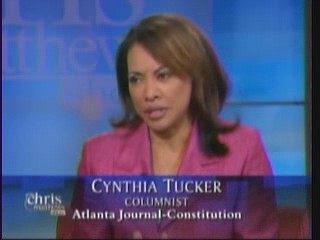
Are you sick and tired of being called a racist because you don’t agree with Barack Obama’s policies? If you are, you shouldn’t read any further, for Cynthia Tucker this weekend claimed the voter anger that threatens the Democrat majorities in the House and the Senate is all a function of racism. With the opening segment of the syndicated program “The Chris Matthews Show” focusing on the strong position the GOP has going into the midterm elections, Tucker said, “We haven’t talked about the elephant in the room, and I don’t mean the Republicans: race. Changing demographics. Fear of a white minority.” She disgustingly continued as host Chris Matthews agreed, “Obama’s election has suddenly made many white Americans aware of the loss of a white majority. That’s what this crazy summer has been all about” (video follows with transcript and commentary, file photo):   CYNTHIA TUCKER, ATLANTA JOURNAL-CONSTITUTION: Well I think it may help the Democrats in some races this time, Chris, because some of the Tea Party candidates are so extreme. But there is another issue. There is, as Norah said, a whole lot of voter anger, discontent out there. We haven’t talked about the elephant in the room, and I don’t mean the Republicans: race. Changing demographics. Fear of a white minority. CHRIS MATTHEWS, HOST: That’s so interesting.  TUCKER: Obama’s election has suddenly made many white Americans aware of the loss of a white majority. MATTHEWS: That’s so interesting.  TUCKER: That’s what this crazy summer has been all about. Anti-mosque construction. Anti-immigrant ravings. It, that fear is very difficult for Obama to overcome. That fear is very difficult for Obama to overcome? You find that interesting, Mr. Matthews?  Well, then why did 43 percent of white Americans vote for  Obama in November 2008? And why did Obama have a 78 percent favorability rating in January 2009 according to Gallup? Did all of these white folks that voted for Obama and previously adored him suddenly become concerned with losing their majority status? It’s one thing that despicable race-baiters like Tucker get to go on shows like this and make such racially-charged comments. But that not one of the people on that panel or the host brought up how popular this same man used to be before he started implementing unpopular policies is deplorable. To be sure, we expect this kind of nonsense from Tucker; she’s been doing it for years. That Matthews along with Newsweek’s Howard Fineman, NBC’s Norah O’Donnell, and Time’s Michael Duffy didn’t offer any resistance whatsoever to her disgraceful comments is what really should anger people on both sides of the aisle. Shame on all of you for continually adding to the racial divide in this nation despite your liberal pretense to the contrary.

View original post here:
Cynthia Tucker: Voter Anger Is About Racism – ‘Fear of a White Minority’

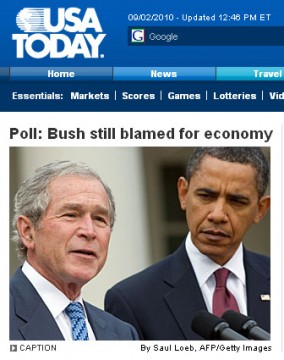
USAToday.com Notes Poll Showing Bush Blamed for Economy, Skips One Showing Voters Favor GOP On Issues

Yesterday the Gallup organization released a poll showing that Americans trust Republicans over Democrats on most major issues heading into the general election season. Today the same polling outfit released a poll that found a large number of Americans blame George W. Bush for the faltering economy.  Guess which one Gallup partner USA Today hyped? Here’s how USA Today staffer Susan Page began her September 2 online story (filed at noon today): Nearly two years after Barack Obama was elected president, Americans still are inclined to blame his predecessor for the nation’s current economic problems. In a USA TODAY/Gallup Poll taken Friday through Sunday, more than a third of those surveyed said George W. Bush deserved a great deal of the blame for economic woes and a third said he should get a moderate amount of it. Not quite another third called that unfair, saying Bush warranted not much or none of the responsibility. The 71% saying Bush should get blamed was a modest decline from the 80% who felt that way about a year ago, in July 2009. A search of the USAToday.com website failed to turn up a story specifically devoted to the September 1 Gallup poll that gauged voter preferences for the parties based on the issues. Staffer Susan Page did make a brief reference to the poll in a September 1 “analysis” article regarding President Obama’s Oval Office speech about the end of combat operations in Iraq, but that occurred in paragraphs 17 and 18 of her 20-paragraph story: But the Iraq war is no longer the driving issue for Americans facing job layoffs and home foreclosures. In a USA TODAY/Gallup Poll of 1,021 adults Friday through Sunday, those surveyed rated the economy, jobs, government corruption and federal spending as the top issues shaping their vote in November’s congressional elections — and preferred congressional Republicans over Democrats on handling the economy by double digits. The war in Afghanistan ranked eighth in a list of nine issues. Here’s an excerpt from Gallup.com’s website regarding the top issues poll: PRINCETON, NJ — A new USA Today/Gallup poll finds Americans saying the Republicans in Congress would do a better job than the Democrats in Congress of handling seven of nine key election issues. The parties are essentially tied on healthcare, with the environment being the lone Democratic strength. The Republicans’ advantage on most issues is an indication of the currently favorable political environment for the party. Of particular note is the parity between the two parties on healthcare, an issue on which Americans historically have viewed the Democrats as superior . A similar USA Today/Gallup poll conducted in October 2006, just prior to Democrats’ major gains in that fall’s elections, highlights the potential implications of these findings. That poll, which includes several issues measured in the current survey, found the Democrats leading on all eight issues tested at that time , including some usual Republican strengths like terrorism and moral values. In more bad news for liberal Democrats, Gallup.com released another poll today that shows that “Republicans Hold Wide Lead in Key Voter Turnout Measure” : PRINCETON, NJ — Two months before this year’s midterm congressional elections, Gallup finds 54% of Republicans, compared with 30% of Democrats, already saying they have given “quite a lot of” or “some” thought to the contests. This “thought” measure is an important variable in Gallup’s well-established classification of “likely voters,” which is put into use closer to Election Day. The current gulf in thought between the parties mirrors the partisan gap in Gallup’s voter enthusiasm measure that is tracked weekly. We’ll have to see how USA Today covers this later today or tomorrow, but I’m not holding my breath for the paper giving it much attention, if any.

Link:
USAToday.com Notes Poll Showing Bush Blamed for Economy, Skips One Showing Voters Favor GOP On Issues

Vanity Fair’s Palin Antagonist: ‘I Have a Lot in Common with this Woman’

The author of a  10,600-word Vanity Fair hit piec e on Sarah Palin is defending his work, claiming he set out to defend the former Alaska governor and vice presidential candidate, but that the resulting article “was forced on me by the facts.” Michael Gross appeared on MSNBC’s “Morning Joe” Sept. 2 to discuss his article in the October issue of Vanity Fair. The piece depicts Palin as a volatile, vengeful, mean-spirited figure, although Gross  only managed to find one person  willing to speak critically of Palin on the record. “The worst stuff isn’t even in there,” Gross said on “Morning Joe” when asked about the extreme picture he paints of Palin. “You know, I couldn’t believe these stories either when I first heard them and I started the story with the prejudice in her favor. I have a lot in common with this woman. I’m a small town person, I’m a Christian. I think that a lot of her criticisms of the media actually have something to them and I figured she’d gotten a bum ride but everybody close to her tells the same story.” Yet for someone so supposedly enamored with Palin, Gross sure turned quickly. He said Palin is “a person for whom there is no topic too small to lie about,” citing a speech in Wichita in which Palin contradicted other statements she’d made about finding out her son, Trig, would have special needs. “She lies about everything,” Gross continued, without offering other examples. “She lies about her personal life. She lies about, she lies about …” At one point, Gross said that “if we start returning to the standard that … a politician has to tell the truth, then she is out of here because she can’t stand up to that.” When host Willie Geist pressed Gross on criticism that his piece is a hatchet job, the author maintained that “it’s exactly the opposite. As I said before, I started this with every good intention toward her. I was just shocked and appalled at every step at what I found and I wrote this story, you know, sort of against my will. It wasn’t what I wanted to write, it wasn’t what I wanted to find. It was forced on me by the facts.”  Like this article? Sign up for “Culture Links,” CMI’s weekly e-mail newsletter, by  clicking   here.

Go here to read the rest:
Vanity Fair’s Palin Antagonist: ‘I Have a Lot in Common with this Woman’

Open Thread: Democrats Moving Away from Nancy Pelosi

Today’s starter topic : Does this represent a policy shift or just a campaign tactic? Some of the Democratic Party’s most endangered lawmakers are taking steps to distance themselves from Speaker Nancy Pelosi in an attempt to inoculate themselves from charges that they are beholden to the unpopular House leader and supportive of the ambitious national Democratic agenda. Three vulnerable Democrats from conservative-oriented districts are already running TV ads spotlighting their defiance of Pelosi. One freshman incumbent recently joked about the possibility of Pelosi not being able to take up the gavel next year because she might pass away. Another member from a tough district suggested he might run for speaker himself. The roster of Democrats currently playing six degrees of separation from Pelosi spans the map, from the Northeast to the South and across the Midwest to South Dakota. Pelosi aides and allies said they understand that embattled members sometimes need to distance themselves from the speaker and note that she doesn’t take it personally, although they caution that how it is done is just as important as why it’s done.

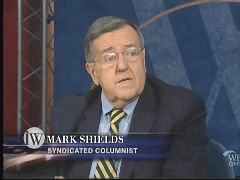
Columnist Mark Shields Despairs George W. Bush Too Honorable to Use as Bogeyman

It will be “very difficult for Democrats to demonize” George W. Bush “again” during this campaign season, liberal nationally syndicated columnist Mark Shields despaired on Friday’s Inside Washington, because he’s “a circumspect and discreet former President.” Quite unlike, he didn’t say, the often boorish Bill Clinton and Jimmy Carter. Reacting to Vice President Joe Biden’s indictment of the supposed disastrous results from the Bush administration’s economic policies, Shields fretted: The problem for the Democrats is this, that the energizer bunny for the 2006, 2008 campaigns has disappeared because of George W. Bush’s being a circumspect and discreet former President it makes it very difficult for Democrats to demonize him again. He’s become a non-person. He shows up at a ball game once in a while, he greets soldiers coming back. He hasn’t said anything controversial and that makes it a tougher fight for Joe Biden to make. Charles Krauthammer is a regular on the weekly program, so I’ll use that as a hook to highlight his latest column, “ The last refuge of a liberal ,” which includes this well-framed observation: Promiscuous charges of bigotry are precisely how our current rulers and their vast media auxiliary react to an obstreperous citizenry that insists on incorrect thinking. Krauthammer elaborated: — Resistance to the vast expansion of government power, intrusiveness and debt, as represented by the Tea Party movement? Why, racist resentment toward a black president. — Disgust and alarm with the federal government’s unwillingness to curb illegal immigration, as crystallized in the Arizona law? Nativism. — Opposition to the most radical redefinition of marriage in human history, as expressed in Proposition 8 in California? Homophobia. — Opposition to a 15-story Islamic center and mosque near Ground Zero? Islamophobia. Another great formulation, about how those tricky Tea Party activists weren’t clever enough to fool the liberal media: When the Tea Party arose, a spontaneous, leaderless and perfectly natural (and traditionally American) reaction to the vast expansion of government intrinsic to the president’s proudly proclaimed transformational agenda, the liberal commentariat cast it as a mob of angry white yahoos disguising their antipathy to a black president by cleverly speaking in economic terms.   ( Inside Washington is a weekly show produced by ABC’s Washington, DC affiliate, which airs it Sunday morning after it runs Friday night on DC’s PBS affiliate, WETA-TV channel 26, and Saturday on local cable’s TBD TV .)

See original here:
Columnist Mark Shields Despairs George W. Bush Too Honorable to Use as Bogeyman

CNN: GOP ‘Very Far to the Right’; Guest Laments McCain’s Rightward Lean

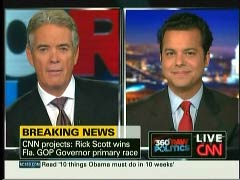
On Tuesday’s AC360, CNN’s John Roberts labeled Republican candidates who have Tea Party support ” very far to the right ,” and specifically referred to Florida gubernatorial candidate Rick Scott as an ” ultraconservative .” Guest John Avlon also bemoaned John McCain’s tack to the right during the primary campaign, and slammed how the senator has been called a “RINO” by many conservatives. Roberts, who was filling in for anchor Anderson Cooper, along with Avlon, CNN liberal contributor Roland Martin and Red State’s Erick Erickson, discussed Tuesday’s primary results from several states for two segments during the first half hour of the 10 pm Eastern hour. Eighteen minutes into the hour, the CNN anchor asked TheDailyBeast.com senior political columnist, “[CNN anchor] John King laid it out there, that it’s going to be a challenging year, to say the least, for Democrats. Some people predicting that this will be equal to, if not worse, than 1994. What do you think?” Avlon replied that the GOP was in “reasonable striking distance” of winning control of the House of Representatives, and later added that “the question is, are the candidates the Republicans have been putting forward in these primaries, some of the more polarizing play-to-the-base candidates, are they going to be Kryptonite when it comes to independent voters and folks in the center? That’s really where this battle is going to be won or lost.” Moments later, Roberts asked Erickson about Avlon’s analysis and included his “right” label: ROBERTS: Erick Erickson, speak to what John Avlon was talking to us about. Some of these candidates who are very far to the right , the one- many of the ones who are backed by the Tea Party- are they going to be Kryptonite come November? The anchor brought back Avlon for a second panel discussion, this time with Republican and former Representative Susan Molinari and Democrat Lisa Caputo, a former press secretary for Hillary Clinton. Roberts raised the issue of the Republican gubernatorial primary in Florida with Molinari 46 minutes into the hour: ROBERTS: When it comes to Rick Scott, who ran as an ultraconservative against Bill McCollum, does he now have to run slightly to the center, if he wants to win in November? Put it this way: the campaign- the Rick Scott campaign is reaching out to CNN, to say, ‘Hey, do you want to have him on tomorrow?’ Four minutes later, Roberts broached the issue of McCain’s lurch to the right during the primary race in Arizona against J. D. Hayworth, which ultimately led to Avlon’s lament of the whole electoral battle between the two: ROBERTS: Well, you heard a lot of that- maverick, maverick, maverick, maverick- 2002, his book, ‘Worth the Fighting For,’ said that it was the ‘education of an American maverick.’ But now, John McCain saying, ‘I’m not a maverick. I never said I was a maverick.’ (laughs) And Susan Molinari, I’m wondering how could he say that?      MOLINARI: Well- you know, times change- (both Molinari and Roberts laugh) politics change, and the situation changed. The situation in Arizona, as he explained it- you know, changed, and the President- you know, by his lawsuit in Arizona, I think really kind of raised the ante. Look, John McCain is a smart politician, and he didn’t do what a lot of other politicians did, which is to assume that, because he was the party nominee for president, that he didn’t have to work hard. And he had sort of the gift which we always think is- you know, a terrible thing of a later primary, to see that some of his incumbent colleagues and others in the House might have taken their election and their reelection in primaries for granted. And so- you know, he ran a smart race. He spent a lot of money, and he did what he needs to do to, presumably, return to the United States Senate. ROBERTS: But John Avlon, it’s almost classic John McCain, where he says, ‘I never said I was a maverick,’ and then you play the audio tape, and you say, ‘Well, with all due respect, Senator, I think you did.’ AVLON: Yeah. No, that’s just a dumb thing for him to have said, (Roberts laughs) and it’s sort of indefensible, because it’s such a core part of his identify, not just one imposed upon him, but one he accepted. And it’s dumb, because this was- this was actually a great year for someone to stress their independence- for someone to stress- the John McCain who the American people have come to know and respect, somebody who was standing up against fiscal irresponsibility when Republicans were spending like drunken sailors. He stood up against his own party. That should be a message that’s perfect for this year, and perfect for the Tea Party. The fact that he was independent should be a strength, but being primaried from the right, people kept saying that maverick was code for independent. So we’ve got to get some clarity right now. The Tea Party folks who say that the number one issue is spending- John McCain should be always a hero to them, and the fact that he’s considered a RINO by some speaks to the sickness in our politics and a problem in the Republican Party right now. ROBERTS: One more quick comment from you, and then we’ve got to go to John King, Lisa. He doesn’t really have to- if John McCain wins the primary, he doesn’t have to worry about the general election. I think he won with 75 percent last time. CAPUTO: Likely not, but what he has to worry about is what’s the public perception of John McCain? ROBERTS: Yeah- CAPUTO: What’s his legacy? Which John McCain are we talking about? Are we talking about the maverick, or are we talking about the Reagan Republican? Who are we talking about? During two July 2009 appearances, Avlon picked “wingnuts of the week” from the right and the left, and was much more critical of his right-wing selections . He also labeled CPAC 2010’s “saving freedom” theme as “a little extreme” during two segments on February 18 and 19 .

Read more:
CNN: GOP ‘Very Far to the Right’; Guest Laments McCain’s Rightward Lean

CBS ‘Early Show’: Can Obama Fix ‘Image Problem’ and Bring Back ‘Campaign Magic’?

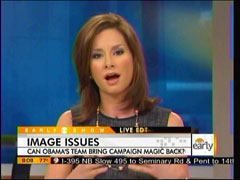
Opening Saturday’s CBS Early Show, co-host Chris Wragge proclaimed: “Image Problem: The President is on vacation and under fire. From the jobless numbers to the Mosque mess – why is the man with the soaring rhetoric having such a hard time getting his message across?” The headline on screen during the later segment read: “Image Issues; Can Obama’s Team Bring Campaign Magic Back?” Introducing the segment, co-host Rebecca Jarvis referred to “conservative critics” taking issue with President Obama’s vacation time on Martha’s Vineyard. In a report that followed, White House correspondent Chip Reid made sure to parrot administration talking points on the matter: “White House advisers stress that this is a working vacation with numerous daily briefings….White House officials say they’re confident the American people understand that with such a high-pressure job, a President needs and deserves some time to unwind and recharge.” Reid also compared Obama’s time-off with that of his predecessor: “By the end of this trip, President Obama will have taken 9 vacations and visited Camp David 14 times for a total of 80 vacation days since he took office. But at the same point in his first term, President Bush had taken far more time away – 14 trips to his Ranch in Texas and 40 to Camp David. The total, 225 days.” During Obama’s earlier trip to Maine, Reid made the same comparison. Following Reid’s report, Jarvis spoke with conservative radio talk show host Amy Holmes and Jennifer Palmieri of the liberal Center for American Progress. Beginning with Holmes, Jarvis wondered about the President’s “image problem”: “…the President has received some criticism here for the types of vacations he’s been taking….Why do you think the White House is having such a tough time shaping its image right now?” Turning to Palmieri, Jarvis cited various low poll numbers for Obama and raised the possibility of replacing White House staff: “The team from Chicago that put this man in office, Jennifer, does that team need to be replaced at this point in time with the approval so low?” Palmieri dismissed the idea, but Jarvis went back to Holmes and asked: “Why do you think they were able to stay so on point throughout the campaign and now it looks like the administration is really missing the mark?” Holmes replied in part: “President Obama has weighed into such a wide diverse range of issues, most recently the Ground Zero Mosque, that he has muddled his own message about what is it he’s really trying to accomplish.” In her final question to Palmieri, Jarvis pressed: “Why isn’t the Obama administration keeping the focus number one on the jobs picture in this country?” Here is a full transcript of the August 21 segment: 8:00AM TEASE CHRIS WRAGGE: Image Problem: The President is on vacation and under fire. From the jobless numbers to the Mosque mess – why is the man with the soaring rhetoric having such a hard time getting his message across? 8:06AM SEGMENT REBECCA JARVIS: Now to President Obama on vacation for the third time this summer. This is a ten day get away and the others were much shorter but his conservative critics say the trip is sending the wrong message. CBS News chief White House correspondent Chip Reid is traveling with the President in Martha’s Vineyard, Massachusetts. Beautiful scene behind you, Chip, good morning. CHIP REID: It sure is, Rebecca. In fact, critics are saying that the President is spending too much time in places like this, creating an image that’s inappropriate for these difficult economic times. [ON-SCREEN HEADLINE: Image Issues; Is the President Struggling to Stay On Message?]   President Obama in casual clothes browsed at a bookstore on the first full day of his ten-day stay in Martha’s Vineyard. Later, he went off to play golf. But White House advisers stress that this is a working vacation with numerous daily briefings. JOHN BRENNAN [ASSISTANT TO THE PRESIDENT FOR COUNTERTERRORISM & HOMELAND SECURITY]: There are a number of issues that the President is following very, very closely and expects to be kept informed about developments on those issues. REID: The President has come under fire from some conservatives for his vacations this summer, first to Bar Harbor, Maine, last weekend to the Gulf, and for the First Lady’s trip to Spain. Critics say his attention should be on the dire economy and the plight of average Americans. RUSH LIMBAUGH: Yes, he’s been working so hard, he’s tamed the economy, he’s tamed Iraq and the oil spill’s fixed. He plugged the hole and now he gets to go to Martha’s Vineyard. REID: By the end of this trip, President Obama will have taken 9 vacations and visited Camp David 14 times for a total of 80 vacation days since he took office. But at the same point in his first term, President Bush had taken far more time away – 14 trips to his Ranch in Texas and 40 to Camp David. The total, 225 days. Presidents, though, are never truly on vacation. Crises often arise. For example, the Christmas day bomber tried to strike while President Obama was vacationing in Hawaii. And for President Bush, Hurricane Katrina struck the Gulf during a long stay at his Ranch. White House officials say they’re confident the American people understand that with such a high-pressure job, a President needs and deserves some time to unwind and recharge, Rebecca. JARVIS: Thank you, Chip Reid. CBS News’s Chip Reid. So why has it become so hard for the man who ran such a disciplined campaign for President to control his message now and his image in the White House? Joining us is independent conservative Amy Holmes, co-host of America’s Morning News, and Jennifer Palmieri of the Center for American Progress Action Fund, a liberal think tank. Jennifer and Amy, great to see both of you this morning. Thanks for being with us. AMY HOLMES: Good morning. JENNIFER PALMIERI: Good morning. [ON-SCREEN HEADLINE: Image Issues; Can Obama’s Team Bring Campaign Magic Back?]                  JARVIS: And, Amy, let’s start out with you, because obviously the President has received some criticism here for the types of vacations he’s been taking, he spent a day visiting the Gulf and now he’s spending ten days in Martha’s Vineyard. His wife, Michelle, visited Spain in the midst of this economic crisis. Why do you think the White House is having such a tough time shaping its image right now? HOLMES: Well, they’re having a tough time because they’re having a tough economic time. But count me among the conservatives that does not begrudge our Presidents their vacations. In fact, I wish politicians spent more time outside of the beltway, less time in Washington, and being really in touch with the American people. Martha’s Vineyard, maybe not exactly in touch, maybe he should be in a camper, I’d like to see that. But, I’m not one of the people that’s actually attacking the President on taking some downtime. JARVIS: A lot of people, though, however are thinking that the President is falling short, his approval ratings have dropped this last week, Jennifer. Across the board, we saw a number of approval ratings that were particularly weak, the Associated Press, 49%, Time, 46%, the Gallup poll, only 42% approve of the President. The team from Chicago that put this man in office, Jennifer, does that team need to be replaced at this point in time with the approval so low? PALMIERI: No, I don’t – I think that the – that the team from Chicago has been dealt a very difficult hand and they’re doing just fine. But the – President Obama’s approval ratings are certainly lower than they have been in the past, but is worth noting that they’re higher than President Clinton’s approval ratings were in 1994 at the same time and even higher than President Reagan’s approval ratings were in 1982 at this same time. And the – I think the Reagan and the Obama situation are sort of – are good comparisons, because Reagan, also, had inherited a very difficult economy. And, you know, the Presidents had a lot of legislative victories, but the White House understands very clearly that you don’t get points from the American people just for legislative victories. They want to see results. And the uncomfortable truth that the White House is wrestling with is that a lot of these policies that they’ve enacted take time for people to see results in their everyday lives and I think, you know, the economy used to shed 600,000 jobs a month when Obama took office. Their adding jobs now each month, not as many as they’d like, but the economy is slowly recovering. But, they understand that there’s a frustration that exists until people see these changes really take effect and that’s just going to take some time. JARVIS: Amy, why do you think they were able to stay so on point throughout the campaign and now it looks like the administration is really missing the mark? HOLMES: Well, there’s a big difference between campaigning and governing and when you’re campaigning, you can stay on message with that close team from Chicago, you know, hope and change. But once you get into government, you’re actually dealing with this – panap- JARVIS: Panoply. HOLMES: This huge array – panoply, thank you – this huge array of issues. And where I think I might disagree with Jennifer in terms of the Obama-Reagan comparison, is that Obama came in with much higher approval. So his fall-off, the drop-off has been much more dramatic than what Ronald Reagan faced and I think also President Obama has weighed into such a wide diverse range of issues, most recently the Ground Zero Mosque, that he has muddled his own message about what is it he’s really trying to accomplish. So we can also look at his policies, even Barney Frank, the liberal from Massachusetts, said that it was quote-unquote ‘dumb’ of this administration to promise that their stimulus bill would keep unemployment below 8%, we’re at 9.5. So he see – the Democratic Party itself is sort of like shooting within the circle when it comes to their own message and this President and they have advisers telling them this fall run, do not walk, away from President Obama. JARVIS: Jennifer, isn’t everybody in this country worried about jobs, why isn’t the Obama administration keeping the focus number one on the jobs picture in this country? PALMIERI: Well, I think that when you see when the President gets out in the country, as he does probably a couple of days a week, that is what he’s – that is what he’s talking about. And they have taken a lot of steps in the beginning of the administration to stabilize the economy and I think that the reason why you don’t see his approval ratings falling off worse is because people understand that he did bring us back from the brink of a depression. And they also understand, and the polling reflects this, that it takes more than 18 months to get out of as a big of a hole as we did have in economy. So I think that people are frustrated but they do understand that why this is so difficult for the President to get out of. JARVIS: Jennifer Palmieri, Amy Holmes, thanks so much to both of you for being with us. PALMIERI: Thank you, Rebecca. HOLMES: Thank you.
See more here:
CBS ‘Early Show’: Can Obama Fix ‘Image Problem’ and Bring Back ‘Campaign Magic’?

AP Praises Democrat Push To Abolish Filibuster

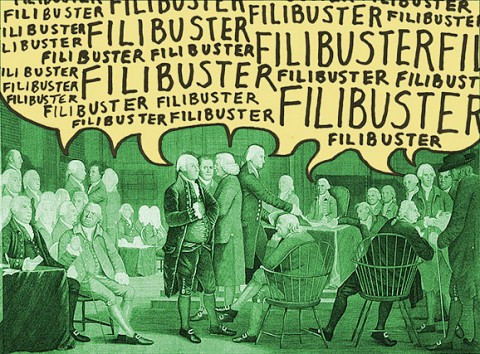
If you’re a Democratic Senator floundering in the polls and about to lose a reliably blue seat, what’s the best way to boost your image? Call up the Associated Press and spout clichés about reforming politics. It worked pretty well for one Michael Bennet, freshman Senator from Colorado. On Thursday, AP writer Jim Abrams interviewed him about a host of suggestions to change the rules in the Senate, allowing him to call the system “out of whack” and “broken.” Abrams then spoke with Senators Claire McCaskill and Tom Udall, from Missouri and New Mexico respectively – both states conveniently being places where the Democratic party is losing its edge. Abrams mentioned their reform proposals with very little background and failed to challenge their selective outrage. Get ready for 16 paragraphs of Democrat campaign talk dressed up as a news report : Those who hold the Senate in low esteem can get a sympathetic ear from some of the chamber’s newer members. These lawmakers also are fed up with the Senate’s ways and would like to change them. “A graveyard of good ideas” is how freshman Democrat Tom Udall of New Mexico sees the Senate. “Out of whack with the way the rest of the world is,” says another freshman, Michael Bennet, D-Colo. “Just defies common sense” is the impression of Claire McCaskill, a first-term Democrat from Missouri, in describing the filibuster-plagued institution. You see, everyday Americans are not fed up with Christmas Eve voting antics, efforts to stall the swearing-in of newcomers, or voting on bills that no one reads. Those ways won’t change. Just the part about Republicans blocking liberal agendas. What actual changes are being proposed? Abrams helpfully lists them: Bennet, the Denver school superintendent appointed to his post after former Sen. Ken Salazar became interior secretary, has put forth an elaborate plan to make the Senate more workable. It includes eliminating the practice known as a “hold” in which a single senator can secretly prevent action on legislation or nominees; ending the ability to filibuster motions to bring a bill up for debate; banning earmarks for private, for-profit companies; imposing a lifetime ban on members becoming lobbyists; and restricting congressional pay raises. “It was immediately apparent to me that the system was broken,” said Bennet, who won a hotly contested primary and faces a tough election this fall. Ah, no one knows more about the broken system than a public school administrator given a Senate seat. Party bosses were not thrilled with Bennet in 2009, claiming that his lack of experience and unpopularity with voters would inevitably give the seat to Republicans in 2010. The party went all-out to protect him from a primary challenger, securing Obama’s endorsement and spending millions on his campaign. It was mere days ago, on August 10, that Bennet won the primary, but since then he’s been trailing Republican Ken Buck. So he trots out familiar reform ideas on earmarks and lobbyists. Every time a political party is facing massive defeat, these things come up but are never imposed. The move to change filibuster requirements is a well-known mission among the far left – a cynical scheme to make slim majorities more powerful. As for anonymous holds, anyone who witnessed the public crucifixion of Rep. Bart Stupak (D – Mich.) immediately understands why Senators would want objections to remain private. Bennet’s reform plan would not allow holdout Senators to stall a vote discreetly. If anyone delayed a vote long enough to read the entire bill or consult with constitutional lawyers, the Senate would publicize their objection and wait for the media to Stupak them. The end result would be more hurried votes from Senators going along to get along. While some of Bennet’s suggestions are good, others will simply discourage dissent and weaken the minority. Yet the AP didn’t bother to examine any unintended consequences. Nothing negative was said about Bennet’s proposal. And in the case of Senator McCaskill’s ideas, Abrams used the vaguest wording possible: McCaskill also has worked with a Republican, Tom Coburn of Oklahoma, to bring more transparency to bills passed by “unanimous consent,” meaning they are approved without debate or roll call votes. Bringing more transparency! Who wouldn’t want that? But what exactly does McCaskill have in mind? This NBer had to search for an explanation elsewhere. Turns out that McCaskill doesn’t want to actually end the practice of passing bills without a vote – she even uses unanimous consent to forward things herself – but she joined Coburn on one superficial request . Coburn’s idea is that if his colleagues allow passage of a bill with no vote, they should at least sign a statement confirming they physically looked at it. That’s what McCaskill is trumpeting as brave new reforms. But without any actual details of the proposal, readers would have no idea how tedious it really was. If Abrams wanted to highlight reform efforts, it might have made sense to speak with Coburn and include his take on the “broken” system, perhaps even allowing him to explain the transparency thing. But Abrams didn’t quote anything positive from a single Republican. Up next was the reform plan from Senator Udall. Turns out Abrams saved the best for last: Udall has what might be the simplest but most radical proposal. He says that when the new session opens next January, he will offer a motion that the Senate adopt rules by a simple majority. That would make it vastly easier for the majority to modify filibuster rules with proposals. Doesn’t this sound great? Not only could the Senate pass controversial bills with 50 plus 1, they could change long-established rules, remove procedural hurdles, or rig the process to favor the majority’s whims. Each new session of the Senate could theoretically operate on a different playing field regarding everything from cabinet nominations to spending bills. The process to censure a senator or impeach a president could also be watered down. Toward the end, Abrams did at least acknowledge a certain amount of hypocrisy from Democrats who suddenly have no interest in protecting the minority: Udall calls his approach the constitutional option. Five years ago, Democrats called it by the more ominous name of the “nuclear option” when then-Majority Leader Bill Frist, R-Tenn., threatened to push through a simple majority rule for overcoming minority Democrats’ opposition to President George W. Bush’s judicial nominees. In the end, nothing happened. Udall’s idea has been put forward several times in the past, Senate historian Don Ritchie said. But “the Senate has always gotten up to the cliff and decided to step back.” “Some of the people advocating these changes might be very glad they didn’t succeed if they end up in the minority,” he said. That’s as close as Abrams got to discussing the negative possibilities. Four paragraphs from the end, he finally got around to quoting one Republican: “I submit that the effort to change the rules is not about democracy,” Republican leader Mitch McConnell of Kentucky said at a recent hearing on the history of the filibuster. “It is not about doing what a majority of the American people want. It is about power.” Supporters of the 60-vote supermajority say it helped prevent Democrats from attaching a government-run public option – an idea unpopular with many Americans – to the health care law. And growing national sentiment that Congress should quit adding to federal deficits was reflected when Democrats needing Republican votes to reach the 60-vote threshold were forced to cut future food stamp benefits and an energy program to pay for a $26 billion jobs bill this month. Just when it looks like Abrams was being fair, wait for the handy little nugget in the very last sentence: Both times, the changes grew out of considerable agitation for reform, in 1917 during World War I and in 1975 after years of civil rights advocates being stymied by filibusters, said Sarah Binder, a political science professor at George Washington University. That’s right, folks. The Senate successfully broke a filibuster to pass the Civil Rights Act in 1964, and that’s why they changed the rules 11 years later. But the internet is such a great thing. Turns out Time magazine has online archives from 1975, allowing NBers to see what contemporary accounts actually said. Turns out that liberal Democrats like Walter Mondale were trying to lower hurdles to pass – wait for it – national health insurance. In a news report that sounds eerily like 2010, Democrats back then were complaining that in “a period of economic crisis” the do-nothing Republicans were blocking them from creating more government programs. There was a side note that dealt with “civil rights,” but only because Democrats wanted voting ballots printed in multiple languages. So the last time these ideas were enthusiastically pushed in the Senate, liberal Democrats were angry because their pet agendas couldn’t pass through. Yet Abrams found a professor who white-washed it as heroic efforts to provide civil rights, and that’s the final sentence left ringing for readers in 2010. It’s nice to know that a prestigious news wire like the Associated Press is doing such hard-hitting investigations.

Read the original:
AP Praises Democrat Push To Abolish Filibuster

WaPo’s Eugene Robinson: Obama Is On A ‘Winning Streak’

What kind of shameless shill do you have to be to claim the President is on a winning streak as his poll numbers plummet, the economy teeters on a double-dip recession, and his Party is facing historic losses in both chambers of Congress? A Pulitzer Prize-winning columnist and former managing editor of the Washington Post, that’s who. Consider that just days after numerous polls were released showing America’s confidence in Barack Obama at an all-time low, and stallwart supporters such as CNN and the New York Times’ Maureen Dowd claimed that even George W. Bush was better at delivering a coherent message to the American people, Eugene Robinson wrote the following Friday: This is a radical break from journalistic convention, I realize, but today I’d like to give credit where it’s due — specifically, to President Obama. Quiet as it’s kept, he’s on a genuine winning streak. Robinson then listed the following items by way of recent headlines: “Last U.S. combat troops leave Iraq” “General Motors to launch stock offering” “Gulf oil spill contained” But here was the best one. In fact, it’s so good it requires a serious warning to remove all fluids, combustibles, and sharp objects from proximity to your computer: And finally, “President wades into mosque controversy”: Yes, I’m serious. Supporting the mosque in Lower Manhattan didn’t score any political points. But Obama saw his duty to uphold the values of our Constitution and make clear that our fight is against the terrorists, not against Islam itself. Instead of doing what was popular, he did what was right. He still hasn’t walked on water, though. What’s wrong with the man? Yep. Robinson is so captivated by this President that he even believes Obama has handled the Ground Zero mosque situation well. Now THAT’S some impressive shilling, wouldn’t you agree? This is sooooo good it requires what Hillary Clinton would call a willing suspension of disbelief. For instance, here are some recent headlines one would have to ignore to come to the conclusion Obama is on a winning streak: Jobless claims hit 500K, a nine-month high New jobs numbers: Bad for economy, worse for Democrats US unemployment figures increase fears of double-dip recession Critics say Obama’s message becoming ‘ incoherent ‘ If polls are any indication, GOP can expect big gains in the fall Even the Poor Are Abandoning Obama , According to Gallup Poll Data ‎ Obama Sees New Lows in Job Approval Obama Receives Low Marks in Economic Poll ‎ Poll: Majority now disapprove of Obama’s job performance 1 in 5 Americans Thinks Obama Is Muslim If this is what Robinson thinks is a winning streak, I can’t imagine what losing looks like to him.

View post:
WaPo’s Eugene Robinson: Obama Is On A ‘Winning Streak’

CBS’s Erica Hill to Ann Coulter: Will Mosque Issue ‘Go Away’ Before November Elections?

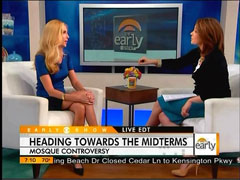
Speaking to conservative commentator Ann Coulter on Thursday’s CBS Early Show, fill-in co-host Erica Hill seemed to hope the Ground Zero mosque controversy had run its course: “Does it go away or does this continue through November?” Hill’s question to Coulter followed fellow guest, Democratic strategist Tanya Acker, ranting: “…the notion that in the United States of America we would deny people the right to have a religious edifice is simply – like, that’s just not – it’s unconscionable….I think that smart Republicans, fair Republicans, fair people of all political persuasions need to look – are looking at this really as a constitutional issue and really as a freedom issue. It should not be this political question that it’s become.” Picking up on Acker’s argument, Hill turned to Coulter: “So, it shouldn’t be a political issue. Though is it going to continue to be one as we head to November?” In her response, Coulter fired back at Acker: “I will say Tanya’s absolutely giving the Democratic position. America, you want a mosque at Ground Zero, you vote for the Democrats.” Acker angrily replied: “No. No, I’m giving – I’m giving the American position, Ann. I’m giving the American position because my constitution says that-” Hill then interrupted, notifying both guests that they were out of time. At the top of the segment, Hill asked both Coulter and Acker for their reactions to the pullout of major U.S. combat forces from Iraq. Beginning with Coulter, Hill wondered: “…this is happening two weeks ahead of President Obama’s schedule, Ann. Is this, perhaps, a step forward for the administration, some more positive news coming out?” Coulter replied: “Well, Iraq isn’t really his war. That is George Bush’s and it’s gone very well.” Hill interjected: “This was his deadline, though.” Here is a full transcript of the August 19 segment: 7:00AM TEASE HARRY SMITH: No regrets. President Obama insists Muslims have the right to build a community center and mosque near Ground Zero. Though a growing number of Democrats say it’s the wrong place, and a majority of Americans agree. 7:07AM SEGMENT: ERICA HILL: Joining us now with their take on the political impact of all this are conservative commentator Ann Coulter and Democratic Party strategist Tanya Acker. Good to have both of you with us this morning. So the last large U.S. combat brigade leaving Iraq. Obviously there are still troops there, as we heard from the General [Steven Lanza], talking about that as well. But this is happening two weeks ahead of President Obama’s schedule, Ann. Is this, perhaps, a step forward for the administration, some more positive news coming out? [ON-SCREEN HEADLINE: Heading Towards The Midterms; Political Impact of Iraq Pullout] ANN COULTER: Well, Iraq isn’t really his war. That is George Bush’s and it’s gone very well. HILL: This was his deadline, though. COULTER: Afghanistan is his war and that’s not going so well. HILL: So you’re not seeing any positive- COULTER: No. I think he’s been a disaster on foreign policy. I mean, there was a reason to concentrate on Iraq. Iraq is good for regime change. The people are fairly educated. That is exactly the opposite in Afghanistan. You’re dealing with peasants who are stoning a couple who elope. Turning that country into a democracy, I think, is a pipe dream, which is why with Bush he went in, he knocked out the Taliban, left a few troops behind. But then turned the major war on terrorism into Iraq, a country that’s good military, that is sitting on a lot of oil, that’s in the middle of a crucial region of the world. What do we want to be in Afghanistan for? And instead, this president, purely out of political correctness, because he wanted to respond to MoveOn.org crowd about ‘oh, Iraq, it’s a war of convenience, whereas Afghanistan it’s a war of necessity.’ No, no, no, no, no. Bush cared about national security. This guy about – Obama cares about political correctness. And it’s a big mistake. HILL: Tanya, I hear you – I can hear you in the background there. I know you want to jump in, go ahead. TANYA ACKER: Well, it’s so funny because Ann’s perspective is so completely ahistorical, and also, it seems – she seems to not have a very good grasp of American political science. Barack Obama’s the President of the United States right now, which means that Iraq is his war. It also means Afghanistan, too, is his war, as it was George Bush’s war when he first directed that operation. I’d also remind Ann that Afghanistan is –  borders this country called Pakistan. And that’s – there’s a reason that we need to keep that country and that region of the world stable. But all that aside, and you know, putting some of that nonsense, bracketing that for a moment, I think the General [Steven Lanza] made a really good point. It is time now that we let the Iraqi people govern themselves. They need to rule themselves. And that – that military really needs to take responsibility for its own country’s security. We’re not gone. We’re going to provide a very important, valuable training mechanism. But I definitely think this is a step in the right direction. HILL: There’s been so much talk. It seems every day something new comes out about plans for a mosque and Islamic center near Ground Zero. Tanya, I’ll let you kick this one off. We’re hearing again from the President on this, saying he doesn’t regret those comments. Is this the kind of thing that’s going to go away or is this starting to shape, in fact, the road to November elections? ACKER: Well, you know, look, I think there are a lot of partisans who are going to try to turn this into an even nastier issue than it’s become. But I think that we would all be wise to follow Ted Olsen’s lead, George Bush’s former solicitor general who lost his wife on 9/11, who said that the notion that in the United States of America we would deny people the right to have a religious edifice is simply – like, that’s just not – it’s unconscionable. And I think the President’s doing the right thing. I think that smart Republicans, fair Republicans, fair people of all political persuasions need to look – are looking at this really as a constitutional issue and really as a freedom issue. It should not be this political question that it’s become. HILL: So, it shouldn’t be a political issue. Though is it going to continue to be one as we head to November? COULTER: Well, one person made it not only a political issue but a national political issue and that is President Obama. Who wanted a standing ovation from a Muslim audience at a Ramadan dinner at the White House. So he comes out in favor of the mosque. And then as soon as he’s not in front of a crowd that’s going to give him a standing ovation for that, he’s taken it back. I don’t know what his position is now that he claims he’s standing by. HILL: Does it go – does it go away though? Does it go away or does this continue through November, before I let you go? COULTER: Not until we know what’s going to happen to that mosque at Ground Zero. And I will say Tanya’s absolutely giving the Democratic position. America, you want a mosque at Ground Zero, you vote for the Democrats. ACKER: No. No, I’m giving – I’m giving the American position, Ann. I’m giving the American position because my constitution says that- HILL: Ladies, we have to leave it there. But there is much more to talk about in the months ahead. Don’t worry. Tanya Acker, Ann Coulter, good to have both of you with us this morning. ACKER: Thank you.

See original here:
CBS’s Erica Hill to Ann Coulter: Will Mosque Issue ‘Go Away’ Before November Elections?