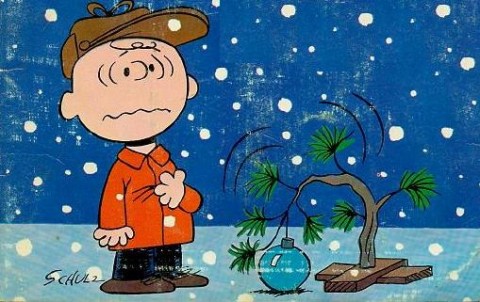
Those eternal kids from the Peanuts gang will get another turn at the big screen in a project spearheaded by Twentieth Century Fox Animation’s Blue Sky Studios. If all goes according to plan, Charlie Brown, Linus, Snoopy and the posse will hit theaters in 2015 with support from the family of Peanuts’ late creator Charles Schulz. The new film’s release will coincide with the 50th anniversary of the 1965 television special A Charlie Brown Christmas . The November 25, 2015 target is also in line with the 65th anniversary of Peanuts’ debut — talk about eternal youth! Charles Shulz’s son Craig and grandson Bryan will write the screenplay alongside Cornelius Uliano, while Ice Age 4: Continental Drift filmmaker Steve Martino is set to direct, according to The Guardian. Details about plot were not disclosed, though a holiday tie-in would not be a surprise. “We are thrilled to partner with the Schulz family and Iconix and honoured to bring the Peanuts characters to the big screen,” Fox Animation’s Vanessa Morrison said via a statement. “This all started with our love and respect for the work of Charles Schulz. We thank the Schulz family and Iconix for letting Fox and Blue Sky bring his vision to new generations of filmgoers.” Charles Monroe Schulz’s Peanuts comic strip was one of the most popular in the history of the medium, making its first appearance on October 2, 1950. Schulz died in February of 2000 and had said he wished for the strip to end after his death. United Features, which has ownership of the strip has honored that wish, but syndicates re-runs to newspapers. New television specials have since been produced, but they have been based on previous strips. Schulz had also said that he views Peanuts TV shows as entirely separate from the strip. [Image: Charles M Schulz/AP] [ Sources: The Guardian , Wikipedia ]
I guess it’s not surprising that a movie franchise that relies on Randy Newman for its theme music would discover rave culture a couple of decades late. Then again, this Pixar Toy Story short is about a dinosaur. Partysaurus Rex finds the Wallace Shawn -voiced dinosaur Rex discovering a whole new group of wet and wild hipster friends when, after being deemed “Party-Pooper Rex” by the old gang, he’s spirited off for some tub play by Andy. If you didn’t catch this Mark A. Walsh-directed short when it ran at cineplex screenings of Finding Nemo 3D , you can watch it in its entirety here. Who said it ain’t easy being green? Follow Frank DiGiacomo on Twitter. Follow Movieline on Twitter.
Paul Schrader and Bret Easton Ellis ‘s indie L.A. noir The Canyons has been a curious project to track — who’s the more random star, comeback queen Lindsay Lohan or porn stud James Deen? — but a new teaser trailer offers an unexpectedly compelling preview of the film, retro-exploitation style. The tongue-in-cheek spirit works well here, even if it does make The Canyons look like one of Tarantino and Rodriguez’s fake Grindhouse trailers. Here’s hoping the actual film has this sort of knowing edge. With teaser lines introducing “a HUGE new talent” in Deen it has to, right? It is worth noting that this trailer offers no dialogue; Deen’s screen presence, shall we say, has been proven in his chosen field but his acting chops here have yet to be seen. Side note: I once overheard strangers talking excitedly about seeing Deen in this movie while waiting in line at a semi-terrible L.A. club, so The Canyons ‘ social media outreach must be working. On Facebook last week director Schrader shared an update after screening The Canyons for Lohan : “Showed LL the film tonight. She saw and she understood. What a wonderful moment for her. Some tears, some hard words, some kisses but that’s life in Lindsayland. Sometimes the movie gods smile. Sometimes you get lucky. LL and I got lucky.” Synopsis (via The Canyons on Facebook): THE CANYONS is a contemporary L.A. noir from director Paul Schrader, writer Bret Easton Ellis, and producer Braxton Pope about the dangers of sexual obsession and ambition, both personally and professionally, among a group of young people in their 20’s and how one chance meeting connected to the past unravels all of their lives, resulting in deceit, paranoia, cruel mind games and ultimately violence. [ The Canyons via The Playlist ] Follow Jen Yamato on Twitter . Follow Movieline on Twitter .
The kinky erotic pop phenomenon 50 Shades of Grey has finally landed — or shall we say, tied down — a writer! British actress/scribe Kelly Marcel, who co-created the short-lived Steven Spielberg-produced series Terra Nova and scripted the upcoming Mary Poppins pic Saving Mr. Banks , will adapt E.L. James’ S&M romance about a young woman who falls for Christian Grey , a damaged dreamboat with a bondage fetish. Marcel’s a surprise choice for the hot property given her relatively scant writing credits; here’s hoping her script keeps all the salaciously sexy allure of the books, which will be one of the bigger challenges Universal and Focus face with their big-screen adaptation. One hurdle: Making a 50 Shades of Grey movie that’s half as great as this fan-made trailer : Oh, man. Never gets old . Once a script’s in place, the next trick will be casting their perfect Christian Grey . Someone not too old, not too young, the picture of male perfection and virility. An actor capable of pulling off both brute sensual dominance and crippling emotional trauma. A dude who knows how to wear a suit. Well, Marcel did co-found a theater company with Tom Hardy after the two worked together on Nicholas Refn’s Bronson , which she re-wrote. (Another fun fact: Dad Terry Marcel wrote and directed 1980’s Hawk the Slayer .) Maybe she can make a phone call… who’s down with casting Tom Hardy as Christian Grey? The official press release: UNIVERSAL CITY, CA, October 8, 2012—Universal Pictures and Focus Features today announced that Kelly Marcel will write the screenplay to the highly anticipated film adaptation of “Fifty Shades of Grey.” Michael De Luca and Dana Brunetti will produce the film based on E L James’ #1 bestselling book, alongside James. The announcement was made by Universal Pictures Co-Chairman, Donna Langley and Focus Features’ Chief Executive Officer, James Schamus. Marcel wrote the 2011 Black List script, Saving Mr. Banks , the story of Walt Disney’s twenty-year pursuit of the film rights to author P.L. Travers’ novel, “Mary Poppins,” and the rocky relationship that formed between the two. The film is currently in production at Walt Disney Studios starring Tom Hanks, Emma Thompson and Colin Farrell with John Lee Hancock directing. Marcel served as the co-creator and executive producer of the Amblin/FOX-TV series Terra Nova, for which she wrote the series’ pilot episode. She will also produce The Madonnas Of Echo Park for HBO. “Kelly’s work demonstrates her flawless structural technique and passionate commitment to emotion, humor and depth of character which is particularly visible in the celebrated screenplay for the upcoming Saving Mr. Banks,” said De Luca. “We were all taken with the depth and passion of Kelly’s engagement with the characters and world E L James has created, and we knew she was the right person to augment our Fifty Shades family,” added Brunetti. Universal Pictures and Focus Features acquired the rights to the three books in the “Fifty Shades of Grey” trilogy in March of this year. Focus Features will market and distribute the first film in partnership with Universal. “Fifty Shades of Grey” has become a global phenomenon and the trilogy has been translated in 45 languages worldwide since its release. In the U.S. alone, the “Fifty Shades” trilogy has sold over 32 million copies in e-book and print, making it one of the fastest selling book series ever. “Fifty Shades of Grey” follows the relationship of 27-year-old billionaire Christian Grey and college student Anastasia Steele. Subsequent novels in the series, “Fifty Shades Darker” (September 2011) and “Fifty Shades Freed” (January 2012) explore the couple’s deepening relationship. For more information please see the official Fifty Shades of Grey Facebook page: http://www.facebook.com/fiftyshadesofgreymovie. Marcel was represented in the deal by WME and Casarotto Ramsay & Associates Limited. [ Deadline ]
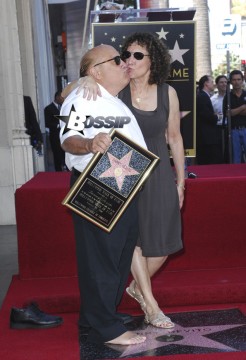
Another day another Hollyweird divorce ! Well for now it’s just a separation… but still we can’t believe that after over 30 years of marriage Danny Devito and Rhea Pearlman appear to be headed for splitsville. According to Entertainment Tonight reports : Actors Danny DeVito and Rhea Perlman have separated after more than 30 years of marriage, ET has learned. The couple’s rep Stan Rosenfield confirmed the news to ET. The pair, who married in January of 1982, have three children together — daughters Lucy, 29 and Grace, 27, and son Jacob, 24. The couple worked together on the classic sitcom Taxi (1978-1983) and appeared onscreen in the 1996 comedy film Matilda. The pair founded Jersey Films, a production company behind many movies including Pulp Fiction, Garden State, and Freedom Writers. This is pretty sad. Hit the flip for a photo of Danny hugged up with the alleged homewrecker that caused the split.
Sopranos writer/director/producer David Chase resisted saying his latest venture, Not Fade Away is autobiographical, but it certainly resembles large swaths of his upbringing. Born in Upstate New York and raised in suburban New Jersey, he used to dream of becoming a successful drummer in a rock band. He is also unabashedly a fan of ’60s-era music and all those elements fit front and center in his first big return to the spotlight since The Sopranos had its final shot in 2007. Fittingly, James Gandolfini stars as the father in Not Fade Away , the title of course being an ode to the 1964 Rolling Stones cover of a song credited to Buddy Holly and Norman Petty. The film will have its Gala World Premiere as the Centerpiece of the New York Film Festival Saturday night. In the film, however, Gandolfini is anything but the underworld kingpin he is in the famous HBO series that made him a household name. The movie celebrates youth and more specifically, youthful angst. The so-called generation gap – a term that was popularized in the era – hits the audience over the head throughout the film. The conflict between accepting life’s conventions and the innate yearning for something different is liberally dished out. “The theme for the movie for me is the conflict between security and freedom,” Chase said at a Lincoln Center pre-gala screening Friday. “Humans are always in that conflict. There’s the desire to be babied and taken care of. And there’s the need to say, ‘go fuck yourself, I want to do what I want, I want to be free to do what I want.’ That’s what initially made me interested in doing this.” In Not Fade Away John Magaro stars as Doug, the nucleus of a pack of suburban Jersey kids who throw off the conservative shackles of their parents and grow their hair out, put on some funky threads, party at each other’s house’s like rock stars and dream of being – well, rock stars. He trades steely glances from his disapproving middle class father (Gandolfini) as he and his pack of spirited friends slowly but assuredly take on the physical and philosophical offshoots of the counter-culture. While it is a rock ‘n’ roll coming-of-age movie, there is no obvious end point. In the kids’ minds, they’re on the threshold of making it, though internal jealousies and conflicting ambitions hold them back. Still, the band gets progressively better and Doug, originally playing drums, eventually takes over lead vocals when it becomes apparent he has the better voice, which of course enrages the guitarist/singer and now competitor he in effect replaces, Eugene (played by Boardwalk Empire ‘s Jack Huston). Musician, songwriter, producer and all around rock legend Steven van Zandt served as executive producer/Music Supervisor on the film and told Chase that it was important to find actors who could ‘play the music.’ Still, Magaro said they were initially very green to music when they came on board. “We were terrible. We’d eek out a song and we were just terrible,” he said. “[At first] we’d look at David and he’d say something like, ‘that’s very encouraging…'” “Part of the authenticity is that most bands are cover bands, or they should be,” said Van Zandt – better known as Little Steven. “But these days, not so much. Most good bands – Rolling Stones, Beatles, E Street Band – they spent a few years covering songs, analyzing them [deconstructing] them and that’s how they learn.” Van Zandt helped create some original music for the movie, but if there’s a soundtrack that comes out – by all means get it. Mostly the band, however, does cover songs and the film is peppered with hits from the era. Just try and not wiggle a bit in your chair while watching this movie. Chase said the film has been an idea of his even before The Sopranos came along and it may be easily interpreted as a nostalgic trip down memory lane. The music and heartfelt performances do carry the film, though it did seem to fall a bit flat ultimately. “I don’t want to get into this thing about bragging about the ’60s. But I think I was lucky to live through that time,” said Chase. “I was living in one of the best musical eras in history. Music at that time was a way into everything. It’s how I learned about art, poetry, fashion, humor , film, politics. Music was everything. And I don’t think that’s the case anymore.”
With her soulful contralto, Adele was born to sing a Bond theme song. She delivers with “Skyfall,” produced by regular collaborator Paul Epworth, and released yesterday on James Bond’s 50th birthday . That should be a relief to music lovers and Bond fans alike, but just how much musical DNA does Adele’s “Skyfall” share in common with the best Bond themes to date? At some point in the mid ’70s, Bond theme songs lost their way. I blame Carly Simon. “Nobody Does it Better,” which she sang for 1977’s The Spy Who Loved Me , is a perfectly good pop ballad — it was Simon’s greatest hit, after all — but it was not a Bond song. It broke all the traditions: its title was different from the movie’s, it was in a major key, and it made no musical allusions to the composer behind the unmistakable 007 sound, John Barry. As if in apology, producers brought back Goldfinger and Diamonds are Forever songstress Shirley Bassey for the next movie, Moonraker , but the rekindling was all too brief. After that, there was a string of songs that sounded like ’80s sitcom theme songs. Seriously, listen to Sheena Easton’s “For Your Eyes Only” and imagine it playing over Three’s Company –style opening credits, with scenes of Bond walking into MI6’s office and throwing his hat onto the coat rack while Ms. Moneypenny rolls her eyes and smiles. Same with “ Octopussy .” Just think of what “Thunderball”’s Tom Jones could have done with that title. MGM and Albert Broccoli seemed to come to their senses after realizing what a mistake they’d made entrusting the theme song for The Living Daylights to A-Ha. They took a step in the right direction with the next one, Gladys Knight’s “License to Kill,” which opens with a direct quote of the opening motif from “Goldfinger.” In 1996, with “Goldeneye,” Tina Turner did with the music what Pierce Brosnan did with the character and helped rescue the entire franchise. Since then, the only real crime against 007 tradition was Madonna’s disjointed dance number for Die Another Day . Adele’s “Skyfall” is the most classic Bond theme since the classic Bond themes. The song may not be as infectiously hummable as some of Adele’s other hits, like “Rolling in the Deep,” but it fits perfectly within the James Bond tradition. Breaking the song down to its constitution elements, we can see how it compares to its predecessors: Voice You can’t listen to this song and not immediately think of Shirley Bassey, though Adele throws in a little more melisma. C-minor key More than three quarters of James Bond songs are in a minor key. The only other one in C-minor, however, was Garbage’s “The World is Not Enough. ” Dr. No references Peppered throughout the song are echoes of the original instrumental theme John Barry wrote for Dr. No , including the unmistakable four-note riff here played by the electric guitar 1 minute 50 seconds in, and the distinctive, sixties-sounding final chord (a minor ninth, if you’re curious), which is the same chord that concludes the Dr. No theme. Instrumentation Like Carly Simon’s “Nobody Does it Better,” the song begins simply, with vocals over piano. But then the strings, electric guitar, and John Barry–esque horn blasts kick in, bringing to mind the Sean Connery–era Bond themes. Thankfully, “Skyfall” did away with the tambourine. Melody The rising fifth in the hook (“… let the sky fall”) is reminiscent of “Goldfinger,” “Diamonds Are Forever,” and “The World is Not Enough,” which all have same interval in the main melody. Also like “The World is Not Enough” and Sheryl Crowe’s “Tomorrow Never Dies,” the verse ends on a suspended fourth chord. Tempo: ca. 78 bpm Practically the same as “License to Kill.” Lyrics This song does a better job of integrating the title into the lyrics than many of its predecessors, although Adele has to break the nonsensical title into two words. Carly Simon simply plopped the words “The spy who loved me” into an otherwise boilerplate love song, and Chris Cornell didn’t even bother including “Casino Royale” into his theme song , “You Know My Name.” Adele’s repetition of the title at the end of the song makes me think of what Tom Jones did with “Thunderball” and Tina Turner did with “Goldeneye.” Anything else? How much deeper can we go in overanalyzing this? Let me know in the comments. Julian Sancton is a writer based in Manhattan. He has contributed to Vanity Fair, Esquire and Playboy, among other publications. Follow Julian Sancton on Twitter . Follow Movieline on Twitter .
The unshakeable bond between a shy nerd from the ‘burbs and his faithful dog is the heart of Frankenweenie , the black and white stop motion picture (in theaters today) Tim Burton refers to as a “memory piece.” Drawn from his own childhood memories of growing up in Burbank, California, it’s an ode to the kooky neighborhood kids and adults Burton knew, the monster movies that shaped him, and, as Burton told Movieline with a smile, his way of teaching kids about one of the toughest facts of life: Death. “It was originally such a memory piece for me, in the sense that it was personal,” Burton told Movieline at Fantastic Fest, where Frankenweenie debuted as the opening night film. “I think it started with that MOMA show, I saw a lot of the old drawings that I’d done, and there was something about the drawings that I wanted to try to recapture.” Frankenweenie brings Burton back to his roots, a feature-length extension of the live-action short film that jump-started his career and earned him cult status – and famously got him fired from Disney. Taking the story of Frankenweenie and fleshing out his nostalgic vision of his old stomping grounds, Burton added characters (including the heavily accented Japanese-American kid Toshiaki, “my favorite”) and texture, and a healthy dose of movie geek references, from Frankenstein to Godzilla and beyond. “[I added] other kids that I remember in school, and teachers, and the geography of Burbank — the real setting,” he explained. “I tried to make everything more personal — even if it was a couple of kids mixed together. For me it made it feel more natural. I didn’t feel like this was just a short, that I was just going to pad it out with something. There were other monsters and other things I’d been thinking about over the years. I tried to treat it as expanding on those feelings and those memories of that time.” In keeping with Burton’s oeuvre, Frankenweenie is playfully macabre. But moreso than his other films, especially those aimed at children, it deals openly with the difficult subject of kids and death. “For me it was a way to explore the concept of death in a slightly abstract but safe way,” Burton offered. He pointed to his own childhood experience that inspired the tale. “My dog, whom I loved, they said he wasn’t going to live — he had this thing called distemper so he wasn’t supposed to live very long, but ended up living quite a long time. So there’s always this weird specter of death hanging over which I didn’t quite understand.” “At the same time I love Frankenstein and I learned about it through those movies, which deal with abstract things and things that are quite hard to explain to children in a slightly safer way,” he continued. “I grew up in a culture where death was very negative, but you see certain Hispanic cultures that have Day of the Dead and they treat it in a more positive way. For me it was an attempt to show death in a different way that’s not negative.” Yes, but is Burton prepared to see the potential increase of copy-cat “science experiments” in young Frankenweenie viewers with dearly departed pets of their own? “Better that than most of the kids that I knew who were torturing animals!” he laughed. “If it takes kids away from that, it’s probably for the best.” Read more on Frankenweenie and read Movieline’s review . Follow Jen Yamato on Twitter . Follow Movieline on Twitter .
Look, I’m sure this Jai Courtney dude from Spartacus playing John McClane’s beefy son/action heir is great and all, but there’s just one reason to watch any Die Hard movie, and his name is Bruce MF’ing Willis . So check out the first trailer for A Good Day To Die Hard even though it takes a full 30 seconds of overly edited shots of warehouses and ambiguously visible bad men with guns to get to Bruno’s familiar smirk and the explosion-y goodness that follows. A Good Day To Die Hard catches up with Willis’s McClane as he and his estranged son (Courtney) fight terrorists in Russia, or something. John Moore of Behind Enemy Lines and Max Payne fame directs from a script by Skip Woods, of Swordfish and Hitman fame, so we’ll see how this one goes. The film hits theaters February 4, 2013. [via Yahoo ]
Indie auteur Joe Swanberg has established himself as the reigning poster child of mumblecore, for better or worse , but as the most surprising filmmaker contributing to the Sundance hit horror anthology V/H/S (in theaters Friday) he begins branching out of his comfort zone with a newfound energy; his entry, The Sick Thing That Happened To Emily When She Was Younger , was filmed using Skype — and a script! — and is also one of the more memorable and inventive shorts in the midnight crowd-pleasing omnibus. Between his V/H/S segments (he also acts in Ti West ‘s road trip gone horribly wrong) and the forthcoming Drinking Buddies , which blends his improvisational style and mainstream stars Anna Kendrick and Olivia Wilde, Swanberg says he sees 2012 as a turning point in his creative evolution. “I feel like I’m ready to be a filmmaker,” he declared to Movieline. Read on for more with Swanberg on how he and West accomplished a lot with very little for V/H/S , why acting in Adam Wingard’s Your Next reinvigorated him as a director, and how his Drinking Buddies stars took to the Swanberg method. You’re involved in two of the segments that most scared me, so well done. How did you first get recruited for V/H/S as a director and as an actor in Ti West’s short? I might venture to say that you out of the entire slate of filmmakers are not so much, or at all, thought of as a horror filmmaker. I would agree! One of the cool things about V/H/S is I think it’s one of the first times it’s actually visible how interconnected the independent film world is, and how easily it crosses genres. I think there was a perception for a long time of mumblecore being this very inclusive little group of [Andrew] Bujalski or Aaron Katz and the Duplasses and I or something, and that the horror world did its own thing and the documentary world did its own thing. But all of us have been friends for a really long time and we just make different kinds of movies. I think Simon Barrett and Adam Wingard went to bat for me as a director for V/H/S , and it helped that [producer] Roxanne Benjamin had seen some of my other films. But I acted in Ti [West]’s first, so that was my first involvement in the project. He shot his in May and I didn’t shoot mine until August, so it was a while where I feel like Adam and Simon were lobbying for me to get the chance to do one of these. Simon wrote your segment, which makes your V/H/S segment the first time you’ve directed something you haven’t written yourself. Not only is it the first time that I’ve directed something I haven’t written, it’s also the first time that I’ve directed something that was scripted. My own films are all improvised. So it was really fun for me to play with somebody else’s material. And Simon wrote it knowing that I was going to direct it and I think he expected that I would just throw the script away once we started, but I actually really loved his script and thought it was a good first chance to go ahead and do that. Your segment uses a Skype chat as its set up for tension; we watch as Emily (Helen Rodgers, pictured with Swanberg above) experiences something strange as she chats online with her boyfriend. How did you fake it, or did you? For V/H/S we actually just used Skype, we didn’t fake it. I did a bunch of research into the best way to fake it and I realized the best way was not to fake it. We were going to build this crazy, elaborate rig with multiple cameras that were connected to each other, and the more I looked at it and researched screen capture stuff I realized we could do high definition screen capturing and actually record live Skype conversations. So it’s a film made without a camera – laptops were our cameras. But you used lighting rigs and such? Adam Wingard DPed my segment and I wouldn’t describe it as a typical lighting set-up but it was modified for our purposes. Adam was usually moving with Helen – the other funny thing is because it’s a real Skype conversation, Helen was the camera operator, essentially. She not only had to act, she was in charge of what was seen and what wasn’t seen. So we had to do pretty elaborate choreography about where and when to turn the computer, when to set it on the bed, all these sorts of things, and Adam was usually following her off-camera with lights. The computer gives off a decent glow so we had some light motivated by the computer but we also had back-up lights, and the cool effect of that is, because it’s a real Skype conversation, one of the reasons we decided it had to be real Skype was that every time it gets bright on Helen’s screen you actually see that reflected on Daniel’s screen. If it wasn’t a real Skype conversation it’d be really difficult to get those lighting rigs set up right, but it’s fun to watch and it adds to the realism because when Helen turns on a light on, Daniel’s room brightens as well. It felt almost like directing dance. And we ended up editing after the fact but most of the takes are long, unbroken, four or five minute takes involving starting in the bedroom and going out to the living room, or weaving around the kitchen, so we had to light and choreograph these long 360 set-ups. That’s pretty fantastic a feat to pull off. In Ti’s segment you acted and also operated the camera, home video-style. It’s cool to see performers having to innovate and actually work with the technology, whether in laptop or camcorder form. One of the cool things about this project was the chance to do that. I’ve used Skype before in Young American Bodies , the webseries I do – we recorded a few scenes in that which were like Skype conversations – but outside of that it becomes really gimmicky if you were to do a whole feature film based around Skype or iChat. That becomes the thing. And one of the great opportunities of VHS is I feel like all the directors were liberated to play around with ideas that might not hold up for a feature running time but that work as shorts. The Skype thing was really fun when I realized that people only have to watch it for 20 minutes, and not for an hour and a half. Well, now Paranormal Activity 4 is running with the Skype thing. I’m not saying they copied you, but yours did come first… [Laughs] I know those guys, and I doubt that they’ve seen V/H/S . It’s unlikely that it influenced them. I don’t know when they shot that movie… In Ti’s segment, what did you actually shoot on and how difficult was it to be mindful of your performance and operating the camera at the same time? I forget the model of the camera we used but it was a little handheld portable – Ti did a bunch of research on cameras. We needed one with a light, because some of the real scary things about Ti’s are when the light switches on in the hotel room from the camera. As an actor it was a fun challenge to have to be mindful of that stuff, and it’s helpful in a way because one of the difficult things about acting especially when the goal is naturalism or realism is to not overthink it. You have to just be in a situation and react. So having the camera and having something to do with my hands that was occupying my brain I think made it easier for me performance wise to react to Sophia [Takal] and be in those scenes. It’s a much different experience than having a crew and a camera pointed at my face feeling like, ‘Okay, here’s the big moment – now act natural,’ with 30 people watching and we only get to do it two times so get it right. Both you and Ti seemed to pull off these segments using so few resources. These must be two of the most affordable short films ever made. Yeah, especially going to Sundance with V/H/S was really crazy – Ti’s and my segments were not the most effects-heavy of the bunch. The Radio Silence one at the end has a lot of really amazing visual effects, and David Bruckner’s, they built that monster creature and Glenn McQuaid’s has that video killer. Ours have pretty much practical effects. But all of them were really affordable. Even the super effects-heavy ones were made on moderate budgets, so it was great to go to Sundance and have the movie feel big despite the fact that it’s a low budget movie. In your career so far you’ve made so many films in such a short time – you’re one of the busiest filmmakers around, especially since you’re not only directing movies, you’re also acting in other people’s films. How do you feel like 2012 Joe Swanberg is most changed from 2005 Joe Swanberg? Starting with going to Sundance with V/H/S , I’m having the time of my life in 2012. It’s been the best, most fun year of my life as a filmmaker and it’s because I feel like I’m doing so much outside of what I’m typically known for. All the movies that I made in 2010 and 2011 when I was hyper-productive, that was sort of my last big push almost as a student; I was making a lot of work in an effort to keep getting better as a filmmaker and keep pushing myself to try things I hadn’t done before. Now I feel like with V/H/S and Drinking Buddies , which I just finished and stars Olivia Wilde and Anna Kendrick and Jake Johnson and Ron Livingston – it’s a much bigger production than I’ve done before – I feel like I’m ready to… be a filmmaker. I’m embracing being a director and what that means. Obviously I’ll be practicing and learning my whole life, but I feel like the kind of workmanlike attitude I’ve had the last couple of years is paying off now in the sense that I’m getting to put that practice into bigger productions that are being seen by more people. Do you feel like this evolution is marked in your process, or your creative choices? It’s in both, actually. A big turning point for me came when I was acting in You’re Next , Adam and Simon’s movie. Getting to be on the set of not a big budget movie, but one much bigger than the ones I make, and seeing Adam, who I’ve worked with really closely on $10,000 movies directing a much bigger movie with a full-sized crew and 20 actors and all these elaborate action sequences, I realized I’m interested in challenging and pushing myself. I don’t just want to shoot conversations in apartments. It would behoove me as a filmmaker, I realized, to know how to do that other stuff. Even if I never make an action movie it would be useful as a director to know how to shoot an action sequence. So I came away from that acting experience feeling energized as a director, to try new things. And V/H/S was the first thing I did. After that I went with an attitude of, like, cool – here’s an opportunity for me to do something I’ve never done before and to really mess it up. Not take the easy route. Figure out how to do this camera work and figure out how to do special effects and really make something that’s going to push me out of my comfort zone. And did that extend to Drinking Buddies ? The same was true with Drinking Buddies , which was still improvised but improvised on a much bigger level, with a full crew that I had to learn to work with. I basically took the process that I normally use with three actors and two crew and do it with 20 actors and a 40-person crew. I’m looking for those challenges now. I’m looking to broaden my spectrum a bit. Drinking Buddies is your biggest movie to date, and it features mainstream actors – how did they adjust to your process? You’ve practically established your own indie subgenre working in a specific style and with regular collaborators. When you were casting did you find that many mainstream actors fell into step with your sensibilities? I went into the casting with the same attitude that I’ve used to cast all of my movies with my friends, which is, who are these people? Are they easy to talk to? Do they have interesting lives and things they’re interested in outside of acting that we can use in the movie? Are they fun to be around? It really was almost the identical process, and the result was I ended up with more people who I love and who gave amazing performances and who are totally ready to show up and figure it out every day. It’s possible they were intimidated by the situation but they never let on. They were really excited to collaborate with me and create these characters. I’m deep into editing right now, and the performances are amazing. Everybody’s going to look at these actors in a new way because of this movie – they’re all really alive in an exciting way. So it’s given me confidence to keep doing this and to feel like I can work with bigger name actors, and that the process isn’t antithetical to the kind of work I’ve been doing in the past or that they’ve been doing. What did you learn about Anna and Jake and Olivia that you then integrated into their characters? All of them, the way that I like to work is that everybody is kind of playing a version of themselves. I write characters and create a very simple set-up, and with the actors I flesh it out. There’s not one specific thing I could point to other than to say when you watch this movie you’ll be watching a really interesting hybrid of my ideas that I came into the movie with and their personalities that they brought to it. There’s a lot of acting happening, and there’s a lot of real stories being told. As is always the goal, I feel like I came out of the film feeling these people were my friends and not just actors I hired for a movie. We all learned a lot about each other during the shoot because that’s how the process works. The more everybody shares, the better the movie is and also the easier it is to create these relationships that don’t actually exist in real life. Side note: I noticed that when you announced your cast for Drinking Buddies you earned a mention on Perez Hilton. Was that the moment when you realized you’d made it in Hollywood? I actually wasn’t aware of that! One of the things about making movies that people started to watch and write about is that they also write mean things a lot of the time. [Laughs] I’ve been pretty disconnected for the past couple of years from any of the press stuff surrounding the movies, so I typically hear about it via friends. I certainly never go looking for it anymore. But now I know! V/H/S is in select theaters Friday. Follow Jen Yamato on Twitter . Follow Movieline on Twitter .