A trailer for a little-known anti-Muslim film that went viral on YouTube sparked outrage and violent attacks overnight at the U.S. Embassy in Libya that left over a dozen wounded and four Americans dead, including U.S. ambassador to Libya J. Christopher Stevens. In a press conference today President Obama condemned the acts and promised justice to those responsible, said to be Muslim protesters angry over insults against the Prophet Muhammad made in a film called Innocence of Muslims . Innocence of Muslims , purportedly made for $5 million in California by an Israeli-American real estate developer named Sam Bacile, satirizes the life of Muhammad, according to Reuters , “as a fool, a philanderer and a religious fake.” The film, which features amateurish performances and cheap-looking sets, depicts the Prophet as a fraud and also includes scenes in which he engages in sexual acts. A 14-minute trailer for the (fairly terrible-looking) film, filled with green-screen CG and painfully wooden performances, hit YouTube in July and was subsequently picked up by news media in Egypt and the Arabic-speaking world. Associations with Koran-burning Florida pastor Terry Jones didn’t help; he endorses the film and screened the trailer Tuesday. Following the attacks in Libya and at the U.S. Consulate in Cairo, Egypt, Bacile went into hiding. Speaking by phone with the Associated Press , he was remorseful about the fatal attacks but stood behind his film as a political statement, saying “Islam is a cancer, period.” In a bizarre twist, The Atlantic spoke with a “militant Christian activist” who consulted on the film who claims that “Sam Bacile” is a pseudonym, calling into question Bacile’s actual identity and background. Meanwhile, President Obama is increasing diplomatic security details at U.S. embassies around the world. Read more via NYT’s The Lede . Follow Movieline on Twitter .
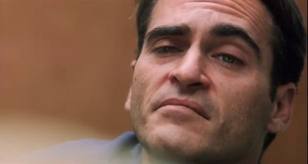
There’s a scene in the Paul Thomas Anderson’ s enthralling new film The Master where Lancaster Dodd ( Philip Seymour Hoffman ) — founder and leader of a cult-like movement called The Cause — instructs his “guinea pig and protege,” the aptly named Freddie Quell ( Joaquin Phoenix ) to face another man hurling taunts and insults at him without losing his hair-trigger temper. I felt like I was being put through a similar test on Tuesday night when, after being invited to a hastily arranged 70-millimeter advance screening of The Master at the wonderful Ziegfeld Theater in Manhattan, I arrived at the will-call table to find a crowd that, had they been carrying torches, would have been at home in the angry villagers scene of Frankenstein . The reason for their anger became apparent shortly after I joined the throng: A woman with bold eyeglass frames and a nervous look on her face announced to the mob that there were simply no more tickets left to hand out. Those who did not make the cut were instructed to sign up for a Thursday screening of the film. I managed to get Eyeglasses’ attention and explained that, as instructed on Monday, I had confirmed my attendance. She shrugged her shoulders and replied that the screening had been overbooked and my tickets had simply been given away. To add insult to injury, just a few seconds before Eyeglasses’ you’re-shit-out-of-luck announcement, one of Arianna Huffington’s minions slunk up behind me, invoked the HuffPo priestess’ name, and received an envelope with tickets. As a longtime observer of the Harvey Weinstein school of stealth marketing, I found the scenario more fascinating than infuriating because in New York preventing a large group of culture addicts from seeing a movie that everyone’s been talking about is actually a sneakily smart way of building interest in the all-important New York market. Now, I’m not saying the Weinstein Company hosed all those people on purpose, but New York is all about access, and last night, getting into The Master became a bit like getting into Studio 54 in the late 1970s. For most Gothamites, rejection is a tonic: When someone tells us we can’t do, see or experience something, we redouble our efforts and, better yet for people like Weinstein, in our quest to succeed, we recruit our friends and infect them with the same passion. Without going into details, that’s exactly what I did, and after seeing The Master , I’m glad I didn’t take no for an answer. (And, by the way, for a screening in which all of the tickets had been given out, I didn’t have any trouble finding a primo aisle seat at the front of the balcony.) To use a term from the film, I am still processing The Master. It’s an intelligent and emotionally complex film that doesn’t provide any easy answers the way that so many films do today. But if I can’t quite commit to saying it’s a great film, I can say that it has more than a few moments of greatness — and those usually occur when Joaquin Phoenix is onscreen. Phoenix gives the performance of his career so far as the feral Freddie Quell, a naval veteran, who can make moonshine out of torpedo fuel and anything else on hand. (“You can’t take this life straight, can you?” Dodd’s wife, played by Amy Adams, tells Quell at one point.) Freddie is the product of an alcoholic father, an institutionalized mother and a traumatizing war, and Phoenix literally embodies these psychic wounds while portraying a lost soul who is menacing, heart-breaking and darkly comic — sometimes all at once. The New York Times reported that Phoenix studied films of animals in captivity to prepare for his role, but his performance, which is pure id, brought to mind other references. The hunched, arms-akimbo way in which Quell stands recalled Martin Short’s Ed Grimley character from Saturday Night Live , and Groucho Marx. His squinting, sneering tomahawk-like face made me think of Hammerhead from The Amazing Spider-Man comics. When I wasn’t marveling at Phoenix’s performance, I found myself thinking that all of this talk about The Master taking on Scientology is a marketing MacGuffin. Yes, Philip Seymour Hoffman plays a L. Ron Hubbard-like character, but this movie is really about the relationship between two kindred spirits who, in some respects, are Freudian polar opposites. Quell is pure id, while Dodd is mostly superego, and each seems to yearn for some of what the other man has. For me, one of the key lines of the movie comes near the end when Dodd tells Freddie that if he can find a way “to live without serving a master –any master,” he should report back. Like I said, I’m still processing The Master , and I plan to see it again as soon as I’m able. Thanks to Harvey Weinstein, I suspect I’ll be waiting in a long line. Follow Frank DiGiacomo on Twitter . Follow Movieline on Twitter
Cinema connoisseurs of two kinds are in luck this week: Panos Cosmatos’s acid-trip of an arthouse thriller Beyond The Black Rainbow hits shelves as Movieline’s highbrow pick of the week, while the comedy classic Airplane! gets the Blu-ray treatment. Surely you can’t resist? HIGH: Beyond the Black Rainbow (Magnolia Home Entertainment; $26.98 DVD, $29.98 Blu-Ray) Who’s Responsible: Written and directed by Panos Cosmatos; starring Michael Rogers, Eva Allan, Scott Hylands. What It’s All About: A young woman (Allan) in 1983 undergoes “therapy” at the mysterious Arboria Institute, although any outside observer would be forgiven for thinking that she’s being mentally tortured by the twitchy and nefarious Dr. Barry Nyle (Rogers). Can she escape? Will her obsessive tormentor allow her to elude his clutches? Why It’s Schmancy: The word “trippy” just scratches the surface of the gorgeous psychedelic freak-out that’s been crafted here by first-time filmmaker Cosmatos. (His father, director George Pan Cosmatos, was the man behind more decidedly mainstream fare like Rambo: First Blood , Part Two and Tombstone .) Beyond the Black Rainbow pays homage to those ’70s thrillers in which dastardly things were happening behind the seemingly sterile walls of coolly impenetrable high-tech companies ( Colossus: The Forbin Project , Parts: The Clonus Horror , Coma , et. al.) with chilly aplomb; Cosmatos gets the period exactly right, from the hypnotically droning and heavily synth-y soundtrack by Jeremy Schmidt to Dr. Nyle’s black-turtleneck-under-tweed-blazer ensemble. The pace is slow, but the wonderfully weird payoffs are worth it. Why You Should Buy It: While a director commentary from Cosmatos would no doubt be illuminating, the auteur apparently prefers to let the work speak for itself; the only extras are the theatrical trailer and some deleted special effects footage where you get to watch a head melt. (Not a bad metaphor for how many audiences will respond to the film.) LOW: Airplane! (Paramount Home Entertainment; $22.98 Blu-Ray) Who’s Responsible: Written and directed by David Zucker, Jim Abrahams and Jerry Zucker; starring Robert Hays, Julie Hagerty, Leslie Nielsen, Robert Stack, Lloyd Bridges, Peter Graves. What It’s All About: This frenetic and outrageous satire of disaster movies in general (and 1957’s Zero Hour in particular) features shell-shocked war veteran Ted Striker (Hays) pursuing his stewardess girlfriend Elaine (Hagerty) on a flight from Chicago to Los Angeles; when food poisoning strikes the crew, Ted is the only hope of safely landing the plane, with a little help from a doctor (Nielsen), a jittery airport manager (Bridges) and Ted’s former commanding officer (Stack). Why It’s Fun: Many have tried but few have succeeded in copying the machine-gun-fire barrage of visual gags, puns, reference jokes and flat-out anarchic weirdness that have made this spoof one of the great American comedies of all time. It may be silly and sophomoric, but Airplane! is a miracle of pacing, with more laughs per minute than maybe any feature film ever made. Generations of new audiences unfamiliar with the 1970s disaster epics being parodied here still embrace this movie for its timelessly wacky pleasures. If nothing else, this movie may have succeeded at removing the word “surely” from serious conversation. Why You Should Buy It (Again): The extras — a feature-length commentary, pop-up trivia, and a “Long Haul” version of the film that allows viewers to click on icons to look at deleted scenes and interviews — will be familiar to anyone who purchased the previous “Don’t Call Me Shirley” edition. But Airplane! has never looked or sounded as sharp as it does on this Blu-Ray release (previously a Best Buy exclusive, now on sale everywhere). Previously: High And Low: Slapstick Savant Buster Keaton And (Surprise!) Horror Huckster William Castle Bring The Funny Follow Alonso Duralde on Twitter . Follow Movieline on Twitter .
Do Paul Thomas Anderson and The Weinstein Co. need to worry about the Church of Scientology ? Following the New York Post’s report of “strange calls” and mounting opposition among members of the organization to pseudo-Scientology pic/festival darling The Master , TWC confirmed to Movieline that the studio has increased security for tonight’s premiere at New York’s Ziegfield Theatre. The Master , which opens in limited release on Friday, stars Philip Seymour Hoffman as a charismatic spiritual leader, a la Scientology founder L. Ron Hubbard, who launches a religious organization in the 1950s while his right hand man, a former soldier/drifter (Joaquin Phoenix), begins to question everything. The film’s ties to Scientology have been a focal point of the buzz around the film since even before Anderson shot it, but in interviews Anderson and Hoffman have downplayed suggestions that the film is a direct depiction of the church and its leader. Still, it’s not surprising that The Post claims efforts from within the organization are underway to battle The Master ‘s marketing campaign ahead of its September 14 release. Before getting an official title, The Master was pretty much known as “Paul Thomas Anderson’s Untitled Religious/Scientology Drama,” so the Scientology camp must have been preparing for its release for a long while. What makes the clash of interests more curious is the claim by a Post source that “strange calls” thought to be from Scientology members have been streaming into the distributor to the point that “some on the film’s team have hired extra security.” A studio source tells Movieline that security for tonight’s premiere has been beefed up as a result, though the nature of said calls and the Weinstein Co.’s exact security concerns are unknown. It should be interesting to see how the image-conscious Church of Scientology reacts to the film and its contents, and to what extent they might feel it necessary to combat The Master ‘s huge (and only getting huger by the day) buzz in the name of defending their own image. (Guess they can’t count on Sci-celeb Tom Cruise to be their public delegate, even if pal Anderson has screened the film for him.) The Master ‘s profile has been steadily ascending with cinephiles swooning in surprise screenings around the country and its recent Venice Film Festival wins , not to mention the added profile boost of having awards guru Harvey Weinstein (who has his own personal crazies to deal with) on its side. This is all shaping up to be a strange case of religion butting heads with the Oscars as awards season gets an early start. And while Scientology certainly has an weird, omnipresent, boogeyman-esque mystique in this town, I’d put my money on Weinstein emerging victorious. Read more on The Master . [ NYP ]
The Jake Gyllenhaal and Michael Peña starrer End Of Watch appears to have hooked audiences at the Toronto International Film Festival , where the police drama premiered. The fast-paced story of two LAPD officers who form a powerful bond as they patrol the mean streets of South Central Los Angeles required both actors to go through months of training and “ride-alongs” with L.A. and Inglewood police officers; the movie itself unfolds a liberal dose of gun fire, fights and some gruesome scenes. But on one patrol in the lead-up to the shoot, Jake Gyllenhaal experienced a true-life horror — a murder. “On my first ride-along, someone was murdered in front of me,” said Gyllenhaal in Toronto. “There was another officer initially on the scene. It was a drug [shoot-out] between gang members. I was probably the safest you can be. And yet I was at the forefront of the danger. There were moments on these ride-alongs when I was afraid. I was amazed with how LAPD took care of us. When there are two actors in the back of the car, you’re an added responsibility and Michael [Peña] and I were very aware of it.” Gyllenhaal plays Officer Brian Taylor, who patrols the gang-infested streets with Officer Mike Zavala (Peña) in the Open Road film, which bows in theaters nationwide September 21st. Directed by David Ayer ( Harsh Times , Street Kings ), who grew up in L.A.’s long troubled South Central neighborhood, the action unfolds on screen through footage of handheld cameras shot from the P.O.V. of hand-held cameras by police officers, gang members, surveillance cameras, dish cams and citizen-caught images in the line of fire. While there are moments peppered throughout the feature showing moments of levity between the two officers that prompted outbursts of laughter in the Toronto audience, the scenes quickly turn to present a mosaic of dark violent streets, human trafficking, gang confrontation and a barrage of shoot-outs. “For me, this movie was a journey,” said Gyllenhaal who also has an executive producer credit on the film. ” I spent five months preparing for this part. I went on ride-alongs with LAPD two or three times a week and was doing tactical training two times per week, and live ammunition training, as well as fight training, every morning. Everything was an internal journey for me. I don’t pay much attention to the external world… It was about that internal ride for me. I have consequently made some of the closest relationships I’ve had in my life so far. It’s safe to say they’re some of my closest friends at the moment.” The building chemistry between Gyllenhaal and Peña’s characters is central to the film. There were quiet whispers among some in Toronto who said that the two had difficulty in their relationship during the long process building up to the film, but Gyllenhaal said that their bond was something he made an effort to build and is happy that their chemistry is visible on screen. “I’m most proud of the relationship between me and Michael. That took the most time to build,” said Gyllenhaal. “Right now in my life, my focus is my work. It’s what matters to me more than anything. The results of that are what the results are. This movie was a different approach to making a movie than I’ve ever experienced.” Along with the ride-alongs with police officers, the two trained together in fighting and with live ammunition. Gyllenhaal admitted that went it came to fights, Peña had the leg up. “Every morning Michael and I would go to this dojo in [L.A. neighborhood] Echo Park and fight these kids. They were between 14 and 20 and they’d beat the crap out of me. Michael is a much better fighter than I am,” he admitted. Stay tuned for more on End of Watch and read all of Movieline’s coverage of the Toronto Film Festival . Follow Brian Brooks on Twitter . Follow Movieline on Twitter .
What’s in a name? J.J. Abrams’ Star Trek reboot sequel finally has one (per Deadline ) and despite my deepest, nerdiest hopes that early reports were on some crazy tip it’s been confirmed so I guess we’re stuck with it. I hope you’re ready for — drumroll please… Star Trek Into Darkness . Star Trek into what now !? I’m sure it was tough to come up with a naming convention that deviated from the original Trek movies’ Roman numeral + subtitle formula, or the TNG -era Trek s’ annoying penchant for terribly vague one-word descriptors (“Nemesis”? “Generations”?). At least those made more sense once you saw the movie. But Star Trek Into Darkness ? For starters, it sounds like Step Into Liquid and Step Up 2 The Streets , which makes me think Chris Pine and Co. are headed for a dance-off with outer space surfers to the music of a British glam rock band. On top of that, dropping the colon forces us to comprehend “Trek” as both a noun and a verb, which makes my brain hurt. Who wants to go Star Trekkin’ with J.J. Abrams? [*Commenter Elijah Sarkesian is right: Maybe someone just forgot the colon. If that’s the case then I forgive Abrams and will move Star Trek: Into Darkness into #10 right under Star Trek: Insurrection , because “insurrection” is at least an interesting vocabulary word.] Maybe I’m being too harsh on poor Star Trek 2 . Looking back on the Trek films, they weren’t all winners. Here’s how I’d rank the 12 franchise titles, from awesome ( KHAAAAAAAN! ) to turrible. 1. Star Trek II: The Wrath of Khan 2. Star Trek III: The Search for Spock 3. Star Trek IV: The Voyage Home 4. Star Trek V: The Final Frontier 5. Star Trek VI: The Undiscovered Country 6. Star Trek: The Motion Picture 7. Star Trek: First Contact 8. Star Trek 9. Star Trek: Insurrection 10. Star Trek: Nemesis 11. Star Trek: Generations 12. Star Trek Into Darkness Yep. Still not working. Sound off below. Together we can get through this, guys. Star Trek 2 is in theaters May 17, 2013. [ TrekMovie.com , Deadline ]
New Zealand native Melanie Lynskey finds her way to the spotlight – at long last – playing a woman, stuck in a sadly hilarious vortex of post-divorce depression, who’s jolted out of her early mid-life ennui by an electrifying affair with a younger man ( GIRLS ’ Christopher Abbott) in Todd Luiso’s Hello I Must Be Going . It’s an extraordinary dual capacity for deeply-felt pathos and comedy that Lynskey possesses and showcases, often simultaneously, as Amy Minsky; for Lynskey, one of the most genuine actors in the game, it was the kind of role that’s come along all too infrequently in the nearly two decades since her assured debut at the age of 15 in Peter Jackson’s Heavenly Creatures . “It was kind of a dream that I would find a part that had so much for me to do, but it’s so rare,” Lynskey said over iced coffees in Los Angeles. Longtime devotees know her well from Heavenly Creatures , in which she and Kate Winslet played a pair of real-life teen murderesses, or from her supporting turns in films like Ever After , Detroit Rock City , and Coyote Ugly ; when we first met in Seattle a few months prior, a fan recognized her as Reese Witherspoon’s old classmate in Sweet Home Alabama (“Baby in a bar!”). But while she’s tasted mainstream success, the soft-spoken Lynskey, whose wicked sense of humor complements her humility (she’s truly one of the most grounded actors around, as evidenced by her Twitter musings ), seems far more at home in the creatively-fulfilling climes of independent film. Three years into her tenure as the daffy, delightful Rose on Two and a Half Men , she asked to be let out of her contract so she could make films while coming back as-needed in a recurring role. In the time since, she’s turned in some of her best, most acclaimed work in potent supporting turns like Away We Go , Up In The Air , The Informant , and Win Win . “The show was so successful and I could see a crossroads,” she explained. “It was like, this way you’ll be a millionaire and one of the people on this show, and this way you’re not going to make a lot of money but you’re going to be able to build something that’s a little more interesting.” In Hello I Must Be Going that choice paid off not just with her first starring role, it also prompted Lynskey to examine her own journey in contrast to Amy’s vulnerable emotional life. “You come home and everything looks beautiful. It gave me a real appreciation for happiness, and for my friends, for interests that I have, and the fact that I do have a life that I really love.” Below, dive in as Melanie Lynskey takes us into her work on Hello I Must Be Going , her reaction to male critics who’ve criticized Amy’s physicality, lessons learned on the set of Heavenly Creatures , her experience on – and pulling away from – Two and a Half Men , her favorite film critics, David Wain’s upcoming They Came Together , and the theme songs she uses to get into character. One of the great things about Hello I Must Be Going is that audiences get to see you front and center – they know your work, we’ve seen you do comedy and drama, but this is a vehicle that allows you to combine those talents. Were you looking for something of this more intimate scale, or these particular chords to play? It was kind of a dream that I would find a part that had so much for me to do, but it’s so rare. We made this movie for no money, but even those tiny, tiny movies – movie stars are doing them, famous people. So much of the stuff that Michelle Williams does – can you imagine doing Wendy & Lucy ? What a dream! Or Blue Valentine ? She’s so amazing. But what a great thing to get to create something like that. It seems performers do have to turn to the independent world to find projects like that. How did they find you for this film? Yeah, I think so. I just got asked – I was in Toronto and my agent was like, do you want to come do this reading for the Sundance Institute? They were doing a staged reading of it in front of a little audience. I read the script and said, “Yes – I will fly myself back!” I loved it so much. At the time I thought I’d just be doing the reading, I didn’t anticipate having a future with it. Who was at the initial staged reading? There were not a lot of the same actors. Dane DeHaan read Chris Abbott’s part, and he was wonderful. There were a lot of good actors in it. It was fun. We worked on it for a day and Todd [Luiso] directed it. It just went really great, the energy was really wonderful. After that reading they said, “We want to make it with you,” and at the time with Dane, and then they tried to get money that way – but they realized they had to ask for less and less money with me in it. [Laughs] Eventually they got some money and stuck with me and I’m so grateful. Your character is stuck in a post-divorce depression but there’s a real humorous undercurrent to her, and so much of that is expressed in your face – in your expressions, your reactions to these oblivious people around you. There’s a tone to the script where you can just tell how Amy is feeling, and it was written from her perspective. There weren’t many reaction cues in the script but Sarah [Koskoff] and are really similar, the writer and I, so that was good – we have a similar take on things and were both excited that we wanted to do the same thing with it. Chris balances the film opposite you – there’s a quality to his eyes that makes you feel you’re peering into his soul, just looking at him. That’s such a perfect way to put it. It’s so true. There’s something about him that’s open and accessible but still mysterious; he has a really interesting quality, and his performance is so spontaneous. It feels off the cuff. He’s such a great person, a sweet, sweet person. Kind and lovely – I got so lucky with him. He seems like he’s always perceiving the world around him. He is, and he’s not judging. It’s nice. There’s a nice quality to him where he’s sort of scoping people out and watching people but he’s not too cool for school, even though he’s very cool. [Laughs] It was funny when I started watching GIRLS – I was like, Oh my god, he’s playing such a goofball! It’s so different from him. Was there much time to get to know him before you started shooting? No. It was crazy, because the other actor was going to do the movie and the casting process was kind of quick after he had to drop out. I remember Todd saying to me one day, “Do you want to watch this audition tape? I keep thinking about this one person…” and when he showed me Chris’s audition tape I started crying. I cried with relief, mostly, like, “Oh thank God they have somebody good!” I was so afraid! That’s a good point – there are so many elements up in the air in the making of a movie. And the age difference between the characters – she’s 35, he’s 19 – sort of requires two performers who can meet in the middle . It was important to me that it wasn’t all about the age difference in a creepy way, and Chris has a maturity to him which I think is important. The characters are at such similar points in their lives; “Who am I, and what am I going to do with the rest of my life?” So I didn’t want it to be sketchy. They cast Chris and I was in Connecticut working with Todd and Sarah and we sort of just awkwardly met each other. He had to leave to go shoot something and they were like, “He’s cute, right? Did you like him?” It was like a weird set-up. “He’s tall!” This was a really quick shoot, which means that you get what you get while you’re there. It’s always interesting to me to just kind of go along for the ride. Sometimes you come across somebody with whom your ideas don’t mesh and it’s an unfortunate kind of clash, but that doesn’t happen very often. What I like seeing is what somebody wants. Every experience is so different, but you never know until you start. Actors often say the gratifying part of the process is the work they do on set, within scenes. Do you feel that way, and to what extent did this particular shoot do that? It’s interesting. It was somewhat of a transition period for me, even though I wasn’t aware of it at the time. It’s interesting to play a character who’s asking, “What does the rest of my life hold for me? I’ve made these choices and I sort of thought everything was going to go one way, and what would happen if it all got turned upside down?” It was interesting to put yourself in that space of having nothing and feeling nothing and just not knowing what was going to come at all. In a lot of those scenes, the toughest stuff for me in those scenes is where she’s very depressed, because it’s just so horrible to sit in that, you know? But it’s hopeful. It’s an interesting thing as a person to spend a day where you’re just letting yourself feel awful. You come home and everything looks beautiful. It gave me a real appreciation for happiness, and for my friends, and for interests that I have and the fact that I do have a life that I really love. It’s good that you are able to pull yourself from that darkness. Not everybody has that, and it seems like one of the tougher aspects of being an actor. I was kind of trained to do that on Heavenly Creatures . It was pretty crazy. They were so worried about taking this 15-year-old who’s never done a movie before and being like, “Hey, cry all day and go crazy and see you tomorrow!” They were so concerned about me losing my mind, so there was a whole process at the end of the day of getting rid of everything. The woman who played my mother was kind of my acting teacher – she was helping me with technique and stuff, and she would brush me off and brush the emotion away. It was really great, and it was a good lesson to learn. You don’t need to take it home with you, and it’s better if you don’t. You were 15 when you made that film – at what point did you realize Heavenly Creatures was the real beginning of a career, that it would launch you into the world? It’s funny, because it doesn’t feel like it did. [Laughs] There was a point when I realized it was not going to. But it was a start. I think when I got an agent in America and I was like, “Oh my god, people really saw this movie.” But the progression was so slow, there was no kind of – here are movies, and here’s other opportunities! It was just like, “Nice job.” I mean, I went to the Venice Film Festival – that was incredible, that was crazy. I had so many surreal moments. Yesterday I was at high school studying for my English exam, and today I’m having lunch with Uma Thurman and Harvey Weinstein. And Quentin Tarantino, talking and talking. It was amazing. Heavenly Creatures is a fascinating film to look at now, just to revisit this point when three careers – yours, Kate Winslet, and Peter Jackson, whose films to that point had been very different – sprang and took off. It’s so amazing. It’s absolutely no surprise to me that Peter has done what he’s done and Kate has done what she’s done. But it was kind of a crazy thing to be a high school student and do this movie with people who had such a fire in them. How did your classmates react to the film? Some people were nice. I had friends who were like, “The movie was really beautiful,” but then most people were like, “I could see your tits.” [Laughs] I was like, yep, you could. “You kissed a girl!” I did. But that was fine. It was just a little alienating.
Kristen Stewart said that the sex scenes and the nudity weren’t the difficult part of playing Marylou in On The Road . Rather it was her character’s emotional openness. “She loved so openly — and that’s hard ,” Stewart said of Lu Anne Henderson. She also referred to her character, who Neal Cassady married when she was just 15, as “a bottomless pit” — presumably a reference to her emotional capacity — who would have been “ahead of her time even now.” (For more photos of Stewart, check out our Toronto Film Festival photo gallery .) Stewart, who wore a sparkly floral dress and black high-tops, seemed her usual intense and uncomfortable self as she spoke during an extremely brief Q&A session that followed the movie. But the more she spoke about Henderson, the more animated the actress became, particularly when she said that Henderson, in spirit, “was so fucking there for me” on the set. The second and last question asked of her came from a fan, who drew winces when, in the spirit of On the Road , she asked Stewart where she’d choose to go if she could go anywhere. After taking a half-hearted stab at answering the question, the actress finally said, “I don’t know, dude.” Judging from the polite applause that followed the screening, the crowd liked but didn’t love On the Road, which, thanks in part to its source material, felt aimless at times. That said, the performances by Stewart, Garret Hedlund, who plays Cassady doppelganger, Dean Moriarty, and Sam Riley, who essentially plays Kerouac, are strong. Stewart doesn’t have a lot of lines, but she brings a sultry radiance to the screen that is impossible to ignore. I don’t know if this performance is going to net her an Oscar nomination, but it’s clear that she’s got the right stuff. As for the sex scenes, the most envelope-pushing performance of the film belongs not to Stewart but to Steve Buscemi who is depicted taking it up the bum from Hedlund. Well, you wanted to know, didn’t you? Follow Frank DiGiacomo on Twitter. Follow Movieline on Twitter.
Keep The Lights On director Ira Sachs ( Forty Shades of Blue , Delta ) tapped into his own experience in a tumultuous relationship that would eventually morph into the film that screened to accolades at the Sundance and Berlin film festivals earlier this year, winning the New York-based filmmaker a Teddy Award at the Berlinale. Keep The Lights On morphed out of the disintegration of a relationship he had with a man that spanned a number of years in New York around the turn of the century. Career demands, extra-relationship temptations, addictions, obsessions and more play into the rocky road experienced by the young couple. Sachs took inspiration for Keep The Lights On from the likes of Lisa Cholodenko’s The Kids Are All Right , Bill Sherwood’s Parting Glances and Jacques Nolot’s confessional Before I Forget , constructing Keep The Lights On as a gay man in NYC while embracing at times details some may consider unflattering. Danish actor Thure Lindhardt plays documentary filmmaker Erik, while American Zachary Booth plays closeted lawyer Paul, a couple who embrace each other while passionately forming a dramatic relationship rife with sex, drugs, highs, lows and dysfunction. Ahead of Keep The Lights On ‘s theatrical release this weekend, Ira Sachs invited Movieline over to his NYC apartment, which, perhaps not so coincidentally served as a prime location for his film. He talks about embracing depictions of addiction and sexuality, the challenges of making indie film today, how making the film affected him personally and what his former partner, who helped inspire the project, thought of the film. When did you decide that you actually wanted to make this film? I saw a film called Before I Forget by Jacques Nolot at (New York’s) Cinema Village, which was programmed by Ed Arentz — who is now my distributor. And what I saw [was] a film that reflected sort of contemporary life — Parisian life — of a filmmaker who was gay, but also what his life in Paris is that looks like something specific. As a gay person how we live looks very specific today and different than it did 20 years ago. I felt like there was no film that looked like my life, and no film which really reflected the community that I live in which is very mixed. The boundaries between gay and straight, I think, for most of us in our everyday lives, though not in our psyche has dissipated. So I wanted to make a film about sort of what I had seen in the last many years here. But specifically I ended a relationship in 2008 and I had a sense that 10 years before that was an interesting story. I started writing and I put it away for a couple of years, and it was really Mauricio Zacharias, my co-writer who read that material and said, “Well clearly this is a story you have to tell.” And in a way because I was doing something so autobiographical, I think I needed someone else to give me the blessing that it would be relevant. So how much of it is similar and how much of it is a departure to your own life during a certain time period? We began with the journals, and diaries, so we began with the raw materials from my life, but then ultimately we were creating a screenplay, which is constructed around its own laws and orders. And in a way, all my films have begun with things that I feel like I know more than anyone else. They’ve begun in a very intimate place. So you’re creating it similarly to the approach you took in Forty Shades of Blue for instance? Forty Shades was kind of about my dad actually. I grew up in Memphis with this larger than life figure who always had these younger girlfriends. And my relationship to those girlfriends was my entry to the film, and that sort of thing. And then when you start making a movie [like Keep the Lights On ] and you’ve cast a Danish actor to play a character based on yourself, then you’re like off to the races because you’re making a film. So what made you decide to go that route with a Danish actor? Was it that the actor Thure Lindhardt personally that appealed to you? I sent the screenplay to an agent that I have worked with in Hollywood, and I got the response that no one in the agency would be available for this [project]. And I knew even before that I wanted to make this film different. I thought that this film needed to be a truly independent film, so it would be financed that way. It would be made that way. So I heard about Thure who I was told was the bravest actor In Denmark and one of the best, and I knew that he would be. I sent him the script and he was alone in a hotel room in Spain, and he ended up using up all the scenes one could shoot alone, which were a series of masturbation scenes. And I knew that he was both comfortable with the material, but also really amazingly interesting to watch. So I casted him. Is this a little reflection, perhaps, on American actors, that they’re less inclined to do this sort of thing? I have a Danish lead actor. I have a Greek cinematographer. I have a Brazilian co-writer. I have a Brazilian editor. I had a Romanian script supervisor. I surrounded myself with non-American sort of sensibilities. And I think that’s a big part of the film. It’s a film about New York, and it’s a very New York film, but I think it’s told in a way that’s not repressed, and it doesn’t look at sex as some foreign object that has to be viewed only in the dark. Do you agree that that’s sort of the American POV generally, that violence in movies is acceptable, but sex is taboo? I do, I do. I think when this film played in Berlin, it was the most ordinary movie you could see.It was extremely ordinary which is very different than how it played at Sundance. How did it play at Sundance then? The subject matter and the sexuality made people uncomfortable. I think there’s a fear of difference in American cinema. And I was thinking a lot about that when I made this film because there used to be an idea that independent cinema was independent cinema . And that production and the means of production were actually separate from commercial cinema. And that gave you certain rights and opportunities — and I had all those rights and opportunities. I am one of a number of filmmakers who started out making films about gay people who stopped. My whole generation, most of us stopped. We either couldn’t make films, or we had to make other kinds of films. And I think that that’s partially about the individual, but it’s mostly about the culture, and trying to figure out how to sustain a career. I think for me, ultimately, I feel now that in some ways my marginal voice is actually my most powerful. It’s also possibly economically my most fertile, because I’m the guy who can make these films. Is there still a pretty low glass ceiling for gay filmmakers generally in this country? It wasn’t any easier to make a film about a Russian woman living in Memphis ( Forty Shades of Blue ). When you’re trying to make non-broad character-driven stories, and I’m interested in documentary as forum, so I’m actually trying to get the details right, which makes it even more specific in a certain way. Going back to Keep the Lights On and Thure’s character Erik, I got the feeling he was a little bit a love junkie. Yeah, and I would agree. He was someone who didn’t feel complete without obsessing over something. I think, no one’s used that term, but I think it’s a good one. It’s better than a sex addict. I mean, I like love junkie… He is someone who just emotionally needs some attachment. I think that there’s a compulsive need to be connected to another person. And I think the film in a lot of ways is less about addiction and more about obsession. There was something, these two guys, both of them are obsessed with the idea of maintaining their life together. And I think with obsession, sometimes it seems like the most comfortable place to be, because it shuts out everything else because you think, “Well if I can control this situation, then I can control my life.” So was it emotional reliving this to a degree? It wasn’t. No? It wasn’t really. I mean, I think by the time that I made the film I really believe I’d done all the therapeutic work and transformation in a lot of ways. Occasionally it felt like déjà vu. It was like an odd sensation that occasionally I was creating fictional scenes that were replicating things that were close to my own life. But mostly I just really felt like my life was one of the drawers that we can open. And I was always very willing to share as much as I could with the actors. But I never felt like they needed to try to do anything other than what was natural to them as actors and as people living the story. I mean, a lot of what I think I do as a director is try to give everything over to the actor. So I disappear. I mean, but the helms are their helms. The spaces are their spaces. I don’t rehearse with my actors. Then what’s your methodology of instruction? I talk to them individually, but I never talk to them together. So really in a certain way it’s more difficult for the actor because there’s a lot of risk, but actually that risk I think is the element that you could actually name in the performance in this film, and in my films in general. I think there’s something risky about it all. This is the moment. So I think to trying to capture the moment means that you’re really valuing the present, which includes the past, but it is about the present which is about the actors, it’s about flirtation, it’s what happens between them. Did you ever consider not emphasizing the drug use? Maybe there would be some other more acceptable vice like — alcoholism? An everyday addiction… Yeah, an everyday addiction, a “legal” addiction, yeah. You know, I really wanted to be unashamed and unabashed about the truth of my relationship and my behavior, and to not shy away from the details, and to not judge the action. So pot-head, crack addict, different kinds of distractions, different kinds of consequences, but the root of addiction is usually similar in lots of ways. And I feel like the drug use that the film talks about is really prevalent in the gay community at least. It’s something I feel like goes unspoken. So has your former partner seen this film? Yeah, he has seen the film. I showed him the film before Sundance. And he’s been very supportive. I mean, I think it’s not him. It’s a story about our relationship as seen through my eyes. Next: The New York filmmaker gives his personal Top 9 NYC films
Born to Die singer Lana Del Rey didn’t exactly conquer the music world with her polarizing entree into showbiz (her SNL appearance will go down as one of the stiffest performances in the history of television), so maybe channeling all that smoky ’60s-tinged mannequin angst into another medium is the ticket: “When I was starting, I had a vision of being a writer for film and that’s what I am doing now,” Del Rey (real name: Lizzy Grant) told Vogue Australia. “I’m so happy… Hopefully I will branch into film work and stay there. That will be my happy place.” [ Vogue AU via NME , Screen Junkies ]