Tag Archives: Actors

REVIEW: Unvarnished Iranian Family Drama A Separation Doesn’t Go for Easy Answers

The filmmaking in Iranian director Asghar Farhadi’s A Separation is so spare and unfussy that, save for the occasional camera jiggle, you’re barely aware of the filmmaking at all. This is a drama about two families — one deeply religious, one not — who clash over an escalating series of misunderstandings, and the emotion Farhadi teases out of this increasingly complex situation are unvarnished but restrained. Nothing earth-shattering happens in A Separation , but the straightforwardness of this view of a disintegrating marriage, set in the context of complicated cultural and religious morés, is dramatic by itself. The movie opens with a couple, Simin (Leila Hatami) and Nader (Peyman Maadi), appearing before a judge to hear Simin’s petition for divorce. The couple have been planning to leave Iran with their 11-year-old daughter, Termeh (Sarina Farhadi). But Nader calls off the move at the last minute, realizing he can’t leave his ailing father behind. Simin wants to, and is willing to, leave without him, to build a better life for her daughter. The judge — whom we can hear but not see — stops her to ask archly if she thinks her daughter won’t be able to have a good life in Iran. He also suggests that he can’t grant her a divorce unless she can prove Nader is a genuinely bad husband — if, for example, he’s an addict, or he beats her, or he fails to give her an allowance. Simin is quick to assert that Nader is a good person, and you can guess the verdict the judge is about to come out with: If Simin really wants what’s best for her daughter, she must stay in Iran with her husband. But if that sounds like a personal — or even a social — victory for Nader, the male head of his household, it isn’t. Farhadi has made a somewhat old-fashioned melodrama. Simin does leave Nader and Termeh, but she doesn’t leave the country: She packs her things and goes to live with her mother. The complication pile-up begins when Nader hires a 30-ish woman, Razieh (Sareh Bayat), who happens to be pregnant, to care for his father; in other words, Razieh will assume the duties that Simin, clearly a devoted daughter-in-law, used to perform. Razieh arrives the next day to care for the old man, with her young daughter (Kimia Hosseini) in tow, but the job appears to be too much for her. We also see that she’s deeply, conservatively religious, and it’s suggested, for reasons that become clear later, that she has reason to fear the wrath of her husband, Hodjat (Shahab Hosseini). This is Farhadi’s fifth picture — his previous movie, About Elly , won the Silver Bear at the Berlin Film Festival in 2009 — and he doesn’t always have full control over his wayward, tangled storyline. Significant unseen events are explained, after the fact, by mere lines of dialogue; there’s perhaps too much telling here and not enough showing. But without making an overt statement about the political, social and religious climate in Iran, Farhadi — who also wrote the script — packs a lot of quiet anger and frustration into the picture. Like his compatriot Jafar Panahi, Farhadi is attuned to the plight of women in Iran, the way their needs and desires are subjugated to those of their husbands. But he shows how this system fails men, too: Nader becomes charged with a crime that, it seems, he didn’t knowingly commit — in any event, his “knowing” is difficult to prove. And even though his wife has been instructed to stay with him, it’s impossible to legislate a human being’s love. As far as his marriage goes, the law may rule in Nader’s favor, but it can’t bring him happiness, and his misery — even as it’s veiled by his more obvious machismo — is clear every minute. The performances here, particularly those of Hatami and Maadi, are subtle and quietly heartfelt. These characters intend to do the right thing despite their own deep, personal pain, but they’re highly imperfect beings struggling to live in an even more imperfect world. A Separation doesn’t try to make easy sense of that world, or of this family’s suffering. It’s simply a quiet cry of anguish. Follow Stephanie Zacharek on Twitter . Follow Movieline on Twitter .

Here is the original post:
REVIEW: Unvarnished Iranian Family Drama A Separation Doesn’t Go for Easy Answers

From Brangelina to Bombs: STV’s 10 Favorite Stories of 2011

I honestly have no idea where 2011 went. I vaguely remember what follows here. There might have been more. You tell me. The Animated Oscar Index Currently in the middle of its second annual cycle, the Oscar Index is, to me, the story of the film industry’s awards race. But despite the tens of thousands of words expended every year, nothing quite sums it up like animated videos of celebrity heads floating inexorably toward golden glory. Drinking adds much to the experience, I’ve found. I Hate Brangelina: An Appreciation They’re mega-glamorous, mega-rich and mega-talented. Brad Pitt and Angelina Jolie would make me sick if they didn’t make me so goddamned happy. The $11 Question The Worst Movie EVER! dazzled everyone by enticing one solitary ticketbuyer to its debut in Los Angeles. The rest is history. Well, kind of. Anyway, this is the story of whatever the hell happened. Consider Uggie The last time someone wore a fur coat in a do-it-yourself Oscar campaign, Melissa Leo won Best Supporting Actress. Imagine what we can do for someone who deserves a statuette! Lumet Life Lessons The late Sidney Lumet was often called a humanist filmmaker, but what does that actually mean? Hint: It’s not because he directed The Wiz . Parsing out some touchstones of his philosophy amounted to one of the more satisfying exercises of the year. Collect Them All! If nothing else, Jacki Weaver’s Awards-Season Trading Card made four weeks of ridiculous design labor worth it. The “Should I See The Smurfs ?” Flow-Chart Review Behold the future of film criticism! Also: I am so sorry. Fair is Fair For the second time in three films, Marshall Curry is once again among the documentarians on the Oscar-consideration bubble. Get used to it — and here’s why. Big “Will He?” Style Despite all the trade gossip and fanboy chatter, Will Smith remains no closer to making any of the projects listed on this year’s list of Smith films you’ll likely never see. Brush up here, and place your updated 2012 bets accordingly. The Celibate Screen I stand by my airtight case for less sex at the movies. That is all. Follow S.T. VanAirsdale on Twitter . Follow Movieline on Twitter .

The rest is here:
From Brangelina to Bombs: STV’s 10 Favorite Stories of 2011

Are Zoe Saldana & Bradley Cooper Spending The Holidays Together?

Read the original:

It was recently reported that newly single it girl Zoe Saldana was caught getting cozy with “Peoples’ Sexiest Man Alive” Bradley Cooper in Paris. Well it looks like there was more to this rumor because the couple are reportedly spending the holidays together. Saldana’s rep denied the two were romantically linked after they were spotted clubbing together last month, but now sources told E! that the actors had plans to go skiing in the Rockies together over the holidays and are “totally dating,” and they’re ready to tell family and friends about their relationship. People’s Sexiest Man Alive has been linked to Scarlett Johansson and Jennifer Lopez in the past few months. “If you’re a single man and you happen to be in this business, you’re deemed a player,” he told People magazine in his Sexiest Man Alive interview earlier this year. “But I don’t see myself as a ladies’ man.” The sizzling pair are starring together in the upcoming film “The Words.” Has Zoe given up on the brothers? This is the second white man she’s been linked to. She recently split from her fiance Keith Britton, who she dated for 11 years. Spotted at thefablife.com Zoe Saldana & Fiance Split After 11 Years! Zoe Saldana Looks Gorgeous In Gold At ‘Colombiana’ Premiere [PHOTOS]

Are Zoe Saldana & Bradley Cooper Spending The Holidays Together?

The Artist, Tinker, Midnight in Paris: Stephanie’s Top 10 Movies of 2011

And so my most-favorite, least-favorite task of the year rolls around again. I never call it a “10 best” list — meaning the unequivocal 10 best films of the year — because I’m fully aware of how subjective it is. Yet as frustrating as it usually is to pull together just the right 10, I found the job surprisingly pleasurable this year. So many movies to love! How could this have happened? Let’s not even address the fact that two 3-D movies made it onto my list — that surprises me as much as anyone. The remarkable thing is that year after year, no matter how much samey-sameness Hollywood (or even so-called indie cinema, for that matter) seems to give us, there are always pictures that resonate, movies that stand apart as if to do so were their God-given right. This year was, I think, particularly rich, but again, no critic’s list can ever be the perfect definition of the year’s finest movies. Besides, all the fun lies in comparing and contrasting. That’s why I urge you to share your favorites with me, in the comments section. That’s one of the things I most look forward to each year. A note about the order: My top four movies are pretty much ranked in order of preference. But the remaining six are just a happy jumble — Drive could just as easily be Number 7 instead of Number 10, and Bill Cunningham: New York could have crept up to Number 6. And in the Honorable Mentions category, all bets are off. This is secretly, or perhaps not so secretly, my favorite part of compiling a year-end list. It’s the place I can revisit every movie of the past year that has somehow stuck with me, without having to make a case for alleged greatness. Because as I’ve said many times — and plenty of other people have said it before me — greatness so often happens in the margins. Here goes: The Artist — Michel Hazanavicius’ nearly silent black-and-white film (featuring the ultra-charming Jean Dujardin and Berenice Bejo) has inspired lots of rapture among critics, but also a great deal of harumphing that it’s nothing more than a trifle and says very little about silent film as an art form. But ideally, what, exactly, might it have said? Beyond offering such beauty and pleasure (as if that weren’t enough), Hazanavicius has reopened the world’s eyes to a long-gone mode of filmmaking. Sure, yes, of course, there are Keaton films, Griffith films, Murnau films that are better, and there are plenty of critics around to remind us of that. But when critics write chiefly for other critics — in other words, to show off how much they know — they forget that thousands of people who have never even seen a silent film will see and enjoy The Artist , and maybe seek out more of the great silents. Meanwhile, no one needs a badge of certification to “properly understand” silent film, or The Artist . Thank God. Melancholia — Lars von Trier’s meditation on serious depression is gorgeous to look at, deeply moody and atmospheric, and always in on its own grim little joke. The most rapturous, uplifting picture about the end of the world — or the end of a world — ever made. Tinker, Tailor, Soldier, Spy — Over the past few weeks, Tomas Alfredson’s intricate John LeCarré adaptation has crept — kind of like a super-stealthy MI6 agent — from my Honorable Mentions section to the bottom of my 10-favorites list to somewhere very close to the top. The picture is sly, precise and deeply fulfilling. It also features Gary Oldman in one of the great performances of the year. Midnight in Paris — In the past 20 years I’ve liked bits and pieces of Woody Allen’s films (Scarlett Johansson’s brainy-cute journalism student in Scoop , the great Elaine May in Small Time Crooks ). But mostly, since Manhattan Murder Mystery , I’ve pretty much loathed them, and that includes the much-lauded Match Point . Which is why it gives me extra pleasure to have fallen in love with a Woody Allen film once again. Midnight in Paris reckons with the past as a real place, even as it worries about the limits of nostalgia. What happens if we don’t care about the past enough to carry it with us into the future? That’s the question Midnight in Paris worries over. It’s a movie about every yesterday we stand to lose as we’re busy making the leap, over and over again, between today and tomorrow. Jane Eyre — Cary Joji Fukunaga understands both the novel’s quintessential Englishness and the raw animal nature that drives it. Michael Fassbender, as Mr. Rochester, finds the character’s inherent, awkward warmth without mistaking it for anything so bland as mere niceness. And Mia Wasikowska’s Jane, physically just a slip of a thing, has carnal boldness to burn. Sex is threatening, as Charlotte Brontë knew, and Wasikowska and Fassbender make this particular dance look exceedingly dangerous. Le Havre — Finnish sadsack Aki Kaurismäki gives us a sort-of bookend to Melancholia , with an equally happy, albeit very different, ending. With this story of an aged Normandy shoeshine guy who takes a African refugee under his wing, even as he faces the loss of his possibly terminally ill wife, Kaurismäki takes the most generous attitude possible toward human nature. Being jaundiced about the world is easy — it takes relatively little energy to expect the worst from everyone. But it’s harder to allow for the possibility of surprise in the way people behave and treat one another, and the rewards are far greater. That’s what Kaurismäki captures in this unapologetically joyful picture. Bill Cunningham: New York — Richard Press’ glorious documentary isn’t just a movie about fashion or street photography or even just one pretty eccentric and fascinating guy, New York Times photo-columnist Bill Cunningham. It’s a picture that captures the vitality and myriad idiosyncrasies of New York. At one point in the film, Cunningham says plainly, “He who seeks beauty will find it.” Press’ movie shows Cunningham leading by example, urging us not just to look, but to really see. Pina — Wim Wenders’ 3-D documentary about choreographer Pina Bausch doesn’t demystify modern dance — it still seems pretty weird, which is as it should be. But Wenders opens up Bausch’s world in a way that beckons us close. This is less a strict documentary than a heartfelt — and visually gorgeous — celebration of Bausch’s work and her mode of working. Werner Herzog’s Cave of Forgotten Dreams — Herzog: What a weirdo! But he’s our weirdo, and with this stunning 3-D documentary about the Paleolithic drawings in France’s Chauvet Cave, he uses relatively new technology to burrow a little deeper, both literally and figuratively, into history — into the nature of mankind, even. At one point Herzog startles a sweet, serious French archaeologist by earnestly posing unanswerable questions about the artists who made these drawings so long ago: “Do they dream? Do they cry at night?” But of course, Herzog knows the answer — doesn’t everybody? Drive Nicolas Winding Refn’s winking existentialist portrait of a laconic getaway driver named, well, Driver (and played superbly by Ryan Gosling) could have been the best drive-in feature of 1975. As it is, it’s the best action movie of 2011. Honorable Mentions: Martin Scorsese’s Hugo , David Fincher’s The Girl with the Dragon Tattoo , William Monahan’s London Boulevard , Jim Sheridan’s Dream House , Tsui Hark’s Detective Dee and the Phantom Flame , Apitchatpong Weerasethakul’s Uncle Boonmee Who Can Recall His Past Lives , Michael Winterbottom’s The Trip , Xavier Beauvois’ Of Gods & Men , Bennett Miller’s Moneyball , Steven Spielberg’s War Horse , Cindy Meehl’s Buck , Kelly Reichardt’s Meek’s Cutoff , Craig Brewer’s Footloose , Andrew Niccol’s In Time , Jake Kasdan’s Bad Teacher . Follow Stephanie Zacharek on Twitter . Follow Movieline on Twitter .

Read more from the original source:
The Artist, Tinker, Midnight in Paris: Stephanie’s Top 10 Movies of 2011

Where’s Billy Crystal on the New Oscars Poster?

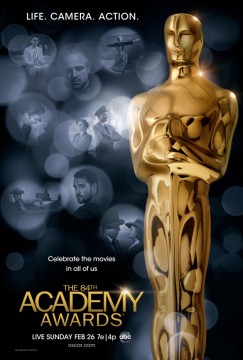
The Academy of Motion Picture Arts and Sciences has released the poster for the 84th Academy Awards, and it’s… nice? I mean, Oscar looks sexy as ever, and all those foggy images of awards-night glories past recall both the champagne-fueled afterparties and the preponderance of white folks who take this hardware home every year. But isn’t something missing? Like, the host? After all that hullabaloo about Brett Ratner and Eddie Murphy that the Academy worked to deflect, and after all the lengths that the Board of Governors went to just to replace Murphy with an ultrasafe, ultrastable emcee, and after years of advertising hosts from Chris Rock to Jon Stewart to Alec Baldwin and Steve Martin to Anne Hathaway and Anne Franco, where is Billy Crystal? If I’m a casual viewer, I’m far likelier to take positive notice of the host than of the centrally positioned reminder that Driving Miss Daisy actually won Best Picture once upon a sad, sad time. Also: Can’t we get some more color in here? Sidney Poitier? Denzel Washington? Mo’Nique? If it has to be Best Picture alums, maybe Poitier and Rod Steiger from In the Heat of the Night ? Even Anthony Mackie and Jeremy Renner from The Hurt Locker . I’m not sure what this says about the young demographic that the aging Academy claims to covet; I doubt they’re watching Giant and/or The Sound of Music . Or maybe they are! Are you “young” and obsessive-compulsively watching Gone With the Wind on a DVD loop in honor of white, uptight, vaunted Academy legacies? Tell us in the comments! [via Awards Daily ]

Read the original:
Where’s Billy Crystal on the New Oscars Poster?

Where’s Billy Crystal on the New Oscars Poster?

The Academy of Motion Picture Arts and Sciences has released the poster for the 84th Academy Awards, and it’s… nice? I mean, Oscar looks sexy as ever, and all those foggy images of awards-night glories past recall both the champagne-fueled afterparties and the preponderance of white folks who take this hardware home every year. But isn’t something missing? Like, the host? After all that hullabaloo about Brett Ratner and Eddie Murphy that the Academy worked to deflect, and after all the lengths that the Board of Governors went to just to replace Murphy with an ultrasafe, ultrastable emcee, and after years of advertising hosts from Chris Rock to Jon Stewart to Alec Baldwin and Steve Martin to Anne Hathaway and Anne Franco, where is Billy Crystal? If I’m a casual viewer, I’m far likelier to take positive notice of the host than of the centrally positioned reminder that Driving Miss Daisy actually won Best Picture once upon a sad, sad time. Also: Can’t we get some more color in here? Sidney Poitier? Denzel Washington? Mo’Nique? If it has to be Best Picture alums, maybe Poitier and Rod Steiger from In the Heat of the Night ? Even Anthony Mackie and Jeremy Renner from The Hurt Locker . I’m not sure what this says about the young demographic that the aging Academy claims to covet; I doubt they’re watching Giant and/or The Sound of Music . Or maybe they are! Are you “young” and obsessive-compulsively watching Gone With the Wind on a DVD loop in honor of white, uptight, vaunted Academy legacies? Tell us in the comments! [via Awards Daily ]

Originally posted here:
Where’s Billy Crystal on the New Oscars Poster?

Help Caption This Photo of Channing Tatum, Alex Pettyfer and Matthew McConaughey Stripping in ‘Magic Mike’

One of the most anticipated titles among circles who enjoy male strippers and movies is the upcoming Steven Soderbergh drama Magic Mike — a movie about male strippers that allegedly lured the filmmaker away from early retirement . At long last, a first image from the project has surfaced featuring Alex Pettyfer, Matthew McConaughey and Channing Tatum striking a pose onstage for what promises to be a very patriotic (and erotic) dance number. You know what this means, fellow Movieliners — grab the nearest captioning pen and stack of singles. Where to even begin? McConaughey appears in classic McConaughey fashion ( shirtless ). Tatum appears in classic G.I. Joe franchise-star fashion (in camouflage). For further captioning reference, the official premise of Magic Mike is as follows: “Veteran male stripper Magic Mike (Tatum) teaches a new male stripper (Pettyfer) about the occupation. They work at the club Xquisite, which is owned by the former male stripper Dallas (McConaughey).” The project is inspired by Tatum’s experiences as a teenage stripper in Florida. Joe Manganiello (also pictured above) co-stars as Big Dick Richie. Magic Mike is scheduled for a June 29, 2012, release. Let the captioning begin! Follow Julie Miller on Twitter . Follow Movieline on Twitter .

Visit link:
Help Caption This Photo of Channing Tatum, Alex Pettyfer and Matthew McConaughey Stripping in ‘Magic Mike’

Help Caption This Photo of Channing Tatum, Alex Pettyfer and Matthew McConaughey Stripping in ‘Magic Mike’

One of the most anticipated titles among circles who enjoy male strippers and movies is the upcoming Steven Soderbergh drama Magic Mike — a movie about male strippers that allegedly lured the filmmaker away from early retirement . At long last, a first image from the project has surfaced featuring Alex Pettyfer, Matthew McConaughey and Channing Tatum striking a pose onstage for what promises to be a very patriotic (and erotic) dance number. You know what this means, fellow Movieliners — grab the nearest captioning pen and stack of singles. Where to even begin? McConaughey appears in classic McConaughey fashion ( shirtless ). Tatum appears in classic G.I. Joe franchise-star fashion (in camouflage). For further captioning reference, the official premise of Magic Mike is as follows: “Veteran male stripper Magic Mike (Tatum) teaches a new male stripper (Pettyfer) about the occupation. They work at the club Xquisite, which is owned by the former male stripper Dallas (McConaughey).” The project is inspired by Tatum’s experiences as a teenage stripper in Florida. Joe Manganiello (also pictured above) co-stars as Big Dick Richie. Magic Mike is scheduled for a June 29, 2012, release. Let the captioning begin! Follow Julie Miller on Twitter . Follow Movieline on Twitter .

Continued here:
Help Caption This Photo of Channing Tatum, Alex Pettyfer and Matthew McConaughey Stripping in ‘Magic Mike’

Pariah Writer/Director Dee Rees on Coming Out, Awards Season, and Pitching ‘Dallas Meets The Wire’

Writer/director Dee Rees has spent six years with Pariah , a film she wrote as a full-length script in 2005, then recalibrated as a short subject in ’07, and finally re-adapted as a feature film that premiered at this year’s Sundance Film Festival. Pariah concerns a teenager named Alike (Independent Spirit Award nominee Adepero Oduye), an expressive girl who only encounters more identity issues as she tries establishing herself as an out lesbian. Though Rees came out as a lesbian in her 20s, she feels a deep connection to Alike — especially in her resistance to “butch” and “femme” labels. Movieline caught up with Rees to discuss Pariah ‘s wonderful story, the visibility of the LGBT coming out experience in 2011, and Rees’s unexpected connection to Dallas . Since Pariah ’s genesis as a short film years ago, there’s been a lot more visibility about the coming-out experience. Did you find it necessary to tailor the movie to the burgeoning sense of awareness about the topic? When I first wrote the script in ’05, I had a sense of who Alike was and where she was going, so there was no pressure to change it because I wanted to stay true to her and what her experience was. I didn’t want to make Alike’s experience vary from anyone else’s experience or make it topical. I just let it be what it was and just trustd that if we’re honest about the character and honest about the world, that it would be relevant no matter when it came out. It’s funny because some people along the way have said, “Is this an issue anymore? Is being gay cool now?” And it’s like, no. It’s not OK now, and it’s not “cool.” Although people’s experiences of coming out are changing and it’s becoming much more visible, that’s not necessarily everyone’s experience. It was about remaining true to the character and what this story was. I’m glad to see that coming out is relevant and people are aware of it, but I definitely didn’t feel compelled to make it fit anything. You’ve said that you came out in your 20s, but you wrote about the coming-out experience of a teenage girl. How did you find the inspiration for her character? It was just my own coming-out experience sort of transposed onto a 17-year-old. I chose to make her 17 because it’s such a higher-stakes age; figuring stuff out that young, it’s going to be higher because you’re still dependent on your parents and so much is still uncertain about you. You don’t know what you’re going to be. For her to make that discovery at that age, it makes her more interesting. For me, it’s also inspired by being in New York and being among out teenagers, which is something I’d never seen in Nashville, Tennessee. I barely saw out adults. To see out teenagers who were not only out, but out in the streets was inspiring for me. It made me wonder, “Even if I had known at 17, would I have that courage to be the person in the film?” – this woman who was trying to live in two worlds. Do you have particular favorite teenager characters from movies? No, not really! I just like Alike because she’s imperfect. Initially she isn’t courageous. In teen movies, we see characters who get to say exactly what’s on their mind and say what they want and thumb their nose in the face of adult authority. For Alike, I wanted someone who didn’t feel quite comfortable – someone who’s not so self-possessed, not so self-assured, and is figuring things out. Pariah ’s lead actress Adepero Oduye just earned an Independent Spirit Award nomination. Can you describe watching her on set? What did she bring to the character? Watching her on set was an experience of watching her inner life. Adepero is so expressive and yet so subtle. It was great to watch changes going on in her eyes and going on in her body language and behavior – those unspoken things. I felt like I was watching her internalize the characters’ feelings. She was really in that moment. She was really feeling what Alike was feeling. The feeling like she wanted to cry, feeling like she wanted to laugh – the changes were literally visceral. They were changing her, moving through her body. Getting to watch somebody unfold on camera is like watching a flower open. Amazing. In recent years, we’ve seen more in the media about gay men’s coming out experiences than lesbians’. Do you think Pariah highlights the specificity of a woman’s coming-out? I think Pariah highlights that there’s this gray area within the gay or lesbian community. Sometimes there’s a pressure to check a box, to either be hard and be butch or be feminine and wear heels. Alike’s neither of those things, so there’s a gray area. And her coming-out experience is different because she’s coming into a different space. Alike’s not figuring out if she’s gay – she knows she loves women, that’s not her question. It’s more “How [do I] be in the world?” The first half hour isn’t “Am I gay?” It’s, “Laura’s telling me I should be butch. Mom’s telling me I should be femme.” Versus other coming out experiences, like… when she’s wearing the club clothes, that’s not really her. When she changes into this different thing for Mom, she’s not that either. We don’t see her changing from her true self into another self – she’s neither of things she’s taking on or off. We don’t know who she is. She doesn’t really want to be this butch lesbian. She just wants to be Alike. You’ve been talking about this project everywhere for years and years. You’re the Carmen Sandiego of the indie film circuit. Which was the best kids’ game show ever! Indeed! What have you gained from spending so much time introducing the film to festival audiences? Specifically from being on tour with the film, I’ve gained a huge connection with audiences – an affirmation that we told the story truthfully. To your point, we weren’t writing it based on what people were saying or what was going on in the world. We stayed in a cocoon and wrote this thing. When we finished, we didn’t know how people would respond. But people felt we told a story and were honest with the experience, so we gained a feeling of affirmation. And personally, having gone from a point where when I was coming out and I was not quite sure the world that the world would accept me for who I have, or not quite sure that I could be loved or find love, and going to this press tour and seeing audiences embrace the film and saying, “We love you,” Pariah basically gave me the courage to be who I am. I came out behind the shield of this film. This tour has been this amazing wash of affirmation and love. It makes me feel good about audiences. They’re smart and progressive and open. They’re willing to see stories beyond themselves, images that don’t exactly look like them. It restored my faith in cinemagoers. They are hungering for good stories and are willing to step outside their experience to get them. Lastly, what do you have coming up? I imagine your new projects differ from Pariah because this movie is so emotional. One project coming up is called Large Print , a spec script I did, which is about a 50-something insurance adjuster who is recently divorced and lately incontinent, and has to redefine happiness for herself. Though she’s 56, it’s still a coming-of-age story. It’s going to be an emotional film because she’s played life by the rules and nothing’s turned out the way she’s expected. The other film I’m writing is called Bolo , a thriller set in the south. It’s also about, “What is home?” What if where you grew up changes? How do you accept that? Though it has more of a genre element, it goes back to these human things. I’m working on a TV series with HBO and Viola Davis about corruption in education, which will be cool. I’m working on another TV series called Reveal set in Nashville. It’s Dallas meets The Wire , about a city going through an identity crisis. I continue to be drawn to characters, and characters that are flawed especially. I love exploring flawed people trying to make their way. Did you just say “ Dallas meets The Wire ?” Yeah! Do you know how exciting that is? Ha! We’ll see! Dallas was the soap growing up. All my aunts gathered around the TV. We should not have been the target audience for Dallas . Pariah debuts in limited U.S. release December 28. Follow Louis Virtel on Twitter . Follow Movieline on Twitter .

Read more from the original source:
Pariah Writer/Director Dee Rees on Coming Out, Awards Season, and Pitching ‘Dallas Meets The Wire’

Pariah Writer/Director Dee Rees on Coming Out, Awards Season, and Pitching ‘Dallas Meets The Wire’

Writer/director Dee Rees has spent six years with Pariah , a film she wrote as a full-length script in 2005, then recalibrated as a short subject in ’07, and finally re-adapted as a feature film that premiered at this year’s Sundance Film Festival. Pariah concerns a teenager named Alike (Independent Spirit Award nominee Adepero Oduye), an expressive girl who only encounters more identity issues as she tries establishing herself as an out lesbian. Though Rees came out as a lesbian in her 20s, she feels a deep connection to Alike — especially in her resistance to “butch” and “femme” labels. Movieline caught up with Rees to discuss Pariah ‘s wonderful story, the visibility of the LGBT coming out experience in 2011, and Rees’s unexpected connection to Dallas . Since Pariah ’s genesis as a short film years ago, there’s been a lot more visibility about the coming-out experience. Did you find it necessary to tailor the movie to the burgeoning sense of awareness about the topic? When I first wrote the script in ’05, I had a sense of who Alike was and where she was going, so there was no pressure to change it because I wanted to stay true to her and what her experience was. I didn’t want to make Alike’s experience vary from anyone else’s experience or make it topical. I just let it be what it was and just trustd that if we’re honest about the character and honest about the world, that it would be relevant no matter when it came out. It’s funny because some people along the way have said, “Is this an issue anymore? Is being gay cool now?” And it’s like, no. It’s not OK now, and it’s not “cool.” Although people’s experiences of coming out are changing and it’s becoming much more visible, that’s not necessarily everyone’s experience. It was about remaining true to the character and what this story was. I’m glad to see that coming out is relevant and people are aware of it, but I definitely didn’t feel compelled to make it fit anything. You’ve said that you came out in your 20s, but you wrote about the coming-out experience of a teenage girl. How did you find the inspiration for her character? It was just my own coming-out experience sort of transposed onto a 17-year-old. I chose to make her 17 because it’s such a higher-stakes age; figuring stuff out that young, it’s going to be higher because you’re still dependent on your parents and so much is still uncertain about you. You don’t know what you’re going to be. For her to make that discovery at that age, it makes her more interesting. For me, it’s also inspired by being in New York and being among out teenagers, which is something I’d never seen in Nashville, Tennessee. I barely saw out adults. To see out teenagers who were not only out, but out in the streets was inspiring for me. It made me wonder, “Even if I had known at 17, would I have that courage to be the person in the film?” – this woman who was trying to live in two worlds. Do you have particular favorite teenager characters from movies? No, not really! I just like Alike because she’s imperfect. Initially she isn’t courageous. In teen movies, we see characters who get to say exactly what’s on their mind and say what they want and thumb their nose in the face of adult authority. For Alike, I wanted someone who didn’t feel quite comfortable – someone who’s not so self-possessed, not so self-assured, and is figuring things out. Pariah ’s lead actress Adepero Oduye just earned an Independent Spirit Award nomination. Can you describe watching her on set? What did she bring to the character? Watching her on set was an experience of watching her inner life. Adepero is so expressive and yet so subtle. It was great to watch changes going on in her eyes and going on in her body language and behavior – those unspoken things. I felt like I was watching her internalize the characters’ feelings. She was really in that moment. She was really feeling what Alike was feeling. The feeling like she wanted to cry, feeling like she wanted to laugh – the changes were literally visceral. They were changing her, moving through her body. Getting to watch somebody unfold on camera is like watching a flower open. Amazing. In recent years, we’ve seen more in the media about gay men’s coming out experiences than lesbians’. Do you think Pariah highlights the specificity of a woman’s coming-out? I think Pariah highlights that there’s this gray area within the gay or lesbian community. Sometimes there’s a pressure to check a box, to either be hard and be butch or be feminine and wear heels. Alike’s neither of those things, so there’s a gray area. And her coming-out experience is different because she’s coming into a different space. Alike’s not figuring out if she’s gay – she knows she loves women, that’s not her question. It’s more “How [do I] be in the world?” The first half hour isn’t “Am I gay?” It’s, “Laura’s telling me I should be butch. Mom’s telling me I should be femme.” Versus other coming out experiences, like… when she’s wearing the club clothes, that’s not really her. When she changes into this different thing for Mom, she’s not that either. We don’t see her changing from her true self into another self – she’s neither of things she’s taking on or off. We don’t know who she is. She doesn’t really want to be this butch lesbian. She just wants to be Alike. You’ve been talking about this project everywhere for years and years. You’re the Carmen Sandiego of the indie film circuit. Which was the best kids’ game show ever! Indeed! What have you gained from spending so much time introducing the film to festival audiences? Specifically from being on tour with the film, I’ve gained a huge connection with audiences – an affirmation that we told the story truthfully. To your point, we weren’t writing it based on what people were saying or what was going on in the world. We stayed in a cocoon and wrote this thing. When we finished, we didn’t know how people would respond. But people felt we told a story and were honest with the experience, so we gained a feeling of affirmation. And personally, having gone from a point where when I was coming out and I was not quite sure the world that the world would accept me for who I have, or not quite sure that I could be loved or find love, and going to this press tour and seeing audiences embrace the film and saying, “We love you,” Pariah basically gave me the courage to be who I am. I came out behind the shield of this film. This tour has been this amazing wash of affirmation and love. It makes me feel good about audiences. They’re smart and progressive and open. They’re willing to see stories beyond themselves, images that don’t exactly look like them. It restored my faith in cinemagoers. They are hungering for good stories and are willing to step outside their experience to get them. Lastly, what do you have coming up? I imagine your new projects differ from Pariah because this movie is so emotional. One project coming up is called Large Print , a spec script I did, which is about a 50-something insurance adjuster who is recently divorced and lately incontinent, and has to redefine happiness for herself. Though she’s 56, it’s still a coming-of-age story. It’s going to be an emotional film because she’s played life by the rules and nothing’s turned out the way she’s expected. The other film I’m writing is called Bolo , a thriller set in the south. It’s also about, “What is home?” What if where you grew up changes? How do you accept that? Though it has more of a genre element, it goes back to these human things. I’m working on a TV series with HBO and Viola Davis about corruption in education, which will be cool. I’m working on another TV series called Reveal set in Nashville. It’s Dallas meets The Wire , about a city going through an identity crisis. I continue to be drawn to characters, and characters that are flawed especially. I love exploring flawed people trying to make their way. Did you just say “ Dallas meets The Wire ?” Yeah! Do you know how exciting that is? Ha! We’ll see! Dallas was the soap growing up. All my aunts gathered around the TV. We should not have been the target audience for Dallas . Pariah debuts in limited U.S. release December 28. Follow Louis Virtel on Twitter . Follow Movieline on Twitter .

More here:
Pariah Writer/Director Dee Rees on Coming Out, Awards Season, and Pitching ‘Dallas Meets The Wire’