Tag Archives: america

Bride diaper available in 50 states, gay marriage… not

Something borrowed, something… poo? Okay, I’m no political activist. My fight for gay rights is really only evident by way of still buying Britney’s albums rather than downloading them – although I did work for the Human Rights Campaign for one day. (As it turned out, standing in 90 degree weather introducing myself with “Do you have a moment for gay rights?” wasn’t for me. Still, I did earn them $84.) But I am gay. Proudly. I am in love. Passionately. And I do want to get married, and I think about it quite often. So when I discovered the “bride diaper” by way of a local radio station’s debate during my lunch hour, I nearly called the HRC to see if I could have my one-day gig back. No, members of the LGBT community can’t get married in every state. But now, ladies and gents, bridal shops across America are unveiling the bride diaper — you know, just in case. READ MORE at http://blogs.creativeloafing.com/dailyloaf/2010/06/25/bride-diaper-available-in-… added by: Ryan_Jent

Pete Quaife, Bassist for The Kinks, Has Died

Kinks bassist Pete Quaife dead at 66 Pete Quaife, the original bassist of the Kinks, has died, according to bandmate Ray Davies. Quaife was 66. Quaife died of kidney failure Wednesday in Herlev, Denmark. He moved to Denmark in 2005 after many years in Canada. He had recently gotten engaged to his partner, Elisabeth. “I am overwhelmed with emotion- I literally can't speak- we might never have done any of this without him,” said Kinks guitarist Dave Davies in a statement on his website, davedavies.com. “The Kinks were never really the Kinks without you.” Peter Alexander Greenlaw Quaife – as he was listed on the back cover of the band's 1968 masterpiece, “The Kinks Are the Village Green Preservation Society” – was the bassist during the band's British Invasion height, playing on such hits as “You Really Got Me,” “All Day and All of the Night,” “Tired of Waiting for You,” “A Well-Respected Man” and “Sunny Afternoon.” In John Mendelssohn's 1985 biography of the band, “The Kinks Kronikles,” producer Shel Talmy called him the most musical of the four-man group. The Kinks – made up of guitarist/vocalist Ray Davies (the band's primary songwriter), Ray's brother Dave and drummer Mick Avory along with Quaife – originally formed in 1961, with Quaife a co-founder. With its hard-driving power chords and distortion, 1964's “You Really Got Me,” the band's third single, has been called a forerunner of heavy metal. But the complicated relationship between the Davies brothers was also a forerunner of that of other angry rock 'n' roll siblings, such as Oasis' Gallagher brothers, and Quaife briefly left the band in 1966 after being injured in an accident – a period he described as “a good break for me” given the discord. He returned a few months later. The Kinks had a fallow commercial period in America from about 1966 until 1969 – ironically a period of some of the band's most notable albums, including 1966's “Face to Face,” 1967's “Something Else by the Kinks” and “Village Green Preservation Society.” Quaife left after the release of that album and the single “Days” to join a band called Maple Oak. He was replaced by John Dalton for the next Kinks album, 1969's “Arthur.” The Kinks were inducted into the Rock and Roll Hall of Fame in 1990, and Quaife played with them at the showcase concert. Quaife is survived by a daughter, Camilla, from a previous marriage. http://img177.imageshack.us/i/thekinksje3.jpg/ added by: EthicalVegan

CNN’s Acosta and Costello Parrot Obama Talking Points on Offshore Drilling Moratorium

CNN’s Carol Costello and Jim Acosta revealed their disdain for a federal judge’s decision to overturn the Obama administration’s 6-month moratorium on offshore drilling when the expert they interviewed on the June 25 “American Morning” made a convincing case against the moratorium. Tom Bower, an author who has written extensively on the oil industry, tried to explain the devastating economic impact the moratorium would inflict on an already beleaguered industry, but Costello and Acosta were blinded by ideology: “But isn’t safety more important than money?” queried Costello. “Because, I mean, these oil companies make massive amounts of money each day.” Bower, author of “Oil, Money, Politics and Power in the 21st Century,” drew the ire of Costello and Acosta for calling the Gulf oil spill an “aberration” and noting the oil industry’s “phenomenal” overall safety record.      “But that’s what they say, it is just an aberration, but the BP disaster happened,” argued Costello. “Nobody thought that could happen either. So, it’s just not logical, is it, that argument?” “What do you mean they’re doing a very good job on the whole down there?” demanded Acosta. “I don’t know what that means. In what sense? You know, I mean, this entire body of water is at risk right now. It has been poisoned. And I’m just curious, what do you mean by doing a good job?” Taking aim at Republicans and moderate Democrats like Sen. Mary Landrieu (La.) who continue to support offshore drilling, Acosta asked Bower: “I’m just curious, you know, is there a little bit of a having your cake and eat it too, when it comes to some of these Gulf Coast politicians saying we want the jobs and the protection from any environmental impact at the same time?” Loaded questions designed to advance the White House’s narrative reflect Acosta’s underlying liberal tendencies. Costello also parroted the Obama administration’s narrative: Well, let’s talk about this moratorium because, and I’m just going to play devil’s advocate here. Let’s say — I mean, what’s wrong with these oil companies to stop drilling in the deepwater, these 33 wells, for four more months? Because that’s all we’re talking about when you take the moratorium in its entirety. What’s wrong with that? Bower’s response, unlike Costello’s sputtering rant, was succinct and nonpartisan: Well, the cost. We see each oil platform, each rig costs at least half a million dollars a day, and often more, and they just can’t afford that sort of equipment lying idle and the contractors will find other places around the world who want the rigs, and they’ll just take them there, so there’s just no choice. After dismissing the expert, Acosta, turning to Costello to offer his informed opinion, lamented that “it just doesn’t feel right, you know, to say that as a whole, the industry’s just doing a great job down there.” The transcript of the segment can be found below: CNN American Morning 6/25/10 6:41 a.m. CAROL COSTELLO, co-host: The Obama administration loses another effort to put a moratorium on drilling in the Gulf. But does lifting that ban serve our nation’s best interests? You know, Bonnie is talking about this storm coming in. JIM ACOSTA, co-host: Yeah.                      COSTELLO: Wouldn’t it be a good idea if they continue to stop drilling on those 33 rigs — you know that are affected by this? ACOSTA: It’s another potential complication for this whole thing. COSTELLO: Yes. We’re going to get really into that with author Tom Bower, who has written a lot on BP and the oil industry. It’s 41 minutes past the hour. ACOSTA: Welcome back to the “Most News in the Morning.” You know, a showdown looms this morning over offshore drilling. A federal judge denied the administration’s request to postpone an order that would end a six-month moratorium. COSTELLO: That means if anyone wants to start up the deep water drills, they certainly can, but the White House says it will introduce a new ban in a few days. We wanted to know what a moratorium really means for safety though. Is it really necessary? Joining us from London this morning: Tom Bower, who is the author of “Oil, Money, Politics and Power in the 21st Century.” Good morning, sir. TOM BOWER, author of “Oil, Money, Politics and Power in the 21st Century”: Good morning. COSTELLO: Well, let’s talk about this moratorium because, and I’m just going to play devil’s advocate here. Let’s say — I mean, what’s wrong with these oil companies to stop drilling in the deepwater, these 33 wells, for four more months? Because that’s all we’re talking about when you take the moratorium in its entirety. What’s wrong with that? BOWER: Well, the cost. We see each oil platform, each rig costs at least half a million dollars a day, and often more, and they just can’t afford that sort of equipment lying idle and the contractors will find other places around the world who want the rigs, and they’ll just take them there, so there’s just no choice. COSTELLO: But isn’t safety more important than money? Because, I mean, these oil companies make massive amounts of money each day. BOWER: Well of course, safety is critical. As we’ve now seen, the catastrophe follows if these are not safe. But on the whole, all the oil corporations are working safely. This is just an aberration. COSTELLO: But that’s what they say, it is just an aberration, but the BP disaster happened. Nobody thought that could happen either. So, it’s just not logical, is it, that argument? BOWER: We don’t stop driving on the road because of a car crash. People carry on driving and people walk up staircases and fall down them, but we still walk up stairs. So in the end — ACOSTA: Totally different when you’re talking about an entire body of water as important as the Gulf of Mexico. I mean, the question that I have is we’ve heard the governor of Louisiana, and I’m sure you watch him closely as well, Bobby Jindal, you know, talk about why this moratorium should be lifted for the sake of jobs and so forth. But at the same time, the governor is saying we need to built berms, we need to do all these other things to protect our coastline, and I’m just curious, you know, is there a little bit of a having your cake and eat it, too, when it comes to some of these Gulf Coast politicians saying we want the jobs and the protection from any environmental impact at the same time? BOWER: Look, I’m not an apologist for the oil industry, but I must tell you that on the whole, their record is very good. And America needs the oil, it needs the gas, and the product in the Gulf has been superb, and they’re doing very good job down there on the whole. So, you know, just like we don’t stop fly when a plane crashes, you just got to improve the regulation — ACOSTA: What do you mean they’re doing a very good job on the whole down there? I don’t know what that means. In what sense? You know, I mean, this entire body of water is at risk right now. It has been poisoned. And I’m just curious, what do you mean by doing a good job? Because the other day, there were CEOs from the entire oil industry testifying on Capitol Hill saying that if they were to also engage in deepwater oil drilling, they essentially have the same plan of action in place if there is a major catastrophe, which is, well, we just have to, you know, see if we can plug the hole. BOWER: Look, again, I can only say I’m not an apologist for the industry, but they are extracting amazing amounts of oil from the most difficult conditions. You got to ask why they’re in the Gulf and not getting it from Mexico, Venezuela or Russia. That’s one of the great issues. ACOSTA: Are you saying that we basically put ourselves in this position? I mean, is that your point? BOWER: I think the countries have gotten the oil to put America in that position. But on the whole, they have done a very good job in the Gulf and the executives who testified on the Hill like (INAUDIBLE) have not had these sort of catastrophes that BP is just having. So, I got to repeat on the whole, they’ve done an amazing job to find oil and gas there, and they are bringing it out safely. The point is that the administration discovered that the regulators, the MMS have done a very poor job so the government has got some of the blame here. They’ve let the oil corporations get away with murder for too long. They’ve now learned a lesson. They’ll clearly have much better regulations down in the Gulf and elsewhere as well, because, believe me, they’re going to have to start digging for oil and drilling for oil off other coastlines around the U.S. again in the near future because America needs the oil. COSTELLO: Funny you mentioned that because BP is doing that, you know, off the shores of Alaska and it’s doing this maneuver where they’re drilling it’s three miles offshore, they drilling down very deeply, and then they’re going to make a horizontal line, something that’s never been done before. So, BP, itself, is being allowed to go ahead with this process when we know that BP doesn’t have it together when it comes to extreme disasters and how to fix things. BOWER: You’re absolutely right. The horizontal drilling is really quite well established now. There’s nothing new on that. That is a very effective way of getting huge amounts of oil out which previously would have got lost. But I think BP has learned a lesson. I don’t think they’re going to make that sort of error again. They’re going to be more careful than ever. They can’t afford another catastrophe nor can any other oil corporation. I mean, you just got to set the seed that of course oil is a very risky business as I show in the book. What they’ve done down in the Gulf is quite phenomenal. This is a catastrophe which never should have happened. Everyone is learning lessons. They’re going to do their best to prevent it from happening again, but the government has got as much responsibility now as the oil corporations to make sure that the regulations are there and enforced. COSTELLO: Tom Bower, many thanks to you this morning. We appreciate it. BOWER: Pleasure. ACOSTA: I’m not sure I agree that they’re doing a bang-up job down there, but that’s just my take on it. COSTELLO: You mean BP or the oil industry as a whole? Because I think he was separating them out. ACOSTA: I think he was trying to separate it, but it just doesn’t feel right, you know, to say that as a whole, the industry’s just doing a great job down there. COSTELLO: It’s sort of like you have to trust them that catastrophes similar to what’s happening with BP doesn’t happen again. And the oil companies are saying, “well, we have a great safety record.” But BP said that, too. ACOSTA: Yes. We can’t go on like this. We’ll move on. –Alex Fitzsimmons is a News Analysis intern at the Media Research Center. Click here to follow you on Twitter.

Read more:
CNN’s Acosta and Costello Parrot Obama Talking Points on Offshore Drilling Moratorium


WaPo’s Stevens-Arroyo Calls for Catholics to ‘Embrace a Redistribution of Wealth’

The Washington Post’s really should consider renaming Anthony Stevens-Arroyo’s column in its “On Faith” blog. “Catholic America” should be “Liberal Democrat Catholic America,” just for the sake of truth in advertising. On June 23, left-wing hack Stevens-Arroyo again injected his politics into the ostensibly religious column. In “ Common good v corp. profits ,” he actually wrote that Catholics should “embrace a redistribution of wealth.” The column sought to explain how Catholics and others should view Judge Martin Feldman’s ruling overturning the Obama moratorium on off-shore drilling. Why, the reader may ask, should this event have Catholic significance, beyond the fact that a liberal writer whose column has “Catholic” in the title was upset about it? It doesn’t. But Stevens-Arroyo gamely offered that, “There may not be a ‘Catholic’ position about the immediate politics of off-shore drilling, but there is an on-going Catholic approach to resolving the competing interests.” Not surprisingly, that approach vindicates the left. To Stevens-Arroyo, the issue came down to “common good,” which led him to make this puzzling statement: “While we have considerable freedom about our personal political choices in the application of principles, Catholics in America are bound to embrace a redistribution of wealth, even if it goes contrary to ranting from groups like the Tea Party or Wall Street.” He never explained where exactly it states Catholics are bound to encourage the government to confiscate legally earned private property to give it to whomever it deems more worthy. Catholics are bound to assist others through charity, not compulsory redistribution. This isn’t the first time Stevens-Arroyo has conflated socialism with faith. Last year he declared that “ the most Catholic ” part of Ted Kennedy’s funeral was the senator’s grandchildren pleading for nationalized health care. But, not content being an arbiter of what is Catholic and what isn’t, Stevens-Arroyo set himself up as a law scholar, hypothesizing that the “Reagan-appointed judge” Feldman’s ruling could be seen as the work of an “activist court.” He ranted that, “a judge is supposed to be limited to matters of constitutionality — and not to impose his jobs’ policy. There can be no doubt that a presidential moratorium falls within the powers of the White House, so stopping this legitimate executive order on questions about its consequences constitutes activism.” Even the Associated Press explained that the moratorium was overturned because the “Interior Department failed to provide adequate reasoning for the moratorium.” Stevens-Arroyo has a history of being unable to hide his liberal viewpoints. Just last March he claimed that Fox New’s Glenn Beck was using “the same strategy of the Hitler Youth and the Polish Communist Party … ” In December he also attempted to compare Ft. Hood shooter Hidal Hassan to World War 1 hero Alvin York and General Patton.

See the original post:
WaPo’s Stevens-Arroyo Calls for Catholics to ‘Embrace a Redistribution of Wealth’

FNC’s O’Reilly Cites NewsBusters Video of Media Praising Obama’s ‘Brilliance’

At the top of Thursday’s O’Reilly Factor on FNC, host Bill O’Reilly cited a NewsBusters video montage of various media figures touting President Obama’s “brilliant” handling of the General McChrystal controversy: “[Obama] has a very powerful ally, the American media. After the President fired General McChrystal yesterday, NewsBusters.org put together this montage of press reaction.” O’Reilly played the video as part of his Talking Points Memo opening the show. After it finished, he joked: “So I guess the firing of McChrystal was a brilliant move.” He then noted how “…we could have played that montage with another 30 seconds with different reporters echoing the same theme.” Minutes later, O’Reilly asked radio host Laura Ingraham about the media all singing from the same hymnal: “When you hear the mainstream media, brilliant, it was brilliant, it was brilliant, it was brilliant.” Ingraham interjected: “It was hilarious.” O’Reilly replied: “Isn’t it? I mean, how far down in the tank does the American people – the American media have to go, before the people just say enough.” Ingraham concluded: “Well, it shows you Bill, how totally out of touch all these media figures – and that montage, I was screaming in the studio here, it was so funny to hear – but it’s so out of touch with the way regular people think.” Ingraham continued: “Most people are saying, okay, what they’re doing on the economy isn’t working. What they’re doing in Afghanistan, we’re losing confidence. We love our troops, we want them to win. But we’re not getting why this is working. And they’re losing confidence across the board in the way this administration is operating. And meanwhile, putting in Petraeus, who obviously is a hero, is ‘Oh, well, that’s brilliant. That’s decisive.’ Later, O’Reilly spoke with liberal Columbia University Professor Marc Lamont Hill about the same topic and declared: “He [Obama] had to do it. But it wasn’t brilliant. It was like he had to do it. And these clowns are going ‘it was a brilliant move.’ What do you think?” Even Hill admitted: “Brilliant was pushing it.” O’Reilly grilled Hill on the left-wing media slant: “…you watch these guys in the mainstream media supposed, you know, objective reporters. You know it’s a farce.” Hill again admitted: “I’ll agree the response last night was clearly a left-leaning analysis.” O’Reilly later observed: “But traditionally, the media in this country are cynical and they’re distrustful of people in power, and they’re looking to get you, and then you go on and ‘he so brilliant.'” On Wednesday night, radio host Mark Levin also cited the NewsBusters item on his show and similarly mocked the media reaction. Here is a full transcript of O’Reilly’s June 24 Talking Points Memo: 8:00AM TEASE BILL O’REILLY: The O’Reilly Factor is on. Tonight: CHIP REID: It sounds like a pretty brilliant decision. WOLF BLITZER: A very brilliant move. CHUCK TODD: It’s going to be seen as a brilliant choice by the President. O’REILLY: The mainstream media senses President Obama may be going down so they are propping him up. We will have opinions on that from Laura Ingraham and Marc Lamont Hill. 8:01AM SEGMENT O’REILLY: Hi, I’m Bill O’Reilly. Thanks for watching us tonight. President Obama on the descent. That is the subject of this evening’s Talking Points Memo. As we reported last night, this week is the low point for the Obama administration. And today, a new Wall Street Journal poll confirms what we said yesterday. For the first time in that poll, more Americans think President Obama is doing a bad job than a good job. 48% Disprove, 45% say he’s doing okay. But the really bad news for the President is that 62% of Americans now feel the country’s heading in the wrong direction. That is the highest number since before the presidential election of 2008. Talking Points believes it is the chaos factor that is damaging the Obama administration, once again. The economy, shaky. The oil spill, chaos. The Afghan war, not going well. And the border situation is so bad the state of Arizona is now defying the federal government. Add it all up and you are in the chaos zone. No president can survive there. Jimmy Carter, Lyndon Johnson, Richard Nixon were all done in by the perception they could not control the country. That is where the President is right now. But he has a very powerful ally, the American media. After the President fired General McChrystal yesterday, NewsBusters.org put together this montage of press reaction: CHIP REID: Sounds like a pretty brilliant decision, really. JIM MIKLASZEWSKI: This is nothing less than a stunning development, Brian. And quite frankly, at a quick glance, almost brilliant. CHUCK TODD: Politically, in this town, it’s going to be seen as a brilliant choice by the President. WOLF BLITZER: A very brilliant move to tap General Petraeus. DAVID GREGORY: I think he took swift and decisive action. I think that’s how it’s going to be read. O’REILLY: So I guess the firing of McChrystal was a brilliant move. By the way, we could have played that montage with another 30 seconds with different reporters echoing the same theme. Like life, politics is not fair. President Obama didn’t cause the oil spill, he did not encourage General McChrystal to make indiscreet comments, he inherited a very bad economy, but has not been able to turn it around. For a guy like the President, who is ultra confident, this must be a frustrating time. His policies simply aren’t working. And if the war in Afghanistan and the economy get any worse, he will go the way of Jimmy Carter. Fair-minded Americans bear no malice towards Mr. Obama. Just as President Bush was treated unfairly at times, so has the President been. But the truth is, America is now in the chaos zone. And November is coming up fast. And that’s the memo.

Read the original here:
FNC’s O’Reilly Cites NewsBusters Video of Media Praising Obama’s ‘Brilliance’

‘Restrepo’: The War That Won’t End, By Kurt Loder

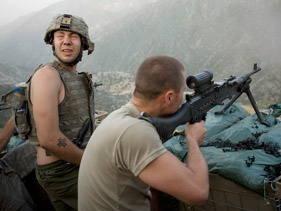
New combat doc raises question: Why are we in Afghanistan? Soldiers in Afghanistan in “Restrepo” Photo: National Geographic Channel Can there be an upside to war? Possibly. In “Restrepo,” a new documentary by veteran combat journalists Tim Hetherington and Sebastian Junger, we find ourselves on patrol with a company of U.S. soldiers in the Korengal Valley, one of the bloodiest corners of the ongoing Afghan conflict. It’s the spring of 2007, and the men have just weathered a heavy firefight. One of them emerges from it jacked-up and exultant. “That was fun!” he says. “You can’t get a better high. Once you get shot at … you can’t top that.” The film vividly captures the dust and blood and the sheer drudgery of war. The unit has been assigned to build a new forward outpost right up against the edge of Taliban territory. Build it from scratch with picks and shovels, while in the surrounding mountains, enemy fire is constant. The Taliban warriors come so close they can be heard talking to one another. But the American soldiers work straight through the night, and make a good start. They never complain. They christen the new base Restrepo Outpost, after a departed comrade, Juan “Doc” Restrepo, who recently took two bullets in the neck and bled out on the med-evac helicopter. They talk about Restrepo a lot, and we see footage of him goofing around on the flight that brought the men over here from a base in Italy. Like them, he was very young. Still sleepless, they set out on patrol. They pass through battered villages, stopping occasionally to interrogate suspicious-looking locals. (“You got pretty clean hands for a goat-herder.”) They meet with village elders and promise to “flood” the area with money and medical supplies if the villagers will only help fight the resurgent enemy. But the people caught in the middle of this conflict have defeat written on their faces. One man tells the company’s captain, through an interpreter, “If we let you know about Taliban, then we will get killed.” Alternatively, of course, this man could be Taliban. As was the case in the Vietnam War 40-odd years ago, in which the U.S. fought another indigenous enemy that didn’t wear uniforms, it’s virtually impossible to know. The company moves on. Intermittently, the crack of gunfire starts up, and the camera jostles wildly in keeping up with the GIs as they hit the ground and crawl through the dirt. One of them has been hit, shot dead. One of his friends briefly breaks down in tears. Another soldier tries to comfort him: “It was quick,” he says. The unit comes to another village. This one has been chewed up by missile fire from the Army attack helicopters whirling overhead. Five civilians have been killed, more wounded. Inside one house we see women, children, even a baby wet with blood. This is the face of collateral damage. Somewhere there’s a grand plan for this war, a political scenario devised by a regiment of office warriors back in Washington. But the soldiers here don’t talk about it. All they know is that there’s an enemy their country is fighting, and their job is to kill him. They’re tough and brave, and they’re good at it. They casually discuss the fact that they may well die here, but that’s not what concerns them most. What concerns them most is the possibility that one of their fellow soldiers may die — one of their pals, the only family they have in this hostile place. The movie follows this company through 2008, when the men completed their 15-month deployment and were being flown back to Italy. What we don’t see is the aftermath. This past April, having alienated the local populace, the Army withdrew the last of its troops from the Korengal Valley. Earlier this month, the Afghan conflict, which began directly after 9/11, became the longest war in U.S. history. More than a thousand U.S. soldiers have died in it. Last December, President Obama announced his intention to send 30,000 more troops to Afghanistan, bringing the total number of U.S. forces in-country to 100,000. But at the same time, he also announced that he’ll begin pulling them out again next year. The president has since wobbled on that commitment. Still, it’s hard to imagine the Taliban not feeling that victory in this long war is now mainly a waiting game. The directors, Hetherington and Junger, acknowledge that they are men of the political left. Apart from the editing decisions they’ve made, though, their documentary recalls, in a smaller way, the disturbing images that emerged out of Vietnam, and ultimately turned America against that war. “Restrepo” is the answer to a question that will surely continue being asked. Don’t miss Kurt Loder’s reviews of “Knight and Day” and “Dogtooth,” also new in theaters this week. Check out everything we’ve got on “Restrepo.” For breaking news, celebrity columns, humor and more — updated around the clock — visit MTVMoviesBlog.com .

View post:
‘Restrepo’: The War That Won’t End, By Kurt Loder

America’s Got Talent Season 5 Episode 8 – Portland Auditions, Part 2

Watch America’s Got Talent S5E8: Portland Auditions, Part 2 The new installment of America’s Got Talent is the TV show’s 8th episode of the 5th season that aired last 06/23/2010, Wednesday at 8:00 pm on NBC. Watch America’s Got Talent 5×8 (0508) Free Online Streaming Full Episodes Replay of the Latest Season and Video Clip Download Link:

Read more:
America’s Got Talent Season 5 Episode 8 – Portland Auditions, Part 2

Greetings from Florida, Land of Driving Dogs and Bong Smoking Babies [We Hate Your State]

In our attempt to defame each of America’s fifty states (we’ve already insulted New Jersey and Michigan ), we turn today to Florida, where incredibly dumb things frequently happen. Like dogs running over humans and babies getting caught smoking weed. More

CNN’s Carol Costello Hypes Up Greenpeace, Sierra Club, and Liberal Environmental Agenda

On the June 24 “American Morning,” CNN’s Carol Costello trumpeted a “revitalized” environmental movement that is hoping the Gulf oil spill will “change the way we feel about oil” and is aggressively lobbying Congress to pass radical climate change legislation. Previewing the “Gut Check” segment, Costello gleefully teased, “Coming up next, environmentalists are revitalized and it’s over the Gulf oil spill. Could this disaster be what we need in this country to change the way we feel about oil?” In lockstep with the Left’s environmental agenda, the fill-in anchor pondered whether the Gulf oil spill would crystallize support for a climate bill or would “it be back to business as usual?” Costello articulated the same phrase environmental groups frequently employ to manufacture a false sense of urgency around their liberal initiatives. Interviewing David Rauschkolb, founder of Hands Across the Sand, a liberal group opposed to offshore drilling, Costello praised the forerunner to Rauschkolb’s new group – Earth Day – for “strengthening the Clean Air Act and helping President Nixon create the Environmental Protection Agency.” Costello did not reach out to conservative critics who argue that draconian environmental regulations stymie economic growth and breed unemployment. Costello also claimed that the Sierra Club, a juggernaut in the environmental movement, capitalized on conservative criticism to generate public support for liberal causes. “When Rush Limbaugh blamed environmentalists for forcing onshore drilling offshore, the Sierra Club used Limbaugh’s comments to raise $120,000 and 110,000 signatures for climate legislation,” contended Costello, who failed to address the substance of the conservative talk show host’s argument. Further hyping the fringe environmental movement and its toxic agenda, Costello noted Clean Energy Works’s robust lobbying campaign for “clean energy legislation” and GreenPeace’s contest to design a new BP logo, without labeling either of these liberal organizations appropriately. Back in the studio, co-host John Roberts sensibly stated that America “can’t stop drilling because we’re not going to stop driving cars.” Channeling her inner liberal, Costello would not let her colleague’s simple logic deprive her of her wide-eyed optimism: “That’s true but will it drive something like climate change legislation? We just don’t know yet. That’s what environmentalists are hoping.” A full transcript of the segment can be found below: CNN American Morning 6/24/10 8:37 a.m. CAROL COSTELLO, co-host: Coming up next, environmentalists are revitalized and it’s over the Gulf oil spill. Could this disaster be what we need in this country to change the way we feel about oil? We’ll try to answer that question in a “Gut Check” coming up next. It’s 37 minutes past the hour. JOHN ROBERTS, co-host: 41 minutes after the hour. A growing number of environmentalists are hoping that the oil crisis in the Gulf will change how Americans treat the environment. We’ve seen that kind of quick reaction after disasters in the past. COSTELLO: I know, you know, Earth Day was born out of an oil disaster. So we wondered: will people really care? Will it change the way we feel about oil or will it be back to business as usual? A “Gut Check” for you this morning.              It’s called Hands Across the Sand. Back in February it drew 10,000 Floridians in protest of offshore drilling. This weekend, Hands says it goes international: 599 American cities will take part, as will 20 countries. DAVID RAUSCHKOLB, Hands Across the Sand: I believe this is a huge opportunity for us and it’s time we take control of our energy future. COSTELLO: David Rauschkolb hopes Hands will be the catalyst Earth Day was back in 1970. It was born after an oil spill in California and is credited for strengthening the Clean Air Act and helping President Nixon create the Environmental Protection Agency. The Clean Energy Works Campaign has hopes too – its launched an ad campaign pushing for clean energy legislation. GreenPeace is actively using the spill as a catalyst too, its members so intent to do something a contest to design a new BP logo has attracted half a million visitors to its Web site. The Sierra Club site is hot too. When Rush Limbaugh blamed environmentalists for forcing onshore drilling offshore… RUSH LIMBAUGH, conservative radio host: When do we ask the Sierra Club to pick up the tab for this leak? COSTELLO:…the Sierra Club used Limbaugh’s comments to raise $120,000 and 110,000 signatures for climate legislation. MICHAEL BRUNE, Sierra Club: This is our chance to actually move beyond oil and the outstanding question – the question that remains – is whether or not President Obama will seize this opportunity and get us off oil once and for all. COSTELLO: While all the passion sounds good for who critics would call “tree huggers,” is it real? Psychologist Jeff Gardere says while oiled birds, dirtied beaches, and black tides will raise awareness, it may not last. After all, there are government regulators already in place who are supposed to prevent disasters like this and didn’t. So why bother? Environmentalists get that but say this disaster will cut through the cynicism.                  BRUNE: We’ve set the ocean on fire, we’ve put thousands of fishermen and women out of work. The coastal tourism economy is collapsing and all of this is happening in slow motion. COSTELLO: It may be happening in slow motion, but Americans have a complicated relationship with oil, and nowhere is that better demonstrated than in Louisiana – they’re angry at BP but they sure don’t want the oil industry to go away. ROBERTS: You’re right, there’s so many people down there – one side of the family is in the fishing industry or the  tourism industry and the other side of the family is in the oil industry. They know that they have to co-exist. I mean, anything that raises awareness of the environment is a good thing, but you know, you’ve got to have – you can’t stop drilling because we’re not going to stop driving cars. COSTELLO: That’s true but will it drive something like climate change legislation? We just don’t know yet. That’s what environmentalists are hoping. –Alex Fitzsimmons is a News Analysis intern at the Media Research Center. Click here to follow him on Twitter.

Excerpt from:
CNN’s Carol Costello Hypes Up Greenpeace, Sierra Club, and Liberal Environmental Agenda

iPhone Mayhem: Robbery, Heat Exhaustion, Shattered Faith [The Way We Live Now]

In cities across America, throngs of fanboys are lined up for the new iPhone. There are too many customers, and too few of Apple’s shiny new product. The chaos is rising with the summer temperature, and so is the anger. More