Tag Archives: Associated Press

AP Howler of the Day: Kasich ‘Keeping Pace’ With Strickland in OH Guv Race

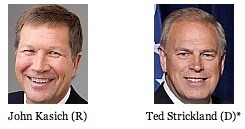
Talk about an in-kind contribution. In a short item about a Democratic Governors Association election complaint about Ohio GOP gubernatorial candidate John Kasich, the Associated Press’s Julie Carr Smyth showed that she is willfully ignoring Buckeye State reality, or has been living a hermit’s existence for the past few months. In describing Kasich’s standing against Democratic incumbent governor Ted Strickland, Smyth claimed that Kasich “is keeping pace with Strickland in polls and fundraising” (a picture of the relevant paragraph is here ). As you can see , that’s sort of like a baseball writer claiming that “The Cincinnati Reds are keeping pace with the Chicago Cubs this year”: For those who aren’t following baseball closely, the Reds have a 21-1/2 game lead on the Cubs with less than 30 games remaining. Who do you think you’re foolin’, babe? (Answer: Relatively disengaged voters who need to given the impression that the sinking Strickland campaign is really on track to victory, instead of heading towards the first defeat of an incumbent governor in the Buckeye State in 36 years.) Democrats are upset that Kasich appeared on Fox News and was able to give out the name of his web site and encourage viewers to donate to his campaign during Bill O’Reilly’s show on August 18. Awwww. The election complaint is carried at a Huffington Post item courtesy of Sam Stein , a former NewsWeak (spelled that way on purpose) reporter . Two years ago, Stein claimed that Republican presidential nominee John McCain couldn’t possibly have vetted VP pick Sarah Palin because no one had visited her town’s local newspaper and looked through its archives. Well Sam, that just might be because the paper’s archives going back a decade were available online , and contained hundreds of entries. This Internet thing is pretty cool when you have a clue about how to use it. Ben Smith at Politico, who is not being linked because of his outfit’s outrageous attempt to shut down the College Politico, seems to think that this complaint has as much validity as Stein’s unproven claim against Team McCain two years ago: It seems to hinge on a chyron and, to my eye, is more in the great tradition of thin, high-profile election-year litigation than about winning in court. Speaking of “in-kind contributions,” maybe Julie Carr Smyth can estimate how much value favoring Strickland we should place on her demonstrably false claim in a national news story that Kasich is only “keeping” pace with him, when the fact is that Kasich has an averaged-out double-digit lead? Cross-posted at Bizzyblog.com .

Go here to see the original:
AP Howler of the Day: Kasich ‘Keeping Pace’ With Strickland in OH Guv Race

July New Home Sales: Wire Reports Dour, But Still Understated; Reuters-Quoted Economist Blames Govt.

July’s bad news in new home sales is even worse than it first appears. The seasonally adjusted annual rate of 276,000 units is bad enough. That is an all-time low since records have been kept and 12% lower than June’s annual rate. It’s also lower than what analysts predicted by about the same percentage. The lazy business press is running with those figures. But, as has been the case so many other times, it takes a trip to the raw (i.e., not seasonally adjusted) data, this time at the Census Bureau ( large PDF ), to fully comprehend the extent of the new-home market’s collapse during this big, fat failed “Recovery Summer.” The raw data shows that 25,000 new homes were sold in the U.S. in July. That’s not a typo, and it really is the figure for the entire country. Worse, that figure, the lowest July since records have been kept, is down by over one-third from July of last year, when the economy supposedly bottomed out, and by 42% from July 2008. I don’t think you’ll see those facts reported today. Here is a graphic cap of a 10:07 a.m. report at Reuters carried at CNBC.com . It contains a jaw-dropper of a quote from an economist (red box is obviously mine): You have to wonder how widely reported Mr. Porcelli’s in-your-face to the government will be, or if it will even survive future Reuters revisions. As would be expected, no similar quote is present at the Associated Press, which used its time-honored business-reporting strategy of downplaying the awful news inside of two larger stories, one about the stock market’s reaction and the other about the not as bad news about durable goods orders, instead of giving it the separate treatment it deserves. Here are a few paragraphs from the two reports. To their credit, the authors of the first cited the lowest-on-record nature of the past three months’ results, but without indicating the degree of the cratering: (Daniel Wagner and Alan Zibel, “Recovery in danger as firms, homebuyers cut back,” as of 12:09 p.m. ) The economic recovery appears to be stalling as companies cut back last month on their investments in equipment and machines and Americans bought new homes at the weakest pace in decades. … Separately, Commerce said new home sales fell 12.4 percent in July from a month earlier to a seasonally adjusted annual sales pace of 276,600. That was the slowest pace on records dating back to 1963. Collectively, the past three months have been the worst on record for new home sales. … The two reports are likely to stoke fears that the economy is on the verge of slipping back into a recession. They follow Tuesday’s report that showed sales of previously owned homes fell last month to the lowest level in decades. Unemployment remains near double digits and job growth in the private sector is slowing. … Housing has never fully recovered from the recession. Builders have been forced to compete with foreclosed properties offered at significantly lower prices. (Stephen Bernard, “More bad news on home sales sends stocks lower,” as of 12:04 p.m. ) The Dow Jones industrial average fell about 16 points in midday trading Wednesday following news that sales of new homes fell last month to the lowest level on record. It was the latest indication that home sales are stagnating after the expiration of a homebuyer tax credit this spring. … New home sales fell 12.4 percent in July to an annual rate of 276,600, the Commerce Department reported. That was the slowest pace on records dating back to 1963 and worse than the pace forecast by economists polled by Thomson Reuters. A day earlier, the National Association of Realtors said sales of existing homes, a far greater proportion of the housing market, fell to a 15-year low in July. … Despite the ultra-low borrowing rates, home sales have been weak since a home buyer tax credit expired at the end of April. High unemployment has kept people from buying homes, and banks still reeling from the crisis in the mortgage-backed securities market have been cautious in making new loans. Note how the last excerpted sentence dodges Porcelli’s contention at Reuters that “There is also little demand for lending.” Banks are being cautious, but there’s plenty of mortgage money out there for people who want to borrow (listen to the constant barrage of lender radio ads if you don’t believe it). There’s just little interest in doing so. Cross-posted at BizzyBlog.com .

See the original post here:
July New Home Sales: Wire Reports Dour, But Still Understated; Reuters-Quoted Economist Blames Govt.

O, M, G — Price Tag for One New LA K-12 Complex: $578 Mil

Call it “No Contractor Left Behind.” The Robert F. Kennedy Community Schools in Los Angeles, apparently opening soon, will serve roughly 4,200 students in grades K-12. Its cost is coming in at $578 million, or almost $140,000 per student ($2.75 million per 20-student classroom). This is the LA Unified District’s most flagrant example of its Taj Mahal obsession, and it is far from the only one. Also, as the Associated Press’s Christina Hoag reported early Sunday evening , LA is not the only place where the Taj Mahal complex is in vogue: The K-12 complex to house 4,200 students has raised eyebrows across the country as the creme de la creme of “Taj Mahal” schools, $100 million-plus campuses boasting both architectural panache and deluxe amenities. “There’s no more of the old, windowless cinderblock schools of the ’70s where kids felt, ‘Oh, back to jail,'” said Joe Agron, editor-in-chief of American School & University, a school construction journal. “Districts want a showpiece for the community, a really impressive environment for learning.” Not everyone is similarly enthusiastic. “New buildings are nice, but when they’re run by the same people who’ve given us a 50 percent dropout rate, they’re a big waste of taxpayer money,” said Ben Austin, executive director of Parent Revolution who sits on the California Board of Education. “Parents aren’t fooled.” At RFK, the features include fine art murals and a marble memorial depicting the complex’s namesake, a manicured public park, a state-of-the-art swimming pool and preservation of pieces of the original hotel (where Robert F. Kennedy was assassinated). Partly by circumstance and partly by design, the Los Angeles Unified School District has emerged as the mogul of Taj Mahals. The RFK complex follows on the heels of two other LA schools among the nation’s costliest – the $377 million Edward R. Roybal Learning Center, which opened in 2008, and the $232 million Visual and Performing Arts High School that debuted in 2009. The pricey schools have come during a sensitive period for the nation’s second-largest school system: Nearly 3,000 teachers have been laid off over the past two years, the academic year and programs have been slashed. The district also faces a $640 million shortfall and some schools persistently rank among the nation’s lowest performing. Los Angeles is not alone, however, in building big. Some of the most expensive schools are found in low-performing districts – New York City has a $235 million campus; New Brunswick, N.J., opened a $185 million high school in January. Memo to Mr. Agron: We’d be more impressed with these ultra-costly “impressive environment(s) for learning” if there was tangible evidence that an impressive amount of learning was actually taking place. Somehow, it seems that we hear about these price tags in the media only after the schools are almost finished. It would be interesting to know what the cost of maintaining these Taj Mahals will be. My, uh, educated guess is “really excessive.” Let’s make that Ms. Hoag’s homework. Unfortunately, these costs will become a permanent burden on already beleaguered taxpayers. Let’s also find out if part of the Taj Mahal motivation around the country is the desire, with the help of apparently limitless tax dollars (readers here know better; school officials apparently don’t), to put even more pressure on private schools by making them appear relatively unattractive, even though on balance more real learning takes place inside of them. Please — Can we dispense with the claptrap about the “under-resourced” and “starving” public sector once and for all? Cross-posted at BizzyBlog.com .

Read the original post:
O, M, G — Price Tag for One New LA K-12 Complex: $578 Mil

Report: Shirley Sherrod to Meet with Vilsack on Tuesday; Will the Press Raise Worker Exploitation Charges?

The Theater of the Sherrod(s) is apparently not over. At AL.com last night, Mike Tomberlin of the Birmingham News reported the following : Former USDA employee Shirley Sherrod says she will meet Tuesday with agriculture secretary Shirley Sherrod, the former USDA rural development director for Georgia, said today she plans to meet Tuesday with U.S. Secretary of Agriculture Tom Vilsack to discuss a new job offer. … Sherrod today spoke in the Sumter County town of Epes at an event hosted by the Southern Cooperatives/Land Assistance Fund. Ben Jealous, executive director of the NAACP, shared the stage with Sherrod during a panel discussion. Sherrod said she had no ill feelings toward the NAACP or President Barack Obama. It the meeting does indeed occur, it will be an interesting test of establishment media credibility, given the accusations leveled at Ms. Sherrod and her husband Charles by Ron Wilkins at the leftist publication Counterpunch several weeks ago . Here are some of the specifics: The Other Side of Shirley Sherrod … The swirling controversy over the racist dismissal of Shirley Sherrod from her USDA post has obscured her profoundly oppositional behavior toward black agricultural workers in the 1970s. What most of Mrs. Sherrod’s supporters are not aware of is the elitist and anti-black-labor role that she and fellow managers of New Communities Inc. (NCI) played. These individuals under-paid, mistreated and fired black laborers–many of them less than 16 years of age–in the same fields of southwest Georgia where their ancestors suffered under chattel slavery. … Mrs. Sherrod says she began to see poverty as more central than race. So, should indigent black child farm laborers warrant less reflection by Mrs. Sherrod? What lessons does she have to share from her tenure as management when she had power over her own people working under deplorable conditions at the same New Communities, Inc.(NCI) identified in the current issue? Shirley Sherrod could have included this chapter of her history in the same confession speech. Justice and integrity require at least as much accountability from Mrs. Sherrod to the poor black farm workers of NCI as to the white farmers she came to befriend. This lack of full disclosure of the whole truth is a “sin of omission” that trivializes the suffering of poor black farm workers and exacerbates the offenses of NCI. Shirley Sherrod was New Communities Inc. store manager during the 1970s. As such, Mrs. Sherrod was a key member of the NCI administrative team, which exploited and abused the workforce in the field. The 6,000 acre New Communities Inc. in Lee County promoted itself during the latter part of the 1960s and throughout the 70s as a land trust committed to improving the lives of the rural black poor. Underneath this facade, the young and old worked long hours with few breaks, the pay averaged sixty-seven cents an hour, fieldwork behind equipment spraying pesticides was commonplace and workers expressing dissatisfaction were fired without recourse. … Worker protest at New Communities eventually garnered some assistance from the United Farm Workers Union in nearby Florida in the person of one of its most formidable organizers, black State Director, the late Mack Lyons. The September 28, 1974 UFW newspaper El Malcriado, page two, reported on the worker’s strike (“Children Farm Workers Strike Black Co-op”) and the UFW stepped in to protect black farm workers from exploitation by NCI. Fearful of both UFW efforts to unionize NCI’s labor force and scrutiny by the Georgia State Wage and Hour Division, the Sherrods and NCI management hastily issued checks in varying amounts to strikers to makeup ostensibly for minimum wage differentials. It is bitter irony that the Sherrods have succeeded in being awarded $300,000 following a discrimination lawsuit, while Mrs. Hawkins and other impoverished NCI black laborers whom NCI exploited were never adequately compensated for their “pain and suffering”. In addition to the “pain and suffering” payments Wilkins noted, NCI “won a thirteen million dollar settlement in the minority farmers law suit Pigford vs Vilsack.” This occurred in late July of last year, just a few days before Sherrod was hired by Vilsack to be the USDA’s Georgia Director for Rural Development. A graphic of the full article to which Mr. Wilkins referred is here . The two most damning paragraphs are these, which directly relate to Charles Sherrod: Your eyes are not deceiving you. The UFW accused the Sherrods of using scab labor. Wilkins wrapped up his Counterpunch column with a challenge: Ask Shirley Sherrod about this part of her history. I know this story well, for I was one of those workers at NCI. Will the establishment press follow up? Based on the non-coverage of Wilkins’s accusations during past three weeks, the prognosis is: “Very doubtful.” A Google News search on “Ron Wilkins” (in quotes) returns all of 10 items , eight of which relate to the Cal State professor’s accusations. Three of those eight cover two items authored by yours truly, including this August 8 NewsBusters post . Of the remaining five, three are posts at center-right blogs ( NCPPR , American Thinker , Patriot Post ). There is also an excerpt at the Daily Caller , plus an item at Digital Journal . A search on “Ron Wilkins” (not in quotes) at the New York Times returns nothing relevant . It’s virtually inconceivable that such damaging baggage would be ignored if a conservative, Republican, or important businessperson had been similarly accused of worker exploitation. The Associated Press has picked the Birmingham News item, which is on the wire service’s raw national feed. There are now no valid excuses for ignoring what Wilkins has alleged. Cross-posted at BizzyBlog.com .

Read more:
Report: Shirley Sherrod to Meet with Vilsack on Tuesday; Will the Press Raise Worker Exploitation Charges?

Michelle Obama’s Portrait Displayed At The Smithsonian

Michelle Obama’s portrait was displayed at the Smithsonian on Friday:   She’s only been on the national stage for roughly two years, but the folks at the National Portrait Gallery figured it was time for her picture to be part of the newly-opened “Americans Now” exhibit. Not surprisingly, the folks at the Associated Press couldn’t hold back their enthusiasm: Move over Martha Washington. Martha Stewart and Michelle Obama are getting space in the National Portrait Gallery in Washington for the first time. A new exhibit, “Americans Now,” opened Friday, featuring famous names from science, business, government and the arts…It’s the first time Michelle Obama’s individual portrait has been shown at the gallery. Frankly, I’m surprised it took this long. 

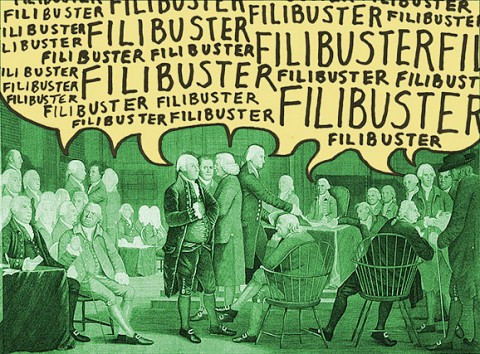
AP Praises Democrat Push To Abolish Filibuster

If you’re a Democratic Senator floundering in the polls and about to lose a reliably blue seat, what’s the best way to boost your image? Call up the Associated Press and spout clichés about reforming politics. It worked pretty well for one Michael Bennet, freshman Senator from Colorado. On Thursday, AP writer Jim Abrams interviewed him about a host of suggestions to change the rules in the Senate, allowing him to call the system “out of whack” and “broken.” Abrams then spoke with Senators Claire McCaskill and Tom Udall, from Missouri and New Mexico respectively – both states conveniently being places where the Democratic party is losing its edge. Abrams mentioned their reform proposals with very little background and failed to challenge their selective outrage. Get ready for 16 paragraphs of Democrat campaign talk dressed up as a news report : Those who hold the Senate in low esteem can get a sympathetic ear from some of the chamber’s newer members. These lawmakers also are fed up with the Senate’s ways and would like to change them. “A graveyard of good ideas” is how freshman Democrat Tom Udall of New Mexico sees the Senate. “Out of whack with the way the rest of the world is,” says another freshman, Michael Bennet, D-Colo. “Just defies common sense” is the impression of Claire McCaskill, a first-term Democrat from Missouri, in describing the filibuster-plagued institution. You see, everyday Americans are not fed up with Christmas Eve voting antics, efforts to stall the swearing-in of newcomers, or voting on bills that no one reads. Those ways won’t change. Just the part about Republicans blocking liberal agendas. What actual changes are being proposed? Abrams helpfully lists them: Bennet, the Denver school superintendent appointed to his post after former Sen. Ken Salazar became interior secretary, has put forth an elaborate plan to make the Senate more workable. It includes eliminating the practice known as a “hold” in which a single senator can secretly prevent action on legislation or nominees; ending the ability to filibuster motions to bring a bill up for debate; banning earmarks for private, for-profit companies; imposing a lifetime ban on members becoming lobbyists; and restricting congressional pay raises. “It was immediately apparent to me that the system was broken,” said Bennet, who won a hotly contested primary and faces a tough election this fall. Ah, no one knows more about the broken system than a public school administrator given a Senate seat. Party bosses were not thrilled with Bennet in 2009, claiming that his lack of experience and unpopularity with voters would inevitably give the seat to Republicans in 2010. The party went all-out to protect him from a primary challenger, securing Obama’s endorsement and spending millions on his campaign. It was mere days ago, on August 10, that Bennet won the primary, but since then he’s been trailing Republican Ken Buck. So he trots out familiar reform ideas on earmarks and lobbyists. Every time a political party is facing massive defeat, these things come up but are never imposed. The move to change filibuster requirements is a well-known mission among the far left – a cynical scheme to make slim majorities more powerful. As for anonymous holds, anyone who witnessed the public crucifixion of Rep. Bart Stupak (D – Mich.) immediately understands why Senators would want objections to remain private. Bennet’s reform plan would not allow holdout Senators to stall a vote discreetly. If anyone delayed a vote long enough to read the entire bill or consult with constitutional lawyers, the Senate would publicize their objection and wait for the media to Stupak them. The end result would be more hurried votes from Senators going along to get along. While some of Bennet’s suggestions are good, others will simply discourage dissent and weaken the minority. Yet the AP didn’t bother to examine any unintended consequences. Nothing negative was said about Bennet’s proposal. And in the case of Senator McCaskill’s ideas, Abrams used the vaguest wording possible: McCaskill also has worked with a Republican, Tom Coburn of Oklahoma, to bring more transparency to bills passed by “unanimous consent,” meaning they are approved without debate or roll call votes. Bringing more transparency! Who wouldn’t want that? But what exactly does McCaskill have in mind? This NBer had to search for an explanation elsewhere. Turns out that McCaskill doesn’t want to actually end the practice of passing bills without a vote – she even uses unanimous consent to forward things herself – but she joined Coburn on one superficial request . Coburn’s idea is that if his colleagues allow passage of a bill with no vote, they should at least sign a statement confirming they physically looked at it. That’s what McCaskill is trumpeting as brave new reforms. But without any actual details of the proposal, readers would have no idea how tedious it really was. If Abrams wanted to highlight reform efforts, it might have made sense to speak with Coburn and include his take on the “broken” system, perhaps even allowing him to explain the transparency thing. But Abrams didn’t quote anything positive from a single Republican. Up next was the reform plan from Senator Udall. Turns out Abrams saved the best for last: Udall has what might be the simplest but most radical proposal. He says that when the new session opens next January, he will offer a motion that the Senate adopt rules by a simple majority. That would make it vastly easier for the majority to modify filibuster rules with proposals. Doesn’t this sound great? Not only could the Senate pass controversial bills with 50 plus 1, they could change long-established rules, remove procedural hurdles, or rig the process to favor the majority’s whims. Each new session of the Senate could theoretically operate on a different playing field regarding everything from cabinet nominations to spending bills. The process to censure a senator or impeach a president could also be watered down. Toward the end, Abrams did at least acknowledge a certain amount of hypocrisy from Democrats who suddenly have no interest in protecting the minority: Udall calls his approach the constitutional option. Five years ago, Democrats called it by the more ominous name of the “nuclear option” when then-Majority Leader Bill Frist, R-Tenn., threatened to push through a simple majority rule for overcoming minority Democrats’ opposition to President George W. Bush’s judicial nominees. In the end, nothing happened. Udall’s idea has been put forward several times in the past, Senate historian Don Ritchie said. But “the Senate has always gotten up to the cliff and decided to step back.” “Some of the people advocating these changes might be very glad they didn’t succeed if they end up in the minority,” he said. That’s as close as Abrams got to discussing the negative possibilities. Four paragraphs from the end, he finally got around to quoting one Republican: “I submit that the effort to change the rules is not about democracy,” Republican leader Mitch McConnell of Kentucky said at a recent hearing on the history of the filibuster. “It is not about doing what a majority of the American people want. It is about power.” Supporters of the 60-vote supermajority say it helped prevent Democrats from attaching a government-run public option – an idea unpopular with many Americans – to the health care law. And growing national sentiment that Congress should quit adding to federal deficits was reflected when Democrats needing Republican votes to reach the 60-vote threshold were forced to cut future food stamp benefits and an energy program to pay for a $26 billion jobs bill this month. Just when it looks like Abrams was being fair, wait for the handy little nugget in the very last sentence: Both times, the changes grew out of considerable agitation for reform, in 1917 during World War I and in 1975 after years of civil rights advocates being stymied by filibusters, said Sarah Binder, a political science professor at George Washington University. That’s right, folks. The Senate successfully broke a filibuster to pass the Civil Rights Act in 1964, and that’s why they changed the rules 11 years later. But the internet is such a great thing. Turns out Time magazine has online archives from 1975, allowing NBers to see what contemporary accounts actually said. Turns out that liberal Democrats like Walter Mondale were trying to lower hurdles to pass – wait for it – national health insurance. In a news report that sounds eerily like 2010, Democrats back then were complaining that in “a period of economic crisis” the do-nothing Republicans were blocking them from creating more government programs. There was a side note that dealt with “civil rights,” but only because Democrats wanted voting ballots printed in multiple languages. So the last time these ideas were enthusiastically pushed in the Senate, liberal Democrats were angry because their pet agendas couldn’t pass through. Yet Abrams found a professor who white-washed it as heroic efforts to provide civil rights, and that’s the final sentence left ringing for readers in 2010. It’s nice to know that a prestigious news wire like the Associated Press is doing such hard-hitting investigations.
Read the original:
AP Praises Democrat Push To Abolish Filibuster

ZBB BS: WSJ Editorial Scoops Beat Journalists on Financial Condition of Obama-Visited Company

Here’s yet another example illustrating why one must treat the editorials at the Wall Street Journal as a primary source of hard news during Democratic presidential administrations. On Monday, President Obama visited ZBB Energy Corp, a maker of high-tech batteries in Menominee, Wisconsin. Helene Cooper at the New York Times , where a larger version of the picture at the right appeared, reported that “The company received a $1.3 million federal stimulus loan, which officials said would triple its manufacturing capacity and could lead to 80 new jobs.” Note the word “could.” At least the Times mentioned the existence of ZBB’s stimulus loan. In three brief reports mentioning the company during the past week, the Associated Press didn’t even do that. The WSJ’s intrepid editorialists did everyone else’s work for them and peeked behind the curtain at ZBB. It is not pretty: Uncle Sam, Venture Capitalist Meet the battery company that Obama visited yesterday. President Obama kicked off a five-state campaign swing yesterday with a stop at a “clean energy” plant in Menomonee Falls, Wisconsin. As it happens, Mr. Obama couldn’t have chosen a better company to demonstrate the risks that taxpayers are taking with their billions in green stimulus investment. … Mr. Obama praised it for “pointing the country toward a brighter economic future,” but we’ll let readers decide if they’d write the same checks if they were investing their own money. ZBB has been around for more than a decade, developing batteries and equipment to store energy from wind turbines and solar cells. … last January, when the Department of Energy announced $2.3 billion in “clean energy manufacturing tax credits,” ZBB was one of 183 recipients—collecting $14 million. We wonder who in government looked at ZBB’s filings with the Securities and Exchange Commission. Since going public in June of 2007, ZBB has been hemorrhaging money. The firm lost $4.9 million in fiscal 2008 and $5.5 million in fiscal 2009. In its most recent filing, in May, it said it had lost $6.9 million for the first nine months of its current fiscal year. It explained it had a “cumulative deficit” of $44.1 million and informed shareholders that it “anticipates incurring continuing losses.” It acknowledged that its ability to continue as a “going concern” was predicated on its ability to drum up additional funds. … Meanwhile, a review by the company’s audit committee last fall discovered that ZBB’s former CEO had been wrongly compensated as both an employee and an independent contractor, and that the company had failed to withhold his proper taxes. He stepped down, and the management team was reshuffled. ZBB was also forced to restate its financial results after a separate audit committee review found the company had recognized revenue from a contract in the wrong quarter. The company also acknowledged in its May filing that the 72,000 square foot manufacturing facility it bought in 2006 is “currently producing at less than 10% of its expected capacity.” That means it can’t currently access the $14 million in federal tax credits, which were supposed to help with equipment for a new facility. Meanwhile, private investors have soured on some energy-storage companies. ZBB’s initial public offering was priced at $6 a share in 2007, and it closed yesterday at 70 cents. A visit to the company’s quarterly income statements at NASDAQ.com reveals that sales during the four quarters that ended on March 31 were less than $2 million; the revenue line during the most recently reported quarter was a whopping $189,000. During that time, the company lost over $8 million. During the four years ended June 30, 2009 , ZBB burned through well over $20 million. You have to wonder how badly stimulus efforts such as these are going if a company in ZBB’s condition is considered worthy of a campaign stop. How bad are the situations at the ones that didn’t make the cut? The Journal gives a partial excuse to the White House press corps for not doing its work: “It has been dragged to so many of these energy events that it has lost interest in looking at the companies it visits.” Sorry, I’m not as forgiving. Allowing yourself to get scooped by a bunch of guys sitting in New York offices demonstrates how inexcusably lazy establishment press beat reporters following the president have become. That laziness would also appear to be influenced by the likelihood that if they really did their job, they’d have to report unpleasant things about their guy in the White House and the mostly accomplishment-free results of “clean energy” efforts thus far. You’ll know that they don’t even care about being scooped if, as I expect, the WSJ’s editorial is the first and last you’ll see of ZBB’s BS in the establishment press. Cross-posted at BizzyBlog.com .

More here:
ZBB BS: WSJ Editorial Scoops Beat Journalists on Financial Condition of Obama-Visited Company

AP Writers Package Months-Old Polling Data As Currently Relevant News

Memo to Alan Fram and Trevor Tompson of the Associated Press and two other writers who contributed to this report (“AP-GfK polls show Obama losing independents”): You should have taken the weekend off. When I saw a shorter, earlier version of the referenced AP report this morning, it didn’t mention when AP’s polling arm AP-GfK Roper had done their work. When I went to the polling home page and found that the most recent entries were from June 9-14, I figured I’d come back later and give the group time to post fresh underlying details. Little did I know that AP’s gaggle of writers were treating the June 9-14 “Poll Politics Topline” as fresh. It gets worse. It turns out that Fram, Tompson et al wasted about 875 words on a report based on polling data that gave equal weights to results from mid-June, mid-May, and mid-April. Considering the primary topic of discussion, independents’ take on the Obama presidency and performance of Congress, this AP report is laughably irrelevant — unless its primary purpose, especially given that earlier versions of the story didn’t identify when the polling took place, was to present data designed to make readers and listeners think that things are better than they really are right now for Democrats heading into the midterm elections. Here are selected paragraph from the bylined AP pair’s non-punctual piece : Independents who embraced President Barack Obama’s call for change in 2008 are ready for a shift again, and that’s worrisome news for Democrats. Only 32 percent of those citing no allegiance to either major party say they want Democrats to keep control of Congress in this November’s elections, according to combined results of recent Associated Press-GfK polls. That’s way down from the 52 percent of independents who backed Obama over Republican Sen. John McCain two years ago, and the 49 percent to 41 percent edge by which they preferred Democratic candidates for the House in that election, according to exit polls of voters. Independents voice especially strong concerns about the economy, with 9 in 10 calling it a top problem and no other issue coming close, the analysis of the AP-GfK polls shows. While Democrats and Republicans rank the economy the No. 1 problem in similar numbers, they are nearly as worried about their No. 2 issues, health care for Democrats and terrorism for Republicans. Ominously for Democrats, independents trust Republicans more on the economy by a modest but telling 42 percent to 36 percent. That’s bad news for the party that controls the White House and Congress at a time of near 10 percent unemployment and the slow economic recovery. … Both parties court independents for obvious reasons. Besides their sheer number – 4 in 10 describe themselves as independents in combined AP-GfK polling for April, May and June – they are a crucial swing group. To try winning them over, Republicans say they will contrast Obama’s campaign promises of change with the huge spending programs he’s approved. Democrats say they will warn independents that a GOP victory will revive that party’s efforts to cut taxes for the rich and transform Social Security into risky private investment accounts. … Independents trust Republicans far more than Democrats for handling national security, but give Democrats a 42 percent to 36 percent edge for dealing with health care – a potential sign that distrust over Obama’s signature issue is receding. Hope is not lost for Democrats. The AP-GfK polls show a narrow 44 percent to 41 percent overall preference for a Democratic Congress. The party is holding its 2008 edge among women and urban residents, and still splitting the vote of pivotal suburbanites and people earning $50,000 to $100,000. Let’s look at just a few relatively current data points from elsewhere relating to the Fram’s and Tompson’s topics: Trust on health care — The antiquated AP-GfK report cites a 49-39 average Democratic edge among all voters across April, May and June (at Page 26 of detailed report; not in AP’s story). A Rasmussen report based on late June polling data shows Republicans with a 51-40 edge. Even that was six weeks ago. Since then we have learned that Team Obama is arguing in court that ObamaCare’s health insurance purchase mandate is a tax after telling the country for months before the legislation’s passage that it wasn’t. There have also been instances where abortion coverage was found in high-risk pool plans in several states, which were only eliminated when the Department of Health and Human Services issued regulations doing so. This exercise proved, as if proof was really needed, that the pro-life Executive Order that supposedly won over the Stupak Stooges — er, the Stupak Six — was nothing but a charade. Trust on the economy — AP-GfK shows a 45-42 average Democratic advantage (again at Page 26 of detailed report). The same Rasmussen report noted previously is 48-39, advantage GOP . Given the wave of weak economic news in the past six weeks, it would notbe surprising to see that the Republican advantage here has increased since then. Preference in who controls Congress — AP-GfK cites a 44-41 Democratic edge. This question has been a virtual dead heat in a Wall Street Journal/NBC poll all year . The latest result based on August 5-9 polling showing a one-point Democratic lead. No AP poll would be complete without a bit of cooking. In this instance, the AP-GfK poll’s average Democratic ingredient outweighed the GOP’s by 44. Gallup’s most recent poll on the topic, admittedly a reversal from most of its results during the past several months, shows the GOP with a 2% edge in party affiliation, including “leaners.” It appears that AP-GfK polls on the topics presented every month. It would thus be reasonable to assume that it has data for July, and that in a few days it will have data for August. Thus, it’s odd that the wire service wouldn’t have simply waited a few days to give us fresher information. Or maybe someone has seen that info, and would prefer not to have to report it at all. Cross-posted at BizzyBlog.com .

See original here:
AP Writers Package Months-Old Polling Data As Currently Relevant News

AP Headline: ‘Flight attendant’s grand exit is a dream for some’

It would seem that what JetBlue flight attendant Steven Slater did earlier this week was the stuff that some small-minded people’s dreams are made of. Would all of you out there who think that way please remove yourselves from jobs that involve contact with the public? One has to wonder, based on her sympathetic paean to the “take this job and shove it — but first, I’ll get my revenge” crowd, if Associated Press Writer Samantha Gross should be among those who deserve involuntary removal from such positions. Ms. Gross’s grotesque near-admiration for others concocting their own supposedly grand exits is my nominee as Exhibit A exemplifying the media’s “strange fascination” with the Slater incident and its meaning noted at this morning’s open thread at NewsBusters. Here are some less than exemplary excerpts from Ms. Gross’s gruel , including a few paragraphs exemplifying people the AP writer apparently intended to portray as nearly noble (bolds highlighting leftist phraseology and boorish behavior are mine): Hasn’t everyone thought about doing it? … Defying the rules, telling people off and walking off a job isn’t usually a launching pad for public acclaim and admiration. But few have fulfilled that particular working man’s fantasy in such grand fashion as JetBlue flight attendant Steven Slater, who left his job via the plane’s emergency chute, beer in hand. It was enough to set America’s heart aflutter. Slater’s sudden exit has rekindled memories of workers’ liberation – and sparked wistful excitement among workers who have long fantasized of choosing pride over pay. … After being scolded for the last time by a boss she believed was treating her unfairly while sleeping with the other waitress on her shift, she (waitress Mary Phelps) seriously considered knocking over the giant pot of tomato sauce sitting on the Italian eatery’s stove. Instead, she walked to the front of the restaurant and took orders from six tables sitting down at the beginning of the dinner rush. Then, before bringing anyone so much as a drop of water, she left. “It felt fantastic. It was a great feeling,” she recalls. “It was absolutely no regrets, absolutely. …” (Phelps’s customers who received seriously delayed service were apparently unavailable for comment — Ed.) (Chris Carter of Knoxville, who says he has walked out of about half of the jobs he has held) says he still gets a thrill of victory every time he walks out the door. “When you’re not making more than $10 an hour, there’s certain things that are not worth putting up with,” he says. “I’ve never allowed myself to get to that point where I feel like I have to put up with this and I have to be somebody’s slave.” Gross reports that Carter is only 30 years old and has held “nearly 40 jobs,” meaning that he has walked out of nearly 20. You’ll have to excuse me for thinking that Carter’s dreams might be more about milking the unemployment compensation system — funded, mind you, by those who put up with their oft-annoying managers and the companies who employ them — than they are about finding a personally rewarding way to serve his fellow man. In this culture, it looks like  there’s another perfectly good reason why employers are reluctant to hire. Of course, there’s the oft-cited  regime uncertainty  of the Obama administration’s legal and regulatory policy and postures. But what about new hire uncertainty? In a culture where significant numbers seem to be treating Slater as a hero, many smaller employers are more likely to either get the work done with the existing help, do without, or contract the required work out to someone else (e.g., a temporary help firm) to avoid the unpleasantness and negative business consequences of someone who thinks he or she can be the next Steven Slater.  Interestingly, Gross cited no examples of federal government worker walk-offs. I wonder why? There’s certainly no shortage of alienation, rudeness, or inattentive behavior. But there is at least one important difference. Uncle Sam’s worker walkouts are probably less frequent because federal pay and benefits are on average twice as high as the private sector, according to this Tuesday USA Today report . Why would a person with an attitude problem want to make a grand exit from that, when they can get their perverse satisfaction beating up on customers all day and still keep their jobs? Cross-posted at BizzyBlog.com .

More:
AP Headline: ‘Flight attendant’s grand exit is a dream for some’

Time Wrings Hands Over Question, ‘Can a Child Be Tried for Jihadist Crimes?’

With his August 12 post, “Can a Child be Tried for Jihadist Crimes?” , Time magazine’s Tim McGirk hit the Obama administration from the left on the military tribunal prosecution of jihadist Omar Khadr. Khadr was captured on a battlefield in Afghanistan in 2002, when he was just 15 years old. He’s charged with the murder of a U.S. soldier, a crime he’s already confessed to, although he now claims his confession was coerced. Although 15-year-olds in the United States are frequently tried as adults for murder and although Khadr is in 23 years old now, McGirk presented the case as the potential first conviction of a “child” for war crimes since World War II. What’s more, McGirk presented the case as a potential travesty of justice in an ill-conceived war on terror, a term he dismissively used in quote marks: Khadr’s trial got underway just as another military tribunal sentenced Osama Bin Laden’s former chef and driver, Ibrahim a-Qosi, to 14 years in prison. The first prosecution of a Gitmo prisoner since Obama took office promising to close down an offshore prison that had become a symbol of the Bush Administration’s riding roughshod over the rule of law in the course of its “war on terror”. Have we no decency! Putting poor cooks, chauffeurs, and children in prison and throwing away the key! At no point did McGirk indict al Qaeda terrorists, particularly Khadr’s late father Ahmed Said —  “an imposing, grey-bearded patriarch” who was “a close friend” of bin Laden’s — as monsters for allowing teenagers to join in suicidal jihad against the world’s most advanced military, even as he closed with this familiar critique of U.S. anti-terrorism policy (emphasis mine): Jury selection for Khadr’s trial is supposed to end on Wednesday and the trial will begin immediately afterwards. It is expected to run until mid September. But r egardless of its finding, the trial is unlikely to reflect positively on the Obama Administration in the eyes of many of its allies in the fight against al-Qaeda. Photo of Omar Khadr via Time magazine .

Link:
Time Wrings Hands Over Question, ‘Can a Child Be Tried for Jihadist Crimes?’