Tag Archives: awards

Citizen Ruth: Looking Back at Alexander Payne’s Prescient Abortion Satire

What’s the Film : Citizen Ruth (1996), available on DVD and Hulu Why it’s an Inessential Essential : The premise — one woman’s attempt to have an abortion turns into a national debate and bidding war — was a bold choice out of the gate for writer-director Alexander Payne. Citizen Ruth is his first feature film, and like his subsequent work, it has a biting wit, absurdities from every corner, and deeply flawed characters. Ruth (Laura Dern) is a dim-witted screw-up who is pregnant for the fifth time; her four offspring have been placed elsewhere because of her addiction to inhalants. When she is charged with a felony for huffing “patio sealant,” the judge coerces her to terminate the pregnancy. In jail, she meets anti-abortion crusaders who start a tug-of-war with pro-choice rivals over the unborn child, who becomes widely known as Baby Tanya after a clinic doctor manipulates Ruth into imagining keeping it. Tackling this tricky subject matter, Payne found an unreal story to tell, except that part of it was real. In the DVD commentary, he and co-writer Jim Taylor reveal that the plot was inspired by the true story of a woman who was offered money by anti-abortion and pro-choice camps to honor their respective wishes for her fetus. The parallels to reality don’t stop there. In one of Dern’s best unhinged moments, Ruth screams at two overzealous medical staffers at a clinic, who then pull out all the stops and force her to watch a video of abortion footage. That seems far-fetched, though maybe not in places like Arizona, where a lawmaker recently proposed a bill that would require women to watch an abortion before having one. The state representative, Terri Proud, calls her idea “(The) Reproductive Games.” Truth is catchier than fiction. Why We Recommend It Now : Released in 1996, Citizen Ruth resonates today, of course, because the issue of affordable health care has evolved into a fight over reproductive rights. Although Baby Tanya, were she real/alive, would be old enough to have a Sweet 16 party this year, not much has changed in the public discourse. Payne skewers the radicals on both sides, who are largely motivated by impressing their leaders — Tippi Hedren, for example, as a mother/god figure to the lunatic pro-choice activists. Their behavior is over the top, but their ideologies still echo. Among the points the movie makes so nicely is that extremists tend to lose sight of the real people and issues involved. When Sandra Fluke testified about hormonal birth control, the point she made — that the drug treats medical conditions — was lost once Rush Limbaugh piped in and turned Fluke into an abstraction and a “prostitute.” Ruth is unfit to be a mother, yet a contingent of crazies think she should take a stab at parenthood, aided by 15 grand, because somehow it’ll just all work out. There’s something to be said for laughing so we don’t cry, and Citizen Ruth allows us to do that. The DVD has few extras, but it does feature a revealing commentary track from Payne, Taylor, Dern and production designer Jane Ann Stewart. Explaining that the film doesn’t take sides, Stewart says her team strived to make both camps look a little foolish. Payne gets to the heart of the matter, saying, “Jane, you asked me, ‘Is nothing sacred?’ And it’s true. Everything is sacred, and nothing is sacred. Everyone is open for being examined as a human being.” Other Interesting Trivia : Payne says the film’s limited release was probably the reason he didn’t receive one threatening letter over it, though he was concerned about potential violence at the time from groups like the Army of God. Dern recalls a conversation with the women who ran Planned Parenthood in Texas, who called her to say how much they loved being mocked in the film. Also, let the end credits roll a couple minutes for a hint at Ruth’s fate. PREVIOUS INESSENTIAL ESSENTIALS The Last Temptation of Christ The Sitter

Read this article:
Citizen Ruth: Looking Back at Alexander Payne’s Prescient Abortion Satire

Citizen Ruth: Looking Back at Alexander Payne’s Prescient Abortion Satire

What’s the Film : Citizen Ruth (1996), available on DVD and Hulu Why it’s an Inessential Essential : The premise — one woman’s attempt to have an abortion turns into a national debate and bidding war — was a bold choice out of the gate for writer-director Alexander Payne. Citizen Ruth is his first feature film, and like his subsequent work, it has a biting wit, absurdities from every corner, and deeply flawed characters. Ruth (Laura Dern) is a dim-witted screw-up who is pregnant for the fifth time; her four offspring have been placed elsewhere because of her addiction to inhalants. When she is charged with a felony for huffing “patio sealant,” the judge coerces her to terminate the pregnancy. In jail, she meets anti-abortion crusaders who start a tug-of-war with pro-choice rivals over the unborn child, who becomes widely known as Baby Tanya after a clinic doctor manipulates Ruth into imagining keeping it. Tackling this tricky subject matter, Payne found an unreal story to tell, except that part of it was real. In the DVD commentary, he and co-writer Jim Taylor reveal that the plot was inspired by the true story of a woman who was offered money by anti-abortion and pro-choice camps to honor their respective wishes for her fetus. The parallels to reality don’t stop there. In one of Dern’s best unhinged moments, Ruth screams at two overzealous medical staffers at a clinic, who then pull out all the stops and force her to watch a video of abortion footage. That seems far-fetched, though maybe not in places like Arizona, where a lawmaker recently proposed a bill that would require women to watch an abortion before having one. The state representative, Terri Proud, calls her idea “(The) Reproductive Games.” Truth is catchier than fiction. Why We Recommend It Now : Released in 1996, Citizen Ruth resonates today, of course, because the issue of affordable health care has evolved into a fight over reproductive rights. Although Baby Tanya, were she real/alive, would be old enough to have a Sweet 16 party this year, not much has changed in the public discourse. Payne skewers the radicals on both sides, who are largely motivated by impressing their leaders — Tippi Hedren, for example, as a mother/god figure to the lunatic pro-choice activists. Their behavior is over the top, but their ideologies still echo. Among the points the movie makes so nicely is that extremists tend to lose sight of the real people and issues involved. When Sandra Fluke testified about hormonal birth control, the point she made — that the drug treats medical conditions — was lost once Rush Limbaugh piped in and turned Fluke into an abstraction and a “prostitute.” Ruth is unfit to be a mother, yet a contingent of crazies think she should take a stab at parenthood, aided by 15 grand, because somehow it’ll just all work out. There’s something to be said for laughing so we don’t cry, and Citizen Ruth allows us to do that. The DVD has few extras, but it does feature a revealing commentary track from Payne, Taylor, Dern and production designer Jane Ann Stewart. Explaining that the film doesn’t take sides, Stewart says her team strived to make both camps look a little foolish. Payne gets to the heart of the matter, saying, “Jane, you asked me, ‘Is nothing sacred?’ And it’s true. Everything is sacred, and nothing is sacred. Everyone is open for being examined as a human being.” Other Interesting Trivia : Payne says the film’s limited release was probably the reason he didn’t receive one threatening letter over it, though he was concerned about potential violence at the time from groups like the Army of God. Dern recalls a conversation with the women who ran Planned Parenthood in Texas, who called her to say how much they loved being mocked in the film. Also, let the end credits roll a couple minutes for a hint at Ruth’s fate. PREVIOUS INESSENTIAL ESSENTIALS The Last Temptation of Christ The Sitter

Continue reading here:
Citizen Ruth: Looking Back at Alexander Payne’s Prescient Abortion Satire

Jason Segel and Michelle Williams: New Couple Alert!

The world of drama has met the world of comedy in one of Hollywood’s newest, cutest couples. Multiple sources confirm that Jason Segel is now dating Michelle Willliams, as the How I Met Your Mother star and three-time Oscar nominee are “smitten and very serious,” according to Us Weekly . The tabloid has posted photos of Segel and Williams on March 24, walking through Brooklyn and, the following day, playing with Williams’ six-year old daughter, Matilda. The unexpected tandem reportedly met through the actress’ close friend, Cougar Town star Busy Phillips. They were friends for awhile prior to ratcheting up the relationship to a romantic level. “She hasn’t been this happy in a long time,” says an insider, who adds that the bi-coastal couple is “trying to make [the distance] work.” [Photos: WENN.com]

Follow this link:
Jason Segel and Michelle Williams: New Couple Alert!

GALLERY: Tarsem on the Late Eiko Ishioka and the Fairytale Look of Mirror Mirror

He’s painted cinematic landscapes of psychosexual kink ( The Cell ), childhood fantasy ( The Fall ), and ancient Greek 3-D abs ( Immortals ), but in this week’s Mirror Mirror director Tarsem takes a turn into uncharted territory: The family-friendly fairytale. Turning his attentions to the story of Snow White , Tarsem creates another visually rich fantasyland of imagination — and gives the fabled princess a post-modern streak to boot — with the help of the late Oscar-winning costume designer and longtime collaborator Eiko Ishioka ( Mishima: A Life in Four Chapters , Bram Stoker’s Dracula , Spider-Man: Turn off the Dark ), who passed away in January at the age of 73. In an exclusive chat, Tarsem takes Movieline through his work with Ishioka and the whimsical, inventive, and utterly imaginative designs of Mirror Mirror that comprise their final collaboration on film. GALLERY: Tarsem on Eiko Ishioka and the Fairytale Look of Mirror Mirror Head over to the Mirror Mirror Gallery here for Tarsem’s notes on the costumes, design, and visual inspirations for Mirror Mirror , or scroll down for additional thoughts as Tarsem discusses his relationship with Ishioka, his approach to the Snow White mythology, and his plans to take a break from heavily visual storytelling with his next project. ON HIS LONGTIME COLLABORATION WITH EIKO ISHIOKA Tarsem says he was looking for a break from his heavily visual films when he decided to take on Mirror Mirror for the chance to work one last time with Ishioka, who succumbed to cancer only months after production wrapped. “On a personal level I did not want to do more than three visual films,” he said, “but the reason that really pushed it together was that I knew that Eiko did not have more than a year to go. She did not have more than a movie left in her. I said, okay, let’s do a visual film. Eiko’s kind of like me, unfortunately – she has only two gears, full speed or off, and I just knew that she wanted to work.” ON THE IMPORTANCE OF MAKING SNOW WHITE A HEROINE CAPABLE OF SAVING HERSELF Tarsem’s Snow White (played by Lily Collins ) springs into action as a swashbuckling bandit princess in Mirror Mirror’s post-modern take — a far cry from the original Disney animation. Tarsem sought to make a family film that simultaneously rejected the “damsel in distress” angle. “I had done three R-rated movies and thought I wanted to do a family film,” he said. “Everyone asked me again and again if I wanted to do a gritty, R-rated Snow White and I said no! The original story, as beloved as it is, is a ten-minute story. It’s just about vanity. I’d never seen the original animation until about a month ago, and I thought I would like to have a different take on it.” ON THE OTHER SNOW WHITE MOVIE, SNOW WHITE AND THE HUNTSMAN Tarsem had to scrap plans to release Mirror Mirror in 3-D in order to get into theaters ahead of the competition — Rupert Sanders’ action adventure Snow White and the Huntsman , starring Kristen Stewart . “We had to come out first because we are a smaller movie than the big, grand action-adventure,” Tarsem explained. “It’s always easier to sell those on a trailer. I said, ‘We have to come first.’ They could afford to come second, but we couldn’t afford to come second.” ON HIS NEXT MOVIE — A ‘NON-VISUAL’ PROJECT “By that I don’t mean handheld, gritty, running around stuff — it’s not going to be Law & Order – but a contemporary tale. The film I’m going towards right now is a very simple drone attack from the perspective of the guys who fly the planes that are actually flying in Africa, but they do it from a little container in the desert. It’s a drone attack, so what are the politics involved in saying, ‘Go ahead and do this’ and just watching the collateral damage of when you can give a go-ahead and when you cannot, and how the same act feels completely different on the ground than for the people in the sky who come and knock them out? It’s what right now I’m gearing towards, but anything that’s interesting right now that isn’t fantasy oriented, a tale that isn’t completely designed, is what I want to do. This is the closest I’m to it right now and I’m going to go for it.” GALLERY: Tarsem on Eiko Ishioka and the Fairytale Look of Mirror Mirror Mirror Mirror is in theaters Friday. Follow Jen Yamato on Twitter . Follow Movieline on Twitter .

Read this article:
GALLERY: Tarsem on the Late Eiko Ishioka and the Fairytale Look of Mirror Mirror

The Case For Building the Better Blockbuster

It’s easy to pile on Hollywood for its craven cash grabs , sequelitis and other low-hanging fruit harvested and passed off in the name of popular entertainment. It’s also fair, after a glance at the top 20 or so openings of all time, to acknowledge that mass audiences have tended to let studios get away with such output over the last decade in particular. But if we’re to take anything from the huge opening-weekend success of The Hunger Games , it might be to look at its place on that list — squarely in third place, below even better-regarded cinematic efforts Harry Potter and the Deathly Hallows: Part 2 and The Dark Knight . With this development, could crowds and critics alike have proven what the sheer volume of lesser hits would seem to contradict — that quality matters? Of course the success of these three films owes plenty to their source material and/or established film franchises preceding them. But virtually every entry in the top 20 enjoys this built-in advantage, from comic-book adaptations ( Spider-Man , Iron Man 2 to decades-old institutions ( Indiana Jones and the Kingdom of the Crystal Skull ) to literary sensations past ( Alice in Wonderland ) and present ( The Twilight Saga ). And few if any among this derivative lot have made as much of a critical impression as those films at the very top, which average nearly 92 percent favorable at the review aggregator Rotten Tomatoes. Not to declare RT any kind of objective barometer of a film’s quality. Still, its documented regard for Deathly Hallows – Part 2 , The Dark Knight and Hunger Games harmonizes with public tastes here in a way that implies something a little more than coincidence. First of all, it is extremely hard to gross more than $150 million in three days, even with the benefit of 3-D premiums — which, of the three, only Deathly Hallows – Part 2 enjoyed (all three had IMAX releases of varying sizes). The only other film to do it, Spider-Man 3 , was met with decidedly more mixed reviews but still remains ranked “fresh” at RT. Despite all you’ve heard about their decline, in both the art-house realms and the rarefied upper box-office echelons, the evidence suggests that critics indeed do still matter. Even the most cynical observer (I’m looking at you, Armond White ) who regards the critical establishment as a legion of pliant, hype-sensitive “shills” would need to acknowledge the success of their mission — largely as a service informing readers about new releases worth considering (or not) — and be encouraged by signs of influence and relevance. It also suggests that creative ambitions require as much a role in the development process as one’s marketing innovations. Just ask Christopher Nolan, or Hunger Games author Suzanne Collins or director Gary Ross . A brand (and sure, 3-D/IMAX) can only take a film so far. Vision seems to carry it much of the rest of the way — something viewers haven’t seen before, even if they know they characters and stakes by heart. Clearly, The Hunger Games ‘ windfall may not help Hollywood reconcile — on paper, anyway — its long-standing love-hate relationship with original ideas and stories. But it doesn’t have to. The Juno s and the Hangover s and Bridesmaids and Safe House s and whatever other original scripts that develop into huge-grossing films aren’t even the same breed of blockbuster. Their conceptual integrity, to the extent they have it at all, yields its own word-of-mouth — its own long tail that may or may not necessitate sequels of its own. So even if the original idea is down, it’s hardly out — not with the potential to follow up a modestly priced, well-liked hit with a true blockbuster in the same vein. At which point we’re back to the development basics: Smarts, vision, ambition and respecting one’s audience. It pays off, Hollywood. The numbers don’t lie. Follow S.T. VanAirsdale on Twitter . Follow Movieline on Twitter .

Read more:
The Case For Building the Better Blockbuster

Anna Faris Basically Wants to Play Tara Reid

“If you show a woman’s mammary glands, if it’s done poorly, it instantly takes away from the comedic element of the scene. It’s too jarring. But [my husband] Chris [Pratt] and I were pitching around a character, a Hollywood-mess character on the red carpet at the opening of a movie. She’s talking to these journalists and she’s wasted. One boob is completely out, and she’s talking on and on, like, [Faris slurs] ‘I’m so excited to be here.’ If you held it long enough and kept it going, just the one boob, it would be so funny.” [ BlackBook ]

Read the original:
Anna Faris Basically Wants to Play Tara Reid

James Cameron Reaches, Tweets From Ocean’s Deepest Point

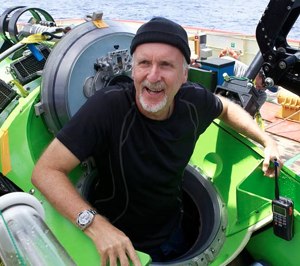
In a milestone of human civilization right up there with landing on the moon and eating 68 hot dogs in 10 minutes , James Cameron reached the deepest point on the planet on Sunday — the Mariana Trench, nearly seven miles below the surface of the Pacific. Naturally, upon reaching bottom, he did what any record-setting blockbuster deep-sea diver would do: Tweeted. Just arrived at the ocean’s deepest pt. Hitting bottom never felt so good. Can’t wait to share what I’m seeing w/ you @ DeepChallenge — James Cameron (@JimCameron) March 25, 2012 Back from trip to deepest pl on Earth – #oceans hadal zone.Puts a new spin on “to hell and back”. Good to see the sunshine. #deepseachallenge — James Cameron (@JimCameron) March 26, 2012 It wasn’t all good, according to a report today from Cameron’s partners at National Geographic: The expedition was designed so that Cameron could spend up to six hours collecting samples and video at the bottom of the trench. But his mission was cut short due in part to a hydraulic fluid leak that coated the window of the sub’s “pilot sphere,” obscuring his view. “I lost hydraulics toward the latter part of dive, and I was unable to use the manipulator arm,” Cameron said this morning Considering the daunting task of sending humans into the deep, such technical glitches are to be expected, Cameron emphasized: “It’s a prototype vehicle, so it’s gonna take time to iron out the bugs.” And even with the hydraulic leak obscuring the explorer’s vision, word has it that the ocean floor looked better than Titanic 3D . [ National Geographic ] Follow S.T. VanAirsdale on Twitter . Follow Movieline on Twitter .

Originally posted here:
James Cameron Reaches, Tweets From Ocean’s Deepest Point

Taylor Kitsch Lays John Carter to Rest

“‘I’m very proud of John Carter . Box office doesn’t validate me as a person, or as an actor. I’d love to go do John Carter 2 . I really would. It’s just shitty I don’t get to work with the [ John Carter ] family. It really was a special thing.” [ EW ]

See the article here:
Taylor Kitsch Lays John Carter to Rest

Teenage Mutant Ninja Turtles Culture War Update: Director Speaks Out, Title Cut in Half

After begging and pleading with the Teenage Mutant Ninja Turtles fan community to please, please not engage in preemptive flame warfare over the rumors and vagaries surrounding the reboot of their beloved franchise, I now recognize the futility of my attempts at diplomacy. This comes after the film’s attached director Jonathan Liebesman — also of this week’s Wrath of the Titans and last year’s eminently regarded ( ahem ) Battle: Los Angeles — only complicated matters with his comments about the kerfuffle. And then there’s the movie’s reported name change. Liebesman toed the company line at last weekend’s Titans junket, urging TMNT devotees to calm down about producer Michael Bay’s proposed alien-turtle-ooze influence — which apparently “comes straight from the series.” I can’t believe I just wrote that, or this: “Look, it’s so funny — if everyone was such a die-hard fan, they would know that the TCRI canisters where the ooze comes from. That is alien ooze. Now I’m not saying what Michael said is exactly what the movie is, because we’re sitting in a room now figuring everything out. So we don’t know, but we are like Michael said: we’re expanding it, and the expansion will be true to the mythology. I promise you: fans will love it.” Even if those fans are to take Liebesman at his word, there’s also this reported nugget that no doubt have them soiling their Donatello jammies: Bleeding Cool has verified that the working title of the upcoming Paramount-Nickelodeon Turtle movie from producer Michael Bay and director Jonathan Libesman is going by the working title of Ninja Turtles . We know all too well where the “Mutant” bit went, but now it seems we’re also losing “Teenage.” We haven’t been able to get a definite statement as to why this title change is occurring, and our sources are not 100% clear on whether or not the Turtles will indeed be adolescents. One of our sources has said: “It seems to be driven by marketing. Think of John Carter and how Disney wouldn’t allow for a title with either ‘Princess’ or ‘Mars.'” Whatever. See you at the refugee camp! I hope they have wi-fi. [ Collider , Bleeding Cool via AICN ] Follow S.T. VanAirsdale on Twitter . Follow Movieline on Twitter .

The rest is here:
Teenage Mutant Ninja Turtles Culture War Update: Director Speaks Out, Title Cut in Half

Weekend Receipts: Hunger Games Claims Insane $155 Million

Lionsgate needed it, and Lionsgate got it: The beleaguered studio’s Hunger Games gamble paid off in record-shattering fashion over the weekend, milking smart social-media strategy with old-fashioned saturation marketing — not to mention an honest-to-goodness good film — on the way to $155 million in three days. $155 million . As in the third biggest opening ever . You weekend receipts are here. 1. The Hunger Games Gross: $155,000,000 (new) Screens: 4,137 (PSA $37,467) Weeks: 1 And let’s not forget the nearly $60 million pulled in abroad, bringing the first adaptation of Suzanne Collins’s dystopian bestsellers to an early $215 million tally overall. I have a few things to say about this a little later in the day, but for now let’s just tip our caps and/or stew jealously at the volume of the numbers here — the third-largest opening ever behind Harry Potter and the Deathly Hallows: Part 2 and The Dark Knight and the runaway biggest opening for a non-sequel. All that’s left now is to predict the week-two drop. 55 percent? 60 percent? Less? Take your best shot in the comments. 2. 21 Jump Street Gross: $21,300,000 ($71,051,000) Screens: 3,121 (PSA $6,825) Weeks: 2 (Change: -41.3%) In other, vastly secondary but still-intriguing box-office news, how about 21 Jump Street holding on with a decent week-two score against outrageous competition? Watch them wind up counterprogramming sequels against Hunger Games films through at least 2016. 3. Dr. Seuss’s The Lorax Gross: $13,100,000 ($177,300,000) Screens: 3,677 (PSA: $3,563) Weeks: 4 (Change: -42.5%) Another solid week. Now pinch your nose, because… 4. John Carter Gross: $5,014,000 ($62,347,000) Screens: 3,212 (PSA $1,561) Weeks: 3 (Change: -63.1%) Money hemorrhaging aside, I had every confidence after week one that Disney could muscle this to $100 million in the States. At this rate, however — I mean, a 63 percent drop ? Even against Hunger Games that’s outrageous — John Carter will be lucky to make it to $90 million. On the bright side, Disney is doing nearly triple the business overseas, enough to make $325 million overall a possibility. Feel free to bet on that while you’re at it. 5. Act of Valor Gross: $2,062,000 ($65,942,000) Screens: 2,922 (PSA $931) Weeks: 5 (Change: -44.8%) I went back a couple years before essentially losing interest in the previous film to finish in the weekend top five with a PSA under $1,000. It’s rare! Congrats to Relativity as well, I guess. [Figures via Box Office Mojo ] Follow S.T. VanAirsdale on Twitter . Follow Movieline on Twitter .

See the rest here:
Weekend Receipts: Hunger Games Claims Insane $155 Million