Tag Archives: bp gulf oil spill

Double Shock: ABC Shows Gulf Residents Panning Obama’s Oil Spill Speech; ABC’s Katrina Focus Group Praised Bush in 2005

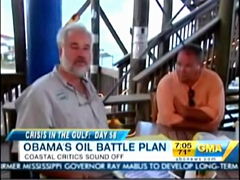
A tale of two disasters: On ABC’s Good Morning America this morning, weatherman Sam Champion’s piece included reaction from several residents of Florida, Alabama and Louisiana to President Obama’s oil spill speech, and found three outright critics and no defenders of the administration’s handling of the disaster. One woman exclaimed: “ What I would have liked to heard from him – that he actually had a plan .” The kindest review came from a man in Alabama who merely hoped the federal response would improve: “I think we’re seeing a change in how he’s handling the situation. And I hope it’s for the better.” Five years ago, after President Bush spoke in New Orleans a few weeks after Hurricane Katrina hit the Gulf coast, ABC assembled a focus group of six people displaced by the storm, and taking refuge in Houston’s Astrodome. But to the evident astonishment of ABC’s correspondent, not one member of that group would denounce President Bush, but instead leveled their criticism at local officials who failed to prepare the city ahead of time. As NewsBuster’s Brent Baker reported at the time : ABC News producers probably didn’t hear what they expected when they sent Dean Reynolds to the Houston Astrodome’s parking lot to get reaction to President Bush’s speech from black evacuees from New Orleans. Instead of denouncing Bush and blaming him for their plight, they praised Bush and blamed local officials. Reynolds asked Connie London: “Did you harbor any anger toward the President because of the slow federal response?” She rejected the premise: “No, none whatsoever, because I feel like our city and our state government should have been there before the federal government was called in.” She pointed out: “They had RTA buses, Greyhound buses, school buses, that was just sitting there going under water when they could have been evacuating people.” Not one of the six people interviewed on camera had a bad word for Bush — despite Reynolds’ best efforts. Reynolds goaded: “Was there anything that you found hard to believe that he said, that you thought, well, that’s nice rhetoric, but, you know, the proof is in the pudding?” Brenda Marshall answered, “No, I didn’t,” prompting Reynolds to marvel to anchor Ted Koppel: “Very little skepticism here.” You can read Brent Baker’s full item from 2005 here . (It’s also worth noting, ABC devoted a full hour of prime time to Bush’s 2005 speech, but — perhaps trying to help downplay expectations — provided only two minutes of analysis following Obama’s speech last night.) Coincidentally, a new poll released yesterday found Louisiana voters giving President Obama lower marks for his response to the oil spill than Bush’s response to Katrina. According to a report posted yesterday at FoxNews.com : Louisiana voters think President George W. Bush did a better job handling the aftermath of Hurricane Katrina than President Obama has done in the wake of the BP oil spill, according to a new poll. The Public Policy Polling survey showed 50 percent of state voters rated Bush’s performance in 2005 as better than Obama’s. Just 35 percent picked Obama…. Louisiana voters by no means are happy with the way the Bush administration handled the flooding in 2005. But while the PPP poll showed just a third of voters approved of the way Bush handled Katrina, the numbers were generally worse for Obama. Sixty-two percent said they disapproved of Obama’s handling of the crisis, compared with 58 percent for Bush. MRC intern Alex Fitzsimmons caught Sam Champion’s report from the Gulf this morning. Co-anchor Robin Roberts framed the reaction as one of “cautious optimism,” but the soundbites from the residents are much more negative than the reporters’ script: CO-ANCHOR ROBIN ROBERTS: People on the front lines of this spill, residents on the Gulf coast, watched President Obama’s address to the nation with cautious optimism. Sam Champion is in Pensacola, Florida and got some of their reactions. Good morning, Sam. WEATHERMAN SAM CHAMPION: Hey, good morning, Robin. Welcome back. We’ve spent a lot of time walking and talking with the people who live in this area. They’ve spent some time watching and waiting. And they really only have one course. You said it at the top of the show: action. Folks in Pensacola Beach usually come to the Flounder’s Chowder House to forget their worries. PRESIDENT OBAMA, HEARD ON THE RESTAURANT’S TV: Tonight, I’d like to lay out for you what the battle plan is going forward. CHAMPION: Tuesday, they faced him in wide-screen. UNIDENTIFIED WOMAN: What I would have liked to heard from him – that he actually had a plan. UNIDENTIFIED MAN: If we’re in a war, as he says we are, then why aren’t we bringing everybody into the picture that’s offered their help? CHAMPION: On Alabama’s Orange beach, a sense that seeing things firsthand may have made a difference for the president. UNIDENTIFIED MAN: I think we’re seeing a change in how he’s handling the situation. And I hope it’s for the better. CHAMPION: On New Orleans’ Bourbon Street, more skepticism. UNIDENTIFIED MAN: I think it’s lacking. I don’t think he’s responded to what we’re going to do about the cleanup issues. OBAMA IN SPEECH: Our top priority is to – CHAMPION: But even before the President spoke, frustration had already given way to anger. ED Valmont (sp?), Gulf coast resident: They said the inner waters were safe. We thought they were protected. CHAMPION: Ed Valmont usually harvests blue crabs off his back yard. On Tuesday, he only harvested oil. VALMONT: I mean that stuff’s like glue. All you got to do is just touch it and it’s on you forever. CHAMPION: But for people who live here, forever is too long. ALLEN PRIEST, Gulf coast resident: We’re not waiting on the government to really take over. CHAMPION: When little Sabine Bay faced a different kind of pollution ten years ago, Allen Priest’s neighbors cleaned it up themselves. Give them the tools and they say they will do it again. (To Priest) The President keeps saying that they want to leave the Gulf coast better than it is right now, after the spill. What does that mean to you? PRIEST: I don’t really think that’s totally our president’s job. I think it’s our responsibility as citizens to do that, if we care about this place. CHAMPION: I’ll tell you, Allen Priest said it. But a lot of other people said it, too. They trust the people they know. He believes his area won’t be polluted because there’s someone he knows watching the water. George. STEPHANOPOULOS: Okay, Sam.
Read the original:
Double Shock: ABC Shows Gulf Residents Panning Obama’s Oil Spill Speech; ABC’s Katrina Focus Group Praised Bush in 2005

Katie Couric Boasts She’ll Be Buying a Prius, the Favorite Car of Obama-Loving Liberals

Confirming her membership in Manhattan’s liberal elite, Katie Couric boasted on Tuesday’s Late Show that she plans to follow Tom Friedman’s admonition, that in refusing to move away from oil “we have met the enemy and he is us,” and so she’s realized she “should” buy a Toyota Prius, the favorite of conspicuously superior liberals, or at least a hyprid. Couric recounted how her daughter told her “‘we should turn in the car we have’ and ‘get a Prius or a hybrid.’ And I said, ‘you know, Ellie, we should do that.’ And we’re going to look into it.” (“Prius owners act as if for every mile they drive, they prevent a coral reef from turning into a tidal wave that will hit Manhattan,” Joel Stein quipped in Time back in February .) “I think Tom Friedman had a great column ,” Couric touted, on how “we are responsible for creating this problem” in the Gulf of Mexico “and we have to start contemplating our choices in terms of energy,” so “hopefully something like this will really force people to reconsider their choices.” She then recited for David Letterman a conversation she had with one of her daughters: My daughter and I – Ellie is here home from college. She’s getting ready to go away tomorrow for two months as a camp counselor. We were talking and Ellie was funny because she was saying, “mom, can we get another car”– because she’s driving now, to have more flexibility for her. And I said “maybe” and then she said to me today, “you know, we shouldn’t get another car and, by the way, we should turn in the car we have,” which is a Chrysler mini-van — am I hip or what? “And get a Prius or a hybrid.” And I said, “you know, Ellie, we should do that.” And we’re going to look into it. But I think everybody, really, I mean they need to look at themselves and their own habits.

Here is the original post:
Katie Couric Boasts She’ll Be Buying a Prius, the Favorite Car of Obama-Loving Liberals

Live Chat of Obama’s Address to the Nation

President Obama will address the nation on live television at 8pm tonigh. He will seek to allay concerns that the federal government’s response to the oil spill in the Gulf of Mexico has been sorely lacking. In fact, a Washington Post/ABC News poll conducted earlier this month found that Americans believe the federal government’s response to the spill has been worse than its response to Hurricane Katrina in 2005. It is widely accepted that Obama will strike a very combative and populist tone in response to public demands that he take a more hardline stance towards BP. The most pressing question, it seems, is whether he will use the opportunity to tout cap and trade legislsation–and in what language he will tout that advocacy if he does. Join us below the jump for discussion and debate on the President’s address. Note: all NB content policies are in effect. Excessive ad hominem attacks and the use of vulgarity of offensive language will get you banned .

See the rest here:
Live Chat of Obama’s Address to the Nation

Politico’s Roger Simon: Obama ‘Calling Out’ Bobby Jindal’s ‘Hypocrisy’

Appearing on MSNBC’s Andrea Mitchell Reports on Tuesday, Politico columnist Roger Simon described a recent interview with President Obama: “…he showed a genuine irritation….when people like Bobby Jindal, you know, standing up, screaming about more federal action…a small-government, no federal aid kind of guy. And the President is calling out those people for hypocrisy.” Simon was discussing a quote from Obama in that interview , in which the President whined: “Some of the same folks who have been hollering and saying do something are the same folks who, just two or three months ago, were suggesting that government needs to stop doing so much.” Apparently, asking the federal government to do its job in a national emergency but not take over people’s health care is the liberal definition of hypocrisy. Earlier, Mitchell asked Simon to preview the President’s prime time address on the oil spill. Simon gushed: “…he’s cool and collected about things but he also realizes that he has to break through that, and tonight is his chance. You know, speeches have never failed Barack Obama. They started his presidential career. They’ve always rescued him at tough times…. I think he wants to re-establish that personal bond he once had with voters.” He could hardly wait for Obama’s performance: “I think tonight we saw a preview of it in Pensacola. He likes to preview the speeches like opening a play out of town before you go to Broadway.”   Here is a full transcript of the June 15 segment: 1:15PM EST ANDREA MITCHELL: For months a voice has been missing. We’ve been missing the voice of Politico’s chief political columnist Roger Simon. He has been struggling with blood poisoning. He’s now made a welcome recovery and is back stronger than ever, having just had an exclusive interview with the President, and then appeared on Meet the Press and Hardball and you join us now. Roger, it is wonderful to see you. ROGER SIMON: Wonderful to be back with you. MITCHELL: I can’t tell you how happy we are in person and also to read your great interview with President Obama. SIMON: Thank you. MITCHELL: Now you spent time – you’re the only journalist who spent time with the President recently as we prepare for tonight’s big speech. Tell us your impression of how he is handling the crisis and what he wants to project tonight. SIMON: Well, it won’t surprise you to learn that he’s cool and collected about things but he also realizes that he has to break through that, and tonight is his chance. You know, speeches have never failed Barack Obama. They started his presidential career. They’ve always rescued him at tough times and I think tonight we saw a preview of it in Pensacola. He likes to preview the speeches like opening a play out of town before you go to Broadway. And he said in Pensacola, ‘I am with you.’ He didn’t say ‘we are with you.’ He’s making it very personal. And I think he wants to re-establish that personal bond he once had with voters. MITCHELL: Now there’s also a thin-skinned aspect to the President at times. You wrote in the Politico interview, discussing the role of the government in the oil spill, you said some of the same – this is quoting the President – ‘some of the same folks who have been hollering and saying do something are the same folks who, just two or three months ago, were suggesting that government needs to stop doing so much. Some of the same people who were saying the President needs to show leadership and solve this problem are some of the same folks who, just a few months ago, were saying, this guy is trying to engineer a takeover of our society through the federal government that is going to restrict our freedoms.’ So he’s reacting to these criticisms. SIMON: He is. And that troubles him, and that’s one of the two moments I think where he showed a genuine irritation there, and – well, three moments. There, dealing with Congress on the same way: ‘Congress, if I had gone to six months before for extra money they would have said no,’ and also with the press, a continuing irritation of his. When he sees people like Bobby Jindal, you know, standing up, screaming about more federal action, more federal aid, well, six months ago, that’s not the person that Bobby Jindal was. He was a small-government, no federal aid kind of guy. And the President is calling out those people for hypocrisy. MITCHELL: Let me just ask you on a personal note, because you’ve been through Hell and back, and there you are, you’ve covered Barack Obama during the campaign, you’ve had interviews in the past, and now you’re entering the Oval Office in a very different way. They reached out to you. You also reached out to them. But how was it different and how did the President accommodate you? SIMON: I was really nervous. I felt like a summer intern on his first job. I’ve been interviewing people for decades. This felt different. You’re in the Oval Office, you’re in the center of power. And also, I must say, the President was extremely gracious. He didn’t wait in the Oval Office behind his desk for me to come in. He came out and walked down the hallway. He greeted me, we entered together, he turned around his chair to face me. So the task is to be grateful for that, which I was, and also as a journalist to fight it and still ask tough questions. MITCHELL: Well, you did it brilliantly. Roger, we are just so grateful you’re back. SIMON: Oh, I’m so happy to be back with you, Andrea. Thank you for this. MITCHELL: Thank you. And we look forward to other exclusive interviews from you, from Politico. SIMON: Thank you.       

Read the original post:
Politico’s Roger Simon: Obama ‘Calling Out’ Bobby Jindal’s ‘Hypocrisy’

MSNBC’s Mitchell Downplays Consequences of Cap-and-Trade

After wondering on Friday if President Obama should help push energy legislation through Congress, MSNBC anchor Andrea Mitchell continued her cheerleading for a new energy agenda on Monday. On her afternoon show “Andrea Mitchell Reports,” Mitchell downplayed the cost of last summer’s Cap and Trade bill, and opined that solar energy should be a part of the American energy future. “Ed Markey’s bill–the Markey-Waxman bill–was a year ago, but it is a Cap and Trade bill, as you were pointing out,” Mitchell said to guest Ron Brownstein of Atlantic Media. “It doesn’t really require us to eat our spinach,” she added. Mitchell introduced the segment by referencing the Oval Office address that President Obama will be delivering Tuesday. “How hard will [President Obama]  press BP, and just how far will he go in proposing new energy legislation?” Mitchell asked. After introducing Brownstein to the segment, Mitchell pitched the question she had asked of New York Magazine columnist John Heilemann on Friday: is now the time for sweeping energy legislation? “Strong energy–almost certainly the time to pitch it,” Brownstein answered. He added that it is not certain whether a climate dimension will be included in the bill. The two then discussed Brownstein’s recent trip to China and his insights on the country’s energy policy. “China is by leaps-and-bounds going to lap us on solar,” Mitchell asserted, and then added that it “should be an American initiative.” Brownstein was able to maintain that while China may be making advances in the alternative energy realm, the country is still heavily dependent on coal and thus continues to oppose international efforts to stop global warming. Mitchell chimed in once more on China’s alternative energy record, “It’s extraordinary, and we are falling way, way behind.” The transcript of the segment, which aired on June 14 at 1:16 p.m. EDT, is as follows: ANDREA MITCHELL: When President Obama addresses the nation tomorrow night, how hard will he press BP, and just how far will he go in proposing new energy legislation? Joining us is Ron Brownstein, political director for the Atlantic Media, and someone who has studied energy more intensively than most of our other colleagues, so we welcome you as an expert on that as well. Let’s talk about– is this the time to pitch strong energy legislation and what are the chances of getting anything passed this year? RON BROWNSTEIN, Political Director, Atlantic Media: You know, strong energy–almost certainly the time to pitch it. The hard part is going to be–as you were talking about with Congressman Markey, whether there is a climate dimension to that or not. I think from the beginning–right throughout his campaign, the Stimulus bill–the President has been a strong proponent of incentives to develop alternative energy, wind, solar, efficiency. They’ve always been somewhat ambivalent about whether it was politically realistic to couple that with a serious effort to control carbon emissions, which most advocates argue is the key to a long-term transition toward clean energy. But it imposes more immediate costs now than the carrots you can offer to develop things like solar. So I don’t know what we’ll see tomorrow. I assume that there will be something of a pitch there. But are they in the trenches, really telling Harry Reid, look, this has to be a comprehensive bill? It’s always been a little bit back-and-forth from the administration on that.   ANDREA MITCHELL: And in fact, Ed Markey’s bill–the Markey-Waxman bill, was a year ago, but it is a Cap-and-Trade bill, as you’re pointing out. It doesn’t really require us to eat our spinach , and– RON BROWNSTEIN: Well, it does have longer-term–I mean, the Waxman-Markey bill was a comprehensive bill that had a variety of incentives for alternatives, for efficiency, but also did have a Cap-and-Trade system which limited the emissions of Carbon Dioxide and the other gasses associated with Global Warming. That hits coal the hardest, harder than it does oil. It would have a big impact over time in moving the U.S. away from a reliance on coal to generate as much of its electricity. It’s impact on oil dependence might be smaller over time, but even that–because so many states rely so heavily on coal. It was always uncertain that you get the sixty votes in the Senate for that, and that’s been the delay. There’s been an entire year, as John Kerry and Lindsay Graham and Joe Lieberman and others have tried to find any formula that could get you to sixty votes in the Senate, while limiting carbon emissions. They’ve never found it, and now Harry Reid has to make this decision. Is this the moment to try to do it again, or do you do an energy-only bill, or maybe you can’t do anything. ANDREA MITCHELL: As he’s of course facing his own re-election fight. You just got back from looking at the energy situation in China, and as Bill Gates, Jeff Imhopt, last week– RON BROWNSTEIN: Put out the report– ANDREA MITCHELL: The CEO, of course, of our parent company GE put out their report on R & D, and Ed Markey has a lot of RND in this bill that’s been sitting there for a year. You were in the Gobi Desert, where China– RON BROWNSTEIN: Yes I was. You don’t get to say that everyday. ANDREA MITCHELL: You know, what a great date line– China is by leaps and bounds going to lap us on solar, which should be an American initiative. RON BROWNSTEIN: Right. China is a paradox. Because on one hand, they rely heavily on coal, and they’re a threat to any international effort to constrain Global Warming because of that. On the other hand, they have made enormous, specific goals in the area of alternative energy, solar, wind, high-speed rail, others–and they are becoming a serious competitor for those jobs that the President is counting on as a part of his long-term economic strategy. About half of the solar panels in the world are already built in China and Taiwan. ANDREA MITCHELL: It’s extraordinary, and we are falling way, way behind. Thank you, Ron Brownstein, we are going to stay on this.

Read more from the original source:
MSNBC’s Mitchell Downplays Consequences of Cap-and-Trade

ABC: Stephanopoulos and Carville Hope Obama Can ‘Hit Reset Button’ on Oil Spill, ‘Contain Political Damage’

On Monday’s Good Morning America on ABC, co-host George Stephanopoulos discussed President Obama’s response to the Gulf oil spill with Democratic strategist James Carville: “Probably no one has been tougher than you on this White House on this response. The President now going back for his forth trip. He’s ratcheted up the rhetoric over the weekend. Is this what you’ve been waiting for?” Stephanopoulos was referring to Carville’s criticism of Obama on the May 26 broadcast : “And it just looks like he’s not involved in this!…We’re about to die down here!” During his Monday appearance, the on-screen headline read: “Carville Demands Justice; Gulf ‘Abused and Neglected'” However, on Monday, Carville struck a more complimentary tone toward the President, remarking that Tuesday’s prime time Oval Office address on the spill could allow Obama “to hit the reset button.” Near the end of the segment, Stephanopoulos, a former Democratic strategist himself, asked Carville: “…put on your strategist hat here, has the President contained the political damage?” Carville reiterated: “I think he can hit this reset button tomorrow night. I think he can not contain the political damage, I think he can eliminate the damage. I actually think done properly, there’s political value in this, I think that he can help himself a great deal.” While hoping for Obama’s political comeback, Carville did speak out against the moratorium on offshore oil drilling: “[Gulf residents are] definitely concerned about this moratorium. This is wrecking the economy down here. What has to be done to get this lifted? How soon can we expect that?” Stephanopoulos continued to tow the liberal line: “…do you really think that’s wise given the kind of dangers we’re seeing with very deep water drilling?” Carville called for more regulation, but concluded: “I think it’s essential to the economy down here….you take fishing and you take petroleum away from this, you don’t have a whole lot left.” Here is a full transcript of the June 14 exchange: 7:08AM EST             GEORGE STEPHANOPOULOS: We’re going to turn now to James Carville, he is down in New Orleans. Good morning, again, James. Probably no one has been tougher than you on this White House on this response. The President now going back for his forth trip. He’s ratcheted up the rhetoric over the weekend. Is this what you’ve been waiting for? [ON-SCREEN HEADLINE: Carville Demands Justice; Gulf “Abused and Neglected”] JAMES CARVILLE: Well, I hope so, and I think he has a chance to hit the reset button tomorrow night. And there certainly is going to be a lot of interest, a lot of anticipation in what he’s going to say. Doug Brinkley has been reporting that the Secretary of Interior said that he’s going to address the issue of our vanishing coastline and have a massive public works project. If that’s true, that’s going to be greeted with – embraced down here and greeted with great approval. But we’ve got to see, and I think people are very, very anxious. I think they want to hear what the President has to say. And I guarantee you, he’s going to have to have a lot of eyes that are glued to the television set tomorrow night. I mean, this is good news. They say they’re going to capture 50,000 barrels and I think that they’re moving in that direction. But last week, we we’re told that the high point was 40,000. So I think these sensors will give people a good, good indication of what’s on there. And hopefully, the scientists can give us a definitive answer because every answer we’ve gotten has been wrong so far. But I’m very encouraged by what I here hear about the ability to capture this oil. I hope it’s true and we’re just praying that’ll be the case. STEPHANOPOULOS: You mentioned this recovery fund that Secretary Salazar talked to historian Doug Brinkley about. What more, specifically, do you think people on the Gulf are waiting to hear from the President tomorrow night? CARVILLE: Well, I mean I think that they definitely want to know what’s the strategy for cleaning this up? How much oil’s been out there? How long do the experts think that this I going to go on? What are going to be the long-term effects on our fishing industry? They’re definitely concerned about this moratorium. This is wrecking the economy down here. What has to be done to get this lifted? How soon can we expect that? And the big thing, of course, is what Doug Brinkley, who is a former resident of New Orleans, is reporting is what is going to happen to our wetlands? We’re losing wetlands at the rate of the size of Manhattan every year. And if this President seizes this initiative and talks about rediverting the river below what they call Myrtle Grove and reflooding those wetlands, that’s going to be a big part of his legacy. That’s going to be an enormous thing and that’s what people are really looking for here. STEPHANOPOULOS: James, you mentioned the moratorium on drilling. And I know a lot of politicians down there in Louisiana and across the Gulf are calling for lifting the moratorium. But do you really think that’s wise given the kind of dangers we’re seeing with very deep water drilling? CARVILLE: Well, certainly we saw this and I think BP last had something like 700 violations and an Exxon operator had one violation. And I think that, certainly, you would have to have stringent regulations. I think every CEO ought to sign off on it. I think we have to have, you know, top flight engineers come in ensuring safety. But I think this stuff can – is necessary. I think it’s essential to the economy down here. And I think properly regulated and properly done, it can be done – nothing can be done risk-free – but I think it can be done much, much better than it was done before. And we’re going to have to get back to this, it’s just a question of when. It’s a very productive field out there and it’s killing the economy of south Louisiana. I mean, you take fishing and you take petroleum away from this, you don’t have a whole lot left. STEPHANOPOULOS: Finally, James, we only have a few seconds left, but bottom line, put on your strategist hat here, has the President contained the political damage? CARVILLE: I think he – I’d rather look forward as we say, and not look back. And you know, I think he can hit this reset button tomorrow night. I think he can not contain the political damage, I think he can eliminate the damage. I actually think done properly, there’s political value in this, I think that he can help himself a great deal. It’s a complex problem. But he’s got to show that he’s on top of this thing. That there’s a strategy in place. That there’s a way to deal with this. And the big thing is, if he’s going to estimate something, estimate it on the conservative side because everything else has been overestimated. STEPHANOPOULOS: Okay, James Carville, thanks very much. CARVILLE: Thank you.

Link:
ABC: Stephanopoulos and Carville Hope Obama Can ‘Hit Reset Button’ on Oil Spill, ‘Contain Political Damage’

Donna Brazile Defends Obama By Badly Misrepresenting Oil Pollution Act, Gets No Challenge From ‘This Week’ Panel

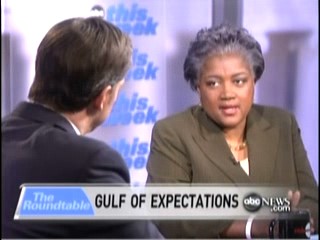
Nothing ruins my Sunday more than a pundit defending his or her politician by completely misrepresenting a law and nobody on the program in question bothers to challenge the falsehood. Such happened on the recent installment of ABC’s “This Week” when Democrat strategist Donna Brazile said of President Obama’s pathetic response to the Gulf Coast oil spill, “The administration has been constrained by the Oil Pollution Act of 1990, which basically gives the responsible party the lead role in trying to not only fix the problem, but contain the problem.” Really? Well, why don’t we look at the Oil Pollution Act of 1990 and see if Brazile was right (video and transcript follow with details about this law and commentary):  ROBERT REICH: But the present spectacle of the Coast Guard asking BP to speed up this clean-up is absurd. I mean, the federal government needs to be in charge. The president needs to be in charge of this. Use BP’s expertise. Use BP’s resources. But the president must be in charge of all of this. Otherwise, he looks like he’s just standing on the sidelines. DONNA BRAZILE: Well, the administration has been constrained by the Oil Pollution Act of 1990, which basically gives the responsible party the lead role in trying to not only fix the problem, but contain the problem. That has been the problem from day one. They’ve waited for BP to come up with the answers, and we know that BP continues to mislead people. This is the Overview of the Act (emphasis added): The Oil Pollution Act (OPA) was signed into law in August 1990, largely in response to rising public concern following the Exxon Valdez incident. The OPA improved the nation’s ability to prevent and respond to oil spills by establishing provisions that expand the federal government’s ability , and provide the money and resources necessary, to respond to oil spills. The OPA also created the national Oil Spill Liability Trust Fund, which is available to provide up to one billion dollars per spill incident. In addition, the OPA provided new requirements for contingency planning both by government and industry. The National Oil and Hazardous Substances Pollution Contingency Plan (NCP) has been expanded in a three-tiered approach: the Federal government is required to direct all public and private response efforts for certain types of spill events ; Area Committees — composed of federal, state, and local government officials — must develop detailed, location-specific Area Contingency Plans; and owners or operators of vessels and certain facilities that pose a serious threat to the environment must prepare their own Facility Response Plans. Finally, the OPA increased penalties for regulatory noncompliance, broadened the response and enforcement authorities of the Federal government , and preserved State authority to establish law governing oil spill prevention and response. Now, let’s take a look at the expanded National Oil and Hazardous Substances Pollution Contingency Plan (NCP)  (emphasis added):  The OPA was enacted to strengthen the national response system. The OPA provides for better coordination of spill contingency planning among federal, state, and local authorities. The addition of the National Strike Force Coordination Center (NSFCC), for example, is expected to relieve equipment and personnel shortages that have interfered with response to oil spills posing particularly significant environmental or human health threats. Today’s rule revises the NCP to implement a strongly coordinated, multi-level national response strategy. The national response strategy, contained primarily in Subparts B and D of the NCP, provides the framework for notification, communication, logistics, and responsibility for response to discharges of oil, including worst case discharges and discharges that pose a substantial threat to the public health or welfare of the United States. The amended NCP further strengthens the OSC’s ability to coordinate the response on-scene and also incorporates a new OPA- mandated level of contingency planning–Area Committees and Area Contingency Plans (ACPs). These committees and plans are designed to improve coordination among the national, regional, and local planning levels and to enhance the availability of trained personnel, necessary equipment, and scientific support that may be needed to adequately address all discharges. The major revisions to the NCP being promulgated today reflect OPA revisions to CWA [Clean Water Act] section 311. These changes increase Presidential authority to direct cleanup of oil spills and hazardous substance releases and augment preparedness and planning activities on the part of the federal government, as well as vessel and facility owners and operators . For example, revised CWA section 311(c) requires the President to direct removal actions for discharges and substantial threats of discharges posing a substantial threat to the public health or welfare of the United States . Revised section 311(d) requires a number of specific changes to the NCP, including the establishment of “criteria and procedures to ensure immediate and effective Federal identification of, and response to, a discharge, or the threat of a discharge, that results in a substantial threat to the public health or welfare of the United States.”  Section 311(d) also mandates the establishment of procedures and standards for removing a worst case discharge of oil and for mitigating or preventing a substantial threat of such a discharge. As such, quite contrary to what Brazile stated Sunday, the Oil Pollution Act of 1990, along with its changes to the National Oil and Hazardous Substances Pollution Contingency Plan, significantly increased the President’s authority over oil spills. As this disaster is now over seven weeks old, surely “This Week” host Jake Tapper should have been aware of the pertinent provisions of this Act. Ditto Reich and George Will who also sat idly by as Brazile made this misrepresentation. With this in mind, why didn’t anyone challenge her on this? This question especially goes out to Will who in recent months has gone after Bill Maher  as well as  Brazile for misrepresenting the facts in his presence.  I guess George wasn’t in the mood for a fight today. Too bad, for it was easy pickings.  Of course, there’s a larger issue here, and why this really angers me when it happens. It’s not surprising that a pol or pundit stretches the truth. It happens almost every time these people open their mouths. However, when their misrepresentations go unchallenged, the viewer assumes the statement was accurate. This is why it’s so important for the host or moderator to be on top of things. Unfortunately, folks watching “This Week” on Sunday were given the wrong impression about this law and its relevance to what’s currently happening on the Gulf Coast. As such, the burden was on SOMEONE present to correct Brazile on this point. Sadly, that didn’t occur. What a shame. 

See more here:
Donna Brazile Defends Obama By Badly Misrepresenting Oil Pollution Act, Gets No Challenge From ‘This Week’ Panel

NYT Rips Obama: It Shouldn’t Have Taken So Long To Get Involved In Oil Spill

The New York Times editorial board on Sunday absolutely tore Barack Obama apart for his handling of the oil spill in the Gulf of Mexico.  “The president cannot plug the leak or magically clean up the fouled Gulf of Mexico. But he and his administration need to do a lot more to show they are on top of this mess, and not perpetually behind the curve,” wrote the Times.  “It certainly should not have taken days for Mr. Obama to get publicly involved in the oil spill, or even longer for his administration to start putting the heat on BP for its inadequate response and failure to inform the public about the size of the spill.”  Quite surprisingly, the Times was just getting warmed up:  If ever there was a test of President Obama’s vision of government – one that cannot solve all problems, but does what people cannot do for themselves – it is this nerve-racking early summer of 2010, with oil spewing into the Gulf of Mexico and far too many Americans out of work for far too long. The country is frustrated and apprehensive and still waiting for Mr. Obama to put his vision into action. Americans need to know that Mr. Obama, whose coolness can seem like detachment, is engaged. This is not a mere question of presentation or stagecraft, although the White House could do better at both. (We cringed when he told the “Today” show that he had spent important time figuring out “whose ass to kick” about the spill. Everyone knew that answer on Day 2.) But a year and a half into this presidency, the contemplative nature that was so appealing in a candidate can seem indecisive in a president. His promise of bipartisanship seems naïve. His inclination to hold back, then ride to the rescue, has sometimes made problems worse. It took too long for Mr. Obama to say that the Coast Guard and not BP was in charge of operations in the gulf and it’s still not clear that is true. Readers should keep in mind this editorial was likely being produced at around the same time the paper’s Washington correspondent Helene Cooper was telling Chris Matthews Obama’s presidency “will go the way of Jimmy Carter’s” if he doesn’t get control of this spill. Adding insult to injury, Times columnist Maureen Dowd also went after Obama in her piece  published Sunday: The press traveling with Obama on the campaign never had a lovey-dovey relationship with him. He treated us with aloof correctness, and occasional spurts of irritation. Like many Democrats, he thinks the press is supposed to be on his side. The former constitutional lawyer now in the White House understands that the press has a role in the democracy. But he is an elitist, too, as well as thin-skinned and controlling. So he ends up regarding scribes as intrusive, conveying a distaste for what he sees as the fundamental unseriousness of a press driven by blog-around-the-clock deadlines. Sometimes on the campaign plane, I would watch Obama venture back to make small talk with the press, discussing food at an event or something light. Then I would see him literally back away a few moments later as a blast of questions and flipcams hit him. But that’s the world we live in. It hurts Obama to be a crybaby about it, and to blame the press and the “old Washington game” for his own communication failures. Now that Obama has been hit with negative press, he’s even more contemptuous. “He’s never needed to woo the press,” says the NBC White House reporter Chuck Todd. “He’s never really needed us.” So, as The Washington Post’s Howard Kurtz writes, the more press-friendly, emotionally accessible, if gaffe-prone Biden has become “the administration’s top on-air spokesman.” How ironic. Instead of The One, they’re sending out The Two. This means that in one weekend, the Times editorial board, its White House correspondent, and one of its top liberal columnists made harshly negative comments about the president they all helped get elected. This led Commentary magazine’s Jennifer Rubin to write Sunday: It’s one more sign that the bottom is dropping out on Obama’s support, and the unraveling of his presidency is picking up steam. Unless he gets a grip and finds some grown-ups from whom he is willing to take advice, this is not going to improve.  Indeed. 

Original post:
NYT Rips Obama: It Shouldn’t Have Taken So Long To Get Involved In Oil Spill

MSNBC’s Mitchell: Oil Spill An ‘Opportunity’ for Obama to Push Energy Bill

Speaking to New York Magazine columnist John Heilemann on MSNBC Friday, anchor Andrea Mitchell wondered if the Gulf oil spill could be a political opportunity for President Obama: “Is there an opportunity now to do something real on energy?” Heilemann proclaimed the disaster was “a triggering action for us to try and get toward a greener future…break our addiction to oil…”              The discussion occurred during the 1PM ET hour on Andrea Mitchell Reports with Mitchell noting how the President was “trying to contain the political damage” from the spill. After she spun the crisis as an “opportunity,” Heilemann argued: “I think this is one of these real moments for any president…what better moment is there than this?” Both Mitchell and Heilemann seem to share the philosophy of White House Chief of Staff Rahm Emanuel that “You never want a serious crisis to go to waste.” Heilemann actually worried that the White House would not exploit the situation enough: “I think that for the White House to do that and not end up with a piecemeal, some kind of small bill – small ball bill – he’s got to go really big and turn this into a crusade.”  He described the “fear” on the Left that the administration was “going to end up settling for a small solution rather than the big one that really changes, fundamentally, our relationship to energy and the – and our climate.” Mitchell then quoted Heilemann’s recent column in New York Magazine: …you wrote that: “As much as pulling the country back from the economic brink or passing health-care reform, the catastrophe in the Gulf offers Obama a chance to rise to the occasion, and in the process not only validate his conception of progressive, activist, and competent governance but reclaim the visionary mantle that inspired so many during his campaign.” Mitchell agreed with the sentiment and declared: “…it strikes me that this is an opportunity for him [Obama] to change the conversation….[to do] what he arguably does best and show his competence and the big conceptual approach to the energy policy, that would really be a major test of leadership.” Heilemann replied: “It would be…he does competency, he also does inspiration really well….he does inspiration terrifically well.” Heilemann concluded: “There’s places where he [Obama] can go here and – on both substance and symbolism – that would actually benefit him and what I – as I said, play to his strengths rather than his weaknesses.” Mitchell was pleased by all of his political advice for the President: “John Heilemann, that’s why we always love to talk to you. Thank you very much.” Here is a full transcript of the June 11 exchange: 1:14PM EST KEITH JONES [FATHER OF OIL RIG VICTIM]: I don’t criticize the President in not having condemned BP or any other party that may have been at fault in the accident. Not yet. ANDREA MITCHELL: Keith Jones, whose son died on the Deepwater Horizon rig after visiting the White House, as BP tries to cap the oil spewing into the Gulf. President Obama is trying to contain the political damage, but as estimates of the oil continues to rise, what is this political fallout? With us now, John Heilemann, national political columnist with New York Magazine and of course co-author of ‘Game Change,’ the best-selling book. John, The President has taken step by step measures to change the policy. Now, he’s inviting BP to the White House next week – summoning really – next Wednesday, after saying for days and days, weeks, that there was no need for them to communicate. He met with the families. He went down and spent hours there last week. He’s going back on Monday and Tuesday. Is this course correction going to work? JOHN HEILEMANN: Well, I don’t know the answer to that question, but I do think that there is, you know, there’s this daunting sense, and I say this not in a way to suggest somehow they were – this is not criticism of the White House. I think for all of us, there’s the sense that this thing is –  the scale of it is much larger than anybody thought and I think more importantly, that the time frame for it is now much longer than most people had ever hoped or expected, right? So this is going to go on for months and months. And so, you know, if tomorrow they capped the well completely, which of course is not going to happen, you would have months of an environmental disaster, an economic disaster, that the President is going to – the political challenge for him and the substantive challenge, is greater, I think, going forward, than it even has been in this last two months. And so as they’ve started to realize that, that this is like – he’s going to be judged not on whether he capped the – plugged the hole, but on how he deals with this. How does he protect the coastline? What changes does he get through in terms of energy policy? That’s where he’s really going to be judged and that’s where he either win or lose. MITCHELL: And on energy policy, do you think – where do you come down? Is this an opportunity or is this a real loss in terms of the ability to get something done? John Kerry and  Lieberman say something can be done. There’s a competing Lugar proposal that actually Lindsey Graham has signed on to. And a vote this week we saw, where – a fairly narrow vote, 53-47, Senator Murkowski tried to limit the White House’s ability to contain emissions and failed. But that was a pretty tough fight in the Senate yesterday. Is there an opportunity now to do something real on energy? HEILEMANN: Well, I think that the politics of it have gotten more complicated, not less, because, as you know, you know, the notion of opening up some offshore drilling was a key carrot to get Republicans and conservative Democrats on board. At the same time, I think this is one of these real moments for any president, where if there is going to be a triggering action for us to try and get toward a greener future, a different kind of energy future, break our addiction to oil, what better moment is there than this? But I think that for the White House to do that and not end up with a piecemeal, some kind of small bill – small ball bill – he’s got to go really big and turn this into a crusade. Lay out a future for American energy, American climate policy, and really drive for that. And I think the fear for people who would like to see him do that is that they’re looking at the difficulty of the politics and they’re going to end up settling for a small solution rather than the big one that really changes, fundamentally, our relationship to energy and the – and our climate. MITCHELL: I read, recently, you wrote that: ‘As much as pulling the country back from the economic brink or passing health-care reform, the catastrophe in the Gulf offers Obama a chance to rise to the occasion, and in the process not only validate his conception of progressive, activist, and competent governance but reclaim the visionary mantle that inspired so many during his campaign.’ You know, it strikes me that this is an opportunity for him to change the conversation so that he’s not arguing over whether he’s emoting enough or feeling the pain enough. That’s not a natural instinct for him, it’s the theatrical – he has to do a little bit of that because he is the commander and consoler-in-chief, but if he does what he arguably does best and show his competence and the big conceptual approach to the energy policy, that would really be a major test of leadership. HEILEMANN: It would be, and look, he also – he does competency, he also does inspiration really well. That’s one of the things we know he does well. He doesn’t do anger well, but he does inspiration terrifically well. So there’s the energy legislation side of this. There’s also another side of this, right? Which is there are going to be – we’re going to need thousands of people to be down in the Gulf trying to keep this oil from getting further into the wetlands than it already is, from getting onto the beaches in Florida. I say why not start a Gulf Conservation Corps or a Gulf Recovery Corps? And start a new branch of our national service of AmeriCorps and tell them – try to inspire young Americans to take a year off and go to the Gulf to save our natural habitat. There are things he can do that would play to his strengths rather than asking him to do some of these theatrical things that don’t play to his strengths and that he, I just think, when he does them he actually looks phony doing them. There’s places where he can go here and – on both substance and symbolism – that would actually benefit him and what I – as I said, play to his strengths rather than his weaknesses. MITCHELL: John Heilemann, that’s why we always love to talk to you. Thank you very much. HEILEMANN: You’re welcome. 

The rest is here:
MSNBC’s Mitchell: Oil Spill An ‘Opportunity’ for Obama to Push Energy Bill

ABC Reporter Hassled on Gulf Coast Beach While Covering Oil Spill

In today’s “Silence of the Cams” segment, an ABC reporter was hassled Thursday for trying to cover the Gulf Coast oil spill from an Alabama beach. According to an article published at ABCNews.com, “Reporting is often about access, but journalists along the Gulf Coast covering the BP oil spill have had some trouble getting it.” The piece continued, “As BP faces more pressure from the government and from its own shareholders unhappy with the company’s falling stock price, it seems to be clamping down on who can talk to reporters” (video follows with more quotes from the article and commentary): Despite company statements that anyone on cleanup crews can share their views, ABC’s Matt Gutman reports that’s not necessarily the case. Today during a “World News” Conversation, he saw firsthand how a BP manager took pains to keep workers away from the press. While preparing for a video chat on his laptop from a public beach in Alabama, Gutman was hassled by the manager of a nearby crew, asking Gutman why he was on the beach. In reality, BP officials likely have learned how to avoid media access by watching the Obama administration handle the press since Inauguration Day. In the end, there are consequences when journalists abdicate their responsibility to advance a political agenda. Maybe if they wouldn’t have assisted candidate Obama’s rise to the White House and then basically reported anything his administration wanted in the opening months of his presidency they wouldn’t be treated with such disregard by a British company. On the other hand, one has to wonder whether or not the White House minds what BP is doing. Think about it: if the Administration wanted greater press access to the beaches and the cleanup, it could just DEMAND BP allow it. After all, these ARE American beaches — or so I’ve been told. 

Follow this link:
ABC Reporter Hassled on Gulf Coast Beach While Covering Oil Spill