Tag Archives: bush

CNN Fails to Label Liberal Group Poised to Sue McDonald’s Over ‘Happy Meal’ Toys

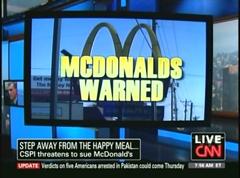
As NewsBusters sister company CNSNews.com reported , the Center for Science in the Public Interest (CSPI), a liberal consumer advocacy group, is threatening to sue the McDonald’s Corporation for “unfair and deceptive” marketing practices unless the fast food company stops giving away toys in its “Happy Meals.” CNN’s “American Morning” on June 23 covered the story half-jokingly, but failed to identify the liberal tilt of organization. Co-host Kiran Chetry reported: “The Center for Science in the Public Interest is delivering a warning to McDonald’s about toys being used to make “Happy Meals” more appetizing to kids. They say “Happy Meals” are unhealthy.” Making no effort to apply an appropriate label to the organization, co-host John Roberts continued: “The group accuses the fast food giant of ‘unfair and deceptive’ marketing practices toward children. McDonald’s, of course, as you could image, rejects the accusations.” On the surface, CNN crafted the impression that CSPI is a quirky but sincere consumer advocacy organization, but underlying the group’s innocuous veneer are liberal activists willing to inject partisan politics into consumer safety.                   Referring to the Bush administration, CSPI Litigation Director Stephen Gardner told CNSNews.com: “Marketers of all kinds in this country, one, were lulled into a sense of true security under the prior administration when the federal agencies did absolutely nothing to protect consumers.” At the end of the segment, both Chetry and Roberts seemed dismissive of the lawsuit, but neither anchor was willing to inform viewers of CSPI’s liberal leanings and history of pushing a public policy diet heavy in government regulation . A transcript of the segment can be found below: CNN American Morning 6/23/10 7:56 a.m. KIRAN CHETRY, co-host: Welcome back to the most news in the morning. The food police have a beef with McyDees. The Center for Science in the Public Interest is delivering a warning to McDonald’s about toys being used to make “Happy Meals” more appetizing to kids. They say “Happy Meals” are unhealthy. JOHN ROBERTS, co-host: Yeah, they’re putting McDonald’s on notice, saying “drop the toys, or we’ll sue you.” The group accuses the fast food giant of “unfair and deceptive” marketing practices toward children. McDonald’s, of course, as you could image, rejects the accusations. CHETRY: They can’t get a break. First they tried to give away the glasses but they had to recall them because of cadmium in the paint on the “Shrek” glasses. ROBERTS: Well that definitely is a bad thing, but the toy? Come on. –Alex Fitzsimmons is a News Analysis intern at the Media Research Center. Click here to follow him on Twitter.

Here is the original post:
CNN Fails to Label Liberal Group Poised to Sue McDonald’s Over ‘Happy Meal’ Toys

Robert Redford Blames Cheney for America’s ‘Failed Energy Policy’

Actor Robert Redford lambasted America’s energy plan that he claimed led to the Gulf disaster, laying the responsibility at the feet of former Vice President Cheney. Appearing Monday night on “Anderson Cooper 360,” Redford blamed the Gulf oil spill not only on BP, but also because of the “failed” energy policy that led to this disaster. ‘There’s a lot being said about BP, and there’s a lot of truth that’s finally bubbling up to the surface,” Redford acknowledged. “But what I’m more interested in is – is looking at it from a historical point of view and trying to connect some dots about how we got here.” “Look, I think one of the reasons we’re in this problem is because we have not only a failed energy policy, but we have an energy policy – because of the way it was designed, and who it was designed by, Cheney – it’s sick and it’s dangerous.” Redford, who supports Obama’s drilling moratorium,  mandated that America must shed its current energy policy and adopt a new one. He rebuked the present policy as an unholy alliance of sorts between Congress, the government, and Big Oil. He gave the example of the US Minerals Management Service (MMS) as an example of a government agency that was asleep at the wheel in its oversight of oil companies. “Look, all that stuff has come out, and it’s painfully obvious what’s happened – the corruption that came with MMS as a result of Dick Cheney and how he engineered this whole thing,” he maintained. Redford’s solution? Get rid of former Vice President Dick Cheney – who’s been a private citizen for 17 months now – and his cronies. “You’ve got to get rid of Cheney and every – and all the horses he came in with. You’ve got to get rid of his energy policy. It’s bad for our health. It’s bad for our economy. It’s bad for our future.” A transcript of Anderson Cooper’s interview with Robert Redford, which aired on June 21, at 10:22 p.m. EDT, is as follows: ANDERSON COOPER, host: As you look at BP’s response to this spill, what stands out? I mean — I think, for a lot of people on the ground here, it’s the lack of transparency that we have seen. What surprises you about the way BP has handled this so far? ROBERT REDFORD: Nothing. What I’m kind of interested in here is, you know, there’s a lot being said about BP, and there’s a lot of truth that’s finally bubbling up to the surface. But what I’m more interested in is — is looking at it from a historical point of view and trying to connect some dots about how we got here. And, you know, when you stop and think about BP’s promises and the consequence of the collusion between government, Congress and big oil companies, what you get is what we’ve got: a failed energy policy — a terrible energy policy — that allowed this to happen. And so, I think, I’m interested in seeing if we can get to the public, connect the dots as to how we got here because we — there have been other disasters despite what they’re saying that have happened. COOPER: It’s interesting because — I mean, Senate Republicans told the President last week, look, focus on the oil spill right now, not on an energy bill. They say the President can’t afford any distractions until this is under control. You say the opposite. You say this is the time to focus on an energy bill. REDFORD: Look, I think one of the reasons we’re in this problem is because we have not only a failed energy policy, but we have an energy policy — because of the way it was designed by who it was designed by, Cheney — it’s sick and it’s dangerous. And any energy policy that’s designed behind closed doors with oil, gas and coal companies is bound to end up being a disaster of some sort. So, I think, we need a new energy policy. And I don’t think it’s next week, or next year or even — it’s now. If we miss this opportunity, we’re missing an incredible opportunity. And history will probably tell us that. So, get rid of this energy policy. It’s a disaster. COOPER: Do you think President Obama has shown leadership in that direction? I mean, he talked — he didn’t really give any details last week about what he wants to see in an energy bill. Were you satisfied with what you heard? Or were you looking for more specifics? REDFORD: No, I wasn’t satisfied with what I heard. I’m somewhat sympathetic to what the guy’s dealing with because he had all these other issues that were paramount when this thing came forward. And I don’t think he or the administration was quite prepared. Nor do I think BP was prepared. Nobody was prepared. I think he’s trying to do the best he can, but I think he’s got to do more. And I think if he thinks that he’s going to push something through with any kind of bipartisanship, I think it should be clear by now that there’s so many voices coming at him from the other side — the voices that, for me, is coming out of the Ice Age, you know, that he should forget about that. He better grab this moment. And I think the public is going to have to push him to push Congress. But he better push them. COOPER: Obviously, around here, the drilling moratorium, the deepwater drilling moratorium is hugely unpopular. There are a lot of jobs at stake here, there’s people suing in courts to try to get this thing overturned — although that seems unlikely to happen. We’ll have a ruling probably by tomorrow. You, obviously, I’m guessing, support the moratorium. Why? REDFORD: Well, I support the moratorium, because I think there’s so many disasters that have occurred in the past when we’ve been lied to about the fact that they would not happen. They have happened. Why have they happened? Because of the collusion between government, Congress and the big oil companies. So, I think — look, we’re not going to get rid of oil. I mean, we should accept that. I accept it. I worked in an oilfield as a kid. But I think what we’re asking for now is a new energy policy. And I think that — I’m totally sympathetic to the people in the Gulf who have lost their jobs, their way of life, environmental devastation and so forth. I understand the voices that want to not have a moratorium because they think it’s going to help jobs. But I think the first thing that should happen is that we have got to figure out — first of all, make sure BP pays every dime that’s owed to these people. My heart goes out to the people on the Gulf. And they need to be paid. And Obama has to push them to do it. Second, we’ve got to figure out how it happened. Why did this happen when we were told over and over again it wouldn’t happen? COOPER: And in terms of oversight by the government — I mean, clearly, the government, both under the Bush administration and even under the Obama administration, have not done as much in terms of reforming MMS. I mean, MMS, which has now been renamed today, has essentially, you know, been kind of a lap dog. REDFORD: It has. Look, all that stuff has come out, and it’s painfully obvious what’s happened — the corruption that came with MMS as a result of Dick Cheney and how he engineered this whole thing. You got to get rid of Cheney and every — and all the horses he came in with. You got to get rid of his energy policy. It’s bad for our health. It’s bad for our economy. It’s bad for our future. And I think the administration has to step up, get tough, get quick, and be very clear about what they’re prescribing. I think they have to be very clear about why there should be some moratorium, like should Shell be allowed to drill up in the Alaskan refuge? No, not yet. We got to get some facts in order first. COOPER: Robert Redford, I appreciate your time tonight. Thank you. REDFORD: You’re welcome.

Visit link:
Robert Redford Blames Cheney for America’s ‘Failed Energy Policy’

While Networks Ignore Obama Golf Outing, CNN Humorist Gets Story Right

CNN correspondent Jeanne Moos has a penchant for quirky, off-beat reporting, but what happens when the eccentric newswoman gives a more accurate picture of important events than the serious journalists? While media outlets relentlessly denounced BP CEO Tony Hayward for taking Saturday off to participate in a yacht race, they mostly glossed over or completely ignored President Barack Obama’s Saturday golf outing with Vice President Joe Biden. It was left to CNN’s resident humorist to connect the dots. “It’s the yachting versus golf smack down, round one,” declared Moos. “BP’s CEO gets pummeled for taking a day off to watch his yacht race…CBS White House correspondent Mark Knoller says already President Obama has played 39 rounds of golf, compared to the 24 George Bush played his entire presidency.” Moos’s evenhanded coverage of Obama’s and Hayward’s weekend misadventures contrasted markedly with reports filed by network news correspondents. ABC’s Sharyn Alfonsi covered the outrage surrounding Hayward’s yachting, but ignored criticism of Obama’s golfing. CBS anchor Charles Osgood parroted White House Chief of Staff Rahm Emanuel’s derision of Hayward, but failed to present an Obama critic. The grown-up journalists might have selfishly ignored Obama’s 39th round of golf since taking office, but as Moos reported, at least the children shared both sides of the story. “My mom doesn’t take breaks like every two months,” proclaimed one child. “You don’t really need to take a break every two months to go see a yacht race.” “President Obama? I’m not sure he should actually be golfing right now,” argued another. The transcript of the segment can be found below: CNN American Morning 6/22/10 6:54 a.m. KIRAN CHETRY, co-host: 54 Minutes past the hour. Time now for the most news in the morning with Jeanne. BP’s CEO did manage to find cleaner waters over the weekend and many said it was a major PR fail for the company. JOHN ROBERTS, co-host: But many critics are saying that the president can’t say anything about it until he puts down the golf clubs. Here’s Jeanne. JEANNE MOOS, CNN correspondent: It’s the yachting versus golf smack down, round one. BP’s CEO gets pummeled for taking a day off to watch his yacht race. JOY BEHAR, co-host of “The View”: How dare he just take off. Sen. RICHARD SHELBY (R-Ala): The height of stupidity. UNIDENTIFIED MAN: How do you spell fool? MOOS: But before you could spell it – BP’s CEO – President Obama’s golfing came under attack. DANA PERINO, former George W. Bush press secretary: Almost five hours on the golf course with Biden. ELIZABETH HASSELBECK, co-host of “The View”: And it shouldn’t have been eight times between the spill and now. MOOS: Actually, seven times. CBS White House correspondent Mark Knoller says already President Obama has played 39 rounds of golf, compared to the 24 George Bush played his entire presidency, including some that got into a Michael Moore film. Former President GEORGE W. BUSH: Stop these terrorist killers. Thank you. Now watch this drive. MOOS: And while some equate president Obama’s golf to Tony Hayward’s yachting – two different men, two different jobs, one management style – the president’s defenders note a big difference. UNIDENTIFIED MAN: That’s the thing, he didn’t create that mess that is there. What do they want the man to do? Put a wetsuit on and go down and fix that pipe? MOOS: Meanwhile, Politico pondered the really important question, why is Tony Hayward’s yacht names “Bob”? Wondering if it has anything to do with the Bill Murray movie, “What About Bob?” Sailor so scared he has to be lashed to the mast. Now Tony Hayward is being lashed. UNIDENTIFIED WOMAN: I really think it was a disgrace. MOOS: On the other hand, surprisingly it was the first day off he’s had in two months. UNIDENTIFIED MAN: I really don’t care. UNIDENTIFIED MAN: Too bad. Look what he did. UNIDENTIFIED MAN: Every day of his life is a day off. UNIDENTIFIED MAN: I think he’s probably due for a little down time. MOOS: But downtime on the water can be a downer. Remember when presidential candidate John Kerry went wind surfing and it ended up in an attack ad. ANNOUNCER: Whichever way the wind blows. MOOS: BP’s CEO is being mocked in an animation by a Taiwanese tabloid website. He sits on the beach sending out a drink to a guy drowning in oil, from the mouths of babes. UNIDENTIFIED CHILD: My mom doesn’t take breaks like every two months. You don’t really need to take a break every two months to go see a yacht race. UNIDENTIFIED CHILD: In the two hours it takes to golf or to go yachting, another 1,000 to 10,000 tons of oil could leak out. UNIDENTIFIED CHILD: President Obama? I’m not sure he should actually be golfing right now. MOOS: Just plug the darn hole, Mr. president. Jeanne Moos, CNN, New York. –Alex Fitzsimmons is a News Analysis intern at the Media Research Center. Click here to follow him on Twitter.

See the article here:
While Networks Ignore Obama Golf Outing, CNN Humorist Gets Story Right

Dem Leader Hoyer: Middle Class Tax Cuts Aren’t ‘Sacrosanct’; WaPo Buries Story on Page A13

In a recent interview, House Majority Leader Steny Hoyer (D-Md.) said that the Bush tax cuts that affect the middle class should not be considered “totally sacrosanct.” The number two Democrat in the House of Representatives “acknowledg[ed] that it would be difficult to reduce long-term deficits without breaking President Obama’s pledge to protect families earning less than $250,000 a year,” reported Lori Montgomery in the June 22 Washington Post. That certainly sounds worthy of front-page placement, especially in the midst of a contentious midterm election year, but Post editors instead parked the 9-paragraph story below the fold on page A13 of the print edition and gave it a snoozer of a headline: “Hoyer: Tax cuts need to be examined.” “Middle-class benefit may not be affordable long-term, he says,” the subheader dryly noted. The online version headline gave a similarly bland headline, “Rep. Steny Hoyer says middle-class tax breaks may not be affordable long-term.” At no point in her article did Montgomery raise the question of whether an increased tax burden would be “affordable” to middle class earners weathering a rough and uncertain economy.

Read the original:
Dem Leader Hoyer: Middle Class Tax Cuts Aren’t ‘Sacrosanct’; WaPo Buries Story on Page A13

ABC’s Tapper: A ‘Good Week’ for White House After ‘Gift’ From Joe Barton

On Friday’s Good Morning America on ABC, White House correspondent Jake Tapper described  White House reaction to Republican Congressman Joe Barton calling BP’s $20 billion escrow fund the result of a government “shakedown”: “…the argument they’re making, that the Republican Party is too close to corporate America…..And they’ve been given this great foil by Joe Barton.” When co-host George Stephanopoulos wondered if the Obama administration was at all concerned about being seen as anti-business, Tapper recited the White House spin: “…they say, at the end of the day, there were inequities throughout the Bush years and they need to correct those inequities. It was the wild west. And they’d rather be on their side, taking on corporate America, than on the Republican side, in their view, defending it.” Later, Tapper concluded: “…they think it was a good week. The President’s trip down to the Gulf, the speech, the $20 billion escrow fund and then this gift from Joe Barton ….they feel like they had a good week. Perhaps their first good week since this crisis began.” At the top of the show, co-host Robin Roberts described the “political firestorm” surrounding BP CEO Tony Hayward’s Thursday testimony on Capitol Hill and Barton’s comments. Later, Stephanopoulos argued that the “beating” Hayward got by members of Congress was “overwhelmed” by Barton. In a report that followed, correspondent Jonathan Karl declared: “Hayward did find one friend on Capitol Hill, Republican Joe Barton.” Turning to Tapper, Stephanopoulos began by noting how Democrats “pounced” on Barton. Tapper quoted a tweet from White House Press Secretary Robert Gibbs: “He said, ‘Who would the GOP put in charge of overseeing the energy industry and big oil if they won control of Congress? Yup. You guessed it, Joe Barton.'” Here is a full transcript of the June 18 Stephanopoulos and Tapper exchange: 7:08AM ET GEORGE STEPHANOPOULOS: Let’s go to Jake Tapper at the White House. And Jake, they just pounced yesterday when they heard that apology. JAKE TAPPER: That’s exactly right. Vice President Biden made comments. And then take a look at this tweet from White House Press Secretary Robert Gibbs. He said, ‘Who would the GOP put in charge of overseeing the energy industry and big oil if they won control of Congress? Yup. You guessed it, Joe Barton.’ And that’s the argument they’re making, that the Republican Party is too close to corporate America, corporations throughout the world, like BP. And they’ve been given this great foil by Joe Barton. STEPHANOPOULOS: Are they concerned at all about the argument that the White House is overstepping its bounds? That the President is just viscerally anti-business, which you’ve heard from many Republicans. TAPPER: Well, a senior White House official I spoke to said that they – they’re careful to walk the line and not be anti-business, they invite businesses to be part of discussions. But they say, at the end of the day, there were inequities throughout the Bush years and they need to correct those inequities. It was the wild west. And they’d rather be on their side, taking on corporate America, than on the Republican side, in their view, defending it. STEPHANOPOULOS: And, Jake, how about the Left? You know, I think the White House was hoping – they kept calling the speech the President gave on Tuesday night an ‘inflection point,’ that it would be a turning point for the President. Yet, they were met by a chorus of criticism, not only by – from conservatives, but also liberals. Concerned by that at all? TAPPER: They are concerned by that. But they think it was a good week. The President’s trip down to the Gulf, the speech, the $20 billion escrow fund and then this gift from Joe Barton, which has really been a lightning rod for the Left, far more than the White House. So I think they feel like they had a good week. Perhaps their first good week since this crisis began. STEPHANOPOULOS: You’re going to have a chance to put a lot of these questions in a big exclusive on Sunday. TAPPER: That’s right, we have an exclusive with White House Chief of Staff Rahm Emanuel. So we’ll talk to him on Sunday. And then we’ve got a great roundtable, as well, George. STEPHANOPOULOS: Okay, Jake, we’re looking forward to that.

Continue reading here:
ABC’s Tapper: A ‘Good Week’ for White House After ‘Gift’ From Joe Barton

Miley Cyrus Attached To Star In Dark Thriller ‘Wake’

Singer/actress is considering role of girl who can enter people’s dreams. By Gil Kaufman Miley Cyrus Photo: Kevin Mazur/WireImage Miley Cyrus is about to take another step in her burgeoning transition from child star to mainstream leading lady. The singer, whose Can’t Be Tamed album comes out on Monday, is in talks to star in the big-screen adaptation of the thriller “Wake,” part of a trilogy of young-adult paranormal novels written by Lisa McCann. According to the Hollywood Reporter, Cyrus, 17, is attached to star in the film, which is being adapted for the screen by “Disturbia” co-writer Christopher Landon. (The movie is being co-produced by MTV Films.)

More:
Miley Cyrus Attached To Star In Dark Thriller ‘Wake’

Behar Panel Sees ‘Bush-Like’ and ‘Corporatist’ Obama, Garofalo Slams ‘Anti-Intellectual’ Prayer

On Wednesday’s Joy Behar Show, HLN host Behar led a discussion of President Obama’s Address to the Nation with left-wing actress Janeane Garofalo and liberal commentator Ron Reagan, all of whom had some criticisms for President Obama regarding the BP oil spill and his speech on the subject. Garofalo started off complaining that “the prayer thing he did was pandering and anti-intellectual and just sort of a waste of time.” After Behar pointed out that Obama had blamed Mineral Management Service members who were still in place from the Bush administration, Garofalo did not give Obama a pass: “Right, so why did he not take care of that when he got into office?” Reagan complained that his speech was “too little too late,” and that “he`s a corporatist like all our other Presidents have been for a long, long time. That`s what`s being revealed here. Barack Obama is just as much a corporatist as George H.W. – or George W. Bush was.” While Behar was generally more inclined to defend Obama, at one point even she asserted that President Obama’s failure to meet with the head of BP was “so Bush, Bush-like. It`s shocking that he`s behaving this way,” prompting Garofalo to lament: “I don`t know who’s giving him the worst advice in the world. I don`t know, I don`t know why this presidency has been as disappointing as it has been. I really feel like he`s being advised terribly.” After Behar fretted that “some Sarah Palin clone” who would be “even worse” might replace Obama, Reagan pessimistically concluded that “you get somebody worse if it’s not Barack Obama”: BEHAR: And who`s going to take the place? Who are we going to get instead of him? Some Sarah Palin clone, or she herself? It`ll be even worse. REAGAN: That`s the dilemma. BEHAR: Isn`t that`s a scary thought? REAGAN: That`s the dilemma for liberals. That`s the dilemma for progressives and liberals is you get somebody worse if it’s not Barack Obama, even though Barack Obama isn’t doing what we want him to do. Below is a complete transcript of the segment from the Wednesday, June 16, Joy Behar Show on HLN: JOY BEHAR: President Obama appears to be doing everything he can to make sure Americans know that stopping the oil spill is his main priority. He met with BP executives today, and last night he delivered a speech on the disaster from the Oval Office. PRESIDENT BARACK OBAMA: But make no mistake. We will fight this spill with everything we`ve got for as long as it takes. We will make BP pay for the damage their company has caused, and we will do whatever is necessary to help the Gulf Coast and its people recover from this tragedy. BEHAR: Well, let`s just hope the next time Malia says, “Daddy, did you plug the hole?” she isn`t 47 years old. So was this speech enough to please his critics or did it just give them more material? Here with me to discuss this are Ron Reagan, liberal commentator, and actress and comedian Janeane Garofalo. … Janeane, start with you, did you like the speech? JANEANE GAROFALO: No, I didn`t feel that it was a strong speech, and I felt that the prayer thing he did was pandering and anti-intellectual and just sort of a waste of time. BEHAR: Anti-intellectual? He’s considered, like, overly intellectual? GAROFALO: He himself is. BEHAR: Yeah. GAROFALO: When politicians use that prayer stuff, it is anti-intellectual. It has nothing do with what has happened, it has nothing to do with any real way to solve a problem. You know, I felt this speech was not very effective. You know, fighting, fighting it with all that they`ve got, what would have been good is to undo the Bush policies that brought this. You know, Ken Salazar should not have been the Interior Secretary. That people from Mineral Management Services should not still have been able to work. BP has a terrible track record. It`s amazing that the Bush policies were allowed to still flourish, that the “drill, baby, drill” policy was still going. That any of these disasters could had been avoided because it wasn`t, it wasn`t unknown what could have gone wrong. BEHAR: Okay, well, he did blame a lot on the agency that was still in place. He did say that it was ineffective. GAROFALO: Right, so why did he not take care of that when he got into office? BEHAR: A good question. Ron, what do you think? RON REAGAN: Well, too little too late I agree with Janeane, he did bring up the Mineral Management Services, of course, and that really is the crux of this, to me. You know, BP was doing what BP could be expected to do – cut corners, act recklessly, all in the name of profits. But Mineral Management Service, which was supposed to be regulating them and overseeing this, had fallen asleep on the job. Actually, that`s not even the right way to put it. Fallen asleep on the job suggests they actually wanted to do the job somehow in the first place, but they didn`t, of course because they`re all former or, you know, prospective oil company employees there. That`s the criminality here, it`s not just BP, it`s the MMS. BEHAR: Do you think it would have been any different if a Republican was in office now? Be the same thing or worse? GAROFALO: Oh, no, the exact same because these are these type of conservative anti-regulation policies and also all this kind of oil culture of oil cronyism. I’m not going to say that Democrats don`t partake in that. Obviously they do. But it might be worse if Bush was in office in maybe more hiding scientific facts or maybe they would do that thing they always say about no fingerprinting, now`s not the time for the blame. Yeah, they always say that. BEHAR: Yeah, yeah, yeah. Whenever they’re to blame. GAROFALO: But the policies are still the same unfortunately. BEHAR: Yes. GAROFALO: The same Bush policies that we`ve been laboring under have been continued. There is no reason why MMS has been allowed to thrive the way they have. There`s no reason Ken Salazar should be at the Department of the Interior, and there`s no reason that BP should still be doing what they`re doing right now as we speak with other rigs. BEHAR: The left is very hard on him, though, I think. The left is going very hard. Part of the frustration, I think, with, on the left and the right, probably is that he can`t fix it. He can`t do it. People say he should do it. What do they want him do? GAROFALO: Well, there’s many, many things a President could and should do to make sure these types of things- BEHAR: Isn`t he doing some of it? GAROFALO: I would hope so, but there should had been regulation. You know, I mean, there should had been regulatory reform as he came into office. BEHAR: When he came into office. GAROFALO: Yes. BEHAR: Yeah. Why didn’t, Ron, why didn`t he do that? REAGAN: Well, because he`s a corporatist like all our other Presidents have been for a long, long time. That`s what`s being revealed here. Barack Obama is just as much a corporatist as George H.W. – or George W. Bush was. He`s a little less obvious about it. I think maybe his heart isn’t quite as in it. He`s not an actual oil man himself, but listen, he`s between a rock and a hard place here. He just proposed that we open up a lot of our coastline to deepwater drilling here, to offshore drilling. Completely ignoring the fact that any dependence on oil by America is dependence on foreign oil. That`s the thing that I think a lot of people don`t understand here. You can drill all- BEHAR: It`s kind of shocking in a way. It`s kind of shocking to me. REAGAN: Well, of course, but you can drill all that you want for oil on American territory, it goes into a global market. We`re going to sell it to China just as much as we`re going to sell it to, you know, American drivers here. There`s no such thing as American oil. It`s all fungible. It`s all global, so any dependence on oil is dependence on foreign oil. BEHAR: Well, he used the opportunity to bring up energy policy. Do you think that he was effective at all? Because I was a little disappointed in that. You know, we need alternative energy and there`s no question about it, and the American people are so lackadaisical about it that even now no one seems to see the urgency of the situation. GAROFALO: I think there’s many people who do see the urgency. They just aren’t given a forum to speak about it. There’s many people who are very concerned about this. There should have been clean energy reform made years and years ago. There`s many people who have tried to do this and because oil runs everything it keeps getting thwarted. There`s no reason why we shouldn`t have more clean energy and more reform in that area, too. It`s just, it`s one of those things it just keeps business as usual, it just keeps going and going and going. BEHAR: I know. Well, he met with BP men today. Ron, do you think that he kicked their butts today at all? REAGAN: No, I don`t think it`s about kicking their butts. No, of course not. It`s nice that there’s going to be a $20 billion fund to pay people off- BEHAR: Right. REAGAN: -but who says when the people actually get the money? There are people that are still waiting for a payoff from the Exxon Valdez, you know, I mean, you know, just because there`s money in a fund doesn`t mean it`s actually going to be going to people. I will imagine that BP will litigate every claim. BEHAR: He said, originally he didn`t want to meet with them because he didn`t want to hear their talking points. That is so Bush, Bush-like. It`s shocking that he`s behaving this way certainly.

See the rest here:
Behar Panel Sees ‘Bush-Like’ and ‘Corporatist’ Obama, Garofalo Slams ‘Anti-Intellectual’ Prayer

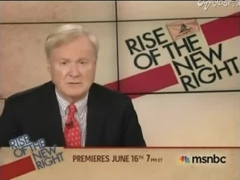
Chris Matthews Crams Year’s Worth of Anti-Tea Party Cliches into One Hour Special

What do Tea Partiers, Truthers, birthers, Birchers, militias, Pat Buchanan, Jerry Falwell, Barry Goldwater, Joe McCarthy, Father Coughlin, Glenn Beck, Rush Limbaugh, Sarah Palin, Michelle Bachmann, Ronald Reagan, Strom Thurmond, Rand Paul, Alex Jones, Orly Taitz, and Oklahoma City bomber Tim McVeigh all have in common? Approximately nothing, but don’t tell Chris Matthews. The MSNBC “Hardball” host spent the better part of an hour last night trying to associate all of these characters with one other. Of course he did not provide a shred of evidence beyond, ironically, a McCarthyite notion that all favor smaller government, and are therefore in league, whether they know it or not, to overthrow the government. Together, by Matthews’s account, they comprise or have given rise to the “New Right.” The special was less a history of the Tea Party movement than a history of leftist distortions of the Tea Party movement. As such, it tried — without offering any evidence, mind you — to paint the movement as potentially violent. Hence, after Matthews tried his hardest to link all of these characters, he went on to paint them all as supporting, inciting, or actually committing violence. Matthews trotted out Mark Potok of the Southern Poverty Law Center to claim that “one spark” could set the militia movement off into a violent frenzy. But Matthews used the statement not to indict the militias Potok was discussing, but rather as evidence that the Tea Party movement at-large is a violent one. Set aside for a moment the fact that Potok is nothing but a partisan hack with a pathetic track record of predicting violence, the B-roll footage while the thoroughly-discredited Potok was making these predictions was footage of the 9/12 Tea Party rally in Washington. This is what Matthews did throughout the special: splice together clips of militias firing weapons with Tea Party protesters in order to create a mental association between the groups. That there is no evidence whatsoever linking Tea Parties to militia groups, nor incidents of violence occurring at rallies, did not dissuade the former Jimmy Carter staffer. Matthews simply chose the unseemly route of trying to associate the numerous characters in his special without any evidence to back up his claims. The only connection that Matthews managed to legitimately draw between the Tea Party and militia groups — indeed, between any of the long list of characters mentioned above– is their aversion to government intervention in their daily lives. That’s right, in the same segment in which Matthews ragged against the late Joe McCarthy, he associated Tea Parties with the Hutaree Militia because both have a distaste for big government (the latter much stronger than the other, obviously). By Matthews’s logic, every American who has qualms with some element of capitalism is complicit in, and supports, openly or not, radical anarcho-socialist violence perpetrated at the G-8, or any other incident of leftist violence (and there have been many of late). Matthews himself has touted the wonders of the ” social state .” So he must support, or at least acknowledge the justifiability of folks who wish to violently overthrow the government and impose a socialist system. That is the only logical conclusion, if we accept Matthews’s premises. Such hypocrisy is rife in the special: if folks associated with the Tea Party use words like “revolution,” they must be literally advocating violence, whereas when mainstream leftists literally advocate violence , they are not worth mentioning. The special’s rank hypocrisy continues right through Matthews’s final monologue. “Words have consequences,” he states. “You cannot call a president’s policies ‘un-American,’ as Sarah Palin has done,” he claims. Or, Matthews forgot to add, as Salon Editor Joan Walsh and Time columnist Joe Klein have done, the former on Matthews’s show and the latter on another MSNBC program. You can’t “refer to the elected government as a ‘regime'” by Matthews’s account, unless, presumably, you are Chris Matthews or a host of other MSNBC personalities , in which case it is permissible. Given that the special really offered no new insight into the Tea Party movement — just the same cliches the Left has regurgitated since the fall of last year — it is hardly surprising, though worth mentioning, that neither Matthews nor any of his cohorts seem to remember their total lack of concern over the potential for anti-government violence during the Bush administration. A movie depicting the assassination of George W. Bush , the plethora of signs at anti-war rallies calling for his death , the litany of incidents of violence committed by leftist groups in the recent past — none of these things were particularly worrisome for the Left throughout Bush’s term. In all of these ways, the “Rise of the New Right” special was just more of the same.

Read the original here:
Chris Matthews Crams Year’s Worth of Anti-Tea Party Cliches into One Hour Special

Senators propose granting president power to shut down Internet in times of crisis

A new U.S. Senate bill would grant the president far-reaching emergency powers to seize control of or even shut down portions of the Internet. The legislation announced Thursday says that companies such as broadband providers, search engines, or software firms that the government selects “shall immediately comply with any emergency measure or action developed” by the Department of Homeland Security. Anyone failing to comply would be fined. That emergency authority would allow the federal government to “preserve those networks and assets and our country and protect our people,” Joe Lieberman, the primary sponsor of the measure and the chairman of the Homeland Security committee, told reporters on Thursday. Lieberman is an independent senator from Connecticut who caucuses with the Democrats. Because there are few limits on the president's emergency power, which can be renewed indefinitely, the densely worded 197-page bill (PDF) is likely to encounter stiff opposition. TechAmerica, probably the largest U.S. technology lobby group, said it was concerned about “unintended consequences that would result from the legislation's regulatory approach” and “the potential for absolute power.” And the Center for Democracy and Technology publicly worried that the Lieberman bill's emergency powers “include authority to shut down or limit Internet traffic on private systems.” The idea of an Internet “kill switch” that the president could flip is not new. A draft Senate proposal that CNET obtained in August allowed the White House to “declare a cybersecurity emergency,” and another from Sens. Jay Rockefeller (D-W.V.) and Olympia Snowe (R-Maine) would have explicitly given the government the power to “order the disconnection” of certain networks or Web sites. On Thursday, both senators lauded Lieberman's bill, which is formally titled the Protecting Cyberspace as a National Asset Act, or PCNAA. Rockefeller said “I commend” the drafters of the PCNAA. Collins went further, signing up at a co-sponsor and saying at a press conference that “we cannot afford to wait for a cyber 9/11 before our government realizes the importance of protecting our cyber resources.” Under PCNAA, the federal government's power to force private companies to comply with emergency decrees would become unusually broad. Any company on a list created by Homeland Security that also “relies on” the Internet, the telephone system, or any other component of the U.S. “information infrastructure” would be subject to command by a new National Center for Cybersecurity and Communications (NCCC) that would be created inside Homeland Security. The only obvious limitation on the NCCC's emergency power is one paragraph in the Lieberman bill that appears to have grown out of the Bush-era flap over warrantless wiretapping. That limitation says that the NCCC cannot order broadband providers or other companies to “conduct surveillance” of Americans unless it's otherwise legally authorized. Lieberman said Thursday that enactment of his bill needed to be a top congressional priority. “For all of its 'user-friendly' allure, the Internet can also be a dangerous place with electronic pipelines that run directly into everything from our personal bank accounts to key infrastructure to government and industrial secrets,” he said. “Our economic security, national security and public safety are now all at risk from new kinds of enemies–cyber-warriors, cyber-spies, cyber-terrorists and cyber-criminals.” A new cybersecurity bureaucracy Lieberman's proposal would form a powerful and extensive new Homeland Security bureaucracy around the NCCC, including “no less” than two deputy directors, and liaison officers to the Defense Department, Justice Department, Commerce Department, and the Director of National Intelligence. (How much the NCCC director's duties would overlap with those of the existing assistant secretary for infrastructure protection is not clear.) The NCCC also would be granted the power to monitor the “security status” of private sector Web sites, broadband providers, and other Internet components. Lieberman's legislation requires the NCCC to provide “situational awareness of the security status” of the portions of the Internet that are inside the United States — and also those portions in other countries that, if disrupted, could cause significant harm. Selected private companies would be required to participate in “information sharing” with the Feds. They must “certify in writing to the director” of the NCCC whether they have “developed and implemented” federally approved security measures, which could be anything from encryption to physical security mechanisms, or programming techniques that have been “approved by the director.” The NCCC director can “issue an order” in cases of noncompliance. The prospect of a vast new cybersecurity bureaucracy with power to command the private sector worries some privacy advocates. “This is a plan for an auto-immune reaction,” says Jim Harper, director of information studies at the libertarian Cato Institute. “When something goes wrong, the government will attack our infrastructure and make society weaker.” To sweeten the deal for industry groups, Lieberman has included a tantalizing offer absent from earlier drafts: immunity from civil lawsuits. If a software company's programming error costs customers billions, or a broadband provider intentionally cuts off its customers in response to a federal command, neither would be liable. If there's an “incident related to a cyber vulnerability” after the president has declared an emergency and the affected company has followed federal standards, plaintiffs' lawyers cannot collect damages for economic harm. And if the harm is caused by an emergency order from the Feds, not only does the possibility of damages virtually disappear, but the U.S. Treasury will even pick up the private company's tab. Another sweetener: A new White House office would be charged with forcing federal agencies to take cybersecurity more seriously, with the power to jeopardize their budgets if they fail to comply. The likely effect would be to increase government agencies' demand for security products. Tom Gann, McAfee's vice president for government relations, stopped short of criticizing the Lieberman bill, calling it a “very important piece of legislation.” McAfee is paying attention to “a number of provisions of the bill that could use work,” Gann said, and “we've certainly put some focus on the emergency provisions.” added by: samantha420

Networks Democratic Congressman’s Street Scuffle, But ABC Pounced on Catty Crack About Boxer’s Hair

None of the three broadcast evening newscasts had even a few seconds last night for video of Democratic Congressman Bob Etheridge physically grabbing and yelling at an unidentified student attempting to ask him whether he supports President Obama’s agenda. But last Thursday, after Republican senate candidate Carly Fiorina was caught making a flip remark about Democratic Senator Barbara Boxer’s hair, ABC’s World News ran a full report on that “caught on tape political moment.” Worth noting: Back on June 10, George Stephanopoulos was sitting in for Diane Sawyer. But last night, Sawyer was back in the anchor chair. In introducing last week’s report from correspondent Jonathan Karl, Stephanopoulos touted the Fiorina flap as “ the latest caught off guard, caught on tape, all too candid political moment.” The Etheridge scuffle would surely fit that same standard, but ABC’s World News had no time on Monday to mention that embarrassment for the Democrats. Fiorina’s campaign had previously been mentioned by World News in round-up pieces about this year’s elections, but Thursday’s item about her gaffe was the first report focused exclusively on her candidacy, a Nexis search reveals: FILL-IN ANCHOR GEORGE STEPHANOPOULOS: And now, to the latest caught off guard, caught on tape, all too candid political moment. Just hours after she became California’s Republican nominee for the Senate, Carly Fiorina forgot that for candidates, the camera is always hot. Here’s Jon Karl on an old lesson, learned again. CORRESPONDENT JONATHAN KARL: Year of the woman, maybe. MEG WHITMAN, GOP NOMINEE for CA GOVERNOR: What a great night. KARL: Year of the political outsider, undoubtedly. CARLY FIORINA, GOP NOMINEE for U.S. SENATE: Yeah, anyway, that’s what they said. KARL: But even if your name is Carly Fiorina and you’ve never run for office before, there’s one old rule that still applies: Beware of the open mike. FIORINA, SEARCHING FOR SOMETHING ON HER BLACKBERRY: I can’t find this thing. KARL: Still basking in her primary victory, Fiorina was waiting for an interview on KXTV in Sacramento when she started musing about her opponent’s hair style. FIORINA: Lauda (sp?) saw Barbara Boxer briefly on television this morning and said what everyone says, “God, what is that hair?” So, yesterday. KARL: But it happens. Even to political pros. Jesse Jackson, talking about cutting off a part of Barack Obama’s anatomy. [on screen: “I wanna cut his n_ts off.”] George W. Bush calling a reporter a CLIP OF GEORGE W. BUSH, 2000: (bleep). CLIP OF DICK CHENEY, 2000: Oh, yeah. Big time. KARL: Judging from Fiorina’s reaction when she realized the mic was on, that won’t be happening again. Jonathan Karl, ABC News, Washington. STEPHANOPOULOS: That lesson is burned in.

See the original post:
Networks Democratic Congressman’s Street Scuffle, But ABC Pounced on Catty Crack About Boxer’s Hair