Tag Archives: close reads

Can Battleship Strengthen Rihanna’s Image, Post-Chris Brown?

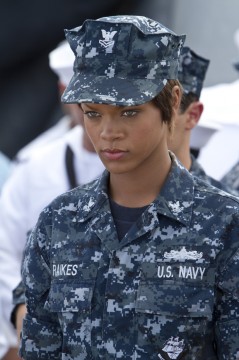
A new batch of Battleship stills show singer-turned-actress Rihanna in Navy gear manning all manner of combat machinery as the resident weapons specialist in Taylor Kitsch ‘s crew. But can her feature debut in Peter Berg’s summer blockbuster counteract the criticism she’s getting from reuniting, at least professionally, with Chris Brown? The stills (below, via Universal and Digital Spy ) hit the web at a conspicuous time for Rihanna, who was assaulted in 2009 by then-boyfriend Brown. After a three-year split, during which time Brown was sentenced to domestic violence counseling and community service and ordered to stay away from Rihanna by restraining order, the two collaborated on a pair of songs released this week. According to producer The-Dream, who oversaw the “Birthday Cake” remix featuring Brown, the move was Rihanna’s idea. “The true thing really is to forgive,” he explained to Billboard Magazine . “And … you want to believe in people.” Some celeb-watchers take the reunion as more than just a professional expression of forgiveness. “The message couldn’t have been clearer to the world,” writes Hollywood Life’s Bonnie Fuller. “We’re a couple again and we’re saying it in the strongest way that we know how — through our music.” That seems like a bit of a stretch, but whatever the relationship, many fans who supported Rihanna as she bounced back from the public fallout of the 2009 incident are understandably upset that the 24-year-old would unite on any front with her former attacker. Enter Battleship . Over a year after the assault, Rihanna was cast as Petty Officer Raikes in Universal’s naval actioner. She’d been looking to break into film already, telling MTV in 2008 that she was looking “seriously” into making her acting debut. Battleship , then, provided a prime opportunity; as Raikes, Rihanna gets to play a strong, serious-minded character involved directly in action sequences whom she’s described as “one of the guys” — as opposed to the film’s eye candy, as embodied in Brooklyn Decker as Kitsch’s love interest. That character quality alone may have been reason enough to break into a side career in acting with Battleship , but it also allows Rihanna to project an image of strength and resilience to her fans. At the helm of a gunboat or wielding assault rifles, she is seen in a position of control and dominance, the would-be executor of violence (against aliens, in this case) instead of a victim. Of course, that’s not to say Battleship will erase the image of Rihanna, battered and bruised, from our collective memories. It certainly shouldn’t, in the least. And it’s not quite a pointed personal statement that, say, a G.I. Jane or a Brave One -styled vigilante pic might be; it’s a subtle move that simultaneously eases first-time actor Rihanna into the movies in a supporting role with more seasoned actors around to do the heavy lifting. Conspicuous as it is that new Rihanna-holding-guns images were released into the world around the same time as her Chris Brown collaborations (joining a few more that were previously released by Universal), it hints at an effort to protect her image from the backlash that any Brown-related association invites. But Battleship has yet to be seen, and Rihanna, who hasn’t yet directly addressed the Brown collaborations, may yet still win back or further alienate her following in the weeks to come.
Here is the original post:
Can Battleship Strengthen Rihanna’s Image, Post-Chris Brown?

Summit and Lionsgate Hoping for Sixth Twilight Movie, Of Course

File under “Duh”: Summit and new overlords Lionsgate say they’d totally be interested in making a sixth Twilight movie , y’know, if author Stephenie Meyer is into it. I get it! It’s hard to pass up another shot at making hundreds of millions of dollars, not to mention fortunes in merchandising. And it’s not like we didn’t see this coming; with a first trailer for Breaking Dawn Part 2 set to be attached to Lionsgate’s Hunger Games in theaters next month, the studio’s pushing hard to make the most of its newfound YA synergy. How can it not try and keep the Twilight cash train rolling? Well, for starters, there’s a very good reason that a sixth, post- Breaking Dawn Pts. 1 & 2 sequel hasn’t been developed yet: With the exception of a supplemental novella ( The Short Second Life of Bree Tanner ) written to coincide with events of the third film, Eclipse , Meyer moved on to other properties like The Host , which is also being made into a film. A fifth Twilight novel, Midnight Sun , was once set to retell Twilight from Edward’s point of view, but Meyer herself spiked it when portions of her manuscript leaked online. (Meyer then posted it here .) Ever since then she’s kind of seemed done with writing more Twilight , even if the door has never been closed completely . And with Meyer so intrinsically linked to the film franchise, a sixth Twilight film would necessarily have to involve Meyer writing a fifth story (her fourth and final Twilight novel, Breaking Dawn , was split into a two-part film adaptation, the second of which hits screens this year). But even if Meyer agrees to a fifth book and sixth film, the motivation of continuing an otherwise concluded series might seem terribly transparent, and opportunistic, to a fanbase that adores the author as much for her vampire fantasy as for her openness with them over the years. Would Twilight fans eat up another chapter of Bella Swan’s life? Without a doubt, especially given the events that conclude the series in Breaking Dawn . But would it somehow cheapen the billion dollar franchise and the dedicated fandom that drives it? The question becomes less about the studios chasing sequels and more about how much Meyer is willing to risk signing off on, and how much her fans will care about the integrity of the franchise if it means they get another Twilight book and film. For many, I’m sure, the series could happily go on forever, manga-style, until the end of time. But as much as Lionsgate could conceivably milk Twilight for years and years to come, I’d like to think Twi-hards, who’ve had to defend themselves from global scrutiny for years and have been gleefully marketed to and squeezed of cash by savvy suits ever since 2008, would draw the line at some point. It’s a debate that J.K. Rowling faces, too, now that the Harry Potter saga has ended, on page and screen. But just as Daniel Radcliffe and Co. are moving on with their careers, so too do the Twilight kids seem ready to spread their wings. The end, it’s seemed for a while, is welcome in many regards. Their time with the franchise has been good — and has made stars of them all, considering that even previously unknown actors like Ashley Greene , for example, are now fronting their own films — but you get the feeling even the actors might dread another go-round (not to mention the fact that some of them are aging past the point of believable onscreen immortality). And so there are new franchises ready to follow the Twilight pattern of success, which brings us to The Hunger Games . Suzanne Collins only wrote three novels in her dystopian bestseller series, and yet, as confirmed last summer , Lionsgate plans on making four films from the series. Unlike Breaking Dawn , which contained a fairly obvious plot break at which the story could be divided, the third Hunger Games book, Mockingjay , seems less conducive to being split into two parts. I’d rather see it all go down in one part, personally, but here Lionsgate’s thinking is more conspicuous. Now that Summit has been slurped up by Lionsgate, I’ll be even less surprised if that cash-grabbing thought process is applied to Twilight . (Incidentally, Breaking Dawn Part 1 hits DVD and Blu-ray tonight.) Let’s just hope someone up there shows some restraint, sooner or later, whether it’s the suits, the stars, or Stephenie Meyer herself. Follow Jen Yamato on Twitter . Follow Movieline on Twitter .

View original post here:
Summit and Lionsgate Hoping for Sixth Twilight Movie, Of Course

How Your DVD Rentals Are Changing Hollywood

Quick quiz: If you were made to wait two months in order to rent say, Final Destination 5 , are you going to be more likely to purchase the DVD, or is it more likely you will forget it was on the saturated home-video market? An easy enough answer, maybe, but not for some of Hollywood’s major studios. They continue banking on the former scenario, despite your continued insistence on renting movies at affordable rates. As it turns out, a number of Hollywood’s companies are trying to revitalize their revenues and expand their scope — but those plans are getting screwed up by your viewing and spending habits.

 Let’s first reflect back to last fall, when Netflix announced the concept of Qwikster — the home-viewing giant’s infamous and short-lived plan to split the company into services (and prices) for DVD rentals and streaming video. The inspiration for that debacle was their forecast of dwindling DVD demand. The result? Vilification, ridicule, mass subscriber exodus, and a plummeting stock price. What a difference a few months makes. The company recently announced a surging final quarter , recovering swiftly from its folly and managing to replace a majority of those subscribers lost during the split-up proposal. More surprising was the news that Netflix’s main rival, the DVD-kiosk operator Redbox, took over as the number-one renter of DVDs and Blu-ray discs. Expect the company to maintain that top position, as this week it announced the purchase of 10,000 kiosk machines operating under the Blockbuster Express banner from rival company RCR. All of this is due to a simple market fact: Demand for affordable DVD rentals remains strong. Meanwhile, studios cling to the evaporating segment of DVD sales — and some are fiercely digging in under the delusion that if you have to wait longer to rent at low prices, then you will become motivated to purchase New Year’s Eve . Right. On the one hand, Hollywood is hardly wrong to anticipate movie fans’ demand-shift with content — and not just with the wait-to-rent audience that sat out the worst filmgoing year since 1992 . The popularity of streaming proves it to be the future of content delivery, but companies seem intent on leaving their customers behind. Anybody with a Netflix Instant subscription and a Roku box can attest to streaming’s fertile future, and from the studios’ own multi-platform content outlet Ultraviolet to Redbox’s just-announced streaming deal with Verizon, the major players are staking out their territory. On the other hand, all of this energy is channeled around the enduring demand to rent new DVDs at affordable rates. Redbox’s ascension speaks for itself, but the fiscal reality at Netflix is that even with twice the streaming subscribers, the DVD-by-mail division provides 50 percent of its gross (streaming thus far only manages 11 percent). “The discrepancy underscores an inconvenient truth for Netflix,” noted industry trade publication Home Media, “namely that while the future may belong to streaming, the present still is very much a disc-driven business, no matter how much management wants to spin it otherwise.”

 Yet as we drift from DVD purchases, the studios are reacting all too desperately to retain those sales numbers. Disney recently announced its intention to join Fox, Universal and Warner Bros. in invoking a 28-day waiting-period to rent new releases on DVD — news that followed Warners’ own decision last week to extend its own rental waiting period for new titles to 56 days. This despite the facts that these windows accompanied a continued plunge in DVD sales in 2011; in the fourth quarter of last year, more market revenue came in from DVD rentals than sales — the first time that has occurred since 1998. Those sales are likely to drop even further, in no small part due to the poorly received cinema titles of last year coming onto the home market. How have the rental companies responded to the call for longer delays? Mostly with a shrug: Netflix decided to simply go along with Warners’ new eight-week window. Redbox, meanwhile, pledged that if it cannot get titles from the studio, then it would seek alternative wholesale outlets for discs. It’s costlier, sure, but when the company raised its base rental price to $1.20 per title, up from 99 cents, it only went on to become number one in the marketplace. Consumers’ obvious preference for low-cost rentals means Redbox flourished as the one company with the continued confidence (or competence) to follow the money. In order to keep that strategy going, it needs to supply a diverse catalog one way or another. Predictably, Warner Bros. has become only more defensive, now leaning on wholesalers to restrict the number of copies sold to any vendor, hoping to limit the amount Redbox can acquire. And even when the studio gets its way — as when Netflix acquiesced to the extended waiting period — it remains unhappy. To wit, when these titles are not instantly on hand via DVD, Netflix subscribers wait it out by placing the titles in their rental queues until they are available. That’s not acceptable to Warners, which now forbids renters from so much as reserving one of its titles in their queues before the eventual rental date. Time Warner claimed last fall that this waiting-game strategy has been successful for them, but factoring in the continuing slide in disc sales would mean that Warner’s on-demand and brand new Ultraviolet titles would have to grow appreciably to compensate for both that drop and its widened rental window. We can reasonably call his bluff, however, especially with content providers like Warners remaining notoriously secretive about VOD numbers and applying persistent pressure upon discount renters in an effort to curtail their proven desires for affordable rates. The whole condition makes for a curious economic scenario: Studios looking back to an era of vibrant DVD sales, vendors looking forward to the streaming era and a majority of consumers left squarely in the middle. But one fundamental factor never changes: The companies need us more than we need them. And as long as we vote with our wallets, we’ll be heard. [Photo: Getty Images]

More:
How Your DVD Rentals Are Changing Hollywood

REVIEW: The Divide Drowns Flat Characters in Arty, Apocalyptic Gloss

Mickey (Michael Biehn), the paranoid building superintendent unwillingly responsible for allowing the characters in The Divide to survive the apocalypse, didn’t plan for or want company. And who can blame him? These people are awful . Like so many groups left in a survival situations (at least in movies, books and MTV reality shows), they shed their veneer of civilization with alarming rapidity as their lives take a turn for the worse. Written by Karl Mueller and Eron Sheean and directed by Xavier Gens, who earned a place for himself in the New French Extreme movement with his 2007  Frontier(s) before heading to Hollywood to make Hitman ,  The Divide is a stylish and would-be shocking variation on a familiar scenario, in which the horrors isolated survivors inflict on each other turn out to be worse than those lurking outside. Gens has talent, if also tendencies to steer the visuals into the music video realm, but he treats the characters here like mobile props and nothing more — the curve of a shaved skull or a tear trickling down a cheek just another bit of nice art direction on the gradual path toward the inevitable destruction of everyone on screen. What happened to the outside world is left to speculation — what looks like a bomb hits the city in the first scene, sending the inhabitants of a New York apartment building scrambling downstairs in search of shelter. Eight people force their way into Mickey’s shelter in the basement before he locks the door. There’s angular heroine Eva (Lauren German), her whiny French fiancé Sam (Iván González), Delvin (Courtney B. Vance), Bobby (Michael Eklund), brothers Josh (Milo Ventimiglia) and Adrien (Ashton Holmes), and Marilyn (Rosanna Arquette) and her daughter Wendy (Abbey Thickson). Mickey has food and water saved up, though not enough — at least not after strange men in hazmat suits barge into the underground shelter, kidnap the little girl, and weld the door shut on the remaining inhabitants. Hell may be other people, but it can also be scenarios in which people endlessly bicker their way to certain doom (this is why I find  The Walking Dead so hard to watch). Power games, alliances and divisions break out as time passes with no hope of rescue or an end, and as the characters grow more unstable and unhealthy, teeth falling out, hair growing patchy as they sit in the dark. Josh establishes himself as the alpha male, sharing Marilyn with Bobby in a scenario that degrades into violent sexual slavery — Arquette deserves either kudos or condolences for the degree to which she surrenders to a role that finds her being chained up, continually degraded and humiliated, treated like a dog, and smearing makeup on her face like some kind of crazed goth dolly. Eva is forced to protect Sam, who’s at the bottom of the totem pole, though she’s drawn to Adrien, who holds on to his sanity as the situation falls apart. These characters are at best doodles, and none of the performances are able to tease more depth out of them — the hints at history between them, like how Sam and Eva met, or the strained relationship between Josh and Adrien, are so sparse that when they’re thrown in they confuse more than they illuminate. The sprinkles of political relevance are clunkier and more problematic. Any film these days that includes the destruction of the New York skyline is going to calls up echoes of 9/11, but The Divide  strongly suggests that Mickey was a firefighter working that day whose issues and isolation are all related to that trauma, from his convictions that “the ragheads” are responsible for bombing the city to his creation of the underground bunker, decorated with an American flag. (Admittedly, Gens makes the Frenchman the least likable character — if the film’s a rough metaphor for a world in decline, the U.S. isn’t alone in taking on the chin.) At two hours, with its elegiac tone and deliberate pacing, The Divide  may lose gorehounds before it gets around to the finger chopping and corpse dismemberment. While there certainly are moments that will have the sensitive covering their eyes, the film’s most disturbing imagery isn’t actually related to carnage. A segment in which Josh heads outside to attempt to figure out what the suited-up soldiers are up to has a hallucinatory, medical nightmare feel to it, rich with the promise of terrible things going on just beyond our comprehension. Later, two characters shave their heads and eyebrows and transform themselves into near-alien figures out of a Matthew Barney video. Gens’s deftness with these visuals, and with the claustrophobic glide of his camera through the dim warrens of the underground space in which The Divide is almost exclusively set, is undeniable. It’s his apparent disinterest in the people filling it that makes the film such an uphill battle, in which the world ends and you can’t wait for the survivors just kill each other off already. Follow Alison Wilmore on Twitter . Follow Movieline on Twitter .

View original post here:
REVIEW: The Divide Drowns Flat Characters in Arty, Apocalyptic Gloss

Can Bill O’Reilly, Ridley & Tony Scott Top These Other Past and Future Retellings of Lincoln’s Assassination?

In 1865, actor and Confederate loyalist John Wilkes Booth assassinated President Abraham Lincoln in the balcony of Ford’s Theatre, committing one of the most notorious crimes in American history. In 2013, Fox News talking head Bill O’Reilly will team up with Tony and Ridley Scott for a two-hour National Geographic documentary exploring the events surrounding Lincoln’s death, adapted from Killing Lincoln: The Shocking Assassination That Changed America Forever , co-written by O’Reilly and Martin Dugard. But with so many previous Lincoln assassination projects in the ether, what new ground can O’Reilly and the Scott brothers tread in Killing Lincoln ? Lincoln’s death, of course, was so violent, tragic, and significant an event that it inspired many a filmmaker over the years. D.W. Griffith made a film in 1930 — his second screen depiction of the act — entitled simply Abraham Lincoln , that examined the president’s life, taking a few creative liberties along the way. (You can watch it here in its entirety, if you’re so inclined.) In the same decade, John Ford made two movies with ties to Lincoln: The Prisoner of Shark Island , about the doctor who tended to Booth after the attack on Lincoln, and Young Mr. Lincoln , which focused on the future president’s career as a young lawyer. And as the decades went on, scores more depictions of Lincoln’s life and death were committed to celluloid as generation after generation of filmmakers sought to mine the event for the social and historical significance it bore to the shaping of America. Unfortunately, other attempts, like Robert Redford’s recent The Conspirator , proved downright snoozeworthy. Hence, it seems, O’Reilly and the Scott brothers’ attempt to jazz up the Lincoln saga with “feature-like re-enactments, rare historical archives and CGI.” CGI! O’Reilly and Dugard’s 2011 nonfiction book promised “history that reads like a thriller.” Set your DVRs for high intrigue at Ford’s Theatre! (And if that’s not enough Honest Abe for ya, there’s also Steven Spielberg ‘s Daniel Day-Lewis-starring Lincoln biopic and the promising Abe Lincoln: Vampire Hunter coming up later this year.) Regardless of how much adrenaline the O’Reilly factor pumps into recreating Booth’s dastardly attack in Killing Lincoln , I’m not sure it could stand up to the rollicking menace of this recreation, as seen in the major motion picture National Treasure 2: Book of Secrets : Or: Might it unearth new theories regarding what motivated Booth to pull the trigger, a la Family Guy ? In any case, there’s no way Killing Lincoln can capture the truth of the event quite like this sketch from The Whitest Kids U Know . I’m pretty sure this is totally historically accurate .

More here:
Can Bill O’Reilly, Ridley & Tony Scott Top These Other Past and Future Retellings of Lincoln’s Assassination?

WATCH: Kirsten Dunst and Jim Sturgess Are Planet-Crossed Lovers in Upside Down

The premise for Argentinean director Juan Diego Solanas’s English-language sci-fi romance Upside Down has one helluva gimmick: Kirsten Dunst and Jim Sturgess find true love against huge odds, the hitch being that they live on inverted planets and are forbidden to cross over to each other’s world. Hell, some people won’t date outside of their area code. Watch the dazzling first trailer and appreciate how much easier relationships are should be on a single planet by comparison. Veuillez installer Flash Player pour lire la vidéo UPSIDE DOWN – BA VOST I love how Jim Sturgess always has that sad romantic hero look about him, as if he hasn’t cut or brushed that dreamy tousle since Across the Universe . (And why should he? It works! Swoon.) Upside Down looks to lean heavily on the dystopian alternate sci-fi universe schtick the central gimmick posits (“I can’t talk to you… you’re from Down Below “) and the Inception gravity tumbling already gives me a bit of a headache. But how gorgeous this all looks! For some reason I get a bit of a Titanic vibe when Sturgess lets go and falls back down to his own world. I think that’s a good thing? (Never let go…) Verdict: I’m so there. Double bill it with Melancholia , anyone? [ Bleeding Cool via HitFix ]

Excerpt from:
WATCH: Kirsten Dunst and Jim Sturgess Are Planet-Crossed Lovers in Upside Down

Here’s My Beef With Taylor Swift’s Hunger Games Song

The problem with Taylor Swift ’s Hunger Games single “Safe & Sound” is – sorry, Swifties – Taylor Swift. Taken on its own it’s a perfectly lovely slice of discordant Americana pop that wisps beautifully with Swift’s reedy warbling as she sings about protecting loved ones as a war rages outside. But as a Hunger Games song… as what promises to be the Hunger Games song associated with the movie (besides Rue’s iconic ditty within the film), it leaves something to be desired precisely because Swift is singing in the spirit and voice of Katniss Everdeen . And you, my adorable little Taylor, are no Katniss Everdeen. Here’s the thing: I have a bit of a love-hate relationship with the oeuvre of Taylor Swift. Do I sing along every time “Love Story” comes on the radio? Fine, yes. Will I ever forget the ear-bleedingly bad live performance she gave at the 2010 Grammys, as horrified duet partner Stevie Nicks gamely powered through? Never. It haunts my waking dreams. And yet Swift is just too bubbly and cute to loathe, dammit. Remember her in Valentine’s Day , all track shorts and legs and smiles? She’s like a crinkle-haired bubblegum-singing bunny rabbit. There is no hating her. So it’s not that I hate Swift as I listen to the twangy strains of “Safe & Sound,” as backed by the band The Civil Wars. But as the first song released from the Hunger Games soundtrack it’s the film’s leading pop single, the one that will be associated with the beloved book’s adaptation from the get go in mainstream media. And it’s kind of disappointing that Swift’s voice is so overpoweringly front and center whilst crooning about life from Katniss’s perspective. Consider another recent pop single from a beloved YA film franchise: Bruno Mars’s Breaking Dawn ditty. Now that’s a catchy, hook-filled number that dances the line between Mars’s signature sound (okay, so it sounds exactly like a Bruno Mars song) while being vaguely related to the themes of the film. Something about if you go away it will rain and your father not approving of your “troublesome” boyfriend. Sure. Why not? Bruno Mars isn’t singing as if he’s Bella Swan. We are not meant to identify him with our heroine, hence Mars seems as if he was simply influenced to write a love song after Netflixing Twilight or something. In Swift’s case, she’s singing as if she is Katniss. And therein lies the problem. Give this song to a singer with a less confrontational voice (Gillian Welch, if she was 17?) and it’d be instantly more palatable. The showy breathiness of Swift’s voice never lets you forget that it’s Taylor Swift singing. I imagine this playing over the end credits of The Hunger Games , a seemingly contemplative coda to the senseless carnage Katniss lives through in the series’ first installment, and Swift’s voice needling its way into my head from the first verse, breaking through my Hunger Games afterglow. TAYLOR SWIFT TAYLOR SWIFT TAYLOR SWIFT is all I fear I’ll be able to think as I exit the theater come March. Worse: The idea of Taylor Swift channeling Katniss Everdeen – singing her life with her words! Killing me softly, and not in a good way! — is an unfathomable vision that does not compute. Put Swift in the Cornucopia and she’d be the first to go down, no question. I’d almost rather Jennifer Lawrence sung the theme song herself. I know it makes total sense for Lionsgate given the tween/teen/YA demographic of The Hunger Games movies, which aim to fill the Twilight gap, and the universal truth that all 13-year-olds love and worship Taylor Swift. But not all of us Hunger Games fans are members of the Taylor Swift fan club. Can we at least graduate to less wimpy pop stars (How about Demi Lovato ? She’s been to rehab !) for the Catching Fire soundtrack? Follow Jen Yamato on Twitter . Follow Movieline on Twitter .

View original post here:
Here’s My Beef With Taylor Swift’s Hunger Games Song

The Ides of March, The Artist and Other Moviegoing Let-Downs of 2011

The key to a list of moviegoing disappointments is the element of expectation: I am prepared to say I watched more suicidally bad films in 2011 than in any other year in my life; to be merely disappointed suggests a certain relativity. For example, I found The Ides of March to be a tremendous let down, I think partly because my hopes were inflated. George Clooney’s high political tragedy is perfectly cast, and that early, loaded exchange of glances between rival campaign managers Phillip Seymour Hoffman and Paul Giamatti goes off like a starter pistol. But The Ides of March is like that — it keeps threatening to start something interesting, right up to the point that it just… ends. I had the same issue with Good Night and Good Luck , another major disappointment and another film that played as if it were perpetually about to begin . The pleasures of Ryan Gosling’s performance as the fledgling spinmeister feel stingy — why tell us that he’s known to rock the microphone when we paid for the show? And Clooney’s Teflon governor is an empty, well-cut overcoat — perhaps the most glaring evidence of both the character and the director’s failure is that his one big scene with his golden boy star is the least exciting one in the movie. Given the improbable, stadium-rolling wave of appreciation that greeted The Artist , I expected much more than the mannered silent that Michel Hazanavicius and co. delivered. A mediocre movie with a couple of bright moments, The Artist also had too little to say about its chosen themes. Given the challenge of holding our attention across a silent film landscape, the music felt either too sparse or too sentimentally obvious, and the droopy patches felt twice as long as they needed to. The story of a silent film star left behind by the transition to sound was unconvincing when it needed to be clear and dolorous when it might have been lyrical. Similarly cranky friends have fixated on the issue of George Valentin’s (Jean Dujardin) refusal to speak on film—was it the accent? A principled stance? The fact that they were at all unsure points out a massive gap in the center of The Artist , one its title sews up too neatly. Any close follower of Werner Herzog’s career should know better than to bring expectations brewed from his last film into the next. Along with an auteurist consistency of preoccupations, Herzog shares with Woody Allen a prodigious output of wildly variable quality. The titles of this year’s Herzogian harvest — the sublime Cave of Forgotten Dreams and the slapdash Into the Abyss — seem interchangeable, but the latter felt to me like Achilles Herzog, a hot check of a documentary passed off as the real thing. Researched and assembled under extreme time constraints, Into the Abyss is an inquiry into the death penalty that gets by on artful narrative juxtapositions and moments of profound, almost invasive intimacy with its interview subjects. The reach for effect often feels more craven than considered, and the crime at the heart of the film is eventually clouded over for convenience. When a topic and a director — and a title! — of this magnitude collide, the viewer wants the Earth to shimmy; instead we had to settle for the Richter equivalent of a quick freehand sketch. I’ve watched Tinker, Tailor, Soldier, Spy twice now and I still couldn’t give you a basic plot summary. Having felt like a failure after the first viewing, after the second I’m prepared to push the better part of the blame onto director Tomas Alfredson and his Let the Right One In editor Dino Jonsäter. It’s a film that seems designed for le Carré obsessives, which means the rest of us may have to sit through all 57 hours of the 1979 BBC production just to get the facts straight. It’s a shame, because the performances and the production design knocked me out, but of all the ways to sex up a retro-procedural, I’d put mincing it into incomprehensibility second to casting Young Jeezy as George Smiley. With The Iron Lady Meryl Streep re-stamps her all-access passport to human history, and proves once again that the only thing she can’t seem to defy are superlative clichés. There are no words left to describe the kind of work Streep does — even those who dismiss her as a mere impressionist have to admit that her Margaret Thatcher is uncanny in its near-total self-effacement. But the film built around that performance is in some sense designed to disappoint: The biopic is an inefficient delivery system for dramatic tension or even, paradoxically, the human arc of a lifetime. It’s the movie equivalent of a greatest hits package, and while I’m not crazy about the appropriation of the still-living Thatcher’s dementia as a dramatic device, for me the more broadly director Phyllida Lloyd played her hand — ruining every successful visual cue by repeating it three times, leaping from one familiar milestone to the next — the farther we move away from the potential of Streep’s performance and the uneven richness of Thatcher’s story, into the straight flush of political iconography. Follow Michelle Orange on Twitter . Follow Movieline on Twitter .

Continued here:
The Ides of March, The Artist and Other Moviegoing Let-Downs of 2011

Exclusive: New Marty Feldman Bio Goes Behind the Scenes of Young Frankenstein

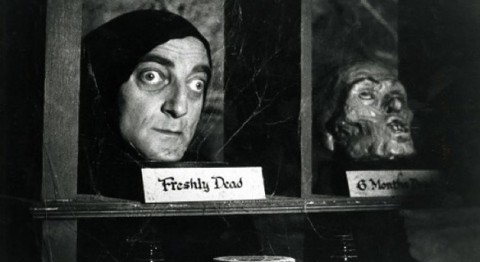
This week brings film buffs and comedy devotees alike the pleasure of Marty Feldman: The Biography of a Comedy Legend , author Robert Ross’s revelatory new chronicle of the turbulent life and premature death of the titular British TV and film comic. An aspiring jazz musician-turned-comedian known predominantly for the pop-eyed visage he brought to his acting, writing and directing projects, Feldman’s broad influence on British comedy of the ’60s receives a close look from interview subjects including Michael Palin, Terry Jones and, from tapes recorded for his unfinished memoir, even Feldman himself. But his impact hardly ended there — as anyone who’s seen Young Frankenstein knows.

See more here:
Exclusive: New Marty Feldman Bio Goes Behind the Scenes of Young Frankenstein

REVIEW: Inspirational Dolphin Tale Doesn’t Go All Soppy

You couldn’t come up with a simpler, more nakedly inspirational story than the one told in Dolphin Tale : Unhappy, disengaged child of single mom finds a wounded dolphin caught in a trap’s ropes and cuts it free; proceeds to bond with the rescue group that’s working to rehabilitate said dolphin; becomes a chief player in dolphin’s gradual and difficult return to swimming with confidence.

Go here to see the original:
REVIEW: Inspirational Dolphin Tale Doesn’t Go All Soppy