I’ve been in love with Cheryl Tweedy for I don’t know how many years now, but I’m not sure if I’ve ever heard her sing. I heard her speak once and I couldn’t understand a word she said, so I can’t imagine her music being all that great, but she’s so hot that I just don’t care. Here she is showing off her luscious long legs and perfect little booty on the set of her new music video. I love that cheesy stripper tattoo on her upper thigh. Classy.
Critics mostly agree that Jonah Hill and Channing Tatum’s undercover cop comedy is ‘a vibrant reboot of a rather forgettable ’80s TV series.’ By Eric Ditzian Channing Tatum and Jonah Hill in “21 Jump Street” Photo: Sony Where my laughs at? We’ve been suffering through a far-too-serious start at the 2012 box office. The first three-and-a-half months of the year have been dominated by weepy dramas (“The Vow”), kid-friendly animated fare (“The Lorax”), middling horror flicks (“The Devil Inside”) and films that should have kept geek flags around the country flying high but instead could barely inspire a gust of nerdy enthusiasm (“John Carter,” “Ghost Rider: Spirit of Vengeance”). Even the adventure-comedy “Journey 2: The Mystery Island” — #4, somehow, on the year’s top-grossing-movies list — elicited more forehead-smacking guffaws than genuine belly laughs. “21 Jump Street” is about to change all of that. As our friends over at NextMovie put it, Jonah Hill’s new film is the “first must-see comedy of the year.” The majority of critics agree, praising the movie’s big laughs, star players and killer supporting performances. Read on for a deep dive into the “21 Jump Street” reviews. The Story “Jonah Hill and Channing Tatum as novice cops who are forced to go undercover as high-school students to bust up a drug ring? Come on, that movie’s going to blow, right? But ’21 Jump Street’ doesn’t blow — which could have been this movie’s raunchy, self-deprecating tagline if it didn’t already have several. ’21 Jump Street’ isn’t a wild, fresh reinvention of the movie-clich
Critics are divided over Will Ferrell’s campy telenovela parody. By Kara Warner Will Ferrell and Diego Luna in “Cada de mi Padre” Photo: Pantelion Films At this point in his storied career, Will Ferrell has taught his fans to expect the unexpected. His latest film, “Casa de Mi Padre,” is a perfect example. The outrageous, purposefully campy and telenovela-esque flick is most certainly not a movie for everyone, and critics are divided on whether its ridiculousness is fun or just plain ridiculous; it currently has a 46 percent Fresh rating over at Rotten Tomatoes . Vamanos a las criticas de “Casa de Mi Padre”! The Premise : “Will Ferrell, speaking passable Spanish (with English subtitles), plays Armando Alvarez, a Mexican rancher hot for the fianc
This is pretty much perfect: “since i am blamed whenever people don’t like it, but never praised when they do, and since most critics forget that they liked or hated something two years ago and cite it as a strength or weakness two years later, i’ve come to be philosophical about the show. if people don’t like the comic who hosts, they hate the show. if no comic hosts, they hate the show and demand that a comic be summoned. when he’s edgier, like chris rock, we get slammed. when he’s bland, like ellen, we get slammed. but a few things are clear. this is the oscars. they still mean something after 83 years, at least in the industry. unlike the mtv awards, their audience is not exclusively 9-18 year olds. unlike the golden globes, the voters are people who actually make movies, not pretend to be journalists. some things are simply inappropriate. it’s a dance every year to figure out what those are. every single line on the oscar show is negotiated. unless you’ve been there, you have no idea how it is put together. it’s like nothing else on earth. i’m writing a book about it, but i have to throw in my sexual escapades to make sure it sells.” [ Filmdrunk ] [Photo: Helga Esteb / Shutterstock.com ]
In February, a federal court threw out a suit filed by Stan Lee Media Inc. against Paradox Entertainment — a failed attempt for the plaintiff to regain the intellectual-property rights of the Conan comic character. It might seem odd enough that a company sues for a claim to the proceeds of a film that lost tens of millions of dollars last summer, but odder still is that Stan Lee himself — the comic-book mastermind responsible for The Avengers, X-Men, Spider-Man, and hundreds of other iconic characters — was neither the plaintiff nor the defendant in that suit. As has been the case for over a decade, the legal wrangling surrounding Lee has been as convoluted and nonsensical as the script to Elektra , and it will only get more confounding on Thursday, when a new federal case comes to trial pitting SLMI against its namesake himself. That’s right: Stan Lee Media is suing Stan Lee over characters created by Stan Lee. Figuring out how an individual becomes a defendant in a case filed by the company bearing his name is an effort nearly as heroic as his own characters’ feats. It involves Lee bouncing between companies during repeated bankruptcies and determining where he was when activities took place. It also involves a company refusing to back down despite losing numerous judgments, and despite the exodus of the eponymous leader. Much of the acrimony dates back to the 1990s, when Lee was still the figurehead at the then-struggling Marvel. Throughout that decade the comic company over-leveraged acquisitions and hemorrhaged enough money to land in bankruptcy. By 1998, the company used that proceeding to end Lee’s contract of $1 million annual salary for life. Stan Lee left Marvel and started a new company , Stan Lee Entertainment (soon becoming SLMI) as a way to maintain control over his intellectual property. The company was started by Lee with a close friend, Peter F. Paul — a man with a checkered history of federal drug and conspiracy convictions for crimes including, but not limited to, selling $8.7 million worth of ” nonexistent coffee ” to Fidel Castro. Paul was to have an equally troubled future that would soon ensnare his new partner Lee. Initially the company made an impact with online animated comics, developing new characters on Web sites with the expectation of spinning them off into various media. The company enjoyed initial success. The creation known as The 7th Portal, for starters, had been acquired by Fox television for foreign broadcast, and was featured as a 3-D attraction for Paramount Theme Parks. Like so many digitally-based companies of the era, SLMI foundered with the bursting tech bubble. Then, after Peter Paul secured a bridge loan to prop up the struggling enterprise, he and numerous board members dumped large amounts of holdings ahead of the ultimate stock collapse. The Securities and Exchange Commission feared insider trading, and Paul feared the SEC — so he fled for Brazil. The company’s stock price plunged to $.13 per share by the end of 2000, and it filed for bankruptcy in February 2001. Two key events occurred during this time. Sensing both SLMI’s downfall and encroaching legal troubles, Lee founded POW! Entertainment — a new company that was strictly his own. He transferred the rights of his properties to POW! during bankruptcy and then departed SLMI. Additionally, in November of 2000, SLMI had negotiated for ownership of the Conan franchise. This came from purchasing all outstanding shares of rights-holder Conan Properties in exchange for SLMI stock, with a minimum price attached. It didn’t take long for this deal to become compromised: The next month, following the stock dump by Paul and other officers, SLMI was delisted from trading by NASDAQ . Sitting in possession of worthless holdings, Conan Properties sued for a reversal of the sale, and in 2002 a bankruptcy court returned the rights to the company. (It eventually sold those rights to Paradox, a Swedish entertainment entity which shepherded the latest Conan film to the screen with Lionsgate.) The latter events coincided with Marvel’s incredible comeback. Led by Vice Chairman (and longtime Marvel power broker) Isaac Perlmutter, the company had climbed out of bankruptcy by licensing the film rights for several of its highest-profile characters including Spider-Man (which Sony would soon develop into a box-office behemoth), X-Men and the Fantastic Four (both successfully adapted by Fox). In light of this swift, lucrative reversal of misfortune, Lee brought suit against Marvel for terminating his contract and demanding payment on the promise of 10 percent of profits earned by characters of his creation. Yet even while he pursued this lawsuit, Lee — and his intellectual property — returned to Marvel. Here is where the dispute regarding rights to Lee’s characters, and whether they ever actually left Marvel, is focused — a dispute SLMI has been trying to win for years and which this week’s trial will attempt to settle once and for all. In 2005, Marvel and Lee settled their case before going to jury; the court records were sealed, although Marvel later reported a $10 million write-down with regard to Lee. Meanwhile, that same year, Peter F. Paul was extradited from Brazil, earning four years of house arrest and 10 years imprisonment after separate plea deals in his SLMI stock-manipulation case. Once he returned to the States, a new group of his acolytes organized as board of directors for SLMI. Since then the company has been rather adept at filing — if not quite winning — lawsuits. Routinely, its legal attempts at securing the rights to comic characters have been denied or dismissed entirely in courts from New York to Los Angeles to Colorado. One suit sought to unseal the 2005 Lee/Marvel settlement in search of proof that Lee left Marvel in 1998 with the rights to his characters. Such a discovery would seemingly prove that Lee brought those rights to SLMI after Marvel spiked his contract and before fleeing SLMI with them illegally. Ultimately SLMI wants to prove that Lee was colluding with Marvel to cover the rights transfer in their 2005 settlement, thus entitling Marvel to full rights while Lee shared in huge profits. In dismissing that case in February 2011, U.S District Judge Robert Sweet summarized the lack of standing SLMI held as the intervening party, writing, “Their alleged mutual misrepresentations regarding the action’s real party in interest, and their mutual mischaracterization of the nature and effect of the Marvel/Lee Employment Agreement have not been established.” Lack of standing has done little to stop SLMI in its legal lurches. It took nine years following the bankruptcy ruling before the board decided to spring up suddenly with its claim to the rights of Conan; it cannily filed that lawsuit the very day Conan debuted in theaters last August. The judge in that case last month rejected the company’s claims, stating that SLMI could not demonstrate proper standing and harm. That makes sense: The company dissolved one month following the Conan rights deal and had no funds to create any product; hard to show harm when you have nothing to show at all. Rather than a formidable archenemy from Lee’s imagination, Stan Lee Media Inc. instead resurfaces with all the predictability and impotency of a villain defeated repeatedly in a serialized superhero saga. Nevertheless, SLMI forges ahead undeterred with its legal process — largely because the company has nothing to lose; it has not produced anything in over a decade. It doesn’t even have a functioning Web site . Making a play for some of the most lucrative properties in Hollywood is all Stan Lee Media Inc. has in its arsenal, and the potential windfall is enough to motivate continuous torts. In a bit of understatement, Judge Sweet alluded to this possible perpetuity when he wrote, “Because of the success of the characters and the conflicting claims concerning their rights, it has been difficult to achieve finality.” Should a loss in this week’s case send SLMI away for good, it still won’t be the end of the lawsuits regarding these properties. The estate of Jack Kirby, a former collaborator of Lee, has also taken to the courts regarding copyrights of characters he also had a hand in creating. Expect Marvel and its corporate parents at Disney to be gathering an Avengers team of lawyers in their defense for years to come. Brad Slager has written about movies and entertainment for Film Threat, Mediaite, and is a columnist at CHUD.com . His less insightful impressions on entertainment can be found on Twitter . [Photos via Shutterstock ; Illustration: Movieline]
On the call, someone called ‘Ru’ was asked to provide an address for emergency responders. By Kara Warner Demi Moore with daughter Rumer Willis Photo: Getty Images Ever since news of Demi Moore’s hospitalization broke, more details have emerged each day to paint a clearer picture of the circumstances that led to the actress’ ambulance ride to the ER on Monday night. Some reports have claimed Moore was inhaling nitrous oxide from aerosol cans, also known as whip-its, the night the 911 call was placed from her home in Los Angeles, the recording and details of which were released Friday (January 27). Several people were heard on the call describing various symptoms the actress was experiencing at the time, as well as a few comments that seemed to indicate that Moore’s friends were just learning of her alleged substance abuse. Photos: Demi Moore through the years. One question that is causing a buzz online is whether Moore’s 23-year-old daughter, Rumer Willis, was present during the ordeal. Careful listening of the 911 call reveals an exchange between one of the callers and someone named “Ru,” who is asked for the specific address and instructions for how the paramedics can get to the house. “Hey, Ru, what’s the name at the gate so that we can buzz them in from here?” a man is heard asking on the call. There has been no confirmation regarding Rumer’s presence at the scene, but she reportedly goes by the “Ru” nickname and references it on her Twitter account. Sources told E! News that Moore’s three daughters are doing fine since their mom’s health scare. Rumer reportedly visited her mother several times at the hospital before she was discharged earlier this week . Tallulah, 17, is with her dad, Bruce Willis. “She’s doing great,” the source said. “Her grandmother [Bruce’s mom] is also there with her.” Moore’s other daughter, 20-year-old Scout, goes to Brown University in Rhode Island and reportedly hasn’t been home since the incident.
Effects work ‘frighteningly well’ but ‘premise is so devoutly ridiculous,’ critics say. By Kara Warner Sam Worthington in “Man on a Ledge” Photo: Summit If your impressions about the new action thriller “Man on a Ledge” are based on the film’s very-literal title , you’re very likely correct in assuming to know a decent amount about the film before entering the theater. “Ledge” is the story of ex-cop and fugitive Nick Cassidy (Sam Worthington), whose seemingly obvious suicidal plan to jump off a building is slowly revealed to be something much more. Thus far, the critical reception for the film is very different from initial audience reactions. The Rotten Tomatoes Tomatometer has “Ledge” at a 22 percent fresh rating from critics, versus a 65 percent fresh audience rating. Read on to see what has the two viewing bodies so divided as we sift through the “Man on a Ledge” reviews: The Premise “It’s an arresting image, Sam Worthington out on that 40th-story ledge. He’s a fairly tough-looking guy, after all, and we know him best as the tooth-gritting blockbuster hero of ‘Avatar’ and ‘Clash of the Titans,’ so it’s head-spinning to see the man’s beefy figure as a speck hovering so precariously close to New York’s infinite sky. The camera swirls around Worthington’s disgraced former cop Nick Cassidy, inching out past that thin strip of architecture, then back in. What if he trips, or jumps? For a while, anything seems possible, and it’s both exhilarating and terrifying. Then the wool comes off, and it’s clear that director Asger Leth and screenwriter Pablo Fenjves have ambitions considerably less grand than their protagonist’s perch. Cassidy’s ledge game — with all the studio-unfriendly moral ambiguities it entails — is just a con, a photo op for the crowds, and Nick’s apparent desire to exit the material world is a front. What he truly, passionately wants to do is steal some jewelry.” — Andrew Lapin, NPR The Impact of Practical Effect “I, on the other hand, was gripping anything in reach, palms dripping, thinking I might not have survived the effects had they been 3-D. Though there were other production sites, serious time was spent actually shooting on that 14-inch ledge wrapping the 21st floor of the Roosevelt Hotel to create the vicarious sensation of being there. Which worked frighteningly well, at least for the vertiginous among us. Oh, that the actual human dynamics of the unfolding story could have been as dramatic, as on the edge as that ledge.” — Betsy Sharkey, Los Angeles Times The Direction “Mr. Leth, the son of renowned Danish documentarian Jorgen Leth, has directed only one other film, ‘Ghosts of Cit
Effects work ‘frighteningly well’ but ‘premise is so devoutly ridiculous,’ critics say. By Kara Warner Sam Worthington in “Man on a Ledge” Photo: Summit If your impressions about the new action thriller “Man on a Ledge” are based on the film’s very-literal title , you’re very likely correct in assuming to know a decent amount about the film before entering the theater. “Ledge” is the story of ex-cop and fugitive Nick Cassidy (Sam Worthington), whose seemingly obvious suicidal plan to jump off a building is slowly revealed to be something much more. Thus far, the critical reception for the film is very different from initial audience reactions. The Rotten Tomatoes Tomatometer has “Ledge” at a 22 percent fresh rating from critics, versus a 65 percent fresh audience rating. Read on to see what has the two viewing bodies so divided as we sift through the “Man on a Ledge” reviews: The Premise “It’s an arresting image, Sam Worthington out on that 40th-story ledge. He’s a fairly tough-looking guy, after all, and we know him best as the tooth-gritting blockbuster hero of ‘Avatar’ and ‘Clash of the Titans,’ so it’s head-spinning to see the man’s beefy figure as a speck hovering so precariously close to New York’s infinite sky. The camera swirls around Worthington’s disgraced former cop Nick Cassidy, inching out past that thin strip of architecture, then back in. What if he trips, or jumps? For a while, anything seems possible, and it’s both exhilarating and terrifying. Then the wool comes off, and it’s clear that director Asger Leth and screenwriter Pablo Fenjves have ambitions considerably less grand than their protagonist’s perch. Cassidy’s ledge game — with all the studio-unfriendly moral ambiguities it entails — is just a con, a photo op for the crowds, and Nick’s apparent desire to exit the material world is a front. What he truly, passionately wants to do is steal some jewelry.” — Andrew Lapin, NPR The Impact of Practical Effect “I, on the other hand, was gripping anything in reach, palms dripping, thinking I might not have survived the effects had they been 3-D. Though there were other production sites, serious time was spent actually shooting on that 14-inch ledge wrapping the 21st floor of the Roosevelt Hotel to create the vicarious sensation of being there. Which worked frighteningly well, at least for the vertiginous among us. Oh, that the actual human dynamics of the unfolding story could have been as dramatic, as on the edge as that ledge.” — Betsy Sharkey, Los Angeles Times The Direction “Mr. Leth, the son of renowned Danish documentarian Jorgen Leth, has directed only one other film, ‘Ghosts of Cit
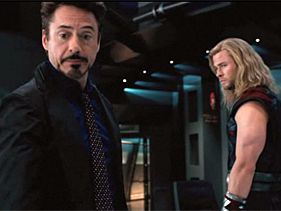
MTV News speculates on which Marvel Comics baddie will be joining forces with Loki when ‘Marvel’s The Avengers’ assembles this summer. By Josh Wigler Robert Downey Jr. and Chris Hemsworth in “The Avengers” Photo: Paramount “Marvel’s The Avengers” promises to pit Earth’s Mightiest Heroes — Captain America, Iron Man, Thor, Hulk, Black Widow and Hawkeye, in case you’ve somehow forgotten — against the trickster god Loki, as well as another nemesis that remains unidentified. Popular theories have long pegged the Skrulls, Marvel’s shape-shifting alien menace, as the likeliest group to join forces with the disenfranchised Asgardian prince. Many fans are also expecting to see another possible foe, “Captain America” villain Red Skull, based on his inclusion in an upcoming “Avengers” action figure line . But leave it to Kevin Feige, head of Marvel Studios, to bust both rumors. Speaking with Empire magazine last week, he revealed that the still-unknown secondary baddies are “not Skrulls.” Additionally, while it would be nice to see Hugo Weaving’s villainous visage at some point down the line, “he’s not in this one.” So, no Skrulls. No Red Skull. It’s Loki, and it’s … someone or something else. But who or what? Feige promised that while Marvel wants to hide the identity of “the alien race” that’s confronting our favorite superheroes, their identity is “not impactful,” even though they exist in the comic books. One imagines, then, that the Kree are out along with the Skrulls. Perhaps it’s as simple as a return of the Jotunheim, last seen in 2011’s “Thor.” Maybe it’s just arbitrary and the identity of these aliens truly does not matter. That doesn’t mean the mystery isn’t important. And that doesn’t mean the aliens are the mystery villain, either. The Latino Review once put forth a report — one that’s unverified by all accounts — stating that Thanos, the hulking purple-skinned alien that’s frequently dusted up with the Avengers and other Marvel heroes, is the secret villain we’ve all been wondering about. It’s a rumor to be sure, but it’s one I’m inclined to believe for a couple of reasons … and it all goes back to Comic-Con. In July 2010, the Marvel booth at Comic-Con featured a display case filled with items from the studio’s upcoming comic book movies. Among them: Thor’s hammer Mjolnir, Captain America’s mighty shield and the bejeweled Infinity Gauntlet. The Gauntlet is one of the more prominent items in the cosmic side of the Marvel Universe, one that’s virtually synonymous with Thanos. Indeed, its inclusion in the Marvel display case felt like an unspoken promise that Thanos would someday have a part to play in the company’s cinematic future. Cut to “Thor” almost a year later, and the Gauntlet appeared as a blink-and-you’ll-miss-it Easter egg that came and went when Jotunheim thieves infiltrated Asgard to reclaim their long-lost prize, the Casket of Ancient Winters. Could it be that the Gauntlet only existed as a wink and nod to the fans back home? Entirely possible. But what if Loki, who clearly knows the history and value of the Casket, has information on the other items contained in Asgard — including what the Gauntlet is, and who would do anything to have it? For someone mightily pissed off at his brother and the Earth-dwellers he’s become so fond of, that’s very powerful information indeed. Consider also that Feige, the same man who kiboshed the Skrulls and Skull, has long said that the cosmic side of Marvel is a big priority for him. In fact, just a few months ago, he revealed that movies based on the “Inhumans” and “Guardians of the Galaxy” were on the docket at Marvel Studios. Fantastic reads both of them, no question, but obscure beyond belief to the non-comic book reader. If Feige is looking ahead at “phase two” of the Marvel plan, as he’s called it in the past, are “Inhumans” and “Guardians” really the best places to start? Perhaps they are … if someone huge, someone massive, someone like Thanos, makes his first appearance in “Avengers,” and lives on to stalk the stars (and the screen) another day. It’s not the meatiest theory out there. It’s based on a rumor, on a taste of what Marvel has given us both on and off the screen, and on a desire to see someone important occupy this oh-so-secretive role. For Feige to come out and say the movie’s second villainous force is not the Skrulls and not Red Skull, and that Loki’s alien army is “not impactful” in identity … either he’s not telling the full story on who or what this unseen enemy represents, or the big reveal is going to be a massive letdown. Given how Marvel has operated in recent years, and given the importance of “Avengers” to their brand and plans, I just don’t see it being the latter option. Here’s what I do see. Loki aside, “The Avengers” will have another deeply meaningful foe to fight come May 4, 2012. And my considerably sized gut tells me it’s going to be Thanos. Who do you think the secret “Avengers” villain will be? Tell us in the comments section. Check out everything we’ve got on “Marvel’s The Avengers.” For breaking news, celebrity columns, humor and more — updated around the clock — visit MTVMoviesBlog.com . Related Photos Key Scenes From The ‘Avengers’ Trailer ‘Avengers’ Take Manhattan: Five NYC Locations From The Trailer





 Breaking Sports Video







