Tag Archives: congress

Big 3 Nets’ Evening News Audience Fails to Break 20 Million in Mid-September

They’re out of excuses. Summer’s over. It’s after Labor Day. The kids are back in school. People are back into their routines. The trouble for the Big 3 broadcast networks is that those routines don’t include watching their early-evening newscasts. Beyond that, last week was a pivotal week in Campaign 2010, with key primaries in New York, Delaware, New Hampshire, and several other states. As far as I know, Brian Williams, Diane Sawyer, and Katie Couric were firmly ensconced in their anchor chairs all week long. With all that, the Big 3 Nets’ audience for the weeks was less than 20 million, almost 5% lower than the same week a year ago, when there were no key election races. The Big 3 are not recovering from what was an awful summer. Here are the numbers (source: Media Bistro — Week of Sept. 13, 2010 ; week of Sept. 14, 2010 ): NBC and ABC both took huge hits in the 25-54 demographic groups, while CBS picked up a bit. If they expected their all-O’Donnell-bashing all-the-time strategy to translate into additional evening news viewers, early returns would seem to indicate that it’s not working out too well. Cross-posted at BizzyBlog.com .

Read the original here:
Big 3 Nets’ Evening News Audience Fails to Break 20 Million in Mid-September

Lib Economist: Second Great Depression a Fiction Created by Wall Street for Bailout Funds

One of the Left’s most esteemed economists, the liberal Center for Economic Policy’s Dean Baker, claimed Monday the “Second Great Depression,” the term given to what many believed the country was heading for if drastic government action wasn’t taken in the fall of 2008, was all a fiction created by Wall Street to get bailed out. In Baker’s view published at the unashamedly liberal Huffington Post, the Federal Reserve could have solved all the problems that ailed us at the time, and had some of America’s largest banks been allowed to fail, their financial loss would have been “our” gain as their money was magically redistributed to Main Street. Potentially most hysterical is that Baker never once mentioned how this all occurred weeks before Election Day, and never once mentioned Barack Obama who not only hyped the collapse to seal his ascendancy to the White House, but also continually reminds Americans to this day that his efforts averted the “Second Great Depression”: Two years ago, the top honchos at the Fed, Treasury and the Wall Street banks were running around like Chicken Little warning that the world was about to end. This fear mongering, together with a big assist from the elite media (i.e. NPR, the Washington Post, the Wall Street Journal, etc.), earned the banks their $700 billion TARP blank check bailout. This money, along with even more valuable loans and loan guarantees from the Fed and FDIC, enabled them to survive the crisis they had created. As a result, the big banks are bigger and more profitable than ever. Notice the total absence of any political figures in this accusation? Much as Obama, the Democrats, and their media minions have been doing for approaching two years, it’s all Wall Street’s fault. Never mind that before Lehman’s collapse and the panic it set off, John McCain and Sarah Palin had just concluded a fabulous convention in Minneapolois-St. Paul and were actually leading in the polls. This crisis was tailor-made for the Left and the press to scare Americans into thinking the world was coming to an end, it was all George W. Bush and the Republicans’ fault, and the solution was a huge transfer of power to Obama and the Democrats. Yet Baker never mentioned the junior senator from Illinois, the elections, or the political fear-mongering going on at the time: This was when the Wall Street boys made their mad rush for the public trough. They enlisted everyone that mattered in the effort, including Treasury Secretary Henry Paulson, Federal Reserve Board Chairman Ben Bernanke, and Timothy Geithner, then the head of the New York Federal Reserve Bank. The line was that the economy would collapse if Congress did not immediately rescue the banks. They were prepared to make up anything to save the banks in their hour of need. Bernanke was probably caught in the biggest fabrication when he told Congress that the commercial paper market was shutting down. Readers should notice that Baker failed to inform his readers that some of the bigger banks, most notably Wells Fargo, didn’t want the government’s assistance, and were actually forced to sign on to the TARP plan. This continued for the next several months as banks across the country were ordered to accept money they neither asked for nor needed. But this was an inconvenient truth Baker ignored: In reality, the Fed almost certainly had the ability to keep the economy going by sustaining the system of payments even if the chain of bank collapses was allowed to run its course. In the 80s Latin American debt crisis, the Fed had an emergency plan to seize the money center banks, and keep them operating, if a default by a major Latin American country pushed them into insolvency. By the time of the Lehman crisis the financial markets had been severely stressed for over a year. The first major bank collapse had occurred more than 6 months earlier. It would have required a degree of unbelievable incompetence and/or irresponsibility for the Fed not to have devised a similar emergency plan to keep the systems of payments operating in a worst case scenario. Furthermore, even if the Fed had been as incompetent as many claim, it would not have taken long for it to improvise a system whereby certain payments would be prioritized and the system of payments would again be up and running. The notion that we would be sitting in a 21st century economy and reduced to barter payments was an invention of the bank lobby to get the taxpayers’ money. To a large extent I agree with much of what Baker wrote in those paragraphs except for the culprits.  The Left in this nation were blind-sided by the injection of excitement the announcement of Palin as Vice Presidential candidate gave the McCain campaign. Suddenly, this was a horse race, and that’s not what Democrats and their media surrogates wanted. When Lehman declared bankruptcy on Monday September 15, and the financial markets around the world imploded, the Obama campaign and its friends in the press were quick to begin painting a picture straight out of a 1950s horror film. We were all destined to walk the streets forever as penniless zombies if the government didn’t rescue the banks and brokerage firms facing imminent collapse, and the nation bought into the fear hook, line and sinker. Now that the world didn’t come to an end as all of these folks forecast, it’s become good politics for the Left and their media to blame Wall Street for taking bailout money: There was absolutely nothing that we could have done back in September-October of 2008 that would have required that we experience a decade of double-digit unemployment. The specter of a “second great depression” is a fairy tale invented by the bank lobby to make the rest of feel good about having given them our money. Had it not been for the bailout, most of the major center banks would have been wiped out. This would have destroyed the fortunes of their shareholders, many of their creditors, and their top executives. This would have been a massive redistribution to the rest of society — their loss is our gain. It is important to remember that the economy would be no less productive following the demise of these Wall Street giants. The only economic fact that would have been different is that the Wall Street crew would have lost claims to hundreds of billions of dollars of the economy’s output each year and trillions of dollars of wealth. That money would instead be available for the rest of society. The fact that they have lost the claim to wealth from their stock and bond holdings makes all the rest of us richer once the economy is again operating near normal levels of output. Maybe this is all true, but it’s certainly not what Democrats and the press were telling Americans in the fall of 2008. To be fair, McCain and most Republicans were also sounding the alarms.  However, the Left and their media knew full-well that depicting this situation in the most dire terms would be bad for McCain and Republicans because it was Bush and his Party getting the blame. To this day Democrats and the press still accuse the 43rd President of causing the entire collapse despite the most pivotal pieces of deregulation occurring on Bill Clinton’s watch. Notice how Clinton’s name is also conspicuously absent from this piece as are the Financial Services Modernization Act of 1999 and the Commodity Futures Modernization Act of 2000. Baker certainly wouldn’t want to bring either of those bills up for then he might actually have to address some of the causes of the collapse which would divert attention away from his premise that it was all Wall Street’s fault. In the end, it may take years nay decades to determine just how close to the abyss we were that fall, and exactly what actions were warranted or just enacted out of a mixture of hysteria and political expedience. Maybe things were not even close to as dire as advertised, and proper monetary manipulations by the Fed would have solved all or most of the financial system’s problems. But one thing’s for certain: the Left and the media were aggressively fanning the panic flames, and you’d have to be a fool not to connect their behavior to the election just weeks away. Although Baker in his opening paragraph gave a “big assist to the elite media,” he chose to ignore what their clear goal was. After all, it’s not like the press are in love with Wall Street. They bash banks, brokerage firms, and the associated CEOs whenever possible. No, the goal the media were after was Obama in the White House, and whatever fear they could help the Democrats instill in the population that furthered this end was exactly what the doctor ordered. Yet, the story doesn’t end there for this revisionist history has a future goal. The Left at this point incorrectly believes much of the anger in the electorate – especially the Tea Party – stems from TARP. The publisher of Baker’s piece, Arianna Huffington, made this pathetic claim on ABC’s “This Week” back on September 12 of this year. With this in mind, despite the absurdity of her view, it’s become necessary to distance Obama and the Democrats from TARP. Who better than a liberal economist from a liberal think tank writing at a liberal online publication? Makes you almost need a shower to wash away the slime, doesn’t it? 

Read this article:
Lib Economist: Second Great Depression a Fiction Created by Wall Street for Bailout Funds

AP Headline on O’Donnell ‘Seeking’ Establishment GOP Help Doesn’t Match Content

I suspect that headline writers at the Associated Press would be pleased as punch if readers stopped at their capsulization of Randall Chase’s story and didn’t read it. The headline at the AP’s main site currently reads: “Surprise Del. primary winner seeks GOP support.” Perhaps they’re hoping that Christine O’Donnell’s Tea Party base will be disappointed at the impression the headline gives, namely that O’Donnell is going to the Republican Party establishment for help, and in the process presumably compromising sensible conservative principles. Well, that hope naively assumes that informed readers trust the factual basis of AP headlines. If they trust AP headlines as much as the rest of the press’s and Big Three TV networks’ output, that’s mostly not true (i.e., only 25% have a great deal of trust). Chase’s report makes it pretty clear that a lot of heavy hitters and strategists in the GOP are actually coming to her: Some members of a GOP establishment that once shunned tea party favorite Christine O’Donnell are getting behind her now that she has won the Republican Senate primary, offering help in the form of cash and experienced staffers. A young spokeswoman who has been thinking of going back to college is no longer handling media calls. Instead, reporters are referred to a public relations firm run by longtime GOP operative Craig Shirley, who has done communications work for the Republican National Committee and a political action committee that spent $14 million to help re-elect Ronald Reagan. O’Donnell is also getting help from Tom Sullivan, a health care industry executive who worked for the Republican Congressional Campaign Committee in 1990 and later as a political consultant, with clients such as former Republican congressman Dick Armey. … But some experienced hands with Washington ties are pitching in, and contributors have poured in more than $2 million to fund her November contest against Democratic county executive Chris Coons. Sullivan said Monday that the campaign recently brought some big guns on board to help with fundraising, though he declined to identify them. If there’s any evidence that O’Donnell has been “seeking” establishment support, it’s not present in any of the excerpted paragraphs, and it’s at best only vaguely hinted at in the rest of Chase’s piece. Instead, it’s pretty clear for the most part she has people joining her. Headline spinners at the AP can’t change that. Cross-posted at BizzyBlog.com .

Originally posted here:
AP Headline on O’Donnell ‘Seeking’ Establishment GOP Help Doesn’t Match Content

‘Morning Joe’ Actively Pushing Moderate Candidates?

MSNBC’s “Morning Joe” has recently delivered some strange messages of bipartisanship and moderation to its viewers. These included lecturing would-be Koran-burner Florida pastor Terry Jones on loving one’s neighbor before cutting him off without opportunity to answer, and showcasing a “Bipartisan Health Challenge” – a group of politicians and journalists walking three kilometers around the National Mall to promote fitness and bipartisanship. The MSNBC morning show featured a slightly odd segment Monday – which Newsbusters’ Mark Finkelstein first reported on – echoing New York City Mayor Bloomberg’s efforts to support moderate political candidates and combat angry political messages from fringe candidates. The “Morning Joe” crew seemed to fully endorse Mayor Bloomberg’s message,attacking “political extremists who are dominating the airwaves.” Of course, the extremists the brew crew has in mind are conservatives such as former House Speaker Newt Gingrich who compared putting a mosque near Ground Zero with a Nazi sign displayed near a Holocaust memorial. “You know, according to the Times, Bloomberg’s going to be helping candidates who aren’t bound by rigid ideology, and that’s the message we’ve been trying to emphasize here,” co-host Joe Scarborough stated. So what kind of candidates is the show actively endorsing? Are they simply endorsing conservatives and liberals who are trying to work with each other, or are they endorsing more centrist and moderate candidates? Among the candidates Mayor Bloomberg is extending a hand to are Sen. Harry Reid (D), former RINO senator and current independent Rhode Island Gubernatorial candidate Lincoln Chafee, and California gubernatorial candidate Meg Wittman. These aren’t exactly the specter of conservatism or liberalism, aside from Senate Majority Leader Harry Reid. Later, Scarborough continued to make an active push for a certain type of candidate. “Now we’re going to continue like we’ve done for three years – to encourage viewers and guests to resist the pull of those people on the far Right and the “Professional Left” who seek division.” To be fair, Scarborough has expressed his approval in the past for conservative stars Gov. Haley Barbour of Mississippi and Gov. Chris Christie of New Jersey, and he is a self-described old-style conservative. He may not have been advocating centrist candidates as much as conservatives and liberals who promise to reach across the aisle. Even so, Scarborough and company’s message seems fuzzy as to who and what exactly they’re endorsing – and why they were taking time to endorse them in the first place. A transcript of the segment, which aired on September 20 at 6:37 a.m. EDT, is as follows: MIKA BRZEZINSKI: Welcome back to “Morning Joe.” New York City Mayor Michael Bloomberg making news over the weekend with his extensive interview with the New York Times. The front page interview raises new speculation about his possible Presidential ambitions. JOE SCARBOROUGH: You think he’s going to run? BRZEZINSKI: I’m thinking. In the interview, Bloomberg confirms he is trying to pull politics back to the middle by helping candidates across the country – Republicans, Democrats, and Independents – fend off the Tea Party. The candidates include Meg Wittman, the Republican running for Governor of California, and Lincoln Chafee, a Republican-turned-Independent, running for Governor of Rhode Island. He also plans to host a fundraiser in Manhattan for Democrat Harry Reid, the Senate Majority Leader facing Tea Party candidate Sharron Angle, who’s being backed by Sarah Palin. Now in the interview, the mayor says this, Joe. “Look, people are angry. … Their anger is understandable. Washington isn’t working. … Anger, however, is not a government strategy .. .It’s not a way to govern.” And that, of course Joe, has been the theme of this show for three years. SCARBOROUGH: I love that line, “Anger is not a government strategy.” And the mayor’s right. He really is. You know, according to the Times, Bloomberg’s going to be helping candidates who aren’t bound by rigid ideology, and that’s the message we’ve been trying to emphasize here, and also in my book – I mean, we’ve been doing it every day on “Morning Joe.” And what we try to do is encourage politicians and thought-leaders, and every American to follow the advice of an old British war poster that carried a very simple message: “Keep calm and carry on.” And, you know, that was a message, Mika, that FDR delivered to a battered nation in the depths of the Great Depression, when, you know, he declared to all Americans that all we have to fear is fear itself. It’s also the message that Bobby Kennedy delivered to a shocked nation on the night that Martin Luther King was assassinated. And I really do believe that’s the message Americans need to hear again today. Because today our nation is confronting a new war. And it’s a war of words. We’ve forgotten how to talk to each other. You’ve got political extremists who are dominating the airwaves and dominating the national debate. And you know, what the White House calls the “Professional Left,” as well as what we call the “Far Right,” now profit from division and hate speech but makes our political system weaker. And yet, isn’t it strange that Washington politicians seem to obsess on those angry voices on the “Professional Left” and the “Far Right,” instead of seeking out voices of people like you, rational Americans who show respect to their neighbors, who raise their families, who go to work, and who play by the rules. It’s time for you, you quiet Americans, to respond, and not with angry words or hateful commentaries, or setting your hair on fire, calling a Republican President a “fascist” or a Democratic President a “fascist.” But rather, to respond with reasonable voices in a rational debate. Now we’re going to continue like we’ve done for three years – to encourage viewers and guests to resist the pull of those people on the far Right and the “Professional Left” who seek division – we’re going to say resist that, and instead let’s keep focusing on the task at hand, ensuring that America’s greatest days lie ahead. BRZEZINSKI: And what we do here, and what we’ll continue to do is we’ll call out those who preach hate, and we’ll continue to celebrate civility and promote open debate for all voices. Voices on all sides are welcome. And as Joe and I try to show you every day – I think we do a pretty good job, except when you interrupt me – SCARBOROUGH: Except when you hit me – BRZEZINSKI: Well, there’s that – that you can disagree without being disagreeable. SCARBOROUGH: Yeah, and Mika, the mayor is right. Now more than ever Americans need to work together, they need to keep calm, and they need to carry on. I like the mayor’s message. Anger is not a governing message, and it’s not a governing message when Republicans are in power, it’s not a governing message when Democrats are in power. We need to keep it together. (…) 7:03 a.m. EDT JOE SCARBOROUGH: (On Newt Gingrich) I’ve said it before, Mika, I’ll say it again. He’s selling books. And unfortunately, as we said last hour – whether it’s the “Professional Left,” or in this case the “Professional Right,” people make extreme statements that may drive up ratings, may sell books, but they hurt America. They hurt America, they coarsen the debate, and hopefully we can move beyond that. (…) 7:45 a.m. EDT SCARBOROUGH: We’ve been talking for some time on this show – if you’ve seen it, you know – we constantly are calling out extreme voices on the Right, and extreme voices on the Left, and one of the reasons is because it makes people’s jobs so much harder in the Senate.

See the original post here:
‘Morning Joe’ Actively Pushing Moderate Candidates?

Marc Ambinder: ‘Media Is Going to Help the Democratic Party’s National Messaging’

In a September 15 post-primary item at the Atlantic (“An Epic End to the Primaries: What It Means”), politics editor Marc Ambinder presented seven “different ways to look at the primaries of September 14, 2010.” His final item reads as follows (bold is mine): 7. The media is going to help the Democratic Party’s national messaging, which is that the GOP is a party full of Christine O’Donnells, a party that wants to take away your Social Security and your right to masturbate. Well, maybe not that last part, but then again, the implicit message of the party is that the GOP is about to elect a slate of hard social rightists to Congress. The bolded text is an obvious point to anyone with even the most rudimentary powers of observation, but it’s a pretty interesting admission nonetheless. That’s especially true because Ambinder is a bona fide member of the media. Indeed, he’s a  self-admitted Journolist member who despite (or perhaps because) of that involvement has a specific assignment involving covering this fall’s elections. On August 27, CBS announced its 2010 campaign coverage team. Marc Ambinder is on that team (HT Media Bistro ): Chief Political Consultant Marc Ambinder and Political Analyst and Contributor John Dickerson will join a veteran group led by CBS EVENING NEWS Anchor and Managing Editor Katie Couric that includes Chief Washington Correspondent Bob Schieffer, Senior Political Correspondent Jeff Greenfield and Correspondents Wyatt Andrews, Sharyl Attkisson, Jan Crawford, Nancy Cordes, Byron Pitts, Bill Plante, Chip Reid, Dean Reynolds and Political Analyst Dan Bartlett. Anthony Mason will once again help break down and analyze election night results for CBS’s viewers. “This already is one of the most-anticipated midterm elections in a generation, and CBS News is adding exceptional talent to offer our audiences comprehensive coverage in a complex and exciting political environment,” said McManus. “Complementing the award-winning tradition of CBS News with the latest technology, our remarkable team will completely cover all aspects of this pivotal election season.” Other items in Ambinder’s seven-pointer at the Atlantic give further clues as to where he stands: 3. I understand why some Republicans are trying to point out that Democrats are “crazy” too by noting how they re-nominated Rep. Charles Rangel in NY 15 and kicked out reformist mayor Adrian Fenty in Washington. That dog won’t hunt. 6. Expect an uptick in Democratic enthusiasm and expect several significant races to tighten. People tend to make judgments through the lens of the last major event. If Democrats interpret last night to mean that radical Republicans are threatening to take control, they’re going to be more receptive to the basic party message. Of course Ambinder’s entitled to his opinions, but facts on the ground appear to be contradicting them: As to his Point 3, the voters in Rangel’s district may or may not be crazy, but at least you can say that 49% of those who cast ballots voted for someone else . If you want evidence of Democratic “craziness,” how about the fact that Rangel got “endorsements and phone calls to voters” from former president Bill Clinton and pretend-Independent Mike Bloomberg? As to Point 6, maybe an enthusiasm uptick is on the way, but it’s missing so far. Two separate items from the Associated Press, which would surely jump on any hint of the real thing happening, demonstrate that it’s not here yet. The AP’s Mark S. Smith, in a report on President Obama’s Saturday speech to the Congressional Black Caucus, specifically cited “polls showing his party facing a wide ‘enthusiasm gap’ with the GOP,” and pollsters’ warnings “that blacks are among the key Democratic groups who right now seem unlikely to turn out in large numbers in November.” In a Sunday morning submission, the AP’s Julie Hirschfeld Davis noted that “in dozens of competitive districts … enthusiasm for the president is at a low; even some of his strongest backers aren’t motivated to go to the polls.” As if anyone needed further reinforcement, here is a passage from a year-ago post by Jeff Poor at NewsBusters addressing Ambinder’s opinion of Sarah Palin’s qualifications to express an opinion about ObamaCare’s “comparative effectiveness” regime (which was actually enshrined into law as part of the February 2009 stimulus bill nobody read), aka “Death Panels,” in a Wall Street Journal op-ed: One left-leaning pundit has questioned if Palin was qualified to interject herself into the debate. Marc Ambinder wrote on the Atlantic Web site on Sept. 8 (that) the media shouldn’t take her Journal op-ed seriously because she doesn’t have the policy “chops” to take on this issue. “Palin has policy credibility problems. Big ones,” Ambinder wrote. “A few op-eds aren’t going to help her. But if the media treats her as as [sic] a legitimate and influential voice today, she won’t need to do the hard work that will result in her learning more about policy and actually becoming conversant in the issues that she, as a potential presidential candidate, will deal with.” However, the argument could made that Palin, with a baby with Down Syndrome, does have real-life expertise dealing with the American health care system. And her position as governor of Alaska makes her qualified to give insight into the bureaucratization of any part of the public sector, despite Ambinder’s calls to dismiss her as a serious voice in the health care debate. That was a great final point by Jeff. Apparently in Ambinder’s world, personal experience with medical challenges and dealing with the medical care delivery system don’t count. Ah, but serving in policy roles that lead to ghoulish ideas like Zeke the Bleak Emanuel’s “complete lives system,” whose priorities for allocating care include “youngest-first, prognosis, save the most lives, lottery, and instrumental value” (i.e., a death panels regime) — that’s great stuff. Ambinder is indeed correct in his assertion that “The media is going to help the Democratic Party’s national messaging.” It appears pretty likely that he’ll be serving as a willing provider of such assistance, and that his ability to deliver objective commentary as a CBS “Chief Political Consultant” is highly suspect. The presence of folks like Ambinder at CBS goes a long way towards explaining why it seems likely that most viewers will be getting their election news somewhere else during the next seven weeks. Cross-posted at BizzyBlog.com .

Read more:
Marc Ambinder: ‘Media Is Going to Help the Democratic Party’s National Messaging’

CBS Begins Media’s Rehabilitation of ‘Fantastic’ Jimmy Carter, ‘Cursed’ Presidency Actually More Successful Than Reagan’s

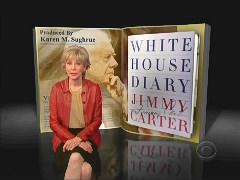
CBS broke into summer re-runs of 60 Minutes to let Lesley Stahl promote Jimmy Carter’s new book, White House Diary , which he maintained delivers “absolute unadulterated frankness” and which she described as an “often harsh critique” of his presidential term. She, however, was far from harsh toward him. Noting an “image of ‘a failed President’ haunts the Carters,” Stahl trumpeted: “Carter argues that despite the image of failure, he actually had a long list of successes, starting with bringing all the hostages home alive,” as if that wasn’t because of Ronald Reagan’s inauguration. Stahl proceeded to tout as a success his installation of “solar panels on the roof of the White House.” Absolving Carter of responsibility, Stahl contended he “was cursed by a dismal economy, poor relations with Congress, and a nightmarish standoff over 52 Americans held hostage by Iran.” Yet, “when all is said and done, and many will be surprised to hear this,” Stahl insisted, “Jimmy Carter got more of his programs passed than Reagan and Nixon, Ford, Bush 1, Clinton or Bush 2.” She empathized with his treatment from an unappreciative public: “And yet, as I say, there’s the sense that you were a failed President.” (Obvious observation: Of all those administrations, only Carter had the luxury of his party in control of both the House and Senate during his entire tenure.) As the two strolled inside Atlanta’s Carter library, Stahl gushed about how a “lot of critics of yours, when you were President, say that you’ve been a fantastic ex-President. You hear that all the time,” leading to a post-presidential “life of good works and good reviews.” This may well have been a start to a media effort to rehabilitate the 85-year-old Carter. NBC is promoting an interview with Brian Williams, an intern in the Carter White House, on Monday’s NBC Nightly News. Williams, though, already got an early start, as detailed in a MRC BiasAlert from about a year ago: “ Williams Prompts Carter: What, In ‘Your Wiring,’ Has ‘Set You Apart’ from Other Presidents? ” Excerpts from Stahl’s story, the only fresh one, on the September 19 edition of 60 Minutes ( CBSNews.com online version with accompanying video of the entire 15-minute segment): LESLEY STAHL: …His tenure, which I covered as the CBS News White House correspondent, was tumultuous. The problems he confronted kept mounting and people wondered if he was cursed by a dismal economy, poor relations with Congress, and a nightmarish standoff over 52 Americans held hostage by Iran. After just one term he was trounced by Ronald Reagan… STAHL: Carter argues that despite the image of failure, he actually had a long list of successes, starting with bringing all the hostages home alive. He normalized relations with China, brokered a peace treaty between Israel and Egypt, deregulated railroads, trucking, airlines and telephones; and his energy conservation programs resulted in a 50 percent cut in imported oil, down to just 4.3 million barrels a day. CARTER: Unfortunately, now we’re probably importing 12 million barrels a day, since part of my energy policies were abandoned. STAHL: Well, and you built solar panels on the roof of the White House. CARTER: That’s right, which were ostentatiously removed as soon as Ronald Reagan became President He wanted to show that America was a great nation. So great that we didn’t have to limit the enjoyment of life. STAHL: And the public seemed to like that better than they liked your message, which was “we have to be limiting.” CARTER: That’s right, America responded to that quite well. STAHL: But when all is said and done, and many will be surprised to hear this: Jimmy Carter got more of his programs passed than Reagan and Nixon, Ford, Bush 1, Clinton or Bush 2. CARTER: I had the best batting average in the Congress in recent history of any President, except Lyndon Johnson. STAHL: And yet, as I say, there’s the sense that you were a failed President. CARTER: I think I was identified as a failed President because I wasn’t re-elected. STAHL: The lesson: getting a lot of legislation passed, even when it’s significant, is not enough. STAHL: A lot of critics of yours, when you were President, say that you’ve been a fantastic ex-President. You hear that all the time. CARTER: I don’t mind that. STAHL: You like that? CARTER: I don’t mind, yes. STAHL: President and Mrs. Carter devote their lives to fighting disease in poor countries and resolving conflicts, as when he recently obtained the release of an American held in North Korea. It’s been a life of good works and good reviews. In 2002 he won the Nobel Peace Prize for his efforts at global diplomacy. But he was called “undiplomatic” when he broke the code that ex-Presidents don’t criticize their successors. STAHL: About Reagan, you said: “If I had been President for four more years, we wouldn’t have had a resurgence of racism and selfishness.” Now that’s pretty pointed. That’s an ouch. CARTER: Yeah, I don’t remember when I said that but I can’t deny that I felt that way. STAHL: But are you suggesting that he stoked racism? CARTER: No, I’m not. STAHL: But that’s what that kind of suggests. CARTER: But there may have been times when I was too outspoken in criticizing an incumbent President. I can’t deny that. …

See the original post:
CBS Begins Media’s Rehabilitation of ‘Fantastic’ Jimmy Carter, ‘Cursed’ Presidency Actually More Successful Than Reagan’s

Schieffer Bashes White House’s ‘Snarky’ Response to Boehner’s Tax Cut Comment

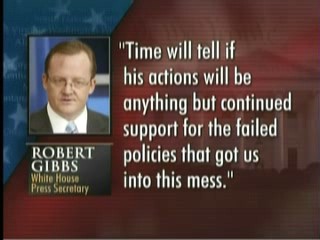
CBS’s Bob Schieffer on Sunday bashed the White House for how it responded to House Minority Leader John Boehner’s (R-Oh.) tax cut comment uttered on “Face the Nation” a week ago. As readers are likely aware, Boehner made news – if not friends amongst conservatives! – by telling Schieffer that if the only thing that came out of the House was an extension of the Bush tax cuts for all but folks that make $250,000 or more per year, he would grudgingly support it.  After reading the White House’s official response to Boehner during this Sunday’s final segment – “Time will tell if his actions will be anything but continued support for the failed policies that got us into this mess” – Schieffer scolded, “I can remember when the first move by a president like Lyndon Johnson or maybe a smart aide in the Eisenhower White House would not have been a snarky press release.” “I`m guessing LBJ would have been on the phone to Boehner in five minutes after seeing him on TV saying something like, if you`re serious, why don`t you come over here quietly and we`ll try to work out something good for both of us and the folks out there,” continued Schieffer. “As we saw, no chance it could happen today. And we`re right back to the partisan war” (video follows with transcript and commentary):  BOB SCHIEFFER, HOST: Finally, House Republican Leader John Boehner did a rare thing on this broadcast last week. He got off the talking points. I asked him about extending the Bush tax cuts that expire this year. Boehner gave me the GOP line: We should extend those cuts for all Americans, rich and poor, Democrats want to extend the cuts only to those making less than $250,000 a year. And when I pressed Boehner, he carefully said that was just bad policy, but if it came down to tax cuts only for the lower and middle income groups or no tax cuts at all, he said, he would reluctantly vote for just the lower and middle income cuts. That was big news all across the country. And it set off a thunder bolt of reaction in both parties. By mid-afternoon the White House acknowledged Boehner`s change in position but added in a written press release: “Time will tell if his actions will be anything but continued support for the failed policies that got us into this mess.” Blame it on a long memory, but I can remember when the first move by a president like Lyndon Johnson or maybe a smart aide in the Eisenhower White House would not have been a snarky press release. I`m guessing LBJ would have been on the phone to Boehner in five minutes after seeing him on TV saying something like, if you`re serious, why don`t you come over here quietly and we`ll try to work out something good for both of us and the folks out there. Call me a romantic, but I believe that might have happened. As we saw, no chance it could happen today. And we`re right back to the partisan war. Too bad really. Nicely done, Bob, but isn’t this possibly another instance of you not being as aware of things going on in Washington, D.C., as you should be? After all, it was only two months ago that Schieffer interviewed Attorney General Eric Holder and not only didn’t ask him about the New Black Panther Party controversy at the Department of Justice, but also admitted to CNN’s Howard Kurtz that he hadn’t heard anything about it.   Regardless of the media’s pathetic echoing of the Democrat talking point that Republicans are the Party of No, GOP members in the House and the Senate have been offering legislative ideas since Obama was inaugurated. Problem is the Party currently controlling Congress and the White House has wanted to implement its policies without any input from Republicans relying instead on their majorities in both chambers. As such, it’s by no means surprising the Obama administration didn’t immediately jump on Boehner’s comments from last Sunday to try to use them as a means of coming to a resolution on this matter. That’s not been this White House’s modus operandi since January 20, 2009, and Schieffer would have known this if he wasn’t accepting the administration’s talking points as the Gospel truth. Why he didn’t this time is anybody’s guess unless like so many folks on the Left he’s beginning to come out from under the Hope and Change ether. Stay tuned. 

The rest is here:
Schieffer Bashes White House’s ‘Snarky’ Response to Boehner’s Tax Cut Comment

Republican Joe Miller Says Unemployment Benefits Are Unconstitutional, Struggles To Say How He Would Deal With Poverty (VIDEO)

In an interview today with “Fox News Sunday,” Alaska GOP Senate nominee Joe Miller had trouble explaining how he would help the 43.6 million Americans in poverty, even as host Chris Wallace repeatedly pressed him for more than conservative talking points. Wallace asked Miller about his assertion in August on CBS's “Face the Nation” that unemployment benefits are unconstitutional, noting that without them, many more Americans would be in poverty. “What would you do for them?” asked Wallace. Miller, however, struggled to come up with an answer, and instead shifted to talking points about reducing the size of the federal government. Wallace repeatedly pressed him on the issue, without ever receiving an actual response: MILLER: I think the question is what is the role of the federal government? Right now we've grown the federal government into such a size we have, I think we have, what — in absolute terms now, $13.4 trillion in debt. If you look at the future unfunded obligation, a lot of those are the entitlement programs, by some estimates $130 trillion. That is unsustainable. That's just the facts. And I think Americans recognize that those are the facts. The exciting thing is Americans are looking for answers. Alaskans are looking for answers. Here in Alaska, 40 percent of our economy in Alaska is somewhat derived from the federal government. If we continue say things have to continue the way they are, the expansion from the government which is unconstitutional in many ways is the future, it's a dead-end road. Particularly for this state, because of the impending bankruptcy — WALLACE: Mr. Miller, if I may, I'm not sure you answered my question. Why are unemployment benefits unconstitutional? In the time of a tough economy, recession, and now kind of a jobless recovery, what are you going to do for the 44 million people who are living in poverty? MILLER: I think what you need to look at is the context. We had an extension of unemployment benefits several weeks ago, which is beyond what we had in the past in this country. What we have in this country is an entitlement mentality. Entitlement, not just as individual but even at the state level. If all goes wrong, it's the federal government's role to get in there and provide for the general welfare and provide for solvency; particularly, of states and the auto companies, and the banks. Everything else that fails, the government should be involved in bailing out. The Constitution provides enumerated powers. I guess my challenge is to anybody that asks, show me the enumerated power. And then look at the 10th amendment that says if it's not done in the Constitution, it's a power that belongs to the state and the people. And I think we as a people need to stop being disingenuous about what the Constitution provides for. It does not provide for this all-encompassing power that we've seen exercised for last several decades. It's what got us in the bankrupt position. Miller's views on unemployment benefits are further to the right than the positions of many Republicans in Congress, who oppose extending them if they aren't paid for, but haven't gone as far as to say that they're unconstitutional. Wallace also seemed frustrated when Miller tried to dodge his question about how he would change the way the Republican Party operates in Washington. He again brought out his talking points about “restricting the growth and actually reversing the growth of government and in the process transferring power to the state” and shifted the discussion to the federal government's role in Alaska. “But I'm asking you more than just Alaska,” responded Wallace. “You made that point clear. How would you like to see the GOP handle things differently in Washington on issues that affect the whole country?” Miller stuck to his message though, saying, “What is good for Alaska is good for the country. Transferring power from the federal government to the states provides opportunity to all states.” added by: TimALoftis

At NYT, Kate Zernike’s Clueless Advice to GOP Candidates: ‘Enlist (Tea Partiers), but Avoid Speeches on the Constitution’

It’s almost tempting to just run a few paragraphs of Kate Zernike’s latest item in the New York Times and simply have folks take their rips, but a bit of background would be helpful. Zernike (pictured at right) is the Times reporter who seems to have made it her mission to somehow singlehandedly discredit what may when all is said and done come to be seen as the most significant grass-roots movement in America in a long, long time. Earlier today, Clay Waters at NewsBusters reviewed Zernike’s new book, “Boiling Mad — Inside Tea Party America,” noted that she “evinces little sympathy or feel for conservative concerns,” and is intent on “finding racism everywhere she looks in Tea Party land.” In a late March post (at NewsBusters ; BizzyBlog ), I noted a Zernike item (“With No Jobs, Plenty of Time for Tea Party”) which cynically questioned “whether the movement can survive an improvement in the economy, with people trading protest signs for paychecks.” This is the same Kate Zernike  Andrew Breitbart memorably called “a despicable human being” after she claimed to have found racism that really didn’t exist at CPAC in February. With that background, the paragraphs that follow from Kate’s latest calamity won’t surprise anyone too much, but they will as usual disappoint if you’re foolishly expecting anything resembling fair treatment (bold as mine): So you’re a Republican candidate and you want to take advantage of the Tea Party energy that jolted once-sleepy primaries. But you aren’t sure whether that means you have to take a stand against masturbation or urge your supporters to gather their bayonets — tactics that seem to have worked for a few Tea Party candidates so far. You’re not certain most Americans share the Tea Party enthusiasm for repealing the 17th Amendment (or even know that it established direct election of United States senators by popular vote). You don’t have Sarah Palin’s phone number. Not to worry. There’s no doubt that the Tea Party is a double-edged sword: a New York Times/CBS poll last week found that while most Americans had not formed a view of the Tea Party, the percentage of independent voters who view it negatively had increased. But the Tea Party has brought a swell of new participants to the political process, and historical and economic trends are working in favor of the party out of power — that would be you, G.O.P. The trick is to take advantage of the Tea Party passion and stay away from its extremes. Celebrate the genius of the Constitution, but don’t get into the particulars. Tea Party activists, Republican moderates and independent handicappers all agree that the road for Republican candidates is to talk about the debt and concerns about the new health care legislation — areas where Tea Party sentiment is more aligned with the views of most Americans. … Tea Party activists — and their candidates — pose a problem when they move the discussion into a broader one about the role of government. “You see these rallies and the signs are all about the Constitution,” said Stuart Rothenberg, editor of a nonpartisan political report. “They want it to be about these big ideological ideas, when I don’t think most voters think that way. It’s very clear that what’s best for the election is to make it about Obama, Pelosi, health care, the deficit.” Rothenberg is about as “nonpartisan” as Larry Sabato , i.e., give me a break. He also doesn’t get it if he really thinks that enough voters to matter aren’t worried about the Constitution and how its limits on Executive Branch perogatives are being ignored. You’ll note that Zernike didn’t quote a bona fide Tea Party member about her novel suggestion to “not get into the particulars” of the Constitution. Zernike? The arrogant condescension continues. Remember in November. Cross-posted at BizzyBlog.com .

Read the original post:
At NYT, Kate Zernike’s Clueless Advice to GOP Candidates: ‘Enlist (Tea Partiers), but Avoid Speeches on the Constitution’

How Not to Talk About Climate Politics

Photo via CO2 Post Yesterday, I wondered aloud whether there was any way to steer the general conversation about climate change away from the realm of political ideology — and the overwhelming response in the comments section left me even more bewildered than before. If anything, the response revealed that there is much work left to do to bring an even-keeled discussion about the science of climate change and potential so… Read the full story on TreeHugger

See more here:
How Not to Talk About Climate Politics