Tag Archives: construction

Wire Watch: Rostenkowski Name That Party Round-up

Wednesday evening, Brent Baker at NewsBusters noted that two of the Big Three television networks failed to tag Dan Rostenkowsi, the former long-time congressman from Chicago who was ousted from his seat in 1994 over corruption charges and ended doing prison time, as a Democrat. Rostenkowski (RIP), who was 82, died yesterday. At the five major wire services whose reports I reviewed — The Associated Press, Reuters, UPI, AFP, and the business-oriented Bloomberg News — Rosty’s Democratic affiliation made at least one appearance. But the prominence and directness of those appearances varied widely. Not surprisingly, the Associated Press and writer Don Babwin did the worst job of identifying Rosty’s party, waiting until the eleventh paragraph to directly tag him (the eighth paragraph contains a generic reference to the “Chicago Democratic machine”), and poured it on the thickest when referring to the supposedly beloved bygone days of bipartisanship: Rostenkowski became symbol of power and excesses With his rumpled suits and gruff, growling voice, former Rep. Dan Rostenkowski was far more comfortable behind closed doors than in front of the camera or behind a podium. Rostenkowski left speeches to others, but he quietly wielded enormous power on Capitol Hill for more than 30 years, becoming one of the most powerful lawmakers of his time – and a potent symbol of Washington’s excesses after he pleaded guilty to corruption charges. When Rostenkowski died Wednesday of lung cancer at age 82, those who knew him recalled a meat-and potatoes politician from an era that doesn’t exist anymore, where leaders crossed party lines to cut deals and seek consensus, and where a young man from Chicago’s Northwest Side could grow up to shape the national agenda as head of a congressional committee. Today most of that power rests with the House speaker. … Back home, where he emerged from the Chicago Democratic Machine, Rostenkowski brought in millions of federal dollars for public works projects, including improvements to the Kennedy Expressway, the transformation of Navy Pier on Chicago’s downtown lakefront into a recreational area, and the construction of a train line to the city’s biggest airport. … Rostenkowski was at once a tough politician who called Chicago politics a “blood sport,” and a master at the disappearing art of political compromise. So even as he fought battles on behalf of Chicago mayors back home, the staunch Democrat worked closely with President Ronald Reagan and President George H.W. Bush in Washington. “We were going to work together,” he once said. “We were going to get something done. We were Democrats and Republicans, but we were also legislators.” Sensible, Constitution-based conservatives more accurately recall the years fondly described by Babwin as the period when Congressional Republicans could usually be counted to eventually cave in to the government-expanding ideas of Democrats and then figure out a way to pay for them by becoming what Newt Gingrich, who become the first to seriously change that dynamic in 1994 (unfortunately not consistently), used to call “tax collectors for the welfare state.” At Reuters , Nick Carey got the D-word into the third paragraph, while remarkably (and correctly) connecting Rostenkowski to a current congressman in serious trouble: Former Representative Dan Rostenkowski dies at 82 Dan Rostenkowski, who as Congress’ chief tax-writer was one of most powerful U.S. politicians in the 1980s and early 1990s until brought down by a corruption conviction and a 17-month prison sentence, has died at age 82. The office of an alderman in Rostenkowski’s old congressional district in Chicago on Wednesday confirmed his death. As chairman of the House of Representatives Ways and Means Committee for 13 years starting in 1981, the Illinois Democrat had a hand in some of the most important legislation of that period. But a federal grand jury indicted him on felony corruption charges in 1994, and he eventually pleaded guilty to mail fraud. Just last March, another Democrat who led the Ways and Means Committee, Charles Rangel, was forced to step down as chairman in the face of ethics charges. UPI’s unbyllined coverage was hard on Rosty but overly light on the D-word, putting in the worst performance of all five wire services in that regard. The coverage never directly referred to him as a Democrat, only noting that his father was a party member: Former U.S. Rep. Dan Rostenkowski dead Former U.S. Rep Dan Rostenkowski, who rose to be chairman of the House Ways and Means Committee and went to prison in disgrace, died Wednesday. He was 82. Rostenkowski died at his summer home in Powers Lake, Wis., after a long battle with cancer, the Chicago Tribune reported. A onetime Washington political insider and power broker, Rostenkowski represented his Chicago 5th Congressional District in Congress for 36 years, rising to head the powerful tax-writing Ways and Means Committee that rewrote the 1986 U.S. tax code. The son of 32nd Ward Democratic Alderman Joseph Rostenkowski, Daniel was first elected to the House of Representatives in 1958 and served until scandal brought him down in 1994. He was indicted on 17 counts ranging from mail and wire fraud to obstruction of justice, including hiring ghost payrollers and maintaining political slush funds. Over at AFP , the unbylined story’s headline weirdly didn’t name Rosty, but got the D-word into the third paragraph, while doing a pretty good job of succinctly describing his political life: Powerful 18-term former US congressman dies CHICAGO — Dan Rostenkowski, a powerful legislator during the Ronald Reagan era who was elected to 18 terms in Congress before being arrested on corruption charges, died Wednesday at the age of 82. An old-style Chicago ward boss and protege of the windy city’s legendary mayor Richard J. Daley, Rostenkowski served in the House of Representatives from 1959 to 1995. As chairman of the powerful Ways and Means Committee from 1981 until 1994, the Illinois Democrat helped broker a key deal to keep the Social Security system solvent and played a major role in reforming taxes, welfare and foreign trade. He was unseated by an upstart Republican in the 1994 election after being indicted in a wide-ranging corruption case where he was accused of everything from maintaining slush funds to accepting bribes. Despite pleading guilty to two counts of mail fraud for misusing taxpayer money in 1996 and serving 15 months in jail, Rostenkowski maintained his innocence for the rest of his life. He was pardoned by outgoing President Bill Clinton just before Christmas 2000. Business-oriented Bloomberg News was the only outlet to put Rostenkowski’s party affiliation into its headline, and otherwise pulled no punches on using the D-word. As would be expected, Laurence Arnold’s story concentrated on Rosty’s involvement with tax legislation: Dan Rostenkowski, Democrat Who Steered Tax Policy, Dies at 82 Dan Rostenkowski, a product of Chicago’s fabled political machine who engineered U.S. tax policy, indulged in the perks of his job during 36 years in Congress and wound up in prison for misusing funds, has died, according to a Democratic official. He was 82. He died today at his home in Wisconsin, the official said. As chairman of the House Ways and Means Committee from 1981 to 1994, Rostenkowski was a Democratic rampart that three presidents had to navigate if they hoped to change U.S. tax laws as well as health and Social Security policies. The grandson of Polish immigrants and protégé of legendary Chicago Mayor Richard J. Daley, Rostenkowski was “big, brash and bellowing — a door slammer and, at times, a bully,” Jeffrey Birnbaum and Alan Murray wrote in “Showdown at Gucci Gulch: Lawmakers, Lobbyists and the Unlikely Triumph of Tax Reform,” an account of the Tax Reform Act of 1986. That law was Rostenkowski’s best-known achievement. He worked with Republican President Ronald Reagan and other lawmakers to lower tax rates while ending enough deductions and shelters to avoid increasing the federal budget deficit. He became something of a national celebrity for urging viewers, in a televised address, to send letters supporting tax reform to “Rosty, Washington, D.C.” Tens of thousands of letters came in that way, and for a time “Write Rosty” buttons were the rage on Capitol Hill. His long career ended in an indictment, lost reelection, conviction and prison sentence. Since Bloomberg mentioned health policy, it’s worth recalling that one of Rosty’s worst political moments related to how he wanted to “reform” Medicare. As would be expected from a Democrat, it involved taxes and higher premiums. Eventually it was kicked to the curb. That’s because as a YouTube courtesy of CBSNewsOnline shows, opposition was fierce. The video’s last few moments capture an exchange that could have come straight out the Democratic Party’s 2010 playbook: Rostenkowski (to a reporter walking alongside him as he was attempting to “escape,” i.e., avoid talking to, an angry crowd of seniors): I don’t think they understand what the government’s trying to do for them. That’s always been a problem. Reporter: Do you sympathize with their anger on this? Rostenkowski: No, I don’t think they understand what’s going on. With all due respect to the late congressman, the upset seniors knew exactly what was going on then; many more of us understand it even better now. Cross-posted at BizzyBlog.com .

See the original post:
Wire Watch: Rostenkowski Name That Party Round-up
CNN’s Fareed Zakaria Returns ADL Award in Protest to Position on Ground Zero Mosque

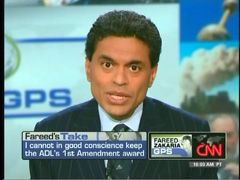
At the top of his eponymous program yesterday, CNN’s Fareed Zakaria took drastic action to protest the Anti-Defamation League’s opposition to the proposed Ground Zero mosque. Zakaria, who was honored by the ADL in 2005 with the Hubert H. Humphrey First Amendment Freedoms Prize, gave back his award because he was “deeply saddened” by the group’s respect for the families of 9/11 victims who oppose the construction of a mosque just two blocks from Ground Zero. “Given the position that they have taken on a core issue of religious freedom in America, I cannot in good conscience keep that award,” lamented Zakaria, who hoped that distancing himself from the ADL would compel the organization to realize its “mistake” and reverse its position. In his lengthy monologue, Zakaria vigorously defended Imam Feisal Abdul Rauf’s constitutional right to erect the mosque: “If this community center were being built anywhere else in the world, chances are the U.S. government would be funding it.” While Zakaria was correct to point out that strengthening ties between moderate Muslims and non-Muslims is a central focus of the wars in Iraq and Afghanistan, he failed to realize the reason so many Americans oppose the construction of a mosque so close to Ground Zero is precisely because of its proximity to the 9/11 attacks committed by Islamic radicals. Displaying stock footage of former Alaska Governor Sarah Palin and former House Speaker Newt Gingrich speaking at the Southern Republican Leadership Conference earlier in the year, Zakaria condemned “politicians who have shamelessly and shamefully capitalized on the public’s wariness” about the construction of a mosque near Ground Zero. Zakaria, eager to omit the most controversial details of the proposed construction project, uttered the word “mosque” only once is his screed, preferring the innocuous term “community center.” The Newsweek columnist proceeded to paradoxically bemoan the “disinformation about this center.”                                      A full transcript of “Fareed’s Take” on the August 8 “Fareed Zakaria GPS” can be found below: You know that ever since 9/11, the United States has been trying to engage in a battle of ideas against radical Islam. Now, America can’t really get involved in a debate within Islam, so that means finding and supporting moderate Muslims. This is a cultural struggle that has been warmly supported by liberals and conservatives. In fact, many conservatives have argued that we should be engaged in a much more extensive and expensive effort to fund moderates and de-legitimize radical and violent Islam. Under both the Bush and Obama administrations, there have been active efforts worldwide to support Muslims who are trying to rescue their religion from extremists, fundamentalists, and jihadists. And this has meant funding mosques, Islamic centers, imams, and community leaders who share a peaceful and pluralistic vision of Islam, except, it turns out, if they are in our own back yard. The debate over the proposed community center to be built a few blocks away from the World Trade Center has missed this fundamentally important point. If this community center were being built anywhere else in the world, chances are the U.S. government would be funding it. The man behind it, Imam Feisal Abdul Rauf, has spent years trying to offer a liberal interpretation of Islam. His most recent book, “What’s Right With Islam is What’s Right With America,” argues that America is actually what an ideal Islamic society would look like because it is peaceful, tolerant, and pluralistic. His vision for Islam, in other words, is Osama bin Laden’s nightmare – we should be encouraging such an Islamic center, not demonizing it. Now, there is of course the much more fundamental issue, freedom of religion in America, which is a founding principle of this country. The most eloquent and intelligent defense of that principle came last week from New York’s mayor, Michael Bloomberg, in an address that should be required reading in every civics class in America. There have, on the other hand, been politicians who have shamelessly and shamefully capitalized on the public’s wariness. The public is wary understandably because there has been so much disinformation about this center. But perhaps the most puzzling stand was taken by the Anti- Defamation League, which was founded to support the freedom of religion. The director of the ADL, Abraham Foxman, explained that the victims of 9/11 had feelings on this matter that should be respected even if they were irrational. First of all, there were many dozens of victims of 9/11 who were Muslim. Do their feelings count? More important, are irrational feelings, prejudices, hatreds OK because those expressing them are victims or see themselves as victims? Will the ADL defend the rights of Palestinian “victims” to be anti-Semites? I have to say I was personally deeply saddened by the ADL’s stand, because five years ago the organization honored me with its Hubert Humphrey Award for First Amendment freedoms. Given the position that they have taken on a core issue of religious freedom in America, I cannot in good conscience keep that award. So this week I’m going to return to the ADL the handsome medal and the generous honorarium that came with it. I hope this might spur them to see that they have made a mistake, and to return to their historic, robust defense of freedom of religion in America, something they have subscribed to for decades and which I honor them for.

See more here:
CNN’s Fareed Zakaria Returns ADL Award in Protest to Position on Ground Zero Mosque

A Super Modest Proposal

Pops Logan has a solution to the problem of immigrant children becoming citizens. added by: Progresshiv

Bring Water Into Climate Change Negotiations

Longer periods of drought, decreased river flow, higher rainfall variability and lower soil moisture content: water is at the heart of the impacts of climate change. Yet the precious commodity scarcely features in climate negotiations. Three hundred million Africans lack access to clean water; 500 million lack access to proper sanitation, according to Bai-Mass Taal, Executive Secretary from the African Ministers’ Council on Water. “Lack of water security will be exacerbated by climate change, which directly threatens food security,” says Dr Ania Grobicki, head of the Global Water Partnership (GWP). Yet there is no focus on water in climate change negotiations under the United Nations Framework Convention on Climate Change. “There is no United Nations agency for water, and there's no international convention regulating water resource management and there is no water focus under the UNFCCC,” says Grobicki. “Water also evaporated from the text of the Copenhagen Accord.” Grobicki and her colleagues argue for a focus on adaptation measures on the ground. Rehabilitation and maintenance of existing infrastructure is one place to start. “With our local partners, we cleaned up a water course that was polluted by waste water from a sugar cane plantation in Swaziland,” says Alex Simalabwi from GWP's Partnership for Africa's Water Development project. “As a result 10,000 smallholder farmers have access to clean water.” Burkina Faso, where 80 percent of the population depends on agriculture for a living, has invested in the construction of more than 1,500 small dams since 1998. These reservoirs – built at relatively low-cost, often with local communities contributing labour to their construction – are a vital protection against drought. Most African agriculture is rain-fed, says Grobicki. “As climate variability increases and temperatures rise, water security drops radically. Dams ensure water is available throughout the year.” The scale and operation of water infrastructure needs to be carefully planned. “Using water from the river for irrigation might benefit a farming community, but it could have damaging effects downstream. That’s why it is important to have shared decision-making. In this process there will be trade-offs, but also shared benefits,” she says. Other adaptation measures include shifting to more drought-resistant crops and the use of satellite imaging to reveal moisture content of soil and guide farmers' irrigation efforts: pilot projects in several countries already send out such information via text messages to farmers' phones. Water-saving technologies can further maximise the benefits of these strategies. “Drip irrigation offers huge potential for saving water in rural areas, while remote sensing can be used to inform farmers about the moisture content of the soil so they know how much water they need to use to grow their crops,” says Grobicki. Drip irrigation is a highly efficient means of watering crops and applying fertiliser via tubing spread throughout the field. In Zimbabwe and Malawi, smallholder farmers are coping with drought with simple drip systems consisting of a couple of large plastic containers on a raised platform, and 100-odd metres of plastic tubes delivering the water to vegetable gardens. snip The call is for water to be recognised in climate change negotiations as both the transmitter of climate change impacts and an important vehicle for strengthening social, environmental and economic resilience to them. continued added by: JanforGore

Master Built Construction

Master Built Construction did my repairs from a Hail storm that hit the Denver area. I saw the other post and dont agree at all with what the person said. The company was very professional and explained the whole process. The gave me a dvd to watch that is also on there web site. How I can to meet Master built Construction was they knocked on my door and offered me a free inspection on my home. They met with my insurance company and got me a new roof and siding. I was very happy with the work th

Originally posted here:
Master Built Construction

Book of Poetry, Cartoons Helps Explain Conservative Values

Craig Wieland never set out to write a book of poetry. “I’m a contractor,” he said with a chuckle. But what began as family dinner-table conversations to help his daughters understand social issues in America have culminated in a book of poems and cartoons about conservative ideas. Wieland, the owner of a nationwide construction contracting company, proved you don’t need a writer’s background or even a college degree to communicate your beliefs. Wieland said he catered to his daughters’ love for Dr. Seuss and Shel Silverstein by putting stories poetic form. “If you put it in a rhyme and use poetry, all of a sudden it becomes unique,” Wieland said in a telephone interview with the Culture and Media Institute about his new book, “Pointed Poems: Tools for Teaching Conservative Thinking.” In the book, Wieland combines poetry and cartoon-like illustrations to convey the differences between conservative and liberal viewpoints on both economic and social issues in America . The book’s 280 pages touch on everything from industry to patriotism to taxes and incorporate over 400 graphic illustrations by Dennis Preston to “give the poetry a little more punch.” “Pointed Poems,” which Wieland described as “unique,” and “fairly provocative,” discusses social issues, such as compassion, the role that personal responsibility plays in government and the problem of social programs that “help” parents raise their children. Wieland said his main message is only hinted at subtly in the book. Wieland hopes his poems show readers “the hypocritical stance that people have of criticizing the very things that they’re using.” For instance, in the poem, “Just Give Us the Outlet… and Nothing More,” protesters of electric generation prevent the construction of a new power plant but soon show their dissatisfaction in the following lines:             “So that’s what happened to our little city.              The planned power plant was not built… what a pity.              But people got mad when their outlets grew quiet.              And when it got hot, they started to riot.” By exposing this hypocrisy, Wieland further hopes to knock liberals off their assumed “moral high ground” on issues like green energy and limited government—topics which liberals use to push their agenda as the “correct” viewpoint. To help conservatives understand the differences between the conservative and liberal viewpoints on a variety of issues, each chapter begins with a brief explanation of the poem and issue, followed by the poem itself and illustrations. Wieland also highlights the “Teaching Tool” for each chapter, a single summary statement of the issue. Following the “Teaching Tool,” each poem starts with a cartoon of a father and son carrying a conversation about politics and American values. The father responds to the son’s questions by giving simple answers that reflect conservative thinking. This father-son exchange further strengthens its use as a tool for teaching conservative values to middle-of-the-road adults as well as the next generation of Americans—children and grandchildren.

Read more:
Book of Poetry, Cartoons Helps Explain Conservative Values

Poachers Kill Last Female White Rhino in South African Reserve

White rhino and calf, photo:

See the original post here:
Poachers Kill Last Female White Rhino in South African Reserve

Planet 100: Top 5 Genius Animals

Read the original here:
Planet 100: Top 5 Genius Animals

Should We Rename the BP Gulf Oil Spill?

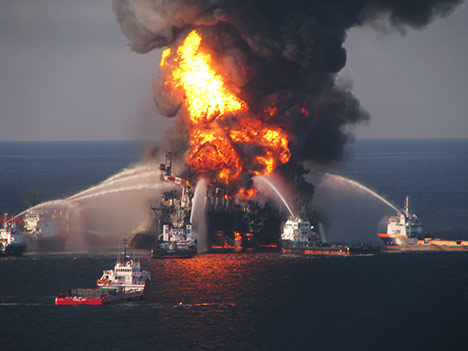
Photo via the US Coast Guard It’s a question that’s been raised repeatedly over the course of the 3-month ordeal in the Gulf of Mexico — what do we call it? Though most publications and journalists (this one included) have leaned towards variations on ” the BP spill ” or ” the Gulf spill ” many have been dissatisfied with this terminology from the start. This isn’t merely a “spill” after all, it’s the biggest environmental disaster in US history, with oil continuously pumped into the Gulf for months… Read the full story on TreeHugger

Read the original here:
Should We Rename the BP Gulf Oil Spill?

The South Gets its First Certified Passive House (Beats California to the Punch)

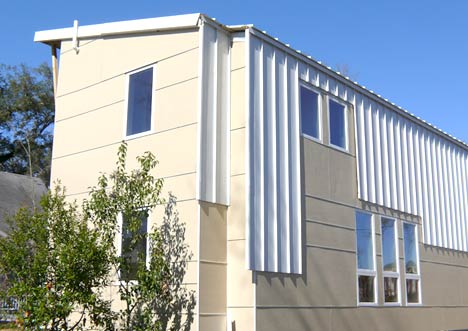
Images: Green Building Advisor Born in Boston and living in Nashville, I’m continually struck by the fact that Southerners expect air conditioning to be everywhere and running at all times. Enduring the summer swelter just isn’t the way it’s done down here. New Yorkers and Bostonians, on the other hand, seem almost competitive over who can endure more heat. Corey Saft, an architecture professor at the University of Louisiana, has built himself a home that will keep him cool, eve… Read the full story on TreeHugger

Read the original post:
The South Gets its First Certified Passive House (Beats California to the Punch)