Tag Archives: crime

AP Report Understates the Financial Impact of LIHEAP’s Heap of Liars and Thieves

At the Associated Press, Kelli Kennedy’s Thursday report on fraud and abuse in the Low Income Home Energy Assistance Program ( LIHEAP ), which is well done in several aspects, nonetheless significantly understates the losses that are occurring in the program. The AP report deals with a now-released Government Accountability Office report on the results of investigations in nine states. Here are the first four paragraphs of Kennedy’s report (HT David Freddoso at the Washington Examiner), including reference to a woman who is LIHEAP’s version of a welfare queen: A federal program designed to help impoverished families heat and cool their homes wasted more than $100 million paying the electric bills of thousands of applicants who were dead, in prison or living in million-dollar mansions, according to a government investigation. The U.S. Department of Health and Human Services spent $5 billion through the Low-Income Home Energy Assistance Program in 2009, doling out money to states with little oversight of the program. Some states don’t verify applicants’ identifies or income. For example, the program helped pay the electric bill of a woman who lives in a $2 million home in a wealthy Chicago suburb and drives a Mercedes, according to the yet-to-be released report obtained by The Associated Press. The Government Accountability Office studied the program after a 2007 investigation by Pennsylvania’s state auditor found 429 applicants received more than $162,000 using the Social Security numbers of dead people. The GAO investigated Illinois, Maryland, Michigan, New Jersey, New York, Ohio, and Virginia, which represented about one-third of the program’s funding in 2009. The agency found improper payments in about 9 percent of households receiving benefits in those states, totaling $116 million. Unless someone can demonstrate that other states’ LIHEAP programs are airtight (good luck with that), the true losses in the program are far higher than the figure Kennedy cited. We already know from her report that Pennsylvania, which was outside the scope of GAO’s investigation, has had serious program problems. Since the states involved “represented about one-third of the program’s funding,” total losses to fraud and abuse are more than likely in the neighborhood of $350 million or three times higher than the reported $116 million. Kennedy should have included a sentence along these lines: “If the experience of these six states is representative of what is occurring in the program nationwide, annual LIHEAP losses to fraud and abuse are about $350 million.” LIHEAP’s long list of “not for profit” and corporate defenders at the Campaign for Home Energy Assistance are already defending the program in response to Kennedy’s report. The following is from a statement currently on the group’s home page : We are disappointed that LIHEAP funds may have gone to ineligible parties. In this economy, more and more households cannot afford to heat and cool their homes because of financial woes. The poor, vulnerable populations that this program serves should not be denied the assistance they needs because of some bad actors or some administrative mismanagement. They also believe that the program’s scope should be quintupled: At $5.1 billion in LIHEAP funding, only 1 in 5 eligible Americans are served, which means there are many people who need assistance and are not getting it. A question separate from AP’s report: What would happen to a business where 9% of payments to employees or vendors were improper? Answer: They’d be out of business. But in government, the easy answer is not to clamp down on fraud and abuse (later paragraphs in the AP article demonstrate a decided reluctance to do that on the part of those who should be doing it). Instead, its “answers” are to either raise taxes or borrow more money while constantly advocating even more spending. Meanwhile, the fraud and abuse go on and on. “Responsible government” and “Government oversight,” once again, are shown to be oxymorons. Cross-posted at BizzyBlog.com .

See more here:
AP Report Understates the Financial Impact of LIHEAP’s Heap of Liars and Thieves

‘Harry Potter’ Actress’ Father And Brother Threaten To Kill Her

The father and brother of Afshan Azad are accused of threatening to kill the star because of her relationship with a Hindu man. By Mawuse Ziegbe Afshan Azad Photo: Getty Images The father and brother of actress Afshan Azad, who plays Padma Patil in the “Harry Potter” franchise, have been accused of threatening to kill the star. Her brother has also been accused of assaulting her at her home in Manchester, England. According to CNN , a spokesman for the Crown Prosecution Service said the actress was allegedly attacked on May 21 because her family disapproved of her relationship with a Hindu man. Azad’s family is Muslim. Azad’s father, Abdul Azad, and brother, Ashraf Azad, recently appeared in Manchester Magistrate’s Court via video link, according to the Manchester Evening News . The actress was also present at the hearing and the two men have been released on bail. Bail conditions stipulate that neither father nor brother can travel to London and must adhere to a curfew. The paper also reports that the pair will appear again in court later this month and that “it is understood” that Azad’s father and brother plan to plead not guilty. Azad was a student with no acting experience when she was cast as Padma Patil, a classmate of Harry’s. Azad reportedly tagged along to an audition with some friends “for a bit fun.” She has since appeared in four movies, and the Manchester Evening News reports that she is expected to appear in “Harry Potter and the Deathly Hallows,” which is set to hit theaters next year. John Wolfson, a lawyer for Azad’s brother Ashraf, said, “I hope for the whole family’s sake this matter can be resolved quickly and happily.”

View post:
‘Harry Potter’ Actress’ Father And Brother Threaten To Kill Her

Max B Recalls Making A Wave Called Yes Tape While On Trial

‘For the music to come out that good while I was in trial, that was surprising to me,’ he tells Mixtape Daily. By Shaheem Reid, with additional reporting by Rahman Dukes Max B Photo: Amalgam Don’t Sleep: Necessary Notables Mixtape : A Wave Called Yes Headliners : Max B and Young Riot Key Cameos : “Living the Life” (featuring Curren$y) Essential Info : Max B said his wave just doesn’t dry up. While the New York MC awaits his appeal of a decades-long prison sentence for manslaughter and various other charges, his music is still being heard. Amalgam Digital recently released a mixtape by the spitter and the upstart Young Riot. “That’s me and my young god, Young Riot,” Max said on the phone from the New Jersey State Penitentiary. “He’s holding it down while I’m up in the spot. We got a few treats on there. I remember the night we did them. [The executives at Amalgam] drove me out to Boston, 2 in the morning. I went out there and drank a 60 of Hennessey and knocked out the whole tape. Knocked the tape out in one night. That’s what professionals do. This is when I was going to trial. They came and got me on a Friday or Saturday, I had to be back on Sunday, Monday morning to go back to court. It was a real busy week. I was really busy on trial. For the music to come out that good while I was on trial, that was surprising to me. That just let me know, no matter how long I’m gone from the game, I’m still a natural. I still can make quality work. I’mma still be Biggavelli.” Amalgam is going to let A Wave Called Yes rock for the summer then drop Max’s solo LP, Vigilante Season. B recently won a court case to be freed from his contract with Jim Jones, who discovered him. “We recorded 40 songs in three weeks,” Max said of his dealings with Amalgam last year. At the time, he was still contractually bound to Jones and did not know if the music would be allowed to be released. “Nonstop in the summertime. Vigilante was real special to me. It was like they giving me a shot. Even if it wasn’t coming out, they gave me the feel of just going to do the album. I was doing it my way.” As for when Max will be free to record again, he says it’s in God’s hands now. The rapper’s appeal could take between 18 months and three years to be resolved. If he loses that appeal, it could be an additional three years before he can appeal again. Max was sentenced to 75 years in prison in September 2009 for conspiracy, robbery, manslaughter and a myriad of other crimes. The jurors in the case felt there was ample evidence to convict him of the 2005 robbery of two men in a Fort Lee, New Jersey, hotel room. One of the men was shot and killed. Max wasn’t at the scene of the crime, but the prosecutors built their case with him as the mastermind. Max still denies being involved. His stepbrother Kelvin Leerdam was also convicted in the matter, and Max’s former girlfriend Gina Conway was involved as well but eventually testified against the men. Leerdam is serving time along with Max. “I always kinda had that problem with finding the right people,” Max said of the choices that led him to prison, right as he appeared to be on the verge of mainstream recognition. “People always say you gotta surround yourself with people who have your best interests in mind. I always found that hard to do, because when you’re in my situation, everybody acts like they got your best interests, but they don’t. We know who got your best interests — your mother, your father, your kid’s mother, whatever. Your immediate family. But you can’t have them on the road with you every day. You gotta be around your n—as. “You gotta pick them carefully,” he added. “I always had a problem with picking the right people I surround myself with. That’s always been my downfall, ever since I was a little kid. That’s something I gotta learn off experience. This is definitely an experience. The toughest sh– I been through in my life. You already know when I beat this, it’s gonna be beautiful. I just can’t wait. That’s the only thing keeping me going. Me saying [to myself], ‘Max, when you beat this, it’s gonna be a whole new lane out there for you.’ Me being able to attack this sh– right and make a living for my mother and my kids and be a good productive [citizen] in society. I’m a G. My moms raised me as a G. The only reason you don’t hear me stressing out, I know I’m coming home and I know I’m coming home soon.” Other Heat This Week

Max B Talks From Jail About Appealing 75-Year Sentence: ‘I’ll Be Home’

‘I’m not worried about the sentence, because I’m not doing that time,’ he tells MTV News. By Shaheem Reid Max B and French Montana Photo: MTV News As it stands right now, Max B is facing 75 years in prison after he was convicted of manslaughter, aggravated assault, robbery, kidnapping, possession of a weapon and conspiracy in 2009. But the New York MC said he’s staying as positive as possible and operating under the radar. When MTV News got him on the phone Monday (June 28) from New Jersey State Penitentiary in Trenton, he explained why he recently fired his trial lawyer, Gerald M. Saluti. “Anytime you lose trial, most of the times, on most occasions, people will fire their trial lawyer,” he said. “You would need to do something like that. For those who’s not familiar with legal terms, it’s called ineffective assistance of counsel. You would have to do that. That’s when your lawyer fails to do his obligated duties. I ain’t supposed to be in here in the first place. My charges were excessive. I was never at the scene of the crime. It’s very insufficient. Just off that alone, I’ll be back. It ain’t about me being convicted. It’s about: Can this conviction stand up in an appellate court? If they deny me on this one, then I’mma do an interview and tell the people, ‘Don’t wait up on me.’ It’s gonna be about four, five, six years later than that.” Max (born Charlie Wingate) was convicted of masterminding the robbery of David Taylor and Allan Plowden. The pair was set up by Max’s former girlfriend Gina Conway, who testified for the prosecution in the trial in exchange for a lighter sentence. Jurors felt that there was enough evidence to convict Max’s stepbrother Kelvin Leerdam of being the gunman and murderer of Taylor. Although Max wasn’t at the scene, jurors handed down a guilty verdict to him as well. Max was sentenced to 75 years in prison in September, but he said the term was reduced to 40. The prosecutor in the case had not returned MTV News’ calls for comment as of press time. “The sentence wasn’t really nothing,” Max said. “It was the ‘guilty’ that was more effective. The part when the jurors say ‘guilty.’ That hurts more than the sentence itself. At that time, I’m coming to court every day. I got the cameras on me. I got my girls waiting outside. I got French [Montana] and them n—as in the parking lot. My Beamer is parked in the lot. My jewelry is on. But now, when they say I’m guilty, I gotta take off my watch. I gotta take off my chain. I gotta pass it off. I pass off my car keys, my apartment keys, and I gotta walk to the back. I can’t walk out that gate. I gotta walk to the back and get locked up. That’s the part that hurt me the most. The sentence, by the time I got to that point, I didn’t hear none of that. I was already deaf to that sh–. My focus was already, ‘All right, we trying to get back.’ I’m not worried about the sentence, because I’m not doing that time. That’s not a number to me. They could’ve gave me a billion years, that sh– is not gonna stand up. That has to stand up in an appellate court. Now if [an appeals court] say, ‘Charlie Wingate, we found no error, you can’t come home’ — once I exhaust all my remedies, that’s different. But it’s still early. I’m on my direct appeal. I’ll be home.” It could be quite some time. Max said, realistically, he’ll have to do at least another year and a half in jail. “They should feel grateful. They should be thankful they got another chance,” Max said of his peers, such as Lil Wayne, Gucci Mane and T.I., who were all sentenced to around a year in prison. “Even though I got another chance, it might not come as easy and quick. My sh– might take up to three years for me to get outta here. It might be 18 months. But that’s just the worst-case scenario. The only person I felt really caught a rough deal was Remy [Ma] . Our situations was similar, as far as the lawyer and stuff go. [Remy] was working and not really focusing on the case at hand. Same thing with me. I was working, not focusing on the case at hand that mattered. And the end, when I had to go in that courtroom, I wasn’t prepared. I just let my lawyer do whatever. That’s a lesson. You got be on top of lawyers, you gotta do your own studying when you get situations like that. You can’t put your faith in his hands. They’re only human. Humans disappoint people. You gotta put your faith in God. You gotta work hard. It’s gonna be all right.” In the meantime, Max’s work will be heard. He recorded dozens of tracks before going to prison, and the music will be brought to the fans by the label Amalgam Digital. The company just put out the Mixtape A Wave Called Yes, which features Max and his rap accomplice Young Riot. Max’s next solo LP, Vigilante Season, is set to drop later this fall. Look for more of Max as he expounds on both projects Tuesday in Mixtape Daily. Related Artists Max B.

See more here:
Max B Talks From Jail About Appealing 75-Year Sentence: ‘I’ll Be Home’

Michael Jackson Doctor Conrad Murray Didn’t Give Fatal Dose, Lawyer Says

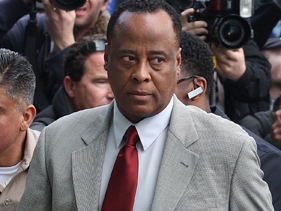
Ed Chernoff claims someone else, or Jackson himself, could have administered deadly amount of propofol. By Gil Kaufman Dr. Conrad Murray Photo: Frederick M. Brown/ Getty Images In a hint of the strategy he’s prepping for the upcoming trial of Dr. Conrad Murray n the death of Michael Jackson , the lawyer for the late pop icon’s personal physician said his client did not deliver a fatal dose of the surgical anesthetic propofol to the singer. As fans gather around the world to pay tribute on the one-year anniversary of Jackson’s death , attorney Ed Chernoff told CNN that his client, who has been charged with involuntary manslaughter in the case, said it’s possible that someone else administered the propofol or that Jackson did it himself. “There is no way that Dr. Murray pumped Michael Jackson full of propofol sufficient for major surgery,” Chernoff said, reacting to an autopsy report that said the level of he powerful anesthetic found in Jackson was equal to what would be used to sedate a patient for major surgery. “No way. I would stake anything that I own on this fact.” The Los Angeles County coroner ruled that Jackson’s death on June 25, 2009, was a result of an overdose of propofol, a drug the singer reportedly used in combination with other sedatives in order to combat chronic insomnia. Murray was hired to be Jackson’s personal physician, at a rate of $150,000 a month, during the rehearsals for the singer’s 50-date This Is It series of comeback shows at London’s O2 arena. The cardiologist has admitted to administering propofol to Jackson as a sleep aid, but Chernoff said it was in much smaller doses than what was found in Jackson’s body during the autopsy. If Murray did not administer the fatal dose, other theories include that another unidentified person entered the singer’s room while Murray was not present gave Jackson a larger dose, or that Jackson woke from fitful sleep and gave it to himself. But an anesthesia expert hired by the coroner appeared to dismiss the notion that Jackson may have accidentally killed himself with propofol. “It would have been difficult for the patient to administer the drugs to himself, given the configuration of the IV setup,” the expert wrote in the autopsy report. Chernoff, who must only convince a jury that there is reasonable doubt that his client contributed to Jackson’s death, seized on those possibilities in the CNN interview. “The coroner’s report deemed it to be unlikely, because it would be difficult, so I’m assuming they’ve addressed that situation and that’s what they believe, but is it possible?” he asked. “Absolutely, it’s possible.” Chernoff said Murray left behind two successful medical practices in Houston and Las Vegas to work for Jackson and that the doctor had no idea what he was signing up for when he agreed to the gig. “Did Dr. Murray know that ‘when I get onboard treating Michael Jackson, that I’m going to have to deal with this drug propofol?’ No,” Chernoff said, noting that Murray knew Jackson suffered from insomnia but not that he used propofol as a sleep aid. He claimed that Murray attempted to wean Jackson off the anesthetic, alarmed that the singer was using such a powerful surgical drug for that purpose. It’s unclear where Murray was in the 90 minutes before Jackson was found unresponsive, with phone records showing he made three calls totaling around 47 minutes during that time and the doctor telling investigators that he only left Jackson’s side for “two minutes maximum” to use the restroom during that time. That period is the only time when someone else, or Jackson, could have given the fatal propofol dose. Prosecutors believe the evidence shows that Murray is the only person who could be responsible for Jacksons’ death, but Chernoff believes a jury will see things differently. “We get a fair jury and we are able to afford just some of the necessary experts and investigators then, yes, the doctor is going to win,” he predicted. “Whatever the doctor did for Michael Jackson, whatever he did, was to help, and he took the necessary precautions and then something happened that is unexplainable.” Murray has pleaded not guilty to the manslaughter charges, and a preliminary hearing in the case is slated for late August. MTV will be remembering the life and music of Michael Jackson all weekend. Don’t miss the one-hour special “Michael Jackson’s Influence on Music,” airing Friday at 6:30 p.m. on MTV. Related Videos Remembering Michael Jackson – One Year Later Related Photos Michael Jackson: A Life In Photos Related Artists Michael Jackson

Visit link:
Michael Jackson Doctor Conrad Murray Didn’t Give Fatal Dose, Lawyer Says

Name That Party: Again-Indicted Kwame Kilpatrick Still Not Tagged as a Dem as AP Appears to Cover His Tracks

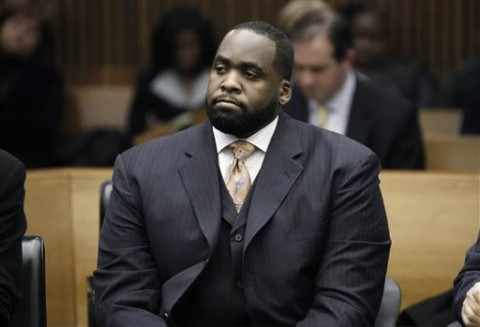
The Associated Press is still failing to tag the currently imprisoned former Detroit Mayor and former beneficiary of President Barack Obama’s high praise Kwame Kilpatrick as a Democrat. I know, same-old, same-old. And Generalissimo Francisco Franco is still dead . But there’s more to this particular chapter in this ongoing “Name That Party” narrative. The wire service kept its near-perfect Kilpatrick non-labeling track record intact in two shorter items and a lengthier treatment of the latest development in Kwame’s calamaties, all published in roughly the past 24 hours. The closest Kwame got to being tagged as a Dem occurred in an otherwise detailed report turned in by Ed White, where he described Kilpatrick’s mother, Congresswoman Carolyn Cheeks Kilpatrick, as “D-Mich.).” The link to White’s report doesn’t contain his byline; I’ll explain why later in the post, where I will also suggest that there is reason to believe the AP has attempted to bottle up White’s full report. A six-paragraph story carried at the Toledo Blade last night (HT to Maggie Thurber in an e-mail) described the latest and by far most serious development in this sickening saga: In an indictment filed Wednesday, he’s accused of failing to report at least $640,000 in taxable income between 2003 and 2008, which includes money, private jet flights and personal expenses paid by the (Kilpatrick) Civic Fund. The government says he used the money to pay for yoga and golf lessons, golf clubs, summer camp for his kids, personal travel, moving expenses, as well as “counter-surveillance and anti-bugging equipment.” White’s report goes into further detail and captures much more additional reaction: A taste for premium steaks, shopping at Gucci and a five-bedroom mansion helped send former Detroit Mayor Kwame Kilpatrick to state prison. His latest legal hardship is a federal indictment with allegations of even more reckless spending. … The indictment said donors were misled into believing their money would be used for legal purposes. Adolph Mongo, a political consultant to Kilpatrick in 2005, told The Associated Press he was paid out of the Civic Fund. He described it as being like an ATM. The government alleges Kilpatrick received nearly $200,000 from the fund in 2007 in the form of cash, private jet flights and other personal expenses — an amount that exceeded his annual salary as mayor. His mother, U.S. Rep. Carolyn Cheeks Kilpatrick, D-Mich., said she was devastated by the charges. The ex-mayor’s spokesman, Mike Paul, struck a positive tone, noting the indictment does not allege any bribery schemes after a yearslong investigation at City Hall that has netted ex-councilwoman Monica Conyers and many others. “This investigation puts an end to the ridiculous rumors that the mayor was personally involved with corruption, payoffs and bribes. … Those rumors were hurtful and were lies from the pit of hell!” Paul said in an e-mail. Not so fast, McQuade told AP. “The investigation is continuing. If we find additional charges that we can prove they will be brought,” the prosecutor said. The 13 fraud charges each carry a maximum punishment of 20 years in prison. Judges, however, mostly order concurrent sentences, which means Kilpatrick would not serve the rest of his life behind bars if convicted. … A prominent Detroit pastor, the Rev. Horace Sheffield, said the federal indictment is another chapter in a “sad saga.” “At some point, the Kwame Kilpatrick story needs to end,” he said. “It tarnishes the reputable way his mother has served in Congress. Detroit is more than Kwame Kilpatrick.” Now it gets interesting. I originally found White’s story with his byline at the AP’s main site last night at about midnight. Going there at about 1:30 p.m. ET, here’s what I found in a search on Kilpatrick’s first name : Though one would expect the first item listed to go to the longer story, here is the full text as found at the link (dynamic, and subject to change): Thus, the wire service has flushed roughly 15 paragraphs of details, including the fact that the investigation is still ongoing, down the memory hole, leaving an opening paragraph that reads like an editorial, two paragraphs of facts, and a paragraph of “let it go” sympathy. You’ve got to be kidding me. The “creative” folks at AP continue to invent new forms of journalistic malpractice. Since when does a detailed report about an indicted criminal get sliced by two-thirds or more about 12 hours after the original event? The answer to that question appears to be: “In AP-Land, when Democrats are involved.” I should note that the word “Democrat” does appear at the long version of the story at MLive.com . Not in the story, but after it, in a comment, where reader “MIRef” responds to the Rev. Sheffield’s “let’s move on” sentiment: “At some point, the Kwame Kilpatrick story needs to end,” he said. “It tarnishes the reputable way his mother has served in Congress. Detroit is more than Kwame Kilpatrick.” Anybody else gag over this quote? In reality, Kilpatrick is the perfect living example of Detroit and what happens when Democrats are given unlimited power. No wonder the AP buried the gory details at its main site. It wouldn’t want readers to start thinking that what “MIRef” has written is true. Go here for a rundown of previous NewsBusters posts on establishment media Kilpatrick-is-a-Democrat avoidance. Cross-posted at BizzyBlog.com .

Read the rest here:
Name That Party: Again-Indicted Kwame Kilpatrick Still Not Tagged as a Dem as AP Appears to Cover His Tracks

On Networks, ‘Controversial’ Law Means Conservative Law

Liberals may like to boast of fighting the establishment and taking on the status quo, but it’s conservative laws that are 30 times more likely to be deemed “controversial” – at least by the mainstream media. In the past five years, when ABC, CBS, or NBC news reporters claimed a law was “controversial,” they were most likely referring to legislation backed by the right. This analysis looked at 110 news transcripts dating back to 2005 where the term “controversial” fell within three words of the term “law.” Of these transcripts, 62 referred to policies that were clearly liberal or conservative. Of the 62 ideologically identifiable “controversial” laws, 60 were conservative and only two were liberal. Whether it was NBC’s “Today” on Jan. 2, 2008, referring to the “controversial new law in Arizona [where] businesses can be shut down if they intentionally hire illegal immigrants,” or ABC’s “Good Morning America” on Dec. 23, 2005, discussing the “extension of the Patriot Act just days before the controversial law was set to expire,” conservative policies seemed to be more hot-button issues for the media than liberal policies. Arizona’s illegal immigration reform act was by far the law most frequently described as “controversial” by the news networks. Though the Arizona law was passed just two months ago, it was described by networks as “controversial” in 56 percent of the liberal or conservative transcripts studied. But the “controversy” over the law is largely media-driven, according to Bob Dane of the Federation for American Immigration Reform. Dane said the media have often mischaracterized the Arizona law. “I would say that the media has focused on all the wrong aspects of [the immigration law]. The criticism of the bill has been far more extreme than anything that is in the bill,” he said. Despite media claims that the law is “controversial,” polls show that Americans are solidly in favor of theArizona policy. After referring to “Arizona’s controversial new immigration law,” Brian Williams of NBC “Nightly News” on May 26 went on to report that “In our new NBC News/MSNBC/Telemundo national poll on this issue, we found 61 percent of people support the Arizona law, 36 percent oppose it.” By comparison, the networks branded few liberal laws as controversial. The recent health care reform law, which 55 percent of likely voters would like to see  repealed , wasn’t labeled “controversial” once. Neither was the auto bailout package, which 53 percent of Americans believe  was a bad idea. The only two liberal laws described as controversial in the transcripts were Oregon’s assisted suicide policy, which ABC’s “World News Tonight,” called controversial on Oct. 5, 2005, and a California law requiring serial numbers on bullets, which ABC’s “World News Sunday” called controversial on Oct. 14, 2007. Other conservative laws deemed controversial by the media included No Child Left Behind, a law banning partial-birth abortion and a law allowing oil exploration in the Arctic National Wildlife Refuge. Methodology: This study reviewed the transcripts of all 110 ABC, CBS and NBC morning and evening news transcripts, as well as NBC’s “Meet the Press” between June 1, 2005, and June 21, 2010, in which the term “controversial” was used within three words of “law.” Duplicate transcripts and those not referring to U.S. laws were excluded. Other transcripts were discarded for the following reasons: The term “controversial” did not modify the law or parts of the law referred to, or The transcript did not mention the name or a description of the law, or The law was called controversial by a guest or interviewee as opposed to a reporter, anchor, or host. The transcript referred to a law that was considered politically neutral (such as a driving regulation inConnecticutand laws banning certain dog breeds in various states). Of the 62 transcripts included in the final results of the study, all referred to policies that were clearly liberal or conservative. Sixty of the times reporters labeled a law controversial, it was a conservative policy and just two of the times it was a liberal policy.   Like this article? Sign up for “Culture Links,” CMI’s weekly e-mail newsletter, by  clicking   here.

See the original post:
On Networks, ‘Controversial’ Law Means Conservative Law

Is Illegal Immigration Raising Arizona’s Crime Rate? NY Times Says No; Relevant Figures Say Yes

On Sunday, New York Times reporter Randal Archibold offered up more of his slanted reporting on Arizona’s pending new immigration enforcement law, suggesting that supporters of tough immigration enforcement are fostering fear by exaggerating the problem of violent crime on the border with Mexico: ” On Border Violence, Truth Pales Compared to Ideas .” But does his evidence stand up? Two conservative writers say no, pointing to FBI statistics that show crime in towns outside major metropolitan areas and rural counties crime has increased substantially. When Representative Gabrielle Giffords, Democrat of Arizona, announced that the Obama administration would send as many as 1,200 additional National Guard troops to bolster security at the Mexican border, she held up a photograph of Robert Krentz, a mild-mannered rancher who was shot to death this year on his vast property. The authorities suspected that the culprit was linked to smuggling. “Robert Krentz really is the face behind the violence at the U.S.-Mexico border,” Ms. Giffords said. It is a connection that those who support stronger enforcement of immigration laws and tighter borders often make: rising crime at the border necessitates tougher enforcement. But the rate of violent crime at the border, and indeed across Arizona, has been declining, according to the Federal Bureau of Investigation, as has illegal immigration, according to the Border Patrol . While thousands have been killed in Mexico’s drug wars, raising anxiety that the violence will spread to the United States, F.B.I. statistics show that Arizona is relatively safe. That Mr. Krentz’s death nevertheless churned the emotionally charged immigration debate points to a fundamental truth: perception often trumps reality, sometimes affecting laws and society in the process . Archibold again pompously implied fear-mongering on the part of supporters of immigration enforcement: Moreover, crime statistics, however rosy, are abstract. It takes only one well-publicized crime, like Mr. Krentz’s shooting, to drive up fear. …. Crime figures, in fact, present a more mixed picture, with the likes of Russell Pearce, the Republican state senator behind the immigration enforcement law, playing up the darkest side while immigrant advocacy groups like Coalición de Derechos Humanos (Human Rights Coalition), based in Tucson, circulate news reports and studies showing that crime is not as bad as it may seem. For instance, statistics show that even as Arizona’s population swelled, buoyed in part by illegal immigrants funneling across the border, violent crime rates declined, to 447 incidents per 100,000 residents in 2008, the most recent year for which comprehensive data is available from the F.B.I. In 2000, the rate was 532 incidents per 100,000. Nationally, the crime rate declined to 455 incidents per 100,000 people, from 507 in 2000. Reporter Jennifer Steinhauer seconded Archibold’s assertion about crime dropping on the Arizona border in her Tuesday front-page profile of Sen. John McCain on the campaign trail in Arizona: While border crime has decreased in this state in recent years , the killing of a prominent rancher in the south by what the police suspect was an illegal immigrant set off rage across the state, and helped fuel a tough new state law directed at immigrants. But Tom Maguire researched the actual FBI statistics and came away with the opposite result, though his results are not definitive: …the stats reprinted below tell a different story — measured by violent crimes per 100,000, the non-MSA portion of Arizona has seen a dramatic increase in crime….these numbers do not support the case that the rural and border areas of Arizona are getting safer. Quite the contrary, actually. Maybe the Times can turn a reporter loose on that. Taking off from Maguire’s spadework, Mark Hemingway at the Washington Examiner explained: …essentially, the FBI crime stats are broken down by region and while crime has fallen 20 percent in cities from 2000 to 2008, in towns outside major metropolitan areas and rural counties crime is up 39 and 45 percent, respectively. In other words, it sure looks like crime is way up in the border regions of Arizona.

View original post here:
Is Illegal Immigration Raising Arizona’s Crime Rate? NY Times Says No; Relevant Figures Say Yes

‘Today’ Shows Cop-Punch 14 Times, Leaves Out Suspect Resisting Arrest

width=”250″ height=”202″> The headline sounds sensational: “Cop punches girl in face during jaywalk arrest.” That’s how the June 17 NBC “Today” show began what might appear to be an even-handed story. But a closer look at what the network aired and what it left out show a far different result. The morning segment repeatedly played a clip highlighting what Matt Lauer referred to as a “violent arrest” – a police officer punching a young woman who interfered in the arrest of the jaywalker. That clip was shown 14 times during the segment. After the first showing of the clip, Lee Cowan told viewers, “Watch again, he closes his fist, winds up and lands a hard right to her face.” Time and again, the segment returned to the video clip showing the police officer punch the 17-year-old. Here’s what they left out. (full video below the fold) The punch didn’t end the incident at all. The YouTube video of the arrest tells a far different tale. After the punch, the 19-year-old continued to wrestle and resist being handcuffed for approximately another minute and 44 seconds. The 19-year-old jaywalker was also confrontational. Prior to the punch, she used the phrase, “get the f— off me” four times. While resisting arrest the young woman used the same expression another 10 times. On “Today”, the phrase can only be heard twice prior to the punch and Cowan talked over the second time. So what really happened was a young woman resisted arrest. Her friend, roughly the same height as the police officer, interfered and shoved the officer. He then punched her to subdue her. That punch was shown by “Today” 14 times. The original woman who fended off the police officer, told him to “get the f— off me” 14 times and that was clearly audible only once during the report. The story spin didn’t end there. “Today” interviewed Don Van Blaricom, a former Bellevue, Wash., police chief who consults on police litigation. He said the punch was a reasonable force to subdue the situation. Lauer asked both Blaricom and Rev. Al Sharpton if the event had been racially motivated. Blaricom said this: “I saw no evidence of racial animus whatsoever and that’s usually signaled by racial overtones, some racial epithet. This officer was calling the crowd ‘sir.'” That clip also never appeared on the broadcast but it was clearly in the original video at 2:30 in. The man filming the incident asks the officer why he punched the young woman and the officer says, “Step back, sir.” But “Today” drove the racial point home by relying on Sharpton, a “civil rights activist,” as Lauer described him. Nowhere in the piece did it detail Sharpton’s own racial controversies. In the 1987 Tawana Brawley case, he slandered an innocent man in the course of defending an infamous “race crime” hoax. He was sued and lost a judgment for $345,000, without ever retracting or apologizing for his accusation. Like this article? Sign up for “Culture Links,” CMI’s weekly e-mail newsletter, by  clicking  here.

Chris Matthews Crams Year’s Worth of Anti-Tea Party Cliches into One Hour Special

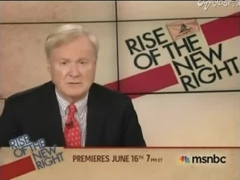
What do Tea Partiers, Truthers, birthers, Birchers, militias, Pat Buchanan, Jerry Falwell, Barry Goldwater, Joe McCarthy, Father Coughlin, Glenn Beck, Rush Limbaugh, Sarah Palin, Michelle Bachmann, Ronald Reagan, Strom Thurmond, Rand Paul, Alex Jones, Orly Taitz, and Oklahoma City bomber Tim McVeigh all have in common? Approximately nothing, but don’t tell Chris Matthews. The MSNBC “Hardball” host spent the better part of an hour last night trying to associate all of these characters with one other. Of course he did not provide a shred of evidence beyond, ironically, a McCarthyite notion that all favor smaller government, and are therefore in league, whether they know it or not, to overthrow the government. Together, by Matthews’s account, they comprise or have given rise to the “New Right.” The special was less a history of the Tea Party movement than a history of leftist distortions of the Tea Party movement. As such, it tried — without offering any evidence, mind you — to paint the movement as potentially violent. Hence, after Matthews tried his hardest to link all of these characters, he went on to paint them all as supporting, inciting, or actually committing violence. Matthews trotted out Mark Potok of the Southern Poverty Law Center to claim that “one spark” could set the militia movement off into a violent frenzy. But Matthews used the statement not to indict the militias Potok was discussing, but rather as evidence that the Tea Party movement at-large is a violent one. Set aside for a moment the fact that Potok is nothing but a partisan hack with a pathetic track record of predicting violence, the B-roll footage while the thoroughly-discredited Potok was making these predictions was footage of the 9/12 Tea Party rally in Washington. This is what Matthews did throughout the special: splice together clips of militias firing weapons with Tea Party protesters in order to create a mental association between the groups. That there is no evidence whatsoever linking Tea Parties to militia groups, nor incidents of violence occurring at rallies, did not dissuade the former Jimmy Carter staffer. Matthews simply chose the unseemly route of trying to associate the numerous characters in his special without any evidence to back up his claims. The only connection that Matthews managed to legitimately draw between the Tea Party and militia groups — indeed, between any of the long list of characters mentioned above– is their aversion to government intervention in their daily lives. That’s right, in the same segment in which Matthews ragged against the late Joe McCarthy, he associated Tea Parties with the Hutaree Militia because both have a distaste for big government (the latter much stronger than the other, obviously). By Matthews’s logic, every American who has qualms with some element of capitalism is complicit in, and supports, openly or not, radical anarcho-socialist violence perpetrated at the G-8, or any other incident of leftist violence (and there have been many of late). Matthews himself has touted the wonders of the ” social state .” So he must support, or at least acknowledge the justifiability of folks who wish to violently overthrow the government and impose a socialist system. That is the only logical conclusion, if we accept Matthews’s premises. Such hypocrisy is rife in the special: if folks associated with the Tea Party use words like “revolution,” they must be literally advocating violence, whereas when mainstream leftists literally advocate violence , they are not worth mentioning. The special’s rank hypocrisy continues right through Matthews’s final monologue. “Words have consequences,” he states. “You cannot call a president’s policies ‘un-American,’ as Sarah Palin has done,” he claims. Or, Matthews forgot to add, as Salon Editor Joan Walsh and Time columnist Joe Klein have done, the former on Matthews’s show and the latter on another MSNBC program. You can’t “refer to the elected government as a ‘regime'” by Matthews’s account, unless, presumably, you are Chris Matthews or a host of other MSNBC personalities , in which case it is permissible. Given that the special really offered no new insight into the Tea Party movement — just the same cliches the Left has regurgitated since the fall of last year — it is hardly surprising, though worth mentioning, that neither Matthews nor any of his cohorts seem to remember their total lack of concern over the potential for anti-government violence during the Bush administration. A movie depicting the assassination of George W. Bush , the plethora of signs at anti-war rallies calling for his death , the litany of incidents of violence committed by leftist groups in the recent past — none of these things were particularly worrisome for the Left throughout Bush’s term. In all of these ways, the “Rise of the New Right” special was just more of the same.

Read the original here:
Chris Matthews Crams Year’s Worth of Anti-Tea Party Cliches into One Hour Special