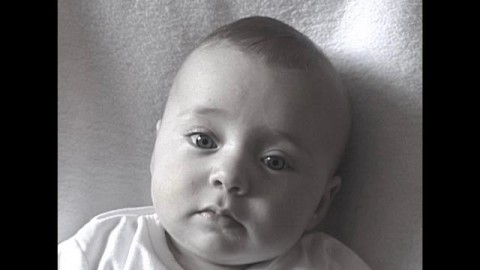
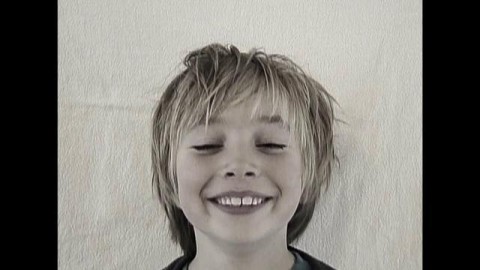
Frans Hofmeester filmed his daughter Lotte once a week from the time she was born until she was 12 years old. He then edited down the massive amount of video into this short clip , which lets you see Lotte grow up right before your very eyes. What’s especially cool is that In many of the shots she’s talking, and even though you can’t hear what she’s saying you get a sense of her expressions and personality… Broadcasting platform : Vimeo Source : Jezebel Discovery Date : 23/04/2012 15:36 Number of articles : 3
Frans Hofmeester filmed his daughter Lotte once a week for the past twelve years and produced this time lapse film. We’ve seen this kind of thing before ( Kalina , etc.) but the use of short snippets of video instead of still photos adds something. Hofmeester has also filmed his son in the same manner for the past nine years. (thx, david) Tags: Frans Hofmeester time lapse video Broadcasting platform : Vimeo Source : kottke Discovery Date : 23/04/2012 15:36 Number of articles : 2
Like He’s Just Not That Into You and What to Expect When You’re Expecting , Think Like a Man is a film adapted from a book that offers advice instead of a story — Act Like a Lady, Think Like a Man , a bestselling dating guide for women from comedian and TV host Steve Harvey. If the work was actually as life-changing and popular when it was published as the movie suggests, I must have missed all the women fighting each other over copies in the aisles of stores (an actual scene). But despite its cloying genuflections to its source material, Think Like a Man is rowdy and funny and showcases an immensely likable ensemble cast it uses to delineate its war between the sexes. The film centers around a group of male friends who conveniently illustrate the personality types Harvey outlines in the book. There’s Zeke (Romany Malco), the player who’s able to sneak past the most bristly of defenses but has no interest in sneaking around, and Dominic (Michael Ealy), the dreamer, whose inability to actually move forward with his goals has driven everyone he’s dated nuts. Jeremy (Jerry Ferrara), the non-committer, has been in a nine-year relationship with a long-suffering girlfriend weary of living in an apartment that looks like a dorm room; Michael (Terrence J) is the momma’s boy who’s still letting his mother do his laundry. Bennett (Gary Owen) is happily married (and, as Jeremy points out, so white that he’s basically “clear”), while Cedric (Kevin Hart), the film’s narrator, describes himself as even more happily divorced and is forever frequenting strip clubs name things like The Sweaty Crack and The Ass Factory. Paired up against them are Mya (Meagan Good), Lauren (Taraji P. Henson), Kristen (Gabrielle Union) and Candace (Regina Hall), women who are looking for stable relationships and, in the case of Kristen, a ring. After seeing Harvey on Oprah, the women all end up buying his book and following his advice, to the dismay of the guys they’re seeing. There’s a lot of potential for this set-up to be a retrograde one about landing your man — Mya in particular decides to adhere to a The Rules -esque regimen of refusing to get into a car unless the door’s opened for her and saying no to sex for the first 90 days of a relationship. But the book gets used more as a means of exploring gender power balance than as a way to trick guys into heading down the aisle — the movie certainly firmly believes in commitment and stepping up and that it’s no hardship to make a few compromises in order to sustain a relationship. For the most part, it’s the guys in Think Like a Man who have to figure the above out, and it’s presented not like a surrender but as a dawning realization — the women in the film are shown to be outpacing the men in terms of ambition and emotional maturity, and are largely waiting for them to catch up. The exception also happens to be the most interesting pairing of the bunch — Lauren, a high-powered Fortune 500 COO who’s been unable to find someone who matches her in terms of success and salary, and Dominic, who’s good with grand gestures but is a broke catering waiter and would-be chef. Henson and Ealy have an irresistibly off-beat chemistry together, and it’s she who has to make the adjustment in learning to deal with dating someone she initially feels isn’t on her level. It’s tough to buy anyone as phenomenally good-looking as Ealy being a perpetual romantic failure, but Henson’s also cast interestingly against type, her giggly warmth going against the typical portrayals of tightly wound workaholics. It’s been a decade since Tim Story directed Barbershop , but his facility with shooting how friends hang out remains unchanged. Think Like a Man divides its time between its various romances and scenes of the characters discussing those love lives with their cohorts, either in a group for the guys, or with the close gal pals each of the women has been given. Some familiar but functional jokes are made about the gender divide — after Candace meets Michael at the book store (you can guess what title she’s there to pick up), her account of him to her bestie Lauren (“soulful” and “sensitive”) is intercut with Michael’s more, er, physical description of her to the boys. Think Like a Man ‘s set in a sleek, upscale version of Los Angeles, the racial makeup of its ensemble neither a thematic focus nor left uncommented on — it’s just another part of the goodnatured banter thrown around between the guys. Hart is made to carry a large part of the comedic burden, and while his motormouthed shtick is initially tiresome, he gets funnier and funnier as the film goes along, shining especially when he insists his friends play what turns out to be a selection of professional basketball players (including Ron Artest and Lisa Leslie) for the right to their court. Chris Brown is among the other celebrity cameos, and actually manages to be amusing as a shifty lothario who creeps out of Mya’s bed after a night together and keeps getting her name wrong when he runs into her on the street. And of course, there’s Harvey himself, appearing to deliver lectures on various TV screens. With characters this charming, his appearances feel more like intrusions, but it’s entertaining to see the various women try out his recommended lines on their men — “What are your long-term goals?” Follow Alison Willmore on Twitter . Follow Movieline on Twitter .
Yikes : “Meenakshi Thapar, 26, who had appeared in the Indian horror film 404 last year, met two aspiring actors who allegedly later killed her on the set of her latest film, Heroine . According to police, her ‘fellow actors’ warned her mother they would force her daughter to take part in pornography films if their demands were not met. Her mother paid 60,000 Rupees [$1,152] into her daughter’s account for her kidnappers to withdraw, but she was allegedly killed soon after. She was strangled to death, beheaded, and her body was dumped at two different sites as her killers made their way back to Mumbai. Her torso was dumped in a water tank and her head thrown out of the bus window in a bag on the road to Mumbai.” [ Telegraph via THR ]
The more I see of Steven Soderbergh ‘s Magic Mike , the higher it climbs up my most-anticipated list. Here’s why: Shirtless Channing Tatum. Sensitive Channing Tatum. Dancing Channing Tatum! A cute romance with total girl next door Cody Horn. Rihanna on the soundtrack! They found love in a pantsless place, you guys . Watch the full trailer after the jump. Beefcake! Sure, we have no idea how Shirtless Alex Pettyfer or Absent-from-the-Trailer Matt Bomer or Joe Manganiello figure into the plot. And I’m 99 percent sure most male strip clubs don’t have this high a percentage of young, hot lady customers. But I do want to know what Channing has to do for those $20s. Head to Apple for the trailer debut in HD. Verdict: I hereby declare June 29 the official ladies movie night of the summer. Who’s with me?
There’s too much people and not enough dog in Lawrence Kasdan’s Darling Companion , and even if you prefer people to dogs, that’s a serious problem. It would be bad enough that Kasdan squanders the gifts of two of his lead actors, Diane Keaton and Kevin Kline, in this aimless, tedious and sometimes downright ridiculous comedy-drama about a fractured family brought closer by unusual circumstances. But he does a disservice to an even more striking face: That of a mutt whom Keaton’s character rescues from the edge of the highway, an elegant, spirited creature she dubs — what else? — Freeway. I had high hopes for Darling Companion in its early moments, particularly a scene in which Keaton’s Beth gives Freeway a bath. She’s just returned from getting him checked out at the vet’s, but hasn’t yet broken the news to her uptight surgeon husband Joseph (Kline) that the dog is going to stay. Watching Keaton as she kneels by the bathtub massaging shampoo into the pup’s fur — the attention clearly sends him straight into seventh heaven — brings with it a certain elemental joy. For this moment at least, Keaton’s expressive radiance has met its match: There’s so much life in both of them that you’d never imagine how far downhill things could go from there. But boy, do they. Written by Kasdan and his wife, Meg Kasdan, the script for Darling Companion dispatches with the dog early on (temporarily) to clear the way for a picture filled with husband-and-wife squabbling, the constant nattering of annoying future-in-laws, the airing of various neuroses and, I kid you not, heaps of faux-mystic wisdom from a beautiful Romany psychic. This is how it all plays out: As Joseph and Beth are recovering from the wedding of their daughter (Elisabeth Moss) to the vet who treated Freeway after his rescue (Jay Ali), Joseph takes the dog for a walk on a trail near the couple’s rustic-luxe Rocky Mountain retreat (as if we didn’t already have enough reasons to hate them). Freeway spots a deer and takes off in pursuit; distracted by one of his Very Important Surgeon cell-phone calls, Joseph fails to coax the dog back. Spoiler alert: Dog lovers will want to know that Freeway does come back, but not until practically the very last frame of the movie, by which time even his exuberant wagging tail is too late to save it. Most of Darling Companion is used up in the search for the dog, during which time the poor fellow becomes completely beside the point. Joseph and Beth are forced to get to know their future brother-in-law, Russell (Richard Jenkins), who has greatly charmed his fiancée-to-be, Joseph’s sister, Penny (Dianne Wiest), but who also seems to be a bit of a wheeler-dealer. Meanwhile, Bryan (Mark Duplass), Joseph’s nephew, who also works with him in his surgical practice, becomes entranced with the caretaker of Joseph and Beth’s vacation house, the exotic, with a capital E, Carmen (Ayelet Zurer). Carmen keeps getting psychic visions of Freeway’s whereabouts, and she sends the family out, in various permutations, based on the locations derived from this rather faulty sixth-sense GPS system. And in the end, guess what? Everybody likes and understands one another better, thanks to a lost dog and a Gypsy Mary Poppins. Darling Companion is all about how we need to keep changing and growing as we get older, which is somewhat ironic considering that as a director, Kasdan seems frozen in time – although we desperately need more movies for grown-ups, lukewarm reheats of The Big Chill aren’t going to do it. Most of a potentially terrific cast is wasted here: Wiest plays the same sweet, neurotic eye-crinkler she’s portrayed so many times she could do it in her sleep. Kline, generally wonderful at playing only semi-likable characters, doesn’t illuminate any corners of Joseph’s personality that might make you feel anything for the guy. Only Keaton, waving her arms and exhorting all those around her to please help her find her dog, makes any sense. Beth’s priorities are unquestionably sound. It’s the movie around her that loses its way. Follow Stephanie Zacharek on Twitter . Follow Movieline on Twitter .
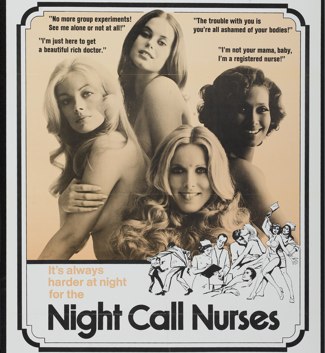
The Film : Night Call Nurses (1972), available on DVD in the new set Roger Corman’s Cult Classics: The Nurses Collection via Shout! Factory . Why it’s an Inessential Essential : The respectability gap between director Jonathan Kaplan’s recent and early-career work is pretty striking. Today, Kaplan works primarily in TV: He served as a co-executive producer for both E.R. and Without a Trace , and has also directed eight episodes of Law and Order: Special Victims Unit , two episodes of Brothers and Sisters and 40 episodes of E.R. But when Kaplan started his filmmaking career, he made sleazy but surprisingly sturdy exploitation pics like Truck Turner (1974), in which Isaac Hayes plays a bounty hunter that is very attached to beer and his cat, and The Slams (1973), a prison flick starring Jim Brown. Now Night Call Nurses , Kaplan’s 1972 directorial debut, has just been reissued in a new collection highlighting four nursesploitation pics produced by schlockmeister Roger Corman. Kaplan’s film is easily the best one in the set — and also a good indicator of Kaplan’s then-nascent talent. Make no mistake, the longevity of Night Call Nurses — a natural moneymaker for Corman — is largely attributable to Kaplan’s experimental direction. As Kaplan explains in the featurette “Anatomy of a Nurse Film,” Nurses ‘ plot is a variation on a formula that Corman swiped from Valley of the Dolls , another film that follows three female protagonists. A trio of nurses test their respective comfort zones: Barbara (Patty Byrne) has a unfulfilling affair with her group therapy psychiatrist while Janis (Alana Stewart) has a fling with a speed-addicted former patient and Sandra (Mittie Lawrence) helps a Black Panther-type convict meet up with his fellow radicals. All three girls are defined via exploitation-friendly character types: Barbara’s the uptight one, Janis is the flirty and free-spirited blonde and Sandra’s the politically motivated black girl. I hesitate to call these girls walking stereotypes, because Kaplan does a good job of contextualizing their titillating and character-defining concerns. One guy trips balls and imagines that he has mirror tiles for hands while a woman kneels before a big red crucifix before throwing herself off a roof (upon impact, we see a porcelain doll’s head crack open). Through these dynamic and trippy scenes, both of which were shot using handheld cameras, Kaplan vividly and quickly the hallucinatory, drug and sex-fueled haze that his characters are trying to define themselves in. Night Call Nurses is atmospheric and visually accomplished, making it a satisfying morsel of junk-food cinema. How the DVD/Blu-ray Makes the Case for the Film : Kaplan’s very forthcoming about the production history of Night Call Nurses in an interview featurette called “Anatomy of a Nurse Film.” He insists on discussing the film as collaboration between Corman and himself. He explains that Corman called Kaplan late one night and offered him the directing gig based on Martin Scorsese’s recommendation. Once he’d accepted the job, Corman was apparently very loose with Kaplan. The only rules Corman laid down was that the picture should be done shooting in 13 days and that T&A must be shot in a certain way, presumably to get past censors. “‘Frontal nudity from the waist up, total nudity from behind (no pubic hair),'” Kaplan says for Corman. Kaplan also explains that working with Corman was a great filmmaking education: “That was the last guy I worked with who ever understood what a director really does.” Which doesn’t mean that Kaplan glosses over Corman’s infamous tendency of cutting budgetary corners. According to Kaplan, Corman’s advice to him was: “‘Ask your cinematographer how long to make it beautiful, how long to make it passable and how long to get an image? And then just get the image.” Kaplan clearly settled for something between “passable” and “beautiful.” And he did it all on a microscopic budget of $75,000, too! Other Interesting Trivia : One of the funnier anecdotes Kaplan relates about working with Corman is his story about trying to convince Stewart to do her big nude scene after she became tentatively skittish. Corman apparently told Kaplan to go to the stretch of Sunset Boulevard called “The Stroll” and hire the “skankiest hooker” that he could find. Kaplan was then told to introduce the prostitute to Stewart as the actress’s body double with the expectation that Stewart would then volunteer to do her own stunts. Kaplan was uncomfortable driving, however, and he failed to convince Roger’s wife Julie Corman to accompany him to the Stroll. So they just talked Stewart into doing the nude scenes without hiring a professional sex worker. It’s probably safe to assume that Kaplan’s never had to do anything so risque for Law & Order: Special Victims Unit. PREVIOUS INESSENTIAL ESSENTIALS The Last Temptation of Christ The Sitter Citizen Ruth The Broken Tower Dogville Simon Abrams is a NY-based freelance film critic whose work has been featured in outlets like The Village Voice, Time Out New York, Vulture and Esquire. Additionally, some people like his writing, which he collects at Extended Cut .
The Tribeca Film Festival opened Wednesday night with the world premiere of Universal’s The Five-Year Engagement , ushering in 10 days of the festival’s 11th annual event. Initial word from insiders is that this year’s festival lineup is its strongest in years. Days from now, attendees will be buzzing about what works and what doesn’t, but Movieline is offering up a sneak glimpse into many of the films playing in the festival’s narrative and documentary competitions , plus its genre-centered Cinemania section. Ahead of the festival, we reached out to its filmmakers to give quick comments about their films and a peak at their trailers or clips, which Movieline will debut here in the coming days — including exclusive premieres, such as the trailer for The Revisionaries , featured below. Have a look, mark your calendars, and share your thoughts on these and other Tribeca films. The Revisionaries , by director Scott Thurman – U.S. [World Documentary Competition] Synopsis Once every decade, the 15 members of the Texas Board of Education meet in Austin to revise the state’s textbook standards. Led by Don McLeroy, a Young Earth Creationist, Evangelical Christian, and beloved local dentist, the panel will debate and implement controversial new standards related to science, evolution, social studies, and American history that will ultimately go into effect in textbooks adopted by schools across the nation. Challenged by outspoken activist Kathy Miller, as well as Thomas Ratliff, a moderate conservative out to unseat him, McLeroy faces an uphill battle, with the fate of American education itself hanging in the balance. [courtesy of Tribeca Film Festival] Comments by Scott Thurman: The Revisionaries quick pitch : The theory of evolution and a re-write of US history are caught in the crosshairs when an unabashed creationist seeks re-election as chairman of America’s most influential board of education. [The film] is about the rise and fall of a small-town dentist, outspoken young earth creationist, and Chair of the Texas Board of Education during a crucial period in determining high-school textbook content for public schools throughout the entire state, which influences schools across the country. …and why it’s worth checking out at Tribeca : The Revisionaries is a very important and timely film about the politics of education. I hope the creative director at Tribeca, Geoff Gilmore, won’t mind if we mention that he’s stated, “It’s such an intriguing point-of-view with the Christian right-wingers.” In an election year, what could be more important than learning more about a major battleground in the American culture wars? Thoughts about the trailer : I’d like audiences to be more informed about how the Texas Board of Education’s political process occurs, and to better understand the motivation and strategies of a handful of characters with opposing world views involved in that process, which could affect all of our children. Although we don’t advertise any specific action steps, we hope the film motivates audiences throughout the country to become more aware of the public school standards in their own state and understand the importance of participating in state board of education elections. First Winter by writer/director Benjamin Dickinson – U.S. [Tribeca Film Festival World Narrative Competition] Synopsis When winter begins, life is serene for a group of new-age Brooklynites living in a remote country farmhouse. Sex, drugs, yoga, and organic cooking absorb their days, safely tucked away from the stresses of urban life. But when a blackout of apocalyptic proportions strands them with no heat and no electricity during the coldest winter on record, their utopian commune is breached by anxiety and their idyllic harmony begins to lose its tune. As time wears on and the food supply dwindles, power struggles, jealousy, and desire threaten the group’s ability to work together in order to survive. [courtesy of Tribeca Film Festival] Comments by Benjamin Dickinson… First Winter quick pitch : It’s about letting go of what’s unnecessary. …and why it’s worth checking out at Tribeca : It’s a compelling story about Brooklynites with some nice drugs, sex, emotional violence, and jokes in there, and but so that’s just to set you up for what it’s really about, which is love and death. Thoughts about the trailer : I wanted to communicate more than anything the tone of the film, which I think this does nicely. It’s slow and visual and moody. The landscape gradually takes over. Jackpot by director Magnus Martens – Norway [Cinemania section] Synopsis Terrified, bloodied, and clutching a shotgun, Oscar Svendsen awakes and emerges from underneath a dead body. He finds himself in the midst of a crime scene in what used to be a respectable strip joint, surrounded by corpses and staring down the barrel of a gun pointed at him by a detective with the National Criminal Investigation Service. Naturally, Oscar is taken into custody, and during his interrogation he timidly relates a bloody story of betrayal, murder, and a soccer lottery prize that was meant to be shared with three ex-con co-workers. But is this the whole story? [Courtesy of Tribeca Film Festival] Comments by Magnus Martens… Jackpot quick pitch : Jackpot is a crime-comedy based on an original story by author Jo Nesbø. …and why it’s worth checking out at Tribeca : If you want to see something hilarious from Norway with a memento to Tarantino´s absurd action universe, you better not miss Jackpot . Thoughts about the trailer : The trailer starts as a scary movie with a crime plot and shifts into a comedy. We wanted to communicate that Jackpot has many ingredients from different genres. While We Were Here by director Kat Coiro – U.S. [World Narrative Competition] Synopsis In this tightly crafted relationship drama, Jane (Kate Bosworth) and her husband Leonard (Iddo Goldberg) travel to Naples—where Leonard is playing viola with the local orchestra—hoping to reinvigorate their silently disintegrating marriage and escape a personal tragedy that hangs heavily between them. Jane, left alone most days, wanders the streets listening to tapes she made of interviews with her grandmother, seeking inspiration to finish a book based on the old recordings. Facing writer’s block, she takes a day trip to stunning Ischia, where she meets Caleb (Jamie Blackley), a young American leading a hermetic yet Dionysian life on the island. As the two embark on an unlikely emotional affair, Jane’s carefully constructed world begins to crack open and she faces drastic changes in her life. [Courtesy of Tribeca Film Festival] Comments by Kat Coiro… While We Were Here quick pitch : Kate Bosworth plays a woman in an unhappy marriage who accompanies her musician husband to the south of Italy where she meets a young, devastatingly handsome man ten years her junior, with whom she embarks on an affair… …and why it’s worth checking out at Tribeca : The setting alone is worth the price of admission. Filmed on location on a little island off the coast of Italy, the movie takes place in grottos, on beaches, off of cliffs, in castles — it’s full-blown location porn. The other draw is the cast. Jamie Blackley is a rising star who shines as Kate Bosworth’s much younger lover, the legendary Claire Bloom narrates and Bosworth taps into a remarkably vulnerable place as a woman at a crossroads. Thoughts about the clip : The clip doesn’t give away any of the tightly wound story but it does transport the viewer to a romantic place and gives a sense of the black and white photography, the stunning location and the original orchestral score. Graceland by director Ron Morales – Philippines [Tribeca Film Festival Cinemania section] Synopsis : Once every decade, the 15 members of the Texas Board of Education meet in Austin to revise the state’s textbook standards. Led by Don McLeroy, a Young Earth Creationist, Evangelical Christian, and beloved local dentist, the panel will debate and implement controversial new standards related to science, evolution, social studies, and American history that will ultimately go into effect in textbooks adopted by schools across the nation. Challenged by outspoken activist Kathy Miller, as well as Thomas Ratliff, a moderate conservative out to unseat him, McLeroy faces an uphill battle, with the fate of American education itself hanging in the balance. [Courtesy of Tribeca Film Festival] Comments from Ron Morales… Graceland quick pitch : Graceland is an intense kidnapping drama that forces its viewers to see the motivations of several characters on several sides of a very dark story. It poses a lot of moral questions, is intensely exhilarating, and takes no prisoners. …and why it’s worth checking out at Tribeca : There’s nothing else like Graceland at Tribeca this year. Its raw ferocity and intense subject matter set it apart from other features, and the fact that it was written and directed by a Filipino now living in Manhattan allows it the exoticism of a foreign film with the heart of a local project. Thoughts about the trailer : The trailer is an extension of the film – calm and intense, with a strong air of concern that hints at the horrors to come. It highlights Arnold Reyes’ bravado performance, which begins calm and subdued, but ultimately throttles the film like a freight train toward it’s unexpected conclusion. Stay tuned for more exclusive festival previews at Movieline, and read all of our Tribeca 2012 coverage here .
The best documentaries tell you more than you think you’d ever want to know about a subject, perhaps fulfilling a curiosity you didn’t know you had. That’s the case with Kevin Macdonald’s Bob Marley documentary Marley , which stretches out at a languorous two hours and 24 minutes without dragging or getting bogged down in extraneous details. Everything in it – from interviews with the singer’s bandmates and his widow, Rita, to vintage and contemporary images of his hardscrabble birthplace of St. Ann Parish, Jamaica, to live-performance footage that captures his extraordinary charisma – feels essential, albeit in a relaxed way. By the end you feel you’ve learned something about the man, yet his mystique emerges intact. Robert Nesta Marley was born in 1945, to an Afro-Jamaican mother, Cedelia, and a much older white Jamaican father, Norval Sinclair Marley, who was of English descent and who barely played a part in young Robert’s upbringing – he’d visit the family occasionally, but he was a shadowy figure who, as it turns out, also fathered a child by another Jamaican woman. Macdonald grounds Marley’s story firmly in a sense of place, using simple images for whopping impact: A black-and-white still photo shows Marley’s childhood home, which is essentially a shack with a few windows. When Marley was 12, his mother moved her little family to the Trench Town area of Kingston, in an effort to build a better life. One of Marley’s childhood friends recalls that that type of “better life” often included going to bed hungry. Kids heard the words “Drink some water and go to bed” a lot, simply because there was nothing else their parents could do for them. Despite growing up amid that kind of hardship — or maybe partly because of it — Marley always loved music and always found ways to make it, and Macdonald does a superb job of outlining a mini-history of ska and reggae, musical forms built in the early 1960s from the spontaneous mingling of Caribbean rhythms and American pop music. One of Marley’s childhood friends described the home-made instruments used to make this music in its most rudimentary form: A box with rigged with strings known as a rhumba box; drums made from cow skin; and the instrument referred to by this fellow as the “shake-shake,” which really needs no explanation. Marley and his friends listened to American acts like the Platters, the Drifters and the Temptations, and after Marley made his first recording, in 1962 – a pseudo-spiritual called “Judge Not” – he became part of the band that came to be known as the Wailers. The group rehearsed for two years before the producer at their local recording studio allowed them to make a record: In the meantime, they played not just in town squares but also in cemeteries, to ward off evil spirits – if you could placate those guys, you’d be able to perform without fear in front of anybody. Macdonald arranges his material in a way that’s chronological though not strictly linear, covering a lot of territory with an easygoing cross-thatching of stories of interviews: Marley’s gradual but steady rise from ambitious, talented writer and musician to revered cult figure; his embrace of Rastafarianism; his association with legendary producer Lee “Scratch” Perry (shown, in contemporary footage, looking and acting extremely wiggy) and Island Records founder Chris Blackwell; and, last but not least, his propensity for consuming somewhere near a pound of marijuana a day. (Did I dream that, or is it actually in the documentary? Either way, he smoked a lot .) Most illuminating are the interviews Macdonald conducted with Bunny Wailer, founder and original member of the Wailers (who holds court before the camera, resplendent in dark glasses and a puffy zebra-striped hat), and Rita Marley, who tells how, at the height of her husband’s fame, she’d sometimes be called in to dispatch his extracurricular girlfriends from his dressing room. (She’d march in, announcing to everyone that it was time for bed.) Marley had a lot of extracurricular action, including a longtime relationship with former Miss World Cindy Breakspeare, who’s interviewed at length in the film. We learn that he fathered 11 children by seven different mothers during his lifetime. (One woman interviewed in the film is identified only as “Baby Mother.”) He died of cancer, in 1981, at age 36 – Macdonald handles the details of his death so matter-of-factly that it might not hit you until later how poignant they are. At one point his daughter, who clearly harbors a lot of resentment toward her free-spirited absentee father, remarks on his appearance after the progression of his illness required him to cut off his heavy dreadlocks: “He looked, like, so tiny.” If Marley lived the high life, sometimes at others’ expense, it’s worth noting that the women around him who lived to tell the tale – Rita Marley, Breakspeare and backup singer Marcia Griffiths – look remarkably youthful: No wrinkles, no cry. Macdonald clearly has a great deal of respect for his subject, and maybe even some reverence. But he doesn’t pretend that Marley’s great talent and charm existed in a vacuum – every minute, he’s finding a new context for the man’s career and life, and the portrait he ultimately comes up with is prismatic and fascinating. With pictures like The Last King of Scotland and State of Play , Macdonald has proved such an adept fiction filmmaker that it’s easy to forget he made documentaries for years, including Touching the Void and the Oscar-winning One Day in September . In that respect, Marley is a homecoming of sorts. It’s at once leisurely and controlled, like a Bob Marley song, with fresh secrets in every groove. Follow Stephanie Zacharek on Twitter . Follow Movieline on Twitter .
This is about as cute as it gets. A video making the online rounds this week reveals a special moment for a young family. When it came time to tell their daughter that they’re expecting another baby, the parents used a t-shirt reading “I’m the Big Sister” to share the joyous news. It takes awhile to get the message across, and thus the video goes on for several minutes. When she figures it out, though, the precious reaction is worth the wait: Little Girl Learns Baby News