Tag Archives: democrat

Schieffer Bashes White House’s ‘Snarky’ Response to Boehner’s Tax Cut Comment

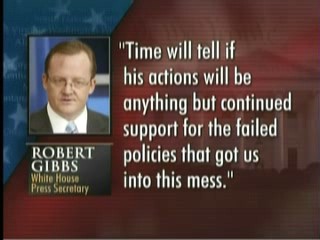
CBS’s Bob Schieffer on Sunday bashed the White House for how it responded to House Minority Leader John Boehner’s (R-Oh.) tax cut comment uttered on “Face the Nation” a week ago. As readers are likely aware, Boehner made news – if not friends amongst conservatives! – by telling Schieffer that if the only thing that came out of the House was an extension of the Bush tax cuts for all but folks that make $250,000 or more per year, he would grudgingly support it.  After reading the White House’s official response to Boehner during this Sunday’s final segment – “Time will tell if his actions will be anything but continued support for the failed policies that got us into this mess” – Schieffer scolded, “I can remember when the first move by a president like Lyndon Johnson or maybe a smart aide in the Eisenhower White House would not have been a snarky press release.” “I`m guessing LBJ would have been on the phone to Boehner in five minutes after seeing him on TV saying something like, if you`re serious, why don`t you come over here quietly and we`ll try to work out something good for both of us and the folks out there,” continued Schieffer. “As we saw, no chance it could happen today. And we`re right back to the partisan war” (video follows with transcript and commentary):  BOB SCHIEFFER, HOST: Finally, House Republican Leader John Boehner did a rare thing on this broadcast last week. He got off the talking points. I asked him about extending the Bush tax cuts that expire this year. Boehner gave me the GOP line: We should extend those cuts for all Americans, rich and poor, Democrats want to extend the cuts only to those making less than $250,000 a year. And when I pressed Boehner, he carefully said that was just bad policy, but if it came down to tax cuts only for the lower and middle income groups or no tax cuts at all, he said, he would reluctantly vote for just the lower and middle income cuts. That was big news all across the country. And it set off a thunder bolt of reaction in both parties. By mid-afternoon the White House acknowledged Boehner`s change in position but added in a written press release: “Time will tell if his actions will be anything but continued support for the failed policies that got us into this mess.” Blame it on a long memory, but I can remember when the first move by a president like Lyndon Johnson or maybe a smart aide in the Eisenhower White House would not have been a snarky press release. I`m guessing LBJ would have been on the phone to Boehner in five minutes after seeing him on TV saying something like, if you`re serious, why don`t you come over here quietly and we`ll try to work out something good for both of us and the folks out there. Call me a romantic, but I believe that might have happened. As we saw, no chance it could happen today. And we`re right back to the partisan war. Too bad really. Nicely done, Bob, but isn’t this possibly another instance of you not being as aware of things going on in Washington, D.C., as you should be? After all, it was only two months ago that Schieffer interviewed Attorney General Eric Holder and not only didn’t ask him about the New Black Panther Party controversy at the Department of Justice, but also admitted to CNN’s Howard Kurtz that he hadn’t heard anything about it.   Regardless of the media’s pathetic echoing of the Democrat talking point that Republicans are the Party of No, GOP members in the House and the Senate have been offering legislative ideas since Obama was inaugurated. Problem is the Party currently controlling Congress and the White House has wanted to implement its policies without any input from Republicans relying instead on their majorities in both chambers. As such, it’s by no means surprising the Obama administration didn’t immediately jump on Boehner’s comments from last Sunday to try to use them as a means of coming to a resolution on this matter. That’s not been this White House’s modus operandi since January 20, 2009, and Schieffer would have known this if he wasn’t accepting the administration’s talking points as the Gospel truth. Why he didn’t this time is anybody’s guess unless like so many folks on the Left he’s beginning to come out from under the Hope and Change ether. Stay tuned. 
The rest is here:
Schieffer Bashes White House’s ‘Snarky’ Response to Boehner’s Tax Cut Comment
George Will Smacks Down Beinart’s Claim Sarah Palin Is GOP’s George McGovern

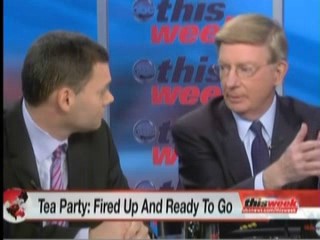
George Will on Sunday refuted Peter Beinart’s claim that former governor Sarah Palin is the Republicans’ George McGovern. As NewsBusters previously reported , Beinart appearing on ABC’s “This Week” claimed the GOP today resembles the Democrat Party between 1968 and 1972 when McGovern took it over and moved it so far to the left that it no longer represented the views of average Americans. This ended up harming the Democrats in the long run leading Beinart to conclude, “The Republicans will do great in 2010, but I think Sarah Palin is really the Republicans’ George McGovern.” Will smartly responded (video follows with partial transcript and commentary): GEORGE WILL: But eight months ago, the worry was the worst case analysis for Republicans was that the Tea Party energies would be diverted in a third party candidacy splitting the conservative vote in this country. Sarah Palin, think of her what you will, has brought them into the Republican Party, and they are one of the main reasons for what is going to be probably decisive in November and that is the enormous enthusiasm and intensity gap that favors the Republicans this year.  Indeed. The fear of the conventional wisdom punditry months ago was that the Tea Party would be so divisive it would result in third party candidates splintering the conservative vote. So far the only such “insurgents” have been sore losers within the GOP establishment like Florida’s Charlie Crist and Alaska’s Lisa Murkowski who refuse to be good Party members and get on board the winner’s bandwagon.   Congressional Quarterly’s Craig Crawford made a similar point on Sunday’s “Reliable Sources”: The thing about the Tea Party that strikes me is it’s very similar in particularly their fiscal conservative views to the Perot movement. And this argument that they’re bad for Republicans doesn’t wash as much with me because as least they’re inside the Republican Party. The Perot people were outside the party and much more damaging to Republicans.   Exactly, which means that liberal media members like Beinart continue to either misunderstand what’s going on with this movement or just choose to dishonestly misrepresent it in order to assist the Party they really  support.  Readers are encouraged to review Brent Baker’s ” Tea Parties Will Lead to 1964-Like Goldwater Debacle…No, Make that a 1972-Like McGovern Drubbing .”  

See the article here:
George Will Smacks Down Beinart’s Claim Sarah Palin Is GOP’s George McGovern

AP Shocker: Bush Tax Cuts Didn’t Just Help The Rich

For almost ten years, the Bush tax cuts have been depicted by media as only helping rich people. Now, with them set to expire, and a Democrat in the White House desperately needing a stronger economy to help him and his Party’s political fortunes, the Associated Press is telling readers the truth with the following headline: Expiring Tax Cuts Hit Taxpayers at Every Level     If you think that’s amazing, wait until you see the contents : A typical family of four with a household income of $50,000 a year would have to pay $2,900 more in taxes in 2011, according to a new analysis by Deloitte Tax LLP, a tax consulting firm. The same family making $100,000 a year would see its taxes rise by $4,500. Wealthier families face even bigger tax hikes. A family of four making $500,000 a year would pay $10,800 more in taxes. The same family making $1 million a year would get a tax increase of $53,200. The estimates are based on total household income, including wages, capital gains and qualified dividends. The estimated tax bills take into account typical deductions at each income level. Okay, so putting this in reverse, doesn’t that mean that when these tax cuts were first implemented – you know, when that awful Republican named George W. Bush was president! – a typical family of four with a household income of $50,000 a year saved $2,900 per annum as a result ? And a family making $100,000 a year saved $4,500?  Gosh, that means these tax cuts weren’t just for the rich as virtually every media outlet in America has been claiming since they were first proposed. Makes you wonder how such organizations can stay in business when they do such a terrible job. 

See the original post here:
AP Shocker: Bush Tax Cuts Didn’t Just Help The Rich

President Obama Picks Elizabeth Warren to Set Up Consumer Bureau

WASHINGTON — Elizabeth Warren, the Harvard law professor who became a darling of the left for her championship of the Consumer Financial Protection Bureau, was appointed by President Obama on Friday to oversee the agency’s establishment by mid-2011, until a director is named later. The appointment will allow Ms. Warren, “a janitor’s daughter,” as Mr. Obama called her in a Rose Garden introduction, to effectively get the agency up and running without having to go through a contentious confirmation battle in the Senate — a fight that a leading Democrat, Senator Christopher J. Dodd of Connecticut, predicted she could not win given opposition from Republicans and the financial industry. Mr. Obama said Ms. Warren would recruit staff and initiate policies for regulating mortgages, student loans and other consumer credit products, and would have a voice in picking the first director. The favorite among administration officials is Michael S. Barr, an assistant secretary of Treasury for financial institutions who is an authority on financial regulation and on services for low and moderate-income households. The interim role for Ms. Warren averts a political problem for Mr. Obama in this election season. Rejecting her would have angered many party liberals, who already are demoralized by administration policies they view as too centrist and friendly to Wall Street. Liberal and consumer groups had lobbied hard for her, along with some lawmakers including Representative Barney Frank of Massachusetts, the chairman of the House Financial Services Committee. “This is the boldest step Obama’s taken so far to rein in the big Wall Street banks,” the leaders of the group MoveOn.org, who often are critical of the president, wrote in an e-mail to members. Business groups, while disappointed, privately acknowledged relief that Ms. Warren appeared unlikely to become director. The creation of the bureau was a central piece of the legislation overhauling the financial regulatory system that Mr. Dodd sponsored and Mr. Obama signed into law in July. Its genesis was an article that Ms. Warren wrote a year before the near collapse of the financial system in 2008, a crisis blamed in part on abusive mortgage practices. added by: BRAVATRAVELS

Joliet Herald-News Ignores Story of Demonstrators With Nazi Signs From Local Congresswoman’s Campaign Office

Joliet, Illinois must be a community absolutely bursting with newsworthy events. Why? Because the Herald-News newspaper in that city was (conveniently) unable to cover a local news story that has become a sizzling hot topic in the blogosphere. All one has to do is enter the name of the Illinois 11th Congressional District Congresswoman, Debbie Halvorson, into Google Blog Search and you will get results chock full of a shocking incident a few days ago, including this video . The Frugal Café Blog Zone, which is but one of many sites covering this, explains : Would MSNBC or CNN have featured this shocking story if the vile protesters at the Nazi-themed protest were CONSERVATIVES or REPUBLICANS or if left-wing extremists had dressed up like Nazis and crashed a tea party posing as conservatives or Republicans? Why do you even ask? Of course they would. When interviewed in the video below, these anti-conservative protesters in Joliet, outside Chicago — proudly carrying Nazi-esque signs slamming GOP congressional opponent Adam Kinzinger and other well-known conservatives, like Glenn Beck and Sarah Palin — denied several times being there in support of, or affiliated with, Democrat Rep. Debbie Halvorson. Congresswoman Halvorson is running against Kinzinger in the November election. … Much later, these bogus grassroots protesters were videotaped returning to the congresswoman’s campaign office in the dark of night. Obviously, they’re part of the liberal congresswoman’s camp. Unless Halvorson had NO IDEA that these left-wing extremist folks had her campaign office keys and gained access to her office. They look pretty darned cozy in there in the video with Julie Merz, Halvorson’s campaign manager. Many prominent blogs are now covering this shocking story of dirty campaign tactics including InstaPundit , Riehl World View , and The Other McCain . What will it take to get the Herald-News to cover this unfolding story in its own backyard of Joliet? A banner headline at the top of the Drudge Report linking to the video of the demonstrators with the Nazi themed signs returning home to the Debbie Halvorson campaign headquarters? Meanwhile a sampling of headlines in the current edition of the Herald-News that they found to be more important than this local political scandal that has heated up the blogosphere: Joliet couple power up for solar energy Yorkville swears in first deputy chiefs Plan set to spend proposed taxes USF to honor alumni at homecoming event

The rest is here:
Joliet Herald-News Ignores Story of Demonstrators With Nazi Signs From Local Congresswoman’s Campaign Office

PBS Ombudsman Bizarrely Claims Pitting Dick Armey vs. Arianna Huffington is Right vs. Center

The PBS NewsHour tried to balance a conservative Republican with a liberal Democrat when it interviewed (on two different Thursdays) Dick Armey and Arianna Huffington . Left-wingers complained to PBS ombudsman Michael Getler that NewsHour anchor Judy Woodruff failed to press Armey about the Tea Party’s funding from corporate billionaires. The far-left media monitors at FAIR wanted Woodruff to bash Armey as a hypocrite who benefits from government entitlements, like Bill Moyers did.  Getler’s response was jaw-dropping. He claimed that PBS had failed to achieve balance, since Armey is conservative and Arianna Huffington is a centrist “and her widely viewed website strike me, as a reader, as an equal-opportunity critic. Armey is not. There are plenty of sharp, critical assessments of the Democratic Party and administration on her site.” Doesn’t it matter that those critics are banging away that Obama isn’t socialist enough? Worse yet, Getler said this should be “remedied” by bringing on another leftist, author Will Bunch of Media Matters for America, because Arianna was clearly not left-wing enough or critical enough of the Tea Party. Getler lamented that PBS has lost left-wing shows like Now and Bill Moyers Journal that are “not in the safe comfortable center.” Getler has granted points to conservative letter writers on occasion (and it seems apparent from his report that he didn’t get conservative letter writers in his latest batch). But Getler holds the liberal opinion that was mandtory for his hiring: that public television is not a forum that should be balanced because it’s taxpayer-funded. Instead, because it is “public,” it should rip on conservatives from the left, because the “safe comfortable center” is already represented by ABC, CBS, and NBC. “Public” television should be anti-corporate and anti-militarist and be so boldly. Arguing that Arianna Huffington’s “beyond left and right” palaver makes her a centrist is truly unsophisticated. In her media criticism like in her less-than-centrist-sounding book Right Is Wrong, that has meant the conservatives should be dumped, since the left is correct and it’s unfair (and dangerous) to “balance” that with inaccurate conservatism, like on global warming. In her PBS interview with Gwen Ifill, it’s quite clear that while Huffington may have posed rhetorically as going beyond ideology, she is not a centrist. She’s lamenting that Team Obama is pandering to centrists instead of being fully progressive when Democrats have total control of Washington: [T]his has been obviously a failure of the Bush years that put their faith in free market economics and deregulation, but also the Democrats during the Obama years, when they had control of the White House, the House, and the Senate, but, instead of going forward with bold proposals that would address the fundamental problems in the country, they tried to basically do what they can to bring everybody along, sort of flirt with Olympia Snowe, and bring Larry Summers to head the economic team in a way that put Wall Street ahead of Main Street. Getler is only correct in that when Ifill asked Huffington to critique or attack the Tea Party movement, she declined and used “beyond left and right” palaver to pose as above ideology (like, well, Obama). NewsHour tried to balance the segments. It was Huffington who failed the leftists’ desire to have someone accuse the Tea Party of being the toy soldiers of billionaires.   But while Woodruff gently pressed Armey that liberals say his proposals to make Social Security and Medicare voluntary would destroy these entitlement programs, Ifill offered no critique of Huffington’s left-wing viewpoint from conservatives, that her proposed solutions would kill chances for a recovery (or that conservatives would say she’s a phony for her pose, or question her funding from left-wing billionaires). Both interviews were gentle, in the Jim Lehrer tradition. It seems as if Getler wants NewsHour to be anchored by Bill Moyers. Here’s the gist of Getler’s mystifying complaint: In the segment with Armey, NewsHour correspondent Judy Woodruff told viewers that this was the first of a two-part series of book conversations with thinkers on both sides of the political spectrum and that “a very different perspective … a conversation with liberal Democrat Arianna Huffington” about her new book would be coming soon. The Huffington interview with correspondent Gwen Ifill aired Sept. 16. One of the benefits of the NewsHour is that it has the time for this kind of series, allowing more in-depth exploration of supposedly opposing views, and I’ve always advocated that viewers judge a news program or publication on the continuity of its coverage of a subject rather than on an individual segment. But this time it didn’t work, in my view. Woodruff is a good interviewer and managed to get in some brief but telling questions, although there was no discussion of Tea Party funding that was the focus of most of the e-mail to me. The “series” turned out, it seemed to me, to be a big public relations win for Armey as mostly a platform for his views, while Huffington’s main point was that “the solutions are beyond left and right” and spent as much or more time bashing the Obama administration, aside from noting that the problems grew from “obviously a failure of the Bush years.” One is that Huffington may be labeled as “a liberal Democrat,” but she and her widely viewed website strike me, as a reader, as an equal-opportunity critic. Armey is not. There are plenty of sharp, critical assessments of the Democratic Party and administration on her site. For me, this fits into a purely anecdotal sense that I have that much of mainstream television coverage for some time now is more from a center-right starting point than left-center-right, where far more talking heads and pundits that are described as liberal or left-of-center, actually are closer to the center and just as likely to criticize the left as the right. That is usually not the case, at least as it seems to me, with conservative or right-of-center guests and pundits. Another point goes to something I posted back in May in the aftermath of the shutting down of two major PBS public affairs programs — Bill Moyers Journal and NOW on PBS. I said: “Both provided an outlet for people and subjects that are not in the safe, comfortable center of what passes for most public affairs programming on television. Rather, they often presented guests and topics that rarely get an airing, although what they have to say is of interest to many people who live and think outside that safe comfort-zone.” Both Armey and Huffington, even though controversial, are in what I’d consider that comfortable, or familiar face, zone. Both have many friendly TV and web platforms where their views and books can be, and are, promoted. Coincidentally, between the Sept. 9 and 16 programs, The New York Times featured a review of a probing new book about the Tea Party by Will Bunch, a senior writer at The Philadelphia Daily News and a senior fellow at the left-leaning research group Media Matters for America. Why not have him, or someone else who has spent time looking into this movement, as a guest who clearly seems apt to present a different view? The Tea Party is important and detailed arguments that challenge it need to be heard and answered. Feel free to contact Getler online here or call 703-739-5920. Be calm and polite, as he is.

Read the original here:
PBS Ombudsman Bizarrely Claims Pitting Dick Armey vs. Arianna Huffington is Right vs. Center

Bozell Column: Medal of Dishonor

In today’s world, video war games are all the rage. The military knows that video games make young men more interested in military service, and can even make them better soldiers. As is so often the case, some of the producers of these games have taken the simulation too far. For the latest version of its wildly popular shooter game “Medal of Honor,” Electronic Arts chose to set the game in post-9/11 Afghanistan. But now it also allows players to fight as the Taliban and kill American troops. This was too much for the military. Army, Air Force, and Navy bases have announced they will refuse to sell the game out of respect to our troops who have been killed by the Taliban. “You know how many of my friends have been killed by the Taliban?” Staff Sgt. William Schober, a fan of the earlier “Medal” games, asked the New York Times. “One of my friends was sniped in the head by them. That’s something you want to have fun with?” It’s another American popular-culture embarrassment. In the international community, defense ministers in countries that have lost troops to the Taliban have also experienced outrage. Britain’s Liam Fox said he was “disgusted and angry” and “would urge retailers to show their support for our armed forces and ban this tasteless product.” Canada’s Peter MacKay added  “I find it wrong to have anyone, children in particular, playing the role of the Taliban.” The lifelike simulations of combat are manufactured out of a close working relationship between game producers and the military. EA made “Medal of Honor” with the consent and assistance of the Army, which gave them access to a replica of an Iraqi village used for training at Fort Irwin in California. But an Army spokesman insisted the Army wasn’t aware that users would have the capability of fighting against U.S. troops and underlined the review process would be more thorough in the future. But why continue a partnership when you’ve been conned? An EA spokesman stressed that the game was intended to celebrate American soldiers. But with the popularity of online multi-player showdowns (where one guy in Virginia can play against another guy in Idaho), game makers have increasingly offered users the options of embracing the role of bad guy. EA’s last version of the game, set in World War II, allowed players to fight against the Allied forces. As tasteless as that is, it’s history. Right now, American boys are dying every day. They deserve this nation’s highest respect, not this final insult. The amorality of these professional war-gamers can be astonishing. Last year, hundreds of parents protested Activision’s game “Call of Duty: Modern Warfare 2” for a scene in which players could take part in a terrorist group’s machine-gun massacre of civilians at a Russian airport. The player acts as a special-ops agent infiltrating the terrorist cell that can either choose to join in the civilian-shooting to remain “credible,” or refrain from the bloodbath. EA’s Frank Gibeau complained to the media that video games are unfairly singled out: “At EA we passionately believe games are an art form, and I don’t know why films and books set in Afghanistan don’t get flak, yet [games] do. Whether it’s ‘Red Badge Of Courage’ or ‘The Hurt Locker,’ the media of its time can be a platform for the people who wish to tell their stories.” Here we go again, the scoundrel’s final defense: It’s “art.” Video games are amazing technological products, but they are not “stories” like a book or a movie. Parents don’t worry about their kids reading Taliban books. I don’t know of any movies where the Taliban are the heroes. It’s only video games where children enter an imaginary (but most realistic and therefore, dangerous) world in which they are the main characters. In a video game, every player is the author and the movie director. The game maker only sets the parameters, and lets the player finish the story. In this case, EA has created a plot in which children can be absorbed for hours in the virtual reality of killing American solders, the best and most honorable product our nation has to offer. The idea that game makers just can’t comprehend why this would be singled out for condemnation is ludicrous. They know exactly what they’re doing as the thirty pieces of silver jingle in their pockets.

Book Review: NY Times Reporter Kate Zernike Still Finding Tea Party Racism in "Boiling Mad"

New York Times political reporter Kate Zernike’s thin new book ” Boiling Mad — Inside Tea Party America ,” is among the first of what will surely be a flood of related books by journalists. Like her reporting for the Times, “Boiling Mad” covers the movement from a mostly hostile perspective that only intermittently becomes something like empathy when she’s talking to one of the invariably pleasant Tea Party citizens themselves. Behind the (of course) red-as-a-Red State-cover lies a mere 194 pages of text, not including a 33-page reprint of an old, biased Times poll on the Tea Party. While not wholly a notebook dump, there’s little new, and Zernike evinces little sympathy or feel for conservative concerns. Her expertise is instead finding racism everywhere she looks in Tea Party land. Even such benign conservative boilerplate as opposition to the minimum wage is racially suspect in Zernike’s eyes, as proven in her dispatch for the Times criticizing Glenn Beck’s gathering on the National Mall on the anniversary of Martin Luther King’s March on Washington: Still, the government programs that many Tea Party supporters call unconstitutional are the ones that have helped many black people emerge from poverty and discrimination….Even if Tea Party members are right that any racist signs are those of mischief-makers, even if Glenn Beck had chosen any other Saturday to hold his rally, it would be hard to quiet the argument about the Tea Party and race. Zernike once wrote that Tea Party members “tend to be white and male, with a disproportionate number above 45, and above 65. Their memories are of a different time, when the country was less diverse.” And during the Conservative Political Action Conference in D.C. in February, Zernike falsely accused conservative author Jason Mattera of using a racist “Chris Rock” voice in a speech (turns out Mattera just has a thick Brooklyn accent). So it’s no surprise Zernike quickly reestablished her race obsession on page 3 of “Boiling Mad,” reflecting on a Tea Party speaker “looking out at the sea of faces, almost all of them white.” The book’s index reveals that 23 pages worth of the book’s slim content refer to”race and racism.” Unlike many mainstream journalists, Zernike grasps shades on the right, noting the Tea Party’s social-media savvy young are “largely libertarian,” and interestingly described the odd mix of young activists and retirees as a “May-to-September marriage of convenience.” But “Boiling Mad” lacks a cohesive narrative, which may be an accurate rendition of the decentralized, libertarian nature of the movement but doesn’t make for a satisfying organic read. That’s partly the function of a merciless pre-electoral book deadline leaving crucial questions unanswered. Will the movement lead the GOP to take back Congress or cause it to blow a historic opportunity? Besides her chapter on the Kentucky Republican primary won by Rand Paul, Zernike uncovers few clues about the political possibilities of the movement. And Zernike’s empathy only goes so far. Showing a touching (and Timesian) trust in government statistics, Zernike marveled at the Tea Party’s ignorance, “impervious to reports from the Congressional Budget Office…that the federal stimulus had cut taxes and created millions of jobs and that the health care legislation passed in 2010 would reduce the federal deficit.” If Zernike truly thinks the CBO is the last word on those issues, she is more gullible than any Tea Partier, especially with new indications health spending is on the rise since Obama-care was enacted. Zernike reaches back to the California’s anti-property tax movement of the 1970s for more racial subtext. “Race was more subtle in conservative populist movements like the tax revolts than began in California and spread across the country in the late 1970s.” So subtle that only liberal journalists can spot it. While loathing the movement’s aims, Zernike genuinely seems to like her individual subjects, like Keri Carender, perhaps the first Tea Partier, a 29-year-old Seattle woman with a nose ring who Zernike called “an unlikely avatar of a movement that would come to derive most of its support from older white men.” Zernike followed resident Jennifer Stefano’s evolution from a random visit to a park in Bucks County, Pa., where she encountered a Tea Party rally in progress, to being nearly arrested barely a year later outside a polling place while trying to get Tea Party candidates on the Republican state committee. She allows activists to have their say, like two women at a rally “agitated that government could force you to wear a seatbelt but left it to women to ‘choose’ whether to have an abortion.” But whenever Zernike steps back to take in the movement as a whole, her observations can be gruesomely unfair. Zernike consistently portrays the movement as antediluvian and racially suspect: To talk about states’ rights in the way some Tea Partiers did was to pretend that the twentieth century and the latter half of the nineteenth century had never happened, that the country had not rejected this doctrine over and over. It was little wonder that people heard the echo of the slave era and decided that the movement had to be motivated by racism. Little wonder indeed! The most unfair section of the book, predictably, involves accusations of racism — the controversial claim that Obama-care protesters shouted racial slurs at John Lewis, black congressman and civil rights hero, during the heated debate before Congress voted on Obama-care. Zernike claimed the Tea Party had “organized the rally,” then took advantage of its loose structure to blame the entire group for any possible bad behavior by any individual in the vicinity, something the Times has never done when covering the truly violent acts committed by some at loosely organized left-wing rallies: It was difficult, if not disingenuous, for the Tea Party groups to try to disown the behavior. They had organized the rally, and under their model of self-policing, they were responsible for the behavior of people who were there. And after saying for months that anybody could be a Tea Party leader, they could not suddenly dismiss as faux Tea Partiers those protesters who made them look bad. Oddly, Zernike’s colleague at the Times, Carl Hulse, wrote an unsympathetic piece on the protesters the day afterward that didn’t mention the Tea Party at all. And the paper actually corrected the same charge when made in its pages by political writer Matt Bai, saying he had “erroneously linked one example of a racially charged statement to the Tea Party movement. While Tea Party supporters have been connected to a number of such statements, there is no evidence that epithets reportedly directed in March at Representative John Lewis, Democrat of Georgia, outside the Capitol, came from Tea Party members.”   Another recurring theme of “Boiling Mad” is anger: “The supporters were angry, but the activists were angrier.” The April 15 rally on Capitol Hill was “a blend of jingoism and grievance,” concerns which Zernike only occasionally attempted to explain. She spent just as much time pulling back her focus to chide the movement with civics lessons: “People might get frustrated with Congress or the federal bureaucracy. But they did not want to leave old people relying on the whims of the market or charity for health and security in their sunset years.” Vulgar critics of the Tea Party movement (“tea-baggers,” anyone?) are left out of her narrative, contributing to the sense of imbalance. Even that back page poll, supposedly a true-to-life snapshot of the movement, is blurred in the paper’s liberal prism. Here’s Question 72: “In recent years, do you think too much has been made of the problems facing black people, too little has been made, or is it about right?” Besides the unsympathetic slant, the problem with “Boiling Mad” is that it’s hard to draw conclusions about a political movement yet to test itself in a nationwide election. The subject needs time to steep. Months premature, “Boiling Mad” is all steam, no substance.

Read the original here:
Book Review: NY Times Reporter Kate Zernike Still Finding Tea Party Racism in "Boiling Mad"

David Brooks Defends Tea Party – Right Before He Bashes It

New York Times columnist David Brooks on Friday defended the Tea Party from many of the criticisms commonly uttered by mainstream media members. In so doing, he took a couple of slaps at the conservative movement that continues to usher in surprising election results across the fruited plain. By the end of ” The Backlash Myth ,” Brooks went so far as to say “the Tea Party doesn’t matter.” But prior to this point, there were positives not typically reported about this group, especially on the pages of the New York Times: The Republican Party may be moving sharply right, but there is no data to suggest that this has hurt its electoral prospects, at least this year. I asked the election guru Charlie Cook if there were signs that the Tea Party was scaring away the independents. “I haven’t seen any,” he replied. I asked another Hall of Fame pollster, Peter Hart, if there were Republican or independent voters so alarmed by the Tea Party that they might alter their votes. He ran the numbers and found very few potential defectors. The fact is, as the Tea Party has surged, so has the G.O.P. Surprisingly honesty, correct? Quite a departure from the normal contempt for this movement and accusations that it’s helping Democrats keep control of Congress this year while killing the Republican Party. Brooks even shared some polling numbers supporting his belief that the Tea Party has actually helped the GOP. But then he took an all too predictable left turn: This doesn’t mean that the Tea Party influence will be positive for Republicans over the long haul. The movement carries viruses that may infect the G.O.P. in the years ahead. Its members seek traditional, conservative ends, but they use radical means. Along the way, the movement has picked up some of the worst excesses of modern American culture: a narcissistic sense of victimization, an egomaniacal belief in one’s own rightness and purity, a willingness to distort the truth so that every conflict becomes a contest of pure good versus pure evil. The Tea Party uses “radical means?” Such as what? Do they break windows, loot stores, and damage private property during their rallies? Do they do any of the things leftist groups do when they protest wars, big business, coal mines, energy facilities, or G-8 meetings? Certainly not. So what “radical means” was Brooks referring to? He didn’t say. As for a “narcissistic sense of victimization,” this movement has been harassed and excoriated by media members for a year and a half. They’ve been called racists, hate-mongers, homophobes, and nutcases. As such, they’ve been victimized by the mainstream media more than any legitimate political group in recent memory. But Brooks ignored such inconvenient truths concluding: But that damage is all in the future. Right now, the Tea Party doesn’t matter. The Republicans don’t matter. The economy and the Democrats are handing the G.O.P. a great, unearned revival.  Unearned, Mr. Brooks? Hardly, for this organization has worked tirelessly for its electoral victories and to get some respect from detractors in the media. That any kind words are being written or uttered by folks like Brooks now is a testament to how hard Tea Party members have toiled almost since Inauguration Day to convey a message to the American people that is resonating enough to possibly ignite an historic transfer of power next January. As Commentary’s Jennifer Rubin noted Friday: [Republican success] is both a result of one-party Democratic rule and the best thing to happen to the GOP since Ronald Reagan. That doesn’t mean its candidates will all win, but when the GOP picks up oodles of seats, much of the credit will go to the Tea Partiers.  Indeed, but will mainstream media members give them such credit on election night, or blame Democrat losses exclusively on the economy? Stay tuned.

Go here to read the rest:
David Brooks Defends Tea Party – Right Before He Bashes It

‘Real World’ Alum Sean Duffy Talks His Republican Primary Win

‘People are not concerned about a reality show from 15 years ago,’ he says of his congressional run. By Gil Kaufman Sean Duffy Photo: Duffy for Congress If you were watching the election results Tuesday night and the Republican candidate for the U.S. House seat from Wisconsin’s seventh district looked familiar, your eyes weren’t playing tricks on you. Yes, that was Sean Duffy, who appeared on season six of MTV’s “Real World,” raising his hands in victory as he raked in 67 percent of the vote. The county prosecutor will now go on to face Senator Julie Lassa, the winner of the Democratic primary, in November’s election. Wisconsin native Duffy, 38, currently the district attorney of Ashland County, Wisconsin, is the kind of candidate seemingly custom-made for a political run in the land of cheese. One of 11 kids, he’s an expert log roller and speed climber, with three world titles at the National Lumberjack Championships who has also done color commentary on ESPN’s Great Outdoor Games. “I’m a traditional conservative, and because of the momentum I built and the ideas I’m talking about, a lot of folks in the Republican Party are excited about me,” Duffy said Thursday (September 16) from his car while traversing his district on another endless round of campaign stops. “When I decided to get into the race, they laughed at me, like, ‘Oh, wow, yeah, you’re a great candidate!’ But because of what I’ve done, people have gotten behind me.” Among the Republican heavyweights who’ve endorsed Duffy are former Alaska governor and 2008 vice-presidential candidate Sarah Palin, Minnesota governor and potential presidential aspirant Tim Pawlenty and another 2008 presidential contender, Mitt Romney. Duffy — who is married to another “Real World” alum, Rachel Campos-Duffy, with whom he has six children — has been re-elected to his current post four times, and he threw his hat in the ring last summer, at a time when the district’s powerful incumbent, 40-year House veteran Democrat David Obey, seemed unbeatable. But not long after he announced his candidacy, Duffy said he was prominently featured in a story on page one of The New York Times about some of the vulnerable chairmen on Capitol Hill, and just 10 days later, Obey announced his retirement. If he’s able to pull off the win, he could be crucial to Republicans taking control of the House of Representatives away from the Democrats. Because his “Real World” stint portrayed him as a bit of a playboy and a na