Tag Archives: democratic

Dissatisfaction With Dems a Boon For Hollywood Conservatives

In the giant morass of Hollywood leftism, there is a small – but growing – group of conservatives doing its best to sway the utter one-sidedness of celebrity politics. The group, known as the Friends of Abe, includes a number of well-known A-list personalities, some of them renowned for their outside-the-mainstream (in their line of work) politics. Kelsey Grammar, Gary Sinese, Dennis Miller, and Jon Voight among them. But though the group is small, secretive, and far less influential than its political-professional counterpart (the rest of Hollywood), “conservative frustration with the Democratic control of Washington might be helping them flourish,” according to the Hollywood Reporter . Indeed, as politicians on both sides of the aisle court such nontraditional groups as the Tea Party and Netroots, the conservative Hollywood clique is hoping for real relevance as Election Day nears. At the group’s large mid-June gathering at a Ventura County horse ranch, Friends of Abe too advantage of the national mood – and the group’s increasing membership and influence – to do its part for California GOP contenders Carly Fiornia, running to unseat Sen. Barbara Boxer, and Meg Whitman, who is taking on sitting governor Jerry Brown. About a thousand people shelled out $200 each to attend, but sources said much of the night’s estimated $200,000 take went to cover expenses and catering. Fiorina received a rousing ovation when she was introduced, but applause doesn’t cost money. Cash for television buys is especially important in the large state of California — during one week in May, candidates spent $10 million. “Obviously, the FOA folks will vote for GOP candidates like Carly and Meg Whitman,” an attendee who requested anonymity said. “But I haven’t heard the sound of many wallets opening.” The stakes are as high as ever: Fiorina is battling for Democrat Barbara Boxer’s Senate seat, and former eBay CEO Whitman is up against Jerry Brown in the governor race. Both Democratic opponents are among the right’s favorite punching bags. What’s more, field polls released a month ago saw both races locked in statistical dead heats, with the Dems holding only tiny leads within the margin of error. (A Public Policy Institute of California poll last week also noted the tight races.) According to the Center for Responsive Politics, which tracks national candidates, Boxer received $677,000 from the movie, TV and music industries, while Fiorina’s take from showbiz donors is so small, it doesn’t even register in her Top 20 ranking of business contributors (not surprisingly, her top donors come from the securities and investment industry). The National Institute on Money in State Politics, the only independent organization that tracks donations to gubernatorial races, calculated that — at least through March 17, the most recent available numbers — Brown received $330,000 from entertainment industry sources and Whitman’s take from the sector was $45,000.
See original here:
Dissatisfaction With Dems a Boon For Hollywood Conservatives

Michigan primary results 2010

Michigan Republican gubernatorial candidate Rick Snyder, center, stands before his supporters at a victory party after the day#39;s primary election, Tuesday, Aug. 3, 2010, in Ypsilanti, Mich. Snyder edged out Michigan Attorney General Mike Cox and U.S. Congressman Pete Hoekstra to face Democratic nominee, and Lansing, Mich. Mayor Virg Bernero, in the November general election. Michigan primary election results: Race Result Governor Republican (100% reporting) Mike Bouchard 12% Mike Cox

Visit link:
Michigan primary results 2010

Matt Lauer Turns Into Deficit Hawk, Asks Gingrich About ‘Funny Math’

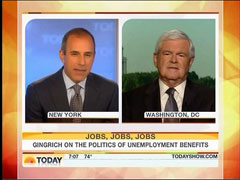
NBC’s Matt Lauer, suddenly turned into a deficit hawk, when he invited on Newt Gingrich on Tuesday’s Today show, to discuss the GOP’s refusal to extend unemployment benefits without paying for them, as he complained to the House Speaker that those same Republicans didn’t offer spending cuts to offset the Bush tax cut and pressed: “Is it funny math?” and “traditionally speaking when you cut taxes, don’t deficits go up as well?” Gingrich initially agreed that the deficit in the “short run” goes up but explained to the Today show anchor that “we proved with Reagan, with the three-year tax cuts in the 1980s” and “again with the Contract With America” that “job creating principles of cutting taxes are far better than the job killing principles of big government and regulation.” The following is the full interview as it was aired on the July 20 Today show: MATT LAUER: Alright, Savannah. Thank you very much. Former Republican Speaker of the House, Newt Gingrich, is a Fox News contributor and the author of the new book To Save America: Stopping Obama’s Secular Socialist Machine. Newt, good to see you. Good morning again. NEWT GINGRICH: Matt, good to see you. LAUER: Let, let me ask you to help me on the math here, alright? What Savannah just talked about, what the President talked about yesterday. You’ve got some Republicans coming out saying, “We’re not in favor extending, of extending these unemployment benefits that carry a price tag of about $33 billion unless there are offsetting cuts in spending.” They are the same Republicans, Newt, who didn’t ask for those offsetting spending cuts when they wanted to make permanent the Bush tax cuts with a price tag of over half a trillion dollars. Is it funny math? GINGRICH: No, I don’t think so. The second biggest concern of the American people after jobs is deficit spending and the fact that this president has been like a teenager with a credit card who has run up – he will have, if he serves eight years, under current plans, he will double the national debt. That is, that is he’ll borrow more than every previous president combined. The average American is beginning to respond with great concern about that amount of debt. LAUER: But traditionally speaking when you cut taxes, don’t deficits go up as well? GINGRICH: Only in the short run. That’s the other difference. I mean we proved with Reagan, with the three-year tax cuts in the 1980s, we proved again with the Contract with America, with the first tax cut in 16 years that, in fact, job creating principles of cutting taxes are far better than job killing principles of big government and regulation. If you look at Rick Perry, the governor of Texas, I think it was in 2007, Texas created more jobs than the other 49 states combined. And the reason was simple. It’s a much lower tax, much lower regulation state in which people found it more convenient and easier to start a business, invest in a company or create a job. [On screen headline: “‘To Save America’ Gingrich’s Formula For Fixing Country”] LAUER: Let’s talk about cutting, cutting the deficit here. You’ve said, you’re thinking more seriously now than ever about running for president. Let’s say I make you president right now. Congratulations. And I give you what a lot of people are predicting – a Republican-controlled House and Senate. That means you’ve got to make some really tough choices in terms of cutting this deficit. What are you willing to say? And name it by name, that you would be willing to cut right now to cut deficits. GINGRICH: First of all, you just may, create a nightmare for virtually every Democrat watching the show, so I apologize to them. But to, but to work out your scenario, in the four years I was Speaker of the House, the average rate of increase was 2.9 percent a year including all the entitlements. That is the lowest rate of increase since Calvin Coolidge in the 1920s. We did it by carefully setting priorities. LAUER: But- GINGRICH: Now, now just let me finish. LAUER: Okay, go ahead. GINGRICH: So, so we doubled, for example, investment in national health research at the National Institutes of Health while we were being very tough on other spending. I would start and I’d go through this budget pretty dramatically and I would eliminate a great deal of federal bureaucracy. I would reform unemployment compensation. I would reform workman’s comp at the state level. I would have a very pro-jobs, very pro-savings, very pro-take-home pay policy. When we reformed welfare, 65 percent of people on welfare either went to work or went to school and we saved billions and billions of dollars. That’s part of how we managed to balance the budget. Remember Matt… LAUER: Would, would you make cuts in Social Security and Medicare? GINGRICH: No, no. LAUER: Would you take those things on? GINGRICH: Well first, well first of all, and we’ve proven at the Center for Health Transformation with a book called Stop Paying the Crooks that there’s between $70 billion and $120 billion a year, that is paid to crooks in Medicare and Medicaid. So sure that, that, by the way, comes out to $700 billion to a trillion, two-hundred billion in savings over the next decade, just by not paying crooks in the federal health system. LAUER: This worst case scenario we just talked about for Democrats, the loss of both the House and the Senate. How likely is it, in your opinion? GINGRICH: About 50/50. It gets worse every month partly because what you just showed was the President with very shallow politics, assuming the American people are dumb enough to follow the latest headline and don’t realize the real problem with unemployment is this is a job killing administration and a job killing Democratic Congress and that’s why those people are unemployed. LAUER: Newt Gingrich. Newt it’s good to see you. Thanks for your time this morning. GINGRICH: Appreciate it. Thanks Matt.

Continue reading here:
Matt Lauer Turns Into Deficit Hawk, Asks Gingrich About ‘Funny Math’

John Edwards Film To Be Directed By Aaron Sorkin

Saga of disgraced politician is an ‘extraordinary story,’ ‘West Wing’ creator says. By Mawuse Ziegbe John Edwards Photo: Jonathan Torgovnik/ Getty Images The saga of disgraced North Carolina politician John Edwards is on its way to the big screen. According to The Hollywood Reporter, screenwriter and “The West Wing” creator Aaron Sorkin has acquired the rights to the tell-all “The Politician: An Insider’s Account of John Edwards’s Pursuit of the Presidency and the Scandal That Brought Him Down.” The tome was penned by Edwards aide Andrew Young, who divulged damaging details about the pol’s extramarital affair. Edwards was vilified in the press for carrying on an affair with campaign videographer Rielle Hunter. The politician was apparently cheating with Hunter while his wife, Elizabeth, battled cancer. The former senator, who sought the Democratic presidential nomination in 2008, also fathered a daughter with Hunter. Edwards initially denied he was the child’s father until a paternity test revealed otherwise. “This is a first-hand account of an extraordinary story filled with motivations, decisions and consequences that would have lit Shakespeare up,” said Sorkin, who will make his directorial debut with the movie. “There’s much more to Andrew’s book than what has been reported, and I’m grateful that he’s trusting me with it.” Sorkin has worked extensively in film and television. In addition to helming the hit political show “The West Wing,” he also created the shows “Studio 60 on the Sunset Strip” and “Sports Night.” He has written screenplays for “Charlie Wilson’s War,” “A Few Good Men” and, most recently, “The Social Network,” based on the rise of the social-media juggernaut Facebook. For breaking news, celebrity columns, humor and more — updated around the clock — visit MTVMoviesBlog.com .

Originally posted here:
John Edwards Film To Be Directed By Aaron Sorkin

No Media Outcry as Democrats Block Amendment to Open Up Gulf Oil Cleanup to Press

It has become clear that the Democratic establishment does not have as much of an interest in press freedom as they would have the public believe. But what is even more telling is the media’s spotty response to censorship efforts in the Gulf of Mexico. On Wednesday, House Natural Resouces Democrats rejected an amendment that would ensure press transparency in the Gulf. The amendment came mere days after the Coast Guard rescinded a policy keeping journalists at least 65 feet from “essential recovery efforts.” Offered by Rep. Paul Broun, pictured right, the amendment stated : “Except in cases of imminent harm to human life, federal officials shall allow free and open access to the media of oil spill clean up activity occurring on public lands or public shorelines, including the BP Deepwater Horizon oil spill.” Since the amendment’s defeat, the response from the mainstream press has been a deafening silence . Democrats ruled it was not germane to the legislation at hand, the Consolidated Land, Energy, and Aquatic Resources (CLEAR) Act. That might seem like a plausible explanation for Democrats’ rejection of the Broun amendment, but as the Washington Examiner’s Mark Hemingway noted, there was a “wide array of items being attached to the bill that are of no particular relevance to the gulf oil spill.” In fact, Republicans offered an amendment specifically designed to remove provisons they called “unrelated to offshore drilling and the Gulf oil spill response or require additional information and facts from multiple ongoing investigations.” These items include a $150 million annual authorization for the next 30 years for the Historic Preservation Fund, which provides grants to states and localities to preserve historic landmarks. Other items, according to a Committee statement , include Renewable Energy. An entire section of this bill is exclusively dedicated to onshore renewable energy. Wind turbines and solar panels hundreds of miles away from the Gulf have absolutely nothing to do with a leaking deepwater oil well that is 5,000 feet under the ocean floor. Onshore Energy Development. Rather than just focusing on offshore drilling, the bill makes numerous changes to onshore energy development. These policies will do nothing to help clean up the Gulf, but will seriously impact onshore American energy production leading to higher energy prices and lost jobs. Aquaculture. The bill restricts the ability of the Secretary of Commerce and Regional Fishery Management Councils from developing or approving any fishery management plan that permits or regulates offshore aquaculture. In addition, it would nullify any permit for offshore aquaculture already granted by the Secretary. Not only is this unrelated to the oil spill, but could lead to further job loss in the Gulf and potentially hinder fishery restoration activities. Uranium Leasing. The bill amends the Mineral Leasing Act to make uranium a leasable mineral, subject to rental and royalty rates. Creating a new uranium leasing program will not help respond to the crisis in the Gulf, but will make uranium, which is used to produce carbon-free nuclear energy, more expensive and difficult to mine. Wildlife Sustainability. A provision in this bill calls for the Secretaries of the Interior and Agriculture to help maintain sustainable populations of native and desire non-native plants and animals on lands under their jurisdiction. Managing onshore federal lands for wildlife has nothing to do with offshore drilling or Gulf Coast restoration. “Looking at the number of largely unrelated items that are actually in the bill,” wrote the Wasington Examiner’s Mark Hemingway, it’s hard to see the rejection of Broun’s amendment as anything other than political. Democrats seem far more concerned about how unrestricted press coverage of the oil spill might affect their political fortunes than whether or not amendments to the CLEAR Act have to be “germane.” For his part, Broun touted the necessity of his amendment as reinforcing the press’s role as a safeguard against malfeasance on the part of the Obama administration — you know, the check on power that journalists are so proud to provide. Anderson Cooper had made a similar statement regarding the Coast Guard’s now-defunct policy. Broun said in a statement , There have been several accounts of the Obama Administration restricting access and stopping the press from thoroughly reporting on this oil spill. The media has a responsibility to not only accurately report the news but to keep everyone associated with the spill accountable. President Obama promised transparency, but we have seen numerous examples where that is not the case. There is no excuse for reporters and photographers to be denied access to public places unless their life is in imminent danger. This amendment is necessary in order to eliminate any confusion and ensure that First Amendment rights truly are protected. As I reminded readers in a previous post , a number of organizations devoted to ensuring press freedom were up in arms after Hurricane Katrina at a FEMA policy that forbade journalists from embedding on rescue missions, citing the safety of those reporters and the victims being rescued. In an attempt to address similar concerns, Broun’s amendment makes sure to issue the caveat, “Except in cases of imminent harm to human life.” The amendment was still rejected. We will see if those same watchdog organizations take notice. For its part, the mainstream press is conspicuously silent on the Broun amendment’s defeat.

Read the original:
No Media Outcry as Democrats Block Amendment to Open Up Gulf Oil Cleanup to Press

Wall Street Reform Passes–Big Banks Celebrate

(Reuters) – The Congress on Thursday approved the broadest overhaul of financial rules since the Great Depression and sent it to President Barack Obama to sign into law. By a vote of 60 to 39, the Senate passed a sweeping measure that tightens regulations across the financial industry in an effort to avoid a repeat of the 2007-2009 financial crisis. President Barack Obama will likely sign the bill into law next week, the White House said. The legislation, opposed by the banking industry, leaves few corners of the financial industry untouched. It establishes new consumer protections, gives regulators greater power to dismantle troubled firms, and limits a range of risky trading activities in a way that would curb bank profits. The Senate vote caps more than a year of legislative effort after Obama proposed reforms in June 2009. The House of Representatives approved it last month. Although Obama originally had pushed for bipartisan support for an overhaul of financial regulation, only three Republican senators voted in favor of the bill, along with 55 Democrats and two Independents. With Republicans poised for big gains in the November congressional elections, Democrats are eager to show voters that they have tamed an industry that dragged the economy into its deepest recession in 70 years. “I regret I can't give you your job back, restore that foreclosed home, put retirement monies back in your account,” said Democratic Senator Christopher Dodd, one of the bill's chief authors. “What I can do is to see to it that we never, ever again go through what this nation has been through.” Along with the health-care overhaul, Democrats can now point out that they have passed two far-reaching reform efforts that will likely shape American society for generations. It is not clear whether that will impress voters. The public's understanding of the regulatory revamp is very low, according to an Ipsos online poll released on Thursday. Of those polled, 38 percent had never heard of the reform, while 33 percent had heard of it but knew nothing about the legislation. Other polls show the public divided about its merits. The bill has also won Democrats few friends on Wall Street as wealthy donors have started to steer more campaign contributions to Republicans. Financial markets showed little reaction on Thursday. Investors said passage was already priced into banks' share prices. Bank stocks have followed the overall market lower since April, weighed down by poor U.S. economic data and the belief that more regulation could crimp profits down the road. JPMorgan Chase & Co said the bill would not compromise its business model but might hurt profitability. “We'll have some effect on revenues and margins and volumes,” its chief executive, Jamie Dimon, said on a conference call. As the largest U.S. derivatives dealer, JPMorgan could have the most to lose from the bill, which aims to curb lucrative trading in risky over-the-counter derivatives and force banks to end trading for their own profits. FEW CORNERS OF INDUSTRY UNTOUCHED Under the 2,300-page bill, mortgage brokers, student lenders and other financial firms will have to answer to a new consumer-protection authority, though auto dealers will escape scrutiny. Regulators, who scrambled to contain the damage from failing firms like Lehman Brothers in the last crisis, will have new authority to dismantle troubled firms if they threaten the broader economy. A council of regulators will monitor big-picture risks to the financial system and many large banks will have to set aside more capital to help them ride out times of crisis. Large private-equity and hedge funds will face more scrutiny from federal regulators, and credit-rating agencies could potentially see their entire business model upended. Much of the $615 trillion over-the-counter derivatives market will be routed through more accountable and transparent channels, and banks will have to spin off the riskiest of their swaps clearing desk operations. http://www.reuters.com/article/idUSTRE66E0MD20100715 added by: ScottyT

ABC’s Z. Byron Wolf Confused: Why Don’t Americans Support Awesome Dems?

The folks at ABC News are confused. Democrats are passing all this awesome legislation, they posit, so why are Americans acting so hostile and looking to hand Congress to the GOP? The key problems, ABC’s Z. Byron Wolf deduces , are that Democrats simply have not embraced liberalism enough and Americans have failed to perceive just how great the Democratic agenda has been. “The imminent passage of a tough new Wall Street Reform bill,” wrote Wolf, pictured right, on ABC’s website, “will cap off a wildly productive two years for Democrats in Washington – they will have passed two pieces of sweeping legislation and an enormous $800 billion stimulus bill to deal with the ailing economy.” Wolf goes on to wonder why those three pieces of legislation haven’t benefited Democrats’ electoral prospects. Let’s see: 6% of Americans believe the stimulus bill created jobs, a strong majority favors repealing the health care bill, and almost 80% of Americans polled have little or no confidence that the financial reform bill will achieve its stated objectives. Is Wolf still confused? He goes on to write that Democrats’ problems stem from the fact that they just have not embraced liberalism to a great enough degree. “Rather than energize the electoral base that helped put Democrats in control of Congress in 2006 — and President Obama in the White House in 2008,” Wolf writes, “the accomplishments have often frustrated activists, who see compromised ideals and watered-down bills instead of legislative victories.” If this is supposed to be an explanation for Democrats’ poor prospects in November, it falls well short. First of all, the districts where Dems are vulnerable are by and large ones they picked up in 2006 and 2008 from sitting Republicans that couldn’t shake the tarnished Republican name. Now that Bush is a memory, red state Dems need to court moderate Republicans, not cater to the far left. Furthermore, the number of Americans who identify themelves as “conservative” is at its highest point since 1994 , when Republicans walloped Dems in the midterm elections. Forty-nine percent of the nation believes that Democrats are too liberal, up 10 points from 2008. Only 10 percent believe they are too conservative. A shift to the left is not going to be a winning strategy. Wolf continues: While Republicans  have, since President Bush left office, instituted an almost myopic, party-wide focus on spending and debt, Democrats  have struggled to rally behind their versions of health reform and Wall Street  reform. They could barely find enough votes to pass the bills. And despite millions of jobs Democrats say were created by the $862 billon stimulus bill, the unemployment rate remains high, and is not expected to come down any time soon. “I think the public doesn’t quite perceive (the accomplishments) because they don’t see much change in their everyday lives. They’re still having trouble finding work,” said Donald Wolfensberger, director of the Congress Project at the Woodrow Wilson Center. Got it? Obama and congressional Democrats have made fantastic accomplishments, but the American people are too dumb, distracted, or removed to perceive it. These three defenses of the Democratic Party in the face of intense public opposition — that they have been politically successful, that they have not embraced the far-left elements of the party, and that Americans are generally unable to perceive just how awesome they are — are tired leftist talking points. And with liberal pundits and politicos parroting them nonstop, is it any wonder Americans are ready for some house (and Senate) cleaning?

The rest is here:
ABC’s Z. Byron Wolf Confused: Why Don’t Americans Support Awesome Dems?

Today Show Job Search Segment Turns Into Ad for Obama Agenda

A segment that was billed as a guide to help some of Today’s unemployed viewers find work, on Wednesday’s show, turned into a platform for the president of the liberal National Urban League to attack those who opposed the President’s plans, as he railed against those in Congress who have been filibustering extension of the unemployment benefits. Today co-anchor Matt Lauer, who hosted the segment, even prompted Morial to address how his organization was going to address the obstruction of the Democratic agenda in Congress, in the upcoming midterm elections, as he asked: “How much do you target candidates who have bad job policies…and support candidates who have good ones?” NBC’s Ann Curry, at the top of the 8:30am half hour of Today’s July 14 show, teased viewers that “Americans, on average, took about 17 weeks to find a job. Well today the number has actually doubled. It’s twice that. So the question is where should you be looking for work? We’ve got some answers this morning.” However when viewers tuned in for those answers they also got a not so veiled anti-Republican diatribe from the National Urban League’s Marc Morial as he chastised those who opposed Democratic measures. MATT LAUER: Marc, let me start with you. I mean 9.5 percent, that’s where the unemployment rate stands right now. It’s been stubborn, it’s not going down nearly fast enough and apparently this job crisis is not an equal opportunity unemployer. It’s striking minorities much harder, isn’t it? MARC MORIAL: African-Americans, the, the rate is more like 16 percent, for Latinos it’s 12 percent. There is no doubt that this recession has been tough for everyone but it’s been especially tough for communities of color. People are hurting. They’re hurting in a very significant fashion and many, many people who’ve worked their entire lives find themselves without work. The new unemployed, it’s a lavender recession. It’s white collar, blue collar, pink collar, it’s across the board, Matt, but especially tough for people of color. LAUER: When you talk about minority communities and you talk to the people in those communities, are you telling them you think the jobs are coming back or are they gone for good? MORIAL: We’re saying that steps have to be taken. And I think our message has been consistent throughout the year that it’s not gonna happen serendipitously. There’s gotta be public policy steps. There’s gotta be a concerted effort. In this nation we can’t tolerate the new normal of a nine percent unemployment rate. That’s not, that’s not acceptable. And right now Congress has been stalling, really the Senate through the use of the filibusters, been stalling an up or down vote on the extension of unemployment benefits, an expansion of the home purchase tax credit, summer jobs. LAUER: Right. MORIAL: These measures, while small, could help many, many people. Lauer then turned to Today’s financial editor Jean Chatzky who, finally, did offer the job seeking advice teased at the top of the half-hour, as she highlighted the best cities to look for new jobs. However Lauer then quickly returned to Morial who finished the segment with a pitch for the National Urban League and its efforts to help elect candidates in the midterms who will help advance the President’s agenda. LAUER: And you know Marc, let me ask you this. I mean we’re coming up to midterm elections here in a couple of months. How political does the National Urban League get with this? How much do you target candidates who have bad job policies, in your opinion, and support candidates who have good ones? MORIAL: I think we’ve got to highlight that there’s been a lot of stalling. The use of the filibuster in the Senate troubles me the most because what it’s done, it’s blocked legislation that would help the economic picture, while on the same time, the very same people who use the filibuster accuse the President and others of not doing enough. So we’ve got to highlight the fact that there’s sort of an inconsistency in that type of message. And jobs, jobs, jobs, are the most important issue we think this fall. LAUER: Marc Morial, Jean Chatzky. Folks thanks very much.

More:
Today Show Job Search Segment Turns Into Ad for Obama Agenda

Bill Press: Obama’s Poll Numbers Down Because Americans Are Spoiled Children

Liberal talk radio host Bill Press says President Obama’s poll numbers are down because Americans are spoiled, impatient children that want everything solved yesterday. After describing to his listeners Tuesday all the fabulous accomplishments this president has made since taking office in January 2009, Press admonished the citizenry for giving the White House resident poor grades for his efforts. “I think this says more about the American people than it does about President Obama,” barked Press. “I think it just shows once again that the American people are spoiled” (audio follows with partial transcript and commentary): BILL PRESS: Basically, spoiled — as a people, we are too critical. We are too quick to rush to judgment, we are too negative, we are too impatient. Especially impatient. We want it all solved yesterday, and if you don’t, I don’t care who you are — get out of the way. And again, basically spoiled. To the point where it makes me wonder if it’s even possible to govern today. I gotta tell you, I don’t think Abraham Lincoln — who certainly didn’t get everything right the first time — could govern today. I’m not sure Franklin Roosevelt could govern today, the way we are again. Just about like spoiled children. And it’s Americans, and it’s the media, and if we don’t get instant gratification, then screw you is basically our attitude. Yes, America, you’re spoiled. We promised that if you elected us, things would get better for you. When you bought into our “Hope and Change” pitch, the unemployment rate was 6.6 percent. Now it’s 9.5 percent. On Election Day 2008, 7.3 million Americans were out of work. Now it’s 14.6 million. And the fact that this makes you unhappy means you’re spoiled and impatient. As Brian Maloney wrote Tuesday, “[O]nly ultra-partisan Democratic Party crony Bill Press could manage to blame voters for Obama’s failure to thrive.”  

Continue reading here:
Bill Press: Obama’s Poll Numbers Down Because Americans Are Spoiled Children

NBC’s Chuck Todd Trumpets Flawed Election Poll, Parrots Democratic Talking Points

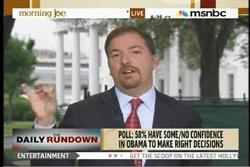
NBC Political Director Chuck Todd cherrypicked a recent Washington Post-ABC News poll to dismiss the possibility that Republicans will regain control of Congress in the November election. He did this despite evidence within the same poll that the political landscape in 2010 resembles 1994, when Republicans picked up 54 seats to take control of the House. On the July 13 “Morning Joe,” Todd emphasized the finding that 72 percent of the country has either “just some” or no confidence at all in the ability of congressional Republicans to “make the right decisions for the country’s future.” “This wild card about this election cycle which makes it different from ’06, which makes it different from ’94, is this issue of the public’s view of the Republican Party,” insisted Todd. The poll is misleading for a number of reasons, none of which Todd acknowledged. First, measuring public confidence in President Barack Obama, congressional Democrats, and congressional Republicans, the pollsters grouped respondents who reported “a great deal of confidence” with “a good amount,” and “just some” confidence with “none at all.” This aggregation resulted in a higher percentage of Americans expressing some or no confidence at all in Republicans than in Obama. But grouping “just some” respondents with “none at all” respondents does not make sense because expressing some confidence is much different from expressing “none at all.” If the pollsters had grouped those who reported “a good amount” of confidence with those who reported “just some” confidence, Republicans in Congress would have received 61 percent support, 14 points higher than Obama. Second, Todd’s insinuation that the public preferred congressional Republicans to congressional Democrats in 1994 but not in 2010 contradicts the same poll he cited to advance the argument that Republicans will not maximize their gains in November. As of July 11, 2010, voters prefer congressional Republicans 47 percent and congressional Democrats 46 percent, a negligible difference. By contrast, on August 8, 1994, 49 percent of the public preferred congressional Democrats while only 42 percent of the public preferred congressional Republicans, a seven point edge. In fact, the public preferred congressional Democrats over congressional Democrats in every Washington Post-ABC News poll taken through the November election. MSNBC host Joe Scarborough challenged Todd on the preference issue, asking, “Aren’t these off-year elections really just an opportunity for Americans to vote up or down for the most part on the party in power, the party that’s running Washington?” Todd, seemingly uninterested in demonstrable trends, insisted that the White House and Democrats are capable of turning the election into something other than a referendum on their liberal agenda. An obstinate Todd continued to rain on the GOP’s parade. “Joe, I think it’s the difference between picking up 25 or 30 seats and picking up 40 seats,” he insisted. NBC’s chief political junkie was all too eager to report the results of a poll forecasting sobering prospects for Republicans without scrutinizing the data or researching relevant historical trends. A transcript of the relevant portion of the segment can be found below: MSNBC Morning Joe July 13, 2010 7:24 A.M. E.S.T. JOE SCARBOROUGH: Hey Chuck, let me ask you something. Of course let’s put up the polls really quickly again from the Washington Post and then I’m going to follow it up with some news you say may not as good for Republicans. First of all, let’s look at the polls. Sixty-eight percent of Americans have little confidence in Democrats; Seventy-two percent, Republicans. Of course we talk about 58 percent, Barack Obama. Now let’s go to the four reasons why you say Republicans may not take back the House in the fall. You wrote about this yesterday and it’s very fascinating. You said the favorable ratings the same as the Democrats. And you are exactly right. In fact, in this case it’s even worse for Republicans than Democrats. But I guess the bigger question is – and I want to get Mark’s thoughts on this as well – aren’t these off-year elections really just an opportunity for Americans to vote up or down for the most part on the party in power, the party that’s running Washington? CHUCK TODD, MSNBC political director: Most of the time they are, and for many voters, this will be the case. This wild card about this election cycle which makes it different from ’06, which makes it different from ’94, is this issue of the public’s view of the Republican Party. And the reason you have to sit there and not ignore it is look at what the message the White House is trying to drive. Look at the message that Democratic candidates in congressional races are trying to drive, which is saying, “okay, you may be mad at us, but look at them.” And look, when you already have 70 percent of the public having a negative view, you can sell that story – you have a better chance of selling the story. SCARBOROUGH: Does that work when Democrats – it’s a monopoly though in Washington though. I guess that’s why it’s so much harder to sell. Listen in ’94 the Republicans actually had a plan. We haven’t seen that yet from this group of Republicans. I guess the bigger question, Chuck is, can you beat something with nothing?    TODD: Joe, I think it’s the difference between picking up 25 or 30 seats and picking up 40 seats and 10 seats in the Senate. Do you see what I’m saying? I think the difference between having a good election night and the majority is somehow starting to improve their favorable rating, and starting to go out there and saying, “we have a plan.” And right now they don’t have that and I think that’s what’s keeping them from getting the entire enchilada here. –Alex Fitzsimmons is a News Analysis intern at the Media Research Center. Click here to follow him on Twitter.

Here is the original post:
NBC’s Chuck Todd Trumpets Flawed Election Poll, Parrots Democratic Talking Points