Tag Archives: economy

Jon Stewart Vulgarly Attacks GOP Concerns for Rising Taxes and Deficits

Comedian Jon Stewart on Wednesday joined the growing liberal chorus attacking Republicans for their concerns about rising taxes and exploding budget deficits. The only thing different about the “Daily Show” host’s approach was that he needed vulgarity to make his point. Potentially even worse, Stewart in his opening segment Wednesday actually used CNN’s Fareed Zakaria to support his view that letting the Bush tax cuts expire would be a good thing for the nation. Ironically, that was the only thing remotely funny about this sketch (video follows with partial transcript and commentary, extreme vulgarity warning, see BMI’s coverage as well ): The Daily Show With Jon Stewart Mon – Thurs 11p / 10c Deductible Me www.thedailyshow.com Daily Show Full Episodes Political Humor Tea Party “Let’s begin tonight in D.C.,” Stewart said. “It’s our nation’s capital. For the last 18 or so months Barack Obama’s been the President and Democrats have controlled both houses of Congress. Purely by coincidence, that’s the exact same amount of time that Republicans have expressed a newfound concern for our nation’s financial stability.” To set-up this “Republicans are hypocrites skit,” Stewart played clips of Rep. Jeb Hensarling, R-Texas, Sen. Mitch McConnell, R-Ky., Rep. Eric Cantor, R-Va., Rep. John Boehner, R-Ohio and former Republican House Speaker Newt Gingrich warning against the budget deficit. At that point, Stewart said, “The deficit wants to skullf–k your mother. It wants to eat your children after it shows your wife a level of physical passion you’ve never been able to provide.” But here was the real punchline: Stewart played a clip from the August 1 installment of CNN’s “Fareed Zakaria GPS” when the host of that show told his viewers that letting the Bush tax cuts expire would instantly shrink our nation’s deficit by 30 percent. After the clip ended, Stewart said Zakaria was right. That would have elicited uproarious laughter from a well-informed audience, for as NewsBusters reported shortly after Zakaria made this pathetic claim, nothing could be further from the truth. Supporting our view, the Heritage Foundation’s Brian Riedl has research that indicates these tax cuts were just a drop in the bucket of the overall federal budget deficit, and the real culprit is the explosion in spending – not the trotted out liberal misnomer that these tax cuts are responsible. Riedl explains the budget surplus forecasted at the end of the Clinton presidency was set to shift to a $6.1 trillion deficit and that the 2001 and 2003 Bush tax cuts were responsible for a mere 14 percent of this shift. The true culprit: the liberal sacred cow of entitlement spending. “Instead of closing the long-term deficit by splitting the difference between tax hikes and spending cuts, lawmakers should address the source-rising entitlement costs,” Riedl wrote. Indeed. In fact, even if the tax cuts were extended, revenues are projected to rise above the historical average by 2017. Contrary to Zakaria and Stewart’s view, this leaves surging spending responsible for the entire increase in long-term deficits. Business & Media Institute adviser and Cato Institute fellow Daniel Mitchell agrees, and refuted Zakaria’s claim on his Aug. 4 podcast . “Our real problem isn’t that deficits are large,” he said. “It is that the government is far, far too big. That’s what we should focus on, so he’s looking at a symptom rather than the underlying disease and then if we have to look at the issue of federal spending and federal revenue – even under the Obama budget projections – while low now because of the economic downturn – are going to climb to their historical post-World War average. We do not have, in other words, a shortage of revenue in the United States or in Washington, D.C. We have too much government spending.” On top of this, as NewsBusters reported a few hours before Stewart made his foolish comments, a new study published by the liberal Brookings Institution found the savings associated with just letting the Bush tax cuts expire on upper-income wage earners – what President Obama is advocating – to be minimal when compared to the current deficit totals. But facts weren’t getting in the way of Stewart’s populist rant as he next asked a truly absurd question: “How exactly can you be for deficit reduction and extending tax cuts? How do those two diametrically opposed thoughts exist in the same Party platform?” Well, Jon, here’s how: the last time Republicans cut taxes while controlling spending in the mid-1990s, the nation produced budget surpluses for four straight years while adding 12 million jobs to non-farm payrolls. Alas, this is an inconvenient truth Stewart and his ilk have chosen to ignore for over ten years, and Wednesday was no exception as the “Daily Show” host then played a clip of Rep. Mike Pence (R-Ind.) saying the following on “Meet the Press” Sunday: REP. MIKE PENCE (R-INDIANA): They talk about tax cuts the same way they talk about spending increases as though the government owned all of the money. They say, “Are they paid for?” Well, I think, I think deciding on a government spending increase is very different on whether or not we allow the American people to keep more of their hard-earned tax dollars. Makes sense, right? After all, it is OUR money! Obviously not according to Stewart, for he not only seemed totally perplexed by Pence’s logic, he mocked it by asking, “So, you’re saying money the government gets is different than money the government spends?” Well YEAH, Jon! When the government is spending $1.5 trillion MORE than what it takes in, there is a difference! A HUGE difference! Clearly missing this indisputable fact, Stewart said the deficit’s opinion on this matter can be summed up with a clip from the movie “Goodfellas”: ACTOR RAY LIOTTA: Business is bad? F–k you, pay me! Oh, you had a fire? F–k you, pay me! Place got hit by lightning, huh? F–k you, pay me!” In reality, although he clearly didn’t know it, Stewart was making the conservative point about the current administration and Party in power: regardless of how the economy and the American citizens are doing financially, today’s government acts like a Mafioso thug demanding to be paid. Thank you, Jon – we couldn’t have said it any better.

View post:
Jon Stewart Vulgarly Attacks GOP Concerns for Rising Taxes and Deficits

Federal Employee Union Buys Radio Ads to…Counter Limbaugh’s Criticism of Federal Worker Pay?

“The nation’s largest federal worker union is taking to the airwaves to defend rank and file federal workers against growing anti-government sentiments,” the Washington Post’s “ Federal Eye” blogger Ed O’Keefe reported Tuesday , the same day Rush Limbaugh picked up on a USA Today story , “Federal pay tops private workers: Compensation gap doubled in decade.” O’Keefe explained: “The American Federation of Government Employees plans to spend about $200,000 to air a 60-second radio ad in more than 30 markets, including Washington and several Southern cities, according to a spokeswoman. The ad stars AFGE President John Gage and workers from the Bureau of Prisons, the Department of Veterans Affairs, and the Social Security Administration, telling listeners to ‘trust me’ as they carry out their work.” ( AFGE’s press release ) In a Wednesday afternoon post, headlined “Gov’t Employees Union to Spend $200K to Counter Rush,” DCRTV’s Dave Hughes interpreted it as an effort to counter Limbaugh: Yesterday, titanic righty talker Rush Limbaugh, heard in DC on WMAL (630 AM), slammed federal workers as being highly paid and unproductive. He said they’re pencil pushers and don’t “produce” anything real or substantial. Limbaugh pointed out that three of the nation’s richest counties are in the DC area, and it’s all because of the federal workers living there. O’Keefe’s post has a list of the 30 cities where the ad will air, “primarily on news/talk, country and sports talk radio stations in the South.” MP3 audio of the 60 second ad. The audio clip is also posted with AFGE’s press release and in O’Keefe’s post.

Read more:
Federal Employee Union Buys Radio Ads to…Counter Limbaugh’s Criticism of Federal Worker Pay?

Ground Zero Mosque Backlash a Symptom of Economy Says Think Progress Blogger

Is it “the economy, stupid” or is it just that the economy makes people stupid? Either way Matt Yglesias, ThinkProgress.org blogger extraordinaire , believes the economy is what’s driving conservative furor over the “Ground Zero Mosque.” On MSNBC’s August 9 broadcast of “Countdown,” Yglesias did his best to psychoanalyze people that are upset a mosque is being built in the shadow of Ground Zero, where over 2,600 people died in the Sept. 11, 2001 attacks. According to Yglesias, whose blog, ThinkProgress.org, is a function the George Soros-funded Center for American Progress, opposition to the plan had nothing to do with sensitivities but instead economics. The anti-mosque sentiment, he believed, couldn’t exist without masterminds like former Alaska Gov. Sarah Palin and former Speaker of the House Newt Gingrich whipping conservatives against the mosque into a frenzy. “Well, it seems to me that there is or at least there – it’s much more visible than it used to be because we’re seeing it stoked by sort of the leads in the conservative movement, by Sarah Palin, by Newt Gingrich, by others, in a way that we never had before 9/11,” Yglesias said. “And I think what’s happening is that when the economy goes down, people become anxious, you see, historically, a lot of increase in xenophobia, in fear and in sort of intolerance . And we’ve got the conservative movement leaders, very opportunistically trying to take advantage of that, try to play on people’s anxieties, and build this kind of anti-Muslim hysteria in a way that President Bush never did in 2001 and 2002.” Yglesias, who also saw nothing wrong with his participation in Ezra Klein’s JournoList, a listserv that left several members of the liberal media intelligentsia embarrassed for their downright angry, conspiratorial and mean-spirited comments from it that have come to light, then went for a historical analogy. He compared the current anti-illegal immigration sentiment to President Herbert Hoover, Depression-era United States deportation of as many as 500,000 Mexicans, regardless of legality . “I think it’s really part of an interconnected series of rising xenophobic and anti-foreign sentiment,” Yglesias said. “In particularly with immigration, every time there’s a major economic downturn, you see new anti-immigrant measures. In 1929, President Hoover launched what he called the Mexican Repatriation Initiative where they sort of swept around the American southwest pretty indiscriminately, finding people of Mexico origin and kicking them back. And this is what happens when the economy goes down – people get more worried about people who are different from them. And politicians who are unscrupulous, you know, really to play on that instead of trying to address the underlying problems in the country.” It’s not known if Yglesias is aware of the problems in Arizona because of the wave of illegal immigrants coming across the Mexican border , but in his view this is nothing more than people wanting jobs and not other issues that come with unfettered movement across international borders. “Well, the idea is that when jobs are scarce, you know, maybe if you round some people up and kick them out, and their jobs will come to other people,” Yglesias said. “Of course, the economy doesn’t really work that way. If 10 percent of the population vanished tomorrow, it would be economic chaos, not extra jobs. But, you know, that’s the kind of zero sum thinking that people get into when they become nervous about things they’re seeing in their life and in their community. And we had in the 1880s as well. That’s when we shut the door to immigrants from China and Japan.”

Read more from the original source:
Ground Zero Mosque Backlash a Symptom of Economy Says Think Progress Blogger

Paul Ryan Strikes Back at ‘Intellectually Lazy’ Paul Krugman

Republican Congressman Paul Ryan of Wisconsin has struck back at Paul Krugman calling the New York Times columnist “intellectually lazy.” As NewsBusters reported Saturday, Krugman wrote an article the previous day castigating Ryan as ” The Flimflam Man ” calling the Congressman a “charlatan” and a “fraud” while claiming his “Roadmap” to balance the nation’s budget was “drenched in flimflam sauce.” Krugman’s criticisms of the Republican rising star were of course praised by all manner of media member from the shills at MSNBC to the sycophants in the liberal blogosphere. Since then, Ryan has responded and responded well, first at the Milwaukee Journal Sentinel on Saturday: The assertion by Krugman and others that the revenue assumptions in the “Roadmap” are overly optimistic and that my staff directed the Congressional Budget Office not to analyze the tax elements of the “Roadmap” is a deliberate attempt to misinform and mislead. I asked the CBO to analyze the long-term revenue impact of the “Roadmap,” but officials declined to do so because revenue estimates are the jurisdiction of the Joint Tax Committee. The Joint Tax Committee does not produce revenue estimates beyond the 10-year window, and so I worked with Treasury Department tax officials in setting the tax reform rates to keep revenues consistent with their historical average. What critics such as Krugman fail to understand is that our looming debt crisis is driven by the explosive growth of government spending – not from a lack of tax revenue. Krugman also recycles the disingenuous claim that the “Roadmap” – the only proposal certified to make our entitlement programs solvent – would “end Medicare as we know it.” Ironically, doing nothing, as Democrats would prefer, is certain to end entitlement programs as we know them, and in the process, beneficiaries would face painful cuts to these programs. Conversely, the “Roadmap” would pre-empt these cuts in a way that prevents unnecessary disruptions for current beneficiaries. It reforms Medicare and Social Security so those in and near retirement (55 and older) will see no change in their benefits while preserving these programs for future generations of Americans. As Ryan noted, his recommendations are hardly as extreme as liberal shills like Krugman claim: Far from the “radical” label that critics have tried to pin on it, the Medicare reforms in the “Roadmap” are based on suggestions made by the National Bipartisan Commission on the Future of Medicare, chaired by Sen. John Breaux (D-La.). That commission recommended in 1999 “modeling a system on the one members of Congress use to obtain health care coverage for themselves and their families.” With respect to Medicare and Social Security, the “Roadmap” puts in place systems similar to those members of Congress have. There has been support across the political spectrum for these types of reforms. By dismissing credible proposals as “flimflam,” critics such as Krugman contribute nothing to the debate. Standing on the sidelines shouting “boo” amounts to condemning our people to a future of managed decline. Absent serious reform, spending on entitlement programs and interest on government debt will consume more and more of the federal budget, resulting in falling standards of living and higher taxes as we try to sustain an ever larger social welfare state. The American people deserve a serious and civil discussion about how to reduce our exploding debt and deficit. By relying on ad-hominem attacks and discredited claims, Krugman and others are missing an opportunity to contribute to this discussion and are only polarizing and paralyzing attempts to solve our nation’s fiscal problems. On Sunday, Krugman replied at his Times blog: As I predicted , a snow storm of words, dodging the math questions. Notice that Ryan does not address the issue of the zero nominal growth assumption, and how that assumption – not entitlement reforms – is the key to his alleged spending cuts by 2020. By the way, if you look at the artful way his excuses are constructed – giving the false impression that he couldn’t get a revenue score for love nor money – how is that not flimflam? On Monday, Ryan spoke with The Weekly Standard’s John McCormack to further clarify the situation: “I realize he’s a columnist and not a journalist, yet he could have easily tried to have verified his claims with a phone call or an email,” Ryan said of Krugman. “Instead he went with his confusion and chose to impugn motives,” said Ryan, “which strikes me as a very intellectually lazy exercise or style.” Krugman wrote on his blog on Saturday that “Ryan could have gotten JCT to do a 10-year estimate; it just wouldn’t go beyond that. And he chose not to get that 10-year estimate.” Ryan says that’s not true. “We asked Joint Tax to do it,” Ryan told me. “They said they couldn’t. They don’t do them long-term outside the 10 year window. They couldn’t do it in the first 10 years because of just how busy they were.” Ryan says Krugman could have cleared this confusion up with a simple phone call. “Megan McArdle figured it out on her own,” Ryan said, referring to a blog post by The Atlantic ‘s business and economics editor.  Clearing up confusion is never Krugman’s modus operandi, as he’s made a living misinforming the public on such issues. But Ryan wasn’t done: Ryan also responded to Krugman’s criticism that his domestic discretionary spending freeze is impractical and doesn’t spell out exactly which programs would be cut. “Domestic discretionary spending went up 84 percent last year,” said Ryan. “There has been such a gusher of domestic discretionary spending that I think we can live with a freeze for a long time to come.” The point of a spending freeze, said Ryan, is to put “strong enforceable controls in place and then make the experts, whether it be the appropriators or the agencies, come up with a way to live within their means.” Ryan marvelously concluded: “The Roadmap is designed to maintain a limited government in the 21st century, and it is the antithesis of the progressivist vision which [Krugman] subscribes to. That’s fine. I understand it violates his vision for a progressivist society,” Ryan continued. “What I think is rather bizarre is his strange personal attack and ad hominem attacks based upon his confusion surrounding the scoring process, which could have been easily clarified with a simple phone call or email.” “I’m not going to descend into the mudpit with Krugman on this stuff,” Ryan said. “I want to stay on policy and ideas.” Actually, mudpit would be an uptick considering the nether regions folks like Krugman propagandize from, for his attacks on Ryan were typically devoid of facts. As NewsBusters reported Saturday, the primary statistical source for Krugman’s “Flimflam” piece, the liberal Tax Policy Center, quickly corrected the record on Friday surprisingly defending Ryan. But Krugman isn’t concerned with that. As Hot Air’s Allahpundit noted Tuesday, the Times columnist is part of an orchestrated strategy by the Left to attack all on the Right that are gaining traction with the American people: It’s the same reason why Chris Matthews went to such pains to make Ryan look unserious and why the DNC is now lumping him in with candidates like Sharron Angle in an attempt to make him seem kooky . According to the Narrative, today’s conservatives are a horde of feral, brainless bigots following whatever primitive impulses their political id generates. Ryan, being both soft-spoken and very intellectually serious about the unsustainability of entitlements, is both a threat to that narrative and to the welfare state itself. As such, frankly, he’s lucky he’s gotten off as easy as he has thus far. Potentially, he’s progressive public enemy number one.  Indeed. What also makes Ryan so dangerous to folks like Krugman is that he represents a new breed of young, extremely intelligent, and attractive conservatives that could very well be presidential material in the future. As such, the liberal attack machine in the media feels it’s necessary to bash him whenever possible and without any concern for the facts. As the fabulous David Byrne sang decades ago, “Same as it ever was.” 

See the article here:
Paul Ryan Strikes Back at ‘Intellectually Lazy’ Paul Krugman

Arianna Huffington Displays Staggering Ignorance of Business, Taxes and Economics

Liberal publisher Arianna Huffington on Monday displayed an absolutely staggering ignorance of business, taxes, and economics. Appearing on MSNBC’s “Countdown” to discuss Republican plans to stimulate the economy and curb the exploding budget deficits, Huffington was sarcastically asked by Keith Olbermann, “Does Huffington Post hire more people when your personal tax rate changes?” Realizing the host was mocking the GOP’s desire to extend the Bush tax cuts to all wage earners including those making over $250,000 a year, Huffington replied, “Huffington Post operates like most American businesses which is that our hiring practices have nothing to do with the income or the tax rate of the people who are running the business.” Ironically, the liberal publisher contradicted herself in the very next breathe (video follows with transcript and commentary): KEITH OLBERMANN, HOST: Now let’s bring in Arianna Huffington, editor in chief, co-founder of the Huffington Post. Arianna, good evening. ARIANNA HUFFINGTON: Good evening, Keith. OLBERMANN: So, the GOP says renew the tax cuts for the richest two percent of Americans. That will free the richest two percent of Americans to start hiring everybody else, and the economy will be stimulated overnight and we’ll all have ice cream in the morning. Does Huffington Post hire more people when your personal tax rate changes? HUFFINGTON: Well, actually, Huffington Post operates like most American businesses which is that our hiring practices have nothing to do with the income or the tax rate of the people who are running the business. And it’s the same everywhere. Whether we hire or not depends on demand. It depends on whether we’re getting enough advertising dollars. So, her organization’s hiring decisions have nothing to do with the income of the people running the business. Instead, they depend on whether the publication is getting enough advertising dollars. Paging Ms. Huffington: isn’t the income of the people running this business directly tied to the website’s advertising dollars? After all, that is the publication’s only source of revenue. To suggest that a business owner’s decision to hire has nothing to do with his or her income is either the height of stupidity or dishonesty. Beyond this, as net income is indeed tied to taxes, to claim business owners hire irrespective of their income tax rate is equally preposterous. If this weren’t the case, maybe we should tax the highest wage earners including Ms. Huffington at 100 percent and see how that impacts their hiring practices. Care to test this premise, Arianna? 

Excerpt from:
Arianna Huffington Displays Staggering Ignorance of Business, Taxes and Economics

‘Recovery Summer’ vs. ‘Mission Accomplished’: Will MSM Immortalize Obama’s Laughable Proclamations?

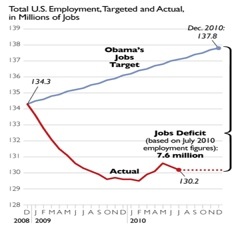
For the media, “Mission Accomplished” represents everything that was wrong with the George W. Bush administration and its war policy. The image of Bush declaring unequivocal victory mere weeks after the invasion of Iraq has been ballyhooed as a visual representation of Bush’s arrogance, naivete, even dishonesty (the media contrived most of this meme – more on that below). Will Barack Obama have a “Mission Accomplished” moment? That is, will the media seize on something he or his administration has said as evidence of the large gap between his rhetoric and the effects of his policies? In fact, the gap already exists. The White House’s ” Recovery Summer ” initiative and Treasury Secretary Tim Geithner’s statement, ” welcome to the recovery ” are completely divorced from economic reality. The only question is whether the media will seize on the catchy and baseless slogans (the two criteria of the “Mission Accomplished” media standard) coming from the White House to illustrate the sizable gap between this administration’s rhetoric, and the facts on ground, so to speak. First, it should be noted that the “Mission Accomplished” meme, as trumpeted by the media since May, 2003, is largely a myth. Bush never delivered those words in the context portrayed by many media liberals. The phrase was never actually uttered on the USS Abraham Lincoln, where Bush spoke in front of a banner displaying the infamous phrase. In fact, the banner was draped from the ship with little involvement or input from the White House. And Bush, during the speech on May 1, 2003, made sure to note that “Our mission continues” and that “We do not know the day of final victory, but we have seen the turning of the tide.” In other words, Bush plainly stated that the overarching mission was not  accomplished. Granted, he did say the following to a group of troops a month later: “America sent you on a mission to remove a grave threat and to liberate an oppressed people, and that mission has been accomplished.” But in the context of the time – when the search for weapons of mass destruction was still ongoing and Saddam Hussein had just been deposed – that statement was true. A grave threat in the Iraqi dictator had been removed, and the hundreds of thousands of Iraqis that bore the brunt of his dictatorial rule had been liberated. The lesson: truth matters less than perception and a coherent narrative in the creation of iconic images that promote or dog entire presidencies. The media’s “Mission Accomplished” meme abandoned truth in favor of a pithy and memorable way to get across a point they were already trying to make: the war effort was a bad idea. The Chicago Tribune channeled the media’s less flustered critics of the “Mission Impossible” statement, calling it ” dramatically premature .” The New York Times, on the other hand, labeled it a product of the president’s ” Never Never Land ” mentality on Iraq. “Welcome to the recovery” is certainly no less deserving – more so, in fact – of the iconic status afforded “Mission Accomplished” and the media’s disdain. Short, catchy, and lacking any real basis in reality, the phrase perfectly captures the Obama administration’s fingers-in-the-ears attitude towards their own economic policies. Three days after Geithner made his “welcome to the recovery” proclamation in the op-ed pages of the New York Times, the economy shed 131,000 jobs. The administration and its left-wing media cheerleaders touted the 71,000 private sector jobs created, not mentioning of course that about double that number would need to materialize for the economy to keep pace with new entrants in the job market. Ed Morrissey explains the numbers in more detail: This isn’t a Recovery Summer. It’s a slow slide, certainly better than the rapid disintegration of 2009, but we haven’t replaced those jobs yet, either. Job losses are cumulative. In a normal recovery with proper economic policies of lower barriers to investor entry, we would see a rapid replacement of jobs in this time frame that would take us back to somewhere around 80% of what was lost, with the remaining 20% being the most difficult to recover. We have not yet even begun that ascent. I’ll update this with a couple of slides later this morning to demonstrate the problem. Expect the White House to hail the best private-sector job creation numbers since March, but economists won’t get fooled. We’re still descending, and will until we get job creation solidly above 100,000 new additions per month. That Geithner’s “welcome to the recovery” statement was “dramatically premature” seems an understatement. is Tim Geithner stuck in Never Never Land? The Treasury Secretary’s declaration of the non-recovery recovery came in the middle of what the White House has formally dubbed its “Recovery Summer” campaign. The effort aims to promote “the surge in Recovery Act infrastructure projects that will be underway across the country in the coming months – and the jobs they’ll create well into the fall and through the end of the year,” according to a release. “Summer 2010 is actually poised to be the most active Recovery Act season yet,” the White House claimed in June. Total job losses during “Recovery Summer” have totaled 352,000 so far. The unemployment rate, meanwhile, has declined slightly, indicating that thousands of Americans have given up on their searches for jobs. Meanwhile, only a fifth of Americans believe the economy is improving, while three quarters believe the stimulus either had no effect on the economy, or has actually made things worse. In short, the “Recovery Summer” label is a joke, even given the modest (and that’s putting it generously) private-sector job creation so far this year. But will the media treat it with the disdain they did Bush’s “Mission Accomplished”? Will they call out Geithner for welcoming Americans to a non-existent recovery? If the economy doesn’t start gaining some steam, media neutrality will truly be put to the test.

See the rest here:
‘Recovery Summer’ vs. ‘Mission Accomplished’: Will MSM Immortalize Obama’s Laughable Proclamations?

Raise My Taxes, Mr. President!

We can’t afford the Bush cuts anymore. For the last few months, we have heard powerful, passionate arguments about the need to cut America’s massive budget deficit. Republican senators have claimed that we are in danger of permanently crippling the economy. Conservative economists and pundits warn of a Greece-like crisis, when America can borrow only at exorbitant interest rates. So when an opportunity presents itself to cut those deficits by about a third—more than $300 billion!—permanently and relatively easily, you would think that these very people would be in the lead. Far from it. The Bush tax cuts remain the single largest cause of America’s structural deficit—that is, the deficit not caused by the collapse in tax revenues when the economy goes into recession. The Bush administration inherited budget surpluses from the Clinton administration. What turned these into deficits, even before the recession? There were three fundamental new costs—the tax cuts, the prescription-drug bill, and post-9/11 security spending (including the Iraq and Afghanistan wars). Of these the tax cuts were by far the largest, adding up to $2.3 trillion over 10 years. According to the Congressional Budget Office, nearly half the cost of all legislation enacted from 2001 to 2007 can be attributed to the tax cuts. Those cuts are set to expire this year. The Republicans say they want to keep them all, even for those making more than $250,000 a year (less than 3 percent of Americans). They say that higher taxes will hurt the recovery. But for months now they have been arguing that the chief threat to the economy is our gargantuan debt and deficit. That’s what’s scaring consumers, creditors, and businesses. Given a chance to address those fears by getting serious about deficit reduction, though, they run away. Look by contrast at British Prime Minister David Cameron, a genuine fiscal conservative. To deal with his country’s deficit, which in structural terms is not so different from America’s, he concluded that he would have to raise taxes as well as cut spending. added by: TimALoftis

As GM Plans IPO, AP Finally Makes Prominent Reference to Drivers’ ‘Resentment’ of Bailout

In what I believe is the first direct acknowledgment by the wire service of what so many have known for so long, the Associated Press’s Tom Krisher wrote the following in an August 5 story about plans for an initial public offering by government-controlled General Motors (bolds are mine throughout this post): Ever since the Obama administration gave the automaker a $50 billion dollar survival loan last year, many drivers have scorned the company and bought cars from rivals. Even though GM has cut costs, changed leadership, and reported its first quarterly profit since 2007, the resentment will linger as long as taxpayers have a 61 percent stake in the company. Actually, the “resentment” goes back to December 2008, when the Bush administration bowed to pressure to use Troubled Asset Relief Program funds to “temporarily” loan a combined $13.4 billion to GM and Chrysler. Also, the total bailout dollars involved are at least $63 billion when GMAC is included, as it should be. If you have relied exclusively on AP reports and its news feeds to subscribing publications since then, Krisher’s assertion that “drivers have scorned the company” would more than likely be the first time you have seen an AP reporter record that observation. Any AP reporter covering the company almost any time in the intervening 20 months could have observed the existence of the scorn and resentment. But if this factor has ever been directly cited by an AP reporter covering the car industry until now, I haven’t seen it. In January 2009, the first month after those “loan” funds were disbursed, year-over-year sales at GM fell 49% . In previous months, the struggling automaker’s year-over-year declines had been in the 30% range. In just one month, the company’s sales decline in the recessionary economy went from roughly matching those seen at archrivals Ford and Toyota to about what cratering Chrysler was experiencing. GM’s sales plunge of 42% during last year’s first five months was far worse than Ford’s or Toyota’s, though not quite as bad as Chrysler’s. During 2009, I only recall two instances where AP got into the neighborhood of explaining what was really going on. The first was in  a May 1, 2009 story in the wake of April’s sales releases: Detroit’s Big Three is becoming Ford and the other two. While its rivals stay afloat with billions in government aid, Ford grabbed a bigger slice of the American car market in April with record sales of its fuel-efficient Fusion. … Most of those gains (at Ford) came at the expense of General Motors and Chrysler, which unlike Ford are dependent on federal help. Later in the report, the AP’s Kimberly S. Johnson and Dan Strumpf quoted an analyst who tied Ford’s success to Chrysler being in bankruptcy court and GM’s near-certain arrival there. Clearly those concerns were relevant, but the unmentioned scorn and resentment were already quite visible. An early June 2009 Rasmussen poll confirmed it : “The government bailout and takeover of General Motors remains very unpopular among the public. Just 26% of Americans believe the bailout was a good idea, and nearly as many support a boycott of GM products.” The other instance of near recognition came in the eighth paragraph of an early November 2009 report (covered at NewsBusters ; at Bizzyblog ) about October’s sales results. In that item, Krisher and Dee-Ann Durbin wrote: Ford Motor Co.’s sales rose 3 percent and it gained U.S. market share for the 12th time in 13 months as its critically acclaimed vehicles continue to grab buyers from rivals. Ford has benefited from consumer goodwill because it didn’t take government bailout money or go into bankruptcy protection, as General Motors and Chrysler did. That’s fine, but it’s one thing to note that customers like the company that wasn’t bailed out. It’s quite another to assert that many resentful customers and potential customers abandoned GM and Chrysler because they were bailed out. Also, Ford wasn’t necessarily the only beneficiary of anti-GM and anti-Chrysler sentiment. So why now? Why did the AP have to wait for GM Chairman Whitacre to say what he said before acknowledging what all of us already knew? Has the wire service seen protecting the company as part of its mission until now? If so, why? Finally, Krisher cannot prove his claim in the opening excerpt that “the resentment will linger as long as taxpayers have a 61 percent stake in the company.” It’s very likely — I would suggest virtually certain — that the resentment will linger until the government sells its entire stake in the company. It’s also not unreasonable to believe that for some, especially those who remember how the government and the company “ripped off” unsecured bondholders during bankruptcy proceedings, the resentment will last a long, long time even if the government fully divests. Cross-posted at BizzyBlog.com .

Continued here:
As GM Plans IPO, AP Finally Makes Prominent Reference to Drivers’ ‘Resentment’ of Bailout

Open Thread: Michelle O’s Lavish Taxpayer Funded Vacation During Recession

For general discussion and debate. Possible talking point: the First Lady is  spending beaucoup bucks on lavish vacations while the country is mired in what her husband calls the worst economic slowdown since the Great Depression! Michelle Obama today faced a fresh wave of attacks over her lavish break in Spain with 40 friends, which could easily cost U.S. taxpayers a staggering £50,000 a day. The First Lady has been lambasted for her extravagance at a time when the economy is still struggling. One blogger went so far as to brand her a modern-day Marie Antoinette. And her critics will be further annoyed when they learn that the president’s wife had a Spanish beach closed off today so that she, her daughter and their entourage could go for a swim. Thoughts? 

See the article here:
Open Thread: Michelle O’s Lavish Taxpayer Funded Vacation During Recession

Zing! Paul Krugman Says Rep. Paul Ryan’s ‘Drenched in Flimflam Sauce’: But Own Source Disputes Him

Paul Krugman’s Friday column in the New York Times attacked Rep. Paul Ryan of Wisconsin, who has dared to present an intellectually honest budget, as ” The Flimflam Man .” Joseph Lawler at the American Spectator calls it ” unusually partisan even by Krugman’s standards ” and he’s right; Krugman calls Ryan’s efforts a “fraud,” Ryan himself “a flimflam man” whose work is (zing!) “drenched in flimflam sauce.” But Krugman’s attack backfired when his main source for his argument, the left-of-center Tax Policy Center, disputed his claim of bad faith on the part of Ryan. Krugman let his trademark petulance show, griping that the Washington Post was too nice to Ryan in a recent front-page article, and went further on his nytimes.com blog Friday morning , calling Post journalists economic ignoramuses: “One thing that has been overwhelmingly obvious in the discussion of Paul Ryan’s roadmap is that lots of people who should know better — including, alas, reporters at the Washington Post — don’t know how to read a CBO report.” (Incidentally, Krugman, feeling the heat from non-fawning blog commenters offering substantive challenges to his glib economic assumptions , now limits the length of those comments.) One depressing aspect of American politics is the susceptibility of the political and media establishment to charlatans. You might have thought, given past experience, that D.C. insiders would be on their guard against conservatives with grandiose plans. But no: as long as someone on the right claims to have bold new proposals, he’s hailed as an innovative thinker. And nobody checks his arithmetic. Which brings me to the innovative thinker du jour: Representative Paul Ryan of Wisconsin. Mr. Ryan has become the Republican Party’s poster child for new ideas thanks to his “Roadmap for America’s Future,” a plan for a major overhaul of federal spending and taxes. News media coverage has been overwhelmingly favorable; on Monday, The Washington Post put a glowing profile of Mr. Ryan on its front page, portraying him as the G.O.P.’s fiscal conscience . He’s often described with phrases like “intellectually audacious.” But it’s the audacity of dopes. Mr. Ryan isn’t offering fresh food for thought; he’s serving up leftovers from the 1990s, drenched in flimflam sauce. Krugman’s gripes about Ryan’s call for “steep cuts in both spending and taxes” include the arguments that Ryan’s proposed spending cuts aren’t feasible, wouldn’t reduce the deficit, and would “cut benefits for the middle class while slashing taxes on the rich” while claiming “the plan would raise taxes for 95 percent of the population” and cutting Medicare. He got most of his points from “the non-partisan Tax Policy Center,” which is affiliated with two left-of-center groups, the Brookings Institution and the Urban Institute. Showing intellectual integrity, The Tax Policy Center actually came to Ryan’s defense this afternoon (hat tip Joseph Lawler at The American Spectator): Krugman alleges fraud because CBO did not score the revenue side of the Congressman’s plan.  (This is correct as the Joint Committee on Taxation is responsible for providing the official revenue score of tax legislation.) Instead, CBO assumed that total federal tax revenues will be equal to “those under CBO’s alternative fiscal scenario…until they reach 19 percent of gross domestic product in 2030, and to remain at that share of GDP thereafter.” Contrary to Krugman’s claims, this assumption is not unjustified . Ryan has explicitly stated that he is willing to work with the Treasury department to adjust the rates on his tax reform plan to “maintain approximately our historic levels of revenue as a share of GDP.” Since 1980 the federal tax revenue has been about 18 percent of GDP. Krugman pulled out his paranoia card at the end, insinuating that Washington is just so intimidated by the resurgent GOP (“deference to power” — what power?) that it’s afraid to call them out on their obvious intellectual fraud, a pretty laughable charge: So why have so many in Washington, especially in the news media, been taken in by this flimflam? It’s not just inability to do the math, although that’s part of it. There’s also the unwillingness of self-styled centrists to face up to the realities of the modern Republican Party; they want to pretend, in the teeth of overwhelming evidence, that there are still people in the G.O.P. making sense. And last but not least, there’s deference to power — the G.O.P. is a resurgent political force, so one mustn’t point out that its intellectual heroes have no clothes . But they don’t. The Ryan plan is a fraud that makes no useful contribution to the debate over America’s fiscal future. While Reason editor Peter Suderman admits that “flimflam sauce” is a “really devastating” comeback, he also has problems with Krugman’s analysis .

Read the original post:
Zing! Paul Krugman Says Rep. Paul Ryan’s ‘Drenched in Flimflam Sauce’: But Own Source Disputes Him