Tag Archives: economy

Obama Gives a Pass: TSA Won’t Touch Muslims’ Junk

Isn't it the point to stop these people from blowing up airplanes? added by: galwayman

George Stephanopoulos Chides Michele Bachmann: Why Is It ‘Okay’ to Extend Tax Cuts?

For the second time in two days, Good Morning America's George Stephanopoulos on Tuesday lobbied for tax increases, wondering why it's “okay” for the “wealthiest Americans” to continue to receive a tax cut. The GMA host pushed Congresswoman Michele Bachmann to accept a deal in exchange for extending the Bush tax cuts. After the conservative leader expressed skepticism about extending unemployment benefits, Stephanopoulos complained, ” But, why is it okay for the wealthiest Americans, earning over $250,000 a year– And remember, the President has called for extending all tax cuts for those under $250,000.” He continued, worrying about why it's acceptable for the wealthy to get “tax cuts extended, but for people who are out of a job and needing unemployment benefits not to have their benefits extended?” read more

See the original post here:
George Stephanopoulos Chides Michele Bachmann: Why Is It ‘Okay’ to Extend Tax Cuts?

Chris Matthews Admits America Is ‘Basically Conservative’

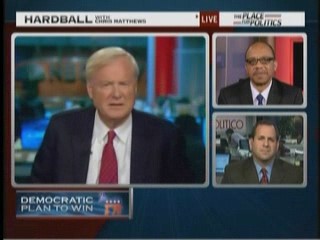
Chris Matthews began Wednesday’s Hardball in usual fashion attacking the Tea Party as the “Cro-Magnon political party,” but he ended this evening’s show in an unexpected way as the MSNBCer advised that the more Obama “sells” his ideas to “the political middle the better his chances” and added “Those who argue otherwise don’t know this country, its history or its basically conservative gut.” Matthews began his “Let Me Finish” segment by suggesting the reason former President Bill Clinton currently has a high approval rating was because he’s “a reminder of a better economic time for an important other. But the real reason is that Bill Clinton…knew the key to political, as well as policy success, lies in keeping faith with the middle.” [ audio available here ] The following Matthews observations were aired on the September 29 edition of Hardball: Question posed to former George W. Bush adviser Mark McKinnon after playing clips from Christine O’Donnell, Sharron Angle and Rand Paul: CHRIS MATTHEWS: You know Mark McKinnon it sounds like we’re listening to the Cro-Magnon political party sometimes. They don’t believe in evolution, they believe guns should be used against congressman and congresswomen if you don’t like the way they voted and we should reconsider the best thing Congress has done in 100 years – civil rights. So what do you make of your political party and the candidates that the Tea Partiers have shoved forward? … MATTHEWS: Let me finish tonight with some numbers. Bill Clinton now has a 53 percent approval rating from political independents in the United States, a 16 percent disapproval, 16 percent disapproval from independents. This for a Democrat at a time the party is under hard assault. There are reasons for this. Clinton’s out of line of fire right now, that’s for one. He’s a reminder of a better economic time for an important other. But the real reason is that Bill Clinton, like Tony Blair in England, was a champion of what both called a third way. They were social democrats, who knew the key to political, as well as policy success, lies in keeping faith with the middle. Scare off the middle and you lose the country. You hold the middle by hugging to their main concerns. You focus on the economy, yes it’s the economy, stupid. You convince people that you want government involvement when and only when the private sector can’t act. You do it out of necessity, not out of desire. If you love big government, you will not succeed with the American middle. Barack Obama won because most believe that the Bush administration lead by ideologues had hijacked America to the course an ideological war. An ideological foreign policy. President Obama will face the same rejection by the same political middle if he’s seen in the hands of ideologues of the left. Big things still need to be done, especially in job creation, energy and immigration. The more he does them and sells them close to the political middle the better his chances. Those who argue otherwise don’t know this country, its history or its basically conservative gut. That’s Hardball for now. Thanks for being with us.

Read more from the original source:
Chris Matthews Admits America Is ‘Basically Conservative’

Journos Slam Liberal ‘Pro-Israel’ Group for Lying About Soros Money

You know things are bad when a liberal organization loses the journalists. On Friday, the Washington Times reported that the dovish “pro-Israel” group J Street had taken hundreds of thousands of dollars from controversial liberal philanthropist George Soros, after the organization had denied for years that Soros was a donor. But instead of ‘fessing up immediately to its true funding sources, a panicked J Street public relations team kept misleading the media in the hours before the Washington Times story broke – and appeared to anger some formerly-sympathetic reporters along the way. “A set of half-truths, non-truths and ambiguities from J Street lead a reasonable person to conclude that the group tried to conceal that George Soros has been one of its largest donors for years, and to falsely claim that it had been ‘open’ about those donations over the past three years,” wrote The Atlantic reporter Chris Good on Friday, noting that J Street officials had lied to him earlier that day. Aware that the Washington Times story was about to be published, J Street had contacted The Atlantic’s Good on Friday morning and offered him an exclusive on the group’s growing “fundraising momentum.” A spokesperson for J Street told Good that the group accepted donations from Soros, and that it had always been open about this source of funding. Good initially wrote a favorable article on the organization’s uptick in donations, but after reading the Washington Times story he issued a massive correction and admitted that J Street had misled him that very morning. “J Street also seemed to distort the fact that it received a large contribution from a donor in Hong Kong. Some of this happened on the phone with me earlier today,” Good wrote. Veteran liberal reporter James Besser, who is one of the most influential and well-respected journalists in Jewish media, also had some harsh criticism for the organization. “I was one of the many journalists who asked [J Street] the question [about Soros funding] – and received in return something significantly less than the truth. Okay, it was a lie,” wrote Besser in a stinging rebuke of J Street in The Jewish Week. “[T]here’s no way this doesn’t sow mistrust among commentators and reporters who write and speak about J Street, and who were repeatedly misled by its officials. J Street sought to create a climate of trust with a press corps that was being spun heavily by its opponents; this news undoes a lot of that effort.” The Jewish Telegraphic Agency’s Washington bureau chief Ron Kampeas, who regularly covers J Street, also echoed Besser’s critique. “On J Street, Jim Besser said it,” wrote Kampeas on his blog. “Sometimes, you wanna write something, but someone else says it just right.” J Street publicly denied to the media for years that it received money from Soros, who is a vocal anti-Zionist and a controversial figure in the Jewish community. J Street calls itself a grassroots “pro-Israel, pro-peace” organization that is funded by small donors in the Jewish community, though opponents have long claimed the group was tied to Soros and criticized it as anti-Israel. “We got tagged as having [Soros’] support without the benefit of actually getting funded!” J Street’s director Jeremy Ben-Ami told Moment magazine last March. In May, 2009, the Associated Press reported that “Ben-Ami says liberal philanthropist George Soros attended a 2006 meeting where ideas for such a group were discussed but bowed out immediately, worried his involvement would draw criticism.” And in a Jerusalem Post interview with Ben-Ami in April, 2009, Ruthie Blum Leibowitz reported that one of J Street’s “initial ideological supporters, George Soros, apparently backed out because he thought his reputation as a bankroller for groups that blame Israel and the US for the world’s ills might not be helpful to this particular organization.” On J Street’s own website, a section clarifying “Myths and Facts” about the group claimed that “George Soros very publicly stated his decision not to be engaged in J Street when it was launched – precisely out of fear that his involvement would be used against the organization…J Street’s Executive Director has stated many times that he would in fact be very pleased to have funding from Mr. Soros and the offer remains open to him to be a funder should he wish to support the effort.” The section, which was written in 2008, implied that Soros was not a donor. In a Huffington Post column on Saturday, Ben-Ami admitted that his group has taken money from Soros since Fall 2008.

Excerpt from:
Journos Slam Liberal ‘Pro-Israel’ Group for Lying About Soros Money

NY Times Op-Ed Writer’s Muddled Logic: Money Not Paid in Taxes a Gift from Government

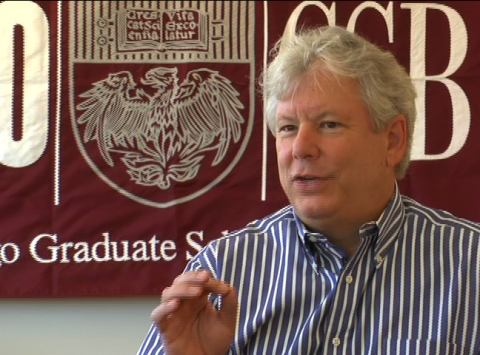
It’s a really skewed view of the relationship between citizens and the government – that anything you earn and get to keep by not paying to the government in the form of taxes is a show of benevolence from the government. But that’s apparently the view of Richard H. Thaler, professor at the University of Chicago . In the Sept. 26 New York Times , Thaler, declares that tax cuts are a gift in his op-ed “What the Rich Don’t Need.” “WANT to give affluent households a present worth $700 billion over the next decade?” Thaler wrote. “In a period of high unemployment and fiscal austerity, this idea may seem laughable. Amazingly, though, it is getting traction in Washington . I am referring, of course, to the current debate about whether to extend all, or just some, of the tax cuts of President George W. Bush – cuts that are due to expire at year-end. They’re expiring because the only way they could be enacted initially was by pretending that they were temporary.” Video Below Fold This caught the eye of CNBC’s Joe Kernen, the co-host of “Squawk Box.” On the Sept. 27 broadcast of his show, Kernen pointed out the flaw in that logic. “Over the weekend, I was reading in The New York Times – it was one of their professors that writes. I forget the guy’s name. I always disagree with him,” Kernen said. “[H]e talks about it as a $700-billion gift to the rich. And I just have a problem when they look at – OK, so they’re using the Clinton tax levels as the standard of where we are. And anything diverges from that is a gift, even though it’s money you earned. It’s a gift back to you.” Kernen questioned why the talking point used by tax cut opponents is always based on what tax levels were during the Clinton presidency and why it is a view that a certain percentage of what taxpayers keep is gift to the them. “Let’s go back to pre-, before Reagan began was around, when it was 70 percent. Anything less than 70 percent, is it a gift to the taxpayer?” he continued. “[D]oes it start at ‘you pay 100 percent to us and anything we let you keep after that is a gift’ or does it start at ‘0 percent and anything you charge me prove that you need to spend that.’ Why don’t you do it that way? Prove that you need anything above zero percent. Show me you’re not going to waste it and then prove you can do it.” Fill-in co-host Michelle Caruso-Cabrera, author of the forthcoming book “You Know I’m Right: More Prosperity, Less Government” summed it up succinctly by explaining what the intended relationship of government and the citizens is. “They work for us,” Caruso-Cabrera said. “We don’t work for them.”

More:
NY Times Op-Ed Writer’s Muddled Logic: Money Not Paid in Taxes a Gift from Government

CBS: The Rich to Blame For Bad Economy, Need to Pay Higher Taxes

On CBS’s Sunday Morning, correspondent Martha Teichner promoted left-wing class warfare talking points from former Clinton Labor Secretary Robert Reich: “[He] in a new book points out another ominous parallel between the Great Depression and the ‘Great Recession,’ its cause.” Reich proclaimed: “More and more of the income that was generated by the economy went to people at the top.” [Audio available here ] Teichner worked to bolster Reich’s argument: “In the last century, there were only two years, in 1928 just before the great crash, and then again in 2007, during which the richest 1% were taking home nearly a quarter of the entire income of the nation.” Reich continued his assault on upper income earners: “Last year, when most Americans were suffering, the top 25 hedge fund managers each earned $1 billion. A billion dollars would pay the salaries of something like 20,000 teachers.” Again, Teichner made sure to back up Reich’s assertions: “That wage inequality, Reich argues, is at the heart of our economic woes. And to fix things, we need to pay those teachers and the rest of the middle class more , not less, so they can spend enough to kick-start the economy. And yes, that means higher taxes for the rich.” For a brief moment, the segment featured the opposing side, in the form of Republican Senate Minority Leader Mitch Mcconnell warning that increasing taxes on the rich could further harm the economy. However, Teichner quickly dismissed such a notion, in favor of liberal economic dogma: “In the partisan battle over the future of the Bush tax cuts, Reich disagrees.” Reich claimed: “We provided a huge tax cut to the rich and nothing trickled down. After 2001, median wages actually dropped.” Teichner tried to suggest that any tax increases would be modest compared with past tax rates: “The top tax rate now is 35%. If the Bush tax cuts are allowed to expire, nearly 40%. For the record, under President Eisenhower, a Republican, the top rate was 91%. Really. Middle class wages were rising and the rich actually got richer.” As NewsBusters’ Brad Wilmouth earlier reported , giving commentary later in the broadcast, Syfy Channel producer Linda McGibney attacked economist and Sunday Morning contributor Ben Stein for opposing a tax increase on the wealthy. In part, she ranted: “I suppose he thinks he’s beyond sharing his good fortune with the rest of Americans who are suffering financially or he just doesn’t care about them. … I have always understood that the have’s are greedy. This is the first time I’ve heard one of them express it out loud so openly.” Here is a transcript of the September 26 exchange between Teichner and Reich: 9:08AM ET ROBERT REICH: Typically in a business cycle, we get back to the same economic path we were on. People get their old jobs back or nearly their old jobs. But this time around, very much like the Great Depression, we are not going to be able to go back on the same road. MARTHA TEICHNER: Former Clinton Labor Secretary Robert Reich in a new book points out another ominous parallel between the Great Depression and the ‘Great Recession,’ its cause. REICH: More and more of the income that was generated by the economy went to people at the top. TEICHNER: In the last century, there were only two years, in 1928 just before the great crash, and then again in 2007, during which the richest 1% were taking home nearly a quarter of the entire income of the nation. REICH: The typical CEO is up to 350 times the salary and benefits of the typical worker. Last year, when most Americans were suffering, the top 25 hedge fund managers each earned $1 billion. A billion dollars would pay the salaries of something like 20,000 teachers. TEICHNER: That wage inequality, Reich argues, is at the heart of our economic woes. And to fix things, we need to pay those teachers and the rest of the middle class more, not less, so they can spend enough to kick-start the economy. And yes, that means higher taxes for the rich. REICH: The economy depends – 70% of demand – on consumers and those consumers are essentially the middle class. People who are very rich, they spend a much smaller proportion of their income. MITCH MCCONNELL [SEN. R-KY]: No recovery will take place if we impose new taxes on the people we need to create jobs. TEICHNER: In the partisan battle over the future of the Bush tax cuts, Reich disagrees. REICH: We provided a huge tax cut to the rich and nothing trickled down. After 2001, median wages actually dropped. TEICHNER: The top tax rate now is 35%. If the Bush tax cuts are allowed to expire, nearly 40%. For the record, under President Eisenhower, a Republican, the top rate was 91%. Really. Middle class wages were rising and the rich actually got richer. REICH: Henry Ford understood this. He paid his workers $5 a day at the Highland Park Model-T plant. That was a lot of money. That was about twice as much as the typical worker was earning. He said, you know, I’m going to make a lot of money because my workers are going to earn enough that they can turn around and buy the Model-Ts that they are making. You know something, Henry Ford was right.

Read the original here:
CBS: The Rich to Blame For Bad Economy, Need to Pay Higher Taxes

Matthews: Businesses Sitting on Trillions of Dollars to ‘Screw’ Economy and Obama

Chris Matthews thinks American businesses are refusing to spend money in order to intentionally harm the economy as part of a long-term plot to “screw” President Obama. Such political paranoia was actually uttered on Monday’s “Hardball” as the host chatted with Eugene Robinson of the Washington Post and Charles Mahtesian of Politico. Readers are strongly advised to prepare themselves for the kind of conspiracy theory normally reserved for the likes of Michael Moore, Oliver Stone, and members of the far-left who actually believe George W. Bush and Dick Cheney had a hand in the 9/11 attacks (video follows with partial transcript and commentary):  CHRIS MATTHEWS, HOST: You know, a great question, Charles, that wasn’t on my list to ask but I’m going to ask you because you seem like a sophisticated guy of many parts. You think business can sit on those billions and trillions of dollars for two more years after they screw Obama this time? Are they going to keep sitting on their money so they don’t invest and help the economy for two long years to get Mr. Excitement Mitt Romney elected president? Will they do that to the country? Yeah, Chris, business owners and corporate executives across the fruited plain are intentionally undermining their companies and their personal fortunes in order to impact an election that is 25 months away. Certainly, they’re not keeping stockpiles of cash out of fear of: rising taxes, increased healthcare costs, the creation of carbon emissions targets, a double-dip recession, or the next regulatory shoe to drop from the current administration. No. They’re just remaining uncharacteristically liquid to harm the man that gives you a thrill up your leg.  Now that we’ve settled that Mr. Matthews, could I interest you in some waterfront property in southern Florida? 

Originally posted here:
Matthews: Businesses Sitting on Trillions of Dollars to ‘Screw’ Economy and Obama

Scooped: British Publication Tells Us Uncle Sam Having Problems Unload Citi Shares

You would think someone in the U.S. establishment press would be following Uncle Sam’s progress or lack thereof in getting out from under its investment in Citigroup, especially since the government promised that it would be fully divested from the bank holding company by the end of this year. From all appearances, you would be wrong. It looks like the government may not be able to keep that year-end divestiture promise. For a fair number of news followers to learn that, the UK’s Financial Times had to take an interest (link may require registration), and Drudge had to link to it: US Treasury stumbles selling Citi shares The US government is in danger of missing its deadline of divesting all of its Citigroup shares by the year-end after a fall in stock market trading volumes prompted authorities to slow down sales in July and August. The lull could prompt the US Treasury, which has a stake of about 17 per cent in Citi, to consider a share offering instead of selling the stock in small quantities in the market, according to bankers and analysts. “The sales of Citigroup stock have slowed way down in July and August … The US Treasury will not finish its share sale by … the end of the year,” said Linus Wilson, a professor of finance at the University of Louisiana. “The only option for the Treasury if it wants to exit Citigroup before the year-end seems to be to conduct a large secondary offering of the stake.” The government only seeks to sell shares equivalent to a small percentage of the overall trading volume in Citi to avoid depressing the price. By the end of August, less than half of the government’s 7.7bn shares in Citi had been sold, with the average number of shares sold per day falling sharply, the latest official data show. The Treasury has until Thursday to complete the sale of 1.5bn shares before entering a “blackout period” ahead of Citi’s third-quarter results. … The government’s continued involvement complicates Citi’s efforts to convince investors its troubled past is behind it. The lack of stateside establishment media interest is, as far as I can tell, complete. None of the stories returned in a search on the company’s name at the Associated Press’s main site contained any information citing the government’s stock-selling difficulty. One item in a group of “Business Highlights” at least acknowledges that Citigroup “is still partly owned by taxpayers.” A search on the company’s name at the New York Times also returned nothing relevant. The Washington Post also has nothing relevant , though it does have an item also carried at the AP’s main site on bonuses that are being paid to Citi execs in (of all things) company stock. But there’s no mention of the problems the government is having in unloading its stake. If Uncle Sam is having trouble unloading Citi, imagine the difficulties it might encounter pulling off its planned initial public offering of stock in Government/General Motors, an attempt which has conveniently been put off until after Election Day. It would appear that the establishment press might be interested in keeping a lid on stories indicating that once the state gets in the business ownership door, it’s very hard for it to get out — assuming it even really wants to. Ultimately, that explains why one has to hope that the British and foreign press stay on top of developments such as these — and that Drudge keeps on reviewing their work. Meanwhile, Tim Geithner says that TARP has worked out just fine , almost as if we’re in past-tense mode. Uh-huh. Cross-posted at BizzyBlog.com .

View original post here:
Scooped: British Publication Tells Us Uncle Sam Having Problems Unload Citi Shares

Today on Planet 100: Clinton’s Vision for the Economy is Clean (Video)

Original post:
Today on Planet 100: Clinton’s Vision for the Economy is Clean (Video)

Misread and Misreported: Tea Party Activism Bullish for Economy

One of the most common threads in the media recently has been how bad the Tea Party movement has been for this United States . It has been derided for lacking racial diversity , promoting policies outside the so-called mainstream and blamed for creating a civil war within the Republican Party. The media often stress those “negatives” at the expense of the positive basic tenets of the Tea Party movement: smaller government, fiscal responsibility and free markets – tenets that, when highlighted, are in fact bullish signals for an ailing economy. This is a phenomenon Larry Kudlow, host of CNBC’s “The Kudlow Report,” explained. “Tonight, free-market capitalism on the comeback trail,” Kudlow said on his Sept. 15 program . “That is one of the messages of the Tea Party power. We saw a lot of that power last night in the primaries. I tell you what folks, that Tea Party power, that free-market capitalist power is so totally bullish for the stock market.” And it has been bullish as of late, both as a forward-looking indicator and in gauging investor sentiment in general with each Tea Party candidate victory. Tea is good for the markets. However, this trend is being missed largely by the media. Charting the course of the Tea Party movement chronologically, from the 2008 presidential election cycle prior to its birth up to today, Kudlow’s hypothesis looks solid. ‘08’s Conventional Wisdom Comes Up Lame Going back to the pre-Tea Party days, in late 2008 before the presidential election, one of common media themes was that an ailing economy boded well for then-presidential candidate Sen. Barack Obama. That was because of the notion Democrats, the theory held, would do better fixing the situation. Part of that stemmed from the idea Obama would take on the excesses of Wall Street, which would make things better as former “NBC Nightly News” anchor Tom Brokaw explained Oct. 13, 2008 . “I mean you’re seeing that right now in the polls. Look, one of the reasons it helps him win is that this is Main Street versus Wall Street,” said NBC’s Tom Brokaw at the time. “ Main Street ’s furious because they think they’ve been hosed by Wall Street and that they’re paying for the excesses of Wall Street.” It’s automatically a mark in the “win” column for Democrats, according to Brokaw, when there’s an anti-Wall Street sentiment. “And when that happens, that of course, I think, generally accrues to the asset side for a Democratic candidate,” Brokaw continued. “Now whether it can be sustained or not, I don’t know.” Others speculated that the public just trusted Democrats more on all things economy, which CNBC’s John Harwood claimed on Sept. 15, 2008 to “Squawk Box” co-host Becky Quick. “We don’t know who’s going to come out ahead in the end, but I’ll speculate this guess Becky – it probably helps the Democratic ticket for this reason: Polls show that voters right now trust Democrats more than Republicans on the economy and John McCain has prospered in the last couple of weeks as the ground has shifted onto culture issues away from economic issues,” Harwood said. “[T]his puts the debate right back on the economy that Barack Obama is uh, has wanted it – not lipstick on a pig or the whole range of culture issues that has lifted John McCain.” However, if you chart some of the economic metrics of the time and compare them to now, that reasoning has proved faulty. Unemployment numbers and U.S. gross domestic product (GDP) have both steadily deteriorated, despite Democratic majorities in both chambers of Congress and control of the White House. In November 2008, unemployment was at 6.9 percent, after having spent nearly half the Bush administration under 5 percent. Nearly two years later, unemployment is at 9.6 percent and it has been above 9 percent for the last 15 months. Charting GDP over roughly that same time period since September 2008 , it has actually decreased overall as a percentage, even though it has been on an inconsistent roller coaster-like trajectory, with significant gains and significant losses in that same time period. And although these metrics show Obama’s liberal policies to be ineffective, they haven’t come cheap for the taxpayers. According to CNSNews.com , in the first 19 months of the Obama administration, the federal debt held by the public increased by $2.526 trillion, which is more than the cumulative total of the national debt held by the public that was amassed by all U.S. presidents from George Washington through Ronald Reagan. Bottom line: Appears the media got it wrong. Democrats haven’t fared well turning a weakened economy around over the course of two years. Birth of the Tea Party and a Renewed Optimism Although you can’t credit any one variable for the increase of the stock market, a forward-looking indicator – the rise of the Tea Party movement – appears to be running parallel to the Dow Jones Industrial Average ( DJIA ). CNBC’s CME Group floor reporter Rick Santelli’s “rant heard around the world” on Feb. 19, 2009 , was the spark that ignited the Tea Party movement. That day, Santelli railed against what was thought to be a forthcoming proposal and the inevitable move to bailout struggling homeowner unable to pay their mortgages. The Dow was trading around 7,300 points and would eventually fall to 6,626 on March 6, 2009. But since then, as the Tea Party has grown and shown it has electoral muscle, the market has rebounded. After victories a Massachusetts , New Jersey and Virginia in late 2009 and early 2010, the Dow has rallied back, even trading above 11,000 for a brief few weeks starting last April. As the Tea Party movement has shown power throughout the 2010 primaries, the markets have been on a steady climb going back to July. Thus, the momentum behind the prospects of limited government, fiscal discipline and free-market appears to be working – if using the stock market as a barometer. There are also indications this momentum will continue. As this Tea Party movement has made strides with candidates in Delaware , Alaska , New York , etc. in just the past few weeks, investor optimism has increased as Alan Abelson noted this in the Sept. 18 issue of Barron’s . “In like vein, but even more emphatically, as Doug Kass of Seabreeze Partners points out, has been the turnaround by members of the American Association of Individual Investors ( the so-called little guys, although their ranks include many folks over six feet tall when unshod),” Abelson wrote. “Three weeks ago, these worthies were as a group 20.7% bullish and 49.5% bearish. Last week, in striking contrast, the bulls among them were 50.9% of the total, the bears a meager 24.3%.” Media Emphasize Politics, Ignore Tea Party Principles This bullish trend in the financial markets has been largely ignored by the media. Instead the focus has been on the Tea Parties’ negatives, as a recent Culture & Media Institute story pointed out. All three broadcast networks have described the Tea Parties as “overwhelmingly white,” CMI found. So have CNN, MSNBC, NPR, the Agence France Presse, The Washington Post, The New York Times, the Los Angeles Times, USA Today, National Journal and US News & World Report. Many of those organizations are the very ones the news industry discusses as having failed to make diversity goals for staff. Other recent reporting in the media has focused on the rise of the Tea Party as 1964 Goldwater phenomenon, which suggests this isn’t democracy at work, but instead something that is strategically debilitating for the Republican as a whole – a theory Peter Beinart, senior political writer for The Daily Beast, subscribes to. “The Tea Party is now the Republican Party,” Beinart said on ABC’s Sept. 19 “This Week.” “I mean I think what we’re seeing in the Republican Party is something akin to what happened to the Democratic Party between 1968 and 1972 in which the forces of George McGovern took over the Democratic Party, overthrew the Democratic Party establishment and moved it substantially to the left.” But whatever it means for the GOP, this ideological change suggests that a shift in control of Congress, whether it is one or both chambers, would likely mean gridlock in Washington . That, as far as business and the markets are concerned, is good news. Stephen Slivinski, author of “ Buck Wild: How Republicans Broke the Bank and Became the Party of Big Government ,” was bullish in an article for the Washington Examiner on Sept. 15 . “So, can gridlock put a cap on spending in the future? I’m optimistic,” Slivinski wrote. “Stimulus programs and corporate welfare spending are proving increasingly unpopular (and ineffective). And the one thing that Republicans seem to have proven over the years is that they are more likely to be opposed to big government when they can turn a Democratic president into the poster child for excessive spending. The GOP pulled their punches during the Bush presidency because to take a swing at the federal behemoth at that point meant taking a shot at their own teammate.” And as Kudlow maintains, the gridlock created by the Tea Party movement would put the brakes on the growth of government, which is a win for the American economy . “They are talking free markets – lower spending, lower taxing, lower regulations, even constitutional limits to government, and you heard me talk about this last week in my free market 12-step plan for prosperity ,” Kudlow said. “The rise of the Tea Party people – they are going to win the vast majority of those Senate races and we are going to see a sea change in American policies, back to freedom and entrepreneurship, and that is bullish.”

Read more from the original source:
Misread and Misreported: Tea Party Activism Bullish for Economy