Law & Order Episode Mirrors Chris Brown And Rihanna Relationship Last night, NBC aired an episode of the popular television drama “Law & Order: Special Victims Unit” with a story line that was all but identical to the real life rollercoaster relationship between Rihanna and Chris Brown . In case you missed it, here’s a brief synopisis: via Hollywood Life The episode awkwardly began with a caption on the screen telling us it was not based on anyone in real life. We see a young singer named Misha performing a duet with Caleb Bryant — interesting initials “CB” — showing that they are really in love with each other. hen, two seconds after kissing on Misha, Caleb moves onto a background singer that looks exactly like Karrueche Tran. Misha obviously sees what is going on, but instead of handling it like a man, Caleb beats her up in front of a handful of people Caleb is a big jerk when he gets arrested for the beating that has now been blasted all over a popular gossip website. What’s also interesting is that when this happens, they actually have the words “Chris Brown & Rihanna” on screen. Comparing this beating to the one of Chris and RiRi were involved in is art imitating life. A few other events happen that mirror the wild child lifestyles of Breezy and Rih-Rih , but things a take a slightly different and significantly more tragic turn as episode comes to a close. Hit the flip to hear exactly how the episode ended and see whether or not the show took it too far.
The news of Jurassic Park 4 probably sent a lot of you scrambling for your brain’s groan button, and I can’t blame you. Though the original film is an important milestone in special effects, and boasts the last decent score John Williams ever wrote*, it preserved Michael Crichton’s dubious grasp of human nature and the book’s b-movie philosophizing – and the less said about the sequels, the better (especially the second film, which seems to consist largely of references to classic monster movies). Still! The dinosaurs, even the ones created using paleolithic CGI back in 1993, look insanely great, and given the advances in special effects that have occurred just in the 12 years since Jurassic Park 3 we can look forward to even more spectacular sauropods. But it isn’t just CGI that has advanced in the last twenty years; paleontology has also made some rather amazing discoveries. Beginning with the discovery of the feathered Sinosauropteryx fossil in 1996, over 30 new specimens have been found, and scientists are beginning to conclude that almost all dinosaur species probably had a coat of feathers. That sounds like a small difference, but it’s huge when you consider how radically that changes the appearance of these beasts. Despite the fact that the first feathered fossils of Archaeopertyx were discovered in the 1860s, dinosaurs were still seen in a largely reptilian context until quite recently. The 1970s and ’80s saw some major breakthroughs (among them the acceptance of the asteroid collision theory of dinosaur extinction), but even though the relationship between birds and dinosaurs was becoming more fully understood, that context remained the norm. Now, it would be a mistake to assume anything in Crichton’s novel is scientific, but his book did make great effort to plausibly reflect the consensus at the time. Jurassic Park , published in 1990, partly reflects that consensus. Dinosaurs in the novel were cloned from preserved DNA found in fossilized amber, with gaps in decayed DNA filled in using amphibian, reptile, and avian DNA. And regardless of the DNA used, as we saw in the film, with the exception of Velociraptors, they still largely resembled giant reptiles. However, Spielberg & Co. have the chance to update their look, and best of all it wouldn’t even require much of a stretch, plotwise, to explain the genetic retcon. Simply explain that advances in paleontology proved that their previous cloning relied too heavily on amphibian and reptile DNA. New clones corrected that mistake, relying more on avian DNA, and the result is a pack of dinosaurs that bear colorful plumage that would make Liberace seethe with jealousy. This doesn’t even begin to get into the new species we’ve discovered, like the aforementioned Sinosauropteryx (which would have been about the size of a chicken), that could populate the new film. And why should it have to? Apparently, T-Rex probably had feathers too. I could think of nothing cooler than that. [ For more on feathered Dinosaurs, check out this great article from Nature, published last summer. ] *Yeah, I said it. Ross Lincoln is a LA-based freelance writer from Oklahoma with an unhealthy obsession with comics, movies, video games, ancient history, Gore Vidal, and wine. Follow Ross Lincoln on Twitter. Follow Movieline on Twitter .
In 2009 Chris Colfer rocketed to stardom as the out and proud Kurt Hummel on Fox’s Glee , a role that nabbed him two Emmy nominations, a Golden Globe, and the adoration of legions of fans worldwide. This week the 22-year-old actor, singer, New York Times bestselling author, and screenwriter makes his feature film debut in Struck By Lightning , in which he stars as an ambitious small town teenager killed by a bolt of lightning, a coming-of-age story which he also scripted. Like Colfer’s Glee alter-ego, Struck By Lightning ‘s Carson Phillips is a restless young man with a yearning for what lies beyond the confines of his high school hallways. But the Glee comparisons fade quickly. For starters, there’s no singing — just a little blackmail, used by wannabe journalist Carson to coerce his rivals into joining an extracurricular program that’s bound to score him points on his college applications. More importantly: Struck By Lightning , a story Colfer first wrote in high school, never acknowledges its hero’s sexual orientation. “I don’t want to do another orientation story!” Colfer exclaimed to Movieline . “I don’t care what it is… I didn’t want an orientation to take away from someone learning the lesson of [Carson’s] story.” Colfer spoke with Movieline about his feature acting and writing debut, the real life upbringing in Clovis, CA that inspired Struck By Lightning , his burgeoning literary career, and more. (The film is available On Demand and hits limited release today.) Struck By Lightning is a project that’s been with you since high school – what was the original seed of the idea that inspired you to write this as your debate project? Even back then I knew I wanted to screenwrite eventually one day, so I started writing it as a screenplay back then when I was 16, and it was a way to vent about my frustrations with my peers in high school and whatnot. Then I got involved in speech and debate and decided to do it as one of the events there, so I compressed all the events into a ten-minute version and I played all the characters. I think I did pretty well with it – I’m not sure if that was the year I got the big trophy or the smaller trophy, but I did do well with it. Then when I finally got Glee and got into this world I started to pursue it even more. You based it on your experience growing up in Clovis, CA. What was it like? Very flat, very conservative, and very strict. Strict? Socially strict – they had a very strict dress code, like, guys weren’t allowed to have our hair grow past our ears, things like that. With all due respect to it, because it is my home, I think there is a lot of progress that could be made there – and even people there know there’s a lot of progress that can be made there. But even though the movie takes place in a place called Clover, it wasn’t me pointing at Clovis – it was more like me winking at Clovis, I would say. And it’s much bigger than Clovis is. Clovis is like 100,000 people and it keeps getting bigger and bigger; Clover is supposed to be this tiny, small, podunk town. How many of the characters of Struck By Lightning did you base on actual peers and friends and people you knew? Only a few, really. A couple of the characters are combinations of the people I knew but the only character really based to a T was Mallory [played by Rebel Wilson], who was based on my best friend Melissa. How did she react to seeing how you filtered her personality through your eyes, onscreen? She knows it was exaggerated heavily and that it was more for Carson having that sidekick like she kind of was for me. But she’s very excited about it – she’s in the movie! She has a cameo, in the scene where I’m arguing with the chemistry teacher and she goes, “I believe in Creationism!” and he goes, “Exhibit A” – that’s her, sitting right in front of me. She’s always been a part of it. Where did the screenwriting impulse come from? I’ve always loved storytelling and I think that’s the current-day method to do it. I think that’s the best way to tell stories and ever since I was a little kid I’ve been writing stories. It’s always been something that I had to do. What about directing? Are you making your way from actor to writer to director as well? Not so much, because when I think about directing I think about lining up shots; I don’t necessarily think about creating a story or characters, and that’s what I’d like to do. But I’d never say never. Which filmmakers most influenced you growing up? Oh gosh! I don’t know. Honestly, unfortunately, I was always more inspired by the characters in a story that I never thought about the people behind them. I always thought “X-Men,” I never thought “Bryan Singer” or “Stan Lee,” you know? I have my favorite writers that I love, like Diablo Cody, Jennifer Saunders ,Tiny Fey – I love that they can make every line funny. Every line is quotable. And I love Woody Allen. So you grow up in Clovis, you move to LA, Glee happens, and you realize you have the opportunity to break into film. How did you approach the task of expanding your Struck By Lightning script into a feature film knowing it’s your first film and such a personal project? A quote that gets out a lot is “Write what you know,” and I definitely knew this character well because I was this character growing up. I felt that it was a very endangered character; every movie is about the same type of person, like a jock with a talent or an aspiring cheerleader trying to be popular. I wanted to know where the stories were for the kids who had dreams and goals and their life was about accomplishing those. Not the John Hughesian archetypal teenagers – the other kids in the hall? With all due respect, because there’s no way this movie would have been made without John Hughes making a mark in the industry, yeah – kids like me! I felt like it was almost an ignored genre all these years. Structurally speaking, why start the movie by killing your protagonist off the bat before we even get to know him? I don’t know where that came from. That was a choice I made in the beginning and I made it work. It’s funny because I ended up making symbolism out of lightning but just the mental visual image of Carson being killed by a bolt of lightning in the beginning of the movie and the audience going, “What?!” I thought that was hysterical. You open this movie, you don’t even know who this kid is, and boom! I thought that was really funny. How fun was it to have the opportunity to cast your own movie parents? Oh, it was great – it was like reverse-adoption, almost. Allison [Janney] was the only person I ever had in my mind to play [Carson’s mother] since day one, and she’s the actress whose voice I had in my head when I was writing it. Dermot [Mulroney] was one of the miracles of the movie; I don’t know if we thought he would ever do it, but a friend of a friend of his said, “You know who’d be great in this? Dermot!” It was that easy. You’re also now a published author, with a companion book for Struck By Lightning out accompanying the film and a novelization, not to mention your own separate novels. How did your literary career come about? It was something that I’ve always wanted to do – I started with The Land of Stories , which is a novel that I’ve always wanted to write since I was 8. I came up with the story then and promised myself that I would get it done eventually, and I never tried pursuing it in any form other than a book, because it came to me as a book – this was going to be a book that kids could read and have an intimate journey with these characters. Struck By Lightning , I never thought about turning into a novel until my publishers saw the movie and asked me if I’d ever like to turn this into a novel and I decided ultimately, yes I would. But I think when you’re writing a novel you’re 100 percent responsible for the story. When you do a movie, you have help – you have a director, a cast, people to help you bring what you write to life. You’ve worked closely with Ryan Murphy on Glee and also read for Dustin Lance Black’s 8 ; what’s the biggest takeaway you’ve gotten from working with folks like these over the past few years? With 8, my involvement was very easy – I got a call asking, Would you like to do this? It was an amazing experience and I think what I learned the most from it was I love people’s stories. I love picking people’s brains. So whenever I get to be in a room, whether it’s Polly Bergen or Allison Janney or George Clooney, or Dustin or Ryan, I’m always picking people’s brains. That’s my favorite thing in the world, just hearing about experiences. There will be inevitable comparisons between Kurt on Glee and Carson in Struck By Lightning ; they’re both high school outsiders striving to be heard, although the similarities mostly end there. Knowing people might draw that parallel, was it important or not for you to present a character that was very different from your Glee character? It’s so funny – people make comparisons that are convenient to the tone of whatever they’re writing, and some people think I made Struck By Lightning only to play a different character and show that I could do something else, but that wasn’t the case. For one, the character’s been with me much longer than Kurt has been with me so I definitely knew who he was before I knew who Kurt was. And had I wanted to do something just to show the world I could do something else, it would have been, like, something on Mars – I wouldn’t have played another high school outcast! [Laughs] It’s ridiculous. But people still like to pigeonhole me into that with their opinions. Were there certain aspects that you deliberately wanted to emphasize, or avoid, in order to evade those Glee comparisons? Not necessarily to stay away from Glee but I never wanted to reveal a sexual orientation for Carson. For one, because I don’t want to do another orientation story! I don’t care what it is. That was number one. And number two, I didn’t want an orientation to take away from someone learning the lesson of his story, because in my Glee experience sometimes if you state a character is gay or straight, the other orientation stops listening or stops paying attention, and thinks, “Oh, I can’t relate to them now.” I didn’t want that for this character. I wanted everyone to be able to feel like they could relate to him. I made him very asexual for that reason but also, does every character have to be defined by an orientation? No! I don’t think you miss it in this story. He’s so set on something that you don’t focus on who he wants to sleep with. He wants to get into college! That’s who he is. It doesn’t matter. Follow Jen Yamato on Twitter . Follow Movieline on Twitter .
Introducing the possibility that the upcoming Sin City: A Dame To Kill For will feature an extremely hip soundtrack packed full of adorkable DIY indie rock classics, Dimension Films announced today that Joseph Gordon-Levitt has been signed on to play a major role in the sequel to the 2005 film adaptation of Sin City . Levitt will play a new character called ‘Johnny,’ whose relation to the events of the story has not yet been revealed, but who will no doubt be both sensitive and hardcore. Per press release, Johnny is “a cocky gambler who disguises a darker mission to destroy his most foul enemy at his best game.” Presumably, Johnny will be forced to decide by the film’s end whether or not to betray, cry, or kill himself over a girl. A Dame To Kill For , the second storyline in the Sin City series, features the first appearance of Sin City’s (arguable) main character Dwight McCarthy, portrayed by Clive Owen in the 2005 film. It takes place chronologically before the events of the first storyline, The Hard Goodbye , which made up a considerable chunk of Sin City , and features a team up between Dwight and Marv, played by Mickey Rourke. The film is already in production under co-directors Robert Rodriguez and Frank Miller at Rodriguez’s Troublemaker Studios, and “weaves together two of Miller’s classic stories with new tales in which the town’s most hard boiled citizens cross paths with some of its more repulsive inhabitants.” Sin City: A Dame To Kill For will feature the return of Mickey Rourke, Rosario Dawson and Jessica Alba; as it takes place before Dwight has reconstructive surgery, it’s possible that if Clive Owen reprises his role, it will only be at the end of the film. Gordon-Levitt joins fellow new additions Jamie King, Michael Madsen and Dennis Haysbert; the film is set for release on October 4, 2013. Ross Lincoln is a LA-based freelance writer from Oklahoma with an unhealthy obsession with comics, movies, video games, ancient history, Gore Vidal, and wine. Follow him on twitter (@rossalincoln). Follow Movieline on Twitter .
The makers of Texas Chainsaw — or Texas Chainsaw 3D , as it’s being widely advertised — would like to you forget all about nearly 40 years’ worth of sequels, prequels, remakes and reboots, and pretend that only a couple of decades or so have passed since the events depicted way back in The Texas Chain Saw Massacre (1974). Helmer John Luessenhop ( Takers ) and a small army of scripters go back to the bloody roots of the long-running franchise to concoct a better-than-average horror-thriller that relies more on potent suspense than graphic savagery or stereoscopic tricks. Don’t be surprised if it scores a B.O. killing. Pic begins quite literally where Tobe Hooper’s ’74 original left off, with a shrieking, blood-splattered beauty fleeing the homestead of a psycho-killer clan, pursued by a masked and humongous brute wielding a chainsaw. The new plot kicks off when angry locals arrive on the scene, torch the home of the fiendish family, and prematurely celebrate as they rashly assume they’ve destroyed Leatherface, the chap with the chainsaw, and all his creepy kinfolk. Flash-forward about 20 years: Lovely young Heather Miller (Alexandra Daddario) is thrown for a loop when she’s informed that the white-trash couple she’s always known as mom and dad really are her adoptive parents. Truth to tell, however, this revelation doesn’t appear to strike her as bad news. Besides, she’s perked up by what she thinks is good news: A recently deceased grandmother she never knew she had has bequeathed her a palatial home near a small town in Texas. Accompanied by her boyfriend (R&B artist Tremaine “Trey Songz” Neverson ), another fun couple (Tania Raymonde, Keram Malicki-Sanchez) and a too-friendly hitchhiker (Shaun Sipos) they pick up along the way, Heather drives deep into the heart of Texas to check out her inheritance. Unfortunately, the house isn’t entirely empty. Even more unfortunately, the sole, secretive inhabitant is a masked maniac with a penchant for heavy-duty garden tools. Luessenhop occasionally springs a wink-wink allusion to Hooper’s original pic — most notably during a scene involving a well-stocked freezer — and sprinkles a few darkly comical touches into the mix. (Heather, it should be noted, is introduced carving steaks in the meat department at a supermarket.) For the most part, however, Texas Chainsaw is deadly serious as it goes about the business of sustaining tension and generating shocks. And while Luessenhop and his writers respectfully adhere to many genre conventions (rest assured that, during the first two-thirds of the story, just about everyone you’d expect to get killed does), they’re surprisingly clever when it comes to subversively shifting audience sympathies during the final 30 minutes of their briskly paced 92-minute pic. Daddario — who’s given ample opportunity to flaunt the flattest stomach of any scream queen in recent memory — makes an impressively resourceful heroine. Standout supporting players include Thom Barry as a sheriff who disapproves of vigilantism; Paul Rae as a mayor who only thinks he knows where all the bodies are buried, and Dan Yeager as the still-crazy-after-all-these-years Leatherface. Sharp-eyed movie buffs may notice Gunnar Hansen, the original Leatherface, and Marilyn Burns, the heroine of Hooper’s ’74 pic, in cameo roles. To his credit, Luessenhop doesn’t linger on the gore in intensely violent moments. (What he does show is more than adequately effective.) Nor does he exploit the 3D gimmickry to startle auds with gushers of blood or severed body parts. On the other hand, the helmer can’t resist the urge to make it appear, every so often, that a chainsaw blade is jutting off the screen, understandably enough for a pic with this particular pedigree. Read More on Texas Chainsaw 3D : Trey Songz On His ‘Texas Chainsaw 3D’ Debut (And R. Kelly’s ‘Trapped In The Closet’) Follow Movieline on Twitter.
Even as Zero Dark Thirty has come under fire by key Senators criticizing its depiction of torture in the hunt for Al Qaeda leader Osama Bin Laden, the film shrugged off the pressure, at least at the box office, in its initial limited roll out Wednesday. [ Related: Golden Globes Unveil 70th Edition Nominees ] The Sony release opted for a specialty-style roll-out Wednesday, opening in limited locations in New York and Los Angeles before it heads wide January 11, not so coincidentally, the day after Oscar nominations are unveiled. The pic, which re-teams Oscar-winning director Kathryn Bigelow and writer-producer Mark Boal ( The Hurt Locker ), scored the biggest Wednesday limited opening ever (without a Disney-style stage show), according to Deadline.com . The film starring Jessica Chastain grossed a tremendous $124,848 in one day from just five theaters giving it a stellar mid-week $24,969 average. The numbers outstrip the likes of other Wednesday openers American Beauty which took in $73K with six theaters and Little Miss Sunshine with $66K from 7 runs. The film has been an early darling for critics with prestige organizations including the New York Film Critics Circle, the Chicago Film Critics Association and the National Board of Review giving the two-and-a-half-hour-plus feature its choice for Best Film of 2012. It also received four Golden Globe noms, including Best Motion Picture, Drama though others such as Lincoln , Django Unchained and Les Misérables scored more. Still, Zero Dark Thirty is expected to be a heavy-hitter come Oscar nomination morning. Some, however, have begun to speculate whether the percolating controversy over the film’s perceived suggestions that water-boarding, extreme isolation and other techniques were useful in ultimately locating Bin Laden and how that may affect Academy voters should the story hold staying power in the headlines. A report from A.P. yesterday said that former Vietnam War-era P.O.W. Senator John McCain slammed the film after viewing a screener earlier this week and BBC reports that McCain and two other Senate colleagues made their objections official in a letter to the head of Sony Pictures Entertainment. The letter said the pic is “perpetuating the myth that torture is effective” and that “the fundamental problem is that people who see Zero Dark Thirty will believe that the events it portrays are facts.” It goes on to say, “the film therefore has the potential to shape American public opinion in a disturbing and misleading manner,” and that the “use of torture in the fight against terrorism did severe damage to America’s values and standing that cannot be justified or expunged.” Also signing the letter, which was made public, were Senators Dianne Feinstein and Carl Levin, all of whom are members of the Senate Intelligence committee. Bigelow has said that her film depicts a “variety of controversial practices and intelligence methods.” She and Boal have also indicated their distaste for torture in statements last week. [Sources: Deadline , BBC ]
There’s a question that The Impossible , the new film from Juan Antonio Bayona ( The Orphanage ), demands be asked, and that is — is it easier for audiences to relate to tragedy when it’s filtered through white characters? This is not a new issue. The movies have a long tradition of approaching stories about people of color, both at home and abroad, through the experiences of Caucasian protagonists, a habit that speaks to both (probably not unfounded) ideas about audience preferences and prejudices and the linked reality of what most of our movie stars still look like. The Impossible is set during the 2004 tsunami that hit South East Asia the day after Christmas, killing over 230,000 people and devastating Indonesia, India, Thailand and other countries, but it’s about how one expat family on holiday weathers the tragedy, an uplifting tale of survival and endurance amidst the ruin. On one hand, yes, it feels undeniably strange and selective to approach the worst tsunami in history by way of vacationing foreigners, with representatives of the local Thai population limited to those who come to their aid. The film begins with the family — Henry (Ewan McGregor) and Maria (Naomi Watts), and their sons Lucas (Tom Holland), Simon (Oaklee Pendergast) and Thomas (Samuel Joslin) — arriving on a turbulent flight, and ends with their worse for the wear departure on another one, and the relief that accompanies that trip to safety comes with an awareness that many of the other people left behind do not have a home elsewhere to go back to. On the other hand, The Impossible , which was written by Sergio G. Sánchez, is based on the true story of a Spanish family (transformed here into a British one) who were some of the many visitors to the area whose trip abroad turned into a nightmare. Their experiences aren’t unworthy of being dramatized simply because they’re not representative of the underreported norm, and the film recreates the horrifying saga in ways that are startlingly visceral, including a masterful sequence in which the first wave arrives like a monster in a horror flick. This story being told doesn’t mean that others are silenced, and The Impossible benefits from taking a limited perspective on an awful larger incident rather than try for something more panoramic. What may be a more relevant question for The Impossible is what its aims are as a movie. It’s a thoroughly and effectively sappy effort about a family searching for one another after an incredible catastrophe in the trappings of traumatic gore film — or vice versa, but either way the two halves sit uneasily beside one another on screen. As in The Orphanage , Bayona demonstrates he has a talent for the disturbing or flat out frightening and a taste for the sentimental, and it’s perhaps because this is a film about a real and recent disaster that both feel amplified, the shock and suffering turned up to apologize for or counterbalance the unabashed drippiness that follows. From a pure filmmaking perspective, it’s the first half that really impresses and perturbs, as Henry, Maria and the kids arrive from Japan to spend their holidays in a gorgeous beachside resort in Khao Lak. They film themselves on Christmas morning opening presents on the veranda, they release a paper lantern on the beach at night, and they sit poolside getting sunburns with other Western tourists and talking about their careers while the boys frolic in the water. The tsunami takes them completely by surprise, as it did almost everyone affected, rumbling from the horizon and taking out everything in its path. We stay with Maria as she’s swept away in the chaotic mass of water, the camera sticking with her as she clutches a tree and howls in pain and upset, then cutting over to Lucas as he’s pulled in the current, the two trying to reach each other in a world suddenly upended. It’s a tour de force sequence, and one that manages to outdo a similar one in Hereafter with little effort. But it’s what follows that’s enough to evoke a physical reaction, as Maria trudges through the wreckage, too stunned to notice the tattered muscles exposed in the gaping wound in her leg. The suffering Watts portrays — she climbs, dripping blood and crying in pain, into a tree and in a later scene coughs up what looks like lung tissue — looks all too agonizingly real, and enabling that requires a committed and deeply believable bit of acting. But watching her ordeal is enough to make you feel shaky, and almost as troubling are the sequences that follow in which Henry trudges through the splintered remains of their hotel, looking for the rest of his family, either alive or dead. The Impossible drops you into the experience of living through the tsunami in specific, achingly realized detail, then pulls back to provide a happier ending. After so much anguish, the need to balance it out with something positive is understandable, but it’s difficult not to be aware of just how much Bayona is yanking on heartstrings as he arranges for near misses and hospital misunderstandings, teary phone calls and kindly old women (Geraldine Chaplin!) providing companionship to forlorn children. Any glimpses of good amidst the destruction are welcome, but after that jarring, unforgettably immediate account of the tsunami, the latter half of The Impossible is so disappointingly movie -ish, tying a bow on the events after portraying them too vividly to allow them to be wrapped so neatly. It wrings out tears with an industrious efficiency that leaves you feeling manhandled after the exhilarating, terrifying footage that’s unfolded before. Follow Alison Willmore on Twitter . Follow Movieline on Twitter .
“Why do we fall, Bruce? So we can learn to pick ourselves up.” Was The Dark Knight Rises the finale that Batman deserved and needed? On the new TDKR DVD/Blu-ray release (on shelves today), Christopher Nolan and his collaborators wax poetic about their Batman saga and shed light on what made Bruce Wayne’s rise, fall, and redemption such compelling material. “Every film has to be driven by a story,” says Nolan in the bonus feature “The Journey of Bruce Wayne” in which he offers up his personal take on the Batman mythos along with brother/screenwriter Jonathan Nolan, David S. Goyer, Christian Bale, and Hans Zimmer. “And story is driven by people, by characters, by the human face. What we recognize in it, what we’re attracted to, what we hope for, for that character — that relatability — is what drew me to Bruce Wayne’s story.” Nolan and his co-writers speak of Batman/Bruce Wayne in clinical terms: He’s depressed, addicted, and traumatized as the events of Batman Begins and moreso The Dark Knight give way to the confrontations of The Dark Knight Rises . “We tried to treat Batman – the Batman costume, the Batman personality — as if it were an addiction,” said Goyer. “He’s addicted to it; he’s addicted to the anger, that he’s addicted to the violence, that he’s addicted to the suit. It’s all he really lives for, how he was able to channel his anger and his energy is by being Batman and as long as there was something to push against he had a reason for existing, and now that the streets are relatively crime free he doesn’t have anything to push against, so he doesn’t have a purpose.” Bale puts it another way: “He’s not the most healthy of individuals.” The imperative for Nolan & Co.’s game-changing approach to superhero stories was, according to Jonathan Nolan, “being conscious of never straying too far from these being films about a man. There’s a city, there’s a rogue’s gallery, there are some amazing, compelling characters — but it’s really the story of a guy who decided to do something very unconventional, illegal, dangerous, out of a somewhat broken sense of righteousness and justice.” Behind-the-scenes looks abound on Warner Bros.’ comprehensive home video release, from a franchise-spanning Batmobile featurette to the plethora of making-of pieces that peel back the layers on the technical orchestration that went into TDKR ‘s explosive, epic production. But if you want to get to the heart of Nolan’s Batman — and the series that, starting with Batman Begins , ushered in a new era for the Caped Crusader and comic book movies for cinephiles and fanboys alike – this is the must-watch of the batch. As much as the bombast and drama of TDKR makes for a standalone watch, it was intended to fulfill a specific purpose: To question all that came before, and round out the complete three-film journey of its hero. “For the ending of The Dark Knight to have the validity of gravity it should have,” says Nolan, “it is important to have The Dark Knight Rises .” Read more on The Dark Knight Rises , on DVD/Blu-ray today. Follow Jen Yamato on Twitter . Follow Movieline on Twitter .
“Why do we fall, Bruce? So we can learn to pick ourselves up.” Was The Dark Knight Rises the finale that Batman deserved and needed? On the new TDKR DVD/Blu-ray release (on shelves today), Christopher Nolan and his collaborators wax poetic about their Batman saga and shed light on what made Bruce Wayne’s rise, fall, and redemption such compelling material. “Every film has to be driven by a story,” says Nolan in the bonus feature “The Journey of Bruce Wayne” in which he offers up his personal take on the Batman mythos along with brother/screenwriter Jonathan Nolan, David S. Goyer, Christian Bale, and Hans Zimmer. “And story is driven by people, by characters, by the human face. What we recognize in it, what we’re attracted to, what we hope for, for that character — that relatability — is what drew me to Bruce Wayne’s story.” Nolan and his co-writers speak of Batman/Bruce Wayne in clinical terms: He’s depressed, addicted, and traumatized as the events of Batman Begins and moreso The Dark Knight give way to the confrontations of The Dark Knight Rises . “We tried to treat Batman – the Batman costume, the Batman personality — as if it were an addiction,” said Goyer. “He’s addicted to it; he’s addicted to the anger, that he’s addicted to the violence, that he’s addicted to the suit. It’s all he really lives for, how he was able to channel his anger and his energy is by being Batman and as long as there was something to push against he had a reason for existing, and now that the streets are relatively crime free he doesn’t have anything to push against, so he doesn’t have a purpose.” Bale puts it another way: “He’s not the most healthy of individuals.” The imperative for Nolan & Co.’s game-changing approach to superhero stories was, according to Jonathan Nolan, “being conscious of never straying too far from these being films about a man. There’s a city, there’s a rogue’s gallery, there are some amazing, compelling characters — but it’s really the story of a guy who decided to do something very unconventional, illegal, dangerous, out of a somewhat broken sense of righteousness and justice.” Behind-the-scenes looks abound on Warner Bros.’ comprehensive home video release, from a franchise-spanning Batmobile featurette to the plethora of making-of pieces that peel back the layers on the technical orchestration that went into TDKR ‘s explosive, epic production. But if you want to get to the heart of Nolan’s Batman — and the series that, starting with Batman Begins , ushered in a new era for the Caped Crusader and comic book movies for cinephiles and fanboys alike – this is the must-watch of the batch. As much as the bombast and drama of TDKR makes for a standalone watch, it was intended to fulfill a specific purpose: To question all that came before, and round out the complete three-film journey of its hero. “For the ending of The Dark Knight to have the validity of gravity it should have,” says Nolan, “it is important to have The Dark Knight Rises .” Read more on The Dark Knight Rises , on DVD/Blu-ray today. Follow Jen Yamato on Twitter . Follow Movieline on Twitter .
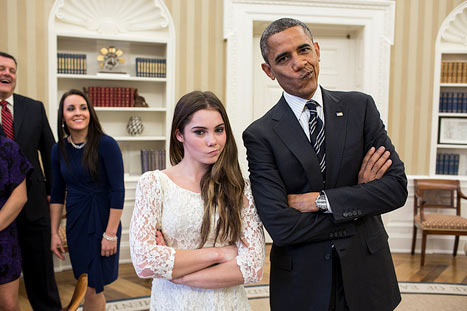
President Barack Obama met with McKayla Maroney and other members of USA’s Fierce Five Olympic gymnastics team – Kyla Ross, Jordyn Wieber, Aly Raisman and Gabby Douglas – yesterday in the Oval Office. But the Leader of the Free World was not impressed. Emulating the look Maroney made famous on the medal stand this summer, Obama folded his arms and curled his lips alongside the gymnast, promoting McKalya to Tweet soon afterward: “Did I just do the Not Impressed face with the President?” Yes, McKayla, you sure did. We wonder how Obama feels about the Kim Kardashian wedding, the Grand Granyon and many other events/monuments the Internet hilariously super-imposed Maroney into a couple months ago.