Tag Archives: film

‘Behind The Candelabra’: Soderbergh Bros Discuss Who’s ‘The Top’ In Liberace’s Bed

I’ve been sold on Steven Soderbergh’s Liberace movie   Behind The Candelabra   since the trailer for the HBO movie hit the web earlier this month. But if you need further convincing, the filmmaker drops some interesting details about the movie in a free-ranging discussion with his younger, gay brother Charley Soderbergh in Out magazine . Behind the Candelabra,  which premieres on HBO on May 26,  tells the story of the flamboyant pianist’s love affair with the much younger Scott Thorson.   Michael Douglas and Matt Damon play the star-crossed lovers, and the trailer, which I’ve posted below, makes the movie look like an over-the-top romp through the back pages of Las Vegas-style opulence. But it’s also reassuring to read Soderbergh tell his lookalike brother, who’s an Atlanta-based hair stylist, that Behind The Candelabra is not going to be an empty exercise in camp: ” I wanted the movie to be very generous to Lee and Scott. I took them seriously, and I took the relationship seriously. It was a real relationship that was derailed because of some very odd external forces, some of them social and some professional. But there was an extended period where they were fat and happy. And if Lee hadn’t worked in a business where he thought that was a problem, or being gay was a problem, I think there would have been a very different outcome. It’s compelling to watch the two of them together. It’s sort of a  Thelma & Louise  thing—they decide to jump off the cliff together. Another fascinating segment of the interview has the brothers Soderbergh discussing scenes from Behind The Candelabra in which Liberace and Thorson argue over porn and who will be “the top” and who will be “the bottom” in the bedroom. As Charley points out, the debates aren’t that different from ones he’s witnessed between straight couples. Out:  One of the most distinctive scenes, perhaps because it’s so rare to see it portrayed honestly in a movie, was the argument they have about who will be a top or a bottom. SS:  Whenever you’re in a sexual relationship that lasts long enough, at some point someone is going to hit on something that they want to do and the other person doesn’t want to do. That’s unfortunate, because it’s really hard to put that genie back in the bottle once it’s come out. If you’re lucky there’s some synchronicity that works out, and on the second Tuesday of every month, you get to do that. That’s absolutely a conversation straight couples have all the time. It doesn’t necessarily have the same significance, but oh, absolutely. CS:  I’ve been privy to conversations between a married male and female couple when one of them wants to try it and the other is balking. And the physical implications are the first thing they’re afraid of, and the social implications are the second thing. So we have two layers of fear. And I just stand there with a smile on my face, thinking,  I can’t wait to see how you work this out. SS:  It’s one of my favorite scenes in the film because it is so blunt and so funny. “Why am I the Lucy in this relationship?” CS:  “Because I’m the bandleader and have the nightclub act.” SS:   That’s [screenwriter] Richard [LaGravenese] really hitting one out of the park. But it is fascinating, because you have Scott saying, “I’m OK with  this , but I’m not OK with  that .” And Lee doesn’t understand, because to him it seems like hypocrisy. I find that really true to life, in the sense that our feelings about sexuality aren’t necessarily linear. Everybody’s got some dot on a line with 10 points on it, and one is out of sync or in the wrong order. It’s a very complex, powerful area of our lives, and it creates really fascinating emotions and delusions and omissions. And I thought,  What an interesting conversation, especially if Lee’s the one in the power position. CS:  Another part of that scene is, “I don’t know how you can watch that stuff,” referring to the porn on the TV. “How does he get it in his mouth?” I’ve talked to gay and straight couples who say, “I don’t know why you watch that stuff, it makes me feel unloved.” And the other one is like, “It’s no big deal!” The brothers also engage in a lively discussion of their childhood that includes a substantial discussion of the cult film, The 5,000 Fingers of Dr. T, which they watched every Christmas. It’s worth checking out. More on Behind The Candelabra :  WATCH:’ Behind The Candelabra’ Trailer — Will Movie Convey Liberace’s Cultural Impact? Follow Frank DiGiacomo on  Twitter. Follow Movieline on  Twitter. [ Out ]

See the rest here:
‘Behind The Candelabra’: Soderbergh Bros Discuss Who’s ‘The Top’ In Liberace’s Bed


‘Behind The Candelabra’: Soderbergh Bros Discuss Who’s ‘The Top’ In Liberace’s Bed

I’ve been sold on Steven Soderbergh’s Liberace movie   Behind The Candelabra   since the trailer for the HBO movie hit the web earlier this month. But if you need further convincing, the filmmaker drops some interesting details about the movie in a free-ranging discussion with his younger, gay brother Charley Soderbergh in Out magazine . Behind the Candelabra,  which premieres on HBO on May 26,  tells the story of the flamboyant pianist’s love affair with the much younger Scott Thorson.   Michael Douglas and Matt Damon play the star-crossed lovers, and the trailer, which I’ve posted below, makes the movie look like an over-the-top romp through the back pages of Las Vegas-style opulence. But it’s also reassuring to read Soderbergh tell his lookalike brother, who’s an Atlanta-based hair stylist, that Behind The Candelabra is not going to be an empty exercise in camp: ” I wanted the movie to be very generous to Lee and Scott. I took them seriously, and I took the relationship seriously. It was a real relationship that was derailed because of some very odd external forces, some of them social and some professional. But there was an extended period where they were fat and happy. And if Lee hadn’t worked in a business where he thought that was a problem, or being gay was a problem, I think there would have been a very different outcome. It’s compelling to watch the two of them together. It’s sort of a  Thelma & Louise  thing—they decide to jump off the cliff together. Another fascinating segment of the interview has the brothers Soderbergh discussing scenes from Behind The Candelabra in which Liberace and Thorson argue over porn and who will be “the top” and who will be “the bottom” in the bedroom. As Charley points out, the debates aren’t that different from ones he’s witnessed between straight couples. Out:  One of the most distinctive scenes, perhaps because it’s so rare to see it portrayed honestly in a movie, was the argument they have about who will be a top or a bottom. SS:  Whenever you’re in a sexual relationship that lasts long enough, at some point someone is going to hit on something that they want to do and the other person doesn’t want to do. That’s unfortunate, because it’s really hard to put that genie back in the bottle once it’s come out. If you’re lucky there’s some synchronicity that works out, and on the second Tuesday of every month, you get to do that. That’s absolutely a conversation straight couples have all the time. It doesn’t necessarily have the same significance, but oh, absolutely. CS:  I’ve been privy to conversations between a married male and female couple when one of them wants to try it and the other is balking. And the physical implications are the first thing they’re afraid of, and the social implications are the second thing. So we have two layers of fear. And I just stand there with a smile on my face, thinking,  I can’t wait to see how you work this out. SS:  It’s one of my favorite scenes in the film because it is so blunt and so funny. “Why am I the Lucy in this relationship?” CS:  “Because I’m the bandleader and have the nightclub act.” SS:   That’s [screenwriter] Richard [LaGravenese] really hitting one out of the park. But it is fascinating, because you have Scott saying, “I’m OK with  this , but I’m not OK with  that .” And Lee doesn’t understand, because to him it seems like hypocrisy. I find that really true to life, in the sense that our feelings about sexuality aren’t necessarily linear. Everybody’s got some dot on a line with 10 points on it, and one is out of sync or in the wrong order. It’s a very complex, powerful area of our lives, and it creates really fascinating emotions and delusions and omissions. And I thought,  What an interesting conversation, especially if Lee’s the one in the power position. CS:  Another part of that scene is, “I don’t know how you can watch that stuff,” referring to the porn on the TV. “How does he get it in his mouth?” I’ve talked to gay and straight couples who say, “I don’t know why you watch that stuff, it makes me feel unloved.” And the other one is like, “It’s no big deal!” The brothers also engage in a lively discussion of their childhood that includes a substantial discussion of the cult film, The 5,000 Fingers of Dr. T, which they watched every Christmas. It’s worth checking out. More on Behind The Candelabra :  WATCH:’ Behind The Candelabra’ Trailer — Will Movie Convey Liberace’s Cultural Impact? Follow Frank DiGiacomo on  Twitter. Follow Movieline on  Twitter. [ Out ]

See the rest here:
‘Behind The Candelabra’: Soderbergh Bros Discuss Who’s ‘The Top’ In Liberace’s Bed

Pain and Gain Review: A Roided-Out Crime Movie

Pain and Gain is like if a Coen Brothers movie and a Scorsese movie had a baby and that baby disappointed its parents and went into porn. At its core, the film is about a trio of hapless men just trying to get ahead in life, but who end up getting in way over their heads. The difference between Pain and Gain and every Coen Brothers movie with that premise is that Michael Bay’s hapless men aren’t timid and pathetic. They’re not looking for recompense or justice. They’re just greedy meatheads. Mark Wahlberg stars as Daniel Lugo, a bodybuilder not satisfied with his decent job doing literally the only thing he knows how to do: personal training. When a rich sandwich magnate named Victor Kershaw (Tony Shalhoub) who’s less of an “asshole,” as Lugo describes him, and more of an annoying weirdo, becomes his client, he decides to twist the advice of a hack motivational speaker played by Ken Jeong ( The Hangover Part III ), and extort him for all he’s worth. To help him, Lugo enlists fellow bodybuilders Adrian Doorbal, played by Anthony Mackie, and ex-con Paul Doyle, played by Dwayne Johnson. As you would expect, the three have no clue what they’re doing, and after a series of failed attempts thought up on the fly, they finally capture Kershaw. The only problem? He won’t sign away all of his material possessions willingly. What follows is a frenetic mess of half-baked ideas to make their plan happen. It’s at times hilarious, and at times truly terrifying in its misguided, unnecessary violence. Bay is the most unapologetically showy director working today. His films are notoriously devoid of character development and plot, and Pain and Gain is really no different. Everything is surface. Characters straight up say what they’re thinking to each other. Voiceovers are given to every major player, in a way that is much less charming and plot-serving than in Casino or Goodfellas . Scenes freeze and captions are thrown up reminding us that yes, this is a true story. The color pallet is bright and saturated. Nothing much remains unseen. And American flags litter the frame. We get it, American dream, yadda yadda. With all its brazenness, though, Pain and Gain actually works. Bay’s style of roided-out Hollywood blatancy fits the story, and given that Bay began in the 90s and has seemed to long for them ever since, he seems comfortable making a movie set in that decade. Pain and Gain would be hard to truly love as a film, though. Not because its characters are idiots, or because their motivations are extremely under-defined (when did that drug addiction come back?? Meh, who cares), but the film, like most of Bay’s works, seems entirely built to make a cool trailer. Trailers are flashy. They say very little. They’re meant to draw you to the theater. But once you’re there, you’re supposed to get more. Well, with Pain and Gain , you don’t get more. In fact, if you’ve seen the trailers, you could probably show up an hour late to the film and know everything the audience knows. That’s a problem. RATING: 2.5/5

See the rest here:
Pain and Gain Review: A Roided-Out Crime Movie

TRIBECA REVIEW: ‘Mistaken For Strangers’ − Sibling Rivalry Plays Out On The National’s Stage

Mistaken for Strangers , a documentary about indie group the National , comes off like an exercise in self-deprecation. As much a diary film as a rockumentary, it almost compulsively veers away from its ostensible subject, the band’s world tour, probing the relationship between lead singer Matt Berninger and his kid brother Tom (who helmed the film) as though worrying a sore tooth.  It remains ambiguous to what extent the director’s screen persona, which raises schlubbiness to an art form, is legit.  But with its wry humor and fantastic mix of music and images, this seemingly odd choice for Tribeca’s opening-nighter could carve out a solid theatrical niche.   Tom has been invited by Matt to join the National’s world tour as a working roadie. The documentary, shot solo on a small camera, is apparently strictly Tom’s idea. A veteran of a couple of schlock horror videos, Tom portrays himself as being woefully unprepared for the job, plunging in, to Matt’s dismay, with no prepared questions, no organization and not even a notebook as he asks hilariously lame questions like, “Do you ever get sleepy onstage?” or “Where do you see the National in 50 years?” About three-quarters of the way through, Tom finally manages to ask, albeit briefly, about the process of songwriting, and Matt speaks fleetingly of the difficulty of early tours, when nobody showed up.  But generally few subjects of substance arise – aside, of course, from the deathless Matt/Tom dynamic. “It sucks being Matt’s brother,” the director says. “He’s a rock star and I am not.” A darling of critics, the National only really achieved commercial success shortly before the featured tour, during which they play to President Obama in Washington and thousands in Paris, London and Warsaw.  Though granted little opportunity to discuss its music, the band is given ample room to perform it, and Matt’s penchant for physically interacting with concert-goers, writhing onstage and screaming into the mic lends the live shows plenty of drama.  Meanwhile, Tom quietly proves himself a whiz at sound/image counterpoint. But when not documenting concerts and occasional rehearsals, the film reverts back to the misadventures of Tom as he screws up his “other” job as assistant to the road manager. This gives the director the chance to crosscut between the band’s triumphant road trip and his own eventual, ignominious return to his parents’ Cincinnati home, where he plies Mom and Dad with anxious queries comparing himself to his brother. Ensconced in Matt’s Brooklyn home six months later, Tom begins to edit the docu, with chaotic results that nearly threaten to derail the film en route to its upbeat finish. More on Mistaken For Strangers :  WATCH: Tribeca Film Festival Rocks Out On Opening Night With The National & ‘Mistaken For Strangers’ Follow Movieline on  Twitter . 

Read more:
TRIBECA REVIEW: ‘Mistaken For Strangers’ − Sibling Rivalry Plays Out On The National’s Stage

REVIEW: Michael Bay’s Physically Punishing ‘Pain & Gain’ Is ‘Fargo’ By Way Of The Three Stooges

The large-scale destructiveness he has previously wrecked upon public and private property (including entire cities), Michael Bay visits on the human body in Pain & Gain , a pulverizing steroidal farce based on a bizarre-but-true kidnapping-and-murder case. Suggesting Fargo  by way of the Three Stooges , Bay’s latest certainly proves that the Transformers  auteur does have something more than jacked-up robots on his mind: specifically, jacked-up muscle men who will stop at nothing to achieve their deeply twisted notion of the American dream. With a very fine ensemble cast recruited to play an array of overtly despicable characters, this unapologetically vulgar, sometimes quite funny, often stomach-churning bacchanal will surely prove too extreme for great swathes of the multiplex crowd. But the marquee value of topliners Mark Wahlberg   and Dwayne Johnson , plus the pic’s reportedly modest $25 million pricetag, spells more gain than pain for Paramount’s box office pecs. Given that every Bay film is something of a stamina test, marked by passages of intense exhilaration and paralyzing fatigue, with Pain & Gain  the director may have lucked into the most fitting subject matter of his career: the world of obsessive bodybuilders and the trainers who push them beyond the brink of exhaustion. Adapted by screenwriters Christopher Markus and Stephen McFeely ( Captain America: The First Avenger,  the Narnia trilogy) from a series of articles originally published in the Miami New Times by Pete Collins , the film tells of one such muscle mecca, Miami’s Sun Gym, where staff and clientele include a liberal mixture of strippers, ex-cons and small-time scam artists. One such hustler is Sun Gym manager Danny Lugo (Wahlberg) who, in the fall of 1994, decides to abduct one of his clients, wealthy Colombian-American businessman Victor Kershaw (Tony Shalhoub) — and defraud him of his net worth. To aid in the scheme, Lugo recruits two accomplices: personal trainer Adrian ( Anthony Mackie ) and former Attica inmate Paul (Johnson), a recovering alcoholic and junkie who found Jesus during his last stint in the slammer. After a couple of near-misses (in real life, there were several more), the trio — decked out in ridiculous Halloween costumes — succeed in nabbing their mark, who they sequester in an abandoned dry-cleaning plant and, over the next 30 days, force to sign over all of his worldly assets, including cars, a local deli franchise and a gaudy McMansion in a posh gated community. In Collins’ reporting, the story of the Sun Gym gang reads like an inordinately malicious bid for the good life by a bunch of overcompensating he-men whose musculature vastly outpaced their intellect — their staggering incompetence rivaled only by that of the Miami-Dade Police, who, when Kershaw (in reality, Marc Schiller) miraculously survived to tell his tale, initially refused to believe him. While sticking largely to the facts, Bay and the writers are clearly aiming for something bigger: a commentary on American self-entitlement and, to an extent, the very sort of ra-ra, macho posturing Bay has proffered without irony in many previous films. In contrast to the unconscionable thug he seems to be on the page, the movie’s Lugo is more of a harebrained dreamer who sees himself as one of life’s “doers,” high on self-help mantras and a sense of his own inviolability. Wahlberg’s deft performance, which plays on his innate likability to conceal his character’s ultimate menace (a side of the actor little seen onscreen since his fine turn as the psycho boyfriend in James Foley’s Fear ), is one of the film’s (few) unqualified pleasures. But the movie’s cynical subtext, and whatever Bay is ultimately hoping to say with it, remain mostly undeveloped. To its credit, Pain & Gain  never succumbs to glamorizing its characters or their crimes, keeping things rooted in a constant, grim tension. For all its absurdist accents, the long middle section, in which Kershaw is beaten and bludgeoned by means that wouldn’t have seemed out of place in Zero Dark Thirty , is punishing to behold and dilutes much of the frantic energy the movie has built up during its opening act. And at 129 minutes, there’s much more to come, including severed digits, penile injections, a spinning weight plate to the neck and, in one unforgettable extreme-close-up, a cargo van’s rear tire backing up over a human face. At his best, particularly in the two Bad Boys  movies, Bay can be a master of exuberant chaos, but here the violence mostly lands with a sickening thud, which is fitting, one supposes, but also ultimately numbing. For better or worse — arguably both — Bay remains one of the most distinctive visual stylists at work in American movies today, and Pain & Gain  is nothing if not an orgy of swooshing, swooping movements, super slo-mo, blazing pastels (for the exteriors) and glowing neon (for the interiors), all captured on an array of pro and prosumer cameras, both film and digital, that give the movie a luxurious array of visual textures. Bay, who previously shot Miami very well in his two Bad Boys  movies, here turns it into a shimmering oasis of sin. One image, glimpsed late in the film, even feels like its maker’s entire career condensed into a single shot: wads of $100 bills laid out on a UV tanning bed. The pic’s home stretch gets a welcome boost from veteran Bay player Ed Harris as the seasoned private eye who ended up blowing the lid off the Sun Gym case. He’s only around for a few scenes, but he slips into them with such masterly ease that the character seems fuller and richer than many with double the screen time. Women, unsurprisingly, are mostly expendable here, reduced to sex objects and convenient surfaces for snorting coke, though the resourceful Rebel Wilson manages to steal a few scenes as Adrian’s clueless nurse girlfriend. Follow Movieline on  Twitter .

Read this article:
REVIEW: Michael Bay’s Physically Punishing ‘Pain & Gain’ Is ‘Fargo’ By Way Of The Three Stooges

Star Trek Into Darkness Clip: They’re Closing Fast!

A new  Star Trek Into Darkness clip has landed. In it, Kirk and Spock argue about whether their ship will fit through a tiny crevasse. I’m guessing it will. Star Trek Into Darkness Clip – Second Chris Pine, Zachary Quinto, and Benedict Cumberbatch star in the sequel to 2009’s  Star Trek reboot. This time, when Starfleet is attacked, the Enterprise crew embarks on a manhunt to take down the person responsible. Alice Eve, Zoe Saldana, Karl Urban, Anton Yelchin, John Cho, and Simon Pegg also star. J.J. Abrams directs the film, which will hit theaters May 17.

Here is the original post:
Star Trek Into Darkness Clip: They’re Closing Fast!

Bossip Exclusive: Lance Gross Talks Kim Kardashian, Negativity In Tyler Perry’s Movies And What’s Next At The Heineken Filmmaker Party In NYC

Lance gives BOSSIP an eye full and talks that talk at the NYC Heineken Filmmaker Party Lance Gross Talks To Bossip About Kim K, Tyler Perry And More Resident chocolate eye candy Lance Gross was seen on the scene in NYC over the weekend at the Tribeca Film Institute’s Heineken Filmmaker Party honoring a host of African-American and Latino filmmakers nominated for the inaugural “Heineken Affinity” award. BOSSIP was in the building to applaud the Affinity award nominees and recipient Ava Duvernay before chatting it up with Lance Gross about Kim K, Tyler Perry getting backlash for negativity in his movies, what’s next for him, and more. Check out our interview below: What can you tell us about tonight’s event and why it was important for you to be a part of this? “I mean, I’m here to support. I think it’ s great what Affinity is doing for African-American filmmakers. I support anybody who supports us. I just recently produced my first film so, you know it means a lot when you have people behind you and $20,000… that’s a lot for somebody who’s trying to get their film off the ground so, I support that.” You mentioned that you already have one movie under your belt as a producer. What else are you working on right now? “I’m actually just looking through scripts right now. My first project that I produced was “The Last Fall” and it was successful so, I just want to get the right project. I don’t want to just do anything.” Lance also gave his two cents on people hating for no reason, Tyler Perry’s controversial movie formula for success, Kimmy Cakes, and when we can expect to see him on the big screen again. Hit the flip to hear what he had to say….

Read more here:
Bossip Exclusive: Lance Gross Talks Kim Kardashian, Negativity In Tyler Perry’s Movies And What’s Next At The Heineken Filmmaker Party In NYC

INTERVIEW: Sandra Bernhard Says ‘It’s Too Late’ To Remake ‘The King of Comedy’

A longstanding gig will keep   Sandra Bernhard  from attending the Tribeca Film Festival’s closing-night screening of The King of Comedy on April 27, but it’s not like she needs her memory jogged. The comedienne recalls that making Martin Scorsese’s prescient and oh-so-dark 1982 comedy about a deluded stand-up comic ( Robert De Niro ) who kidnaps his favorite talk-show host ( Jerry Lewis ), was a “coming-of-age experience that left me a changed person.” Talk about a breakthrough. Bernhard played Masha, an obsessed  and similarly deluded fan of Lewis’ Jerry Langford character, who after helping to carry out the the kidnapping, entertained the duct-taped Langford in her bra and panties. Great comedy is often deeply unsettling, and Bernhard’s portrayal of Masha is so unabashedly off the wall that she left movie audiences squirming and Jerry Lewis genuinely aghast.  It’s one of the purest comic performances captured on film. Here’s a little taste: The Monster Masha I talked with Bernhard about her experience making the movie, her scene with three-fourths of the British punk band the Clash , and her thoughts on whether a movie as prescient as The King of Comedy could be re-made at a time when the world is full of Rupert Pupkins and Mashas. Movieline: Let’s start with all the talent you beat out for the role of Masha.  You’ve talked about how Debra Winger and Ellen Barkin were in the running, but Meryl Streep wanted that part as well. Any others that come to mind?  Sandra Bernhard:  I had heard that as well. So many people were up for that role, but I don’t know who exactly because they obviously didn’t tell me. I only knew about Ellen because I heard from her directly.  I know that the part kind of came down to me and another actress, but I don’t remember who it was.  Somebody did tell me at one point but it wasn’t anybody really compelling. How has the movie’s meaning for you changed over the years?  I haven’t seen the movie in a long time. How many times can you watch yourself, you know?  It’s uncomfortable.  I am curious to see it again all cleaned up and restored.  The film was so representative of an era in filmmaking when people would  take their time in a scene. It wasn’t a case of rush, rush, rush onto the next moment. You had room to breathe, and I think that in itself made people uncomfortable because the topic was so weird and out of left field at the time.  Now, expectations of fame and desire run so extreme that the film almost seems tame in comparison, but there’s still something about The King of Comedy that’s very disarming and offbeat and something you’ll never see again.  And so those are the emotions I feel. It was very evocative. I agree. One of the reasons the film is so memorable is the way the camera lingers on the discomfort that you and De Niro create in your scenes. It’s very visceral and pure in a way.  Exactly.  All of this extreme in-your-face social media doesn’t really have any impact because it doesn’t breathe. You don’t have to stay with it. As quickly as you look at it, it’s gone. This film has resonance and depth.  It’s made of earth and mud and shit — stuff that sticks to you. And yet, for a film that observes the old rules of filmmaking, it’s pretty prescient when you consider the celebrity-obsessed moment we’re now experiencing.  Yes, but even though it was predicting where things were going to go, it did so in a much more human, relatable way that we’ve lost in the inception of all the things that The King of Comedy predicted. Do you think this movie could be made or remade today? No way.  At one point, Jack Black wanted to remake it, and I was like — I mean I love him, he’s fabulous, don’t get me wrong, but I don’t think it would have worked. It’s too late to remake it.   We’re here and there’s nothing to really predict.  It’s just an ongoing conversation you have every day of the week like, “Can you believe he’s famous?”  There’s nothing to say about it.  We’re in the middle of it. Scorsese has said making the film was very difficult and trying because of the subject matter, and he and De Niro didn’t work together again until 1989 for Goodfellas .  Was that evident when you were filming? I don’t remember it being that way, but I think Marty puts a lot of his own intellectual and emotional weight into everything he does.  He’s a brooding kind of person and I think that things get under his skin and affect him.  I’m so the opposite.  I just go and do it, and then I pull out of it. I try not to stay with the feelings. Maybe it shook him up in a way that didn’t affect me. When it’s your film and you’re making it, you’ve got a lot more at stake. Do you have one particularly memorable moment of him directing you.  Did you crack Scorsese up? I cracked him up more than once, but I think the most important thing I learned from working with him was keep to things very small.  I was used to working on stage where everything needs to be big and gesticulated and over-the-top.  Whereas, when you’re making a movie, the littlest nuance and the littlest emotion are read very easily when the camera is right there in your face.  So he would always tell me, “tone it down.” Your performance is very real and that makes the movie all the more unsettling.  I remember flinching while watching the film and thinking, “This is so intense.”  It was, and in order to not, like, completely shatter the screen, there had to be a little bit of holding back. You have a scene where you tangle with members of the Clash in the movie: Paul Simonon, Mick Jones and the late Joe Strummer. How did that happen?  Marty was a big fan of theirs, and I think they were in town doing something and he just got them to do the scene.  We shot that in front of the Colony Records on a very, very hot day — sometime in July. It was nuts. They were just smoking and leaning against the place, you know, talking to me, and I said: “look at the street trash….”  It was crazy. Did De Niro or Lewis give you any guidance on the set?  Well, Jerry loves to direct.  Whereas he is not as magnanimous as the rest of them, he would still acknowledge a powerful scene or a great moment by his reaction.  He would register total fear and shock while sitting across the table from this lunatic Jewish girl. He had never seen anything like me. In that respect, the movie also represents a real moment in comedy:  you’ve got Lewis, the old guard, starring opposite you, who was satirizing his brand of Vaudevillian comedy in your nightclub act.  Absolutely. There couldn’t have been two more disparate worlds than the ones Jerry Lewis and I inhabited in 1981 when we shot the picture. Jerry had never been in a movie with a lady like me. I was deconstructing self-deprecating female comedy and the kind of dusty shtick of that generation — my father’s generation. I think that was another reason they liked me for the role: I brought that new avant-garde attitude to the whole thing. Did you improvise the entire dinner scene with Lewis?  There were parameters — points that I needed to get to throughout the scene — but Marty wanted me to bring some of the act I was doing at a time into it, and he just let me go. I was supposed to be this crazy character who was on her own in the world.  And I just tapped into who I was at the time and let it fly. Both Masha and Rupert are incredibly self-involved characters seeking fame and attention. All these years later, it feels like a world of Mashas and Ruperts is being spawned before our eyes.   That certainly was the most prescient part of the movie when you look at it now.  But at least they were interesting, complex characters.  Now they’re just morons.  I’d do anything to see anybody as interesting as the two of us, God forbid. Look at the crap on all the different websites and the blogs.  It’s like, sorry, you’re not cutting the mustard.  You have nothing to add to this conversation.Can it. Will you be in attendance on closing night?  I can’t  be there because I’m performing in Pittsburgh in association with the Andy Warhol Museum . The gig has been on the books for six months now. They wouldn’t let me out of the gig so I said, at least I had more than 15 minutes of fame . Last question.  What are you doing next? I’m on the road doing my one-woman shows.  I’m in the middle of trying to set up this TV series for myself and another actress, but I don’t want to talk about it as this stage. And I’m shooting a little independent small film in Brooklyn in the fall called Love in Brooklyn .  It’s a cute film that supposed to take place in the ‘80s.  It has a dance vibe to it. Follow Frank DiGiacomo on  Twitter. Follow Movieline on  Twitter.

Read the rest here:
INTERVIEW: Sandra Bernhard Says ‘It’s Too Late’ To Remake ‘The King of Comedy’

Ann Curry "Humilated" by Today Firing, Mocked by Producers for Fashion Choices

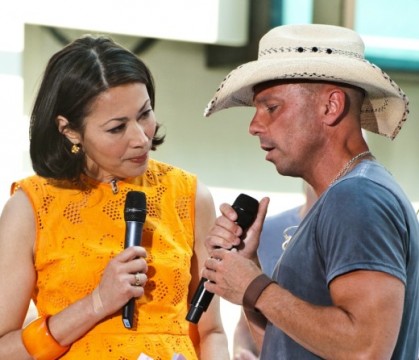
Excerpts from a new book have been released and they echo a previous report regarding Ann Curry and her firing from Today : Matt Lauer may suck, but producers were to blame for the horrible situation at that NBC program. In “Top of the Morning: Inside the Cutthroat World of Morning TV,” Brian Stelter writes that Curry received never-ending flak from those around her, with one staff members telling the author: “A lot of time in the control room was spent making fun of Ann’s outfit choices or just generally messing with her.” Case in point? The yellow dress above, a photo of which employees reportedly posted backstage alongside a picture of Big Bird and the caption: Who Wore It Best? Among other ways in which higher-ups made fun of Curry, according to the book: Executive Producer Jim Bell “commissioned a blooper reel of Curry’s worst on-air mistakes.” Prior to her ousting in June, boxes of Curry’s items went missing and somehow ended up in a coat closet. It was known around the office that Bell wanted to replace Curry with Savannah Guthrie and even referred to the plans to fire her as “Operation Bambi.” Bell has denied these charges, which were published today in The New York Times . As for Curry? She is trying to stay out of the spotlight, hanging out at her family house in Connecticut. The reporter remains “profoundly hurt and humiliated” by her dismissal, Stelter writes, concluding: “She told friends that her final months were a form of professional torture.”

View original post here:
Ann Curry "Humilated" by Today Firing, Mocked by Producers for Fashion Choices

Ann Curry "Humilated" by Today Firing, Mocked by Producers for Fashion Choices

Excerpts from a new book have been released and they echo a previous report regarding Ann Curry and her firing from Today : Matt Lauer may suck, but producers were to blame for the horrible situation at that NBC program. In “Top of the Morning: Inside the Cutthroat World of Morning TV,” Brian Stelter writes that Curry received never-ending flak from those around her, with one staff members telling the author: “A lot of time in the control room was spent making fun of Ann’s outfit choices or just generally messing with her.” Case in point? The yellow dress above, a photo of which employees reportedly posted backstage alongside a picture of Big Bird and the caption: Who Wore It Best? Among other ways in which higher-ups made fun of Curry, according to the book: Executive Producer Jim Bell “commissioned a blooper reel of Curry’s worst on-air mistakes.” Prior to her ousting in June, boxes of Curry’s items went missing and somehow ended up in a coat closet. It was known around the office that Bell wanted to replace Curry with Savannah Guthrie and even referred to the plans to fire her as “Operation Bambi.” Bell has denied these charges, which were published today in The New York Times . As for Curry? She is trying to stay out of the spotlight, hanging out at her family house in Connecticut. The reporter remains “profoundly hurt and humiliated” by her dismissal, Stelter writes, concluding: “She told friends that her final months were a form of professional torture.”

View original post here:
Ann Curry "Humilated" by Today Firing, Mocked by Producers for Fashion Choices