The Cannes jury is now complete. The Descendants director Alexander Payne and actor Ewan McGregor have joined the festival’s competition jury, which will judge the 65th annual event’s 22 films in competition . They join previously announced jury president Italian director Nanni Moretti ( We Have a Pope ) who will announce the Cannes winners on stage at the closing ceremonies on May 27th. And it’s not just filmmakers and actors taking on this year’s festival competition in the hallowed maze that is the Palais des Festivals in Cannes. French designer Jean Paul Gaultier – forever famous for designing Madonna’s external lingerie way back in the Blonde Ambition days – is on the jury. Joining him are Haitian director Raoul Peck ( Moloch Tropical ), actor Diane Kruger ( The Host ), actor Emmanuelle Devos ( In the Beginning ), British writer-director Andrea Arnold ( Fish Tank ) and Palestinian actress Hiam Abbass ( Miral ).
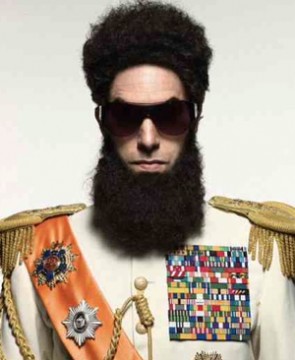
“He then began threatening the exhibitors to put his movie in their theaters, or else he said he might detonate imaginary bombs underneath their seats. ‘Is that chewing gum underneath your seat? Certainly they are not plastic explosives,’ he teased. ‘Trust me, there are bigger bombs in John Carter . Just shoot the executive behind that. Oh — wait, you did,’ he said, referring to [Rich] Ross’s recent departure from Disney. But perhaps the harshest zinger was aimed at Steven Spielberg’s DreamWorks. To urge CinemaCon attendees to see a screening of The Dictator later Monday evening, Cohen promised free Rolexes, blood diamonds, and young girls — ‘or boys, if you are from DreamWorks.'” [ LAT ]
G.I. Joe: Retaliation director Jon M. Chu and star Dwayne Johnson popped up to unveil a new trailer for the exhibition pros Monday night at CinemaCon, where The Rock was dubbed the CinemaCon Action Star of the Decade and described with a nickname that’s been floating around here and there for months: “Franchise Viagra.” The new Rock-centric trailer for G.I. Joe: Retaliation seems to agree with that sentiment. So watch it below and discuss: Could Johnson’s muscle-bound box office draw enhance just any limp franchise’s potential? Johnson earned the moniker by helping Fast Five to a box office bonanza last year, but he also notably made the Journey to the Center of the Earth sequel a hit (and let’s not forget his film career beginnings, turning an appearance in the Mummy franchise into his own starring spin-off). With Chu behind the camera ramping up the cool factor on G.I. Joe 2 — Bees that turn into bombers! Rappelling mountainside ninja fights! Bruce Willis! — this new trailer makes it known that the sequel is Johnson’s film. His Roadblock is the solid wall of man meat who leads the Joes on a quest to clear their names and avenge their fallen brethren after Cobra Commander infiltrates the government and turns their own country against them. The whole “betrayed agent avenging comrades to clear their name” thing has been done to death recently ( Salt , Haywire , The A-Team , The Losers , Mission Impossible: Ghost Protocol , ugh make it stop), but halfway through the trailer I realized that yes, I will watch just about anything The Rock is in. Especially if he’s all bronzed and sweaty, which is just about always. Verdict: G.I. Joe 2 was more enticing when it was all mountain ninjas and Channing Tatum and Bruce Willis in the back of that El Camino before all this silly plot reveal business, but on the other hand it has The Rock, and therefore I am in.
Where have you read this before ? “In December, Paramount made the unconventional decision to release Ghost Protocol exclusively in IMAX theaters five days before broadening its release. The move, which Mr. Bird advocated, helped catapult the film to the No. 1 spot when it went wide the following week on the way to becoming the highest-grossing Mission Impossible installment yet. For Mr. Bird, the point is that the typical multiplex theater lacks excitement. When he was young, he says ‘if you wanted to see a brand new movie, the only way was to see it perfectly projected in a really big theater with the bulb turned all the way up and an attentive projectionist.'” Adds Christopher Nolan: “These were cameras that had been to the top of Mount Everest, to the bottom of the ocean and into outer space, but people thought we couldn’t make a feature film. It was absurd.” [ WSJ ]
British actress Emily Blunt has traveled both the studio and indie route during her career, most recently appearing in Lasse Hallström’s specialty feature Salmon Fishing in the Yemen and starring this week opposite Jason Segel in Universal’s romantic comedy The Five-Year Engagement . Meanwhile, another project Blunt is promoting in New York, writer-director Lynn Shelton’s Your Sister’s Sister , joined Engagement as part of this year’s Tribeca Film Festival, still underway in Manhattan. The smaller of her two Tribeca titles, Sister proved something of career déjà vu for Blunt, who told an Apple Store audience that her experience working on the feature reminded her of her very first film feature role. “The whole time I was shooting my first film My Summer of Love [2004], I was terrified because it was all improvised,” Blunt said at the event, co-hosted this past weekend by Indiewire . “I hadn’t worked that way in years, so I was [eager] to do it again. It’s daunting, but I was excited.” Your Sister’s Sister co-stars Blunt as Iris, who sends her good friend Jack (Mark Duplass) to her family’s island following the death of his brother. After he arrives at the island getaway, he has a surprising encounter with Iris’s sister Hannah (Rosemarie DeWitt), which unleashes a revealing stretch of antics over the course of several days. While the film is intended to be dramatic, comedic elements surface even in surprising ways for the actors. “I almost felt sorry for my character because when I was playing her, I was thinking very seriously,” said DeWitt, commenting on audience laughter during some scenes with her character. “But I think that when people laugh, they’re seeing themselves in the character,” Blunt added. Filming Your Sister’s Sister , Shelton worked with Blunt, DeWitt and Duplass as collaborators, in a working style she calls “collaborative and improvisational” — reminiscent of Shelton’s more recent feature Humpday (which also starred Duplass) and her debut feature We Go Way Back (2006). “I like to attach the actors first and then get the script together,” Shelton said. “The studio way is to have a script first, then you get the actors.” Shelton added that her methodology for making a film is akin to a playdate: “My way is to get friends together and say, ‘Let’s make a film this summer.’ It’s hard to do that with the studio system.” Shelton will next put her approach to the test with her upcoming — and comparatively larger-budgeted — Touchy Feely . The film will have a 20-day shoot boasting an ensemble cast (including DeWitt and Ellen Page) and many story lines, a departure from the more streamlined plot in Sister . “I’ve made five features in my cheap way, so I think I deserve this,” Shelton said. As for Blunt, the rising star will continue to promote The Five-Year Engagement , in which she stars opposite Segel as a bride-to-be chasing a fleeting wedding day, and has a number of other projects waiting in the wings. “I love the variety and choices out there,” said Blunt. “I want to do all things. As an actor, you want to have a bag of tricks that you never get to the bottom of.” Your Sister’s Sister opens June 15 in limited release from IFC Films. Read all of Movieline’s Tribeca 2012 coverage here . [Top photo: Getty Images; middle photo of (L-R) Blunt, DeWett, and Shelton: Movieline]
Oh to be young and in love and periodically a flesh-rending creature of globular, hairy, throbbing pulp. That’s the curse heaped upon the eponymous romantics in Jack and Diane , one of the more anticipated — and more disappointing — features in Tribeca 2012’s narrative competition. It’s hard to be too down on such lean passion; Jack and Diane ‘s premiere Friday night amounted to the culmination of nine years of work by filmmaker Bradley Rust Gray, whose acclaimed 2010 drama The Exploding Girl served as sort of a hetero prelude to the lesbian body horror/romance mashup swamping his latest: Diane (Juno Temple) is a hot British teen mess visiting her aunt in New York City, all babydoll dresses, knit watermelon halter tops and purple knee socks, rocked by the hormonal lighting strike that is butch, brooding Jack (Riley Keough). The girls club, they kiss, they bond, they exchange vaguely sweet Manhattan banalities (“I have a Metrocard if you want it”), and then… I don’t even know. On the one hand it’s not worth spoiling; jumpy genre reveals are involved, hinted at by customarily grisly animation by the Brothers Quay. On the other hand, Jack and Diane is too much of a mess to spoil, suffocated in the dynamics of longing without even the hope of dramatic — or even darkly comedic — satisfaction. It’s a movie whose shadowy genre overtones — a girl! In a bathroom! With a bloody nose! And a monster! — surrenders to the same auteurist A.D.D. that sank The Exploding Girl . For once, I would like to see Gray’s New York not refracted surveillance-style through long lenses and the fraught nubile wits of characters whose doe eyes and costumes connote virtually the whole story. Temple’s expressive genius — all matted blond hair and mischievous (and monstrous) pixie — goes only so far against Keough’s near-total blankness, getting most of its mileage out of a single early, affecting confessional between the star-crossed girls. Ultimately, though, it’s hard to know just how seriously to take Jack and Diane , with all its sinewy portent and bizarre porn digressions and tragicomic pube-shaving and actual straight-faced dialogue such as, “Do you have to take a shit? Try to do like I do and fart it out.” Viewers familiar with The Exploding Girl might realize after a while that they’re only staying with Jack and Diane for the promise of more B-list hipster-goddesses losing control; then it was Zoe Kazan’s simmering epileptic panic, and now it’s the viscera-devouring prospect of sapphic passion — in one case featuring Elvis Presley’s grandaughter (Keough’s mother is Lisa Marie Presley) and Kylie Minogue in a heavily tattooed cameo. It is what it is, and it never feels like much more. Nevertheless, there is at least one glint of salvation in Jack and Diane , though it has nothing to do with its filmmaking or performances (and here I should issue a spoiler alert): Keough and Minogue make out to the strains of Shellac’s rare and entrancing hate-punk ballad ” Doris ,” which I suppose means that someone somewhere has a clean MP3 of the notoriously vinyl-only single. Rejoice! Can I have a copy? Read all of Movieline’s Tribeca 2012 coverage here . Follow S.T. VanAirsdale on Twitter . Follow Movieline on Twitter .
“[M]y history is dotted with shameful unfinisheds. The Great Gatsby ? I put it down in eighth grade and haven’t picked it up again. Should I not be saying this? Will I be sent away somewhere awful? I often don’t finish books, even ones that I like.” Pfffft , it’s totally fine, Lena — that’s why they’re making another movie of it! Also: This reminds me, I should probably finish watching Tiny Furniture at some point. [ NYT ]
The Tribeca Film Festival opened Wednesday night with the world premiere of Universal’s The Five-Year Engagement , ushering in 10 days of the festival’s 11th annual event. Initial word from insiders is that this year’s festival lineup is its strongest in years. Days from now, attendees will be buzzing about what works and what doesn’t, but Movieline is offering up a sneak glimpse into many of the films playing in the festival’s narrative and documentary competitions , plus its genre-centered Cinemania section. Ahead of the festival, we reached out to its filmmakers to give quick comments about their films and a peak at their trailers or clips, which Movieline will debut here in the coming days — including exclusive premieres, such as the trailer for The Revisionaries , featured below. Have a look, mark your calendars, and share your thoughts on these and other Tribeca films. The Revisionaries , by director Scott Thurman – U.S. [World Documentary Competition] Synopsis Once every decade, the 15 members of the Texas Board of Education meet in Austin to revise the state’s textbook standards. Led by Don McLeroy, a Young Earth Creationist, Evangelical Christian, and beloved local dentist, the panel will debate and implement controversial new standards related to science, evolution, social studies, and American history that will ultimately go into effect in textbooks adopted by schools across the nation. Challenged by outspoken activist Kathy Miller, as well as Thomas Ratliff, a moderate conservative out to unseat him, McLeroy faces an uphill battle, with the fate of American education itself hanging in the balance. [courtesy of Tribeca Film Festival] Comments by Scott Thurman: The Revisionaries quick pitch : The theory of evolution and a re-write of US history are caught in the crosshairs when an unabashed creationist seeks re-election as chairman of America’s most influential board of education. [The film] is about the rise and fall of a small-town dentist, outspoken young earth creationist, and Chair of the Texas Board of Education during a crucial period in determining high-school textbook content for public schools throughout the entire state, which influences schools across the country. …and why it’s worth checking out at Tribeca : The Revisionaries is a very important and timely film about the politics of education. I hope the creative director at Tribeca, Geoff Gilmore, won’t mind if we mention that he’s stated, “It’s such an intriguing point-of-view with the Christian right-wingers.” In an election year, what could be more important than learning more about a major battleground in the American culture wars? Thoughts about the trailer : I’d like audiences to be more informed about how the Texas Board of Education’s political process occurs, and to better understand the motivation and strategies of a handful of characters with opposing world views involved in that process, which could affect all of our children. Although we don’t advertise any specific action steps, we hope the film motivates audiences throughout the country to become more aware of the public school standards in their own state and understand the importance of participating in state board of education elections. First Winter by writer/director Benjamin Dickinson – U.S. [Tribeca Film Festival World Narrative Competition] Synopsis When winter begins, life is serene for a group of new-age Brooklynites living in a remote country farmhouse. Sex, drugs, yoga, and organic cooking absorb their days, safely tucked away from the stresses of urban life. But when a blackout of apocalyptic proportions strands them with no heat and no electricity during the coldest winter on record, their utopian commune is breached by anxiety and their idyllic harmony begins to lose its tune. As time wears on and the food supply dwindles, power struggles, jealousy, and desire threaten the group’s ability to work together in order to survive. [courtesy of Tribeca Film Festival] Comments by Benjamin Dickinson… First Winter quick pitch : It’s about letting go of what’s unnecessary. …and why it’s worth checking out at Tribeca : It’s a compelling story about Brooklynites with some nice drugs, sex, emotional violence, and jokes in there, and but so that’s just to set you up for what it’s really about, which is love and death. Thoughts about the trailer : I wanted to communicate more than anything the tone of the film, which I think this does nicely. It’s slow and visual and moody. The landscape gradually takes over. Jackpot by director Magnus Martens – Norway [Cinemania section] Synopsis Terrified, bloodied, and clutching a shotgun, Oscar Svendsen awakes and emerges from underneath a dead body. He finds himself in the midst of a crime scene in what used to be a respectable strip joint, surrounded by corpses and staring down the barrel of a gun pointed at him by a detective with the National Criminal Investigation Service. Naturally, Oscar is taken into custody, and during his interrogation he timidly relates a bloody story of betrayal, murder, and a soccer lottery prize that was meant to be shared with three ex-con co-workers. But is this the whole story? [Courtesy of Tribeca Film Festival] Comments by Magnus Martens… Jackpot quick pitch : Jackpot is a crime-comedy based on an original story by author Jo Nesbø. …and why it’s worth checking out at Tribeca : If you want to see something hilarious from Norway with a memento to Tarantino´s absurd action universe, you better not miss Jackpot . Thoughts about the trailer : The trailer starts as a scary movie with a crime plot and shifts into a comedy. We wanted to communicate that Jackpot has many ingredients from different genres. While We Were Here by director Kat Coiro – U.S. [World Narrative Competition] Synopsis In this tightly crafted relationship drama, Jane (Kate Bosworth) and her husband Leonard (Iddo Goldberg) travel to Naples—where Leonard is playing viola with the local orchestra—hoping to reinvigorate their silently disintegrating marriage and escape a personal tragedy that hangs heavily between them. Jane, left alone most days, wanders the streets listening to tapes she made of interviews with her grandmother, seeking inspiration to finish a book based on the old recordings. Facing writer’s block, she takes a day trip to stunning Ischia, where she meets Caleb (Jamie Blackley), a young American leading a hermetic yet Dionysian life on the island. As the two embark on an unlikely emotional affair, Jane’s carefully constructed world begins to crack open and she faces drastic changes in her life. [Courtesy of Tribeca Film Festival] Comments by Kat Coiro… While We Were Here quick pitch : Kate Bosworth plays a woman in an unhappy marriage who accompanies her musician husband to the south of Italy where she meets a young, devastatingly handsome man ten years her junior, with whom she embarks on an affair… …and why it’s worth checking out at Tribeca : The setting alone is worth the price of admission. Filmed on location on a little island off the coast of Italy, the movie takes place in grottos, on beaches, off of cliffs, in castles — it’s full-blown location porn. The other draw is the cast. Jamie Blackley is a rising star who shines as Kate Bosworth’s much younger lover, the legendary Claire Bloom narrates and Bosworth taps into a remarkably vulnerable place as a woman at a crossroads. Thoughts about the clip : The clip doesn’t give away any of the tightly wound story but it does transport the viewer to a romantic place and gives a sense of the black and white photography, the stunning location and the original orchestral score. Graceland by director Ron Morales – Philippines [Tribeca Film Festival Cinemania section] Synopsis : Once every decade, the 15 members of the Texas Board of Education meet in Austin to revise the state’s textbook standards. Led by Don McLeroy, a Young Earth Creationist, Evangelical Christian, and beloved local dentist, the panel will debate and implement controversial new standards related to science, evolution, social studies, and American history that will ultimately go into effect in textbooks adopted by schools across the nation. Challenged by outspoken activist Kathy Miller, as well as Thomas Ratliff, a moderate conservative out to unseat him, McLeroy faces an uphill battle, with the fate of American education itself hanging in the balance. [Courtesy of Tribeca Film Festival] Comments from Ron Morales… Graceland quick pitch : Graceland is an intense kidnapping drama that forces its viewers to see the motivations of several characters on several sides of a very dark story. It poses a lot of moral questions, is intensely exhilarating, and takes no prisoners. …and why it’s worth checking out at Tribeca : There’s nothing else like Graceland at Tribeca this year. Its raw ferocity and intense subject matter set it apart from other features, and the fact that it was written and directed by a Filipino now living in Manhattan allows it the exoticism of a foreign film with the heart of a local project. Thoughts about the trailer : The trailer is an extension of the film – calm and intense, with a strong air of concern that hints at the horrors to come. It highlights Arnold Reyes’ bravado performance, which begins calm and subdued, but ultimately throttles the film like a freight train toward it’s unexpected conclusion. Stay tuned for more exclusive festival previews at Movieline, and read all of our Tribeca 2012 coverage here .
The best documentaries tell you more than you think you’d ever want to know about a subject, perhaps fulfilling a curiosity you didn’t know you had. That’s the case with Kevin Macdonald’s Bob Marley documentary Marley , which stretches out at a languorous two hours and 24 minutes without dragging or getting bogged down in extraneous details. Everything in it – from interviews with the singer’s bandmates and his widow, Rita, to vintage and contemporary images of his hardscrabble birthplace of St. Ann Parish, Jamaica, to live-performance footage that captures his extraordinary charisma – feels essential, albeit in a relaxed way. By the end you feel you’ve learned something about the man, yet his mystique emerges intact. Robert Nesta Marley was born in 1945, to an Afro-Jamaican mother, Cedelia, and a much older white Jamaican father, Norval Sinclair Marley, who was of English descent and who barely played a part in young Robert’s upbringing – he’d visit the family occasionally, but he was a shadowy figure who, as it turns out, also fathered a child by another Jamaican woman. Macdonald grounds Marley’s story firmly in a sense of place, using simple images for whopping impact: A black-and-white still photo shows Marley’s childhood home, which is essentially a shack with a few windows. When Marley was 12, his mother moved her little family to the Trench Town area of Kingston, in an effort to build a better life. One of Marley’s childhood friends recalls that that type of “better life” often included going to bed hungry. Kids heard the words “Drink some water and go to bed” a lot, simply because there was nothing else their parents could do for them. Despite growing up amid that kind of hardship — or maybe partly because of it — Marley always loved music and always found ways to make it, and Macdonald does a superb job of outlining a mini-history of ska and reggae, musical forms built in the early 1960s from the spontaneous mingling of Caribbean rhythms and American pop music. One of Marley’s childhood friends described the home-made instruments used to make this music in its most rudimentary form: A box with rigged with strings known as a rhumba box; drums made from cow skin; and the instrument referred to by this fellow as the “shake-shake,” which really needs no explanation. Marley and his friends listened to American acts like the Platters, the Drifters and the Temptations, and after Marley made his first recording, in 1962 – a pseudo-spiritual called “Judge Not” – he became part of the band that came to be known as the Wailers. The group rehearsed for two years before the producer at their local recording studio allowed them to make a record: In the meantime, they played not just in town squares but also in cemeteries, to ward off evil spirits – if you could placate those guys, you’d be able to perform without fear in front of anybody. Macdonald arranges his material in a way that’s chronological though not strictly linear, covering a lot of territory with an easygoing cross-thatching of stories of interviews: Marley’s gradual but steady rise from ambitious, talented writer and musician to revered cult figure; his embrace of Rastafarianism; his association with legendary producer Lee “Scratch” Perry (shown, in contemporary footage, looking and acting extremely wiggy) and Island Records founder Chris Blackwell; and, last but not least, his propensity for consuming somewhere near a pound of marijuana a day. (Did I dream that, or is it actually in the documentary? Either way, he smoked a lot .) Most illuminating are the interviews Macdonald conducted with Bunny Wailer, founder and original member of the Wailers (who holds court before the camera, resplendent in dark glasses and a puffy zebra-striped hat), and Rita Marley, who tells how, at the height of her husband’s fame, she’d sometimes be called in to dispatch his extracurricular girlfriends from his dressing room. (She’d march in, announcing to everyone that it was time for bed.) Marley had a lot of extracurricular action, including a longtime relationship with former Miss World Cindy Breakspeare, who’s interviewed at length in the film. We learn that he fathered 11 children by seven different mothers during his lifetime. (One woman interviewed in the film is identified only as “Baby Mother.”) He died of cancer, in 1981, at age 36 – Macdonald handles the details of his death so matter-of-factly that it might not hit you until later how poignant they are. At one point his daughter, who clearly harbors a lot of resentment toward her free-spirited absentee father, remarks on his appearance after the progression of his illness required him to cut off his heavy dreadlocks: “He looked, like, so tiny.” If Marley lived the high life, sometimes at others’ expense, it’s worth noting that the women around him who lived to tell the tale – Rita Marley, Breakspeare and backup singer Marcia Griffiths – look remarkably youthful: No wrinkles, no cry. Macdonald clearly has a great deal of respect for his subject, and maybe even some reverence. But he doesn’t pretend that Marley’s great talent and charm existed in a vacuum – every minute, he’s finding a new context for the man’s career and life, and the portrait he ultimately comes up with is prismatic and fascinating. With pictures like The Last King of Scotland and State of Play , Macdonald has proved such an adept fiction filmmaker that it’s easy to forget he made documentaries for years, including Touching the Void and the Oscar-winning One Day in September . In that respect, Marley is a homecoming of sorts. It’s at once leisurely and controlled, like a Bob Marley song, with fresh secrets in every groove. Follow Stephanie Zacharek on Twitter . Follow Movieline on Twitter .
Nicholas Sparks. The name alone conjures up images of a romantic connection leaping between two people like an electric current, of fireworks illuminating the sky behind a couple canoodling at the side of a silvery lake somewhere and swearing they’ll never be parted — except that she’s dying of terminal amnesia and he has to leave tomorrow for an 50-year deployment in the Middle East, oh no! Love means never having to say “I wasn’t crying, my allergies just got really bad all of a sudden!” in Sparks’s world, and that remains true for the latest adaptation of his work, The Lucky One , directed by Shine ‘s Scott Hicks and starring Zac Efron and Taylor Schilling in a story as gauzily soft and disposable as the tissues the susceptible might need to pack. Efron plays Logan, a Marine home after three tours of duty and struggling through a sense of displacement and jolts of PTSD. One morning after a raid while he was still in Iraq, he spotted a photo on the ground and went to pick it up. The act took him out of the path of a bomb that exploded a few seconds later, one that would have killed him if he’d stayed put. After surviving a few more brushes with death, he came to believe that the picture, of a blond woman, was his lucky charm, and he vowed to find her in order to thank her. He does this by packing up a duffel and heading out on foot with his dog, walking from Colorado to Louisiana in search of the (fictional) small town of Hamden, Louisiana, located in that region of the South — I’m sure you know it — in which it’s perpetually golden late afternoon. He matched a lighthouse there to one in the background of the photo, and after a little asking around, he finds his way to a dog kennel owned by the cheery Ellie (Blythe Danner) and her granddaughter Beth (Taylor Schilling), a skittish single mom with a bullying ex-husband — and, of course, the “guardian angel” from the photo. The Lucky One is filled with talk of destiny, much of it done by Efron in the opening and closing voiceover, but like any movie romance, it needs a complication to potentially keep its fated leads apart. In this case, it’s the seemingly easily surmountable (it’s no terminal amnesia) quirk that Logan “can’t find the right words” to tell Beth why he’s really there, and so instead takes a job at the kennel and begins winning her over with his kindness and rippling biceps. What will Beth do when she finds out? She’ll get mad, but I’m honestly not sure why — maybe if he’d been carrying around a nude photo of her, or been keeping locks of her hair and smelling them compulsively, it’d be something to get creeped out about, but his explanation is pretty legitimately sappy. Efron and Schilling play a Disneyland version of a traumatized veteran and an emotionally abused spouse, their emotional wounds salved by their time together during a courtship that consists of a lot of mutual ogling through windows and fixing of boats (not a metaphor). Logan also bonds with Beth’s son Ben (Riley Thomas Stewart), a boy whose love of chess and playing the violin doesn’t sit well with his demanding, tough-guy father Keith (Jay R. Ferguson). Efron isn’t plausible as a battle-scarred soldier, but even without the fake tattoos he’s no longer built like a tween heartthrob. While Schilling — in cutoffs or floral dresses, her hair in a messy ponytail — is treated with chaste deference by the camera (she first appears walking out of the light like a near-death vision), the film has no problems lovingly objectifying the newly buff physique of its male lead. The Lucky One aspires to but never reaches the grandly melodramatic heights of the über-Sparks adaptation The Notebook , though a reconciliation embrace in an outdoor shower of some sort seems deliberately staged to evoke the earlier feature. The film can’t with any conviction portray this as a great love, even on simplified and schmaltzified scale (“You should be kissed every day, every hour, every minute,” Logan tells Beth) — Efron and Schilling simply look like two pretty people who are bound to get together because they both have the big blue eyes of a porcelain doll. Their problems are made to appear so mild, and the setting in which they live so idyllic that The Lucky One becomes numbingly pleasant, a cinematic anesthetic. It may not be The Notebook , but The Lucky One does unintentionally evoke another cable-TV standard in its story of a zen-like wanderer, trying to leave behind a violent past, who comes to a small town, rents a run-down place to live and falls in love with a girl whose jealous ex has a lot of local power. It’s Road House without, well, the road house. And instead of doing tai chi out by the water, Efron’s character prefers, sensibly but less interestingly, to just walk. Follow Alison Willmore on Twitter . Follow Movieline on Twitter .