
Tag Archives: government

Olbermann Cherry-picks Gingrich, Accuses GOP of Blaming Unemployed for Bad Economy

Keith Olbermann on Thursday cherry-picked an article by former Speaker of the House Newt Gingrich to make a pathetic case that Republicans are targeting and blaming unemployed Americans for the country’s economic woes. In his opening “Countdown” segment on MSNBC, the host began, “When it came time to invade, Republicans used cherry-picked intelligence to make the case for war in Iraq. Now, they`re using cherry-picked intelligence to wage war on the middle class.” Particularly in Olbermann’s crosshairs was Gingrich who the “Countdown” host claimed “targeted one individual American who`s struggling to make ends meet and held him up as part of the problem.” Ironically, it was Olbermann that was guilty of cherry-picking as he quoted a very tiny portion of a Human Events article the former Speaker wrote Wednesday (video follows with commentary and full transcript at conclusion): After showing clips of various Republicans talking about how extending unemployment benefits reduces the incentive for those out of work to accept jobs being offered to them – including positions that pay them less than they were previously making as well as below what they’re getting on unemployment – Olbermann went after Gingrich: KEITH OLBERMANN, HOST: But now, as we mentioned, Republicans have targeted one individual American who`s struggling to make ends meet and held him up as part of the problem. Former House Speaker Newt Gingrich writing yesterday, quote, “The extension of unemployment benefits has given people a perverse incentive to stay on unemployment rather than accept a job.” He continued “`The Wall Street Journal` quotes an engineer who admits he turned down more than a dozen offers because the salary would have been less than he made on welfare. This story encapsulates the problem of the long-term unemployed, the depth and length of this recession is at risk of creating a permanent pool of unemployed Americans who get so used to being unproductive that they are willing to accept welfare indefinitely instead of taking a job.” The man who turned down those offers will tell his own side of the story in just a minute and the reasons for turning down a job are not always as simple as Mr. Gingrich is. “The Journal” interviewed Rick Helliwell about his company`s difficulty finding people, quote, “The jobs require a little more than a high school diploma and fluency in English. They include free accommodation of medical care and starting pay of about $30,000 a year. Mr. Helliwell speculates that Americans might be hesitant to move to Dubai where the jobs are based.” Speculates — you might add other possible reasons for giving up a job, such as — saving the country, or because Republicans thought you unfit to work. Gingrich was referring to an article in the Wall Street Journal published Monday entitled, “Some Firms Struggle to Fill Jobs Despite High Unemployment”: With a 9.5% jobless rate and some 15 million Americans looking for work, many employers are inundated with applicants. But a surprising number say they are getting an underwhelming response, and many are having trouble filling open positions. “This is as bad now as at the height of business back in the 1990s,” says Dan Cunningham, chief executive of the Long-Stanton Manufacturing Co., a maker of stamped-metal parts in West Chester, Ohio, that has been struggling to hire a few toolmakers. “It’s bizarre. We are just not getting applicants.” Employers and economists point to several explanations. Extending jobless benefits to 99 weeks gives the unemployed less incentive to search out new work. Millions of homeowners are unable to move for a job because the real-estate collapse leaves them owing more on their homes than they are worth. Later in the piece came this: Some workers agree that unemployment benefits make them less likely to take whatever job comes along, particularly when those jobs don’t pay much. Michael Hatchell, a 52-year-old mechanic in Lumberton, N.C., says he turned down more than a dozen offers during the 59 weeks he was unemployed, because they didn’t pay more than the $450 a week he was collecting in benefits. One auto-parts store, he says, offered him $7.75 an hour, which amounts to only $310 a week for 40 hours. “I was not going to put myself in a situation where I was making that small of a wage,” says Mr. Hatchell. He has since found a better-paying job at a different auto-parts dealer. With this in mind, Gingrich wrote in his piece Wednesday entitled “Indisputable Failure”: An article in the Wall Street Journal Monday painted a frustrating picture of the joblessness situation, showing that, despite our high unemployment, many firms are having trouble filling job openings. According to the Federal Reserve Bank of Atlanta, if job openings were getting filled at a normal rate, the unemployment rate would be 6.8% instead of 9.5%. So there are actually many jobs out there that need to be filled. Yet, in the worst recession since the Great Depression, many employers can’t make hires. The article cites several reasons for this phenomenon, a few of which are long term trends such as our education system not producing enough qualified engineers. But others factors fall squarely on the backs of this administration and Congress. For instance, the extension of unemployment benefits has given people a perverse incentive to stay on unemployment rather than accept a job. The part-owner of a machine parts company, Mechanical Devices, is looking for as many as 40 new engineers, but is quoted in the article as saying many applicants at job fairs were “just going through the motions so they could collect their unemployment checks.” The article also quotes an engineer who admits he turned down more than a dozen offers because the salary would have been less than he made on welfare. This story encapsulates the problem of the long-term unemployed. The depth and length of this recession is at risk of creating a permanent pool of unemployed Americans, who get so used to being unproductive that they are willing to accept welfare indefinitely instead of taking a job. Readers should notice that Gingrich NEVER mentioned Hatchell’s name. Isn’t it difficult to “target” someone without saying his or her name? In fact, the Hatchells didn’t even know about what Gingrich said until Olbermann’s crew informed them and invited the couple on the show to discuss it. Kind of makes it look like they were actually targeted by Olbermann and NOT Gingrich. Making the “Countdown” host’s position even weaker, Gingrich’s unnamed reference to Hatchell represented one sentence in a 1300-word article! I guess that qualifies as “targeting” in Olbermann’s world. In reality, if the “Countdown” host wanted to point fingers, he should have done so at the Journal and not someone referring to one of its articles. Yet, such logic didn’t prevent Olbermann from attacking Gingrich and other Republicans. But what was most fascinating about this lengthy segment is that it ended up proving Gingrich and the GOP’s point. As Olbermann spoke to Mike and Sarah Hatchell, they admitted that he turned down job offers because they would have paid him less than what he was making on unemployment. Now, the harsh reality for this couple and many in this situation is that such a pay cut might force them out of their homes. However, the conservative argument is that this is still a disincentive for such folk to accept gainful employment that could put them in a better position of getting a higher-paying job in the future. History has shown people that are working actually have a greater likelihood of being offered a job than those that aren’t. More importantly, as the Journal noted Monday: If the job market were working normally-that is, if openings were getting filled as they usually do-the U.S. should have about five million more gainfully employed people than it does, estimates David Altig, research director at the Federal Reserve Bank of Atlanta. That would correspond to an unemployment rate of 6.8%, instead of 9.5%.  And that’s coming from someone working for the Fed. With this in mind, not only were Olbermann’s accusations concerning Gingrich and Republicans targeting “one individual American who`s struggling to make ends meet and held him up as part of the problem” completely false, this segment actually proved what the Journal and conservatives have been claiming about the downside of extending unemployment benefits. Nice try, Keith!  Full transcript: KEITH OLBERMANN, HOST: Good evening from New York. When it came time to invade, Republicans used cherry-picked intelligence to make the case for war in Iraq. Now, they`re using cherry- picked intelligence to wage war on the middle class. In our fifth story tonight: without the cloak of national security to hide behind, Republicans are about to meet one member of the middle class who is fighting back. We asked him to come on tonight because it is the first time in this “blame the unemployed” strategy from the right that we can recall Republicans targeting an individual American. For months, Republican politicians have argued that extending unemployment benefits will slow job growth, because Americans would rather take a handout. (BEGIN VIDEO CLIPS) UNIDENTIFIED MALE: You`re clearly going to dampen the capacity of that growth if you basically keep an economy which encourages people to, rather than go out and look for work, to stay on unemployment. OLBERMANN: Two Republican — SEN. JON KYL (R), ARIZONA: Continuing to pay people unemployment compensation is a disincentive for them to seek new work. (END VIDEO CLIPS) OLBERMANN: Two Republican candidates for Senate have gone further and said that Americans should start accepting lower salaries. (BEGIN VIDEO CLIPS) RON JOHNSON (R), WISCONSIN SENATORIAL CANDIDATE: When you continue to extend unemployment benefits, people really don`t have the incentive to go take other jobs. You know, they`ll just wait the system out until their benefits run out, then they`ll go out and take, probably not as high-paying jobs as they would like to take, but that`s how you have to get back to work. SHARRON ANGLE (R), NEVADA SENATORIAL CANDIDATE: You can make more money on unemployment than you can going down and getting one of those jobs that is an honest job, but it doesn`t pay as much. And so, that`s what`s happened to us, is that we have put in so much entitlement into our government that we really have spoiled our citizenry. (END VIDEO CLIPS) OLBERMANN: It is the continuation of President Bush`s economic philosophy that American workers should keep working into their old age, that working, you know, three jobs just to make ends meet is fantastic. (BEGIN VIDEO CLIP) UNIDENTIFIED FEMALE: I`m a divorced single mother with three grown adult children. I have one child, Robbie, who is mentally challenged, and I have two daughters. GEORGE W. BUSH, FMR. U.S. PRESIDENT: Fantastic. I mean, we are living longer and people are working longer, and the truth of the matter is, elderly baby boomers have got a lot to offer to our society. And we shouldn`t think about giving up our responsibilities in society. Isn`t that right? UNIDENTIFIED FEMALE: That`s right. BUSH: You don`t have to worry. UNIDENTIFIED FEMALE: That`s good, because I work three jobs and I feel like I contribute — BUSH: You work three jobs? UNIDENTIFIED FEMALE: Three jobs, yes. BUSH: Uniquely American, isn`t it? I mean, that is fantastic, that you`re doing that. UNIDENTIFIED FEMALE: Yes. Thank you. BUSH: Get any sleep? UNIDENTIFIED FEMALE: Not much. Not much. (END VIDEO CLIP) OLBERMANN: But now, as we mentioned, Republicans have targeted one individual American who`s struggling to make ends meet and held him up as part of the problem. Former House Speaker Newt Gingrich writing yesterday, quote, “The extension of unemployment benefits has given people a perverse incentive to stay on unemployment rather than accept a job.” He continued “`The Wall Street Journal` quotes an engineer who admits he turned down more than a dozen offers because the salary would have been less than he made on welfare. This story encapsulates the problem of the long-term unemployed, the depth and length of this recession is at risk of creating a permanent pool of unemployed Americans who get so used to being unproductive that they are willing to accept welfare indefinitely instead of taking a job.” The man who turned down those offers will tell his own side of the story in just a minute and the reasons for turning down a job are not always as simple as Mr. Gingrich is. “The Journal” interviewed Rick Helliwell about his company`s difficulty finding people, quote, “The jobs require a little more than a high school diploma and fluency in English. They include free accommodation of medical care and starting pay of about $30,000 a year. Mr. Helliwell speculates that Americans might be hesitant to move to Dubai where the jobs are based.” Speculates — you might add other possible reasons for giving up a job, such as — saving the country, or because Republicans thought you unfit to work. This as “The New York Times” reports that yet another Republican politician, South Carolina`s Governor Mark Sanford, has been approved by the Department of Labor to accept stimulus money targeted to expanding that state`s unemployment benefits — an expansion Governor Sanford once predicted would cause tax increases, but which now appears to have embraced wholeheartedly — he now appears to have done so — signing the bill two months ago, expanding those unemployment benefits for his state to the tune of $98 million. Governor Sanford joining the ranks of other Republican governors who once denounced such stimulus spending before they embraced it, such as Dave Heineman of Nebraska and Georgia`s Sonny Perdue. But despite the rush of Republicans to embrace the stimulus, most of America seems to have forgotten that it was their party, not President Obama`s, that bailed out Wall Street banks. A new poll finding that more Americans, 47 percent, think President Obama signed the Troubled Asset Relief Program, TARP, into law, only 34 percent know it was actually, shh, President Bush who did it. And now, as promised, COUNTDOWN exclusive, the man singled out by former Speaker Gingrich, because he in Gingrich`s words, admits he turned down more than a dozen offers because the salary would have been less than he made on welfare, Mike Hatchell joining us from his home in Lumberton, North Carolina, along with his wife, Sara. Eleven-year-old Wyatt unfortunately visiting family in California, although thrilled, I`m sure, that we`re showing his Science Achievement Award photo on national TV tonight. Mike and Sarah, thanks for joining us tonight. MIKE HATCHELL, MECHANIC: Thank you, Keith. SARA HATCHELL, WIFE OF GOP TARGET: Thank you. M. HATCHELL: How are you? OLBERMANN: Let me start with your bio, Mike. You`re at 52 years old now, former law enforcement officer, used to have your own business as a mechanic. You were unemployed for 59 weeks, collected $450 a week in benefits and Mr. Gingrich suggests you got used to being unproductive. If that`s not true, why did you turn down so many job offers? M. HATCHELL: Keith, it`s really hard for someone like Mr. Gingrich to understand the fact that when you have a mortgage, off family to support, you have car payments, insurance, everything else, that when you`re going out and looking for a job, you know, and, obviously, it was a job, different jobs that I was looking at that were going to pay probably half of what I`m used to making. So, that was the situation. I mean, when they`re offering me these jobs, they`re saying, well, this is — this is going to be a situation where we`re going to start you out at the entry level wage. And I — obviously, I`ve got some 32 years of experience in the automotive business and it`s kind of hard for me to do that, and then looking also the fact that even at 40 hours at $7.75 an hour or whatever it might, you know, it`s going to total $310, $320 a week. After you pay taxes, everything that comes out, Social Security and everything else, you might be $275, $265 or something like that. I mean, with the mortgage and everything else, I mean, yes, I was drawing unemployment of $450 a week, which I actually paid into since I was a young man. OLBERMANN: Right. HATCHELL: You know, probably at least 35 years. And I felt like that, well, it`s unemployment insurance, it`s not welfare, that Mr. Gingrich has spoken about. And I felt like, well, until such time as I can actually get a gainful job that`s going to help me keep my house, keep my family fed, not necessarily anything other — you know, expensive, nothing, just doing those basic things, I was not going to take any other job. OLBERMANN: They seemed to leave out the idea that it is insurance and you did pay into it. That`s sort of — pay now and don`t get it later. M. HATCHELL: Yes, sir. OLBERMANN: If you had — if you had taken those lower-paying jobs, your family would be considerably worse off now than it actually is, correct? M. HATCHELL: Yes, sir. I would hate to even think. You know, I mean, with a mortgage payment, if you don`t make the mortgage, I mean, they`re going to come and take the house. And, unfortunately, we`d be out on the streets, you know, God knows doing what, you know? But, you know — I mean, it`s just unreal. I mean, that`s all you can do, is try to do the best you can, you know? And when I found a situation where I did have a better offer, of course, I took it. You know, something I knew that would work for me. So — OLBERMANN: Sarah, let me ask you something, can you weigh in on how you reacted when we brought Mr. Gingrich`s remarks to your attention today? S. HATCHELL: I was appalled, frankly, that he would even consider welfare being a part of unemployment insurance. I saw my husband beat the streets of Robeson County, a very poor county, to try to find work, to save our home. It`s been a really bad couple of years. OLBERMANN: Whichever one — whichever one of you wants to take this, can you give us some idea of your life financially? Meaning, you seem like a typical American family. How is the classic American Dream looking for you right now in terms of your retirement? Your son`s college is coming up in the not-too-distant future — how`s that looking? M. HATCHELL: Obviously, I mean, with the unemployment, after 59 weeks without a job, you know, I mean, the IRA accounts, you know, that got drained. We basically have no retirement other than, hopefully, the government will have Social Security. We all know how big that might be in the future. We`re still struggling. I mean, you know, for not making enough wage and actually keeping everything up, insurance, you know, the mortgage, food on the table, you know. We actually struggle to the point where we lost one car. Not able to make the two car payments, you know, so she had a vehicle and I had a vehicle. And quite honestly, I mean, we`re still behind on our mortgage. I mean, we`re still trying to make that up, you know, make sure we keep the house. Just haven`t been able to get to the point where we can actually catch up with the back payments that we got behind on. So, it`s really tough, you know? And we just continue to fight. I mean, I go to work. I feel like as long as I`m working, you know, and I go to work every day, you know, then things are going to get better. And I hope my wife will get a job here soon. You know, she`s been out of work even longer than I have, some 25 or 26 weeks. So, it`s tough. It`s tough in the South, as we would say. So — OLBERMANN: Last question, Mike. Is there anything else you`d like to say to Mr. Gingrich or the other Republicans who say that, you know, the unemployed stay that way for the benefits, so that they`re, you know, spoiled or lazy and should take those lower-paying jobs and get off the public dime? M. HATCHELL: Keith, I think it`s no surprise to us that, as it has been for quite some time, that our politicians are going to use that word, are not in touch with the American people, especially the middle class or the lower class people, because — I mean, that`s the only thing that`s keeping us going. I mean, when I was on unemployment, I would sit there in front of the television, reading newspaper, look online, to make sure, you know, whether they were going to extend my benefits or not, so I could tell whether or not I need to make other arrangements, maybe find some place to live, you know, or move some place that I could afford to live. And it was just, it was always tough, you know? I mean, when that`s all you have to depend on, I mean, what are you going to do? Your life is in their hands, pretty much, you know? And I don`t think there`s anyone out there just drawing unemployment just to be drawing it. OLBERMANN: Yes. M. HATCHELL: I mean, obviously, they didn`t ask to be laid off, you know? And as far as I know, it`s still unemployment insurance, and we all pay into that. It should be a situation where anyone who calls it welfare, I don`t understand how he even calls it welfare. While we`re on the term, I don`t mean to speak out of turn, Keith, he was talking about this company that was trying to hire 40 engineers. OLBERMANN: Yes. M. HATCHELL: That particular story they read, OK, they were actually machinists that the company was trying to hire, and most of the machinists I know — I have been in the automotive field all my life — machinists make considerably more than $13 an hour, that`s what this company was actually offering for a machinist. And I can understand why they wouldn`t accept that. If they`ve been working as machinists, I`m sure their unemployment was either at that level or more, and they were in the same situation that I was where had they taken a lesser paying job, they would have lost everything, you know, even more so than we have, you know? So, I just think that — you know, Washington is not in touch with the actual people, I`m afraid. And that`s nothing new. I think it`s always been that way since I was a young child. So, I wish it was different, but it`s not. So — OLBERMANN: Mike and Sara Hatchell — I think we`ll take the common sense wisdom of Mike the mechanic over Joe the plumber any day. We thank you for your time and for your willingness to come forward and, obviously, our best wishes to you and the family. Thank you much. S. HATCHELL: Thank you, Keith. M. HATCHELL: Thank you, Keith, very much. Thank you for having us on. OLBERMANN: Our pleasure.

Read the rest here:
Olbermann Cherry-picks Gingrich, Accuses GOP of Blaming Unemployed for Bad Economy
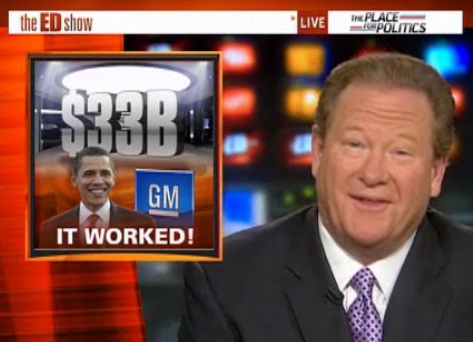
Liberal HuffPoster Smacks Down Ed Schultz’s GM Success Story

A liberal Huffington Post contributor and board member of the website’s Investigative Fund rained on Ed Schultz’s GM success story victory parade on Thursday. After the MSNBC host crowed about the positive earnings report from the government-owned car company, he clearly expected that left-leaning guest Leo Hindery was going to join him in the celebration. Quite to the contrary, the admittedly “progressive” Hindery, who has contributed almost $1.5 million to Democrats in the past ten years, quickly threw a heapin’ helpin’ of cold water on this party before it got started. “I love being on this show. But I`m going to push back a little bit on your accolade for GM,” he marvelously began.  “There will be more jobs created in Mexico by the Big Three automobile manufacturers than will be created here in the United States” (video follows with transcript and commentary, pay particular attention to the smile being washed off Schultz’s face): ED SCHULTZ, HOST: Well, the automobile loan program seemed to have worked. General Motors also known as “Obama motors,” “government motors,” raked in over $33 billion in revenue last quarter. It`s G.M.`s strongest performance in six years. To top it off, the company is set to go public again, possibly as soon as Friday. Now, this is I think an unbelievable success story. This was a great American company on the brink and the ripple effect would have been unbelievable. And what did President Obama do? He put a team together that came in and fixed it. The bottom line: government intervention sometimes works. Folks in Washington should be looking at how they can do the same thing in other sectors of the economy but, of course, the Republicans aren`t for that. And, you know, it`s interesting, we don`t hear any Republican naysayers today. They`re out there being so quiet because this is a successful story. The ripple effect if the government had not loaned G.M. the money, it would have been so strong, there would have been hundreds of thousands of jobs lost across our economy. Joining me now is populist hero, Leo Hindery, managing partner of Intermedia Partners. Mr. Hindery, good to have you with us tonight. We have — we`ve had quite a battle with the White House in recent days about the professional left. I would say that this is a pretty good story to start off on to go in a different direction, wouldn`t you think? This is what they ought to be talking about. LEO HINDERY, INTERMEDIA PARTNERS: You know, Ed, I think I was labeled one of the professional left earlier this week, but, you know, I love being on this show. But I`m going to push back a little bit on your accolade for G.M. And we should take pride as a nation that the bailout did produce the profits that you describe. But we`ve got to be real honest about what`s going to happen here over the next decade. There will be more jobs created in Mexico by the Big Three automobile manufacturers than will be created here in the United States. So, these profits are important. But we didn`t put — we didn`t put any quid with the quo so to speak and we didn`t demand that the growth in these three companies, the recovery of these three companies be found here in American workers. And you and the Reverend Jackson just spent a compelling 10 minutes or so pointing out that the only thing that matters right now is the real employment, and in converse, the real unemployment of Americans. And I`m distressed when I hear that G.M., especially, just committed in the last week or so, $500 million more to yet another one of its plants in Mexico. So, give them a pat on the back for sure. But don`t give them too big a pat because they`re not creating jobs here in the United States. SCHULTZ: Well, but they are saving jobs, are they not, Leo? They did save a ripple effect of plastics, of electronics, of upholstery, of tire and glass that would have been even more devastating than the economy that we saw? HINDERY: Right. And there is — there`s a sharp line, a bright line, Ed, between saved jobs and created jobs. SCHULTZ: Yes. HINDERY: We need both. But what we didn`t get out of G.M. or Chrysler is a commitment to create jobs here in the United States. And that`s why I pat them on the back for saving a bunch of them, and I couldn`t be happier for the state of Michigan, the state of Ohio, and the state — Upstate New York. SCHULTZ: But moving forward is your concern, and moving forward, it should be a concern based on the news that came out today. The CEO of General Motors, Ed Whitacre, is going to be stepping down and he`ll be replaced by Daniel Ackerson. He is a managing director of the Carlyle Group. Now, the Carlyle Group is known for one thing, and that is shipping jobs overseas. How troubling is this move in your opinion? HINDERY: Well, it`s very troubling because that is Dan`s modus operandi. And nothing we`ve heard in the last several weeks and we were all surprised by Mr. Whitacre`s announcement today. But we`ve not heard a single word out of this company about committing to American jobs. So, they`re going to grow and they`re going to grow based on taxpayer money, tens of billions of dollars. SCHULTZ: So, what should the president do at this juncture? Get a commitment? Try to get a commitment or where do we go? Where is the loyalty? HINDERY: Well, I think Secretary Geithner let the nation down when he just gave them money and didn`t demand that they create U.S. jobs. Again, I like the fact that we saved a bunch of `em. But we need to find, Ed, 22 million jobs to put this nation back at full employment. And we need our big manufacturers to be stable and growing here in the United States. And G.M. and Chrysler made no such commitment when they took our money. SCHULTZ: Mr. Hindery, always a pleasure. You do great work. I love reading your stuff on “Huffington Post.” I appreciate your time tonight. HINDERY: It`s always a privilege to be here, Ed. Thanks. SCHULTZ: You bet. For the record, Hindery is quite left of center. Last week he admitted in a HuffPo piece that he is on the “progressive side.” According to Wikipedia, his name was being tossed around in 2004 as a successor to Democratic National Committee chairman Terry McAuliffe. He served as senior economic policy advisor to presidential candidate John Edwards, and is even an advisor to the Obama administration. As such, Schultz probably wasn’t expecting any push back on his celebration. Wasn’t it glorious?

Follow this link:
Liberal HuffPoster Smacks Down Ed Schultz’s GM Success Story

Stewart Exposes GOP Hypocrisy: Extending Bush Tax Cuts Won’t Lower Deficit (VIDEO)

Last night on “The Daily Show” Jon Stewart took on Republicans for their dramatic words about the deficit and simultaneous defense of the Bush tax cuts. While conservative pundits refer to the deficit as “crushing” and dangerous to our “children and grandchildren,” Stewart worried that the GOP doesn't understand what's causing the deficit they fear so much in the first place. “Do they not realize that the tax cuts strengthen the deficit monster that's going to eat our babies?” According to Fareed Zakaria, letting the Bush tax cuts expire at the end of this year would reduce the deficit by 30%. Still, conservatives such as John McCain and John Boehner argue that we should extend the tax cuts and not raise taxes. Amazed at how two opposing ideas can exist on the same party platform, Stewart asked, “how exactly can you be for deficit reduction and extending tax cuts?” before airing a clip wherein Sarah Palin argues for both in the same sentence. Other conservatives argued that the money the government earns in taxes isn't the same as the money they spend, so the tax cuts will not affect the deficit. To this, Stewart responded with the famous “F**k you, pay me” scene from “Goodfellas.” “The deficit doesn't care where [the money] comes from,” Stewart said. added by: TimALoftis

Police Stole $100,000 Which "Smelled" of Marijuana

Although a search of a vehicle that yielded a backpack full of cash that smelled like marijuana was ruled invalid, the money was never returned to the vehicle’s occupants. In June the appellate division of the state Superior Court ruled the search was invalid but many readers — including John Paff, who is chairman of the New Jersey Libertarian Party’s Open Government Advocacy Project — were curious as to what happened to the smelly money. It was divided between the agencies involved in the case. The Hunterdon County Prosecutor’s Office got $25,197.60, the Readington Police Department $37,796.40 and the state kept the remaining $41,906. Ricardo Webb and Brian Bennett of Georgia were arrested on May 5, 2005. According to police, at 2:26 a.m. a motorist called to tell them that a white Chevy Yukon with New York plates had been driving erratically on Route 202 before turning onto Old York Road near the Branchburg/Readington township line. Patrolman Joe Greco spotted the SUV turning onto Pleasant Run Road and pulled it over after having to go 60 mph in a 25 mph zone. Greco reported that he searched the vehicle after smelling a “strong odor of raw marijuana” and found a black backpack with more than $100,000 stuffed inside. added by: Omnomynous

Hype-brids: Networks Tout Green Vehicles, But Americans Buy Four Times as Many SUVs

If news outlets were fueled by bias, then ABC, CBS, and NBC would be Hummers. Over the past two years, the media have declared Sport Utility Vehicles (SUVs) “dying” while celebrating the popularity of hybrid cars. Americans disagree. Data from Edmunds.com showed SUV market share has grown or remained stable whereas hybrid market share has declined. In July 2010 alone, SUVs outsold hybrids 4 to one. When gas prices were high in summer 2008, the media eagerly reported the demise of the SUV and wrote its epitaph, as CBS News’s Hattie Kauffman eloquently did on May 26, 2008: “Here lies the mighty sport utility vehicle, once a symbol of status and power, now collecting dust.” From July 2009 to July 2010, total SUV sales increased by 38.9 percent whereas hybrid sales have decreased by 32.7 percent. Large SUV sales alone have increased by nearly 40 percent. Yet back in 2008, the three networks all paid their respects to the “dying” SUV, with ABC’s Chris Cuomo jumping on the hybrid bandwagon before the SUVs body was even cold: “Everybody’s trying to sell their SUV, want to get into one of these new jobs, you know, the smart car, the hybrid, the high-mileage type vehicles, all these alternative cars.” The “everybody” Cuomo mentioned must only have included the hybrid owners and not the SUV owners. Despite the overwhelming numbers, since June 2008, the Business & Media Institute discovered the networks’ covered hybrid cars three to one over SUVs. Specifically, there were more stories about the Toyota Prius (37) than on the top 5 best-selling SUVs combined (24). Still, back in 2008 network reporters such as ABC News’s David Muir predicted a green upheaval as he erroneously reported on the SUVs demise. “American carmakers are looking for a revolution, too. The gas guzzlers so popular yesterday are no longer popular today,” Muir said on July 20, 2008. The only “guzzlers” are the media members who continually drink the liberal Kool Aid. In May 2008, the first month of high gas prices, hybrid models had 2.52 percent market share. The hybrid model market share in May 2010, two years into the “revolution:” 2.52 percent. Those numbers didn’t stop CBS’s Anthony Mason from ushering in the “electric era” on the April 1, 2010 CBS “Evening News:” “Well, it’s a real challenge, but Katie, we are at the dawn of the electric era,” Mason declared. That “dawn” may not be rising as fast as Mason hoped. According to the Market Data Center , the best selling vehicle in the month of July was the Ford F150, a pickup truck. Fortunately, for Kauffman, Muir, and Mason, as their network ratings crumble , there are plenty of “gas guzzling” SUVs around to carry their remains. Volt and Prius: A Media Love Story Despite pedestrian sales numbers and recalls, reporters at the big three networks continue channeling their inner Billy Mays, turning their segments into infomercials for eco-friendly cars. The media’s favorite green cars have been the new Chevy Volt and the Toyota Prius. The networks aired nearly twice as many Volt stories (42) as they aired on the top five selling SUVs combined (24). Further proof of network favoritism: Ford F150’s have outsold the Prius nearly three to one, yet the networks have covered the Prius over the F150 three to one (37 to 12). The Prius has established itself as an environmental symbol thanks to the media hyping its popularity with the liberal Hollywood elite, as CBS reporter Ben Tracy did on Feb. 11, 2010. Tracy interviewed actors Penelope Cruz and Orlando Bloom and concluded Hollywood star power “helped make the Prius a household name.” Being outsold three to one by a “gas guzzler” is an awfully big amount for a “household name.” The Chevy Volt, a plug-in electric car expected to hit the market in November, has also been popular with the media. Both NBC “Today” host Matt Lauer and CBS’s Mason took test rides in the Volt, with Lauer being the first non-GM person to actually drive it. Additionally, all three networks hyped the Volt in their coverage of the 2009 and 2010 Detroit International Auto Shows, nearly two years before the Volt was even expected to hit the market. Recently, some in the media were outraged when GM announced the Volt would be priced at $41,000. Of course, when challenged about the price in a July 29 press conference, Ron Bloom, Obama’s senior advisor to the Treasury Secretary for automobiles, distanced the government from GM. “We do not tell GM what to charge for cars,” Bloom said. “Most kinds of new technology are expensive.” Unlike batteries, which require positive and negative charges to work, the government only operates on positive charges, such as the positives touted by Obama in his July 30 visit to Michigan, but dismisses negative charges. The Obama Administration found plenty of positive charge in the network news reports, as all three networks praised Obama’s July 30 visit to GM where he test rode the Volt. ABC’s Karen Travers called it a “victory lap” and NBC’s Savannah Guthrie echoed Obama’s remarks that the “American auto industry [is] resurrected from the dead.” Since summer 2008, only ABC and NBC interviewed analysts skeptical of the green car business model. NBC’s Phil LeBeau interviewed Standard and Poor Equity analyst Efraim Levy on May 6, 2009, where Levy noted smaller, green cars would result in smaller profits but larger losses. “Smaller cars have smaller price tags. So, therefore, you have less room to make the profits, and if a car’s not successful, the losses are even more painful,” Levy said. Case in point: the 1997 GM EV1, which was named one of Time magazine’s ‘ Worst Cars of All Time. ‘ The EV1, GM’s first attempt at an electric car, flopped due to disappointing battery power and a lack of demand . The EV1 retailed at $34,000, cost GM $80,000 per vehicle, and ultimately GM lost $2 billion on the EV1 program. The $2 billion is more than the $1.3 billion second quarter profit GM recently reported. Instead of the SUV, the GM EV1 is now the vehicle “collecting dust.” Cart Before the Horse On April 1, 2010, the big three network news broadcasts fooled their viewers with reports on fuel emission standards. ABC, CBS, and NBC evening news shows each aired stories about the new fuel emissions standards, which had been based on the 2007 Corporate Average Fuel Economy (CAFE) rules and championed by the Obama Administration. According to the new standards, by model year 2016 all cars and light trucks must average 35.5 miles per gallon. ABC and CBS sandwiched their reports between stories on – you guessed it – Toyota and the Volt, whereas NBC’s Lee Cowan devoted a full two minute report on the new standards. He actually noted the cost of lowering emissions will trickle down to the consumer: “But reaching that new efficiency level does come with a price, an estimated $52 million for car manufacturers to be paid by the consumer. About $1,000 per car may be added on to the sticker price,” Cowan reported. But Cowan still encouraged viewers to buy a green car, saying it will save them money in the long run: “Now, Brian, although these new cars will cost a little bit more, the government says that will be more than offset by your savings in fuel, they’re saying about $3,000 over the course of that new environmentally-friendly vehicle.” Cowan’s report was misleading. A 2006 study by Kiplinger’s Personal Finance Magazine discovered that of the top seven hybrids, only the Prius will save you money over five years compared to a non-hybrid vehicle. According to the study, three out of the seven hybrids will cost you over $3,000 more, the amount the government claims you’ll save. Myron Ebell, director of energy and global warming policy at the Competitive Enterprise Institute, a free market think tank, told BMI he thinks the new fuel emission standards will lead to more dire consequences than just hitting consumers’ pockets. “I think automakers will go bankrupt again,” Ebell said. “In order to meet the new standards, big cars will become expensive and they’re going to have to sell a lot of small cars. Detroit automakers have never figured out how to make a profit on small cars.” Ebell added that the 2007 CAFE standards “foreshadowed” the auto bailouts and that the bailouts have turned Chrysler and GM into “creatures of the Obama Administration.’ “The automakers are in worse shape than had they gone into bankruptcy,” Ebell said. “Bankruptcy would have broken the worst part of the union contract and they [GM and Chrysler] wouldn’t have to answer to the government.” Only ABC News interviewed anyone challenging the government’s boat-without-a-paddle auto policy and its relation to energy standards. On Jan. 11, 2009, ABC’s Bianna Golodryga interviewed Jean Jennings, editor-in-chief of Automobile magazine: “The government is on the wrong track because they are dictating fuel economy without an energy policy,” Jennings said. “And yet, they are forcing the car companies to spend billions of dollars in development costs for a technology that might be way ahead of what people want.” Yet the networks didn’t challenge the Obama Administration’s fuel emission demands for the auto industry. Ironically, for three networks that won’t cover SUVs, they’ve become SUVs for Obama’s auto plan: Steadily Urging Victory. End of the Road In “Home Improvement,” Tim “The Tool Man” Taylor often shouted “more power!” For the media, it’s worth shouting “less bias.” With SUVs alive and well, the network news shows remain committed to promoting green cars and cheerleading the Obama Administration’s auto policies. According to Michael LaFaive, director of the Morley Fiscal Policy Initiative at The Mackinac Center for Public Policy, a free market think tank, Obama’s auto praises are played out in the media like a “Rooseveltian victory lap.” “There’s no ribbon cutting ceremony for tax cuts like there is for opening a new battery factory,” LaFaive said. “The government has nothing to sell this as a way to stimulate demand.” Despite the unfavorable media coverage, SUVs are still in demand and rather than collecting dust, they’re making hybrids eat their dust. Methodology The Business & Media Institute examined news stories from ABC, CBS, and NBC from June 1, 2008, through July 15, 2010. June 1, 2008, was selected because it was after Memorial Day and in the thick of the high summer 2008 gas prices. BMI also examined the three evening news stories from Friday, July 30, 2010, the day Obama visited the Volt assembly plant in Michigan. Final numbers included 69 stories on hybrid vehicles and 19 on SUVs. Based on the June sales from AOL Autos, the top five best selling SUVs are the Chevy Traverse, Chevy Equinox, Toyota RAV4, Ford Escape, and Honda CR-V. Only stories longer than 100 words were counted. Recall stories were excluded because they focused on consumer safety as opposed to the actual cars. Data was provided courtesy of Edmunds.com, HybridCars.com, The Wall Street Journal Market Data Center and AOL Autos. Like this article? Then sign up for our newsletter, The Balance Sheet .

Read the original post:
Hype-brids: Networks Tout Green Vehicles, But Americans Buy Four Times as Many SUVs

Social Security: Government ‘Ponzi’ Scheme Turns 75 with $41 Billion Shortfall

This is a historic year for the largest government program: Social Security, which turns 75 in just a few days. The program is also running a deficit for the first time since 1983, and ahead of estimates. Initially, Social Security was created to provide supplemental income to elderly and disabled people who could not work, and was signed into law by President Franklin D. Roosevelt Aug. 14, 1935. Social Security is in the red six years earlier than forecasted, and for the first time since 1983 (the last time the program was “fixed”). Downplaying the significance of the problem, The New York Times reported March 24, that the program is facing a “small” $29 billion shortfall this year because the high 9.5 percent unemployment rate is cutting into payroll tax collections that fund the program’s benefits. Oh, and because there isn’t actually a trust fund with all the money previously collected by people paying into the system. Problems are mounting for the Social Security program which essentially is a government-created “Ponzi scheme.” It was a boon for the earliest entrants to the program like Ida May Fuller. She was the recipient of the first monthly retirement check, in 1940, and continued to collect until her death in 1975. Fuller worked only three years under the system: paying in $24.75 in taxes. By the time of her death she had collected a total of $22,888.92 according to the Social Security Administration. In 2010, the public is skeptical that they will get anything back from the system they pay into with each paycheck. A USA Today/Gallup poll found that three-fourths of people between 18 and 34 years of age don’t expect to get a Social Security check. Yet the news media have opposed much needed reform recently by ignoring or downplaying the problems with Social Security, and during the Bush years by attacking conservative reform proposals. They have allowed liberals to attack conservatives for wanting to make changes to the program, editorialized that Social Security will be just fine and practically ignored the failure of the program’s trustees to provide its annual report on time this year. The three broadcast networks have done little reporting on the postponement – even though the trustees are delaying bad news during an election year. The president’s debt commission is also looking into entitlements like Social Security to come up with policy solutions, but those won’t be announced until December – conveniently after the election. Every year the trustees of Social Security are required to publish their annual analysis by April 1. CATO Institute’s Jagadeesh Gokhale and Mark J. Warshawsky pointed this out in Forbes on July 12, 2010. “This year, however, the trustees have postponed its release indefinitely.” Why does that matter? Because, according to that article “The program’s financial condition continues to remain hidden from public view.” The trustees’ report was finally released Aug. 5, but when The New York Times announced its findings there was no mention that the report was four months late.The Times’ story also hyped the solvency of Medicare (something seriously in question), while admitting that Social Security is in the red. Nor did it point out that the shortfall had grown to a projection of $41 billion this year, $12 billion more than the Times had reported in March. Still, the Times quickly reassured the public it was “not a cause for panic,” according to Social Security commissioner Michael J. Astrue. The Times quoted the report, Social Security trustees, Treasury Secretary Tim Geithner and the co-chair of a liberal coalition, but not a single conservative voice. A Times editorial predictably spun the report by saying, “Social Security is holding up even in the face of a weak economy.” USA Today supplied its view on Social Security in an editorial Aug. 9. “[H]ere’s something Americans can cross off their be-very-afraid list: whether Social Security will be around so they can worry about all those other threats in relative financial comfort.” According to the liberal media, the problems facing Social Security are “easily fixable.” USA Today argued that it is only necessary to “economize elsewhere,” but that Washington doesn’t like to do that. CNN Money’s senior writer Jeanne Sahadi also said that fixing Social Security “should be a snap.” Sahadi’s solutions were not new: increase the retirement age, reduce growth in benefit levels and raising the cap on how much of wages is subject to the payroll tax. But she didn’t point out how politically difficult those solutions actually are, or the mainstream media’s past attacks on reform proposals. When President Bush attempted to tackle Social Security reform , the five major networks (ABC, CBS, NBC, CNN and FOX) aired twice as many left-leaning stories as right-leaning. Despite the media spin, “urgent reform is necessary” said Nicola Moore of The Heritage Foundation. Moore pointed out that Social Security has a $7.9 trillion shortfall “which means the program would require $7.9 trillion in cash  today! – to afford its promises.” Kathryn Nix, also of Heritage, wrote in June that “the early arrival of the need for a Social Security bailout should serve as a severe reminder to the Obama Administration that entitlement reform is needed now.” MSNBC Host Portrays Conservative Attempt at Reform as Attack on Middle Class According to at least one leftie pundit on MSNBC, attempts toward reform are actually attacks on the middle class in disguise. That’s what Keith Olbermann said on Aug. 9. “Republicans are tipping their hand somewhat about where they would get the money to pay for more tax cuts from the rich. Take it from the middle class. And make Americans work longer before they can retire,” Olbermann declared on his program. He cited Republican leader John Boehner’s comments about raising the retirement age to 70. Boehner has offered that possibility in June as one solution to make Social Security solvent, not , as Olbermann suggested, simply a way to “pay for more tax cuts from the rich.” Olbermann showed video of NBC’s David Gregory trying to force Boehner to say that he “favors” raising the retirement age. The MSNBC talking head didn’t bother to inform his viewers that the government is already paying out more for Social Security than it is taking in and will only get worse without intervention. The ‘Trust Fund’ Myth, a ‘Ponzi Scheme’ Despite the use of the phrase “trust fund” by politicians and journalists, to describe Social Security, the government has been spending that money and replacing it with Treasury bonds (IOUs) for years. A Nexis search for Social Security and trust fund found 68 newspaper stories at just four major newspapers in the past year. News articles such as the Aug. 6, USA Today story about Medicare and Social Security mentioned the “trust fund” as if it were a pile of money that “won’t run dry” until 2037. But Los Angeles Times business columnist Michael Hiltzik took it much further than the average news story. Hiltzik attacked those concerned with Social Security’s fiscal viability Aug. 8. In a piece entitled, “Myth of Social Security shortfall,” he said that the shortfall would be “covered” by “interest on the Treasury bonds in the Social Security trust fund.” Hiltzik further defended the notion of those bonds being “real money,” and lashed out at those “trying to bamboozle Americans into thinking Social Security is insolvent.” But it isn’t real “money,” any more than a person swapping debt by paying one credit card with another is paying with money. Unless revenue comes in that can cover the debts, the person is in trouble. CATO’s Michael Cannon criticized the Aug. 9, New York Times editorial on Social Security for claiming the program can still “pay full benefits until 2037” and current attention to the red ink does not “endanger benefits, because any shortfall can be covered by the trust fund.” Cannon reacted: “No. It. Can’t. Because there are no funds in the Social Security ‘trust fund’.” He characterized the entire idea as “an institutionalized, ritualized lie.”. One that news outlets continued to promote. Back in 2009, Mark Brandly , a professor of economics and adjunct scholar of the Ludwig von Mises Institute, explained how the system works and why it is deteriorating. Social Security is a “pay-as-you-go system,” he said. “[T]he government takes your money and gives it to Social Security recipients. In order to get workers to accept this system, the government promises to take other people’s money and give it to you when you retire.” Essentially, Brandly said it is a huge Ponzi scheme . Surprisingly, CNBC’s Jim Cramer who “loves” Social Security, completely agreed with the Ponzi characterization. In 2008, the ‘Mad Money’ host ranted that the Bernard Madoff $50 billion scam was not the “largest Ponzi scheme ever,” as some had been calling it. “We know the truth about Ponzi schemes,” Cramer said. ” We all know the name of the biggest Ponzi scheme in history and it’s not even illegal. In fact, it is run by the U.S. government. And the name of it – well they call it Social Security.” Cramer explained that by its very definition, Social Security was such a scheme: “In a Ponzi scheme, investors get the returns from the money paid in by subsequent investors and eventually the whole thing falls apart. The last people to invest get hosed. In Social Security, a program I love, workers pay for the benefits of current retirees and hope someday future workers will pay for their benefits – it’s all a Ponzi scheme.” Yet, even reporters who admit that the “trust fund” is a joke, continue to use the phrase instead of criticizing the politicians who perpetrate the myth that Social Security is solvent. Brandly also wrote that the system can only remain sound if “a lot of people die before collecting” check, and if there are more people paying in that collecting. But as more people were paying in the Social Security Administration (SSA) ran a “surplus,” but as government often does – it borrowed from itself leaving IOUs in the so-called “trust fund.” The program is in trouble for that very reason, and because people are living longer and the baby boomers are about to retire, leaving far fewer younger workers paying into the system. According to The CPA Online , Social Security paid out only to retiring individuals 65 and older beginning in 1942. Between 1937 and 1942, it paid out in lump sum to individuals retiring. Benefits did not extend to dependents and survivors until 1939. In 1935, when the program was created average life expectancy was below 65 years of age: 59.9 for men and 63.9 for women . Even by 1942, life expectancy was much lower than today (64.7 for men, 67.9 for women). The projected life expectancy for 2010 is 75.7 for men and 80.8 for women. Currently, people can begin collecting full benefits at age 66, or collect at a permanently lower rate beginning at age 62 or a higher rate if they wait until age 70. But the mainstream media attitude seems to be – don’t worry, it will all work out. Even the USA Today maintained optimism in an editorial that admitted (unlike its earlier news story) the fund is “just IOUs.” They still argued that it would politically impossible to ” renege ” on benefits for retiring Americans. Attacks on Private Accounts The network news media has historically provided a skewed perspective on Social Security and reform proposals. A three – part Business & Media Institute Special Report in 2005, when reform was a hot topic, found a left-ward tilt in Social Security stories twice as often as a conservative slant. That study, Biased Accounts, examined 125 stories on the five major networks and discovered that 44 percent of stories were slanted to the left, compared to 22 percent in the conservative direction. The remaining stories were neutral. Those findings might have looked drastically different if President Bush had not made a concerted effort stumping for Social Security reform. The president’s appearances and statements on the issue accounted for almost one-fourth of the conservative talking points in the study. One of the most popular talking points about Social Security was the liberal idea that personal accounts lead to “risky” stock investments. The argument that the conservative plan and/or the stock market were “risky” came up 53 times. Trish Regan even set her Feb. 5, 2005, “CBS Evening News” report against the backdrop of Reno, Nev., a popular gambling destination. Unsurprisingly, local worker Maureen Fager said about personal accounts, “This is Reno, Nevada. I know a gamble when I see it.” The financial planner they took her to, David Yeske, even claimed that humans aren’t cut out to deal with such matters though that is how he makes his living. “The human brain has been wired for social interactions, not analyzing numbers,” Yeske said. That same report also misstated the age of retirement for Fager and a 27-year-old worker. It was unclear whether Yeske or the reporter was making the mistake.

Prop 8 | Decision on Stay Expected in California’s Same-Sex Marriages Case

Decision on stay expected in California same-sex marriages case By the CNN Wire Staff August 12, 2010 1:57 a.m. EDT Los Angeles, California (CNN) — A federal court in California will rule Thursday on whether to keep a temporary stay in place in the case that overturned the state's ban on same-sex marriages. The United States District Court for the Northern District of California will announce its decision between 9 a.m. and noon (12 p.m. and 3 p.m. ET). If the stay is lifted, same-sex marriages will be legal in California. Last week, Chief U.S. District Judge Vaughn Walker in San Francisco struck down the state's ban on same-sex marriage, ruling that voter-approved Proposition 8 violates the U.S. Constitution. The 136-page opinion is an initial step in what will likely be a lengthy fight over California's Proposition 8, which defines marriage as a union between a man and a woman. At question in the trial was whether California's ban on same-sex marriage violates gay couples' rights to equal protection and due process, as protected by the U.S. Constitution. The high-profile case is being watched closely by both supporters and opponents of same-sex marriage, as many say it is destined to make its way to the U.S. Supreme Court. If it does, the case could result in a landmark decision on whether people in the United States are allowed to marry people of the same sex. Same-sex marriage is currently legal in five U.S. states — Massachusetts, Connecticut, Vermont, Iowa and New Hampshire — and in the District of Columbia, while civil unions are permitted in New Jersey. “Proposition 8 fails to advance any rational basis in singling out gay men and lesbians for denial of a marriage license. Indeed, the evidence shows Proposition 8 does nothing more than enshrine in the California Constitution the notion that opposite-sex couples are superior to same-sex couples,” Walker, who was appointed to the federal bench by former President Ronald Reagan, wrote in his opinion. “Race restrictions on marital partners were once common in most states but are now seen as archaic, shameful or even bizarre,” he added. “Gender no longer forms an essential part of marriage; marriage under law is a union of equals.” After the ruling, elated supporters gathered to celebrate the judge's opinion in San Francisco's Castro district. People waved rainbow flags and U.S. flags, and carried signs that read, “We all deserve the freedom to marry,” and “Separate is Unequal.” Similar rallies unfolded in Los Angeles and San Diego. “For our entire lives, our government and the law have treated us as unequal. This decision to ensure that our constitutional rights are as protected as everyone else's makes us incredibly proud of our country,” said Kristin Perry, a plaintiff. Perry and Sandy Stier, along with Jeffrey Zarrillo and Paul Katami, are the two couples at the heart of the case, which, if appealed, would go next to the 9th U.S. Circuit Court of Appeals before possibly heading to the U.S. Supreme Court. Opponents of same-sex marriage have said their best bet lies with higher courts and have vowed to appeal the federal judge's ruling. In a national survey conducted by Gallup in May, 53 percent of respondents said same-sex marriages should not be recognized by law, while 44 percent said they should. Proposition 8 is part of a long line of seesaw rulings, court cases, debates and protests over the controversial issue of same-sex marriage. It passed in California with some 52 percent of the vote in November 2008. “Big surprise! We expected nothing different from Judge Vaughn Walker, after the biased way he conducted this trial,” Brian Brown, president of the National Organization for Marriage, said last week. “With a stroke of his pen, Judge Walker has overruled the votes and values of 7 million Californians who voted for marriage as one man and one woman.” added by: EthicalVegan

New Study Documents Media’s Servitude to Government

A newly released study from students at Harvard’s John F. Kennedy School of Government provides the latest evidence of how thoroughly devoted the American establishment media is to amplifying and serving (rather than checking) government officials. This new study examines how waterboarding has been discussed by America’s four largest newspapers over the past 100 years, and finds that the technique, almost invariably, was unequivocally referred to as “torture” — until the U.S. Government began openly using it and insisting that it was not torture, at which time these newspapers obediently ceased describing it that way: Similarly, American newspapers are highly inclined to refer to waterboarding as “torture” when practiced by other nations, but will suddenly refuse to use the term when it’s the U.S. employing that technique: As always, the American establishment media is simply following in the path of the U.S. Government (which is why it’s the “establishment media”): the U.S. itself long condemned waterboarding as “torture” and even prosecuted it as such, only to suddenly turn around and declare it not to be so once it began using the tactic. That’s exactly when there occurred, as the study puts it, “a significant and sudden shift in how newspapers characterized waterboading.” As the U.S. Government goes, so goes our establishment media. ARTICLE CONTINUES… added by: Omnomynous

Did The CIA Assassinate Matt Simmons For Blowing The Whistle On The BP Gulf Oil Spill?

Matt Simmons, a prominent oil industry expert who lately has been very outspoken about the BP Gulf Oil Spill coverup, was found dead in his home after supposedly drowning after apparently suffering from a heart attack. But did Matt Simmons really die of a heart attack or was he assassinated? Matt was very vocal on several nationwide news programs making claims that have led some people to question his sanity along with blowing the whistle on BP and Government on several issues. Matt Simmons was very well connected to other oil industry insiders and top government officials in charge of regulating the oil industry. As a result of those connections Matt has blew the whistle on several lies BP and Government where telling to the public. Matt called the claims that only 5,000 barrels of oil were leaking preposterous and instead conjectured there must be at least a minimum of 120,000 barrels of oil per leaking into the Gulf. Matt also reported that there were leaks 5 to 7 miles away which were later confirmed by a NOAA report issued by the Thomas Jefferson. Matt Simmons also revealed that NOAA ships discovered a huge underwater plume of oil at 1100 meters below the surface which could possibly cover up to 40% of the Gulf of Mexico at a time when NOAA and the federal government were publicly denying the existence of underwater plumes of oil. Matt made national headlines by stating BP would go bankrupt because they didn’t have enough money to clean up the Gulf of Mexico as well as making claims that the well integrity and pressures were so high that nothing short of a nuke could close this well. More at the Link…………. http://beforeitsnews.com/story/132/335/Did_The_CIA_Assassinate_Matt_Simmons_For_… added by: CarlosBobthe3rd

CBS’s Erica Hill: GOP ‘Extreme Right;’ Dems Just Need to Alter Message ‘A Little Bit’

During a discussion of the upcoming midterm elections on Monday’s CBS Early Show, co-host Erica Hill asked Republican strategist Kevin Madden: “…when you look at this from the Republican perspective… there is some competition from the Tea Party, from those perhaps to the extreme right…is this race Republicans to lose, and if so, what do they have to do to hold on to it?” Hill picked up the “extreme right” label from her other guest, Democratic strategist Tanya Acker, who had just ranted: “I think that it’s very evident that we’re running against a group of Republican candidates, in large part, who’ve really positioned themselves at an extreme end of the right – of the right wing, which is really where not most of the country is….what Democrats have to do is talk about what it is they’re standing for and why it is the country doesn’t want to go back to a time when, frankly, a lot of us were much worse off.” Madden responded to Hill by pointing to the left-wing agenda of the Democrats: “…independent voters…they’ve abandoned Democrats, in large part because of the spending, because of the deficits, because of a very left of center agenda….it is a very good place to be right now when you’re the alternative to a Democrat agenda.” Instead of challenging Acker on the Democrats “very left of center agenda,” Hill gently wondered: “What about the President? He’s doing a lot of fundraising, does he need to, though, work on a little bit different message or is he doing the right thing?” Acker reasserted her previous point: “…the real competition here is for the moderates, is for independents. And in order for Democrats to successfully get them back on board, they’re going to have to explain why the alternatives are far too extreme.” Hill moved on, pressing Madden on Republican policy proposals: “Kevin, in terms of a message from your end, from the Republican side, there’s been a lot of criticism, and we heard it from the President…that Republicans aren’t presenting new ideas….are they presenting their ideas, though, at this point, solidly enough?” Madden replied: “…the Democrats want to spend more, they want to grow the size of the government. We presented alternatives….we’re for smaller government, we’re for lower taxes, and we’re for less spending; and that we are the better party to lead the country in the right direction.” Here is a full transcript of the August 9 discussion: 7:08AM ET ERICA HILL: Joining us now is Republican strategist Kevin Madden, also in Washington this morning, and from Los Angeles, Democratic strategist Tanya Acker. We’re going to get a closer look at what both sides need to do in these upcoming elections from the both of you this morning. Tanya, I want to start with you. as we just heard this two-point message here, don’t go back and things would be even worse were the Democrats not in charge. Is that enough for voters at this point or does there need to be a little alteration, perhaps, of the message? TANYA ACKER: Well, I think the Democrats have to focus on getting that message out very clearly in the first instance. Because look, I think that it’s very evident that we’re running against a group of Republican candidates, in large part, who’ve really positioned themselves at an extreme end of the right – of the right wing, which is really where not most of the country is. I mean, you’re talking about candidates who want to do things like take the country back to a time before Social Security, who want to really overturn a lot of the things that – reforms that the country’s really behind. So I think the Repub – what Democrats have to do is talk about what it is they’re standing for and why it is the country doesn’t want to go back to a time when, frankly, a lot of us were much worse off. HILL: Kevin, when you – when you look at this from the Republican perspective- KEVIN MADDEN: Mm-Hm. HILL: -there are some of those messages, there is some competition from the Tea Party, from those perhaps to the extreme right, as Tanya mentioned, but essentially is this – is this race Republicans to lose and if so what do they have to do to hold on to it? MADDEN: Well, look, to Tanya’s point and to your question, I think that this race is really going to be won – I think this – these elections, these midterm elections are really going to be decided in the middle. And right now those independent voters that were a big part of the Democrats’ successful coalition by – of winning in 2008, they’ve abandoned the – the White House, and they’ve abandoned Democrats, in large part because of the spending, because of the deficits, because of a very left of center agenda. So I think where Republicans feel we have an opportunity is talking to those voters and persuading them that the Democrats have taken the country in the wrong direction. The country’s on the wrong track. That we’re spending too much money, deficits are going too high, and that we can do a better job. And right now we – we have to go out there and talk about a proactive agenda, but it is a very good place to be right now when you’re the alternative to a Democrat agenda. HILL: It’s interesting because in some ways it sounds like 2008 all over again. You talk about the moderates, there was so much talk about moderates and independents, of course, during the 2008 elections, which worked out well for the Democrats, Tanya. This time around, I know you said they need to alter the message perhaps a little bit, but what about the President? He’s doing a lot of fundraising, does he need to, though, work on a little bit different message or is he doing the right thing? ACKER: I think that right now – I mean, look we’re seeing that the President is not – is having some troubles in the polls. He’s certainly polling lower than he has at any time during his presidency, and which is not unusual for any President at this point in his term. But I think that where we’re really seeing President Obama be effective is in – is in fundraising. And in order for Democrats to get the message out there, there’s no question that they’re going to need a lot of money. Because again, as Kevin pointed out, and as you pointed out, the real competition here is for the moderates, is for independents. And in order for Democrats to successfully get them back on board, they’re going to have to explain why the alternatives are far too extreme.                  HILL: Kevin, in terms of a message from your end, from the Republican side, there’s been a lot of criticism, and we heard it from the President in Bill’s package, that Republicans aren’t presenting new ideas. I know that you – you disagree with that. MADDEN: I disagree with that, yes. HILL: But are they presenting – are they presenting their ideas, though, at this point, solidly enough? MADDEN: Yes, I – I do believe so. Look, when John Boehner handed the – the gavel to Nancy Pelosi in 2008, he said – 2006 – he said, look, we are going to be an opposition party but we are going to disagree with you on substance. And if you look at the health care debate, you look at the stimulus debate. Republicans presented the American public alternatives. They presented a vision for what they would do, where they would take the country in a different direction. And I think in large part that’s going to be where you can win in the arguments in 2010. Is that we can say, look, the Democrats want to spend more, they want to grow the size of the government. We presented alternatives. The entire – during this entire debate, that said we’re for smaller government, we’re for lower taxes, and we’re for less spending; and that we are the better party to lead the country in the right direction. HILL: Well, everyone will be trying to get their messages out, especially as we ramp up with three months to go. Tanya Acker, Kevin Madden, always good to have your insight with us. MADDEN: Great to be with you. ACKER: Good to see you. CHRIS WRAGGE: Safe to say it’s going to be an interesting November. HILL: I think we can say that, yes.

Read the original here:
CBS’s Erica Hill: GOP ‘Extreme Right;’ Dems Just Need to Alter Message ‘A Little Bit’






