Tag Archives: illusion

Dennis Kucinich: “WikiLeaks Gave Us 92,000 Reasons To Leave Afghanistan PICK ONE!”

Video added by: joeeddy

Dennis Kucinich: “WikiLeaks Gave Us 92,000 Reasons To Leave Afghanistan PICK ONE!”

Video added by: joeeddy

Moral Decay Within the Pentagon the Cause of Leaks Revealed by Wikileaks

Corporate corruption of the defense industry is at the heart of the motivation that leads insiders to leak information to Wikileaks. Honest everyday people that work for the government and its myriad of private contractors in the capitalist world are morally repulsed by the information that they are being charged with keeping secret represent to their sense of honoring their other sense for justice and truth. They cannot help themselves but reveal the corruption because it is morally repugnant to them. +++ The leak may have come from the State Department itself The controversy and the caliber of the information have led some political analysts to the conclusion that it could only have leaked from the State Department itself, which puts its efficiency under question. Vitaly Leibin, the chief editor of Russian Reporter, a magazine which claims to officially collaborate with WikiLeaks, also believes that the leaks are the result of people inside the US government wanting the information exposed. “These leaks would never have happened if not for the number of insiders who are ready to leak this information. It looks like it’s linked to the wars in Iraq and Afghanistan when officers understood that they are working for a not exactly fair business, and this moral decay inside the Pentagon caused these leaks,” he said. “The main thing this leak has done is break the illusion that the State department has everything under control. There have been exposed mechanisms – not secret, but quite simple and cynical. Partners of the US will be more careful now. It’s another sign that the US is no longer dominating the world,” he added. What the WikiLeaks incident shows is how the whole intelligence community has become over-reliant on technology, said former intelligence officer Glenmore Trenear-Harvey. He pointed out the inherent problems with the Secret Internet Protocol, a system of networks used by the US Defense and State Departments to transmit classified information that is one of the alleged sources of the leak. “The idea was for an exchange of information after 9/11, when the intelligent services weren’t sharing their information together,” he said. “Now what has happened is that whereas maybe 40,000 people within the intelligence community would have access, suddenly, bizarrely, diplomats, military people and, indeed, intelligence people – there’s over 2 million people that had access to it.” +++ Now that these revelations are making governments reconsider their security I would venture to say that this is going to lead to an extended cyberwar along with resistance from states to support some of the security measures that will likely be proposed by US lawmakers. added by: jubal

Moral Decay Within the Pentagon the Cause of Leaks Revealed by Wikileaks

Corporate corruption of the defense industry is at the heart of the motivation that leads insiders to leak information to Wikileaks. Honest everyday people that work for the government and its myriad of private contractors in the capitalist world are morally repulsed by the information that they are being charged with keeping secret represent to their sense of honoring their other sense for justice and truth. They cannot help themselves but reveal the corruption because it is morally repugnant to them. +++ The leak may have come from the State Department itself The controversy and the caliber of the information have led some political analysts to the conclusion that it could only have leaked from the State Department itself, which puts its efficiency under question. Vitaly Leibin, the chief editor of Russian Reporter, a magazine which claims to officially collaborate with WikiLeaks, also believes that the leaks are the result of people inside the US government wanting the information exposed. “These leaks would never have happened if not for the number of insiders who are ready to leak this information. It looks like it’s linked to the wars in Iraq and Afghanistan when officers understood that they are working for a not exactly fair business, and this moral decay inside the Pentagon caused these leaks,” he said. “The main thing this leak has done is break the illusion that the State department has everything under control. There have been exposed mechanisms – not secret, but quite simple and cynical. Partners of the US will be more careful now. It’s another sign that the US is no longer dominating the world,” he added. What the WikiLeaks incident shows is how the whole intelligence community has become over-reliant on technology, said former intelligence officer Glenmore Trenear-Harvey. He pointed out the inherent problems with the Secret Internet Protocol, a system of networks used by the US Defense and State Departments to transmit classified information that is one of the alleged sources of the leak. “The idea was for an exchange of information after 9/11, when the intelligent services weren’t sharing their information together,” he said. “Now what has happened is that whereas maybe 40,000 people within the intelligence community would have access, suddenly, bizarrely, diplomats, military people and, indeed, intelligence people – there’s over 2 million people that had access to it.” +++ Now that these revelations are making governments reconsider their security I would venture to say that this is going to lead to an extended cyberwar along with resistance from states to support some of the security measures that will likely be proposed by US lawmakers. added by: jubal

The Federal Reserve bailout scandal explained

All the numerous tendrils of financial corruption are starting to re-converge on the core of the scandal. Here is what happened and how you got screwed by the bankers and the US Government in layman's terms. 1. Wall Street created the mortgage-backed security as an investment device, sold them, used ponzi scheme tactics to make them look immensely profitable while the SEC looked the other way. 2. In order to meet the demand for MDS created by the illusion of major profits from the Ponzi activity, the mortgage bundlers pledged the same mortgages over and over and over again into different investment bundles. 3. In late 2008 the fraud started to appear in US financial circles. Congress, itself invested in the financial firms that bought those fraudulent mortgage-backed securities, voted through TARP to save their own fortunes at the expense of the US taxpayer. 4. In 2009, the foreign banks began to realize that Wall Street had screwed them and began to demand the repurchase of the bad paper. The Fed started handing out trillions of dollars borrowed against the American people, mostly to foreign banks, to cover the fraud. 5. But cash was flowing out of the nation faster than the Federal Reserve could print it up. Something needed to be done to balance the loss and put the bankers back into the black, so the only real hard assets left n the nation, Americans' homes, were to be sacrificed for the good of the banks' capital structure. 6. By perpetuating tax credits that encouraged the offshoring of American jobs to other countries, the US Government created a situation in which millions of Americans would no longer be able to make their mortgage payments and lose their homes to the banks. The banks would then add the full value of those homes to their balance sheets to keep themselves appearing solvent. The US Government deliberately killed your jobs, so the fraudulent bankers could save themselves from prison by taking your homes to cover the buybacks from Europe. That is pretty much the story of the last few years. Analysis from Mike Rivero at What Really Happened added by: maasanova

‘Buried’ Preview: Moviegoers Get Trapped In A Box With Ryan Reynolds

‘This is not a film to be seen but a film to be experienced,’ director Rodrigo Cortes says. By Adam Rosenberg Ryan Reynolds in “Buried” Photo: Versus Entertainment You open your eyes and are greeted by nothing but darkness. Fumbling around blindly, you can tell that you’re in tight quarters but there’s no obvious way out. Discovering a butane lighter in your pocket, you flick it on and discover the grim truth of your situation: You are completely sealed inside a plywood box with no aid of any kind beyond what’s in your pockets. This is the ride you take for 94 minutes with yan Reynolds, who plays kidnapped, Iraq-stationed civilian contractor Paul Conroy in director Rodrigo Cortes’ sophomore feature “Buried.” MTV spoke with Cortes as part of our ongoing Fall Movie Preview week — the Sundance-spawned thriller will be released by Lionsgate on October 8 — and he admits that the challenges Chris Sparling’s script presented are what originally got him interested in the project. “I was sent this script that many people loved but everybody thought it was impossible to make a movie with. But I felt exactly the opposite,” he explained. “I saw the possibility of doing something that had never been done. I love to go against common sense, and everything in this project has been done against common sense. This is the kind of movie that shouldn’t be done, it’s totally nonsense. It’s foolish. It’s impossible to make. And that’s exactly what attracted me.” Alfred Hitchcock’s influence reverberates loudly through the tiny chamber in which our protagonist is stuck — along with the viewing audience — for the length of the film. The confined setting is essential to the staging of the narrative, in that you don’t ever really know who to trust. Cortes doesn’t shy away from the comparison to the legendary filmmaker either. “Hitchcock … came to my mind, because I thought of ‘Lifeboat,’ for instance, just one boat with six characters never leaving the boat,” he said. “So those [sorts of] technical challenges, like ‘Rope’ and [giving the illusion of] shooting [an entire movie] in a single take, and ‘Rear Window,’ with respect to [a fixed] point of view.” Cortes is quick to name Hitchcock among his five favorite filmmakers, describing his film as ” ‘North by Northwest’ in a box.” Even with aspirations to create a tale of Hitchcock-level suspense, it was a tough sell initially. “Nobody could understand [why I wanted to do it],” Cortes said. “Everybody thought it was an experimental, obscure, strange, dark film.” Sparling’s script is where it all started. The pages didn’t specify it, but Cortes revealed that a lot of the doubters he spoke to believed that in order to make the film accessible to mainstream audiences, both speakers participating in the film’s various phone calls should be shown onscreen. He wasn’t having it. “In my opinion, that was a perfect way to spoil everything, to ruin an amazing idea,” Cortes said. “Stories don’t have to do with cubic inches, they have to do with [narratives] that evolve or change, you want to know more from them. And that’s exactly what happens. “I didn’t want to leave it to the point of view of Paul Conroy,” he continued. “I wanted everybody to be inside his shoes. I thought [it was] the key to the whole project. That was the only way of [bringing across] this physical experience. To make everybody feel what being buried for an hour and a half is.” Asked what he’d like viewers to know going into the movie, Cortes said that, in this case, less is more. “That’s part of the magic of the film: You never know where you are. And every time you trust a character, you find out that you shouldn’t have. At the beginning of the film, you try to trust everybody and at the end of the film you suspect everybody. This is part of the game. This is the roller coaster. “This is not a film to be seen but a film to be experienced,” he continued. “That’s the way I made it. I didn’t want the film to be seen only with the eyes but also with the muscles and with the bone and with the skin and with the blood. People watch it on the edge of their seats. It’s a physical and sensorial experience.” From the saucy Jessica Alba in “Little Fockers” to James Franco’s grueling journey in “127 Hours,” the MTV Movies team is delving into the hottest flicks of fall 2010. Check back daily for exclusive clips, photos and interviews with the films’ biggest stars. Check out everything we’ve got on “Buried.” For breaking news, celebrity columns, humor and more — updated around the clock — visit MTVMoviesBlog.com . Related Videos Exclusive Clips From The Fall’s Most Anticipated Films Related Photos Fall Movie 2010 Preview Week: Exclusive Photos

Read more:
‘Buried’ Preview: Moviegoers Get Trapped In A Box With Ryan Reynolds

An Island Without The Sea

From the wall of the Malec

The poor starve amidst plenty: food waste in America

*America discards 40% of the food it makes, while a billion in the world go hungry. How can we stop such dire misallocation? The world's food systems are in crisis. Droughts and flooding have compromised crop production across the globe and more than 1 billion people are hungry. But here in America, our overstocked supermarket shelves continue to propagate the illusion of plenty and, in the past decade, our rate of food waste has more than doubled. According to a recent study, over 40% of the food produced in America is wasted each year, and only 2% of this waste is composted. Food waste is now the second largest waste stream sent to landfills, where it produces methane, a deadly greenhouse gas that further impacts climate change. Climate change, in turn, is having a deadly impact on our food supply. One time-honoured way to reduce waste is to increase the perceived value of the goods in question. Despite the fact that food prices have increased substantially in the past few years, Americans on average still spend proportionally less than any other nation on food. According to research compiled by the USDA, 6.9% of household spending in America was on food, compared to 13.7% in France and 45.7% in Indonesia. If we were required to lay out a greater percentage of our household budget for food, we would probably be less likely to throw it in the garbage. Increasing food prices is a hard sell when 14.6% of American families are food-insecure. But government intervention, which leads to artificially cheap food, is wreaking havoc with the global food chain and needs to be addressed. Farm subsidies, for instance, which favour certain crops, encourage over-production and flood the market with underpriced goods. This has a devastating effect on developing countries, which cannot compete with the subsidised produce; it also has a negative impact on the domestic market, as farmers end up leaving food in their fields to rot since it would cost more to harvest than would be gained by selling it. Figuring out how to salvage this food and deliver it to the needy is the next problem. During the Clinton administration, Joel Berg was USDA co-ordinator for food recovery and gleaning, but when the Bush administration took over, the position was discontinued. These days, if you call the USDA to ask for information about gleaning, you will be connected with the Society of St Andrew (Sosa), a privately funded, faith-based organisation that does an excellent job salvaging approximately 25m lb of food. Sosa only has offices in eight states, however, and volunteer operations in an additional 11 states. What happens to discarded food in the other 31 states is anybody's guess. Another scandalous reason that food is discarded is because it doesn't meet superficial aesthetic criteria. So carrots that are not straight enough and potatoes that are not round enough end up being weaned out in the sorting process. But even perfectly formed vegetables and other perishables will end up in supermarket dumpsters because as Berg put it, “we are far too hung up on cosmetic issues and artificial sell-by dates.” There are many non-profit organisations such as DC Central Kitchen and City Harvest in New York that work with supermarkets and restaurants to recover food. But many businesses choose not to get involved in recovery because it seems like more trouble than it's worth. There is some cause for optimism, though, as more businesses are starting to realise the cost benefits of reducing waste. Walmart, of all places, is leading the charge to becoming a sustainable company. At a recent EPA roundtable on food recovery issues, Bobby Fanning, senior manager of solid waste and recycling for Walmart, discussed plans to make the round stickers on bananas biodegradable. Somehow, that makes me feel that all is not lost. The other cause for optimism is that individual consumers have a lot of power to effect change by altering our own behaviour. Jonathan Bloom, author of the upcoming book American Wasteland: How America Throws Away Nearly Half of its Food (and What We Can Do About it), has a five-step plan to reducing post-consumer waste. Plan your meals; make a detailed shopping list and stick to it; serve reasonable portions; save your leftovers and eat those leftovers. Since I started writing this piece a day ago, I've had to discard three broccoli crowns, two peaches and a tub of yoghurt that I failed to eat on time. Any one of the hungry billion people in the world would have been very glad of that food. As the global population continues to explode – it is expected to reach 9 billion by 2045 – and our ability to produce food continues to be compromised, more and more people will go hungry. I'm going to try to keep this in mind next time I dump my food in the trash can. added by: JanforGore


Ryan Reynolds’ ‘Green Lantern’ Costume Revealed

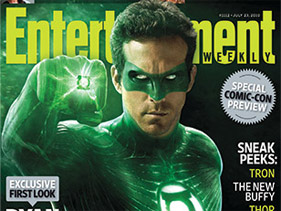
DC Comics superhero makes his glowing debut on Entertainment Weekly. By Eric Ditzian Ryan Reynolds on the July 16 cover of Entertainment Weekly Photo: Entertainment Weekly For Ryan Reynolds, the most professionally satisfying moment of 2009 was the first time he saw the Green Lantern costume he’d be rocking for the upcoming big screen adaptation of the classic DC Comics superhero. “It was a moment when I was like, ‘This is happening, and it’s happening in the right way,’ ” Reynolds told MTV News last fall. “That’s a pretty cool, definitive moment for me.” Now the rest of us are getting a chance to see the costume that blew Reynolds’ mind. Entertainment Weekly has debuted a first look at the Green Lantern — and his test-pilot alter ego, Hal Jordan — who will be gracing multiplexes in the summer of 2011. The cover image shows Reynolds in familiar Lantern garb, complete with green mask, glowing green suit and iconic power ring, which can bring into existence nearly anything Hal can imagine. “Will and imagination are his superpowers,” said Reynolds, who reportedly injured his shoulder on the “Green Lantern” set earlier this week. “We need a circus of Timothy Learys to think of things Hal would invent with his ring.” Though experienced in the action movie realm, from “Blade: Trinity” to “X-Men Origins: Wolverine,” Reynolds confessed that nothing could prepare him for the wire-work involved in the “Green Lantern” shoot, which required him to fly through the air at up to 60 feet per second to simulate the illusion of real flight. “The first time you do it, you’re seriously considering an adult diaper,” Reynolds said. Directed by Martin Campbell (“Casino Royale”) and co-starring Tim Robbins, Blake Lively, Mark Strong and Peter Sarsgaard, the movie is set to hit theaters on June 17, 2011. In MTV News’ earlier conversation with Reynolds, he heaped praise on Campbell’s vision for the film. “When you have a guy like Martin Campbell, part of his charm is that he has ba–s of titanium, and the other part is that he’s slightly crazy, and you have to be to take on something with the scope of ‘Green Lantern,’ ” he said. “I sat down with him, and I could not even believe what he was saying. When I went to the meeting, I was entirely cynical. I thought, ‘What the hell, I’ll see what they have to say,’ and I left the room with a completely different perspective.” Check out everything we’ve got on “Green Lantern.” For breaking news and previews of the latest comic book movies — updated around the clock — visit SplashPage.MTV.com .

The rest is here:
Ryan Reynolds’ ‘Green Lantern’ Costume Revealed

Canadians Declare War on Facebook [Your Privacy Is An Illusion]

Remember how Facebook unilaterally appropriated private friend lists and profile photos several months ago? A new class-action suit says that action violated Canadian privacy and consumer protection laws, and demands a cut of Facebook’s ill-gotten revenues. Nice, ay? More