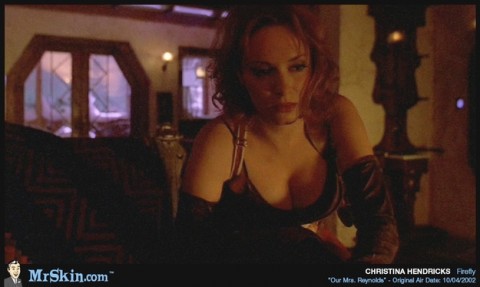
It’s no secret that ladies love Ryan Gosling , but now guys have a reason to like the Blue Valentine (2010) star, too. Gosling is re-teaming with his Drive (2011) co-star Christina Hendricks for his directorial debut, the “modern fairy tale neo-noir” How to Catch a Monster . Gosling apparently charmed Hendricks into accepting a starring role in the film by sending her the script in a ” cool box with an interesting little key, and cool artwork in it ,” as she explained to Vulture at TIFF this weekend. But that’s not the SKINteresting part of the story– when pressed to explain more about the ” very surreal club ” where her character works in the film, Hendricks hesitated, then finally admitted that it was a ” fetish club .” She refused to reveal any further details, but we kind of prefer it that way. Will she be popping balloons? Dressed in latex? Getting her toes licked? Wielding a bull whip? No matter what, she’s going to make a select group of people very happy–just hope that it’s your paraphilia she’s referring to. Let your imagination go wild with pics and clips of Christina Hendricks right here at MrSkin.com!
Well Damn. Looks like Juan Williams shocked his news anchors along with the rest of us after Ann Romney gave her speech last night during the RNC. Williams took heat from his Fox co-workers and even more criticism from conservative bloggers for his assessment of the potential first lady’s address Tuesday night. “Mitt Romney’s wife, Ann Romney, on the other hand looked to me like a corporate wife,” Williams said on Fox News. “And you know the stories she told about struggle, eh, it’s hard for me to believe. She’s a very rich woman, and I know that and America knows that.” Williams also said that Ann Romney didn’t convince him she understood the struggles of the average American woman and looked like “a woman whose husband takes care of her and she’s been very lucky and blessed in this life.” Of course Money Mitt’s team swooped in to criticize Williams’ comments: “We respect our colleagues in media and appreciate they too have invested a lot to be here to cover the convention,” a Romney aide said in a statement to POLITICO. “But, Juan’s comments are deeply disappointing: Not only were they unfair and personal, they were wrong.” They didn’t sound wrong to us but you know they had to come to Ann’s defense. Juan in the meantime defended himself this morning saying, “I think my criticism was aimed at the reality of the economics and the blessings that the Romneys have had,” Williams said. “They’re not average Americans, in terms of their wealth, by any stretch of the imagination.” If Mitt wants to try and pull any of us in, having his wifey up on stage looking like a robot isn’t going to sway our opinions at all. Source Images via Youtube/WENN/Twitter
We are ever vigilant here at Skin Central as we monitor the nefarious activities of the Parents Television Council , the most killjoy group of no-fun flesh haters this side of the MPAA. The funny thing is, they’re probably doing the same thing to us. (Hi, guys! Good job setting up that Google alert!) The PTC’s newest assault on all things nude is a formal complaint about the prevalence of pixelated nudity on prime time TV, but not because of the confusion it sparks amongst sheltered youngsters who think women’s breasts get all fuzzy as soon as they take off their bras. Their beef with pixelation is that it leaves too little to the imagination, showing the ” full body of flesh tones ” and thus leading to all sorts of impure thoughts. Some sort of “slippery slope” thing. ” [Pixelation] could be perceived to be a closer simulation of complete frontal nudity given that the viewer is seeing all flesh tones ,” the PTC says. We aren’t fans of pixelation either, but for completely opposite reasons. So whaddaya say, PTC? Truce? After all, the enemy of my enemy is my something something boobs. Check out the forbidden flesh the PTC doesn’t want you to see with prime time nip slips from Nicki Minaj , Janet Jackson and more right here at MrSkin.com!
The Toronto International Film Festival unveiled its Canadian lineup Wednesday, including new work from Sarah Polley , Bruce Sweeney, Xavier Dolan, Michael McGowan and Bernard Émond. Today’s 19 titles will screen in the September festival’s various sections. The lineup also spotlights first-time feature work from Jason Buxton, Brandon Cronenberg, Igor Drljaca and Kate Melville. “Through comedy, thrills, drama and suspense, films in the lineup present stories of youth and violence, coming of age, the environment, dysfunctional families, sex and celebrity,” said Steve Gravestock, Senior Programmer, TIFF. “From intimate, affecting stories with big impact to films with global scope, the Canadian films in this year’s Festival will move audiences.” Toronto’s Canadian lineup with descriptions provided by TIFF : Special Presentations : Antiviral by Brandon Cronenberg, Canada/USA North American Premiere Syd March is an employee at a clinic that sells injections of live viruses harvested from sick celebrities to obsessed fans. When he becomes infected with the disease that plagues superstar Hannah Geist, he must unravel the mystery surrounding her before he suffers the same fate. Starring Caleb Landry Jones and Sarah Gadon. Inch’Allah by Anaïs Barbeau-Lavalette, Canada World Premiere Chloe is a young Canadian obstetrician working in a makeshift clinic within a Palestinian refugee camp in the West Bank where she treats pregnant women under the supervision of Michael, a French doctor. Facing daily checkpoints and the separation barrier, Chloe is confronted with the conflict and the people it affects. Her encounter with the war draws Chloe into an adventure that’s both deeply personal and as large as the land. From the producing team behind Academy Award®-nominated Monsieur Lazhar and Incendies. Laurence Anyways by Xavier Dolan, Canada Toronto Premiere In the 1990s, Laurence tells his girlfriend Fred that he wants to become a woman. In spite of the odds — and in spite of each other — they confront the prejudices of their friends, ignore the counsel of their families, and brave the phobias of the society they offend. For ten years, they try to live through this transition, and embark on an epic journey which, unbeknownst to them, may cost Fred and Laurence their love. Starring Suzanne Clément and Melvil Poupaud. Liverpool by Manon Briand, Canada Toronto Premiere A coat check attendant in a bar decides to take an unclaimed coat back to its owner, but soon finds herself in the middle of criminal intrigue. A regular of the bar has long harboured a secret love for the attendant — enough to put his life on the line to help her. Starring Stéphanie Lapointe, Charles-Alexandre Dubé and Louis Morissette. Rebelle by Kim Nguyen, Canada Toronto Premiere Komona, a 14-year-old girl, tells her unborn child the story of how she became a child soldier. A tale set in Sub-Saharan Africa, Rebelle is also a love story between two young souls caught in a violent yet beautiful and magical world. Starring Rachel Mwanza (winner of Silver Bear for best actress at Berlin International Film Festival), Alain Bastien and Serge Kanyinda. Still by Michael McGowan, Canada World Premiere Based on true events and boasting a veteran cast, Still is a heartfelt story about an 89-year-old New Brunswicker (James Cromwell) who faces jail time when the government tries to stop him from building a more suitable house for his wife (Geneviève Bujold), whose health is beginning to fade. Stories We Tell by Sarah Polley, Canada North American Premiere In this inspired, genre-twisting film, Academy Award-nominated writer/director Sarah Polley discovers that the truth depends on who’s telling it. Polley is both filmmaker and detective as she investigates the secrets behind a family of storytellers. She playfully interrogates a cast of characters of varying reliability, eliciting refreshingly candid, yet mostly contradictory, answers to the same questions. As each relates their version of the family mythology, present-day recollections shift into nostalgia-tinged glimpses of a lively, fun-loving past and the shadows just beneath. Polley unravels the paradoxes to reveal the essence of family: a messy, intense and loving tangle of contradictions. Discovery : Blackbird by Jason Buxton, Canada World Premiere An alienated teenager’s online threat ignites fear in a small community, in this disturbing and perceptive look at how our media-fuelled, post-Columbine culture can transform typical teen angst into intimations of murder. Krivina by Igor Drljaca, Canada World Premiere Miro, an immigrant from the former Yugoslavia, lives in Toronto. He has a hard time relating to others and he never stays in one place for too long. When he finds out that his pre-war friend Dado, who has been missing for almost two decades, is now wanted for war-era crimes, his life starts to unravel. Upon hearing that Dado still visits Zljebovi, a village on the outskirts of Sarajevo, Miro embarks on a trip to Bosnia to find his friend. Picture Day by Kate Mellville, Canada World Premiere Forced to repeat Grade 12, Claire’s reputation is sliding from bad-ass to bad joke. At night, she escapes to would-be rock star Jim (aged 33), while at school, she bonds with Henry, a nerdy freshman she used to babysit. Eventually, Claire learns the difference between sex, intimacy and friendship. Tower by Kazik Radwanski, Canada North American Premiere Kazik Radwinski’s debut feature Tower is about a single and career-less man who lives at home with his parents in Toronto. He wanders alone in search of companionship and suddenly finds himself in an intimate relationship. Irritated by a raccoon that tears up his garbage, he sets out to catch it. Contemporary World Cinema : Camion by Rafaël Ouellet, Canada Toronto Premiere After being involved in a road accident causing the death of a woman, truck driver Germain’s world collapses as he feels an overwhelming sense of guilt and remorse. His state of mind starts to worry his younger son Samuel, who puts his own janitor job in Montreal on hold to track down his older brother, drifter Alain, in New Brunswick, hoping to head back together to their hometown to give some support to their father. The Crimes of Mike Recket by Bruce Sweeney, Canada World Premiere Bruce Sweeney (Last Wedding) returns to the Festival with this neo-noir police procedural — set against the backdrop of economic hard times — about a failed real estate agent (Nicholas Lea) whose recent attempt to turn things around makes him a suspect in a criminal investigation. Home Again by Sudz Sutherland, Canada World Premiere Home Again is about three adults raised “foreign” (in the USA, United Kingdom and Canada) from childhood and deported back to their birth country, Jamaica. Back “home” each discovers a different Jamaica from the paradise in vacation ads. We follow these three deportees on a journey for survival that surprisingly is filled with hope. My Awkward Sexual Adventure by Sean Garrity, Canada World Premiere To win back his unsatisfied ex-girlfriend, conservative accountant Jordan Abrams enlists the help of Julia — an uninhibited exotic dancer — to guide him on a quest for sexual experience, leading him into a world of strip clubs, sensual massage parlours, cross-dressing and S & M. The Lesser Blessed by Anita Doron, Canada World Premiere The Lesser Blessed is a powerful coming-of-age story about Larry, a Native teenager balancing his romantic heart with a dark past that threatens to unravel his life. Vanguard : I Declare War by Jason Lapeyre and Robert Wilson, Canada World Premiere A group of friends play an innocent game of capture the flag in the neighbourhood woods, arming themselves with nothing more than sticks, their imagination and a simple set of rules. One afternoon, the game takes on a more serious tone and the quest for victory pushes the boundaries of friendship, giving the would-be warriors a glimpse of the darker side of human nature. Masters : Tout ce que tu possèdes (All That You Possess) by Bernard Émond, Canada World Premiere A disgruntled academic refuses a substantial inheritance because the fortune was amassed dishonestly. Soon after, he is reunited with his teenage daughter whose mother he had abandoned when she was pregnant. From the filmmaker responsible for La donation and La neuvaine. Previously announced in the Masters programme: Peter Mettler’s The End of Time. TIFF Docs : Revolution Rob Stewart, Canada World Premiere The much anticipated follow-up film from the filmmakers of internationally acclaimed, box office hit Sharkwater, Revolution follows Rob Stewart on an adventure from photographer/filmmaker to environmental activist trying to change the world. Stewart faces danger, conflict and drama in his struggle to find the key to empowering the conservation movement so it can affect change on a global scale. Canadian films previously announced in the TIFF Docs programme include: Simon Ennis’ Lunarcy! , Jamie Kastner’s The Secret Disco Revolution and Barry Avrich’s Show Stopper: The Theatrical Life of Garth Drabinksy . Previously announced Canadian features include: Denis Côté’s Bestiaire (Wavelengths), Ruba Nadda’s Inescapable (Gala) and Deepa Mehta’s Midnight’s Children (Gala).
Here are Nuts Magazine outtakes of Lucy Pinder and her friends. Obviously, I can’t show the good stuff but sometimes leaving a little for the imagination is a good thing. Ok, that’s a load of crap. I hate that saying because I know a prude woman started it. Anyway, for more visit Nuts’ website.
Canadian pop singer describes writing song with Redfoo over the phone. By Jocelyn Vena Carly Rae Jepsen Photo: Carly Rae Jepsen has captured America’s collective eardrums with her inescapable hit “Call Me Maybe,” teasing just what pop lovers might hear on her in-the-works full-length debut, set for release in September. In addition to her duet with Owl City on “Good Time” and an already-teased collaboration with her boss, Justin Bieber , the singer has shared that she is also working with LMFAO party rocker Redfoo on the fall release. “I ran into Redfoo from LMFAO at the airport,” she told Billboard magazine, via Ace Showbiz , about the collaboration, explaining that they’ve been writing together over the phone. So he called her, no maybes about it. “And we’ve been writing a song together today. Over the phone. “What I really love about music is that despite all this craziness, the creative process remains the same,” she continued. “And that same exciting feeling I had before anybody knew me, when I was just beginning to work on ‘Call Me Maybe,’ is the same feeling I had today with Redfoo from LMFAO.” Later this year, in addition to dropping her album, she’ll also be hitting the road with Bieber on his massive Believe tour , kicking off in September. “It’s not that I didn’t have my dream show built in my head before all of this — it’s just that I never had the resources together to actually put it to life,” she said. “I feel very giddy with the idea of making my imagination take form and being able to put on a show where people leave feeling like they’ve experienced something.” Related Artists Carly Rae Jepsen Lmfao
It seems that every time I see Salma Hayek , her breasts keep getting bigger. Is it my imagination? I’m not complaining, she’s always had some of the best breasts in the business so if they happen to be getting larger I’m all for it. Here she is on the set of something, showing off not only a substantial amount of cleavage, but a pretty nice little spandex booty shot. That’s a two for one special I’d be willing to pay for.
Oscar-nominated director Guillermo del Toro has been in the craft of filmmaking since he was 16, filling roles as diverse as P.A., assistant director and makeup effects. He made his first film Cronos at 28 and received his Academy Award-nomination in 2007 for Pan’s Labyrinth , making him one of the most prominent filmmakers to emerge from his native Mexico. In a candid interview, he explains how he learned filmmaking in author Mike Goodridge’s new book, FilmCraft: Directing . Goodridge, who until recently served as editor of Screen International and is now CEO of the international sales and financing company Protagonist Pictures wrote the book which features in-depth interviews with 16 of the world’s celebrated and respected film directors including Del Toro, Clint Eastwood ( Million Dollar Baby ) Paul Greengrass ( The Bourne Supremacy ), Peter Weir ( The Truman Show ), Terry Gilliam ( Brazil ) and Park Chan-wook ( Oldboy ). These and other filmmakers share their insights and experiences on development, storytelling/writing, working with actors and cinematographers, as well as other areas necessary to completing a successful film. In this excerpt from the book, which will be available via Amazon beginning June 15th, Guillermo del Toro gives his take on the mistakes and triumphs of his first movie as well as the first movie of other filmmaking greats, a life lesson courtesy of John Lennon, Tom Cruise’s take on filmmaking, what made him cry during his first movie, making ‘everything’ theatrical and why having “enough money” will get you, err… screwed. Director Guillermo Del Toro excerpt from FilmCraft: Directing : I came from the provinces, from Guadalajara, which is the second largest city in Mexico and nobody makes movies there. When I was a teenager, I started building relationships in Mexico City and I started as a blue-collar member of the crew. I was either a boom guy or a PA or an assistant director. I was makeup effects. I did my floor time in both TV and movies. My first professional work on a movie was at the age of 16 and I made Cronos when I was 28, so I had twelve solid years of doing just about everything in between. If somebody needed something, I would do it. I even did illegal stunt driving. But what happened is that I learned a little bit of everything and, once you put your time into exploring everything, you get to know what every piece of grip equipment is called and how many you need, and how to do post — I edited my own movies and did the post sound effects on all of them. So to some extent, directing came naturally to me from my first movie. My first movie Cronos is not in any way a perfect movie, but it’s a movie full of conviction. When you make your first movie, whatever mistakes you make are very glaring, but if you have conviction, and I would even say cinematic faith, this also shines through. I recently watched Cronos again and I thought, “I like this kid,” he has possibilities. After your first movie, with a little bit of craft, diligence, and more importantly, experience, you learn to make virtues out of some of your defects. What I mean is that any first movie has good moments, even if it is not entirely perfect. It can be a filmmaker as famous as you like, such as Stanley Kubrick, whose first film F ear and Desire (1953) is about 70 minutes long and stars Paul Mazursky. It is very stilted, very awkwardly paced, full of stuff that doesn’t work, the actors speak in a patois, and it has a very non-naturalistic rhythm. But what is incredibly fascinating is that the very stilted quality, that artificial rhythm, eventually became his trademark in later films. He bypasses it in more naturalistic films like The Killing (1956) and Paths of Glory (1957), but comes back to that type of hyperrealism or strange filtered reality in his later movies, and he is in complete control of it there. Kubrick used the tools he acquired in making other films to transform what you thought was a defect in Fear and Desire into a virtue. In my case, when I make movies in Spanish, starting with Cronos , I purposefully avoid characterizing certain things in the conventional Hollywood sense, and that comes out as a blatant defect. Specifically, I had shot a much longer film, including a whole section between the husband and wife where she noticed that he is getting younger and they start falling in love again. At night, he would come and sleep underneath her bed. But I couldn’t make it work. The way I staged it was simply too stilted and strange, and I didn’t feel comfortable leaving it as part of the movie. Even to this day, I think there is a mix of different tones in that movie. I change from the dramatic to the comedic too often. I try to do it generically, mixing horror with melodrama, and there are moments in Cronos that are really jarring for me. I sometimes allowed Ron Perlman to be too broad and it simply didn’t work. I think I did it better in my later movies. I don’t know whether that mix of genres is my trademark. One of the things that was very influential for me when I was kid was the book by Tolkien in which he discussed fairy stories in literature. I remember him saying in that book that you should make the story recognizable enough to be rooted in reality, but outlandish enough to be a flight of fancy. So I try to mix an almost prosaic approach, or at least a rigid historical context, with fantastic elements. I treat the fantasy characters very naturalistically or else I root the story in a precise context like The Devil’s Backbone or Pan’s Labyrinth , or in Cronos , post-NAFTA Mexico. As Tolkien says, when you give the audience a taste of what they can recognize, they immediately accept the rest of the concoction; it’s almost like wrapping a pill in bacon for a dog to swallow it. You need, for example, the bacon of domesticity in Cronos . I wanted to shoot that family as a very middle-class family in Mexico. I wanted a kitchen that looked like a kitchen you’d recognize, a really ordinary bedroom and very mild, neat clothing design. Out of that middle-class reality, I wanted a single anomaly — the mechanical clockwork scarab device. If the audience believes that this abnormality is as real as it can be, they will respond to the story. Many directors think that the more you keep the creature in the shadows and don’t show it, the better it is, but I don’t believe that. I don’t have monsters in my movies, I have characters, so I shoot the monsters as characters. For example, in Hellboy , I shot Abe Sapien, the fish-man, like any other actor. I didn’t fuss about it, I shot the monster with the same conviction that I would shoot Cary Grant or Brad Pitt; in other words, if I shot it in a different way than I would the regular actors, I would be making a mistake. What I do in every movie very consciously is to ensure that this anomaly is shot two notches above actual reality, so it’s weird enough to accommodate the monster, but not too stylistic that it’s unrecognizable. For example, everything you see in Pan’s Labyrinth — the house, the furniture — is fabricated to be slightly more theatrical than it needed to be. The uniforms for the captain and his guards are exactly what were worn at the time, but we tweaked the cut and the collar to make them more theatrical. Everything around the creatures, therefore, exists like a terrarium for them to live in so that when it comes to shoot them, I can shoot them in a normal way. I was very nervous on Cronos , but the adrenaline carried me through. Directing is almost like keeping four balls in the air on a monocycle with a train approaching behind you. There were days, for example, like the scene with the husband sleeping under the bed, where I knew I’d fucked up. The makeup was wrong and we didn’t have time to go back and change it, we didn’t even have time to test it. The light was wrong. Everything was wrong, and I arrived home to my wife that night and cried. I said that I had destroyed the scene I had dreamt of for years. I didn’t have the luxury of reshoots. Of course, you can only break down in front of your wife, or your partner, or your parents. In front of the staff on the film, you need to keep total control. You don’t want anyone thinking the general is afraid—you have to be leading the charge. There are two very lonely positions on a movie set: the actor and the director. The cinematographer has a close liaison with the director, the gaffer, the grip, etc. The director is alone on one end of the lens and the actor is alone on the other. That’s why the great, most satisfying partnerships on set are when a director and actor come to love and support each other. Being from Mexico is an enormous part of who I am as a filmmaker. The panache, the sense of melodrama, and the madness I have in my movies that allows me to mix historical events with fictional creatures, all comes from an almost surreal Mexican sensibility. I’m really prone to melodrama. This comes from watching Mexican melodrama obsessively, to the point where I was watching The Devil’s Backbone with a Spanish architect and the architect said to me that it was more Mexico than Spain; the characters were acting like Latin characters. If my father hadn’t been kidnapped in 1998 then frankly I would be making Mexican movies interspersed with the European and American. Since 1998, I cannot go back to Mexico because I would be too visible a target, especially when there is a printed schedule of where I am going to be every day for the entire run of a shoot. I think of the audience every second during writing; I think of them as me. I question how I would understand something, or what would make me feel a certain way. When I’m shooting a scene that moves the characters, I weep, I feel the emotion on set, so when I am writing it, if it doesn’t work, I don’t print it out until I have that feeling. Creating tension is a different skill to creating fear. For fear, you try to create atmosphere. You ensure the scene is alive visually before anything is added, then you craft the silence very carefully because silence often equals fear. Rarely can you elicit fear with music unless the music is used very discreetly, underlining the scene in a way that is almost invisible. When the Pale Man appears in Pan’s Labyrinth there is music, but Javier [Navarrete, the film’s composer] is almost just underlining his movements. It becomes like a sound effect. Silence is one of the things that you learn to craft the most because there is never real silence in a movie; you always have distant wind, cars, dogs barking, or crickets in the distance. I think really well-crafted silence creates tension, and by the same token an empty frame, an empty corridor for example — if it’s empty in the right, creepy way — is a tool. You know if a scene’s not working on set, and as you get older and craftier, you can learn to re-direct it in post. You can patch it up in your coverage and recover it—you can even end up with a great scene because beauty rarely comes out of perfection. For something to work, I think it has to come out of emotional turmoil. You can’t encapsulate the perfect melody; a huge component of it is instinctive. Then, of course, there are the actors. Many times you storyboard and rehearse with the actor, and then you come to the scene and it’s not working. But then you try something different and something suddenly happens that makes it work. It’s very raw. It’s funny, we enthrone this idea of the perfect filmmaker, this myth of the all controlling, all-seeing, all-encompassing person, but even for Kubrick or von Stroheim there is a part of the process that is entirely instinctive. I once asked Tom Cruise about it and he confirmed that Kubrick often found things in a panic on Eyes Wide Shut (1999). I love imperfection. I have been friends with James Cameron since 1992 and because he is so incredibly precise, people sometimes don’t think he is human, but the beauty of being a close friend is that I’ve seen him burn the midnight oil and toil and sweat. These imperfections in the façade are what make the work more admirable. Art depends on that human touch that doesn’t make perfection; in fact the filmmakers and films I am most attracted to require a level of human imperfection. On the big effects films, you try to prepare thoroughly but there are always surprises. John Lennon said, “Life is what happens when you are making other plans” and I think film is what happens when you are making other plans. You come onto the set and either the actor or the material doesn’t come out as you expect and the film comes out better for it. If you have either experience or inspiration, one of the two will get you through. One you accumulate through the years, the other you cherish. As a young filmmaker you’re full of inspiration and if you are unlucky you are only trading it in for experience. You need to remain on dangerous ground to continue to be inspired. I am always tackling things I shouldn’t tackle and meddling with stuff I shouldn’t meddle with. You never have enough money. If you ever feel one day you have enough money, that’s the day you’re fucked. FilmCraft: Directing is available via Amazon beginning June 15th. Follow Movieline on Twitter .
Also in Wednesday morning’s news round up, Warner Bros. is taking a cue from Marvel’s Avengers with its own superhero lineup, a J.D. Salinger adaptation is in the make for the big screen, a Frozen thriller pick up for North America and the rising fortunes of non-U.S. actors as big budget films target international markets. ARC Picks The Frozen for North America Psychological thriller The Frozen has been picked up by ARC Entertainment. The directorial debut of Andrew Hyatt and starring Brit Morgan, the film centers on two people who take an ill-advised winter camping trip. “After a snowmobile accident, the couple is left stranded in the woods where they are forced to survive the elements while waiting for help to arrive. In a twist of fate, Mike disappears and Emma is left on her own not only to battle the weather, but also to elude a mysterious man (Segan) who has been tracking her through the forest.” Around the ‘net… Dark Knight Rises Ticket Sales Set for Monday The Batman movie still has 45 days before it hits screens, but for those wanting to make extra sure they’re in a theater opening night for the final Christopher Nolan epic can get reserve their tickets via the internet at noon June 11th, EW reports . Hot Writer Pushing Justice League at Warner Bros. The Avengers is a punch out for Disney and Marvel, but Warner Bros is stealthily getting its own superhero brass, with Will Beall set to write Justice League based on the WB-held series of DC Comics, Variety reports . My Salinger Year Set for Adaptation River Road Entertainment has optioned screen rights to Joanna Smith Rakoff’s My Salinger Year and Emma Forrest will adapt the novel. The story centers on the author’s own experience when she took a clerical job at an agency that represented The Catcher in the Rye author J.D. Salinger and their unexpected relationship, Deadline reports . Journey 2 Director Ponders Disaster Movie San Andreas 3D Brad Peyton is in talks to direct New Line’s San Andreas 3D . The plot is secret, but San Andreas is the name of California’s biggest fault lines, so let your imagination go wild… The budget is said to be in the $100 million range (now it can go really wild), THR reports . A Brave New World for non-U.S. Film Stars Noomi Rapace, Idris Elba, Gael García Bernal. Those are some of stars who could capitalize as big-budget filmmaking increasingly targets new markets, The Guardian reports .
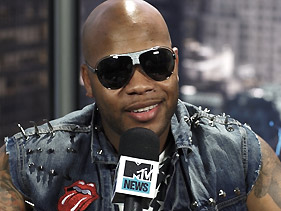
‘But if you listen to it, you can take it another way as well,’ Flo Rida tells MTV news of his latest single. By Rob Markman Flo Rida Photo: MTV News Flo Rida sure has a way with words. On one hand, the Miami spitter crafts catchy tunes that appeal to the masses, but Flo is also a master of the double entendre, masking some pretty suggestive lyrics with a candy-pop coating. His latest single , “Whistle,” is a perfect example. “Can you blow my whistle baby, whistle baby? Let me know,” Flo croons on the hook before he instructs his lady to put her lips together and “come real close.” “It’s definitely for referees,” Flo Rida joked when he visited earlier in May. “Well, put your own swing on it, but for the most part I keep it clean, but if you listen to it, you can take it another way as well,” he finally admitted about his infectious pop single “Whistle” isn’t the first time Flo employed such dual meanings. On his 2009 #1 Billboard Hot 100 single “Right Round” he didn’t leave much to the imagination, singing, “You spin my head right round, when you go down” on the chorus. It’s a playful formula that has paid huge dividends for the rapper, but how does he know where to draw the line between sexually suggestive and downright dirty? Well, he gets a little help. “I’m not the only one in the studio a lot of times, so I have my boys in there and they’ll tell me and give me their suggestions and what they think,” he explained. “If it’s too much I’ll go back.” So has Flo ever crossed that line? “Yeah, definitely [on] records that you won’t hear,” he confirmed. “But for the most part I go into the studio with it all planned out.” What do you think of Flo Rida’s “Whistle”? Tell us in the comments! Related Artists Flo Rida