Tag Archives: industry

Who’s being Fooled by Dairy Front Groups?

Click original link for post with external links to thing and it will make more sense. ____________________ I'd like to thank gmail's targeted ad system for, again, enlightening me to the presence of another pro animal-exploitation front group. (Always click on these ads when you get them. These places often pay per click in order to keep their ad up.) Front groups, for those of you who don't know, are groups designed to protect industries that are failing due to various reasons- exposure for cruelty to animals, health reasons, environmental reasons, worker exploitation, oil spills (BP has one), etc. The Center for Consumer Freedom is one of the most famous of these groups and has attacked everyone from doctors studying obesity to anti-smoking proponents. Today's front group is the Real California Milk campaign, who espouses on their sight that “99% of California dairy farms are family owned”. Well, since 95-99% of these farms are the dreaded “factory farms” then we know now that most factory farms are “family farms”. So if you read into the site, it is telling you the truth about the industry- when people say “family farm” it often still means “factory farm”. My favorite part is the Happy Cows section, trying to convince us that every drop of milk is “made with 100% pure happiness!” A video on the page shows green pastures with cows tagged for milking and slaughter, factory farming pens and milking parlor machines in nice, soft lighting, and baby cows just birthed fromn their mothers shortly before being torn away from them to be made into future dairy cows or veal. This footage is juxtaposed with interviews with the farmers who exploit, beat, confine, forcefully impregnate, kidnap, and kill discussing how much they love their animals. I guess business owners have to do what they have to do when so many undercover videos come out showing horrible abuse on dairy farms. One of the biggest messages of the video is that the cows “need” these farmers to exploit them in order to live (before they are killed of course), and thus, the relationship involves mutual respect and help. Talk about ridiculous. It doesn't take an animal rightsist to realize that when you force an animal to breed and force the babies into these farming conditions, that they are not voluntarilly doing anything. It's also quite true that farm animals survive quite well outside of dairy farms. Take the rescued veal calves living out their lives at Woodstock Farm Animal Sanctuary as an example. Another apparently touching section of a video is a farmer patting himself on the back because, after his cows are dragged to the milking parlor (in which machines are attached to them to extract the milk that should have gone to their calves- who are sent to slaughter for veal and beef), he offers them a soft bed of hay in the pen they are dragged back to, with clean water to boot! What kind of industry is this where hay to lay on top of in a prison and clean water are extreme luxuries? It's funny watching these farmers trying to hide their desire for capital behind “caring” for the cows- of which every measure is based on how much they can get her to produce. There is a constant insistence that if a cow is fed correctly, that's how she produces. That is the main concern here- not the actual well being and desires of the cows, just how much milk they make. What happens when she stops? Oh more rape and kidnapping and if she still doesn't produce enough- slaughter. At the end they claim animal liberationists have something to gain from calling for the abolition of the exploitation of animals. Really? What's that exactly? The same person says he'd invite anyone to see his farm. That's all well and good for the ad online, but in reality he'd call the cops and prosecute people for trespassing or for taking pictures of the animals- something punishable by “terrorism” laws in many areas. Even so, most farm tours never include the slaughter process or veal crates. That way, they can send people away, still able to deny that those things happen. So, bravo, “Real California Milk”! You've actually taught me more about why I oppose the dairy industry- including the “family” farms. Keep up the good work and misinformation. You might be able to combat the fact that a new undercover video comes out every month that most people can not make it through due to the cruelty involved in the dairy industry. added by: animalia_libero

Read more:
Who’s being Fooled by Dairy Front Groups?

Rudy Giuliani, MSNBC’s Dylan Ratigan Eviscerate Joe Scarborough for Blaming Bush for Oil Spill

Former New York City Mayor Rudy Giuliani (R) and MSNBC anchor Dylan Ratigan on June 17 joined forces to lambaste “Morning Joe” co-host Joe Scarborough for continuing to defend President Barack Obama’s handling of the BP oil spill. Scarborough presented a litany of arguments in Obama’s defense, but Giuliani and Ratigan countered with specific examples of the president’s failed leadership. Regurgitating liberal talking points, Scarborough blamed the crisis on George W. Bush and Dick Cheney. “We hear that we had the technology to stop this,” Scarborough claimed. “In 2002, though, Dick Cheney and his energy task force said, ‘No, we’re not going to take an extra step.'” Giuliani responded with an eviscerating counter punch: “It’s important to know as part of the history of this but the reality is, he’s been president now for 18 months. It’s about time we stopped blaming Bush.” Scarborough thought that the former New York City Mayor would credit Obama for securing from BP a $20 billion victim compensation fund, but instead Giuliani criticized the president. “I say it was a good deal for BP,” retorted Giuliani. “If I can put even a tentative limit on the liabilities, I’ve helped save my company.” “Democrats only wanted $10 billion,” claimed Scarborough. “You can’t say something nice about the president?” “The president has so mishandled this that it will be impossible for me to even describe how horribly handled this was,” argued Giuliani. “BP would be more than willing to give $20 billion to get themselves somewhat off the hook.” When pressed by Scarborough, Giuliani gave a detailed explanation for how he would have handled the crisis differently: First of all, the first thing I would have done is to bring in experts from the industry who are independent source of advice for me…If your father or mother were sick, you would go get a second opinion from an expert doctor. Not from an academician which is what he did. Go ask the question. Has anyone done remediation before? Has anyone done it better than BP? Bring them in. Make them your eyes and ears. Have them watching everything. Maybe they could have gotten the estimate right of the amount of oil that was coming out. It was horrendous. This is a horrible case of malpractice, negligence, gross negligence. They were off by 60 times. That had to infect every wrong judgment you make. Instead of crediting Giuliani for articulating a coherent plan, Scarborough attempted to deflect and politicize the issue, wondering whether the “malpractice” was “shared by both political parties and the entire Washington establishment over 15 years that has allowed oil companies to drill in areas where they have no backup plan if something goes wrong?” Ratigan rushed to Giuliani’s defense, railing against Obama for failing to consult independent industry experts at the beginning of the crisis: I actually completely agree with the mayor which is we can talk all day about the problems but until you actually address the matter of the fact that oil continues to go into the Gulf of Mexico, and there are other ways to deal with it that have not been brought in, or have been brought in too late–that is shameful. When Giuliani took aim at Obama for addressing the oil spill as a political problem, Scarborough jumped to the president’s defense. “It is a political problem,” exclaimed Scarborough. “It’s a substantive problem, but it’s a political problem!” “He’s just dealing with it as a political problem,” countered Giuliani. “That’s why he went down there only a couple of times at the very beginning. Didn’t take charge. We had Gibbs saying for three weeks that BP was in charge. The speech last night, Obama said the federal government’s been in charge from the beginning. Well, nobody ever told anybody that for the first four weeks. Maybe they were in charge in secret.” Scarborough then claimed that Obama took charge early on, making the oil spill the “top priority for this government,” but Ratigan disagreed, proclaiming, “My biggest criticism of this administration which is why I agree with the mayor when it comes to the response is the incredibly incompetent appearance of the containment strategy.” The transcript of the segment can be found below: MSNBC Morning Joe 6/17/10 8:04 a.m. JOE SCARBOROUGH: $20 billion. MIKA BRZEZINSKI: That’s pretty good. RUDY GIULIANI, former New York City mayor: Even nowadays that’s real money. That’s real money. SCARBOROUGH: Let’s give the president– DYLAN RATIGAN: Unless you get it from the Federal Reserve, in which case it’s not real money. SCARBOROUGH: Mr. Mayor, let’s make headlines, let’s give the president credit right now for being able to get $20 billion from BP without a single lawsuit being filed. What do you say? BRZEZINSKI: Come on. SCARBOROUGH: That’s pretty good. GIULIANI: I say it was a good deal for BP. BRZEZINSKI: Why? GIULIANI: Divide it by four or five years. What do they make per year? Jim would know this. JIM CRAMER, CNBC anchor: They make $6 billion per quarter. GIULIANI: If I can put even a tentative limit on the liabilities, I’ve helped save my company. SCARBOROUGH: But they haven’t done that yet. They did not waive liability. GIULIANI: But that’s a pretty good indication of it’s going to be hard to get above that $20 billion. It gets them– SCARBOROUGH: Democrats only wanted $10 billion. You can’t say something nice about the president? BRZEZINSKI: There’s nothing nice here? SCARBOROUGH: You can’t say, “Mr. President, good job of getting $20 billion?” GIULIANI: The president has so mishandled this that it will be impossible for me to even describe how horribly handled this was. SCARBOROUGH: He got $20 billion from people in my backyard. That’s pretty good, isn’t it? GIULIANI: He would have gotten with the same leverage in a second. BP would be more than willing to give $20 billion to get themselves somewhat off the hook. Unfortunately, they stepped all over it with a comment that the CEO made. SCARBOROUGH: What would you have done differently as far as substance goes? GIULIANI: Every single thing from day one. First of all, the first thing I would have done is to bring in experts from the industry who are independent source of advice for me. I met with some of the– SCARBOROUGH: The president didn’t do that? GIULIANI: Two days ago I had dinner in Houston, with several people who were top people in the industry. Never reached out. Never, never asked, gee, has Shell done this before? Has Exxon done this before? If your father or mother were sick, you would go get a second opinion from an expert doctor. Not from an academician which is what he did. Go ask the question. Has anyone done remediation before? Has anyone done it better than BP? Bring them in. Make them your eyes and ears. Have them watching everything. Maybe they could have gotten the estimate right of the amount of oil that was coming out. It was horrendous. This is a horrible case of malpractice, negligence, gross negligence. They were off by 60 times. That had to infect every wrong judgment you make. SCARBOROUGH: Isn’t that malpractice, though, shared by both political parties and entire Washington establishment over 15 years that has allowed oil companies to drill in areas where they have no backup plan if something goes wrong? DYLAN RATIGAN, MSNBC anchor: I’ll do you one better. The American people consume four gallons of gasoline for every gallon of gasoline that exists on the Earth. We have the biggest subsidized cost of energy. We have a false price for energy in our country to this day. The cost of the wars is not in the cost of energy. The environmental liability is not in the cost of the energy. None of the liability associated with our lifestyle is actually priced in. For capitalism to work, you actually have to be paying the actual price that represents the actual cost. So if we were actually paying the real cost of energy, we would be incentivized, believe me, to come up with something else. But because of the government and the culture of political expedience subsidies of energy costs everybody’s happy to take it so we hire BP to the tune of $6 billion a quarter to figure out–which is not easy, by the way–the technology to drop 18,000 feet beneath the ocean surface to suck oil out so we can continue to enjoy our lifestyle. If you ask me whether it’s the obvious failure in the government–MMS is obviously conflicted. Whether it’s the obvious fact that we built a sports car that could basically do anything. They had the technology to go to the bottom of the sea but they didn’t have a braking system, no way to turn it off which is incredibly reckless. And you put it all together. You find yourself in a situation where everybody’s pointing fingers but no one is containing the spill. So I actually completely agree with the mayor which is we can talk all day about the problems but until you actually address the matter of the fact that oil continues to go into the Gulf of Mexico, and there are other ways to deal with it that have not been brought in, or have been brought in too late–that is shameful. SCARBOROUGH: Do you agree that there are because we have been are defending this White House saying on substance for the most part they’ve gotten it right, do you agree with the mayor that actually they haven’t gotten it right? CRAMER: I think the mayor is dead on when he says that if they had known that the spill could be 60,000 barrels, which was available if you talk to the former heads of Exxon or if you talk to Boone Pickens, which you asked me to do. (Inaudible) GIULIANI: And the people in the industry believe that he hasn’t talked to the industry because they’re bad guys. (Inaudible) GILUIANI: A bunch of bad guys. CRAMER: They’re all bad actors. GIULIANI: And from the point of view of crisis management, this is an F. You couldn’t have done it worse. Some day Harvard will do a study on if you have a crisis like this, these are the things that Obama did wrong. Here are the things to do right. I could go on and on; that was the first mistake that he made. The second mistake that he made was to kind of treat this as a political problem. Which he was doing right up until the speech the other night. Treat it as a political problem. SCARBOROUGH: It is a political problem. It’s a substantive problem, but it’s a political problem! GIULIANI: He’s just dealing with it as a political problem. That’s why he went down there only a couple of times at the very beginning. Didn’t take charge. We had Gibbs saying for three weeks that BP was in charge. The speech last night, Obama said the federal government’s been in charge from the beginning. Well, nobody ever told anybody that for the first four weeks. Maybe they were in charge in secret. SCARBOROUGH: Well, the president said himself though on April 22nd. BRZEZINSKI: Yes. I just pulled up that. SCARBOROUGH: On April 22nd he called all the agency heads in and he said, “Okay, listen. This is going to be very bad.” It’s before–it’s before the thing blew out of the water and said this is the top priority for this government. We have to focus on it. This is job number one. RATIGAN: Where is the containment strategy? GIULIANI: That’s worse because if this was job number one look at the horrible–if this is job number one which I don’t think it was because the president was off on vacation twice during all of this, if this were job number one– SCARBOROUGH: Did you go on vacation Mr. Mayor? GIULIANI: Did I go on vacation as mayor? No. SCARBOROUGH: Isn’t that a cheap shot? You never went on vacation? GIULIANI: Not in the middle of a crisis. SCARBOROUGH:  Ronald Reagan went on vacation. George W. Bush went on vacation. GIULIANI: Not in the middle of a crisis. This is the second time the president has done that, and I resent it. On Christmas day when we had Christmas bombing, he was on vacation. Remained on vacation for 11 days. SCARBOROUGH: It was Christmas! GIULIANI: He is the President of the United States of America. SCARBOROUGH: They got microphones in Chicago. GIULIANI: On Christmas evening, the first year that I was the mayor, I left my house and went to the hospital and I spent five hours there because I was the mayor of New York City and I should be on the spot taking charge of something from the very beginning. This has been a gross failure in crisis management. Could not have done it worse. SCARBOROUGH: Okay. I’m sorry. Didn’t mean to–   GIULIANI: : And you shouldn’t be on vacation when a crisis is affecting the country. RATIGAN: There are two problems here. One is the capping of the well which I think is BP’s problem. BP obviously was negligent in the construction of dealing the well. There’s a totally unrelated problem, which is the containment problem. And in order to deal with the containment problem, that is the government’s problem and you have to know what the flow rate is accurately and early in order to have a containment strategy. So my biggest criticism of this administration which is why I agree with the mayor when comes to the response is incredibly incompetent appearance of the containment strategy. SCARBOROUGH: That’s not monday morning quarterbacking? I mean, who knew? RATIGAN: The oil is still coming out, Joe. They could still bring–Matt Simmons knew. T. Boone Pickens knew. Booms, put booms around it. Drop a curtain. Put super tankers in the middle and start sucking the oil out. (Inaudible) RATIGAN: Booms, curtain, super tanker. Super suck technology. Next question. GIULIANI: And actually, Joe, it is worse if you’re right and they were in charge from the beginning because if they were in charge at the beginning they really didn’t know what they were doing. I actually don’t think they were in charge. I think their real failure was they trusted BP. And they shouldn’t have trusted BP but they trusted BP. SCARBOROUGH: And let’s just say that has been our one critique on substance that perhaps they–two things. One, they trusted BP too much from the beginning. Two, they made a political calculation that if “we go down there, we own the story. It’s not BP’s story. It’s our story.” That is a critique I think we’ll hear for some time. And can we go right now? Because this is a fascinating conversation. You’re actually the first person that’s come on this show and when I’ve challenged them give me substance. Actually you three guys, you’re talking specifics about what the president should have done. Let’s go to the barni-cam right now. Mike Barnicle. Is he wearing the white sox right now? Are you listening to this? MIKE BARNICLE, MSNBC contributor: Yeah I am. SCARBOROUGH: We’ve got three guys here that are loaded for bear. And they’ve got some specifics. What do you think?                          BRZEZINSKI: Taking shots. BARNICLE: Let’s place all of our faith in BP because they’ve done such a great job. They’re still using the same instruments on oil spills that they were using in California in 1969. If British Petroleum, which they used to call themselves, or any of these oil companies were in charge of technological advancements in our society we would still be using a rotary phone and looking at a 12-inch Bendix TV set. (Inaudible) SCARBOROUGH: Do we have the cameraman from “24” now? Mike Barnicle brings up a point but let me ask you again in the role of devil’s advocate. We hear that we had the technology to stop this. In 2002, though, Dick Cheney and his energy task force said, “No, we’re not going to take an extra step.” GIULIANI: I have no idea what Dick Cheney did, you know, five or six years ago. SCARBOROUGH: Isn’t that important to know? It’s part of the story. GIULIANI: It’s important to know as part of the history of this but the reality is, he’s been president now for 18 months. It’s about time we stopped blaming Bush. RATIGAN: Hang on, Mr. Mayor. I don’t mean to interrupt you but the North Sea has a totally different set of safety standards–totally different governmental standards. These standards have to be taken into consideration. –Alex Fitzsimmons is a News Analysis intern at the Media Research Center. Click here to follow him on Twitter.

Read the rest here:
Rudy Giuliani, MSNBC’s Dylan Ratigan Eviscerate Joe Scarborough for Blaming Bush for Oil Spill

Eva Mendes Knows She’s a Whore of the Day

Sure Eva Mendes may not be doing much in these pictures…She’s sloppy like an off duty stripper on her way to the drug store to get Plan B…but she’s Hispanic and she has money in the bank even after sending out payments to all her lazy relatives, what do you really expect. Hispanics don’t do things….especially when they don’t have to for survival… But I like her because she gets naked in movies…and I know most actors are whores…but she actually accepts and rationalizes the fact that she will do whatever it takes to get movie roles so that she doesn’t end up on the street doing whatever it takes to get her baby formula…I guess it’s that Hispanic suvival instinct in her where she can go farther being naked on screen than naked in a back alley with a stranger’s big black AIDS dick inside her… She told W magazine: “I’ve never had a problem with nudity, but I don’t put it out there without a reason – I’m not an exhibitionist – but, honestly, for my art I’ll do anything almost. I’ll go there. I know I walk a fine line between being a respected actor and being what they call a sex symbol. But I’ve never felt objectified. Nothing you see me do is an accident. I might act like it’s an accident but the opposite is true. I’m incredibly calculated when it comes to my career.” And I always love pussy that rationalizes being a whore… Here’s a throwback clip of her in her earlier roles doing what she had to do for the part…you know calculated career moves…cuz if she didn’t get naked another Spic bitch woulda got the part…since they are a dime a dozen in America… Pics via Fame

See the article here:
Eva Mendes Knows She’s a Whore of the Day

Amanda Seyfried’s Boring Ass Playing With Ball of the Day

Amanda Seyfried continues to bore me after her life changing role in Chloe. This kind of wholesome girl next door playing a game of One-on-One with her dad like some kind of Kays Jeweler commercial is really limiting her fucking audience….you see the only people who can get off to this shit are the real perverts who live next door and you don’t realize they are watching your daughter with a huge hard-on as they pretend to rake the leaves or mow the front lawn to get the right view….She needs to broaden her appeal, dress in something that doesn’t look like what she slept in at some sleepover party with a group of Girl Scouts and not in what she slept in after a night of getting fucked from every angle…she needs to show off her tits and pussy…or she needs to quit the industry and stop wasting my time. I fucking hate this cunt but for some reason I am compelled to write about her everyday…I think she is my new internet soulmate I need to start stalking as a joke in hopes of ending up on Entertainment Tonight after getting arrested for stalking the bitch I am not really even stalking but instead am just using as a prop to get me noticed…not that you care…but maybe you’ll like her little boring ass in leggings…so here are the pics… Pics via Fame

See original here:
Amanda Seyfried’s Boring Ass Playing With Ball of the Day

Could Drake’s Thank Me Later Sell A Million In Its First Week?

Experts are skeptical of Drake joining Lil Wayne, Eminem in exclusive hip-hop club. By Jayson Rodriguez Drake Photo: Walik Goshorn It’s a benchmark in hip-hop that only two MCs have ever realized: selling 1 million album units during an opening release week. Eminem achieved the feat — with his second and third albums, The Marshall Mathers LP and The Eminem Show, respectively — and in 2008, Lil Wayne joined the exclusive club as he pushed seven-digits worth of his sixth set, Tha Carter III, an act that cemented his ascent to super-stardom. Kanye West came close with his third collection, Graduation, but stalled just short of the platinum plateau. And 50 Cent is the only debuting rapper who ever came anywhere near the mark when he pushed more than 800,000 copies of Get Rich or Die Tryin’. Now, on the verge of releasing his major label debut, Thank Me Later , many are wondering whether Drake — last year’s mixtape wunderkind — can deliver on all of the hype to become only the third rapper to break the one-million mark in first week sales. “I always said that his setup was so impeccable, so crazy, that I just thought he would get really close to 1 million,” Vibe magazine editor-in-chief Jermaine Hall told MTV News. “The one thing he needed was that big record and I don’t think he was able to get his ‘Lollipop’ out the gate,” he said referring to Wayne’s breakout Carter III single. “But still, I think the setup is incredible and I expect him to sell 500,000 to 600,000 the first week.” While “Find Your Love” is a favorite among Drake’s fans, the Kanye West-produced single has yet to crack the top 10 on the Billboard Hot 100 chart. The melodic track followed Drake’s first official single from Thank Me Later, the brooding “Over,” an unconventional ode to the paranoia fame can bring; not an especially traditional pair of singles for an upstart rapper. Also, Thank Me Later, while highly anticipated, is just the latest offering from Drake, who has released a string of records post- So Far Gone, from “Fear” to Forever.” Add to that the fact that his album leaked online well ahead of its June 15 release date. “Obviously, it’s 2010, it’s not 2003 anymore and the industry has changed a lot and I think everyone has sort of had to trim their expectations because of that,” Entertainment Weekly ‘s Simon Vozick-Levinson said. “That’s not something that reflects on Drake personally, it’s just that it’s hard to sell records. To look at some more recent examples of people who have sold more than 500,000 [in a week], Sade did that, Eminem, last year, did about 600,000. These are artists who were gone for a while that had big fan bases waiting for an album to come out. Drake is at a different place in his career.” The EW scribe also said he believed Drake would not cross the one-million mark, instead predicting sales of 300,000 to 400,000 copies of his debut. XXL ‘s Bonsu Thompson shared the same sentiments, predicting 400,000-plus sales; he noted Drake’s achievements and emphasized the rapper’s long-term potential, even as he drew the line below gold certification and well below platinum. “I don’t think Drake will do a million his first week,” Thompson said. “First, you have to compare it to the rapper who did achieve that, that was Lil Wayne. You have to look at all the elements that contributed to him selling 1 million in the first week. I don’t think [Drake] has that smash single. The girls like ‘Find Your Love’ and the guys dig ‘Over,’ but it’s not like that smash crossover, where everyone is in a state of panic and we have to have this album right now.” Much like box office tallies, first-week sales in music make for splashy headlines, yet ultimately a blockbuster’s health is measured not by the opening haul but by how strong the project fends off sharp dips and maintains a steady stream of revenue. A true star’s worth may lie in his ability to avoid the dreaded second-week dive. That’s the theory the New York Times ‘ Jon Caramanica subscribes to, noting Drake’s own goal may not be realized via those first-week sales. Instead, he noted Drake’s ambitious plans, outlining how the rapper’s sales down the road may be a better indicator of the impact of his debut. “I think the real question for Drake is what are his fifth-week numbers, what are his 10th-week numbers, what are his 20th-week numbers, if he still pops in July, in August, in September, then that’s a win,” Caramanica told MTV News. “Then it doesn’t matter if he sells a million the first week. But if he’s gonna last, that’s the thing, that’s a Kanye, that’s a Wayne, that’s a Jay. And I think ultimately, that’s the guy he wants to be considered as. I don’t think anyone should get bent out of shape. They should get bent out of shape if he only sells two [copies].” Do you think Drake will sell a million copies of his debut in the first week? Share your thoughts in the comments!

Read more here:
Could Drake’s Thank Me Later Sell A Million In Its First Week?

U.S. Identifies Vast Riches of Minerals in Afghanistan

The United States has discovered nearly $1 trillion in untapped mineral deposits in Afghanistan, far beyond any previously known reserves and enough to fundamentally alter the Afghan economy and perhaps the Afghan war itself, according to senior American government officials. The previously unknown deposits — including huge veins of iron, copper, cobalt, gold and critical industrial metals like lithium — are so big and include so many minerals that are essential to modern industry that Afghanistan could eventually be transformed into one of the most important mining centers in the world, the United States officials believe. An internal Pentagon memo, for example, states that Afghanistan could become the “Saudi Arabia of lithium,” a key raw material in the manufacture of batteries for laptops and BlackBerrys. The vast scale of Afghanistan’s mineral wealth was discovered by a small team of Pentagon officials and American geologists. The Afghan government and President Hamid Karzai were recently briefed, American officials said. While it could take many years to develop a mining industry, the potential is so great that officials and executives in the industry believe it could attract heavy investment even before mines are profitable, providing the possibility of jobs that could distract from generations of war. “There is stunning potential here,” Gen. David H. Petraeus, commander of the United States Central Command, said in an interview on Saturday. “There are a lot of ifs, of course, but I think potentially it is hugely significant.” The value of the newly discovered mineral deposits dwarfs the size of Afghanistan’s existing war-bedraggled economy, which is based largely on opium production and narcotics trafficking as well as aid from the United States and other industrialized countries. Afghanistan’s gross domestic product is only about $12 billion. “This will become the backbone of the Afghan economy,” said Jalil Jumriany, an adviser to the Afghan minister of mines. American and Afghan officials agreed to discuss the mineral discoveries at a difficult moment in the war in Afghanistan. The American-led offensive in Marja in southern Afghanistan has achieved only limited gains. Meanwhile, charges of corruption and favoritism continue to plague the Karzai government, and Mr. Karzai seems increasingly embittered toward the White House. So the Obama administration is hungry for some positive news to come out of Afghanistan. Yet the American officials also recognize that the mineral discoveries will almost certainly have a double-edged impact. Instead of bringing peace, the newfound mineral wealth could lead the Taliban to battle even more fiercely to regain control of the country. The corruption that is already rampant in the Karzai government could also be amplified by the new wealth, particularly if a handful of well-connected oligarchs, some with personal ties to the president, gain control of the resources. Just last year, Afghanistan’s minister of mines was accused by American officials of accepting a $30 million bribe to award China the rights to develop its copper mine. The minister has since been replaced. Endless fights could erupt between the central government in Kabul and provincial and tribal leaders in mineral-rich districts. Afghanistan has a national mining law, written with the help of advisers from the World Bank, but it has never faced a serious challenge. “No one has tested that law; no one knows how it will stand up in a fight between the central government and the provinces,” observed Paul A. Brinkley, deputy undersecretary of defense for business and leader of the Pentagon team that discovered the deposits. At the same time, American officials fear resource-hungry China will try to dominate the development of Afghanistan’s mineral wealth, which could upset the United States, given its heavy investment in the region. After winning the bid for its Aynak copper mine in Logar Province, China clearly wants more, American officials said. Another complication is that because Afghanistan has never had much heavy industry before, it has little or no history of environmental protection either. “The big question is, can this be developed in a responsible way, in a way that is environmentally and socially responsible?” Mr. Brinkley said. “No one knows how this will work.” With virtually no mining industry or infrastructure in place today, it will take decades for Afghanistan to exploit its mineral wealth fully. “This is a country that has no mining culture,” said Jack Medlin, a geologist in the United States Geological Survey’s international affairs program. “They’ve had some small artisanal mines, but now there could be some very, very large mines that will require more than just a gold pan.” [More to read in the link] added by: UrbanGypsy

Kurtz: Helen Thomas Has Been Excused for Saying Questionable Things for Years

CNN’s Howard Kurtz on Sunday said an inconvenient truth that few in his industry would care to admit: “Helen Thomas has been saying all kinds of questionable things in [the White House] press room for the past decade, but her colleagues, for the most part, had given her a pass until now.” This indeed is the real lesson behind last week’s retirement of the nation’s longest living member of the White House press corps: she for years was allowed by her colleagues to regularly get away with what most of them knew was unacceptable behavior. Interesting that media members are learning this lesson only when one of their own falls from grace. The question is whether or not they’ll recognize that they should always be scrutinizing each other’s performance in order to maintain the integrity and professionalism key to an industry that is charged with policing government and the politicians that serve our very nation. This seems especially important given how the same people now admitting they let Thomas get away with media malpractice ignored all journalistic standards during the last presidential campaign and have continued to do so since Barack Obama was inaugurated. Consider that as you watch Kurtz and his panel discuss the Thomas affair on the opening segment of Sunday’s “Reliable Sources” (video follows with transcribed highlights and commentary, full transcript at end of post):   HOWARD KURTZ, HOST: Dana Milbank, has the White House Press Corps, where Helen Thomas’ views have been no secret, been protecting her for years?  KURTZ: Lynn Sweet, I know you like and admire Helen Thomas. Do you think she was cut some slack because she was in her ’80s…before this incident?    KURTZ: Well, because she had worked for UPI, but then she was a columnist, which ordinarily would not warrant you a front-row seat.    After playing some clips of absurd things Thomas has said in the press room in the past, Kurtz asked, “What correspondent or columnist gets to say things like that?” The Washington Post’s Dana Milbank answered, “Nobody else, I think, with the exception of her.”   KURTZ: But, see, if you look at some of the sound bites we just played, some of the questions that she’s asked over the years, I would agree, to some extent, she basically didn’t care what people thought of her. She was there to ask the kind of questions, particularly to President Bush, who she did not like, that she called one of the worst presidents ever. But is it the role of the journalists, even opinion journalists, to denounce the war in Iraq, to accuse the administration of killing civilians?   JEFFREY GOLDBERG, NATIONAL CORRESPONDENT, “THE ATLANTIC”: Well, there’s two sides to this. I mean, no. Obviously, you’re not supposed to be in the press room advocating for a Hezbollah opposition. KURTZ: But, Lynn, did it ever make you uncomfortable when Helen Thomas would talk about the brutal military occupation by Israel, or talk about the U.S. inflicting collective punishment against Lebanon and Palestine? Did that ever bother you?  LYNN SWEET, CHICAGO SUN-TIMES: Yes, it bothered me, but the — whether or not it bothered me, yes. KURTZ: But I wonder — here you have this room full of journalists, and they write about everybody else, and yet they don’t write about colleagues who do this sort of thing. GOLDBERG: We all have or have had grandmothers who occasionally say wacky things. And when you reach the age of 89, you know, you do get some slack.  (CROSSTALK) GOLDBERG: Well, and there are always lines. KURTZ: And the wacky grandmothers don’t have a seat in the press room and here on television.  Exactly. Kurtz was hitting on an important point here: this is the White House press room. Why was the “wacky grandmother” given a seat in the country’s most prestigious press venue for so many years and allowed to make these statements with cameras rolling? And why did her colleagues — who supposedly feel pride in their profession and the journalism industry as a whole — allow it to happen for so long without writing about it to the point that she was forced out long before this final embarrassing moment? As the segment moved to a close, it was Goldberg that really hit the nail on the head:  KURTZ: Do you think, Lynn Sweet, that the media are allowing this unfortunate controversy — and it is unfortunate — to overshadow this storied career that Helen Thomas has had?  SWEET: Perhaps not. Stories unfold, Howie, in chapters. The first chapter had to be the news of what she said. And I think in time there will be a balance. You know, she had this seat because she was a trailblazer, not because of her views on Mideast relations.  KURTZ: Agreed? MILBANK: I think it will be — the Germany remark will become the second half paragraph now, but not the first.  GOLDBERG: But let’s be real for a second. Helen Thomas has excoriated generations of White House officials, congressional leaders. She cut them no slack when they made a gaffe. KURTZ: And therefore?  GOLDBERG: And therefore —  KURTZ: The same standard should apply to her?  GOLDBERG: The same standard should apply to all journalists.   Indeed, and therein lies the larger lesson. For years, so-called journalists allowed Thomas to play the part of the White House press room clown with total impunity. Now, the industry has been tarnished by their lack of diligence. With the way these same folks have behaved in recent years — from their abysmal coverage of the last administration to how they helped the Democrats take over Congress in 2006 and how they enabled an inexperienced, unqualified junior senator from Illinois to become President of the United States — they had better understand the broader scope of this issue. After all, as Kurtz and Company pointed out, Thomas wasn’t the only journalist behaving badly. In the end, when you dishonestly protect one of your own from scrutiny — whether it’s a fellow journalist you like or a politician you support — you’re doing your industry and the nation a grave disservice.  Full transcript for those interested: HOWARD KURTZ, HOST: It came as a shock to much of the country when Helen Thomas, a White House fixture and icon, a trailblazer for female journalists, self-destructed before the cameras — a single video camera wielded by a rabbi, to be precise. The reaction to her anti-Israel diatribe was so overwhelming, that Thomas resigned this week as a Hearst newspaper columnist. But why was it such a stunner to so many people? Helen Thomas has been saying all kinds of questionable things in that press room for the past decade, but her colleagues, for the most part, had given her a pass until now. (BEGIN VIDEO CLIP) KATIE COURIC, CBS NEWS: A legendary career in journalism ends over some angry words about Israel. DIANE SAWYER, ABC NEWS: What happened to the 89-year-old fixture in the front of the briefings? UNIDENTIFIED MALE: It’s a very creepy and slightly chilling statement. RICK SANCHEZ, CNN: Helen Thomas seems to side with Hamas when it comes to Israel. With Hamas. KAREN HANRETTY, REPUBLICAN STRATEGIST: This is a woman who thinks that Jews should go back to the place where they were eliminated, where they were liquefied, and it’s Germany. (END VIDEO CLIP) KURTZ: The words that abruptly ended Thomas’ career were recorded by Rabbi David Nesenoff during a White House celebration of Jewish Heritage Day. RABBI DAVID NESENOFF, RABBILIVE.COM: Any comments on Israel? We’re asking everybody today. Any comments on Israel? HELEN THOMAS, FMR. HEARST COLUMNIST: Tell them to get the hell out of Palestinian. UNIDENTIFIED MALE: Any better comments than that? THOMAS: Remember, these people are occupied and it’s their land. It’s not Germany and it’s not Poland. NESENOFF: So where should they go? What should they do? THOMAS: They go home. NESENOFF: Where’s home? THOMAS: Poland, Germany. NESENOFF: So you think Jews should go back to Poland and Germany? THOMAS: And America and everywhere else. (END VIDEO CLIP) KURTZ: Joining us now to talk about this sad finale for Helen Thomas and what it says about Washington journalism, Dana Milbank, who writes “The Washington Sketch” column for “The Washington Post”; Lynn Sweet, Washington bureau chief of “The Chicago Sun-Times” and a columnist for PoliticsDaily.com; and Jeffrey Goldberg, national correspondent for “The Atlantic.” Dana Milbank, has the White House Press Corps, where Helen Thomas’ views have been no secret, been protecting her for years? DANA MILBANK, “THE WASHINGTON POST”: Well, protecting her in the sense that there was a great deal of fondness for her because of her history, because she was such an institution. I don’t think she’s ever said anything quite like this before. I think people will tolerate a stand against Israel as distinct from an anti-Semitic stance, basically, against Jews, which we heard her say there, so it was just shocking to hear that. Now, it wasn’t surprising that she held those views, it was shocking that she actually said it, I think. KURTZ: Lynn Sweet, I know you like and admire Helen Thomas. Do you think she was cut some slack because she was in her ’80s? LYNN SWEET, WASHINGTON BUREAU CHIEF, “CHICAGO SUN-TIMES”: Well, no, because she ended up losing her job over this — (CROSSTALK) KURTZ: But before this incident? SWEET: Well, before this incident, she was a singular person in the White House. People might not know it, but organizations are given seats in the press room, as you know, Howie, not individuals. And she had that seat as a recognition of her career as a trailblazer. So, yes, she was cut slack. KURTZ: Well, because she had worked for UPI — SWEET: She had this seat. KURTZ: — but then she was a columnist, which ordinarily would not warrant you a front-row seat. SWEET: Ordinarily, it wouldn’t warrant you a seat. You always would have entree (ph). You know, Dana could go to the press room anytime he wants, he just stands on the side. It was very special for Helen to have the seat that was part of her identity. MILBANK: ABC, NBC, CBS — SWEET: Right. MILBANK: — Helen Thomas. KURTZ: Dana stands on the side of a lot of events. (LAUGHTER) SWEET: Right, which is why the debate over who gets the seat is really not one that is parallel to Helen’s seat. KURTZ: The debate over the seat is of interest to about 10 people, and I wish the media would get off of it. Jeffrey Goldberg, were you surprised by the intensity of the reaction to those anti-Israel remarks to the point where she was basically pressured into retiring? JEFFREY GOLDBERG, NATIONAL CORRESPONDENT, “THE ATLANTIC”: Not really, because these remarks marked the first time that a philosophical concept advanced by Mahmoud Ahmadinejad, the president of Iran, had been voiced by a seemingly mainstream figure in America. This is not — as has been pointed out, this is not merely anti-Israel criticism of an Israel policy. This was — KURTZ: People criticize Israeli policies all the time. You have. GOLDBERG: Even I have. But this is something completely different. This is an idea that the most anti-Semitic figures on the world stage have advanced. It’s a kind of a — (CROSSTALK) KURTZ: The Jews have no right to be on that land? GOLDBERG: Not only the Jews have no right to be on that land, but they should “go back” to Germany and Poland, which is almost — not only absurd, but almost sort of comically cruel. It betrays either a profound ignorance of history or a lack of caring about history. KURTZ: But let’s take a look at some of the things that Helen Thomas has been saying and asking during the past 10 years in her role as a columnist in that White House press room. (BEGIN VIDEO CLIP) THOMAS: Does the president think that the Palestinians have a right to resist 35 years of brutal military occupation and suppression? It could have stopped the bombardment of Lebanon. We have that much control with the Israelis. TONY SNOW, WHITE HOUSE PRESS SECRETARY: I don’t think so, Helen. THOMAS: We have collective punishment against all of Lebanon and Palestine. SNOW: No, what’s interesting, Helen — THOMAS: And what’s happening — and that’s the perception of the United States. SNOW: Well, thank you for the Hezbollah view. THOMAS: Mr. President, you started this war, the war of your choosing. And you can end it alone today. Thousands and thousands are dead. Don’t you understand? (END VIDEO CLIP) KURTZ: Now, she’s there representing Hearst. What correspondent or columnist gets to say things like that? MILBANK: Nobody else, I think, with the exception of her. In fact, often, you’d get the answers, “We’ll take a break for this moment for Helen to do an advocacy minute,” or, “Thank you, Secretary of State Helen Thomas.” KURTZ: So you’re saying that press secretaries used her as a kind of comic relief? MILBANK: Well, yes. Just this nice, old lady. She’s saying some wacky. People — the rest of us would sort of roll our eyes and say that’s Helen being Helen. But there were also times when she would hold the president’s feet to the fire on very serious issues that had nothing to do with the Palestinians. SWEET: Well, particularly in Iraq. She kind of had another chapter of her life when the U.S. went to war with Iraq, because she was very skeptical of it and she was holding the then Bush administration’s feet to the fire on that. KURTZ: More skeptical, many would say, than many of the mainstream journalists who a lot of people think rolled over during that period. SWEET: Right. No, she had a lot of questions that turned out that people weren’t asking at the time. That’s why this is, I think, a bit — I think you used the term in your column, “a tarnished icon,” and that is why this is complex. She ended a career with a few-second statement that had all this background to it. KURTZ: But, see, if you look at some of the sound bites we just played, some of the questions that she’s asked over the years, I would agree, to some extent, she basically didn’t care what people thought of her. She was there to ask the kind of questions, particularly to President Bush, who she did not like, that she called one of the worst presidents ever. But is it the role of the journalists, even opinion journalists, to denounce the war in Iraq, to accuse the administration of killing civilians? GOLDBERG: Well, there’s two sides to this. I mean, no. Obviously, you’re not supposed to be in the press room advocating for a Hezbollah opposition. On the other hand, her lack of awe, the lack of awe that she felt for the presidency, certainly for press secretaries, was useful and a good part of democracy, and people should adopt that general pose more frequently. SWEET: Well, I think you need to separate out, because this is a journalism show. Almost anyone could go to a White House briefing. You can’t always get to a White House press conference and get called on. I’m often surprised on why more columnists don’t show up and just ask their questions, whether or not they (INAUDIBLE) advocacy or not. MILBANK: And as it is, there are all kinds of opinionated people in that room, and I often find that it’s one of the far right or far left people who ask that question. They say, oh, wait a second, wee didn’t know about that, and it starts the debate in a different direction with the mainstream reporters. KURTZ: But, Lynn, did it ever make you uncomfortable when Helen Thomas would talk about the brutal military occupation by Israel, or talk about the U.S. inflicting collective punishment against Lebanon and Palestine? Did that ever bother you? SWEET: Yes, it bothered me, but the — whether or not it bothered me, yes. Any time anyone says or makes a reference to the Holocaust in Germany in the way she did, one of the most horrible, horrible things that ever have happened, yes, it should bother not only me, by the way, but everybody that the Holocaust happened. So let me clear on that — sure. But having a debate about the Mideast situation, even in terms that aren’t pleasant to hear, is something that you hear all the time when you cover the White House and when you cover Washington. MILBANK: People ask ridiculous questions all the time about Obama’s birth certificate, about pedophilia. I mean, it is a circus if you actually watch — GOLDBERG: But I think we did discover this week a true red line. I think we did discover a true red line — don’t bring up the Holocaust, OK, in that way. SWEET: And that’s why, frankly, people often just rip off comparisons — oh, he’s a Nazi. Even the food Nazi bothered me because how can you compare — the soup Nazi. All those things, I think, really, people should think a little bit about what they’re talking about. KURTZ: But I wonder — here you have this room full of journalists, and they write about everybody else, and yet they don’t write about colleagues who do this sort of thing. Let me throw this back to you, Jeffrey Goldberg. You know, some critics out there say — I’m sure you’ve heard this — that this shows the U.S. press is pro-Israel and you get in trouble when you criticize Israel. And if Helen Thomas had said the opposite thing about the Palestinians, she’d still have her job. GOLDBERG: A, I don’t think that last point is necessarily true. If you gave this long diatribe about the Palestinians don’t exist, which is sort of the equivalent argument, I don’t think you’re going to last that long in the mainstream press. No. You know, I always refer to this discussion as the taboo that won’t shut up. Everybody argues all the time that you can’t say anything you want about Israel. If you’ve looked at “The New York Times” op-ed page over the last month, I think there have been 15 different denunciations about Israeli policies and behaviors by a plethora of regular columnists and guest columnists, and that’s fine. That’s fine. We’re talking about a different subject. KURTZ: Let me play a few words in the aftermath of this controversy by Fox’s Sean Hannity, who had this to say about the aftermath of Helen Thomas’s ouster — (BEGIN VIDEO CLIP) SEAN HANNITY, FOX NEWS: Yet, for decades, the left-leaning White House Press Corps embraced her, even rewarding her with a front row seat in the briefing room. (END VIDEO CLIP) KURTZ: So, it’s all the fault of you liberal reporters? MILBANK: Well, I think that’s just silly. Let’s point out that I think it was two or three years ago, Helen Thomas wrote a book excoriating the White House Press Corps for being a bunch of pansies and too soft on President Bush. So, I mean, we can’t have it both ways in this situation. So, the notion we’re protecting her, I mean, we’re protecting her in the sense that it was like the crazy uncle. It’s like, oh, that’s Helen being Helen. But nobody agreed with her. GOLDBERG: We all have or have had grandmothers who occasionally say wacky things. And when you reach the age of 89, you know, you do get some slack. (CROSSTALK) GOLDBERG: Well, and there are always lines. KURTZ: And the wacky grandmothers don’t have a seat in the press room and here on television. (CROSSTALK) KURTZ: Do you think, Lynn Sweet, that the media are allowing this unfortunate controversy — and it is unfortunate — to overshadow this storied career that Helen Thomas has had? SWEET: Perhaps not. Stories unfold, Howie, in chapters. The first chapter had to be the news of what she said. And I think in time there will be a balance. You know, she had this seat because she was a trailblazer, not because of her views on Mideast relations. KURTZ: Agreed? MILBANK: I think it will be — the Germany remark will become the second half paragraph now, but not the first. GOLDBERG: But let’s be real for a second. Helen Thomas has excoriated generations of White House officials, congressional leaders. She cut them no slack when they made a gaffe. KURTZ: And therefore? GOLDBERG: And therefore — KURTZ: The same standard should apply to her? GOLDBERG: The same standard should apply to all journalists. KURTZ: All right. Jeffrey Goldberg, Lynn Sweet, Dana Milbank, thanks very much for joining us this morning.

Go here to see the original:
Kurtz: Helen Thomas Has Been Excused for Saying Questionable Things for Years

Bill Maher: ‘The Oil Industry Creates Jobs – So Does The Kiddie Porn Industry’

Bill Maher on Friday compared Americans working for oil companies to the vermin creating and distributing child pornography. In the “New Rules” segment of his “Real Time” program, the HBO host concluded with a discussion about the “murderous, hateful” oil industry. “You know, it’s Washington gospel that jobs in the private sector are better than government jobs,” said Maher. “But oil jobs are private, and look at the toll this industry takes: cooking the planet; enslaving us to Saudi Arabia; killing animals,” he continued. “Yes, the oil industry creates jobs – so does the kiddie porn industry” (video pending, partial transcript follows):  BILL MAHER: New rule – stop talking about jobs being lost in a murderous, hateful industry like it’s a bad thing. Now, last week I may have hurt a few feelings when my response to the complaint that jobs will be lost in the offshore drilling business was, “Fuck your jobs.” But I meant it. And it goes double for burning coal and chopping down redwoods. Sorry, roughnecks, but eventually you’re going to have to find something else to do. Try building windmills. You know what happens when windmills collapse into the sea? A splash. You know, it’s Washington gospel that jobs in the private sector are better than government jobs. You even hear Democrats saying it. But oil jobs are private, and look at the toll this industry takes: cooking the planet; enslaving us to Saudi Arabia; killing animals. If the government hired away all the 58,000 oil workers who work now in the state of Louisiana, and paid them their same salary to work repairing infrastructure and building solar panels, it would cost us $5.5 billion which the Pentagon loses every day in the couch. Wouldn’t that be worth it? Is working on an oil rig really that great a job anyway? You spend weeks at a time on a floating well in the ocean. Do you want to avoid your family that bad, take up golf. Yes, the oil industry creates jobs – so does the kiddie porn industry. Honestly, how low will this man go?

Follow this link:
Bill Maher: ‘The Oil Industry Creates Jobs – So Does The Kiddie Porn Industry’

World Cup Hype

See the rest here:
World Cup Hype

Poll: Americans Overwhelmingly Reject Government’s Plan to ‘Save Journalism’

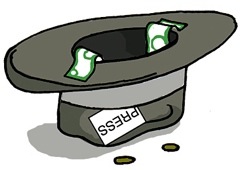
An overwhelming majority of Americans prefer freedom of the press to outdated models of journalism, according to a new Rasmussen poll. The survey comes in the midst of discussions in the Federal Trade Commission and the Federal Communications Commission to intervene on behalf of Old Media. Eighty-five percent of respondents in the Rasmussen poll said they believe maintaining press freedom is more important than financially supporting the newspaper industry. Only six percent said the latter is more important. Just 14 percent said they would favor a bailout of the newspaper industry. Respondents worried that government involvement in the industry would compromise press neutrality. Indeed, this sentiment reflects the findings of a number of studies over the past few years. As with any bailout, a bailout of a newspaper would inevitably mean at least some say in that newspaper’s content. In the words of a report released last year by the Business and Media Institute: As soon as Obama bailed out Detroit, he forced out GM Chairman and CEO Rick Wagoner. The White House also gave majority ownership in Chrysler (55 percent) to the UAW. Wall Street bailouts resulted in overnight government regulation – even salary controls. Government intervention in media gives Obama the same opportunity to control the news. Seven major newspaper chains have gone into bankruptcy. If he uses the same strategies he used for Detroit, that would let Obama control major media outlets across the nation and he could dictate the news. A Harvard/Northwestern study observed just such trends in the newspaper industry of Argentina after that nation’s government instituted subsidies for its own failing newspapers. According to one blogger who reported on the study, Their analysis found a “huge correlation” between, in any given month, how much money went to a newspaper and how much corruption coverage appeared on its front page. For example, if the government ad revenue in a month increased by one standard deviation — around $70,000 U.S. — corruption coverage would decrease by roughly half of a front page. …in periods where newspapers were getting more money from the government, they produced fewer corruption scoops of their own and covered fewer of the scoops produced by other newspapers. (It should be noted here that the study only looked at the front pages of newspapers — so it’s possible rival papers were writing about the scandals uncovered by their peers. But if so, they were doing it on inside pages.) The Washington Examiner’s Mark Tapscott brilliantly captured the inevitability of a stilted journalism once public funding is introduced. He noted that the not-too-subtle goal of the campaign to “save journalism” is to transform the news industry from an information product collected by private individuals and entrepreneurs as a service to private buyers, to a government-regulated public utility providing a “public good,” as defined and regulated by government. The inevitable result of the campaign, Tapscott writes, is more government control over the news, since “government always expands its control over any activity it either funds or regulates.” The poll’s respondents presciently observed this attempt at a power grab–and resoundingly rejected it. According to Rasmussen, Sixty-nine percent (69%) think it at least somewhat likely that a newspaper that receives government funding to hire journalists will avoid criticizing government officials and policies, with 45% who say it is Very Likely. Twenty-three percent (23%) say it’s not very or not at all likely that newspapers will avoid such criticism if they get government funding. Seventy-one percent (71%) oppose a government bailout of the newspaper industry like the ones for the financial sector and the automobile industry, up from 65% in March of last year. Only 14% say a government bailout of the newspaper business is a good idea. Of course the federal government is considering a number of options beyond the gifting of taxpayer funds to ailing newspapers. Still many of its options could leave the door open to cronyism and compromising conflicts of interest between journalists and their federal benefactors. One such option is the creation of an “Americorps-type program that would hire and pay journalists to work for newspapers around the country,” in Rasmussen’s phrasing. First of all, as Reason’s Peter Suderman notes , the last thing American journalism needs is a crop of reporters on the public dole. But more to the point of this study, AmeriCorps itself has served as a prime example of cronyism in the distribution of public money. It is certainly not a model to be emulated. And besides, the combined price tag of these programs to save journalism could cost as much as $35 billion, according to Suderman. That’s almost 100 times the FCC’s annual budget. Any federal program doling out that kind of money will attract sycophantic would-be recipients, ready to do what it takes to get their hands on a slice of that pie. Americans, apparently, have a firm grasp of these facts. 

See the original post:
Poll: Americans Overwhelmingly Reject Government’s Plan to ‘Save Journalism’