The North Koreans are coming, it appears, instead of the USSR in the remake of Red Dawn , the Cold War cult favorite starring Patrick Swayze and Lea Thompson. Chris Hemsworth and Josh Hutcherson star in this reboot, which at least took 28 years to be remade (way more than the new Total Recall or The Amazing Spider-Man ). The 2012 Red Dawn plot is basically the same, in any case. Get ready for an action adventure pitting the Wolverines – a rag-tag band of handsome and wholesome U.S. teens – against formidable international invaders:
Joan Rivers made headlines this week when she handcuffed herself to a cart at Costco in protest of that chain refusing to sell copies of her memoir, shouting to customers that the store is akin to ” Nazi Germany .” In response, the Anti-Defamation League issued a statement that called out the comedian for these remarks, saying: “Such comparisons only serve to trivialize the Holocaust and are deeply offensive to Jews and other survivors.”
Also in Friday afternoon’s round-up of news briefs, The Hunger Games gets a new Tribute. And remembering Oscar-winning Special Effects Artist Carlo Rambaldi and writer/actor David Rakoff. Keira Knightley Takes Lead in Jack Ryan Reboot Knightley will play the female lead in Kenneth Branagh’s Untitled Jack Ryan project. The actress is currently in talks to star as Jack Ryan’s wife, a role previously portrayed by Anne Archer, Gates McFadden, and Bridget Moynahan in previous installments of the franchise. Knightley joins Chris Pine, who’s long been attached to play the lead role, and Branagh, who in addition to directing will also star as the villain, THR reports . E. Roger Mitchell Boards The Hunger Games: Catching Fire Mitchell will play a Tribute from District 11 who previously won the 45th annual Hunger Games. The follow-up has past winners, including Jennifer Lawrence’s Katniss participating in the “Quarter Qeull,” or the 75th anniversary Hunger Games, Deadline reports . Justin Theroux to Swear to God with Will Ferrell and Steve Carell Theroux will rewrite and direct Warner Bros. comedy Swear to God , starring Will Ferrell and Steve Carell. The story revolves around Ferrell who is a narcissistic hedge fund manager who believes he has seen God, Deadline reports . David Rakoff, Comic Essayist and Actor Dead at 47 His mother confirmed his death following a long battle with cancer. He described himself as a “New York writer” and a “Canadian writer” and a “mega Jewish writer.” He appeared in the Oscar-winning short The New Tenants (2009) which he also adapted. The New York Times reports with background from Wikipedia . E.T. Special Effects Artist Carlo Rambaldi Dead at 86 Rambaldi worked on more than 30 films and received two Oscars for E.T. (1982) and Alien (1979). He died in his southern Italian home following a long illness, The Washington Post reports .
Danielle Harris is an irrelevant Hollywood actor who does a bunch of straight to DVD Horror movies that you have probably never heard of….and probably will never really hear of….even though she’s doing her best to get noticed….from posting bikini pics on twitter….to doing segments on Dr Phil about being stalked trying to trick us into thinking people actually care….despite being 35 and pretty much old enough to throw in the towel and go back to being a Jewish mom with a rich Jewish husband, making babies and living the good life for her peers to gossip about…instead of humiliating herself by pretending she’s an actual actor…..
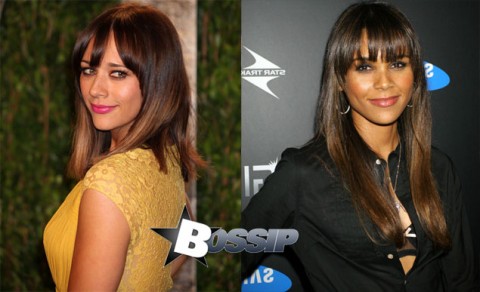
We got such strong reactions from our post about Rashida Jones picking her white side to make it in Hollyweird that we felt compelled to do a little digging into her old interviews and we had to revisit this 2005 Glamour Magazine interview that really delved into Rashida’s upbringing alongside her sister Kidad and includes quotes from their actress mom Peggy Lipton and their producer dad Quincy Jones. It goes a long way in explaining why Rashida relates so well to Jewish folk and how she got turned off black men. We thought it was also interesting because her sister Kidada, who relates more to her black side, even says at one point that Rashida passed for white back in the day. Here’s some excerpts from the part of the interview about their childhood, we’ve bolded the parts of the interview that stood out most to us: RASHIDA: I wouldn’t trade my family for anything. My mother shocked her Jewish parents by marrying out of her religion and race. And my father: growing up poor and black, buckling the odds and becoming so successful, having the attitude of “I love this woman! We’re going to have babies and to hell with anyone who doesn’t like it!” KIDADA: We had a sweet, encapsulated family. We were our own little world. But there’s the warmth of love inside a family, and then there’s the outside world. When I was born in 1974, there were almost no other biracial families–or black families–in our neighborhood. I was brown-skinned with short, curly hair. Mommy would take me out in my stroller and people would say, “What a beautiful baby…whose is it?” Rashida came along in 1976. She had straight hair and lighter skin. My eyes were brown; hers were green. IN preschool, our mother enrolled us in the Buckley School, an exclusive private school. It was almost all white. RASHIDA: In reaction to all that differentess, Kidada tried hard to define herself as a unique person by becoming a real tomboy. KIDADA: While Rashida wore girly dresses, I loved my Mr. T dolls and my Jaws T-shirt. But seeing the straight hair like the other girls had, like my sister had…I felt: “It’s not fair! I want that hair!” PEGGY: I was the besotted mother of two beautiful daughters I’d had with the man I loved–I saw Kidada through those eyes. I thought she had the most gorgeous hair–those curly, curly ringlets. I still think so! KIDADA: One day a little blond classmate just out and called me “Chocolate bar.” I shot back: “Vanilla!” QUINCY: I felt deeply for Kidada; I thought racism would be over by the eighties. My role was to put things in perspective for her, project optimism, imply that things were better than they’d been for me growing up on the south side of Chicago in the 1930s. KIDADA: I had another hurdle as a kid: I was dyslexic. I was held back in second grade. I flunked algebra three times. The hair, the skin, the frustration with schoolwork: It was all part of the shake. I was a strong-willed, quirky child–mischievous. RASHIDA: Kidada was cool. I was a dork. I had a serious case of worship for my big sister. She was so strong, so popular, so rebellious. Here’s the difference in our charisma: When I was 8 and Kidada was 10, we tried to get invited into the audience of our favorite TV shows. Mine was Not Necessarily the News, a mock news show, and hers was Punky Brewster, about a spunky orphan. I went by the book, writing a fan letter–and I got back a form letter. Kidada called the show, used her charm, wouldn’t take no for an answer. Within a week she was invited to the set! KIDADA: I was kicked out of Buckley in second grade for behavior problems. I didn’t want my mother to come to my new school. If kids saw her, it would be: “your mom’s white!” I told Mom she couldn’t pick me up; she had to wait down the street in her car. Did Rashida have that problem? No! She passed for white. RASHIDA: “Passed”?! I had no control over how I looked. This is my natural hair, these are my natural eyes! I’ve never tried to be anything that I’m not. Today I feel guilty, knowing that because of the way our genes tumbled out, Kidada had to go through pain I didn’t have to endure. Loving her so much, I’m sad that I’ll never share that experience with her. KIDADA: Let me make this clear: My feelings about my looks were never “in comparison to” Rashida. It was the white girls in class that I compared myself to. Racial issues didn’t exist at home. Our parents weren’t black and white; they were Mommy and Daddy. RASHIDA: But it was different with our grandparents. Our dad’s father died before we were born. We didn’t see our dad’s mother often. I felt comfortable with Mommy’s parents, who’d come to love my dad like a son. Kidada wasn’t so comfortable with them. I felt Jewish; Kidada didn’t. KIDADA: I knew Mommy’s parents were upset at first when she married a black man, and though they did the best they could, I picked up on what I thought was their subtle disapproval of me. Mommy says they loved me, but I felt estranged from them. While Rashida stayed and excelled at Buckley, Kidada bumped from school to school; she got expelled from 10 in all because of behavior problems, which turned out to be related to her dyslexia. KIDADA: We had a nanny, Anna, from El Salvador. I couldn’t get away with stuff with her. Mommy knew Anna could give her the backup she needed in the discipline department because she was my color. Anna was my “ethnic mama.” PEGGY: Kidada never wanted to be white. She spoke with a little…twist in her language. She had ‘tude. Rashida spoke more primly, and her identity touched all bases. She’d announce, “I’m going to be the first female, black, Jewish president of the U.S.!” KIDADA: When I was 11, a white girlfriend and I were going to meet up with these boys she knew. I’d told her, because I wanted to be accepted, “Tell them I’m tan.” When we met them, the one she was setting me up with said, “You didn’t tell me she was black.” That’s When I started defining myself as black, period. Why fight it? Everyone wanted to put me in a box. On passports, at doctor’s offices, when I changed schools, there were boxes to check: Caucasian, Black, Hispanic, Asian. I don’t mean any dishonor to my mother–who is the most wonderful mother in the world, and we are so alike–but: I am black. Rashida answers questions about “what” she is differently. She uses all the adjectives: black, white, Jewish. RASHIDA: Yes, I do. And I get: “But you look so white!” “You’re not black!” I want to say: “Do you know how hurtful that is to somebody who identifies so strongly with half of who she is?” Still, that’s not as bad as when people don’t know. A year ago a taxi driver said to me, That Jennifer Lopez is a beautiful woman. Thank God she left that disgusting black man, Puffy.” I said, “I’m black.” He tried to smooth it over. IF you’re obviously black, white people watch their tongues, but with me they think they can say anything. When people don’t know “what” you are, you get your heart broken daily. KIDADA: Rashida has it harder than I do: She can feel rejection from both parties. RASHIDA: When I audition for white roles, I’m told I’m “too exotic.” When I go up for black roles, I’m told I’m “too light.” I’ve lost a lot of jobs, looking the way I do. PEGGY: As Kidada grew older, it became clear that she wouldn’t be comfortable unless she was around kids who looked more like her. So I searched for a private school that had a good proportion of black students, and when she was 12, I found one. KIDADA: That changed everything. I’d go to my black girlfriends’ houses and–I wanted their life! I lived in a gated house in a gated neighborhood, where playdates were: “My security will call your security.” Going to my black friends’ houses, I saw a world that was warm and real, where families sat down for dinner together. At our house, Rashida and I often ate dinner on trays, watching TV in Anna’s room, because our dada was composing and performing at night and Mom sat in on his sessions. RASHIDA: But any family, from any background, can have that coziness too. KIDADA: I’m sure that’s true, but I experienced all that heart and soul in black families. I started putting pressure on Mommy to let me go to a mostly black public school. I was on her and on her and on her. I wouldn’t let up until she said yes. PEGGY: So one day when Kidada was 14, we drove to Fairfax High, where I gave a fake address and enrolled her. KIDADA: All those kids! A deejay in the quad at lunch! Bus passes! All those cute black boys; no offense, but I thought white boys were boring. I fit in right away; the kids had my outgoing vibe. My skin and hair had been inconveniences at my other schools–I could never get those Madonna spiked bangs that all the white girls were wearing–but my girlfriends at Fairfax thought my skin was beautiful, and they loved to put their hands in my hair and braid it. The kids knew who my dad was an my stock went up. I felt secure. I was home. RASHIDA: Our parents divorced when I was 10; Kidada went to live with Dad in his new house in Bel Air, and I moved with Mom to a house in Brentwood. Mom was very depressed after the divorce, and I made it my business to keep her company. KIDADA: I wanted to live with Dad not because he was the black parent, but because he traveled. I could get away with more. RASHIDA: At this time, anyone looking at Kidada and me would have seen two very different girls. I wore my navy blue jumper and crisp white blouse; K wore baggy Adidas sweatsuits and door-knocker earrings. My life was school, school, school. I’m with Bill Cosby: It’s every bit as black as it is white to be a nerd with a book in your hand. KIDADA: The fact that Rashida was good at school while I was dyslexic intimidated me and pushed me more into my defiant role. I was ditching classes and going to clubs. RASHIDA: About this time, Kidada was replacing me with younger girls from Fairfax who she could lead and be friends with. KIDADA: They were my little sisters, as far as I was concerned. RASHIDA: When I’d go to our dad’s house on weekends, eager to see Kidada, the new “little sisters” would be there. She’d be dressing them up like dolls. It hurt! I was jealous! KIDADA: You felt that? I always thought you’d rejected me. RASHIDA: Still, our love for the same music–Prince, Bobby Brown, Bell Biv DeVoe–would bring us together on weekends. It sounds like the Jones girls had quite an interesting upbringing, but it’s clear that Kidada always knew she was attracted to black men and Rashida was more open to “others.” Still, we thought it interesting that Rashida says she never tried to be what she wasn’t but later in the story she describes how once she went to college at Harvard she “chose” her black side and created an identity to “fit in” with the black crowd there. Hit the flip for that and to see actual scans from the story.
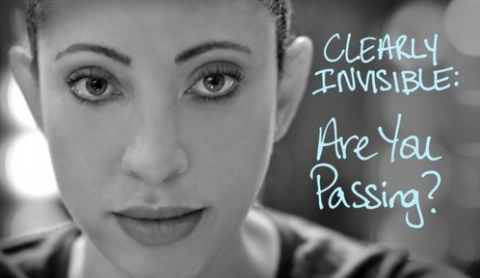
Book On Racial Passing “Clearly Invisible” There’s a new book out on the topic of racial passing but this time it also explores people passing for the opposite sex and the other ways people take on alternate identities to pave the way to their desired paths in life. We thought the trailer was pretty interesting you can watch it below: Here’s a little more info from the author: Everybody passes. Not just racial minorities. As Marcia Alesan Dawkins explains, passing has been occurring for millennia, since intercultural and interracial contact began. And with this profound new study, she explores its old limits and new possibilities: from women passing as men and able-bodied persons passing as disabled to black classics professors passing as Jewish and white supremacists passing as white. Already hailed as a pioneering work in the study of race and culture, Clearly Invisible offers powerful testimony to the fact that individual identities are never fully self-determined—and that race is far more a matter of sociology than of biology. Does this make you want to read the book? How does Dawkins’ theory apply to entertainers? Think about all the gay artists pretending to be straight, or even the straight female artists pretending to be bi — or hell even the former corrections officers turned rappers pretending to be hustlers. Things that make you go hmmmm? YouTube
Bar Refaeli really isn’t that great…..even when underwater…I know this because if she was that great..I wouldn’t want to see her never come up for air…I’d want to jump in and save her even just to give her mouth to mouth and make her feel like she owes her life to me, that I can exploit for sexual favors….but with this one I’d be more into telling her screaming friends I don’t know how to swim, cuz really she’s not worth getting wet over…..maybe I am a psychopath and watching half naked bitches struggle for breath is a turn on or maybe the real psychopath is the guy who thinks she deserves to be saved…. Maybe I just don’t like overrated entrepreneurial models who think they are hotter than they are….who dodge the draft in their country while everyone else has to do it…on some Jewish Princess kick….or Maybe I’m an anti-semite….but I think it has less to do with her religion and more to do with being a thick, coked up model who never fully made it and has already peaked but who dates celebs and acts like she matters….useless. Here are her underwater pics cuz she knows it’ll make her saggers look at their best….
Mila Kunis, the most loved girl in Hollywood, even though she is cute at best, in what I can only assume is that “jew looks attainable”….only she’s not cuz you aren’t famous, or Jewish, or maybe you are and that is why she’s in all these movies, cuz you are a loyal fan boy and you are the only one buying movie tickets cuz you don’t drink and this is your entertainment, especially when Mila Kunis is cast, cuz you can pretend one day when you become a billionaire, or inherit your Grandfather’s millions, you’ll get her to marry you, so that you can have a decent Jewish family, with kids and Jewish until remembering she’s with Ashton Kutcher….he’s fucking the girl you think is your girl even though it is all fantasy, but your coddled life and overbearing mother gave you hope that you could have anything you want, you fucking brat…. That said, who really cares about what she’s gotta say, Interview Magazine, we really just wanna see her naked….and this photoshoot doesn’t really cut it, but it does show some upper thing which is enough for the religis to cum themselves too…
It’s easy to dismiss the films of Tyler Perry , undisputed king of a niche multi-media empire of his own making, as broad, caricature-laden comedy populated by what Spike Lee famously labeled “coonery buffoonery.” But beneath the be-wigged, slapstick-y heft of Perry’s most famous character, Madea, and her often violent crusades in the name of family values — as seen in Friday’s Madea’s Witness Protection , the sassy grandmother’s seventh big-screen outing — lies a fount of subversive discussions of race, class, and self-examination. The only question is: Is Tyler Perry aware of it? Perry, who dons the Madea dress once more in Witness Protection (grudgingly so, he tells Movieline — more on his mixed feelings about Madea below), wrote and directed the comedy after hitting upon an idea over dinner: What if Bernie Madoff had to move in with Madea as punishment for his fiscal crimes? Eugene Levy stars as a Wall Street accountant who agrees to testify against mobsters involved in a Ponzi scheme, only to be ushered, along with his family, into protective custody – Madea’s house, to be more precise. It’s there, in this fish out of water set-up, that Perry plumbs more thoughtful ground. Economic responsibility is a theme, as Perry draws a direct line between the privileged suits that run the world’s financial institutions and the working class plebes whose life savings are often at stake. Race and class divides become blurred as Levy’s Jewish-American family finds common ground, and perhaps even stronger ties, with their equally uncomfortable hosts (Perry as both Madea and her cranky brother, Uncle Joe). There’s just one thing about all the considered socio-cultural conversations seeded in the subtext of Witness Protection : Perry admits that he didn’t set out with any conscious agenda other than making himself laugh. “I just thought, ‘This is funny,’” he told Movieline, adding “What’s so great is that these thoughts that you’re raising for me, I will be thinking about.” Read on as Tyler Perry talks with Movieline about his Madea character, why he is eager to retire her – if his audience will allow it — what he has to say to his critics, and why he jumped at the chance to play the lead in his forthcoming mainstream crossover pic, Alex Cross . Especially compared to the more melodramatic tone of Big Happy Family , Madea’s Witness Protection is different in terms of its themes and characters — what sort of ground did you want to explore this time around? I was actually having dinner with a friend and they said, “You know what would be great punishment for Bernie Madoff? If he had to move in with Madea.” So I took that thought and ran with it, just the thought of it made me laugh so hard. I said, “Let me write this — and who can I get to play it?” I thought of Eugene Levy. So the whole tone of this movie is about, if everything was taken away from you and you had to be forced to live a very simple life and focus on what is real, which is his family, how much would you change? Another interesting new element, especially given your oeuvre of primarily African-American characters, is that this is a story about what might be considered “white people problems” — these are rich, country-clubbing suburbanites who are probably at the farthest remove from Madea’s world. [Laughs] Yes, right. And the story seems to be saying that one group’s problems are really everyone’s problems, certainly economically speaking — Eugene Levy’s character is involved in a financial scam that inadvertently has stolen money from Romeo’s church, for example. Sure. There’s also a plot thread that suggests Eugene’s character might be half-black, which interestingly brought that point home even more — aligning the black and Jewish cultural experiences together, in a sense. How much were these unifying themes present for you in the process of making the film? [Laughs] You’re trying to make it seem like I’m so smart! And that I did not even think about. I just thought, “This is funny — this is funny if they think Uncle Joe and [Eugene Levy’s mother] had a one-night stand and he thinks he’s his son.” I wasn’t even thinking at all about any of that. Well, go ahead and run with it! Be my guest. I will! You delve into economic awareness and the avoidance of victimhood, with many of your characters dealing with the repercussions of these Wall Street scandals trickling down into their lives. One of the elements I admire in the Madea character is that she seems to be a proponent of personal responsibility, throughout the films. Wow, again — I wasn’t thinking that either! What’s so great is that these thoughts that you’re raising for me, I will be thinking about. All I was doing was writing a simple story, I didn’t get into the subconscious of it. For me, after Colored Girls and Alex Cross and Good Deeds I wanted to do something where I just laughed. Even with Madea’s Big Happy Family , where one of the characters had cancer, I just wanted to do something where nobody’s sick, we’re all going to just laugh and have a good time, and remember why family is important. I heard that Madea might be ringing the NASDAQ bell … [Laughs] That I’d like to see! I don’t know who’s going to be playing Madea, but I’m going to be busy that day. There are moments in Witness Protection that almost have a guerrilla-style Borat feel — the scenes with Madea in New York City, discovering different parts of her posh hotel in particular. There’s a real improvised feel to them. And there’s an outtake at the end involving Madea phoning down to the concierge to inquire about the bidet that’s pretty hilarious. Yeah, but you know what the thing about that is? I’ve never seen Borat , but thinking about my mother and the first time she went to a really nice hotel, or the first time she had to go through an airport. So a lot of those things didn’t take me going very far to imagine or to create, because it is very much what is close to, or what has happened to, my own family. Have you ever considered doing the Madea character as a sort of faux documentary along the lines of what Sacha Baron Cohen has done with Borat — just putting her out into the world to capture the way people react to her? The only problem with that is, I would have to be in costume out in the world, and that won’t work for me. [Laughs] If I take Madea off the stage or have to put her in a room, I’m telling you… I am so uncomfortable in that costume. I can barely look at myself, I certainly don’t want other people looking at me. Really? Oh, yeah. You’ve voiced a similar sentiment before about the character and the costume — it seems like she may not be your favorite character to play, but you keep coming back to playing Madea because your audience loves her. Absolutely. One hundred percent. It is definitely about the audience and it’s also about the amount of joy she brings to people, and the amount of people that she keeps employed. So absolutely, that’s what it’s about. But I would be pretty good with passing it on. What’s behind your mixed feelings about Madea? Is it as simple as being uncomfortable in the costume? The costume is so difficult to wear. It’s so tight. I’m sweating, it’s hot, with the wig — it’s all just a pain. Everybody on staff on the crew knows that once I get into costume, they’ve got to be hustling, moving lights, because I don’t want to have it on — I’m ready to take it off. And Joe is worse! Joe is like being wrapped like a mummy all around your face. That’s right. At least Joe doesn’t usually move around much, he seems to mostly just sit in his easy chair. That’s why! I’m like, listen — I’m not about to sweat this stuff off and have them put it back on for another 6-8 hours a day. I’m not doing that! Do you have a shelf life in mind for Madea, or do you think you’ll draw a line at playing her after a certain point? Well, you know what, it really is about the audience. As long as they want to see it I think it would be unfair for me to do anything but deliver. But whenever they stop coming, then Madea will retire to an island. You’ve received criticism over the years for the Madea films in particular. What is your response to those who accuse these works of perpetuating certain stereotypes? You know what, I’ve stopped trying to defend that stuff. I don’t even deal with it anymore. I like to let the audience speak for themselves. We all know what we like, we all know what we like and how we like it and what we want to see, and I think that it’s awful that we as black people – and this is where most of the criticism comes from, it comes from within our own culture — that we are so ashamed about certain parts of our society, about our own culture, that we want to act like it doesn’t exist. But this woman exists. I still know her. She is still in my neighborhood. She was my mother and my aunt. She didn’t go to an Ivy League school, and she took care of the whole family. So it’s not a stereotype, it is a part of our culture that we all need to embrace. I do have a critic friend who watched the film and took issue with Madea’s violent streak — her tendency to threaten corporal punishment to those who don’t act reasonable in her eyes. That says more about your friend than it does about the character. That’s what I think. I’d like to discuss what we might call Madea’s history lessons in this film — there is a scene in which Doris Roberts struggles with the difference between using the term “Negro” instead of “Negro spirituals.” The other characters, who are white, are horrified by this, but then Madea comes in and tells them they’re all being too uptight about it, before firmly but gently correcting her. Are you by proxy telling your audience that maybe we’re too uptight when it comes to discussing these sensitive racial and historical issues? [Laughs] Let me tell you something, you are so deep into this movie, you are reading things that I never even thought about or imagined. Because in that scene, what I’m thinking is, this woman has dementia. She’s trying to say “Negro spirituals” but she keeps saying “Negroes.” I’m thinking it’s a hysterical joke because I laughed my ass off when I wrote it, and I laughed my ass off when she did it, and when Madea corrects her — because everybody’s panicked that she’s saying “Negroes” and they don’t understand that she’s trying to say “Negro spirituals” — it’s like, calm down, get an understanding of what she’s saying before everybody jumps off the handle. I feel like that taps into a larger discussion of your films, even, and the idea that you’re working within a very specific niche. But looking to what you have coming up next, you’re starring in Alex Cross , an action thriller adapted from James Patterson’s novel. Did you see this as an opportunity to cross over from your established niche into a wider mainstream audience? No, I never do things to think about crossing over. The thing that appealed to me was that I always liked James Patterson’s books and I liked the franchise and the character itself. When it came to me out of all of the things that I’m offered — I’m offered quite a bit — that was the most intriguing. I thought, “Wow – this is a character that I like,” and I wanted to do it. That’s what that’s about. Madea’s Witness Protection is in theaters Friday. Follow Jen Yamato on Twitter . Follow Movieline on Twitter .
With the return of Love and Hip-Hop last night on VH1, it’s getting harder and harder to believe how a show without much love or Hip-Hop has this much staying power. Regardless of how you may feel about the monster that Mona Scott-Young has created, the show has generated a cultural impact for better or worse… Continue









 Breaking Sports Video







