Tag Archives: massachusetts

First State Recognized Slave Was Owned by Anthony Johnson – a Black Man

Anthony Johnson (? – 1670) was an early black resident of the Virginia Colony. He was one of the original 20 African laborers brought to Jamestown in 1619 as an indentured servant. On records from Jamestown, he is referred to as “Antonio a Negro”. In the 1640s, he purchased his freedom from indentured servitude for both himself and his wife and by 1651 he was prosperous enough to import five “servants” of his own, for which he was granted as “headrights”. According to the earliest known court records, slavery was first established in Virginia in 1654, when Johnson convinced the court in Northampton County that he was entitled to the lifetime services of John Casor, also a black man. Claiming that he had been imported as an indentured servant, Casor attempted to transfer what he argued was his remaining time of service to Robert Parker, a white, but Johnson insisted that he “had ye Negro for his life. The court ruled that “seriously consideringe and maturely weighing the premisses, that the said Mr. Robert Parker most unjustly keepeth the said Negro from Anthony Johnson his master….It is therefore the Judgement of the Court and ordered That the said John Casor Negro forthwith returne unto the service of the said master Anthony Johnson, And that Mr. Robert Parker make payment of all charges in the suit.” The unfortunate defendant in the court action, John Casor, thus became the first individual in Virginia known to be legally declared a slave by the government (before this case legally defined bondage had not yet fully taken hold in Virginia, although it had already by the 1630s in Massachusetts; in Virginia blacks were indentured servants up until slavery gradually took effect). http://www.pbs.org/wgbh/aia/part1/1p265.html added by: ibrake4rappers13

Andrea Mitchell Wistfully Yearns for Ted Kennedy’s Presence In Passing Liberal Legislation

On Friday’s edition of MSNBC’s Andrea Mitchell Reports, Mitchell brought on the Boston Globe’s Peter Canellos to pine for the widow of Ted Kennedy, Vicki, to challenge Republican Scott Brown for the Massachusetts Senate seat, as well as imagine how effective the liberal “lion” would be in championing health care and unemployment extension legislation if he were still around today. A wistful Mitchell remarked of the the late Senator: “It seems as though his legacy only grows in contrast to how low, what low regard the Senate is now held because of the gridlock and the, the sort of petty differences.” Mitchell then set up the Globe’s editorial page editor as she questioned if Kennedy “were trying to pull things together politically today, if we were blessed by his presence…do you think it would still be the passion for health care, or would he be looking to the larger economic issues?” To which Canellos remembered fondly: “When it comes to unemployment, I mean you can easily hear him…thundering against those who would deny unemployment to people who have been suffering.” The following is the full exchange as it was aired on the August 20 edition of MSNBC’s Andrea Mitchell Reports: ANDREA MITCHELL: Next week will mark the first anniversary of the death of Senator Ted Kennedy. There is increasing talk in political circles about whether his wife Vicki will enter politics in Massachusetts. Peter Canellos is the Boston Globe editorial page editor and a columnist and author of Last Lion: The fall and Rise of Ted Kennedy, now out in paperback. Peter thanks so much for joining us. A year later, what a change in Massachusetts politics. And we’ve seen also the pressure on Vicki Kennedy, I guess Democrats are looking for anybody to go up against the very popular political figure there, Scott Brown. PETER CANELLOS, THE BOSTON GLOBE: Yeah. I think that’s true. And I think there’s the feeling that the state has lost a lot with the Kennedy franchise kind of sidelined. And so it’s both a desire to have a good candidate against Scott Brown but also a desire to kind of rekindle the Kennedy mystique. MITCHELL: What is happening with the other members of the family and whether or not Joe Kennedy or, or any of his offspring might also be willing to get back into politics? CANELLOS: Well I think some of his offspring will get involved in politics but not run for the Senate. They would probably run for the House. MITCHELL: Right. CANELLOS: He has two 28-year-old sons. Whether he will run, whether Vicki will run, it’s all a matter of speculation right now. And they’re, they’re all downplaying it. So I would say that it’s probably more likely than not that none of the Kennedys will run. But, but nonetheless, as long as that possibility is out there, people are gonna cling to it. MITCHELL: Well one of the things that she said, that Vicki said to the Globe in an interview about this anniversary is, “My heart is so heavy. I like to just keep busy and keep moving on. And that’s why it’s been great to kind of get around. And when people honor Teddy, to be there, to always sort of look at it, from his point of view, the future, and to try to make a positive difference going forward. But when you get into that level of really thinking about, really living his life, that’s a step that’s just too hard. That’s too hard.” Thinking about trying to step into a campaign and the Senate seat. That is different from going and representing him and speaking about his legacy. CANELLOS: Oh, absolutely. And, you know, right now she’s kind of a beloved figure, and you know, people’s, you know, grief over, over his loss is sort of translated into kindness towards her. As soon as she runs for the Senate, you know, she’ll be hammered on the issues. You know she’ll have challengers. It will, will be very, very tough for her. So she has to be emotionally ready. And it doesn’t sound at all like she is right now. MITCHELL: And in thinking back over this past year, and we were up there in Hyannis a year ago and went through all of that with that extraordinary funeral and the procession and coming back to the burial at Arlington, it seems as though his legacy only grows in contrast to how low, what low regard the Senate is now held because of the gridlock and the, the sort of petty differences. CANELLOS: Yeah. I agree. And I think they miss, they miss him a lot in the Senate. I mean, he was a great sort of deal maker. And that’s, that’s precisely what they’ve missed in the last year. MITCHELL: One of the things that back in the, in the day when he was in the Senate really actively working with Republicans, if you recall back when Dan Quayle and Ted Kennedy were working on unemployment legislation together. That doesn’t happen these days. CANELLOS: Yeah. It really doesn’t happen these days. I think people were partly drawn to kind of the Camelot mystique in him, but then they were totally taken by him. He was very gregarious but he was an extraordinary hard worker and I think he, he sort of kept them honest in a way. MITCHELL: And if, if he were trying to pull things together politically today, if we were blessed by his presence, what would be his focus? Do you think it would still be the passion for health care, or would he be looking to the larger economic issues? CANELLOS: Yeah I think a little of both. He certainly would be working to shore up the health care achievement and would be out there promoting it probable more aggressively than the Democrats are right now. But I think when it comes to, to unemployment, I mean you can easily hear him, you know, thundering against those who would deny unemployment to people who have been suffering. You know he would have, he knows sort of, he knew when to make things a political issue. And, and for example, the unemployment insurance extension would have been one that he would, you know, thunder about at a, in a partisan way. But then when it came to sort of cutting a deal to get it done, he would be willing to sort of take half a loaf rather than nothing. MITCHELL: Well when you think that it was only two years ago that he came out of a hospital bed to make that farewell speech at the Democratic Convention in Denver, and then a year ago we were in, in Hyannis and in Boston, of course, for the funeral. Peter Canellos, thank you very much. This is a figure who becomes larger even after life, as large as he was in life. Thank you, Peter. CANELLOS: Thank you, Andrea.

Visit link:
Andrea Mitchell Wistfully Yearns for Ted Kennedy’s Presence In Passing Liberal Legislation

How Proposition 8 Went Down

A video summarizing how and why proposition 8 was overturned. Very easy to follow and very to the point. Part two will be posted in the comments Description: Part 1 of a look at the recent ruling in Perry v. Schwarzenegger, which struck down California's Proposition 8 as violative of the due process and equal protection clauses of the 14th Amendment to the United States Constitution. Part 2: http://www.youtube.com/watch?v=fZNUo6… FOOTNOTES: 1. Commonwealth of Massachusetts v. U.S. Department of Health and Human Services http://docfiles.justia.com/cases/fede.. . ; Gill v. Office of Personnel Management http://docfiles.justia.com/cases/fede.. . 2. Perry v. Schwarzenegger https://ecf.cand.uscourts.gov/cand/09.. . 3. “Conservative Jurist, With Independent Streak” (New York Times, 8/5/2010) http://www.nytimes.com/2010/08/06/us/.. . 4. “Judging Marriage” http://www.breakpoint.org/bpcommentar.. . 5. http://nomblog.com/ 6. http://www.youtube.com/watch?v=kpNscb… 7. http://www.youtube.com/watch?v=gZnVlD… 8. http://www.youtube.com/watch?v=m8e762… 9. From William Lane Craig's website http://www.reasonablefaith.org/site/N.. . 10. “Challenging Judge Walker” by Sherrilyn A. Ifill http://www.theroot.com/views/challeng.. . 11. West Virginia School Board v. Barnette http://caselaw.lp.findlaw.com/scripts.. . 12. Donald P. Haider-Markel, Alana Querze, & Kara Lindaman, “Lose, Win, or Draw?: A Reexamination of Direct Democracy and Minority Rights”, 60 (2) Political Research Quarterly 304 (June 2007). 13. “It's all about children (or at least the anatomical possibility thereof).” http://www.youtube.com/watch?v=fzUFYN… added by: MizPiz

Man grows pea plant inside lung

A Massachusetts man who was rushed to hospital with a collapsed lung came home with an unusual diagnosis: a pea plant was growing in his lung. Ron Sveden had been battling emphysema for months when his condition deteriorated. He was steeling himself for a cancer diagnosis when X-rays revealed the growth in his lung. Doctors believe that Mr Sveden ate the pea at some point, but it “went down the wrong way” and sprouted. “One of the first meals I had in the hospital after the surgery had peas for the vegetable. I laughed to myself and ate them,” Mr Sveden told a local Boston TV reporter. Red more….. http://www.bbc.co.uk/news/world-us-canada-10945050 added by: Cubejam

Prop 8 | Decision on Stay Expected in California’s Same-Sex Marriages Case

Decision on stay expected in California same-sex marriages case By the CNN Wire Staff August 12, 2010 1:57 a.m. EDT Los Angeles, California (CNN) — A federal court in California will rule Thursday on whether to keep a temporary stay in place in the case that overturned the state's ban on same-sex marriages. The United States District Court for the Northern District of California will announce its decision between 9 a.m. and noon (12 p.m. and 3 p.m. ET). If the stay is lifted, same-sex marriages will be legal in California. Last week, Chief U.S. District Judge Vaughn Walker in San Francisco struck down the state's ban on same-sex marriage, ruling that voter-approved Proposition 8 violates the U.S. Constitution. The 136-page opinion is an initial step in what will likely be a lengthy fight over California's Proposition 8, which defines marriage as a union between a man and a woman. At question in the trial was whether California's ban on same-sex marriage violates gay couples' rights to equal protection and due process, as protected by the U.S. Constitution. The high-profile case is being watched closely by both supporters and opponents of same-sex marriage, as many say it is destined to make its way to the U.S. Supreme Court. If it does, the case could result in a landmark decision on whether people in the United States are allowed to marry people of the same sex. Same-sex marriage is currently legal in five U.S. states — Massachusetts, Connecticut, Vermont, Iowa and New Hampshire — and in the District of Columbia, while civil unions are permitted in New Jersey. “Proposition 8 fails to advance any rational basis in singling out gay men and lesbians for denial of a marriage license. Indeed, the evidence shows Proposition 8 does nothing more than enshrine in the California Constitution the notion that opposite-sex couples are superior to same-sex couples,” Walker, who was appointed to the federal bench by former President Ronald Reagan, wrote in his opinion. “Race restrictions on marital partners were once common in most states but are now seen as archaic, shameful or even bizarre,” he added. “Gender no longer forms an essential part of marriage; marriage under law is a union of equals.” After the ruling, elated supporters gathered to celebrate the judge's opinion in San Francisco's Castro district. People waved rainbow flags and U.S. flags, and carried signs that read, “We all deserve the freedom to marry,” and “Separate is Unequal.” Similar rallies unfolded in Los Angeles and San Diego. “For our entire lives, our government and the law have treated us as unequal. This decision to ensure that our constitutional rights are as protected as everyone else's makes us incredibly proud of our country,” said Kristin Perry, a plaintiff. Perry and Sandy Stier, along with Jeffrey Zarrillo and Paul Katami, are the two couples at the heart of the case, which, if appealed, would go next to the 9th U.S. Circuit Court of Appeals before possibly heading to the U.S. Supreme Court. Opponents of same-sex marriage have said their best bet lies with higher courts and have vowed to appeal the federal judge's ruling. In a national survey conducted by Gallup in May, 53 percent of respondents said same-sex marriages should not be recognized by law, while 44 percent said they should. Proposition 8 is part of a long line of seesaw rulings, court cases, debates and protests over the controversial issue of same-sex marriage. It passed in California with some 52 percent of the vote in November 2008. “Big surprise! We expected nothing different from Judge Vaughn Walker, after the biased way he conducted this trial,” Brian Brown, president of the National Organization for Marriage, said last week. “With a stroke of his pen, Judge Walker has overruled the votes and values of 7 million Californians who voted for marriage as one man and one woman.” added by: EthicalVegan

Howard Dean Claims Unpopular ObamaCare Mandate Could be Ruled Unconstitutional

A well known political figure appears on MSNBC’s Daily Rundown and announces, in the wake of Missouri voters overwhelmingly supporting Proposition C to remove the insurance mandate from ObamaCare, that it is so unpopular that it will probably be removed from that legislation or that the courts will rule it unconstitutional. So was the person who delivered this opinion a conservative Republican? Nope. It was Howard Dean, former Democrat presidential candidate and chairman of the DNC who made that statement to a surprised Chuck Todd and Savannah Guthrie. The Daily Rundown conversation begins with Chuck Todd discussing the Proposition C landslide in Missouri: CHUCK TODD: In Missouri this week there was referendum on the ballot. Non-binding but it was, frankly, the legislature didn’t want to deal with the issue of healthcare and this mandate and about whether the state should challenge the mandate on the new healthcare plan. It got 71%. Yes, more Republicans turned out than Democrats. But 71% in Missouri, that has to make Democrats nervous, particularly in that Senate race. Robin Carnahan has got an uphill battle. HOWARD DEAN: She does have an uphill battle. She’s a great human being and a great person and I hope that she’s going to win that one. I think she can but the truth is the mandate is not essential to the plan anyway and never was essential to the plan. They did it in Massachusetts and had a mandate but we had universal healthcare for kids in my state without a mandate. At this point, a clearly surprised Savannah Guthrie steps in. SAVANNAH GUTHRIE: But wait, how can you say the mandate isn’t essential? The way we always had it explained to us by folks at the White House is that if you want to do anything about pre-existing conditions you got to get everybody into the game. That without the mandate you can’t require insurance companies to stop prohibiting… DEAN: We did. We did it 20 years ago in my state. We did it 20 years ago in my state. TODD: Without a mandate? DEAN: Without a mandate. TODD: How did you do it? DEAN: We just said all comers will have to get insurance. And you can’t charge…this is why our bill is so much better than what they just passed…you can’t charge more than 20% above the basic rate and the Senate is 300% based on age. The fact of the matter is I thought that the President was right in the campaign. Academically you want a mandate. The American people aren’t going to put up with a mandate. And I’ve made this prediction before and I am going to make it again, by the time this goes into effect in 2014 I think the mandate will be gone. Either through the courts or because it’s unpopular. You don’t need it. There will be 2 or 3 percent of the people who cheat. That is not enough to bring the system to a halt. And people don’t like to be told what to do. TODD: So you expect them to drop the mandate? DEAN: Well, the courts may rule it unconstitutional. So it isn’t only conservatives who think the ObamaCare mandate is not only unpopular but may be ruled unconstitutional as well. Count Howard Dean among the growing ranks of those who have the same belief. Which is why Todd and Guthrie were so surprised.

Read this article:
Howard Dean Claims Unpopular ObamaCare Mandate Could be Ruled Unconstitutional

‘Face the Nation’: Supreme Court Upholding Same-sex Marriage ‘Enormous Stretch’

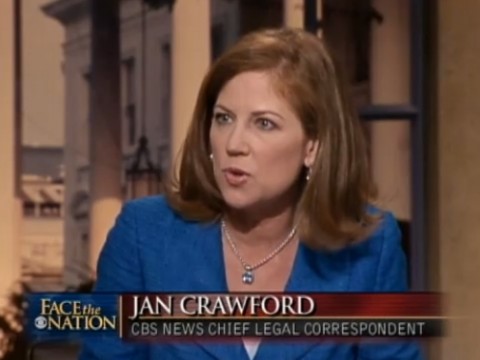
Analysts that spend their time critiquing the media normally don’t have very good things to say about what they observe these days, but the final segment of Sunday’s “Face the Nation” on CBS was a marvelous exception. Substitute host John Dickerson invited on the network’s chief legal correspondent Jan Crawford and the Washington Post’s Dan Balz for a refreshingly open and honest discussion of two pivotal legal issues facing our nation: a judge’s decision to overturn California’s controversial Proposition 8 which banned same-sex marriages, and; whether or not the 14th Amendment should be revised to address illegal immigration. What ensued was a tremendously informative seven minute report about these two issues without any cheer-leading or accusatory finger-pointing: Crawford gave the facts about both legal matters as she saw them; Balz addressed the political ramifications for both parties as well as the White House, and; Dickerson asked great questions to keep the conversation moving. With that as pretext, sit back and watch – or read if you’re so inclined – the way these kinds of issues should be discussed on a television news program (video follows with transcript and commentary):  JOHN DICKERSON, HOST: We’re back with more on same-sex marriage with Dan Balz of the Washington Post, and our chief legal correspondent Jan Crawford. Jan, I want to start with you. And the question I asked David Boies. This is a big leap for the Supreme Court when it finally gets there, isn’t it? JAN CRAWFORD (CBS News Chief Legal Correspondent): Well, David Boies said it was not. But clearly it is. I mean they are asking the Supreme Court to set aside, essentially, the laws of forty-four states. So that is an enormous stretch. Now, of course, the Supreme Court has taken up issues of gay rights in the past. Justice Kennedy, the key swing vote in 2003, said that states could not criminalize homosexual sex in the privacy of your bedroom. So– but that is an entirely different matter than saying there’s a federal constitutional right to– to same-sex marriage. JOHN DICKERSON: In this case, Judge Walker, quoted Anthony Kennedy fifteen times or so. It was a letter to him. Wasn’t it? And is that going to work writing directly to Kennedy, basically, trying to use his own words to say hey, you’ve go to vote with me. JAN CRAWFORD: No. I mean clearly this decision was written with an eye on appeal. And it’s going to be appealed all the way up to the Supreme Court. The court is so narrowly divided right now in these key social issues, you know, you’ve got your four liberals, your four conservatives and then that man in the middle, Anthony Kennedy, who is kind of like this, you know, human jump ball. And what they are asking Justice Kennedy to do, in this case, is not only, I mean, he’s got to grab the ball, take it down the court, slam it in the basket, and shatter the backboard. I mean this is something that Anthony Kennedy doesn’t do. He’s a very cautious justice. He doesn’t like to get ahead. Like I said, the same-sex ruling that he wrote in 2003, that struck down laws that criminalized homosexual sex. No one was enforcing these laws. This would change the law of the nation. They would be so far ahead of public opinion and that is why this case was controversial from the beginning. Remember, the traditional gay rights groups did not want David Boies and his conservative counterpart, Ted Olsen, to file this case because they think the Supreme Court is not ready. They wanted to see more states pass laws allowing same-sex marriage and then take it to the court and not put that onus and that pressure on the Supreme Court. And I would not be so confident if I were David Boies. JOHN DICKERSON: Dan, let’s talk about the politics of this. It does seem like from the Republican side, you know, George Bush when a Massachusetts Supreme Court ruled on– in favor of same-sex marriage, immediately he came out with a constitutional amendment to ban it. This time pretty quiet from Republicans. DAN BALZ (Washington Post): Yes. And I think that– there’s a good reason for that. In 2004, the Republicans needed to do everything they could to motivate their base. Their base this year is highly motivated. They don’t need to do more to crank up the anger, the energy that’s there on the right. The second, I think, and more important reason, is they have very good issues to deal with in this midterm–the economy, the size and scope of government, debt and deficit. Those are issues that unify their entire coalition and also reach out to independents to introduce in a significant and loud way same-sex marriage would threaten to pull away from that– pull that coalition apart. JOHN DICKERSON: Distract. Okay. If it’s going to keep the Republicans quiet on this issue, what about the Democrats? How do they handle this? DAN BALZ: Well, the Democrats are equally conflicted or– or quiet on this. Because while much of the Democratic base favors same-sex marriage, the truth is most elected officials including President Obama are opposed to it. And so, there is conflict within their base. They don’t want to really get into this at this point and stir things up. The President has stayed away from this issue for the most part, as have most other Democrats. So I don’t think you’re– going to see Democrats trying to leap to make this into an issue in the fall. Even in– even in some districts. I think where this will play is in some conservative districts in some red states. Individual Republicans will use it, particularly, through micro-targeting. They will reach to voters not with broad messaging but by direct mail or phone calls things like that. JOHN DICKERSON (overlapping): That’s it. Go on. JAN CRAWFORD: And– keep in mind, though, too. I mean, this is the first ruling by one federal judge and it’s going to be appealed. This case is going to get to the Supreme Court pretty close to 2012. So, you know whether or not it’s an issue in this year’s midterm or not it’s going to be an issue in the presidential election. DAN BALZ (overlapping): I think that’s right. And I think– JAN CRAWFORD: And President Obama is going to have to s– I mean, what does he do? DAN BALZ: And– and I think, as you said, the question is public opinion is changing on this, and fairly dramatically over the last four or five years. But it’s not at the point where there’s majority opinion in a majority of the states in favor of same-sex marriage. The court may end up ruling on this long before public opinion reaches to the conclusion a majority favors same-sex marriage. JOHN DICKERSON: Jan, I want to ask you about another legal issue. The same-sex case is about the 14th Amendment. There’s also been some Republicans talking about the 14th Amendment in another context, in terms of this automatic birthright citizenship in the United States. What’s happening on that front? JAN CRAWFORD: Well, I had about an hour-long talk about this actually on Friday with Senator Lindsey Graham. And this is really kind of one component of what he sees and is pushing is some broader immigration reform. And it– he believes that it is a real problem that people are coming to this country illegally, having babies, and then they’re automatically U.S. citizens. And then they kind of piggy-back, the parents can piggy-back on those kids to stay here in this country illegally. He has all these figures. There’s been a fifty-three-percent increase in births to foreign people, who’ve come here to have their babies in the last four years alone. So, this is a way he wants to look at the 14th Amendment and say maybe it’s time for us to rethink that. Remember the 14th Amendment which is sacrosanct I think to– to so many people was passed to give citizenship rights to the freed slaves. Because obviously the Southern States weren’t going to be doing that unless the federal government stepped in. So he’s saying it’s time to rethink this. When we’re really looking at immigration reform as part of a broader package, securing the borders, giving a path to citizenship for the twelve million people who are here legally now, having some kind of worker ID card, and then also stopping this practice where people can come here illegally or not, have children here, and those children be U.S. citizens. JOHN DICKERSON: Dan, this is an issue, Republicans want to talk about as opposed to the same-sex marriage. DAN BALZ: Absolutely. I mean I think what you’re seeing is that almost all of the elements of the immigration debate that are being discussed now, public opinion tends to be on the side of where the Republicans stand. The Arizona Immigration Law–there are a lot of Democrats particularly, in the west, who are very unhappy that Justice Department and the President decided to step in on that case, feeling that this was a moment that they didn’t want to get into an issue like that that the administration needed to stay focused on the economy. The 14th Amendment issue is another one. I mean we are a long way away from any serious legislating on immigration reform. It died this year. It will– it may come back next year, but we’re a long way away from that. Nonetheless, this discussion is lively right now. And it is helping the Republicans. JOHN DICKERSON: Okay. Dan Balz, thanks so much. We’re going to have to go, Jan. thanks. Bravo, folks. This really was one of the most interesting and informative segments concerning these two issues I saw all week. If television news outlets reported like this more often, I wouldn’t have much to write about. 
See the article here:
‘Face the Nation’: Supreme Court Upholding Same-sex Marriage ‘Enormous Stretch’


MSNBC’s Dylan Ratigan Froths: Wall Street Frightens ‘Little Boy’ Obama, Makes Him ‘Bend Over’

MSNBC’s Dylan Ratigan appeared on Morning Joe, Wednesday, to dismiss Barack Obama as a “little boy” in the eyes of Wall Street and to assert the President “just bends over,” rather than stand up to the financial industry. The charged language surprised host Joe Scarborough who sputtered, “You know, I was so uncomfortable with a couple of the things you said and then the exclamation point at the end.” Speaking of financial reform, Ratigan attacked, “…When the Wall Street guys got across the table from him and said ‘Oh you going to change our tax code little boy ?'” After dismissing Obama’s ability to oppose Wall Street, Ratigan vulgarly claimed, ” But with this guy, he just bends over every time.” After Scarborough and co-host Mika Brzezinski expressed their amazement over the comments, Ratigan first asserted, “I’m not trying to offend.” He then quickly changed course and opined, “I am trying to offend, because I am offended. And everybody in America is offended and they are right to be offended.” Ratigan isn’t the first MSNBC and Morning Joe regular to make highly questionable comments. On February 23, 2010 , Donny Deutsch appeared on another program, the Joy Behar Show, and referred to Republican Marco Rubio as a “coconut.” (Coconut is a racist term for Hispanics who are brown on the outside and white on the inside.) Deutsch later apologized . Considering that many liberal journalists have jumped on any criticism of Obama as proof of racism, it will be interesting to see how Ratigan’s comments are received. A transcript of the July 14 segment, which aired at 7:11am EDT, follows: JOE SCARBOROUGH: When do we start cutting back? DYLAN RATIGAN: We start cutting after we start clawing back. I don’t know why, as country, we refuse to deal with the issue of compensation that is being paid out to individuals who are taking that money predicated on their control of the government and not on their introduction of any value. 75 percent of what happens in the financial industry is a racket. It should be basically outlawed so that we can restore capitalism. And why we don’t deal with tax dodge that exists at the top. Again, Barack Obama, very aggressive in his campaign trail about [starts doing an Obama impression] how he was going to take care of the private equity tax loophole and work for the American people. It’s not a very good Barack Obama. Maybe that was- JOHN HEILMANN: Sounds more like a Texas Congressman. RATIGAN: And he didn’t do it, when it came down to it, when the Wall Street guys got across the table from him and said “Oh you going to change our tax code little boy? ” I think not. Because I’ll tell you right now, when you’re a 75 yr old or an 80 year old billionaire from New York who is looking at any government in this country that’s trying to play with the tax code- Who know who wins, the 80 year old billionaire from New York every time. If its Teddy Roosevelt in office who is not intimated by these types of people he might say “Listen. I don’t care who you are, I don’t care how rich you are, its not going to happen.” But with this guy, he just bends over every time. MIKA BRZEZINSKI: Dylan, you’re very- Oh, my God! SCARBOROUGH: You know, I was so uncomfortable with a couple of the things you said and then the exclamation point at the end. RATIGAN: It’s unbelievable to me. I’m not trying to offend. SCARBOROUGH: Well- RATIGAN: No, no. They want to cut teachers and cops, okay?. You want to cut teachers and police in California, in Massachusetts and Ohio, but you don’t want to restore any fairness to the tax code or eliminate the theft, let alone the extraction? We go to BP, health care, etc. SCARBOROUGH: You don’t actually try to offend. RATIGAN: I am trying to offend, because I am offended. And everybody in America is offended and they are right to be offended.

Read the original post:
MSNBC’s Dylan Ratigan Froths: Wall Street Frightens ‘Little Boy’ Obama, Makes Him ‘Bend Over’

Establishment Press Misses Rhode Island Parallel to Ariz. Immigration Law for Nearly Three Months

Preconceived notions are dangerous things in journalism. They cause one to assume facts that aren’t in evidence, leading to false or incomplete results. A classic example has played out in the nearly three months since Arizona passed its “1070 law.” Among other things, it mandates that law enforcement officials verify citizenship status in situations involving police contact if they have a reasonable suspicion that someone is not in the country legally. It seems that virtually everyone covering the story has been assuming that Arizona’s law is the first of its kind. Well, maybe as a “law” it is. But in Rhode Island, of all places, Boston Globe reporter Maria Sacchetti finally noticed on July 6 (HT Hot Air ) that police have been doing what Arizona will start doing on July 29 since 2008 as a result of a gubernatorial executive order: R.I. troopers embrace firm immigration role In contrast to Mass., they report all who are present illegally From Woonsocket to Westerly, the troopers patrolling the nation’s smallest state are reporting all illegal immigrants they encounter, even on routine stops such as speeding, to US Immigration and Customs Enforcement, known as ICE. “There are police chiefs throughout New England who hide from the issue . . . and I’m not hiding from it,’’ said Colonel Brendan P. Doherty, the towering commander of the Rhode Island State Police. “I would feel that I’m derelict in my duties to look the other way.’’ Rhode Island’s collaboration with federal immigration authorities is controversial; critics say the practice increases racial profiling and makes immigrants afraid to help police solve crimes. But it is a practice that Governor Deval Patrick’s opponents in the governor’s race are urging Massachusetts to revive. The Patrick administration has staunchly opposed having state troopers enforce immigration laws, and shortly after he took office in 2007, the governor rescinded a pact by his predecessor, Mitt Romney, to assign 30 troopers to the so-called federal 287(g) program, which trains local police to enforce federal immigration law. … In 2008, Governor Donald L. Carcieri, a Republican, issued an executive order mandating immigration checks on all new state workers and ordering State Police to assist federal immigration officials. Sitting in his office in an old farmhouse off a country highway, Doherty said the State Police had collaborated with federal immigration officials before, but the relationship has become more formal in recent years. In 2007, he said, he trained all state troopers in how to deal with noncitizens because of widespread confusion and because Congress did not resolve the issue of illegal immigration. Troopers learned to notify consulates when noncitizens are arrested, how to recognize different forms of identification, and how to deal with different cultures. One can’t help but wonder how well Ms. Sacchetti or whoever came up with the idea of looking into Rhode Island’s posture is being treated in the Globe’s newsroom these days. Her bosses and the rest of the establishment press should be really be asking themselves why they didn’t bother to look into what other states are doing when the Arizona law passed. Or, worse if true, they should be justifying why parallels they did find (how could they have missed California, as noted by the NewsBusters staff on Friday ?) were somehow not worthy of coverage. Did they decide to not look at Rhode Island because “everybody knows” that such a liberal state couldn’t possibly be strictly enforcing immigration laws — when in fact it is? Cross-posted at BizzyBlog.com .

Read more:
Establishment Press Misses Rhode Island Parallel to Ariz. Immigration Law for Nearly Three Months

MSNBC Scarborough Slams Republican Sharron Angle as a ‘Jackass’

On Tuesday’s edition of “Morning Joe,” Joe Scarborough and his panel discussed the 2010 midterm elections and trashed Republican candidate Sharron Angle as a “mental patient” and a “jackass.”   The conversation, which included Chris Matthews and Mike Barnicle, began innocently enough when MSNBC contributor Mike Halperin said Angle is “vulnerable” in the race because “she has extreme positions that are out of step with the mainstream.” One doesn’t have to be fan of Angle’s to question the rude, demeaning outbreaks hurled in her direction.   Barnicle boldly stated that Angle was “embarrassing” to the residents of Nevada and ” sounds like a mental patient .” After this incident, Chris Matthews began to misquote Angle’s radio interview with Lars Larson asserting, “She understands why people think of and resort to second amendment solutions to the Democrats in Congress they don’t like.”   Here’s the actual quote in full: You know, our Founding Fathers, they put that Second Amendment in there for a good reason and that was for the people to protect themselves against a tyrannical government. And in fact, you know, Thomas Jefferson said it’s good for a country to have a revolution every 20 years.