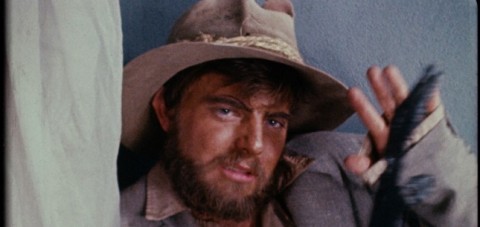
Director reveals that Philip Seymour Hoffman’s character is based on L. Ron Hubbard, but not the organization itself. By Kevin P. Sullivan Philip Seymour Hoffman in “The Master” Photo: he Weinstein Company
Movieline would like to introduce The Player , a recurring feature in which we look at the crossroads where video games and moviemaking intersect. We’ll regularly be looking at games that inspire movies, movies that inspire games and a lot of fun stuff in between. For our first foray, Luke McKinley writes on Manos: The Hands of Fate , an excruciatingly bad 1965 micro-budget film that manages work well as a video game. “The game of the movie” is a worse curse than Cruciatus , and usually causes more pain. It’s such a guarantee of failure that even the Street Fighter movie game sucked, and that started with one of the greatest games of all time. They’re terrible because the studio has to acquire the license, and when any company spends most of its budget on lawyers, the lawyers are the only ones who get to have any fun. Once the rights are secured, there’s usually enough cash left in the kitty for a design team of two interns and a crayon. FreakZone Games found a way around this: Start with the worst movie of all time. That would be Manos: The Hands of Fate. (To watch the entire movie, if you dare, scroll down to the YouTube video below). This abomination was made when an insurance and fertilizer salesman named Harold P. Warren bet that he could make a horror movie for less than $20,000. He failed spectacularly. The results would have less painful — and more coherent — if he’d filmed himself drinking $20,000 worth of tequila. The actors are so bad that they can barely talk. One is so bad he can barely walk. John Reynolds, who played Torgo, handyman and henchman to the villainous “Master,” appeared to have taken his acting classes from electroshock therapy. Reynolds’attempts to look supernatural make his appearances look jerkier than an art student’s stop-motion film — and more tedious, too. It can take up to three minutes for him to cross a scene, and if you think the camera or actors do anything to distract from this you are wildly overestimating: a) their commitment to the project; b) their understanding of cinema, c) their baseline brain activity. Then there’s the movie’s title villain, The Master, played by Torn Neyman. At one point, he studies himself in the mirror and declares, “Yes, I am the face of horror.” That’s him in the poster with the fancy moustache. Scary, right? In addition to being widely recognized as one of the biggest stinkers in filmdom, Manos is also a testament to the healing power of laughter. The movie is now a cult favorite thanks largely to the crew behind Mystery Science Theater 3000, who mocked it to pieces in 1993 , and, on Aug. 16, mauled it a second time — this time, live — when they reunited under the name of Rifftrax . FreakZone took a similar approach. The video game version of Manos: The Hands of Fate is an homage to retro gaming and a satire of almost every other movie game ever made. It avoids sucking by wallowing in the cliches of video-game movie adaptations. And there are many. In the 1980s and ’90s, every movie franchise was turned into a platformer. Childish sword and sorcery tales, action movies, romantic dramas, tearjerkers about people in wheelchairs who were scared of heights — it didn’t matter. Manos, the game, improves upon the movie right from the get-go with better acting. It also reminds you of how evil games used to be before they started being built for the mediocre skills of broad movie-going audiences. In FreakZone’s Manos , it’s possible to die at the first jump. Tap A and misjudge the distance, and that’s it, you’re dead. (In Manos , the movie, the Master takes a good 20 minutes to get around to killing Torgo.) There are also invincible immortal enemies (who do nothing but float up and down), edge-of-the-block jumps for bonus items, and even curse-inducing sine-wave-flying enemies to knock you off platforms and trigger Castlevania flashbacks. The real glory of this game is proving that the internet is better for creativity than a whiteboard made of LSD. Hollywood spends more money to minimize risk than the Secret Service, and the gaming industry hasn’t just been taking notes. If you walked into a video game publisher in the ’90s and told them you wanted to make this game, they would have hired new security to escort you out of the building just so their regular security didn’t have to touch you. But now a few people with the right combination of skills and mental problems can build and sell a game like Manos: The Hands of Fate for a couple of bucks, and it’s fantastic. There’s a real chance the $1.99 I paid for the game will represent 50% of the publisher’s entire profit on the sale, but I’m still glad I gave it to them. That’s because with Manos: The Hands of Fate , FreakZone has achieved the impossible: It made a game that was better than the movie. Luke McKinney loves the real world, but only because it has movies and video games in it. He responds to every tweet. Follow Luke McKinney on Twitter. Follow Movieline on Twitter.
The Master (2012), Paul Thomas Anderson ‘s “it’s-totally-not-about-Scientology-I-swear” epic starring Phillip Seymour Hoffman as the charismatic leader of a cult-like group, Amy Adams as his doting wife, and Joaquin Phoenix as a conflicted disciple, is at the top of our list of movies to see this year, but not for the nudity. Sure, P.T.A. made Boogie Nights (1997), the movie that brought Roller Girl Heather Graham to our attention, but that movie was about porn . Of course it had a lot of skin. But a creepy 1950s period piece like The Master won’t be nude. Right? Wrong! Anderson was on hand for an exclusive 70mm preview screening of The Master at Chicago’s Music Box Theatre last night, and among the lucky attendees was our own Skin Skout. Our Skout reports that Amy Ferguson , whom you may remember from Garden State (2004) and Tanner Hall (2009), goes topless in the film, as does newcomer Jennifer Neala Page . But that’s nothing compared to a party scene 1 hour and 8 minutes into the film where Joaquin imagines an entire room full of women nude–and we get to see it all, including full frontal from Katie Boland. Talk about a Master -piece. The Master opens in theaters nationwide on September 21 , but you can get a sneak peek of skin from Amy Ferguson , Katie Boland and star Amy Adams right here at MrSkin.com!
Nicki Minaj has some NSFW words for 97.1 FM. The rapper appeared opposite Funk Master Flex on that New York radio station this morning and addressed the beef she has with another station DJ, Peter Rosenberg, that led to her canceling her appearance at the Hot 97 Summer Jam on Sunday. That last-minute decision stemmed from Rosenberg’s remarks to open the concert two days ago, when he introduced the first act by saying: “I know there are some chicks in here waiting to sing along with Starships later. I’m not talking to y’all now. F–k that bulls–t.” Encouraged by Lil Wayne, who was on hand to hear Rosenberg slam his friend, Minaj pulled out of her appearance and says in the interview it was a matter of “respect.” She also says many other naughty words. Take a listen: Nicki Minaj Slams Radio Station, Funk Master Flex
Deepak Chopra discusses suffering with ONE http://www.youtube.com/v/dNEi79p1yiw?version=3&f=videos&app=youtube_gdata More: From The ONE Vault – Deepak Chopra on suffering
Reality is different in different states of consciousness http://www.youtube.com/v/WOwzatRQeO4?version=3&f=videos&app=youtube_gdata The rest is here: The Universe evolves in consciousness
Official release plans haven’t been revealed for Paul Thomas Anderson’s mysterious untitled religious drama , known as The Master , which stars Philip Seymour Hoffman and Joaquin Phoenix and was reportedly filmed on 65mm. But while distributor The Weinstein Co. hasn’t let slip potential release dates yet, producer/financier Megan Ellison dropped a hint on Twitter about a possible fall opening. Responding to the PT Anderson fansite Cigarettes & Red Vines , Ellison (whose Annapurna Films financed the project) gave hope for a late 2012 debut. @ cigsandredvines I know you guys are waiting on a release date for ‘the Master’, and it’s still a bit early, but I’d keep my eyes on October — Megan Ellison (@meganeellison) March 6, 2012 If the October date lands it could potentially mean we’ll see The Master debut at Cannes in May, where Punch-Drunk Love premiered before opening in October of 2002, or play Telluride/Toronto/NYFF right before release at the start of awards season. While one Tweet (and Anderson’s film fest history) is awfully little to go on, it’d make sense if things shook out this way, but stay tuned for more as this phantom October date approaches. [ @meganeellison via Slashfilm ]
In 2006, Beyonce dropped 20 pounds in two weeks after participating in the “Master Cleanse/ Lemonade Diet” for her role as Deena Jones in the screen adaptation of “Dreamgirls.” The “Master Cleanse” is a 10-day fast (including an intake of only 1,300 calories), used for detoxing and weight loss purposes. With a couple of extra pounds added during her pregnancy, we wonder if King Bey will put on her cleats and tackle the diet again– just in time to make it to the Grammy’s in a form fitting, show-stopping dress… The diet takes at least 10 days (up to 40 days, the period of time that Jesus fasted after his baptism, as Burroughs points out) The only nourishment that you take is a special lemonade concoction made from the Master Cleanse ingredients: lemon juice, maple syrup, cayenne pepper, and water, six to twelve glasses per day, each glass containing about 110 calories in sugar carbohydrates An herbal laxative tea is drunk at night and a quart of salt water is drunk first thing in the morning, resulting in several liquid bowel movements every day — you need to always be near a toilet when you do this diet, and you need to stock up on toilet paper You come off the diet by transitioning to solid food over a few days, ideally becoming a raw food vegetarian in Stanley Burroughs’ version of the diet The Master Cleanse was originally developed in 1940 as a stomach ulcer cure by alternative health practitioner Stanley Burroughs. Forget Beyonce, would you do the “Master Cleanse?” Find out more information, here !
The idea of seeing Queen Latifah and Dolly Parton in a movie together, not to mention a movie about a gospel choir, is a particular kind of heaven. Latifah is a radiant performer capable of elevating even the most mundane material to a level of charm and grace unachievable by most mere mortals. And Parton, aside from having one of the sweetest and most haunting voices in all of country music, is a firecracker presence by herself — if you could bottle force of will in a perfume bottle, you couldn’t name it anything but Dolly. But whatever Latifah and Parton might have achieved together in that mythical heavenly ideal, it’s just not coming together in this lifetime – or at least not in Joyful Noise , a well-intentioned, pleasant-enough picture that shoots off in too many directions to ever ignite. Latifah plays Vi Rose Hill, a sturdy, no-nonsense family woman who inherits the leadership of her church choir after the death of its beloved director (played, in just a few tiny scenes, by Kris Kristofferson). But this is a very small town we’re talking about — Pacashau, Georgia, pop. 233, or something like that — and petty rivalries and resentments abound. It turns out that G.G. Sparrow (Parton), who has contributed heaps of money to the church and who’s also a leading (and undeniably shapely) figure in its Divinity Church Choir, thinks she should inherit the mantle. She has some new ideas for the group, which she wants to implement before the all-important National Joyful Noise Competition. Vi Rose, a traditionalist, likes to do things the old-fashioned way. The two women start trading insults and play-fighting even before it becomes apparent that G.G.’s rapscallion grandson, Randy (Jeremy Jordan), who has just drifted into town from New York City, is madly attracted to Vi Rose’s daughter, Olivia (Keke Palmer), the choir’s obvious rising young star. Actually, there’s a new conflict every five minutes in Joyful Noise : It’s pretty much all writer-director Todd Graff ( Bandslam ) can do to tamp each one down, Whac-a-Mole style, before another one pops up. Vi Rose doesn’t much approve of Randy, until he takes her pop-music-loving, Asperger’s-afflicted son, Walter (Dexter Darden), under his wing. (Walter’s favorite song is the Left Banke’s Walk Away Renee , and if you’re going to have just one favorite, that’s not a bad one to have.) Randy, you see, is an ace pianist and arranger, and he also has some ideas for spiffing up the choir’s material and moves. Meanwhile, Olivia starts acting up, as young ‘uns will. And don’t look now, but a rival for her affections (Paul Woolfolk) is just about to show up at the local quarry, where Randy and Walter have gone to practice their vocals (it makes a handy echo chamber). That could be big trouble. And yet, somehow, it’s really not. There’s so much going on in Joyful Noise that there doesn’t seem to be much time for anyone to actually sing. Still, the gang manages to squeeze some in. Many of the numbers are pop songs reimagined as gospel material, some making the transition with ease (like Sly Stone’s “I Want to Take You Higher”) and others (“Maybe I’m Amazed”) that, no matter how you slice them — or tweak the lyrics — still sound like secular love songs rather than hymns of praise. One of the loveliest numbers is Latifah’s spare rendition of “Fix Me, Jesus”: It’s plain and unvarnished, in a way that too much of Joyful Noise isn’t. Parton sings a duet with Kristofferson (he returns from the grave specifically for this purpose), called “From Here to the Moon and Back,” which is pretty enough in its serene, wistful way. But even though there’s so much going on in Joyful Noise , there still isn’t much for its two stars to do other than trade one-liners masquerading as small-town insults. (Observing G.G.’s superblond tousle of hair, Vi Rose snickers, “What, you’re worried you’re not gonna be seen from space?”) Parton and Latifah are both high-spirited all right, and their sparring is reasonably fun to watch. But Parton’s face, as those of us who have loved her for years, is not what it used to be, and looking at it is a bit disconcerting. Latifah, on the other hand, looks as luminous as ever. As performers, the two clearly have a great deal of respect and admiration for each other, and that’s the motor that drives Joyful Noise . But movies need more than just good mechanics, or even just good chemistry, to bloom. They always need at least a scrap of divine intervention. And on that count, Joyful Noise could still use a little fixing from Jesus. Follow Stephanie Zacharek on Twitter . Follow Movieline on Twitter .