Tag Archives: media

WaPo’s Marcus: Palin Is Homophobic for Calling Reporters Limp and Impotent

The lengths liberals will go to trash Sarah Palin knows no bounds. On Friday, the Washington Post’s Ruth Marcus actually accused the former Alaska governor of being homophobic for calling reporters “limp” and “impotent.” As NewsBusters reported Thursday, Palin, while on Sean Hannity’s radio program the day before, bashed “impotent, limp and gutless reporters [that] take anonymous sources and cite them as being factual references.” From this, Marcus divined the following utter nonsense : The Vanity Fair writer, Michael Joseph Gross, is gay, which makes matters worse — conjuring the stereotype of “limp-wristed.” But whatever the sexual orientation of the offending reporter, Palin should not have been questioning his manhood. There are sexist aspects to the commentary about Palin, as with other female politicians. Sometimes sexism is imagined or overplayed; sometimes it is real and deserves to be called out. A new campaign, Name It, Change It, has been launched to expose such episodes. Fine, but women politicians have to keep to the high road if they don’t want men making fun of their high heels. Impotent and limp? No male politician accused a female reporter of being hormonal or frigid. To begin with, Palin never mentioned Vanity Fair or Gross’s name, nor did Hannity. In fact, their discussion about the media was precipitated by the former Alaska governor saying how poorly written a recent CQ Politics piece about her was. As such, it’s a stretch on Marcus’s part to claim Palin was specifically talking about Gross. Beyond this, how would Palin know Gross was gay? Until I read Marcus’s piece, I didn’t know that.  Did Marcus herself learn this from the gay and lesbian publication Advocate.com which published the following editorial Thursday: Is Sarah Palin using code words to slam gay journalist Michael Joseph Gross, a frequent Advocate contributor who wrote the much-buzzed-about profile of the former vice presidential nominee in this month’s Vanity Fair? Palin didn’t mention Gross by name while talking Thursday on Sean Hannity’s WABC radio show, but she seemed to be referring to the article – and pointedly used emasculating words that have long been used as euphemisms for homosexuality – when she called reporters who publish “rumors” about her “impotent,” “limp,” and “gutless.” So, a gay and lesbian publication made this accusation Thursday, and Marcus decided to echo it at the Washington Post the following day. This now officially puts Marcus in the same category as MSNBC’s Ed Schultz who last month said Palin was sexist for suggesting Barack Obama lacked cojones when it comes to illegal immigration. Attagirl, Ruth! That’ll help you get that Pulitzer Prize you’ve always wanted.

Go here to see the original:
WaPo’s Marcus: Palin Is Homophobic for Calling Reporters Limp and Impotent

CNBC Money Honey Exaggerates Job Growth to Boost Obamanomics on Meet the Press

Erin Burnett, one of CNBC’s famed “money honeys,” exaggerated the relative strength of the economy Sunday in order to boost the success of President Obama’s stimulus plan. Appearing on NBC’s “Meet the Press,” Burnett several times characterized this economic recovery as not only far stronger than any of the indicators suggest, but also “faster” than those in the recent past. “Our recovery started more quickly than after any other recession in the past 25 years,” the CNBCer told David Gregory and his panel. Burnett later elaborated on this preposterous claim as fellow panelist Rich Lowry of the National Review shook his head on screen (video follows with transcript and commentary): DAVID GREGORY, HOST: And big picture, the president maintains, in response to the jobs numbers, “Look, we’re going in the right direction here. We are part of the solution, not part of the problem.” But as I suggested to David Plouffe, there is a–an economic record there that is tough to run on. ERIN BURNETT, CNBC: Yes, very tough to run on. He’s right, though. I mean, I call it the “tortoise economy.” The economy’s growing. The numbers are coming out. We’re getting better – in fact, after this recession we have – our recovery started more quickly than after any other recession in the past 25 years. So it’s accurate to say we’re growing and we’re going in the right direction. Politically, though, how do you spin a 9.6 unemployment rate to have it be positive? That’s incredibly difficult. And it’s very hard politically to see how they’re going to make that case. ————————- MR. GREGORY: But, Erin Burnett, the big question on unemployment, if, if–and in 30 seconds, when is there a meaningful dent in the unemployment rate that can help these political fortunes? MS. BURNETT: Well, I think it’s interesting, because by the way, I don’t think the stimulus has been a failure, and I think that you are correct that it is perceived that way. But I don’t think it’s actually true. Without that stimulus, we would be significantly worse off than we are right now. There, there’s really no question about it. You can ask any economist on Wall Street or any CEO. I see you shaking your head, I know you disagree. But, but, but, but my reporting would show otherwise. E. J. DIONNE, WASHINGTON POST: Keep going. MS. BURNETT: I – look, I, I, I think the problem is you have the fastest job creation in this recovery than you have in any recession in 25 years, but it is still not enough. You aren’t going to win this on jobs, and that is the problem. It’s going to take a long time. I don’t know how you get around that problem, but technically speaking, this recovery has not been tepid. Really, Erin? And exactly how did you come to such a conclusion? Let’s begin our analysis of Burnett’s claim by first recognizing that the organization responsible for determing when recessions begin and end – the National Bureau of Economic Research – has yet to announce when the last recession concluded. In fact, as Fortune reported on August 6, NBER may be delaying its announcement to see if the economy double-dips: The National Bureau of Economic Research is known to be slow at declaring the starts and stops of a recession, but it looks as if it might have been right to hold off on any bold declarations this time around, potentially proving many policymakers and Wall Street analysts wrong. Many economists say the recession ended over a year ago — last June or July — even while NBER (the ones tasked to make the formal call) has hesitated from doing so. As early as April, the organization’s committee of academic economists said that it would be “premature” to declare an end to the recession that started in December 2007. Who knows when the NBER will declare the end of this latest recession. Whatever date it falls on, last summer certainly didn’t feel like the end of the recession even while many economists argue that it was. And in the coming year, it might feel even less like it. The NBER has never declared a double-dip recession, but believes it is basically one continuous recession with a period of growth occurring and then a slip back to a downturn. At the rate we’re going, it looks like a double-dip is plausible. As such, it is possible that months from now, the NBER data may indicate we are currently still in a recession making Burnett’s argument Sunday totally absurd. On the other hand, as the Gross Domestic Product did start growing in the 3rd quarter of 2009, let’s operate from the premise that the recession ended in June of last year. As NBER believes the recession started in December 2007, that means its duration was 18 months.  According to NBER, the early ’90s recession went from July 1990 to March 1991. Depending on how you calculate it, that’s a duration of eight to nine months. NBER views the early ’00s recession as going from March 2001 to November 2001, also a duration of eight to nine months. With this in mind, if the most recent recession ended in June 2009, it took at least twice the time to get out of it than the previous two recessions thereby completely refuting Burnett’s claim. As for job growth coming out of a recession, this “recovery” is by no means something to brag about. According to the Bureau of Labor Statistics, in the fourteen months since this recession theoretically ended, non-farm payrolls have decreased by 329,000. Even if you look at the “private sector” numbers the administration and their media sycophants have been trying to focus the nation’s attention on, this has shown a decline of 205,000 jobs since the recession “ended.” To be sure, both of these figures are better than what we saw during the early ’00s recession. However, non-farm payrolls increased by 45,000 in the first fourteen months following the end of the early ’90s recession while private sector employment declined by 220,000. If Burnett wants to hang her hat on this 15,000 private sector jobs “improvement” as a sign that this recovery is faster and stronger than the one in the early ’90s, it seems certain given all the data she’d be skating on thin ice. Of course, she’d certainly look good doing it, a fact that even Chris Matthews noticed three years ago: Yes, it appears something other than Barack Obama gives Matthews a tingle up his leg – at least that was the case in August 2007. As for Burnett, given that she represents one of this country’s foremost financial news networks, it would be nice if she did her homework before making such sweeping claims about the economy.

See the original post here:
CNBC Money Honey Exaggerates Job Growth to Boost Obamanomics on Meet the Press


Washington Post Asserts French ‘Disturbed’ by Crackdown on Unruly Immigrants, But 2/3 Back Sarkozy

A Washington Post news story earlier week served to demonstrate that mainstream media journalists apply the same prism overseas as they do domestically when covering illegal immigration and the Ground Zero mosque: When an overwhelming majority of the public goes against the media’s position, journalists see division and portray politicians sharing the majority position as causing rancor. Case in a point: An article from Paris on page A6 of the Tuesday, August 31, Washington Post, “ Crackdown on Roma divides French : Unease grows as Sarkozy razes camps, expels residents,” in which the newspaper’s Edward Cody led: “Much of France has returned from summer vacation in a rancorous mood, disturbed by a crackdown ordered by President Nicolas Sarkozy against illegal Roma camps and naturalized immigrant youths who attack police in troubled suburbs.” Yes, the French people are “disturbed” that the police are reacting against immigrants who attack them. Cody proceeded to assert “the unease over the action against illegal Roma immigrants, most from Romania and Bulgaria, has been particularly strong, with the expulsions drawing criticism at home and abroad.” Indeed, “for many, such policies undermine France’s idea of itself as a haven for exiles and a beacon for human rights. Similar fears of intolerance were raised in July when, at Sarkozy’s urging, the National Assembly passed a law banning women from wearing full-face Islamic veils in public.” Those Cody cited were hardly the citizenry, but Sarkozy’s political opponents and meddling foreigners, starting with how “a U.N. human rights panel sharply criticized Sarkozy’s actions against the Roma camps last week and called on him to halt the campaign. Pope Benedict XVI, speaking in French to make sure the message was received, called on Catholics to respect human diversity.” Cody also maintained: “In the political arena, the policies have generated protests from Sarkozy’s opponents, on the right as well as the left.” Not until the 7th paragraph did Cody relay some information that undermined his entire premise and explained why a politician like Sarkozy would be pursuing policies that supposedly enraged the electorate: In a recent poll, two-thirds of those queried approved of the campaign, suggesting the policy might provide at least temporary gains as Sarkozy maneuvers to set the stage for reelection in 2012. Cody’s next sentence should have been: “Never mind.”

The rest is here:
Washington Post Asserts French ‘Disturbed’ by Crackdown on Unruly Immigrants, But 2/3 Back Sarkozy

Kara DioGuardi Announces ‘American Idol’ Exit

‘I feel like now is the best time to leave ‘Idol,’ ‘ songwriter says. By Mawuse Ziegbe Kara DioGuardi Photo: Frank Micelotta/Getty Images/ FOX The Great “American Idol” Judge Shake-Up continues. Kara DioGuardi has been announced as the latest talent critic to exit the show in recent months. After joining “Idol” in its eighth season, the songwriter said in a statement on Friday (September 3) that she won’t be returning for season 10. “I felt like I won the lottery when I joined ‘American Idol’ two years ago, but I feel like now is the best time to leave ‘Idol,’ ” DioGuardi said. “I am very proud to have been associated with ‘American Idol’ — it has truly been an amazing experience. I am grateful to Fox, FremantleMedia and 19 Entertainment, as well as the cast, crew and contestants, for all they have given to me. I look forward to my next challenge, and want to thank everyone who has supported me. All the best to everyone on season 10!” DioGuardi didn’t elaborate on her next step, but “Idol” producers wished the songwriter well in her future projects. “Kara is one of the world’s best songwriters,” “Idol” creator Simon Fuller said in the release. “She has been passionate and committed to ‘Idol’ over the last two seasons. I will miss having her on the show, but I look forward to working with her in music for many years to come.” “As one of the most proclaimed songwriters in the U.S., Kara brought a wealth of experience and a unique perspective to ‘American Idol,’ ” “Idol” executive producer Cecile Frot-Coutaz added. “We are very grateful for the time she spent on the show, and we wish her nothing but the best in all her future endeavors.” The announcement confirms months of rumors that DioGuardi would not return for the show’s upcoming season. In July, reports surfaced that “Idol” producers were dropping the songwriter and mounting a return to a three-judge panel. In August, DioGuardi’s father said she heard the news that she was being edged out of the show the same way millions of “Idol” fans did: through the media. “She read [about her supposed firing] the way you and I did. Her disappointment is that that’s the way she’s being treated, and she feels that’s not proper,” Joe DiGuardi said on the TV show “Capital Tonight.” DioGuardi is the latest judge to exit the Fox ratings magnet. In January, outspoken longtime judge Simon Cowell announced his departure to helm the American version of the British talent show “The X Factor.” In July, comedienne Ellen DeGeneres jumped ship after one season, citing a packed schedule, among other issues. Will you miss Kara on “American Idol”? Share your thoughts in the comments! Get your “Idol” fix on MTV News’ “American Idol” page , where you’ll find all the latest news, interviews and opinions. Related Photos Who Should Be The Next ‘American Idol’ Judge? Kara DioGuardi’s Run On ‘American Idol’

Continue reading here:
Kara DioGuardi Announces ‘American Idol’ Exit

Kanye West Bashes Bush While Apologizing To Taylor Swift On Twitter

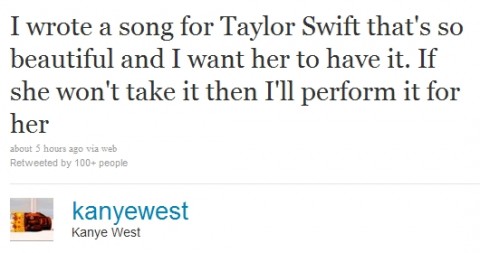
Rap star Kanye West bashed former President George W. Bush on Saturday while apologizing to country singer Taylor Swift for his appalling behavior at last year’s MTV Video Awards. Our story begins with West making a fool of himself – again! – when he interrupted Swift last September during her acceptance speech for best female music video of 2009 (right). With the 2010 Awards quickly approaching, West must have felt it necessary to make amends. As People.com reported moments ago, West took to Twitter early Saturday morning issuing a bizarre stream of consciousness apology: “I wrote a song for Taylor Swift that’s so beautiful and I want her to have it,” he said on his Twitter Saturday morning. “If she won’t take it then I’ll perform it for her.” West’s actual Twitter account doesn’t show any of these tweets. However, the People links do indicate the activity being reported suggesting West has since taken them down: Nearly a year since he first apologized to Swift, the hip-hop artist is still offering up I’m sorries, calling her “justa lil girl with dreams like the rest of us” on his Twitter . “She deserves the apology more than anyone,” he Tweeted , before thanking the creators of Twitter for making a public platform for expression.   ” We’re both artist[s] and the media and managers are trying to get between us. Everyone wants to capitalize off this [in] some way.”  Maybe even more delicious, MTV.com reported some other tweets People missed: Expounding on the backlash he received, he wrote, “If you Google a–hole my face may very well pop up 2 pages into the search. … There are people who don’t dislike me … they absolutely hate me. People tweeted that they wish I was dead … No listen. They wanted me to die, people. I carry that.” I was indeed hoping his face would appear in such a Google search. Unfortunately, no. But I digress: Kanye went on to say that the media vilified him. He alluded to his claim during a 2005 NBC telethon for Hurricane Katrina that “George Bush doesn’t care about black people,” as a point for which the media was looking to pay him back. He noted that in the VMA aftermath, the media played the race card and turned it into an angry black man versus innocent white girl issue. “Even though the NBC telethon was widely praised y’all didn’t think they was just gone let me get away with that did y’all???!!!” he questioned, rhetorically. “The media has successfully diminished the ‘receptive’ audience of… KANYE WEST. …taking a 15 second blip the media have successfully painted the image of the ‘ANGRY BLACK MAN.’ The King Kong theory. With the help of strong will, a lack of empathy, a lil alcohol and extremely distasteful & bad timing … I became George Bush over night.” I was wondering when he’d take to bashing Bush. For those that have forgotten, this was West during the aforementioned Hurricane Katrina telethon in September 2005: I hate the way they portray us in the media. If you see a black family, it says they’re looting. See a white family, it says they’re looking for food. And you know that it’s been five days because most of the people are black. And even for me to complain about it, I would be a hypocrite because I’ve tried to turn away from the TV, because it’s too hard to watch. I’ve even been shopping before I’ve even given a donation. So now I’m calling my business manager right now to see what is the biggest amount I can give, and just to imagine if I was down there, and those are my people down there. So anybody out there that wants to do anything that we can help with the set up the way America is set up to help the poor, the black people, the less well-off as slow as possible. I mean, the Red Cross is doing everything they can. We already realize a lot of people that could help are at war right now, fighting another way, and they have given them permission to go down and shoot us…George Bush doesn’t care about black people. Makes one wonder how much alcohol and “extremely distasteful & bad timing” it took for West to again make an “a–hole” of himself. Actually, it should now be apparent that this isn’t that difficult for him. 

See the original post here:
Kanye West Bashes Bush While Apologizing To Taylor Swift On Twitter

TIME: Rising Unemployment Rate Is Good News

The following headline appeared at Time.com shortly after the release of Friday’s jobs report: What’s Good About Rising Unemployment What should jump out at the eagle-eyed reader is that headline didn’t end with a question mark. Time senior writer Stephen Gandel was actually making the case that the rising unemployment rate was good news. Watch just how far a liberal media member is willing to go today to make economic data look favorable for the Party currently in power, and imagine the unlikelihood of such a thing happening if a Republican was in the White House (h/t Rusty Weiss ): The unemployment rate, probably the most famous of economic gauges, may actually be a very bad indicator of how healthy the economy is. The unemployment rate peaked in late 2009 at just above 10% and has been mostly falling ever since. But the hiring numbers, or less firing numbers, have only been improving recently. So what was going on? The unemployment rate tracks not just how many people have jobs, but how many people are looking for jobs. And, up until August, the number of people looking for jobs was dropping rapidly. Really? And just how did Gandel reach that conclusion? Here is the Bureau of Labor Statistics’ table of folks 16 and over currently out of the labor force but wanting a job now: As is plainly visible, the number of folks out of the labor force but wanting work has been fluctuating between 5.61 million and 6.31 million since last August. It did experience a large drop in May, but has pretty much been rising since and is now basically where it was in April and January. As such, claiming that “up until August, the number of people looking for jobs was dropping rapidly” is utter nonsense not supported by the data. In fact, this number is basically right back to where it was last September. With that in mind, let’s continue: When people give up looking for work, essentially giving up on the economy, that indicates a really bad drop in confidence, something a recovery feeds on. So the reason the unemployment rate was rising has less to do with more people getting jobs, and more to do with fewer people looking. Is this really a senior writer?  Let’s walk through that last sentence again: “So the reason the unemployment rate was rising has less to do with more people getting jobs…” Huh? The unemployment rate is a simple arithmetic equation whereby the number of people unemployed is divided by the number of people considered part of the labor force.  Using data just released Friday, there are currently 14.86 million people considered unemployed. The labor force is 154.11 million. This produces an unemployment rate of 9.64 percent. Now, when people get jobs, the number considered unemployed declines reducing the numerator and therefore decreasing the unemployment rate. As such, to claim rising unemployment has less to do with more people getting jobs makes absolutely no sense. On the other hand, the final part of that sentence “and more to do with fewer people looking” needs to be addressed. “Discouraged workers” – those out of the labor force but wanting a job – can have a huge impact on the unemployment rate. The way these numbers are calculated, you are only considered unemployed and part of the labor force if you’re actively looking for work. As such, when folks give up their search, it reduces the number of unemployed and the labor force by an equal amount. Once again going back to simple arithmetic, a decrease in the numerator and denominator by an equal amount results in a lower ratio. 2 divided by 3 equals .67; 1 divided by 2 equals .5. With this in mind, the unemployment rate can decline simply by discouraged job seekers ending their search. This has happened a number of times in the past few years. Conversely, discouraged workers re-entering the labor force can cause the unemployment rate to rise. An increase in the numerator and denominator by equal amounts produces a higher result. Gandel claimed this is what happened last month: According to today’s report, 550,000 people entered the workforce in August. That’s a huge jump of new people looking for work, either because they haven’t worked before or because they decided that this was the month to get back off the couch and start looking. With that many people entering the workforce, the fact that the unemployment number only rose 0.1% is quite a good thing. In fact, more than half of those people who began looking for work in August, or 290,000, landed a job in August.  I agree that this this could be good news, but not necessarily for the same reason. To make the case that the big jump in the labor force in August was even partially due to discouraged workers starting to look for work again goes against the data as the number of people out of the labor force and wanting work now increased by 86,000. It goes without saying that if this huge increase in the labor force was caused by discouraged workers re-entering it, the number of discouraged workers wanting work should have declined. But that’s not what happened. Instead, it appears the August data might have been confounded by seasonalities and the associated adjustments. As employment watchers are painfully aware, there are seasonal changes in the jobs market that make for wild shifts in the numbers depending on the month. The summer is a particularly volatile period with teachers out of work, students taking part-time jobs, and graduates getting full-time positions. To smooth out the data, the Labor Department makes adjustments to the raw figures each month; the headline numbers are always “seasonally adjusted.” However, these manipulations at times present a peculiar picture of the labor market. As Gandel correctly pointed out: It is possible that coming at the end of the summer an uptick in people looking for work is not as positive as it appears. This is the time of year, after two hot months, when recent graduates start to actually think about their future and send out resumes. And you can image many other out of work people deciding to take off looking for a job in the summer. In August, with the summer ending, some of those people started looking again in earnest. Exactly. As such, the uptick in the labor force might have had little to do with discouraged workers beginning a new search as he suggested earlier.  In fact, the unadjusted data actually showed a 600,000 decline in the labor force as well as an almost 400,000 decrease in the number of people unemployed. This means the August data could easily be confounded by seasonalities and their related adjustments thereby offering a fuzzy picture about what any of this means going forward. This is not to say Friday’s report wasn’t better than expected. Over the past couple of weeks, signs had been pointing to a much worse economic conditions leading analysts to ratchet down their estimates for these numbers. As a result, what the BLS released Friday was certainly better than the gloomiest predictions out there. But, calling this clearly mixed bag “good news” should be left to the administration and the Party currently controlling Congress and not so depicted by a so-called journalist.   This seems especially true given that these exact same numbers would certainly not have been reported with such optimism when George W. Bush was in the White House. Or have you forgotten the media’s favorite economic term during his presidency “jobless recovery?”

Read more:
TIME: Rising Unemployment Rate Is Good News

Vanity Fair Reporter Admits Error In Sarah Palin Hit Piece

For almost two years, Sarah Palin has been complaining about media members making things up about her. On Friday, one finally admitted it. As NewsBusters reported Wednesday, Vanity Fair’s October issue has a hit piece on its cover about the former Alaska governor that Palin-hating press members have been predictably fawning and gushing over. Now, the Associated Press is reporting that the author, Michael Joseph Gross, has admitted making a mistake in his piece: Reporter Michael Joseph Gross describes Palin’s youngest son, Trig, being pushed in a stroller by his older sister, Piper, before a rally in May in the Kansas City suburb of Independence. “When the girl, Piper Palin, turns around, she sees her parents thronged by admirers, and the crowd rolling toward her and the baby, her brother Trig, born with Down syndrome in 2008,” according to the article. “Sarah Palin and her husband, Todd, bend down and give a moment to the children; a woman, perhaps a nanny, whisks the boy away; and Todd hands Sarah her speech and walks her to the stage.” Later in his piece, Gross described Piper joining Sarah on stage to “allow Palin to make a public display of maternal affection.”  Unfortunately, as Politico’s Ben Smith reported Thursday, that was a different Down syndrome baby: Trig wasn’t at the event, according to its organizer, Karladine Graves, a 61-year-old Kansas City physician, who, in 2009, founded one of the wave of new local conservative groups, this one called Preserving American Liberty. The “woman, perhaps a nanny,” was the boy’s mother, St. Louis talk radio host Gina Loudon, according to Graves. But it gets worse according to the AP: The mother of that child, conservative activist Gina Loudon, told the St. Louis Post-Dispatch that she told Gross during the rally that the child in the stroller was her son, not Palin’s. She said she tried to make it clear because the two children look a lot alike. “I told him that. And he ignored it,” Loudon said. “It’s not even like he didn’t fact check – he just ignored facts.” Now, Gross has admitted it: Gross said in a written statement sent to The Associated Press that he was mistaken. “Trig was with his mother the next day in Wichita (Kan.), but the child in Independence was someone else, and I regret the error,” he said. He regrets the error? No he doesn’t. He regrets getting caught, for as Smith wrote Thursday, this has been a modus operandi for dishonest media members like Gross for two years: [T]he Vanity Fair piece on Sarah Palin is so emblematic of much that’s wrong about the way she’s covered that it’s worth returning to, and I’ve learned that the its long wind-up is based on fundamental confusion about which of Palin’s children was at an event in Kansas City. Palin almost never talks to neutral media outlets, leaving her – as critics accurately note – subject to none of the questions, challenges  and reality checks that the political press puts regularly to almost every other national political figure. She takes a lot of heat for this, deservedly. But with the hunger for information about her, and the traffic she drives, the press sometimes compensates by printing such thinly sourced, badly reported nonsense about her that it’s hard to imagine it making it into a serious magazine like Vanity Fair if it concerned any other figure. Of course, this might not happen if she spoke to reporters, but that’s no excuse. Yeah it is, Ben, for what’s the point of talking to the press if they’re going to just make stuff up? Of course, this is the kind of yellow journalism by “impotent, limp, gutless reporters” Palin ridiculed while chatting with Sean Hannity Wednesday, and is why it’s difficult to believe any of the nonsense about her in the media. Vanity Fair should be so proud of itself. 

See more here:
Vanity Fair Reporter Admits Error In Sarah Palin Hit Piece

Journalism Institute Honors Dan Rather; He Calls for ‘Trust-Busting’ Our Media Monopoly

The Poynter Institute welcomed disgraced former CBS anchor Dan Rather to share his thoughts on his long career and on the media in general this week. In an interview with Poynter’s Mallary Tenore , he complained “So often, particularly covering politics, enterprises that describe themselves as journalistic enterprises, and journalists who describe themselves as journalists, in fact just become transmission belts.” That’s exactly what Poynter’s interview was, a transmission belt for Rather’s lamest hits, including how the press needs a “spine transplant” and his shameless insistence that his phony-documents Texas Air National Guard story is still true. If Poynter cared about the reputation of journalism, why continue to entertain and spread doubt about the falsehood of Rather’s most atrocious “scoop”? The only thing fresh here is Rather’s growing socialism , as he insists (just like Bill Moyers) that money is corrupting politics and the government needs to break some alleged media monopoly where only four mega-corporations distribute most of America’s news: So number one is journalists need to get back to their business of being patriotic journalists in a free and democratic country and perform their function as watchdogs, as part of the system of checks and balances. We all know that huge sums of money are corrupting the whole political process, beginning with elections. For example, the last presidential election in this country, when all was said and done and you put everything together, costs more than $2 billion. That’s what was spent through the primaries, through the general election, all told. That money, not all of it came from special interests, but the bulk of it came from special interests — big pharmaceutical companies, big broadcasting networks, television, radio, electronic, big labor — and that’s a very short list. But you have a more recent example here in Florida where just to win a primary, at least two candidates spend what, more than $50 million or $60 million of their own money. This has reached the serious out-of-whack stage. So you say how can we improve coverage? Getting serious about where the money comes from, who gives it to whom, for what purpose — and most of it is given for a purpose. The case can be made — and I’m here to make it — that very large, international corporations, conglomerates control the government, and I would include some elements of big labor in that. The public is not well-served by political coverage as it is today. And I think it has to be noted, and there’s no joy in noting this, that in many important ways, very big business is in bed with big government and whoever’s in power in Washington, whether it be Republicans or Democrats — not in the public interest, but in the business interest of the huge corporations and in the staying in power business of those in Washington. And this seriously affects news coverage. Someone might say, well what is he talking about? Well let me give you an example. As recently as the 1950s, mid-1950s, there were more than 50 news enterprises, which is to say businesses, in the country that could accurately be described as having national distribution or large regional distribution. Now, there are no more than six, and I would argue only four, very large conglomerate, international corporations who control more than 80 percent of the national distribution of news. This is out of whack . Let me pause and say I’ve never worked for anybody in the enterprise other than a profit-making enterprise. I believe in the capital system, but as applied to media, we have in no small degree monopolies now. Now a great Republican president, Theodore Roosevelt did his party great service, and more importantly his country a great service, by breaking up the trust, which is to say the monopolies at the turn of the 20th century …. I’m not a business person, but in the end I think they’re not in the best interest of American business. I recognize that one gets criticized very heavily when get into this area, but I’m at the age and stage in my own career where I try to draw from my experience. I love this country, I want the country to be better for my children and grandchildren as most Americans do. And when and if the public finally get focused on this — that too few big international companies control too much of the national news distribution — then I think it may change. But until the public really understands what is happening with this, and understands that it is not a special pleading of journalists such as myself, can we come back to a really vibrant, truly independent, fiercely independent press that is important to the survival of freedom and representing government as we know it. Rather should really be writing for The Nation or Mother Jones, with this kind of hard-left talk about capitalism despoiling democracy. Poynter’s Tenore is especially embarrassing when asking Rather about the latest Internet trends, where he is clearly not well versed. He claimed “There are very few journalism enterprises on the Internet” and couldn’t answer whether he has his own personal Facebook page:  “I don’t think so.” Shouldn’t a journalist who insists his craft is so grievously lacking be a little more up-to-date?

See the original post here:
Journalism Institute Honors Dan Rather; He Calls for ‘Trust-Busting’ Our Media Monopoly

A Private Star

“In retrospect, it’s all sort of hilarious,” says Annette Bening of the media circus in which her current life as star, mother, and wife of Warren Beatty began. Here she opens up about why she dislikes feminist complaints about Hollywood, what actors intimidate her, and just how unlikely it is her husband would approve of her doing a nude scene like the one she did in The Grifters .

Link:
A Private Star

Phone Hacking at Murdoch’s Tabloid Was Widespread, Unapologetic [Scandals]

Four years ago, Rupert Murdoch -owned UK tabloid The News of the World got caught hacking the voicemail of “hundreds of celebrities” and other public figures. Now, the full extent of the hacking’s coming out —and it’s bad. Amazingly dirty, actually! More