Tag Archives: military

Muslims pray less than 80 feet from Pentagon’s 9/11 crash site

While Americans are bitterly debating the proposed building of a mosque near New York's ground zero, Muslims have been praying for years less than 80 feet from where another hijacked jetliner struck. The Pentagon chapel is part of a memorial to the 184 people killed in 2001 when hijacked American Airlines Flight 77 flew into the west side of the Pentagon and plowed through three of the building's five office rings. As part of its massive renovation, the Pentagon opened the nondenominational chapel in November 2002. The chapel hosts a daily prayer group and weekly worship service for Muslims and provides similar services for Jews, Hindus, Mormons, Protestants, Catholics and Episcopalians. Pentagon officials say that no one in the military or the families of the victims of the Sept. 11 terrorist attacks has ever protested. They describe the 80-seat chapel as a peaceful place where some 300 to 400 Pentagon employees come to pray each week. The goal of the Pentagon chaplain office, which runs the chapel, is to “provide assistance and support for the religious, spiritual and morale needs of all service members and employees,” said Army spokesman George Wright. A proposal to build an Islamic cultural center near ground zero in New York has prompted angry protests by victims of the 2001 attacks, which were done in the name of Islam. A majority of New Yorkers say they are opposed to the plan. More @ link added by: Future_America

In ‘Tillman Story,’ Anti-Bush Conspiracy Just Doesn’t Add Up

There are three important things going on in “The Tillman Story” (in selected theatres today), two of which almost make the conspiracy-mongering documentary worth your time. The first and best is the opportunity to get to know better the extraordinary and extraordinarily complicated and interesting Pat Tillman. In the best sense of the word, this was a fierce and fiercely passionate man – fierce on the football field, fierce on the battlefield, and fierce in his personal beliefs. This was also a man who only ever dated one woman, the woman he would marry the same week he enlisted; and my guess is that Tillman was the kind of man and husband who found leaving the fame of professional football much easier than leaving his young bride.  You also meet Tillman’s family; his parents, brother and wife – a decent, loving, inconsolable group dealing with the terrible loss of someone they obviously loved and miss very much. This is a family furious with a United States government who didn’t know all the facts before they told the story of Tillman’s death to them, and to the American people. And as far as that goes, they are right to be angry.  Unfortunately, you also witness a partisan filmmaker attempting to prop up the absurd anti-Bush conspiracy theory that it wasn’t the ever-reliable incompetence of government bureaucracy that caused what was probably the second worst day in this family’s life – the day they were told Tillman had been killed in a friendly fire incident, but rather a sinister plot hatched by the Administration and the Pentagon to use Tillman’s death as a flag-waving symbol to bolster military recruitment and support for the war. The Tillman family agrees wholeheartedly with this conspiracy, believes that the memory of their heroic son was maliciously abused in this way. But with all due respect to them (and they are due our respect), neither logic nor facts come close to making that case.    As far as addressing the specific details surrounding the film’s specific charges, using his military experience and keen mind, Kurt Schlichter has already taken much of the film’s case completely apart, piece by piece, and I urge you to  read his review . My review will remain focused solely within the context of the documentary itself, a documentary no intellectually honest person can respect, much less champion.    To director Amir Bar-Lev’s credit, the most important fact of this entire case is not left out of what basically plays like an overlong “60 Minutes” segment. But this important fact is glossed over and presented so early on that – probably by design – you might forget all about it during the third act as circumstantial evidence is laid out hot and heavy with the help of foreboding camera moves – such as the one that slowly rises though a mob chart of Administration “bad guys” until ominously arriving at the smiling face of one President George W. Bush. It’s just too bad for Bar-Lev that the melodramatic use of a camera crane doesn’t equal damning facts.  On May 3rd, 2004, a memorial for Pat Tillman took place in San Jose’s Municipal Rose Garden. Tillman was posthumously awarded the Silver Star and both his family and the whole world believed he had been killed in a Taliban ambush during a brave attempt to draw their fire in order to save his own men.  Just a few weeks later, the Army would come forward to acknowledge that this narrative was wrong and that Tillman had been killed by friendly fire.  At this point, the question that came to my mind was why would the Pentagon and the Bush Administration voluntarily come forward and uncover their own conspiracy? The film makes no mention of any outside pressure on the Pentagon from the Tillman family or even the media to get the bottom of anything. Meaning that at this point everyone believed the initial report and apparently all the Administration and military had to do to keep us all believing was to keep their mouths shut.  So the question is: If the idea was to use Tillman’s death for nefarious pro-war purposes, why just a few weeks after the memorial service would those with the most to lose from doing so, voluntarily kick over a political hornets’ nest by telling the truth? Why not milk the situation for as long as possible and for as much propaganda as possible, especially with a presidential election just five months off? At the very least, why not save all the political heartache and fallout this revelation was sure to bring (and did) and stall until after Bush is reelected?  A producer once told me that whenever you have a film character open a refrigerator door you either have to show them close it or include the sound effect of the door closing, or else the audience will get unsettled thinking the door has been left open. Bar-Lev’s refusal to address or explain why a supposed-group of conspirators would of their own volition blow the whistle on their own supposed conspiracy leaves that door open. And no fancy camera move or sinister scoring is going to close it.  As the film moves towards its climax, an August of 2007 Congressional hearing, the conspiracy becomes even less convincing. Democrat Rep. Henry Waxman brought together all the players, including Donald Rumsfeld and General Richard Myers, to testify under oath and before the television cameras about what they knew and when they knew it. You get the sense that Bar-Lev actually wants us to believe that Henry Waxman, one of the most extreme Bush haters in all of Congress, was – at best – less than enthused at this opportunity or maybe even in on the alleged cover up.  Bar-Lev’s sin of omission is not giving the audience any background on Waxman’s  investigative crusades to bring Bush down , which would go a long way towards giving this Congressional hearing looking into the Tillman case credibility. But that kind of knowledge would also work against the filmmaker’s obvious political agenda. No one wanted Bush’s scalp more than Henry Waxman. Instead, however, all we see are shots of the Congressman looking indifferent and bored.  To anyone who’s even a tenth the independent thinker Pat Tillman was, this documentary looking into his death never rises above the level of left-wing propaganda.  Pat Tillman was a patriot and an American hero, and the truth of what happened that terrible day changes none of that. As far as Pat Tillman’s family, there is nothing they deserve more than whatever emotional closure one can have in such a situation. I do hope they find it. But where they’re looking for it now, it simply doesn’t exist. Crossposted at Big Hollywood

View post:
In ‘Tillman Story,’ Anti-Bush Conspiracy Just Doesn’t Add Up

‘The Expendables’ Arsenal: A Weapon-By-Weapon Guide

Weapons supervisor Kent Johnson leads us through the biggest, baddest arms from the action hit. By Adam Rosenberg Dolph Lundgren and Sylvester Stallone in “The Expendables” Photo: Millennium Films Sylvester Stallone proved that his action star still burns brightly with the box-office-winning performance of “The Expendables,” which he wrote, directed and starred in. The veteran of action classics like “First Blood” and “Demolition Man” ceded some screen time in this latest outing to action stars of yesterday and today, particularly the core “Expendables” team of Jason Statham, Jet Li, Dolph Lundgren, Terry Crews and Randy Couture. As impressive as that lineup is, the collected firepower of the group is what makes them really scary. Just try to identify some of those guns and blades in the heat of combat — it’s impossible. So MTV News got on the phone with Kent Johnson, property master and weapons supervisor for “The Expendables,” to get the inside scoop on who used what and why. For those who haven’t seen the movie, spoilers ahead. You’ve been warned. Handguns and Revolvers Stallone actually makes use of three handguns in the movie: a pair of semi-automatic pistols and a more traditional six-shooter, the sort that you’d see in a Western — only far more dangerous-looking. Johnson identified the pistols as custom-made Kimber Gold Combat IIs. “It’s a .45 [caliber],” Johnson said. “Kimber put them together for us. Sly wanted something a little bit different, a little more unique, a little more of an individual style, so we were able to make the body of the gun a little darker with black grips and little chrome pieces on it. Just very subtle, to make it more personal.” As anyone who’s seen the movie knows, Stallone fires those twin pistols at a remarkable rate. According to Johnson, that’s perfectly realistic and all based on the skill of the shooter, who in this case is one of the most accomplished action stars of the past 30 years. “A gun will fire as quick as you let the gun work, because it’s a gas-activated gun — meaning the gas in the chamber causes the recoil — which causes everything to work in the gun and the next shell coming up. So as fast as you could possibly pull the trigger is how fast that gun will.” Compare that to Sly’s revolver, which is an “1873 six-shooter with a 3-inch barrel” seen in the first and last scenes of the movie. “It’s a single-action gun, which means it won’t cock, it won’t fire like [the Kimbers], where you just pull the trigger and it’ll go bang, click, bang, click. With a single-action, you have to pull the hammer back,” Johnson explained. “[Stallone] was using it like the old Western style, like a fanner-type gun. What it is, is you have your finger on the trigger pulled at all times, and you fire and rotate, fire and rotate, by pulling the hammer back on the gun [and then letting it go], which is what a lot of quick-draw and fast-draw artists [do].” Shotguns and Rifles As cool as Sly’s paired pistols are, the undisputed star weapon of the movie is Hale Caesar’s (Terry Crews) automatic shotgun, an “MPS AA-12 Sledgehammer.” The weapon itself is a beastly thing, capable of laying down rapid-fire shotgun blasts. What makes it a force to be reckoned with in “The Expendables” however is the ammo that Caesar fills it with, which he describes in great detail during one particular scene. Said Johnson: “It has fins and it explodes before it hits the target. … It’s like a little missile, a little ground-to-air missile. You could load a shotgun shell with a solid pellet, you could load it with birdshot, you could load it with buckshot, you could load it with all different things. The way we did it [in ‘The Expendables’] was, basically, [we built it] to take down buildings, and it does. In real life, this shotgun would do pretty close to what you see on the screen.” Even more frightening is the idea that such a destructive bit of firepower exists. It does, Johnson said — sort of. “There’s something like that that does exist, yeah. We basically made up our own shell, but we copied one that was a prototype that is in development for the military.” A range of assault rifles are also on display in the movie, though the climactic battle is highlighted by two in particular. First, you have the bad guys, led by David Zayas’ General Garza. “All of Garza’s military guys we had [equipped] with AK-47s,” Johnson revealed. “Which is the right gun, [because], basically, they work all the time. So the AK-47, which is the old traditional standard workhorse, versus our boys with their modern weaponry.” In the case of the Expendables, “modern weaponry” is one tactical assault rifle in particular: the Noveske N4. “In the real world, it’s high-tactical, more in Europe than the States. It’s a high-caliber, it’s a very uniquely balanced weapon, a close-quarters weapon. It’s short and has a lot of firepower,” Johnson said. As with most of the other weapons on display in the movie, the N4 was Stallone’s pick. “He liked the look; it works off of rail systems, so we were able to put smaller but better sights on it, we were able to put better scopes on it. Visually, it was just a better, more futuristic-but-contemporary look without getting into silver [plating] or other crazy things, it’s just a real kick-ass weapon.” The Sharpened Blade Not all of the weapons in “The Expendables” go boom. Some slice through the air with nary a sound. Dolph Lundgren’s Gunner Jensen and Jason Statham’s Lee Christmas both make notable use of bladed weapons. “[Lundgren’s] Bowie knife … that was a Gil Hibbons. That’s the knife that Gunner gives Christmas [at the beginning of the movie]. “Gil Hibbons made a custom knife for us, for Sly. He and Sly have worked throughout the years together,” Johnson continued. “It was a white-bone handle and had the Expendables logo, the same logo that was on the motorcycles. It’s a traditional Bowie knife, but he custom-made it for us for the movie. The design was Gil’s, but he [used] some subtleties in the handle, very small little subtle things to make it a unique piece.” Then there’s Statham’s Christmas, who excels at killing silently from a distance with his throwing knives. “That was director’s choice on the [throwing] knives to have a little ring at the top so [Statham] could flip them and do different things,” Johnson explained. “We worked in different ways on making [Statham’s draw look right]. We went from a shoulder draw to a hip draw to kind of like a gun draw almost. That’s pretty much what we ended up with, where we had the three knives on each side of his hips. “That was the director’s idea in working with Jason, what made him feel comfortable and made him feel like he could be as quick as anybody with a gun with that knife. You’ve got to be able to get that knife and then be able to get the second one and the third one. He always carried at least six knives with him at all times when he was in his combat gear.” Finding the Right Weapons for the Job With all the killing force detailed above, the obvious question is: Where does it all come from? Johnson, being the man who makes it all happen, has the answer. “There’s different prop rental houses and different weapon rental people. I’ll work with the director and what his vision is for the movie, and basically I’ll go out and bring him an assortment of guns. Sly’s even gone to the gun room, multiple times, where he wanted to look at things,” Johnson said. He’s worked on Stallone projects since 1989’s “Tango & Cash,” and on “Big Trouble in Little China,” “Death Wish II,” “The Final Countdown” and others before that. “There’s one shop that I work with extensively called Independent Studio Service. They’re in Sun Valley, California, and they have the biggest weaponry [selection] probably in the world for the movie business,” he said. The guns themselves are the other key to the puzzle. These are all actual weapons that have been converted for prop use, though in most cases converting them back to live weapons is possible. Some of them still are live weapons; they’re simply loaded with blanks. “A gun with blank ammo, all you’re doing is making the gun think it’s firing a bullet,” Johnson explained. “They’re all real guns, they all have been modified to shoot blanks. Sly’s 3-inch 1873 six-shooter that he had in the small of his back, you could put live rounds in that gun and fire that gun because it’s a non-plugged gun. Non-plugged meaning, when you fire a semi-automatic or a full automatic, you actually plug the barrel of the gun and control the amount of gas that stays there to make the gun think that it’s shooting a live round out. “So you’re fooling the gun. All of these guns that are converted for studio use can be converted back to live fire.” Check out everything we’ve got on “The Expendables.” For breaking news, celebrity columns, humor and more — updated around the clock — visit MTVMoviesBlog.com .

View post:
‘The Expendables’ Arsenal: A Weapon-By-Weapon Guide

Misdiagnosed Vets Can’t Get PTSD Treatment

Alex Simmons produced Vanguard's “War Crimes,” about veterans who have been charged with violent crimes. In the last two years the Army has drastically cut the number of “personality disorder” designations, increasingly diagnosing soldiers instead with post-traumatic stress disorder, or PTSD. This change comes after The Nation reported that thousands of soldiers at the height of the Iraq War may have been misdiagnosed, and were thus unable to seek treatment for what they really have — PTSD. From one recent news account: Unlike PTSD, which the Army regards as a treatable mental disability caused by the acute stresses of war, the military designation of a personality disorder can have devastating consequences for soldiers. Defined as a “deeply ingrained maladaptive pattern of behavior,” a personality disorder is considered a “pre-existing condition” that relieves the military of its duty to pay for the person's health care or combat-related disability pay. In “War Crimes” we saw that PTSD can be treated but — when it goes unchecked — it can lead to disastrous scenarios. Read more from The Nation about this issue. Watch an extra from “War Crimes” about a Los Angeles organization that treats vets with PTSD: “War Crimes” airs Wednesday, August 18 at 10/9c on Current TV. Watch a trailer for the episode after the jump. added by: alexsimmons

Open Thread: Michelle O’s Lavish Taxpayer Funded Vacation During Recession

For general discussion and debate. Possible talking point: the First Lady is  spending beaucoup bucks on lavish vacations while the country is mired in what her husband calls the worst economic slowdown since the Great Depression! Michelle Obama today faced a fresh wave of attacks over her lavish break in Spain with 40 friends, which could easily cost U.S. taxpayers a staggering £50,000 a day. The First Lady has been lambasted for her extravagance at a time when the economy is still struggling. One blogger went so far as to brand her a modern-day Marie Antoinette. And her critics will be further annoyed when they learn that the president’s wife had a Spanish beach closed off today so that she, her daughter and their entourage could go for a swim. Thoughts? 

See the article here:
Open Thread: Michelle O’s Lavish Taxpayer Funded Vacation During Recession

CNN Features Disabled Iraq War Hero Selflessly Assisting Other Injured Veterans

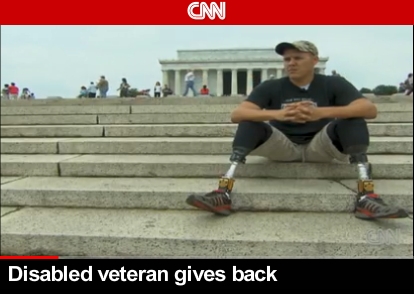
A lot has been said over the years about how our media ignore heroes returning from the wars in Iraq and Afghanistan. On Friday, CNN aired an absolutely fabulous piece about Dale Beatty. “In 2004, at the age of 26, Dale’s vehicle hit a land mine in northern Iraq and at that moment, Dale’s life was about to change forever,” said Kyra Phillips on “CNN Newsroom.” “I met Dale when we were partnered together in the Fisher House Golf Tournament. Fisher House provides free lodging for military families receiving treatment for war injuries,” she continued. “And it was then that Dale told me about his charity, Purple Heart Homes. Vets helping vets from every war, from building awareness to building ramps.” Try to watch the following fabulous story without shedding a tear (videos follow with transcript and commentary): KYRA PHILLIPS, ANCHOR: August 7th, 1782, George Washington established the Purple Heart, a badge of military merit declaring, quote, “Let it be known that he who wears the military order of the Purple Heart has given of his blood in the defense of his homeland and shall forever be revered by his fellow countryman.” Now I’d like to introduce you to one such man who not only wears that Purple Heart badge of honor, but Sergeant Dale Beatty lives it. In 2004, at the age of 26, Dale’s vehicle hit a land mine in northern Iraq and at that moment, Dale’s life was about to change forever. I met Dale when we were partnered together in the Fisher House Golf Tournament. Fisher House provides free lodging for military families receiving treatment for war injuries. And it was then that Dale told me about his charity, Purple Heart Homes. Vets helping vets from every war, from building awareness to building ramps. CNN photojournalist Jay McMichaels shows us how Dale Beatty is “Making His Mark.” (BEGIN VIDEOTAPE) DALE BEATTY, U.S. ARMY VETERAN & CEO OF PURPLE HEART HOMES: I’m Staff Sergeant Dale Beatty, retired from North Carolina. Playing drums in my band today, Southern Fried. Hopefully we’re going to rock these other bands off the stage. (MUSIC PLAYING) BEATTY: A big part of getting back to living is doing therapy. I had to start playing drums again because I had done that before. (MUSIC PLAYING) BEATTY: Purple Heart Homes is a 501(c)(3) public charity founded by John (INAUDIBLE) and myself. We are 100 percent veteran owned and operated. We’re both combat wounded veterans. Today, we’re out here for a Vietnam veteran, Kevin Smith, who is looking at some decreased mobility in the near future due to injuries received in the line of duty. KEVIN SMITH, VIETNAM VETERAN: I have had 14 surgeries on my right knee with three total knee replacements. I have had eight operations on my elbow with two total elbow replacements. I have had three back operations with steel plates and rods put in my back. BEATTY: And what we’re doing here is building him an accessible ramp and a nice deck where he can get into his house. Coming down from his driveway, he has steps with no handrails, and he’s looking at probably being in a wheelchair very soon. SMITH: I mean, it’s difficult for me to even do yard work. PAUL COCKERHAM, U.S. MARINE VETERAN: When I heard about the project, I asked if anybody had volunteered for the landscaping. The answer was no, so I volunteered. I believe in the mission of Purple Heart Homes, and I just wanted to be a part of it. I’m hoping Purple Heart Homes can gain a foothold and spring good to the wounded veterans. BEATTY: This is probably about I’d say 60 hours of volunteer labor to get us to this point. Why don’t I make it rough on you, give you that one. BEATTY: This will be done today or tomorrow and hopefully we can move inside Mr. Smith’s house where he has even greater need for accessibility with his bathroom. This is my office right here. Steve Jobs would like that, wouldn’t he? But most of our calls are really not veterans looking for something to be done for them but veterans that want to say, “Hey, I want to contribute my time or effort or my business specialty to what you guys are doing.” SMITH: Dale Beatty is a true hero, and to see the sacrifices that he’s made for our country and then turn around and say thank you and to help other people that are not as fortunate as some, it’s overwhelming. (MUSIC PLAYING) (END VIDEOTAPE) PHILLIPS: Now, Dale Beatty joins us live from Charlotte, North Carolina. Good to see you, Dale. BEATTY: Good to see you, Kyra. PHILLIPS: Let’s talk a little about – before we talk a little bit about your organization — your connection to these Korean vets, these Vietnam vets — because when we first met, you talked more about them, and then you talked a lot about the guys in Iraq and the guys coming back from Afghanistan. What is it about the connection you have with these guys? What brings you and these guys together from — because you’re from totally different wars, totally different generations? BEATTY: Well, first of all, it’s really a strong relationship with the military and my family. I have Korean, Vietnam, World War II veterans in my family, and even some from world war I and before. So, it’s really important to me that my children respect that generation of veterans, and we call them the Greatest Generation, World War II. So, it’s just important for me. It’s what our country has been established on. It’s the people who went overseas and fought and came back and built this country to what it is today. PHILLIPS: And can I ask you what you’ve learned from those family members and what you’ve learned from those older vets so when you went over to Iraq, did you remember what they had taught you, told you? What stuck in your heart and your mind as a young soldier? BEATTY: Really as a young soldier I didn’t think about those older guys until I actually went to war. And dealing with what I had to deal with, I look back to what my grandfather dealt with in World War II, and some of the things he told me we never even came close to the hardship he endured. So I guess, really, some of the stories he told me when my guys would start whining in Iraq, I’d say, “Look, my grandpa was gone for four years and he never came home, and here we have Internet. We have nothing to complain about.” That’s the main thing I learned is not to complain. From those guys. PHILLIPS: That’s what’s interesting. I mean, you lost both your legs when that land mine hit your vehicle. Yet you say you have no reason to complain. BEATTY: Well, there’s always somebody worse, and even from the people getting hurt like this for hundreds of years, defending for the same values, defending the freedoms of this nation. You know, here on American soil and overseas. So, it’s a no-brainer. PHILLIPS: Tell me what you need, because we want to get the word out right now about Purple Heart Homes, and we’re going to put up the web site Purple Heart Homes North Carolina. It’s phhnc.org. Tell me what you need. I know you need financial support to keep this going. Do you need volunteers? And also, as we do ask for people to contribute and help build your fund, we saw what you were doing for one Vietnam vet, building that handicapped ramp so he can get in and out ever his house easily and get around his house easily. But tell us what this money will go towards and why you need more support, Dale. BEATTY: Well, we need more support because we’re just — I believe we just really scratched the surface with what the project you saw with Kevin Smith. We have eight more candidates, and not all of them are meeting our criteria for us to help them. So, really if people want to contribute to us in general they can go to our Web site and make a donation. That would be great. Or they can e-mail us if they’re local here and tell us how they want to support, be it through their business that they have or just volunteer labor. That’s really what we need. And also really I want for people — what I need from people is to really think about how much the private sector can do for these veterans who are still out there from Vietnam. The government can’t do everything, and that’s why we created Purple Heart Homes because the private sector and the local communities can take better care of people that are next door and in their own backyards than somebody from 600 miles away. PHILLIPS: Amen. BEATTY: So, we really need people to step up and even if they’re not helping Purple Heart Homes, go shake a veteran’s hand and tell them thank you. PHILLIPS: Well, I tell you what. It was always an honor to shake your hand, not just because you beat me on the golf course, and I was very impressed but you’re a remarkable human being, Dale. BEATTY: Thanks, Kyra. PHILLIPS: Also Southern Pride (sic), your band, maybe somebody — a record producer will spot you guys out and you can cut a CD and put that money toward the organization. BEATTY: And that would be great, too. PHILLIPS: That would be a double whammy. You’re a heck of a drummer. Dale Beatty, great to see you. Have a fabulous weekend. BEATTY: Thank you, Kyra. You too. How marvelous. Brava Kyra, bravo Jay, and God bless you Dale Beatty. 

The rest is here:
CNN Features Disabled Iraq War Hero Selflessly Assisting Other Injured Veterans

Obama Touts Fulfilled Iraq Pledge, But Withdrawal Deal Was Set Up by Bush

President Barack Obama told disabled veterans in Atlanta on Monday that he was fulfilling a campaign promise by ending U.S. combat operations in Iraq “on schedule.” But the timetable for withdrawing U.S. troops in Iraq was decided during the Bush administration with the signing of the Status of Forces Agreement (SOFA) by U.S. and Iraq officials on Nov. 16, 2008. The Iraqi parliament signed SOFA on Nov. 27, 2008. The agreement , which had been in negotiations since 2007, set a timetable calling for most U.S. troops to leave Iraqi towns and cities by June 30, 2009, with about 50,000 troops left in place until the final withdrawal of all U.S. military forces by Dec. 31, 2011. “Today’s vote affirms the growth of Iraq’s democracy and increasing ability to secure itself,” President George W. Bush said of the Iraqi parliamentary vote in a statement on Nov. 27, 2008. “Two years ago this day seemed unlikely – but the success of the surge and the courage of the Iraqi people set the conditions for these two agreements to be negotiated and approved by the Iraqi Parliament.” At the convention for disabled vets on Monday, many of whom served in Iraq, President Obama took credit for ending the war. “As a candidate for president, I pledged to bring the war in Iraq to a responsible end,” Obama said. “Shortly after taking office, I announced our new strategy for Iraq and for a transition to full Iraqi responsibility. “And I made it clear that by August 31st, 2010, America’s combat mission in Iraq would end,” Obama said . “And that is exactly what we are doing – as promised and on schedule.” On Feb. 27, 2009 — one month after taking office as president — Obama in a speech said, “Let me say this as plainly as I can. By August 31, 2010, our combat mission in Iraq will end.” On his campaign Web site, Organizing for America, however, it states that Obama would end the “war responsibly” within 16 months of assuming office, or by roughly May 20, 2010. The Web site reads: “Barack Obama will work with military commanders on the ground in Iraq and in consultation with the Iraqi government to end the war safely and responsibly within 16 months.” A Dec. 2, 2008 article in the Christian Science Monitor reported that President-elect Obama told Iraqi officials he supported the SOFA. “The security pact was the first such agreement since the invasion to outline specific terms for U.S. involvement in Iraq,” the article stated. “It was also the first in the region to be publicly debated and approved. Iraqi leaders backed the agreement after reassurances from President-elect Obama that his administration would not try to change the accord negotiated by the Bush administration.” The “surge” by U.S. troops in Iraq was announced by President Bush in January 2007 and involved the deployment of more than 20,000 additional soldiers. By mid-June, the additional brigades were in place and the surge began, focusing on al-Qaeda, Sunni and Shia foes in Anbar, Baghdad, Babil and Diyala provinces. By September, U.S. commander Gen. David Petraeus was able to report to Congress that “the military objectives of the surge are, in large measure, being met.” At the time Bush announced the surge in January 2007, then-Sen. Barack Obama (D-Ill.) said, “I personally indicated that an escalation of troop levels in Iraq was a mistake and that we need a political accommodation rather than a military approach to the sectarian violence there.” Then, in January 2008, after Bush’s state of the Union Speech and when it was evident that the surge had been successful, Obama said , “Tonight we heard President Bush say that the surge in Iraq is working, when we know that’s just not true.” House Speaker Nancy Pelosi (D-Calif.), who also opposed the surge, issued a statement on Monday this week giving Obama credit for ending the war in Iraq. “America’s brave men and women in uniform have done everything that has been asked of them in the war in Iraq; they have performed excellently,” Pelosi said. “Soon, our nation will begin a new chapter in this effort, ending combat operations on the schedule President Obama promised.” But in February 2008, Pelosi said Bush’s military strategy in Iraq had failed. “The purpose of the surge was to create a secure time for the government of Iraq to make the political change to bring reconciliation to Iraq,” Pelosi said on CNN’s “Late Edition.” “They have not done that.” In Atlanta on Monday, Obama praised the withdrawal of U.S. troops from Iraq, which will finally end, according to the SOFA agreement, on Dec. 31, 2011. “Already, we have closed or turned over to Iraq hundreds of bases,” Obama said. “We’re moving out millions of pieces of equipment in one of the largest logistics operations that we’ve seen in decades. “By the end of this month, we’ll have brought more than 90,000 of our troops home from Iraq since I took office – more than 90,000 have come home,” Obama said. Crossposted at NB sister site CNSNews .

Originally posted here:
Obama Touts Fulfilled Iraq Pledge, But Withdrawal Deal Was Set Up by Bush

SEC Claims Information Opacity, But Media No Longer So Concerned With Transparency

It seems that not even the truth can possibly overturn the narrative that President Obama and the Democrats in Congress have brought transparency to Washington. Last Wednesday I wrote about how the Dodd-Frank financial regulatory bill Obama signed into law last month contains a provision exempting the Securities and Exchange Commission from Freedom of Information Act requests. Such an exemption would surely have been grounds for a media outcry during the Bush administration, yet apart from The Wall Street Journal and CNN, only blogs have been following the developments. The latter opted simply to parrot the administration’s claims without challenge. Other media ouetlets, such as National Public Radio and MSNBC, completely ignored the controversy, in stark contrast to their extensive coverage of the Bush administration’s attempts to curtail the scope of the Freedom of Information Act. NPR’s Don Gonyea said “When conflicts arise over what should or should not be open, the administration does not hesitate to invoke the memory of 9/11. And while it’s true that 9/11 changed the security landscape, it’s also true that the administration was tightening the control of information much earlier . . .” Some journalists are simply accepting the official SEC double-talk at face value. Unlike The Wall Street Journal , which actually bothered to talk to people familiar with the SEC and the bill, CNN just repeated what Chairwoman Mary Schapiro said in her letters, starting off their story with: “The Securities and Exchange Commission was not seeking a blanket exemption from public information laws . . .” Contrast this “see no evil” approach with CNN’s coverage of similar controversies during the Bush administration. In August of 2007, CNN’s Jack Cafferty covered the Bush administration’s attempt to exempt the White House Office of Administration from FOIA, noting the administration’s claims that certain federal officers were exempt from the law. “What do you suppose is in the millions of missing White House e-mails that President Bush doesn’t want anyone to see?” Cafferty asked, rhetorically. And in March of 2004, CNN analyst Ron Brownstein hammered home the alleged lack of transparency in the Bush administration, as evinced by its stance on FOIA. “They’re [the Bush administration] very tough on executive privilege in general, and on the flow of information more broadly than that,” Brownstein claimed. “Everything from the Freedom of Information Act to the Cheney Commission on Energy.” But with Obama in office, CNN doesn’t seem to be particularly concerned about the SEC’s apparent disdain for transparency. All it’s doing is reprinting talking points, after all. MSNBC, another news outlet that has yet to devote a single word to the SEC exemption, was also far more concerned with openness during the previous administration. Mike Barnicle, guest-hosting Hardball in 2007, said in reference to Bush’s Office of Administration: “The White House says the Freedom of Information act doesn’t apply to the office that handles their e-mails, even though their Web site says it does. Are they breaking the law?” Meanwhile, Rachel Maddow claimed on the day after Obama’s inauguration that secrecy was “the hallmark of the Bush years, the thing that often made Bush administration law-breaking possible because nobody knew it was happening. The best tool that we, the people, have to break through government secrecy is often the Freedom of Information Act. It was treated as an annoyance, an obstacle to be overcome by the Bush administration.” Again, these are a concerns this cable network has yet to extend to the SEC. Chairwoman Schapiro has written letters to Sen. Chris Dodd (D-Ct) and Rep. Barney Frank (D-Ma) explaining that the law doesn’t really exempt them from responding to FOIA requests. She asserted that entities regulated by her agency under the new financial “reform” legislation must “be able to provide us with access to confidential information without concern that the information will later be made public.” Schapiro claimed in her letter that the provisions in question are “not designed to protect the SEC as an agency from public oversight and accountability.” The mainstream press has apparently decided to take her word for it. How nice of them. It’s not like federal bureaucrats have ever failed to follow their agency’s guidelines . . . This press’s attitude, of course, stands in sharp contrast to just a few years ago, when members of the media were outraged by Republican attempts to restrict FOIA requests. Many in the media have, like NPR, decried the Bush administration’s use of 9/11 to curtail transparency, but thus far no one has criticized the current administration’s use of financial reform for the same goals. The double standard is telling.

Read the original here:
SEC Claims Information Opacity, But Media No Longer So Concerned With Transparency

Was WikiLeaks Leaker Lashing Out Against ‘Don’t Ask Don’t Tell’?

Army Spc. Bradley Manning may face some serious charges for allegedly leaking tens of thousands of classified military documents to the website WikiLeaks. The leak could have serious consequences for the war effort. Former Chairman of the Joint Chiefs Adm. Mike Mullen claimed that WikiLeaks “might already have on their hands the blood of some young soldier or that of an Afghan family.” In investigating the leak, will the media explore every plausible motivation on Manning’s part, even in spite of strong resistance from the forces of political correctness? We’re about to find out. Manning was openly gay, and possibly transgendered. The UK Telegraph gleaned a number of posts from his Facebook page in which he expressed what seems like intense depression, and occasionally disdain for the US military. There is evidence that he took part in protests against the military’s “Don’t Ask, Don’t Tell” policy. Did he leak the information in question as an act of protest or vendetta against military policies of which he disapproved? It’s not at all clear. But shouldn’t the mainstream press at least note that possibility? The evidence of that motivation, mind you, is at this point far from conclusive. But given the evidence, it is appropriate to pose the question. The UK Telegraph reported last week (emphasis added): The US Army intelligence analyst, who is half British and went to school in Wales, appeared to sink into depression after a relationship break-up, saying he didn’t “have anything left” and was “beyond frustrated”. In an apparent swipe at the army, he also wrote: “Bradley Manning is not a piece of equipment,” and quoted a joke about “military intelligence” being an oxymoron… Mr Manning, who is openly homosexual, began his gloomy postings on January 12, saying: “Bradley Manning didn’t want this fight. Too much to lose, too fast.” At the beginning of May, when he was serving at a US military base near Baghdad, he changed his status to: “Bradley Manning is now left with the sinking feeling that he doesn’t have anything left.” Five days later he said he was “livid” after being “lectured by ex-boyfriend”, then later the same day said he was “not a piece of equipment” and was “beyond frustrated with people and society at large”. His tagline on his personal page reads: “Take me for who I am, or face the consequences!” … Pictures on Mr Manning’s Facebook page include photos of him on school trips during his time in Wales and at a gay rights rally, where he is holding up a placard demanding equality on “the battlefield” . Does the possibility that Manning’s opinions on DADT motivated him to leak the documents in question have any bearing on the validity of the policy itself? Of course not. No one is suggesting that Manning’s homosexuality in itself motivated him to allegedly leak these documents, and therefore that homosexuals should be banned from the military. The only relevant issue is Manning’s motivation in committing the alleged offense – the rantings on his Facebok page provide a key insight into a possible motivation that any responsible reporter would be remiss in dismissing out of some concern for political correctness. Of course the media has not been keen on drawing out possible motives when the explicit mention of those motives could offend some protected group. We saw the same trend after the Fort Hood shootings, when journalists simply could not bring themselves to proclaim that Maj. Nidal Hasan was a Muslim and motivated by his faith. He may have yelled “Allahu Akhbar” while opening fire on unarmed servicemen, but the first five media outlets to report on the shooting didn’t mention the shooter’s religion. Chris Matthews wondered whether it was “a crime to call al Qaeda” – as Hasan had – and CNN actually misquoted a soldier shot by Hasan to cast doubt on the cries of “Allahu Akbar”. So far in the case of Bradley Manning and WikiLeaks, the mainstream press seems similarly averse to even considering the possibility that the Army Specialist was acting out against military policy to which he was strongly opposed. Ace contends that “If it doesn’t advance The Narrative, it never really happened,” and that the press will remain silent. Is he right? We’ll see.

Read the original:
Was WikiLeaks Leaker Lashing Out Against ‘Don’t Ask Don’t Tell’?

CNN Correspondent Touts Mangos as Tool to Fight Militants

Mango diplomacy, maybe.  Mango defense, not so much. It would be much less disconcerting to say the above headline is a joke, ripped from the headlines of The Onion .  But alas, it is frighteningly accurate. Hillary Clinton recently lauded the benefits of Pakistani mangos in a discussion of better trade cooperation between Pakistan and Afghanistan. As Reuters reports, “Hillary Clinton has lots to worry about in Pakistan, but she has found one thing she can wholeheartedly embrace:  Pakistani mangos … Clinton suggested mangos might be one place to start when discussing benefits of better trade cooperation, including Pakistani requests for improved market access.” But an analysis (emphasis mine) of Clinton’s economic recovery efforts via CNN’s Reza Sayah , defies explanation, and require a tremendous leap in logic from economic benefits, to military benefits (h/t Weasel Zippers via Michelle Malkin): Well, I think the U.S., the Obama administration, is convinced that this is the right approach.  In addition to the military approach, you have to have an economic approach. They say it’s an interesting project here.   If Mrs. Clinton has her way in the months and years to come, Pakistan will export more of its delicious and very juicy mangoes. Americans will eat them.   It will all be a part of the fight against militants. Sayeh later doubles down on the mango defense system, explaining that “… the ultimate goal is success against militants in this region.”  The mango program, he surmises, will help to curb anti-Americanism and bridge a “huge trust deficit”.  Sayeh swings for the fences at the end with, “So if you like mangos, look for Pakistani mangos to come to a fruit stand near you in the months and years to come.” John Roberts concluded the report by agreeing with the tasty allure of the legendary but intimidating, Pakistani mango: “That would be a good thing, too, because they’re quite good.” Indeed. But isn’t using mangos as a tool to curb anti-Americanism a form of mango propaganda?  Following the news, mango sales in Afghanistan rose sharply, as militants attempted to reverse engineer the fruity weaponry. To be fair, perhaps Sayeh thought that Clinton was deploying a similar program developed by the Indian army, in which they announced plans to use the world’s hottest chili pepper as a weapon to flush out terrorists.  But if India plans to use smoke grenades with a material 100 times hotter than a jalapeño, what would ‘delicious and very juicy mangos’ do to militants, make them drool into submission?  Truly, a fate worse than waterboarding.  Photo Credit:  B.K.Bangash/AP Please send tips/comments to Weiss.Rusty@gmail.com . 

See the original post:
CNN Correspondent Touts Mangos as Tool to Fight Militants