Tag Archives: Money

Glee’s Coincidental Tribute To Whitney Houston “I Will Always Love You” [Video]

The show aired last night, but naturally it was recorded weeks ago and coincidentally aired. More On Bossip! Quote Of The Day: Country Singer Miranda Lambert Says Chris Breezy “Needs To Be Put Back In His Place” A Verrrry Special Night: These Celebrities May Possibly Have Been Conceived Righhht Around Valentine’s Day Rosa Acosta And Her Cakes Wish Us All A Lovely Happy Valentine’s Day Hey Big Spender: Studies Show That The Average American Will Spend $126 On Valentines Day, Will You Be One Of Them??? Continue reading →

Cash Money’s Third Annual Grammy Party [Photos]

Cash Money held their third annual pre-Grammy party this weekend and the entire YMCMB family, and a gang of additional celebrities, were in attendance. The party was held at the Paramount Pictures Studio Lot and event producer Colin Cowie created a Parisian theme for the evening. Actress Taraji P. Henson was the host and performers included Drake, Lil Wayne, and Eryka Badu… Continue Continue reading →

Hey Big Spender: Studies Show That The Average American Will Spend $126 On Valentines Day, Will You Be One Of Them???

J.Lo said “Love Don’t Cost A Thing” sheeeeeeeeeeit we can’t tell… The visual assault happens pretty quickly after stores clear out their winter holiday displays. It starts with a few standard candy bars discreetly forming into heart shapes, and then the contagion spreads. By February 1, your favorite retailer is hemorrhaging pink and red. The signs all proclaim “Happy Valentine’s Day!” Subtext: “Buy lots of our stuff! It’s the same stuff as before, but a different color. You know, to prove your love!” This is out of control. According to the National Retail Federation, the average American will spend $126.03 on Valentine’s Day this year. That’s the highest amount since the survey started ten years ago. Those numbers are enough to give my frugal heart a coronary. I don’t do Valentine’s Day. I’m not anti-love and I’m not anti-gift, but I just can’t participate on principle. Call me a Valentine’s Day Grinch, but I don’t think I’m just being contrarian here. I don’t see a lot of equality in this love-inspired holiday. The NRF survey found that men spend nearly twice as much as women on Valentine’s Day. Informal polling of my male colleagues indicated an even wider spending gap. It was also implied by my co-workers that they think women expect gifts and that the dollar amount can matter. It’s hard to support a holiday that may make men feel inadequate and women seem materialistic, not to mention one that marginalizes all those single Americans. Source $126 seems like a bit much you say? Perhaps for some ladies it’s not enough. Let’s take a look at the stereotypical things that this money is spent on. Maybe it will help some of you fellas save a buck or two and be a lil more creative with how you tell your significant other that you love them.

Read this article:
Hey Big Spender: Studies Show That The Average American Will Spend $126 On Valentines Day, Will You Be One Of Them???

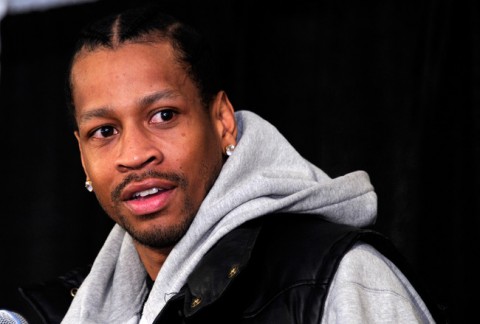
Allen Iverson Doesn’t Have A Job Because He Thought He Was Too Big Time To Start In The D-League

A.I. just won’t ever learn. Iverson was nearly a member of the Lakers, according to ESPN’s Stephen A. Smith, but he apparently wasn’t willing to meet their demands. Not only would he have had to practice, according to Smith, he would’ve had to do it while wearing the jersey of their D-League affiliate L.A. D-Fenders. Didn’t A.I. say he would do anything he could to get back in the NBA? Now he won’t even go to the D-league and start from scratch to get back in the league? Lord knows he needs the money . Maybe him and T.O. can start a Watch The Loan tour going around begging for money to get back on their feet. More On Bossip! How Precious! Jay And Bey Release The First Pictures Of Blue Ivy Carter!! Who Looked More Bangin??? Rihanna Vs. Kelly Rowland (2012 Grammy Awards) The Ultimate Swirl: Brothas Who Made White Dudes Mad [Photos] Galleries: Amber Rose, Wiz Khalifa, Kim Kardashian, Sanaa Lathan, Serena Williams, Kelly Rowland And More At Clive Davis Pre-Grammy Gala [Photos]

Read more:
Allen Iverson Doesn’t Have A Job Because He Thought He Was Too Big Time To Start In The D-League

Lil Wayne Disses Jay-Z, Kanye In Pre-Grammy Freestyle

‘I asked her what she want to watch, she said, ‘Surely not the Throne,’ ‘ Weezy rhymes, adding to the MCs’ back-and-forth. By Rob Markman Lil Wayne Photo: Kevin Winter/ Getty Images Here we go again. Hours before Lil Wayne and the Throne face off in the Grammy battle for Best Rap Album at Sunday night’s (February 12) awards show, Weezy threw shots during YMCMB’s pre-Grammy party in Los Angeles on Saturday night. After receiving some new sales plaques for his wall, announcing that he had signed R&B singer Christina Milian and paying homage to the late Whitney Houston , Wayne dropped an a cappella freestyle directed at Jay-Z and Kanye West. “I met a bad red bone, I took the bi— home/ I asked her what she want to watch, she said, ‘Surely not the Throne,’ ” Weezy spit before he dropped the mic and moseyed offstage, according to Rap Radar . Things began to sour after a 2009 interview in which Cash Money CEO Bryan “Birdman” Williams objected to Jay-Z taking the crown for MTV News’ “Hottest MCs in the Game” list for that year. “I don’t think he the #1 MC, in no kinda way,” Baby said, casting the first stone. “Wayne is the best, he do the most and he make the most money. I don’t think no n—a in the business make more money than us.” Jay returned fire at the top of 2011. On the Throne’s “H.A.M.,” Jigga made it clear that not only was Birdman, a.k.a. Baby, and Wayne not holding any Hov-caliber bucks, but that financially they couldn’t even compare to his wife, Beyonc

Lil Wayne Disses Jay-Z & Kanye West At Cash Money’s Pre-Grammy Party [Video]

Cash Money’s annual pre-Grammy party was full of performances from the YMCMB crew, and Erykah Badu, but Lil Wayne’s jab at The Throne is getting most of the attention.

Excerpt from:
Lil Wayne Disses Jay-Z & Kanye West At Cash Money’s Pre-Grammy Party [Video]

REVIEW: In Darkness Takes the Holocaust Underground — to Dull, Didactic Effect

Based on a true story out of World War II-era Lvov, Poland (now Lviv, Ukraine), In Darkness seeks to distinguish itself from the painfully distended genre of Holocaust movies with relentless “you are there” realism. It’s not quite Smell-o-vision, but the idea seems to be to try and make the experience of the 12 Polish Jews who hid in a sewer for 14 months as uncomfortable for the audience as it was for them. It seems significant that even a movie like The Reader paused in the midst of its “I was deflowered by a war criminal” melodrama to acknowledge that there is nothing to be learned from the Holocaust. Because its stories of annihilation and survival have taken on the ritual interplay of genre, often they have as much to tell us about current narrative appetites as they do about history. In Darkness , currently nominated for a Best Foreign-Language Feature Oscar, is foremost a Holocaust movie that asks to be measured against all the others; its primarily lessons are directed toward the genre itself. Not all of the victims, for instance, are noble or even particularly nice. Director Agnieszka Holland ( Europa, Europa ) seems so enamored with her own resolution on this account that little more is offered in the way of characterization. But making the victims “human” does not necessarily make them complicated, or well drawn; in fact it leaves them vulnerable to cliché. So here we have the upper-class couple (Maria Schrader and Herbert Knaup) and their two small children, the resourceful hero (Benno Furmann), the rogue (Marcin Bosak), the pretty sister (Agnieszka Groshowska), the wanton redhead (Julia Kijowska), and a few others who never really emerge from the sewer’s shadows. Crammed together into a miserable crevice of the Lvov underground after a pogrom destroys the city’s Jewish ghetto, they all behave badly some point. There are fights over food, space, noise — and though bitter religious recrimination occasionally erupts, it feels more like a requirement of the genre than a reflection of deteroriating inner lives. In Darkness is based on the story told in a 1991 book called In the Sewers of Lvov , by Robert Marshall (adapted here by David F. Shannon). Its central figure is also one we have come to recognize on film: the benevolent gentile. Leopold Socha was a Catholic Pole and prolific thief when the war broke out; he also worked in the sewer system, and offered to help hide the group of Jews in exchange for payment. Robert Wieckiewicz, an enigmatic performer with a tough potato face, plays Socha as a Polish Tony Soprano by way of Graham Greene, with all the charisma, martyr issues and ambivalence about his own better nature that suggests. In Darkness is most successful when it follows Socha through a city where life goes on despite the nightmares unfolding in plain view and underfoot. The opening scenes use an effective contrast to set up the question: What kind of times are these? Socha and his sidekick (Krzysztof Skonieczny) shake down a couple of teenagers in what appears to be a middle-class family home; during their getaway they cross paths with a group of naked women racing through a forest, pursued to their death by nattily uniformed gunmen. From there Holland continues to effectively exploit the tension between Lvov’s ominous sense of suspended reality and the denial human beings are capable of when not directly threatened themselves. Socha and his wife (Kinga Preis) speak about the massacres that take place in their streets like they have just read a report about a country halfway around the world. Though the tensions are not addressed in depth, the fact that German, Yiddish, Russian, Polish, and Ukrainian are spoken more or less interchangeably evokes the clashing ethnic currents that made Poland the Holocaust’s crucible, a better host than most of the region for genocide. Absolutely everyone is on the take, and the sudden perishability of human life has only heightened the instinct for self-preservation. That that instinct is more acutely felt in the character of Socha and his life above ground suggests the overriding misery emanating from the film’s depiction of life in the sewer. With a few exceptions — including cinematographer Jolanta Dylewska’s bravura depiction of a flash flood that threatens to drown the stowaways — Holland cannot make the group’s determination felt because she’s so intent on making us feel the mortification of their suffering. The squeaking and scampering of rats becomes a motif over two and a half hours — it ends almost every scene with one last dash of disgust — and the seemingly high incidence of sewer sex gets lingering attention as well. Rather than beginning with the assumption that there is no possibility of our coming to know that kind of suffering exactly and using imagination and insight to truly take us inside the Lvov Jews’ plight, Holland makes the base conditions of their confinement a narrative as well as aesthetic priority. And frankly it’s boring as shit. Follow Michelle Orange on Twitter . Follow Movieline on Twitter .

Read the original post:
REVIEW: In Darkness Takes the Holocaust Underground — to Dull, Didactic Effect

REVIEW: Damn! My Eyes! Who Hit Safe House with the Ugly Stick?

Safe House is a twisted claw of a movie, a picture so visually ugly that, to borrow a line from Moms Mabley, it hurt my feelings. Let’s forget, for a moment, about the sub-sub-sub- Training Day plot, in which a wily old-coot operative played by Denzel Washington simultaneously annoys and educates spring-chicken CIA agent Ryan Reynolds. The plot mechanics don’t matter much. What does matter is the inexplicable horror of how lousy this film looks. Movies aren’t strictly a visual medium — they’re too complicated for that — but there’s something wrong when the only thing you can think of while watching a picture is, “Damn! My eyes!” Where to lay the blame? It’s hard to say, but let me unwrap these gauze bandages and I’ll try. The director of Safe House is Swedish-born director Daniel Espinosa, who made a 2010 crime caper called Easy Money . Are the horrors of Safe House completely his fault? Probably not. The script, by David Guggenheim, seems serviceable enough, if generic: Washington’s character, a fugitive smoothie named Tobin Frost, is brought in by the CIA for questioning and a little waterboarding. It’s all in a day’s work, right? Frost has info the organization desperately wants. Of course, other people want it, too: The joint where Frost has been locked up is suddenly overrun by Middle Eastern-looking baddies, who try to kill him. Poor Matt Weston, Reynolds’ character, has been entrusted to watch Frost and needs to spirit him away to safety, thus giving Frost many opportunities to chuckle derisively at the antics of this plucky little greenhorn. Meanwhile, somewhere at CIA headquarters, a bunch of people in suits — played by Sam Shepard, Brendan Gleeson and Vera Farmiga, among others — call up info on Frost on big computer screens, loudly reciting Important Facts about this Very Dangerous Man. Through it all, Frost and Weston have to run around. A lot. They also have to shoot people. A lot. And they also get shot at. A lot. All of these things are standard in contemporary action thrillers — by themselves, they’re not enough to make or break a picture. Washington and Reynolds don’t seem to give particularly bad performances — in fact, they run around, shoot people and get shot at with actorly proficiency. The problem is, it’s just so hard to look at them. Like many features these days, Safe House was shot with a handheld camera. But while smart filmmakers have learned to chill out with the camera jiggling, the Safe House cameras are partying like it’s 2009: This isn’t just shaky-cam, it’s super -shaky-cam. The camera moves back and forth, up and down, just because it can. Craving a bunch of wholly unnecessary circular pans? Safe House has ’em! The tonal palette consists mostly of ochre yellows and greeny grays — cataract colors. And the editing is razor-sharp, meticulous and rapid-fire — so razor-sharp, meticulous and rapid-fire that you can’t really see anything. It’s like eating vegetables that have been sliced so thin they barely exist. Safe House is, I guess, pretty violent, from what you can actually see: There’s some ewky business in which flesh is stabbed with a shard of glass. Yet despite the presence of this sort of brutality, the picture has no pulse. It’s so crappy looking it anesthetizes you — the story it’s trying to tell dissolves away to vapor. So who’s holding the bag for this stinkbomb? The cinematographer, Oliver Wood, has shot plenty of other movies that look perfectly fine, including Surrogates and Fantastic Four , as well, as perhaps most tellingly, the Bourne movies. The editing is by Richard Pearson, who cut The Bourne Supremacy , as well as other cogent features like Quantum of Solace and United 93 . Moviegoers are divided, of course, on the way the Bourne movies have been shot and edited: For some, they’re too crazy, too disconnected, too frenetic. I think they generally work, coasting on their sheer peripatetic energy — but it’s possible their time has passed. It’s also possible that Safe House , while borrowing its style from the Bourne movies, is simply missing some key ingredient: What if every shot were held just one or two seconds longer? What if the camera jiggle was controlled even by just a few centimeters at the top, bottom and sides of the frame? What if the colors didn’t look as if they’d been run through the washer and dryer on the extra-hot setting, every day for three months straight? Then, maybe, it would be possible to look at Safe House directly without having to immediately remedy the experience with two Tylenol. Extra-strength. And throw in some Codeine, too. Please. Follow Stephanie Zacharek on Twitter . Follow Movieline on Twitter .

Read more:
REVIEW: Damn! My Eyes! Who Hit Safe House with the Ugly Stick?

Birdman Buys Lil Wayne A Bentley! [VIDEO]

Go here to see the original:

“Everytime I do something for myself, I like to do it for my son too,” says Baby . That would explain the brand new black Bentley and red bow he presented to “son” Lil Wayne …just because. The Cash Money boss, likes to spoil his team, no matter the cost! The Bentley Mulsanne is valued at around $285,000. BIRDMAN BLOOD LOVE feat WEEZY & MACK MAINE from DERICK G on Vimeo . RELATED: Nicki Minaj Gets Gift From Birdman: “This Is Too Rich For Me” [VIDEO] Birdman On Drake’s Beef With Common: “We’re Supporting Him 100%” [VIDEO] Lil Wayne Reportedly Fought NFL Player Dez Bryant At Miami Nightclub Lil Wayne Explains His Syrup Sipping Habit [VIDEO]

Birdman Buys Lil Wayne A Bentley! [VIDEO]

Oscar Index: It’s the Charm, Stupid

“Let’s have a moment of silence for the suffering Oscar bloggers as they enter the most trying and mortifying weeks of their labors.” Such was Glenn Kenny’s tweeted lament earlier this week — one eerily anticipating today’s latest, sanity-thrashing edition of Oscar Index. And that’s just its effect on readers! You really don’t want to see the catatonic pall saturating Movieline’s Institute for the Advanced Study of Kudos Forensics. On the other hand, we’re gonna make a fortune recycling this mounting pile of wine bottles. To the Index! The Final 9: 1. The Artist 2. The Help 3. The Descendants 4. Hugo 5. Moneyball 6. The Tree of Life 7. Midnight in Paris 8. The Daldry 9. War Horse Some shuffling in the ranks reflected little more than two things: 1) The profile boosts that certain films’ respective individual nominees received in the acting and directing categories, and 2) our arrival at the harsh depot known as Smug City — an awards-season juncture to which we return seemingly every year now, described this time around by EW ‘s Owen Gleiberman : The audience — remember them? — is no longer a very big part of the equation. I had assumed, mistakenly, that because The Help was an astonishingly big hit, and because its success sprung from the way that it clearly touched a racial-cultural nerve in people, that the movie’s organic popularity — as opposed to the heavily marketed freeze-dried quasi-popularity of The Artist — would be decisive at the Academy Awards. But all I was demonstrating was a mode of analysis about how the Oscars work that is now, more or less, completely outmoded. Seriously, you’ve heard this all before: Gleiberman goes on to contrast the populist glories of Oscar nights past (e.g. The Sting, Rocky , even creatively challenging smashes like The Silence of the Lambs ) with recent triumphs just barely removed from the art house ( No Country For Old Men and especially The Hurt Locker ) as a means of writing off The Artist’s presumed Oscar-night victory over The Help . Yet he makes supplementary points about the smash The King’s Speech (while overlooking another about the hit Slumdog Millionaire ) underscoring an even more critical factor we’ve seen consistently in this year’s Index: It’s the charm, stupid. It sounds obvious. Yet every time we look for someone new to blame for the disconnect and/or disaffection gripping the Oscars, we always manage to forget the only true currency of any value for any of these nominees. The contemporary Oscar economy runs entirely on charm. Your movie can make $1 million or $1 billion, be a polarizing scourge or smothered in plaudits and acclaim. You can place ads everywhere, send thousands of DVD screeners and engineer a fortune’s worth of publicity. But by the time nomination ballots are mailed in late December, if you haven’t found a way to charm a vote out of an Academy member, then you and your film are about as long for the awards race as Angelina Jolie is for a burger-eating contest. Steven Spielberg and War Horse , for example, couldn’t mount the glad-handing charm offensive ultimately necessary for any legitimate chance at Oscar supremacy. I mean, at least Clint Eastwood had the advantage of stars to push forth J. Edgar , but you can barely get Leonardo DiCaprio (or even Eastwood) to promote a good film, let alone a terrible one (DiCaprio wasn’t even in the right hemisphere to do so, shooting The Great Gatsby in Australia all winter), so we saw how that worked out. Among slightly better-faring films, Midnight in Paris makes up for the lack of personal charm from the absentee Woody Allen and Owen Wilson by whisking voters into its nostalgic ensemble charms. Hugo leapfrogged Midnight exercising both nostalgic ensemble charms and a passionately invested filmmaker. Tree of Life compensates for its fleeting aesthetic charms thanks in part to charming stars on the circuit for other movies with charm of their own (though, alas, maybe not enough to spare for the Big Dance). The Descendants is led by the crown prince of awards-season charm, who can only hope that King Harvey Weinstein chokes on an M&M and lets someone else reign temporarily while he flails for aid. Which brings us to The Artist and The Help . I love you, but listen closely: No one cares which you think is superior, or how predictably you ( or I ) think everything has turned out, or your personal pleas , or if you look forward to eating those Artist -themed Oscar cookies just for the metaphorical pleasure of shitting them out, or if Jean Dujardin appears in a naughty French movie poster , or whether The Help is or isn’t just a condescending pile of white-liberal-guilt piffle , or what 2011 releases you’d prefer in either film’s places as we head into awards-season’s home stretch. All that matters is whether or not the nominees’ collective principals have the stamina, timing, access and appeal to capitalize on their late-season standings, and which will extend those narratives more deeply through the media. As such, I feel like should take this opportunity to ask Emma Stone to call me there’s really no more to say about the Best Picture race as it stands today. Everyone is told by the campaigners and commentariat alike that The Artist is the film to beat — except that maybe The Help has enough underdog muscle and goodwill to surmount it in the late-going, and what if the votes are split and George Clooney or Martin Scorsese did do enough to nudge their babies up the middle? The immutable truth is simpler: We think ourselves too smart to be this helpless against their charms, and we hold that helplessness against the wrong people. Even The Daldry , which had no outwardly detectable charm reserves to speak of before nomination morning (yet, it should be noted, earned that nickname for a very Academy-friendly reason), got nominated for Best Picture — while The Girl With the Dragon Tattoo lingers in the periphery. That’s life for you in Smug City. Your money’s no good here. The Final 5: 1. Michel Hazanavicius, The Artist 2. Alexander Payne, The Descendants 3. Martin Scorsese, Hugo 4. Terrence Malick, The Tree of Life 5. Woody Allen, Midnight in Paris No charm or smugness slouch himself, Payne won a nice endorsement this week from the American Cinema Editors, who named the Descendants director their Filmmaker of the Year . Keep in mind that not so long ago this award used to go to old pros in their twilights ( Rob Reiner or Richard Donner , anybody?) before last year winding up with Christopher Nolan; if the Academy’s editors branch really did want to get behind Payne and The Descendants — whose own cutter Kevin Tent is nominated for an all-important Best Editing Oscar — then that could translate to a movement in other branches as well. Repeat: Could . (Though have you seen the Descendants box-office lately? For a movie that only 12 days ago went to 2,000 screens? Jesus Christ . I’ll bet Fox Searchlight can pack that with some charm of its own.) The Final 5: 1. Viola Davis, The Help 2. Meryl Streep, The Iron Lady 3. Michelle Williams, My Week With Marilyn 4. Rooney Mara, The Girl With the Dragon Tattoo 5. Glenn Close, Albert Nobbs Let’s not belabor what we covered last week : Viola Davis could have gone the Mo’Nique anti-charm route and still won on talent and performance alone. But instead, she’s evincing both the humility of her role’s profile and her team’s broader insistence that people take The Help seriously, topics about which Oscar oracle Mark Harris had yet another terrific piece this week at Grantland: [A]n award to Davis for making the absolute most of an imperfect part in an even more imperfect movie with a terribly imperfect grasp of history would be the truest definition of a milestone: A mark along a path by which progress can be assessed, and perhaps also found wanting. Finally, we have a category with the kind of churning emotion and uneasy subtext that too much of this steadily room-temperature Oscar season has been lacking. “Category” is a little generous under the circumstances: It would seem to imply that among the rest of the nominees we can find anything more stirring than Weinstein mailing literally barely legal Iron Lady ads exhorting Streep for the Oscar win because, you know, it’s been 29 years. Not very charming! And for every pro-Streep pundit broadside there’s a pro-Davis reaction seemingly just waiting for it. Streep is going to have to press a lot of flesh in the next two weeks to overcome the charm-inflected reality that has sunk her hopes time and again for years now: It’s never about how you badly you want Oscar. It’s about how badly he wants you. The Leading 5: 1. Jean Dujardin, The Artist 2. [tie] George Clooney, The Descendants 2. [tie] Brad Pitt, Moneyball 4. Demi